IJEDR1704061
International Journal of Engineering Development and Research (www.ijedr.org)
385
Medical Image Compression – Performance Analysis
based on Decomposition Level
Y S Sumathy, Dr. Andhe Pallavi
Dept of Electronics & Instrumentation Engg, RNS Institute of Technology, Bangalore, VTU, India,
________________________________________________________________________________________________________ Abstract - Today medical images are stored in PACS and the future is Cloud storage. Be it PACS or Cloud the cost per GB storage is very high. Compression is predominantly the only solution to reduce the size. Among the several compression methods, wavelet based compression method is popular due to their multiresolution property. For automatic compression of medical images using wavelets it is very much important to find the optimum algorithm, wavelet, encoding loop and decomposition level. In this paper wavelet based SPIHT algorithm in combination with bior4.4, Haar and Daubechies are used to study the effects of decomposition level.
Keywords:MedicalImage Compression, Decomposition Level, SPIHT, Wavelets
________________________________________________________________________________________________________
I. INTRODUCTION
There is an enormous increase in the amount of medical image data being generated. This is due to the increase in aged population, awareness among people about the benefits of early diagnosis of diseases, increase in the size and resolution of the images, retention policies and backup images for disaster management.
It is estimated that every year there is an 8 % increase in the number of procedures accounting to petabytes of data and the industry wide storage needs are increasing by 20-25% year after year. This poses a very serious challenge in the storage and transmission of images.
Today majority of the hospitals use Picture Archiving and Communication Systems (PACS) for managing storage and transmission of medical images. Issues like migration and the cost involved is forcing the hospitals to look for alternatives. Cloud storage is one such alternate. But security issues and bandwidth constraints are limiting them from being widely implemented.
Be it PACS or Cloud there is a direct or linear relationship between cost and storage. , the cost involved in per GB data storage is very high. If storage is reduced, the overall cost is reduced. Therefore any move to reduce the storage capacity will result in significant savings for healthcare organizations.
Image compression is predominantly the cost-effective solution which offers a means to reduce the cost of storage and increase the speed of transmission and at the same time retains the relevant diagnostic information as much as possible.
Although a large variety of compression methods have been proposed for medical images such as predictive coding, vector quantization, segmentation-based coding etc. the techniques that are based on linear transformations dominates the field. The main advantage of the transform based coding methods is the ability of allocating different number of bits to each transform coefficient that emphasize the frequency components which contribute more to the way of image perception and de-emphasize the less significant components, thus providing an effective way of image compression[1].
II. WAVELET BASED IMAGE COMPRESSION
Over the years, a variety of new and powerful algorithms have been developed for image compression. Among them wavelet-based image compression has gained much popularity due to their overlapping nature which reduces the blocking artifacts and multiresolution character, leading to superior energy compaction with high quality reconstructed images. Wavelet-based coding provides substantial improvements in picture quality at higher compression ratios. Furthermore, at higher compression ratios, wavelet coding methods degrade much more gracefully than the DCT methods. The block diagram of wavelet based image compression is shown in Fig. 1
Figure1. Wavelet based image compression
In wavelet based image compression process the first step is to decompose the image into approximate, horizontal, vertical and diagonal details using Discrete Wavelet Transform. The advantage of decomposing images to approximate and detail parts is that it enables to isolate and manipulate the data with specific properties.
The multiresolution property of wavelets which decomposes the signal into its coarse and detail components is useful for data compression, feature extraction and denoising. The user may decompress only the coarsest scale representation of an image to
Compressed Image Image Wavelet
IJEDR1704061
International Journal of Engineering Development and Research (www.ijedr.org)
386
decide whether he or she wants to examine it at a finer resolution. It also enables fast browsing of image database. This has made DWT based image compression very popular.III. DECOMPOSITION of MEDICAL IMAGES
The quality of a compressed image depends on the number of decompositions. If larger number of decompositions is used, we will be more successful in resolving important DWT coefficients from less important coefficients. As decomposition level increases the computational complexity also increases.
Medical images can be decomposed at different levels. Decomposition at level 2 and 3 is useful in contour identification, whereas level 1 is too sensitive to noise and decomposition at level 4 and 5 are too coarse for sensitivity to small changes. IV. PERFORMANCE EVALUATION
The quantitative assessment is accomplished by comparing CR and BPP. Compression ratio (CR), means that the compressed image is stored using only CR% of the initial storage size and Bit-Per-Pixel ratio (BPP), gives the number of bits required to store one pixel of the image.
Two commonly used measures for quantifying the error between images are Mean Square Error (MSE) and Peak Signal to Noise Ratio (PSNR). The MSE is the cumulative squared error between the compressed and the original image, whereas PSNR is a measure of the peak error.
The MSE between two images I and K is defined by 𝑀𝑆𝐸 = 1
𝑀𝑁∑ ∑‖𝐼(𝑖, 𝑗) − 𝐾(𝑖, 𝑗)‖
2 𝑛−1
𝑗=0 𝑚−1
𝑖=0
Where I (i, j) is the original image, K (i, j) is the compressed image and M, N are the dimensions of the images. 𝑃𝑆𝑁𝑅 = 20log10[
𝑀𝐴𝑋𝑖
√𝑀𝑆𝐸]
Here, MAXi is the maximum possible pixel value of the image. For an 8-bit gray scale image MAXi is 255.
Lower the value of MSE, lower is the error and higher the PSNR, better the quality of the compressed or reconstructed image. Typical values for lossy compression of an image are between 30 and 50 dB and when the PSNR is greater than 40 dB, then the two images are indistinguishable. A higher value of PSNR is good because it means that the ratio of Signal to Noise is higher. Here, the 'signal' is the original image, and the 'noise' is the error in reconstruction. So, if you find a compression scheme having a lower MSE (and a high PSNR), you can recognize that it is a better one.
V. METHODOLOGY
In wavelet based image compression transformation and encoding are the most important steps. Application of different combinations of these will enable us to find the optimum compression algorithm.
For automatic compression, it is very important to choose the optimal compression ratio and the compression method
specific to anatomical structure and modality. An extensive study was carried out to evaluate and analyze the effectiveness of
wavelet based Embedded Zero Tree (EZW), Set Partitioning in Hierarchical Trees (SPIHT), Spatial Orientation Tree (STW) and Wavelet Difference Reduction (WDR) compression techniques on medical images using Haar, Daubechies, Symlets and Biorthogonal wavelets.
All the experiments were carried out using MATLAB software on anatomy specific test images obtained from two widely used modalities, CT and MRI. All the images are of size 512x512 with 8-bit resolution.
SPIHT method gave very good results and thus we have chosen the same to study the effects of decomposition level on wavelet based compression of medical images.
In order to choose the optimum decomposition level, medical images were subjected to compression at 3, 4 and 5 levels. This is because the maximum decomposition level for bior4.4, db7 filter for 512x512 images is 5. The results are tabulated in Table 1.
VI. RESULTS and DISCUSSION
Table 1 Performance Analysis at Different Decomposition Level using Bior 4.4 wavelet Medical
Images / Parameters
MSE PSNR BPP CR
CT Brain
3 0.89 48.59 2.72 65.9
4 1.245 47.18 2.03 74.62
5 2.62 43.94 1.47 81.55
CT Abdomen
3 9.156 38.51 3.5 56.04
4 24.2 34.29 2.5 68.44
IJEDR1704061
International Journal of Engineering Development and Research (www.ijedr.org)
387
CT Skeletal3 0.85 48.8 2.96 62.95
4 1.14 47.55 1.66 79.23
5 1.258 47.13 1.59 80.12
MRI Brain
3 1.017 48.06 2.85 64.3
4 1.228 47.24 1.83 77.13
5 1.238 47.2 1.75 78.07
MRI Abdomen
3 3.5 42.69 3.3 58.53
4 5.97 40.36 2.3 71.23
5 3.3 42.89 1.53 80.82
MRI Skeletal
3 1.907 45.33 3.2 59.9
4 1.3 46.96 1.97 75.3
5 1.306 46.97 1.9 76.2
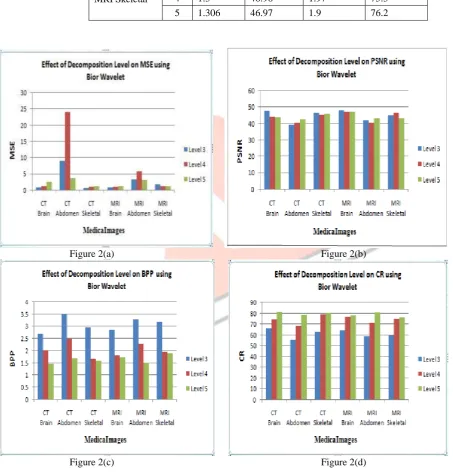
Figure 2(a) Figure 2(b)
Figure 2(c) Figure 2(d)
Figure 2 (a) Effect of Decomposition level on MSE Figure 2 (b) Effect of Decomposition level on PSNR Figure 2 (c) Effect of Decomposition level on BPP Figure 2 (d) Effect of Decomposition level on CR
The result analysis for medical image compression at different decomposition levels using SPIHT algorithm in combination with bior wavelet is as follows.
Level 3
IJEDR1704061
International Journal of Engineering Development and Research (www.ijedr.org)
388
Irrespective of the modality and the anatomy as the decomposition level increases there is an increase in compression ratio but to find the optimum decomposition level we consider the PSNR parameter.
In ideal case higher the decomposition level higher the PSNR is expected but from the experimental results above, it can be stated that this analogy may not hold good for all medical images.
For abdomen CT and MRI images there is an increase in PSNR when the images are subjected to decomposition level 3 and 5 and there is a decrease in PSNR at decomposition level 4.
For CT and MRI brain and also CT skeletal as the decomposition level increases there is a decrease in PSNR. For MRI skeletal images, PSNR increases with increase in decomposition level.
Therefore considering variation in PSNR values for different images it is ideal to choose decomposition level 3 as the optimum decomposition level for wavelet based medical image compression because at decomposition level 3 we get the highest PSNR for majority of the medical images.
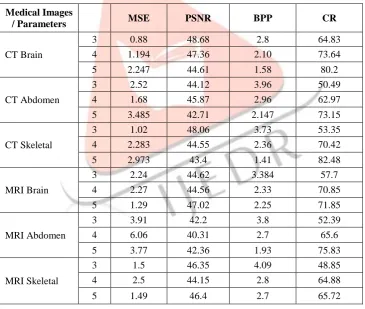
Table 2 Performance Analysis at Different Decomposition Level using Haar Wavelet
Medical Images
/ Parameters MSE PSNR BPP CR
CT Brain
3 0.88 48.68 2.8 64.83
4 1.194 47.36 2.10 73.64
5 2.247 44.61 1.58 80.2
CT Abdomen
3 2.52 44.12 3.96 50.49
4 1.68 45.87 2.96 62.97
5 3.485 42.71 2.147 73.15
CT Skeletal
3 1.02 48.06 3.73 53.35
4 2.283 44.55 2.36 70.42
5 2.973 43.4 1.41 82.48
MRI Brain
3 2.24 44.62 3.384 57.7
4 2.27 44.56 2.33 70.85
5 1.29 47.02 2.25 71.85
MRI Abdomen
3 3.91 42.2 3.8 52.39
4 6.06 40.31 2.7 65.6
5 3.77 42.36 1.93 75.83
MRI Skeletal
3 1.5 46.35 4.09 48.85
4 2.5 44.15 2.8 64.88
IJEDR1704061
International Journal of Engineering Development and Research (www.ijedr.org)
389
Figure2. Effect of Decomposition on PSNR using Haar WaveletTable 3 Performance Analysis at Different Decomposition Level using Daubechies Wavelet Medical Images /
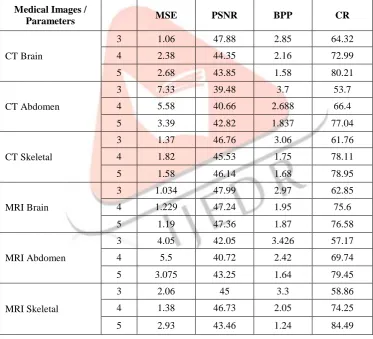
Parameters MSE PSNR BPP CR
CT Brain
3 1.06 47.88 2.85 64.32
4 2.38 44.35 2.16 72.99
5 2.68 43.85 1.58 80.21
CT Abdomen
3 7.33 39.48 3.7 53.7
4 5.58 40.66 2.688 66.4
5 3.39 42.82 1.837 77.04
CT Skeletal
3 1.37 46.76 3.06 61.76
4 1.82 45.53 1.75 78.11
5 1.58 46.14 1.68 78.95
MRI Brain
3 1.034 47.99 2.97 62.85
4 1.229 47.24 1.95 75.6
5 1.19 47.36 1.87 76.58
MRI Abdomen
3 4.05 42.05 3.426 57.17
4 5.5 40.72 2.42 69.74
5 3.075 43.25 1.64 79.45
MRI Skeletal
3 2.06 45 3.3 58.86
4 1.38 46.73 2.05 74.25
5 2.93 43.46 1.24 84.49
0 10 20 30 40 50 60
CT Brain
CT Abdomen
CT Skeletal
MRI Brain
MRI Abdomen
MRI Skeletal
PS
NR
MedicaImages
Effect of Decomposition Level on PSNR using
Haar Wavelet
Level 3
Level 4
IJEDR1704061
International Journal of Engineering Development and Research (www.ijedr.org)
390
Figure3. Effect of Decomposition on PSNR using Daubechies WaveletFrom Fig.1, 2 and 3, it can concluded that irrespective of the imaging modality and anatomy of the medical images and also the different wavelets, highest PSNR is obtained at decomposition level 3 for majority of the medical images and hence decomposition level 3 as the optimum decomposition level for wavelet based medical image compression.
V. CONCLUSION
The quality of a compressed image depends on the number of decompositions. In an ideal case, higher the decomposition level higher is the PSNR obtained. This is not true for medical images. Though compression ratio increases with increase in decomposition level there is variation seen in PSNR at decomposition level 4 and 5 for different images.
For automatic compression of medical images using wavelets it is very much important to find the optimum decomposition level and hence decomposition level 3 may be chosen as the optimum decomposition level irrespective of the modality and anatomy or compression of medical images using wavelets and MATLAB.
REFERENCES
[1] Eleftherios Kofidis, Nicholas Kolokotronis, Aliki Vassilarakou, Sergios Theodoridis, Dionisis Cavouras “Wavelet-based medical image compression” Future Generation Computer Systems (1999) 223–243
[2] G.Sadashivappa and Dr. K.V.S.Ananda Babu, “Performance Analysis of Image Coding Using Wavelets”, International Journal of Computer Science and Network Security, VOL.8 No.10, October 2008
[3] Pandian R, Vigneswara T and Lalitha Kumari S, “Effect of Decomposition Levels of Wavelets in Image Compression Algorithms” Journal of Biomedical Sciences ISSN 2254-609X Vol.5 No.4:29 2016
[4] P.Sunitha, J.L.Srinivas, “Performance Analysis of SPIHT algorithm in Image Compression” International Journal of Science, Engineering and Technology Research (IJSETR), Volume 4, Issue 1, January 2015
[5] Wavelet Decomposition Using Haar Wavelet,
http://shodhganga.inflibnet.ac.in/bitstream/10603/20682/12/12_chapter%203.pdf
[6] Wavelet Transforms on Images, http://www.leap.ee.iisc.ac.in/sriram/teaching/MLSP_16/refs/wavelet-2d-images.pdf
[7] Nicolas Treil, Stephane Mallat, and Ruzena Bajcsy, "Image Wavelet Decomposition and Applications",. April 1989, University of Pennsylvania Department of Computer and Information Science Technical Report No. MS-CIS-89-22
[8] Stephane G. Mallat, “A Theory for Multiresolution Signal Decomposition: The Wavelet Representation”, IEEE Transactions on Pattern Analysis and Machine Intelligence. Vol. Ii, No. 7. July 1989
[9] http://www.debugmode.com/imagecmp/classify.htm 0
10 20 30 40 50 60
CT Brain
CT Abdomen
CT Skeletal
MRI Brain
MRI Abdomen
MRI Skeletal
PS
NR
MedicaImages
Effect of Decomposition Level on PSNR using
Daubechies Wavelet
Level 3
Level 4