IJEDR1702301
International Journal of Engineering Development and Research (www.ijedr.org)1939
Comparison of various Error Diffusion Algorithms
Used in Visual Cryptography with Raster scan
1Digvijay Singh, 2Pratibha Sharma
1Student M.Tech, CSE 4th SEM., 2Assistant Professor CSE Career Point University, Hamirpur (H.P.), India
________________________________________________________________________________________________________ Abstract: Visual Cryptography is a cryptographic technique which allows optical information to be encrypted .Visual Cryptography encrypt secret image into n halftoned shares. The secret image can be recovered by stacking these shares together without any complex computation involved. These shares are very safe because individually they show nothing about the secret image. A particular halftoning method named as error diffusion method is used for the better generation of halftoned shares. Error diffusion algorithms have attracted much attention in the image processing. In this paper three error diffusion algorithms are used for generation of halftoned shares of secret image and these algorithms are compared on the basis of four parameters such as PSNR, WSNR, LDM, and UQI.
Keywords: Error Diffusion, Half toning, Raster scan, PSNR, WSNR, LDM, UQI.
________________________________________________________________________________________________________ I. INTRODUCTION
In visual cryptographya secret image can be decrypted in simple way by human. In VC a secret image is divided into 2 or more shares depend upon the scheme of VC to be chosen. Any VC encrypts a secret image into n halftone shares, then the secret images can be recovered in simple way by implementing stacking process and combined that shares together without any complex computation involved. These shares are very safe because separately they show nothing about secrets image. There are various VC schemes which are used for implementation of visual data. A concept named as half toning is used in VC to generate halftone shares of selected secret images. There are various half toning methods which are used to perform halftoning.An error diffusion method is provide simple and efficient algorithm for half toning named as Floyd-Steinberg, Jarvis ,Stucki. In this paper, an error diffusion technique is used for generating half-toned shares with raster scan type which is more pleasant to human eyes. Also, we will take a review of all the methods and compare all these methods. After that, we will adopt the one which will give us the best result with respect to visual cryptography.[1] Visual cryptography is Simple to implement, Decryption algorithm is not required, We can send chipper text through fax or email, Lower computation costetc. It can be used in number of applications like Remote Electronic Voting, Bio metric authentication, Banking Customer Identification, Stenography, Watermarking etc.
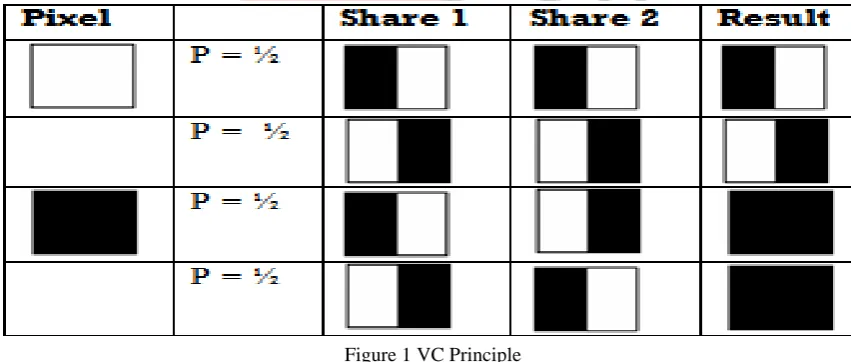
Figure 1 VC Principle
We consider the two out-of-two visual scheme. According to Figure 1, in (2, 2) Visual Cryptography Scheme, original image is divided into 2 shares. Each pixel in original image is represented by non-overlapping block of 2 or 4 sub-pixels in each share. Anyone, having only one share will not be able to reveal any secret information. Both the shares are required to be superimposed to reveal the secret image.
There are many techniques for encoding the pixels of original image. In a technique, in which each pixel in original image is represented by two sub-pixels in each share, while reading the pixels in original image, if a white pixel is encountered, one of the first two rows in Figure 1is selected with probability 0.5, and the shares are assigned 2 pixel blocks as shown in the third and fourth columns in figure.
IJEDR1702301
International Journal of Engineering Development and Research (www.ijedr.org)1940
implies that the superimposition of the shares represents the Boolean OR function. The last column in Figure 1 shows the resulting sub-pixel when the sub-pixels of both the shares in the third and fourth columns are superimposed. [1]II. HALFTONING
Halftone visual cryptography (HVC) is a visual sharing scheme where a secret image is encoded into halftone shares taking meaningful visual information’s can use here error diffusion Half toning concept.
Error-Diffusion half toning
Error diffusion is a simple but efficient way to halftone a grayscale image. The quantization error at each pixel is filtered and fed into a set of future inputs. The quantization error depends upon not only the current input and output but also the entire past history. The error filter is designed in such a way that the low frequency difference between the input and output image is minimized. The error that is diffused away by the error filter is high frequency or “blue noise.” These features of error diffusion produce halftone images that are pleasant to human eyes with high visual quality. [2]
Error diffusion works by “diffusing” – or spreading – the error of each calculation to neighboring pixels. If it finds a pixel of 96 gray, it too determines that 96 are closer to 0 than to 255 – and so it makes the pixel black.
When it moves to the next pixel, the error diffusion algorithm adds the error of the previous pixel to the current pixel. If the next pixel is also 96 gray, instead of simply forcing that to black as well, the algorithm adds the error of 96 from the previous pixel. This results in a value of 192, which is actually closer to 255 – and thus closer to white! So it makes this particular pixel white, and it again makes note of the error – in this case, the error is -63, because 192 is 63 less than 255, which is the value this pixel was forced to.[1]
Raster Scan: In this paper I can show the halftone share of select image in raster scan type. In raster scan beam will move across
the screen, one row at time. The direction of movement is top to bottom. When beam move from top to bottom beam will be on or off so pattern of spots is created.
III. ALGORITHMS FOR ERROR DIFFUSION HALF TONING
There are several error diffusion algorithms to perform half toning on color images. A. Floyd Steinberg half toning algorithm.
B. Jarvis half toning algorithm. C. Stuckie half toning algorithm.
A.Floyd Steinberg Half toning algorithm: This error-diffusion algorithm is proposed by Floyd and Steinberg. Here the idea to
keep track of the error. The algorithm compares the grayscale value of the current pixel that is represented by an integer value between 0 and 255, to some threshold value (typically 128). If the grayscale value is greater than the threshold, the output pixel is considered to be black (value 0), else it is considered white (value 1). The difference between the pixel’s original grayscale value and the threshold is considered as an error. And the track of this error is kept by this algorithm.
B. Jarvis half toning algorithm: Another error diffusion algorithm
has been proposed by Jarvis, Judice and Ninke. It diffuses the error in the 12 neighboring cells instead of 4 cells as in the Floyd-Steinberg algorithm as shown in figure below. As a result, this algorithm is even slower.
error 3/8
1/8 1/8
IJEDR1702301
International Journal of Engineering Development and Research (www.ijedr.org)1941
C. Stuckie Error Diffusion Half toning Algorithm: Stucki diffused the error in the 12 neighboring cells as shown in Figure below.
The only difference between Jarvis algorithm and Stucki algorithm is the fraction which is added to the neighboring pixels.
error
IV. RESULT AND ANALYSIS
The experimental results of the entire error-diffusion half-toning algorithms used in color visual cryptography. We will compare these algorithms on the basis of following parameters and the algorithm which leads to better quality of image will be considered as the best error diffusion algorithm.
PSNR (peak signal to noise ratio): Higher is better. WSNR (weighted signal to noise ratio): Higher is better. LDM (Linear Distortion measure): lower is better. UQI (Universal quality index): higher is better.
The tables showing the different parameter values in case of input images named as “Tulips.jpg” and “School.jpg” .The error diffusion algorithms are generated halftone of selected images with raster scan.
IJEDR1702301
International Journal of Engineering Development and Research (www.ijedr.org)1942
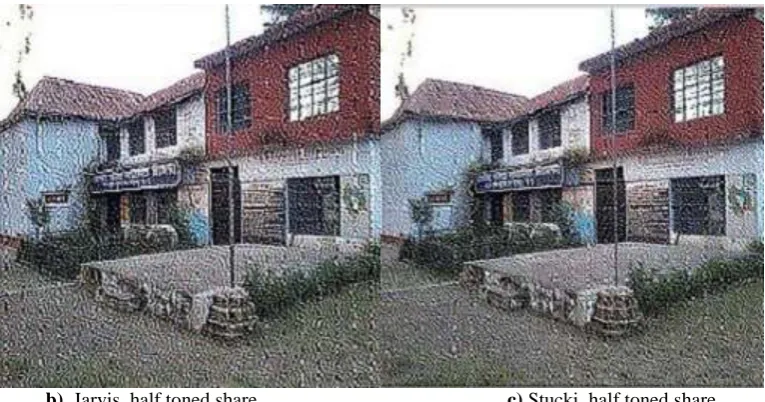
a) Original image b) Floyd half toned shareb) Jarvis half toned share c) Stucki half toned share
IN CASE OF “School.jpg”:
IJEDR1702301
International Journal of Engineering Development and Research (www.ijedr.org)1943
b) Jarvis half toned share c) Stucki half toned shareTABLE 1: UQI, LDM, PSNR & WSNR ratio for all the Algorithm in case of “Tulips.jpg”
Images Scan type Algorithms PSNR RATIO WSNR RATIO LDM RATIO UQI RATIO Tulips Raster Floyd-Steinberg 4.62744 9.93803 0.20134 0.270399
Tulips Raster Jarvis 4.5602 9.30273 0.221207 0.250528
Tulips Raster Stuckie 4.588 9.50367 0.213806 0.253641
TABLE 2: UQI, LDM, PSNR & WSNR ratio for all the Algorithm in case of “School.jpg”
Images Scan type Algorithms PSNR RATIO WSNR RATIO LDM RATIO UQI RATIO School Raster
Floyd-Steinberg
5.20004 10.6025 0.232498 0.119385
School Raster Jarvis 5.01133 9.2424 0.28537 0.111756
School Raster Stuckie 5.08471 9.6814 0.266525 0.112498
V. CONCLUSION
Different algorithms for error diffusion are compared. The comparison is done on the basis of WSNR, LDM, UQI and the PSNR values. From the implementation of all the algorithms, it is observed that
1. Image quality is high when Floyd algorithm is implemented.
2. Floyd algorithm is best in case of halftone generation of selected image. Thus, Floyd-Steinberg can be concluded as the best Error Diffusion algorithm.
REFERENCES
[1] Meenakshi Rana, “Comparison and Review of Various Error Diffusion Algorithms used in Visual Cryptography” International Journal of Engineering and Computer Science Volume 2, Volume 6 Issue No. 6, 2016.
[2] Anuprita U. Mande, Manish N. Tibdewal, “Parameter Evaluation and Review of Various Error-Diffusion Half toning algorithms used in Color Visual Cryptography” International Journal of Engineering and Innovative Technology (IJEIT) Volume 2, Issue 8, February 2013.
[3] V. Pandit1, M. Bobade2 et.al, “Threshold Visual Cryptography For Fingerprint Based Authentication” International Journal of Research In Science & Engineering.
[4] Asmita Mishra, Dr. Tripti Arjariya, “Visual Cryptography Techniques-A survey &
IJEDR1702301
International Journal of Engineering Development and Research (www.ijedr.org)1944
Algorithms for Quality Images Using XOR” International Journal of Emerging Trends & Technology in Computer Science (IJETTCS), Volume 2, Issue 2, March – April 2013.[6] M.Siva Kumar, A.Shilpa et.al, “A SURVEY ON VISUAL CRYPTOGRAPHY
TECHNIQUES” International Journal of Application or Innovation in Engineering & Management (IJAIEM), Volume 5, Issue 2, February 2016.
[7] Pratima M. Nikate, Prof. I. I. Mujawar, “Performance Evaluation of Floyd Steinberg Halftoning and Jarvis Haltonong Algorithms .
in Visual Cryptography” International Journal of Innovations in Engineering and Technology (IJIET), Volume 5 Issue 1 February 2015.
[8] Archana B. Dhole , Prof. Nitin J. Janwe,” An Implementation of Algorithms in Visual
Cryptography in Images” International Journal of Scientific and Research Publications, Volume 3, Issue 3, March 2013. [9] Rucha R. Raut ,Prof. Komal B.Bijwe, “An Enhanced Technique for Secure Image