IJEDR1904104 International Journal of Engineering Development and Research (www.ijedr.org) 618
Study on Soil Structure Interaction and Base
Isolated System for Seismic Performance of
Structures Resting on Different Types of Soils
1Dr. S.Amaresh Babu, 2Ahmed Zubedi 1Professor, 2Student
1Nawab Shah Alam Khan College of Engineering and Technology,
2Structural Engineering, Nawab Shah Alam Khan College of Engineering and Technology
__________________________________________________________________________________________________
Abstract - The conventional approach to seismic resistant design is to incorporate adequate strength, stiffness and inelastic deformation capacity into the building structure so that it can withstand induced inertia forces. This was with the presumption that during strong ground motion, whenever inertia forces exceed their design earthquake levels, the structure will dissipate this excess energy through deformations at predefined locations scattered over the structural framework. It was observed that, even with members designed for ductility, the structures did not always perform as desired. It was realized that a design based only on the principle of incorporating ductility as a safeguard against seismic effects needs a critical review. Engineers came up with the innovative idea of introducing a flexible medium between supporting ground and the building, thereby decoupling the structure from the energy rich components of seismic ground motion. This strategy came to be known as the Base Isolation method.This thesis aims to determine the significance of using Base Isolation as a technique to withstand the seismic forces. This thesis also aims to show the importance to consider soil structure interaction rather than analyzing the structure as fixed base. The comparison is mainly done between structures with soil structure interaction effects and base isolated structures. The analysis is done using computer program SAP2000 v18. The method of analysis is Fast Nonlinear Analysis (FNA). There are 18 models which are analyzed in which there are symmetric and asymmetric in plan models, which are analyzed as fixed base models, models with the consideration of soil structure interaction, and models with base isolation (lead rubber bearing). These models are assumed to be resting on three soil types namely limestone, stiff clay, and loose sand. All the models are G+13 storey. The results show that considering soil structure interaction effects for structures resting on medium and soft soils is more significant when compared to structures resting on hard soil because there is not much difference noticed in the response of structures with and without soil structure interaction effects resting on hard. Also base isolation system is best suited for structures resting on hard soil. The base shear, storey displacements, and torsion are reduced to a great extent
keywords - Base Isolation, Soil Structure Interaction, Fast Nonlinear Analysis.
__________________________________________________________________________________________________
1. INTRODUCTION
IJEDR1904104 International Journal of Engineering Development and Research (www.ijedr.org) 619 must be jointed properly, so that they can act together against the earthquake shaking at the time of seismic force transferring to the ground.
1.2 Soil Structure Interaction: Normally, in the conventional method of the dynamic analysis of a building under seismic conditions, base of the structure is considered to be fixed and subjected to the free field ground motion. Such ground motion is that which is not influenced by the presence of the structure. This is applicable to rock formations because due to extremely high stiffness of rock, seismic wave motions therein is not constrained by the structure supported thereon. Hence, it can be termed as Free Field Motion. However, if the structure is supported on soft soil of considerable thickness overlying the rock, then the structure and soil will interact with one another to influence the behaviour of both. This is termed as Soil Structure Interaction. If a lightweight flexible structure is built on a very stiff rock foundation, a valid assumption is that the input motion at the base of the structure is the same as the free-field earthquake motion. If the structure is very massive and stiff, and the foundation is relatively soft, the motion at the base of the structure may be significantly different than the free-field surface motion. For code design buildings it is important to consider the effect of the SSI.
1.3 Base Isolation : It is a system that may be defined as a flexible or sliding interface positioned between a structure and its foundation, for the purpose of decoupling the horizontal motions of the ground from the horizontal motions of the structure, thereby reducing earthquake damage to the structure and its contents. Base isolation system absorbs and deflects the energy released from the earthquake before it is transferred to the structure. Base isolation is a passive control system meaning thereby that it does not require any external force or energy for its activation. The base-isolation techniques prove to be very effective for the seismic protection of new framed buildings as well as for the seismic retrofitting of existing ones. An isolation system should be able to support gravity loads (including those due to vertical seismic acceleration), be sufficiently stiff to minimize displacements under repeated small magnitude lateral loads such as those due to wind, be highly flexible to absorb the energy during strong motion earthquakes and possess capability to self-centre after an earthquake event. Quite clearly, this means that the isolator should possess non-linear stiffness characteristics. It should also possess adequate damping characteristics to assist dissipation of seismic energy and not have excessive lateral displacement across the isolator interface. Midrise structures with 10 to 15 stories are the most suitable to be base-isolated. Base isolation provides an excellent substitute for fixed base design where earthquakes are frequent. The economy of base isolation is not viewed in terms of its initial installment but over the design period of the structure during which it is expected to experience earthquake. After an event of earthquake, the repair of structure, and loss of non-structural components may be a more costly affair than installing base isolation. So far, base isolation technology has been adapted in very important structures such as hospitals, laboratories, and data centres etc. Also, base isolation has been found to be extremely useful for retrofitting of the old structures where the aesthetic, architectural and heritage value is required to be maintained intact.
Fig.1. Elastometric Isolators Fig.2 Flat Sliding Bearing being used as an Isolator
1.4 Objectives of the Study
• To study the response of structures for Soil Structure Interaction effects resting on different types of soils subjected to seismic effects.
• To study the response of structures for Base Isolated system resting on different soils subjected to seismic effects. • To compare the response of structures for Soil Structure Interaction effects & Base Isolated system resting on different
types of soils.
2. LITERATURE REVIEW
IJEDR1904104 International Journal of Engineering Development and Research (www.ijedr.org) 620 asymmetric in plan structures and also soil structure interaction was not considered during analysis. Hard and medium soils were also not considered for analysis. These research gaps have been overcome in this dissertation.
Chandak (2013) studied the “Effect of Base Isolation on the Response of Reinforced Concrete Building”. Their main objective was to investigate the differences caused by the use of different codes in the dynamic analysis of multistoried RC buildings with fixed and isolated base conditions. The analysis was done by response spectrum method using computer program SAP2000. The design spectra recommended by IS 1893-2002 part 1 and Euro Code 8 were considered for comparison. Two types of base isolators, rubber bearing and friction isolator were used. The research work does not take soil structure interaction into consideration. This dissertation overcomes the research gap by considering soil structure interaction. Dia Eddin Nassani and Mustafa Wassef Abdulmajeed (2015) studied the effectiveness of “Seismic Base Isolation in Reinforced Concrete Structures”. Their objective was to study the effectiveness of isolated base(HDR) structures over fixed base structures. The analysis was performed in SAP2000 following time history analysis using El-centro earthquake data. 4 structures were analysed in which two are symmetrical and two are asymmetrical in plan. Their research work did not consider soil structure interaction. This dissertation covers the research gap.
Meena Noorzai et al.(2015) studied the “Response of Fixed Base and Isolation Base (LRB)”, on G+25 storied buildings using ETABS software. LRB was used as base isolator. The soil structure interaction is not considered. This dissertation covers up this research gap.
Sabu et al.(2014) studied the “Effectiveness of Lead Rubber Base Isolators, for seismic resistance of Buildings, supported on different soil stratas”, on G+7 storey building by comparing the analysis with and without LRBs in seismic zone V on different soil types using computer program ETABS. In this case study the soil structure interaction was not considered and also asymmetric in plan buildings were not considered. This dissertation fills the research gap.
Jenifer Priyanka et al.(2012) performed “Studies on Soil Structure Interaction of Multi Storeyed Buildings with Rigid and Flexible Foundation”, analysed G+10 storey buildings with Fixed and Flexible supports subjected to seismic loads under different soil conditions like hard, medium and soft using software STAAD Pro v8i. Size of the plan was 30 x 30 m in zone V. Asymmetric in plan structure was not considered and base isolation technique was not considered in this project. This dissertation fills these research gaps.
3. METHODOLOGY 3.1 General
Earthquake and its occurrence and measurement, its vibration effect and structural response have been continuously studied for many years in earthquake history and thoroughly documented in literature. Since then the structural engineers have tried hard to examine the procedure, with an aim to counter the complex dynamic effect of seismically induced forces in structures, for designing of earthquake resistant structures in a refined and easy manner. This reexamination and continuous effort has resulted in several revision of Indian standard: 1893: (1962, 1966, 1970, 1975, 1984 & 2002) code of practice on the ―criteria of earthquake resistantǁ by the bureau of Indian standards (BIS), New Delhi. In order to properly interpret the codes and their revisions, it has become necessary; that the structural engineer must understand the basic design criteria and procedures for determining the lateral forces. Various approaches to seismic analysis have been developed to determine the lateral forces, ranging from purely linear elastic to non-linear inelastic analysis. Many of the analysis techniques are being used in design and incorporated in codes of practices of many countries. However, this chapter is restricted to method of analysis described or employed in IS 1893 (part 1): 2002 of ―criteria for earthquake resistant design of structures, essentially to building although in some cases that may be applied to other type of structures as well.
3.2 Analysis : Various analysis procedures can be used out of which Fast Nonlinear Analysis has been adopted for this dissertation
3.2.1 Fast Nonlinear Analysis
Fast Nonlinear Analysis (FNA) is a modal analysis method useful for the static or dynamic evaluation of linear or nonlinear structural systems. Because of its computationally efficient formulation, FNA is well-suited for time-history analysis, and often recommended over direct-integration applications. During dynamic-nonlinear FNA application, analytical models should be primarily linear-elastic and have a limited number of predefined nonlinear members.
In addition to nonlinear material force-deformation relationships, these link objects may simulate concentrated damping devices, isolators, and other energy-dissipating technologies. If fuse mechanisms are not integral to the design intention, an initial elastic analysis may reveal locations where inelasticity is likely to occur. However, it is always best to predefine inelastic mechanisms such that their design may provide for sufficient ductility, while elastic systems are ensured sufficient strength. Capacity Design provides for a more reliable model and a better-performing structure.
The efficiency of FNA formulation is largely due to the separation of the nonlinear-object force vector RNL(t) from the elastic stiffness matrix and the damped equations of motion, as seen in the fundamental equilibrium equation of FNA, expressed as:
M ü(t) + C ú(t) + K u(t) + RNL (t) = R(t)
Stiffness and mass orthogonal load dependent ritz vectors represents the equilibrium relationships within the elastic structural system. At each time increment, the uncoupled modal equations are solved exactly, while forces within the predefined nonlinear DOF, indexed within RNL(t), are resolved through an iterative process which converges to satisfy equilibrium. Following this procedure, FNA is an efficient and accurate dynamic-nonlinear application which satisfies equilibrium, force deformation, and compatibility relationships
IJEDR1904104 International Journal of Engineering Development and Research (www.ijedr.org) 621 4.1 General
There are 18 structures which are analysed using the CSI software SAP2000 v18. These 18 structures are divided into three categories. 6 structures are analysed as Fixed Base buildings, 6 structures are analysed considering Soil Structure Interaction, and 6 structures are analysed by introducing Base Isolation technique (LRB). The design of LRB is shown in chapter III Methodology.
All the 18 structures are G+13 storey. All these structures are analysed by Fast Nonlinear Analysis method. For each category there are 3 buildings symmetric in plan and 3 buildings asymmetric in plan. Each 3 buildings are analysed on three different soil conditions namely Limestone (Hard), Stiff Clay (Medium), and Loose Sand (Soft). For better understanding, the different models are categorised using flow chart below:
Fig. 3 Classification of Fixed Base Structures Similarly SSI and BI structures are also Classified as shown above.
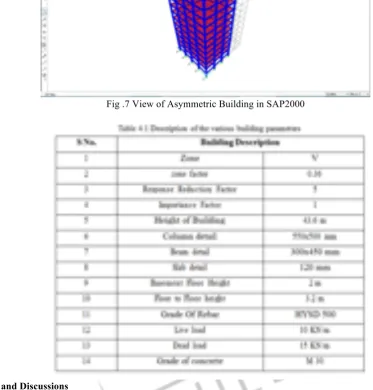
4.2 Details of Plan, Member Sizes and Materials used The plan details are shown below:
Fig. 4 Plan of Symmetric Building Fig. 5 Plan of Asymmetric Building
IJEDR1904104 International Journal of Engineering Development and Research (www.ijedr.org) 622 Fig .7 View of Asymmetric Building in SAP2000
5. Results and Discussions 5.1 General
In this chapter, dynamic analysis is performed by using SAP2000 v18.0.1. The results and discussion are presented for eighteen G+13 storey Reinforced Concrete Frame models Symmetric and Asymmetric in plan which are Fixed base models, models with the consideration of soil structure interaction, and Base Isolated (LRB) models on different soil conditions that are Limestone (Hard), Stiff Clay (Medium), and Loose Sand (Soft). The results are compared in terms of base shear, storey displacement and torsion.
5.2 Base Shear
IJEDR1904104 International Journal of Engineering Development and Research (www.ijedr.org) 623 From Fig. 5.1, it is found that the Base Shear for Fixed Base building is 3004.018 KN. But when the structure is analysed considering soil structure interaction, the Base Shears increased to 3014.395KN. When the Base Isolated structure is analysed, it is found that the Base Shear has reduced by 81.6% i.e., 554.642 KN when compared with structure with the consideration of SSI as the response of model considering soil structure interaction is close to real values when compared to Fixed Base model.
IJEDR1904104 International Journal of Engineering Development and Research (www.ijedr.org) 624 It is observed from Fig. 5.6 that the base shear for fixed base structure is found to be 3671.784 KN. When soil structure interaction was considered, the base isolation was found to be 3537.498 KN. When base isolated building is analysed, the base shear reduced to 722.88 KN which is 79.595% less.
Fig. 5.4 Base Shear for symmetric building on Medium soil in X-direction
It is observed from Fig. 5.5 that the base shear of fixed base structure is 3671.784 KN. The base shear of structure whose analysis included soil structure interaction effects was found to be 3648.804 KN. The base shear of base isolated structure is 721.732 KN that is there is a reduction of 80.22%.
5.3 Storey Displacements
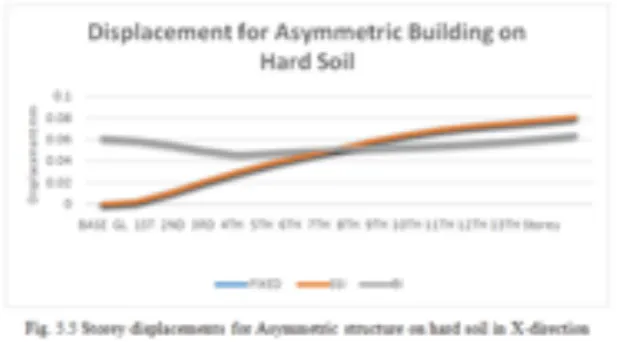
IJEDR1904104 International Journal of Engineering Development and Research (www.ijedr.org) 625 displacements decreases upto almost half the height of structure and then increases. But the maximum displacement is reduced by 20.3% when compared to structure with soil structure interaction effects.
IJEDR1904104 International Journal of Engineering Development and Research (www.ijedr.org) 626 5.4 Torsion
Torsion is the action of twisting or the state of being twisted. It is produced when the centre of mass and centre of rigidity do not coincide.
It is found from Fig.5.8 that the torsion experienced by the fixed base model is 33549.0139 KN-m. When considering soil structure interaction, the torsion increased to 33620.8532 KN-m. But when base isolated structure was analysed, the torsion reduced to 6666.3944 KN-m which is 80.17% less when compared to structure with soil structure interaction
6.Summary and Conclusions 6.1 Summary
This project report deals with the analysis of 18 models which are fixed base models, models with soil structure interaction effects, and base isolated models. The models are analysed using Fast Nonlinear Analysis method which is discussed in detail in Chapter 3, Methodology. The models are analysed on three types of soils namely Limestone, Stiff Clay, and Loose Sand. The structures are of two types i.e. symmetric in plan and asymmetric in plan. All these models are G+13 storey.
The results show that the consideration of soil structure interaction effects is more significant for models resting on stiff clay and loose sand when compared to limestone. The Base Isolation system is most effective for structures resting on limestone when compared to structures resting on stiff clay and loose sand.
6.2 Conclusions
6.2.1 General Conclusions
After the analysis was carried out, and the results were compared, it is found that considering soil structure interaction for structures resting on medium (stiff clay) and soft soils (loose sand) is more significant when compared to structures resting on hard soil (limestone) as there is not much difference in the response of structures resting on hard soil with and without the consideration of soil structure interaction Base isolation system is found to be most effective for structures resting on hard soil (limestone) when compared to structures resting on medium soil (stiff clay) and soft soil (loose sand). .
6.2.2 Specific Conclusions
Through the comparison in the response of structures for soil structure interaction effects and base isolation system, it is found that:
The base shear for structures resting on limestone is 81.5% less for base isolated system when compared to structures with soil structure interaction effects.
The base shear for structures resting on stiff clay is 80% less for base isolated system when compared to structures with soil structure interaction effects.
The base shear for structures resting on loose sand is 78.5% less for base isolated system when compared to structures with soil structure interaction effects.
The storey displacements for structures resting on limestone is 21.5% less for base isolated system when compared to structures with soil structure interaction effects.
The storey displacements for structures resting on stiff clay is 43% less for base isolated system when compared to structures with soil structure interaction effects.
The storey displacements for structures resting on loose sand is 45% less for base isolated system when compared to structures with soil structure interaction effects.
The torsion for structures resting on limestone is 80.5% less for base isolated system when compared to structures with soil structure interaction effects
The torsion for structures resting on stiff clay is 76% less for base isolated system when compared to structures with soil structure interaction effects.
The torsion for structures resting on loose sand is 75% less for base isolated system when compared to structures with soil structure interaction effects.
6.3 Scope for further study
IJEDR1904104 International Journal of Engineering Development and Research (www.ijedr.org) 627 Base Isolation along with different bracing systems could be used to further minimise the storey deflections.
Base Isolation could be implemented on vertical irregular and mass irregular buildings on different soil strata
References
[1] Chandak N. R., (2013), “Effect of Base Isolation on the Response of Reinforced Concrete Building“, Journal of Civil Engineering Research, 3(4), 135-142.
[2] Criteria for Earthquake Resistant Design of Structures,Indian Standard 1893 Part- I2002, New Delhi
[3] Dhananjay A. Chikhalekar, Murudi M.M., (Sept.2015) “Seismic Performance of Structures with Fixed Base, Base Isolated Structure and Structure with Viscous Damper”, International Journal of Research in Engineering and Technology, 4(9), 158-166.
[4] Dhiraj Raj, “Non-linear Static Analysis of Building-Foundation System considering Soil-Structure Interaction using SAP 2000 v 14”, Research Scholar, Department ofEarthquake Engineering, IIT Roorkee.
[5] Dia Eddin Nassani, Mustafa Wassef Abdulmajeed, (February 2015), “Seismic Base Isolation in Reinforced Concrete Structures”, International Journal of Research Studiesin Science, Engineering and Technology, 2(2), 1-13.
[6] Jenifer Priyanka R.M., Anand N., Justin S., (December 2012) “Studies on Soil Structure Interaction of Multi Storeyed Buildings with Rigid and Flexible Foundation”, International Journal of Emerging Technology and Advanced Engineering, 2(12), 111-118
[7] Ketan Bajaj, Jitesh Chavda T., Bhavik Vyas M., (December 2013), “Seismic Behaviour of Buildings on different types of Soils”, Proceedings of Indian GeotechnicalConference, Roorkee,
[8] Meena Noorzai, M.N. Bajad, Neha Dodal, (May 2015), “Study Response of Fixed Base and Isolation Base”, International Journal of Innovative Research in Science,Engineering and Technology, 4(5), 3674-3681.
[9] Sabu S.K., Chore H.S., Patil S.B., (2014), “Effectiveness of Lead Rubber Base Isolators, for Seismic resistance of Buildings, supported on different soil stratas”, 2(4), 53-59.
[10]Seismic Rehabilitation of Existing Buildings, American Society of Civil Engineers 41-06, United States of America. [11]Sharad Manohar, Suhasini Madhekar, (2015), “Seismic Design of RC Buildings, Theory and Practise”, Springer
Publications.
[12]Subramani T., Jothi J., Kavitha M., (June 2014), “Earthquake Analysis of structure by Base Isolation Technique in SAP”, Int. Journal of Engineering Research andApplications, 4(6), 296-305.
[13]Syed Ahmed Kabeer K I, Sanjeev Kumar K.S., (Oct 2014), “Comparison of two similar buildings with and without Base Isolation”, International Journal of AdvancedResearch, Ideas and Innovations in Technology, 1(1), 28-36.