
SYNCHRONIZATION T-CHAOTIC SYSTEM
Assist.Prof. Sahab A.R. PhD.1, M.Sc. Abazari M.1 Faculty of Engineering - Lahijan Branch Islamic Azad University, Iran 1
Abstract: In this paper, we study on chaos, one of the most important phenomenons based on complex nonlinear dynamics. We will focus
on T-system chaos and in continue, using three synchronization methods, Brain Emotional Learning Based Intelligent Controller (BELBIC), Generalized Backstepping Method (GBM) and adaptive method, the chaotic system will be synchronized. To prove usability of the controllers, the results will be compared with the results obtained by Active Control and Backstepping Controllers. According to the results, proposed controllers synchronize chaotic systems with higher speed, lower setting time, lower overshoot and smaller control signal versus active control and backstepping controllers.
Keywords: CHAOS, BELBIC, GENERALIZWD BACKSTEPPIG METHOD, ACTIVE CONTROL
1. Introduction
Chaos is an important phenomenon, happens vastly in both natural and man-made systems. Lorenz [1] faced to the first chaotic attractor in 1963. In continue, a lot of researches were achieved on chaotic systems [2-11]. A new 3D chaotic system (T-system) from the Lorenz system was derived in [12,13]. Over the last two decades, chaos control and synchronization have been absorbed increasingly attentions due to their wide applications in many fields [14–25]. Active control [28], backstepping [28] and adaptive control [28] are three different methods for synchronization of T system. Active control [28] and backstepping [28] methods are selected when system parameters are known, and adaptive control [28] method is applied when system parameters are unknown. GBM [26,27], a new method to optimize backstepping method, controls chaos in nonlinear systems better than backstepping design.
A kind of BELBIC model was introduced to control nonlinear systems [29] and aerospace launch vehicle control [30]. Another model of BELBIC was proposed for control and tracking of vehicles [31] and Intelligent autopilot control design [32]. This paper proposes new controllers to control and Synchronize T chaotic system according to three models, BELBIC [29,30], GBM [26,27] and adaptive method, and Simulation results shows that mentioned controllers synchronize this chaotic system more better and faster than active control and backstepping controllers.
2. Generalized Backstepping Method (GBM)
GBM [26-27] will be applied to a certain class of autonomous nonlinear systems which are expressed as
( )
( )
(
X)
g(
X)
uf
X G X F X
η η
η
η ,
, 0
0 +
= + =
& &
(2)
In which
η
∈ℜand[
]
nn
x x x
X= 1, 2,K, ∈ℜ . In order to obtain an approach to control these systems, we may need to explain a new theorem as follow.
Theorem. Suppose (2) is available, then
ϕ
i( )
X for the thi state could be determined
i
a manner which by inserting theth
i term for
η
, V( )
X would be a positive definite (3) with negative definite derivative.( )
∑
=
=
n
i i
x X
V
1 2
2
1 (3)
Therefore, the control signal and also the general control Lyapunov function of this system can be obtained by (4) and (5).
(
)
[
( )
( )
]
( )
( )
[
X]
f(
X)
k i nk
X g x X
g X f x X
g u
i n
i
i i
n
i i i n
i n
j
i i j i
, , 2 , 1 , 0 ; 0 ; , ,
1
0 1
1 1 1
0
K =
>
− − −
− +
∂ ∂ =
∑
∑
∑∑
=
= = =
η
ϕ
η
η
ϕ
η
(4)(
)
[
( )
]
2
1 1
2 2 1 2
1
,
∑
∑
= =
− +
=
n
i i n
i i
t X x X
V η η ϕ (5)
3. Genetic Algorithm
The genetic algorithms are used to search the optimal parameter
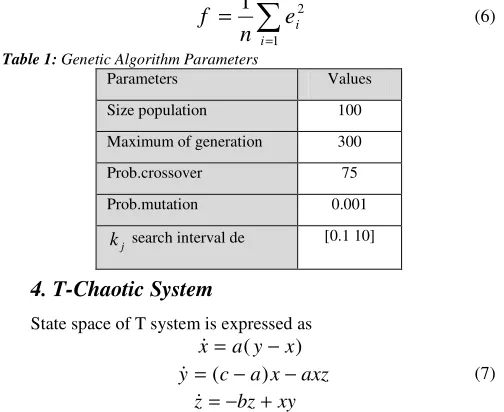
k(kj;j=1,2is positive constant)in order to guarantee the stability of systems by ensuring negativity of the Lyapunov function and having a suitable time response [33-34]. The fitness function used is
∑
=
=
ni i
e
n
f
1 2
1
(6)
Table 1: Genetic Algorithm Parameters
Parameters Values
Size population 100
Maximum of generation 300
Prob.crossover 75
Prob.mutation 0.001
j
k search interval de [0.1 10]
4. T-Chaotic System
State space of T system is expressed as
x
&
=
a
(
y
−
x
)
axz
x
a
c
y
&
=
(
−
)
−
(7)z
&
=
−
bz
+
xy
Where a=2.1,b=0.6,c=30 are system constants. Fig.1 displays state trajectory of (7) and its xyzphase portrait diagram is displayed in Fig.2 in t=250Secwith initial conditions
(
0.1,−0.3,0.2)
.5. Synchronization T-System using GBM
For synchronization, we consider master system as (8): )
( 1 1
1 a y x
x& = −
1 1 1
1 (c a)x ax z
y& = − − (8) z&1 =−bz1+x1y1
And slave system by adding control inputs 2 1,u
u as (9).
)
( 2 2
2 a y x
x& = −
y&2 =(c−a)x2−ax2z2+u1 (9)
2 2 2 2
2 bz x y u
z& =− + + We define error between (8) and (9) as
1 2 x
x
ex = −
1 2 y
y
ey = − (10)
e
z=
z
2−
z
1Now, by putting (10) in (8) and (9)
)
( y x
x a e e
e& = −
1 1 1 2
2 )
( )
(c ae a x z x z u
0 2 4 6 8 10 -20
-10 0 10 20 30
Time (sec)
s
ta
te
s
t
ra
je
c
to
ry
v
a
ri
a
ti
o
n
x y z
Fig. 1 State trajectory of (7)
-10 -5
0 5
10
0 10 20 30 -20 -10 0 10 20
X State Z State
Y
S
ta
te
Fig. 2 xyzphase-page diagram of (7) in t=250Sec
Now, based on GBM method, we consider virtual control signals as
0
22 21 1211
=
ϕ
=
ϕ
=
ϕ
=
ϕ
(12)Finally, according to (3), control signals for synchronization between these systems are obtained by
u
1=
−
[
ce
x+
k
11e
y+
k
12e
z−
a
(
x
2z
2−
x
1z
1)]
]
)
(
[
21 22 2 2 1 12
k
e
k
b
e
x
y
x
y
u
=
−
y+
−
z+
−
(13)According to (4), Lyapunov function is expressed as
]
)
(
)
(
)
(
)
(
[
2
1
2 22 2
21
2 12 2
11 2
2 2
ϕ
ϕ
ϕ
ϕ
−
+
−
+
−
+
−
+
+
+
=
z z
y y
z y x
e
e
e
e
e
e
e
V
(14)Now, using genetic algorithm and according to fitness function in (6), optimize GBM controller in (13). For this purpose, we consider gains
k
11,
k
12,
k
21,
k
22 as genetic algorithm inputs. After optimization, the best values for these gains are obtained as0108 . 7 , 127 . 2 , 9697 . 1 , 7165 .
8 12 21 22
11= k = k = k =
k (15)
For master and slave systems, assume initial condition
(
( ) ( ) ( )
) (
)
( ) ( ) ( )
(
0, 0, 0) (
2.4, 3.3,14.5)
2 . 0 , 3 . 0 , 1 . 0 0 , 0 , 0
2 2 2
1 1 1
− =
− =
z y x
z y
x (16)
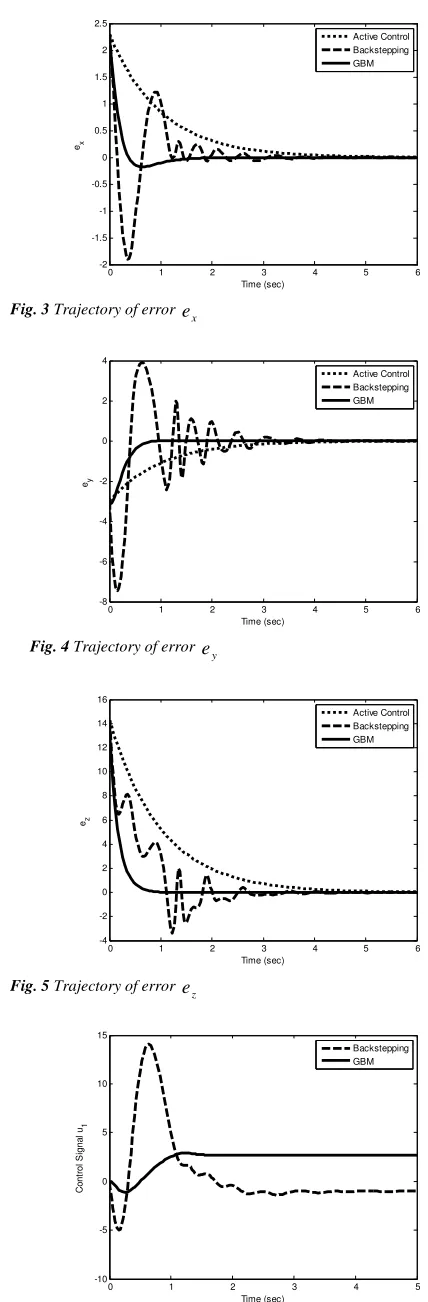
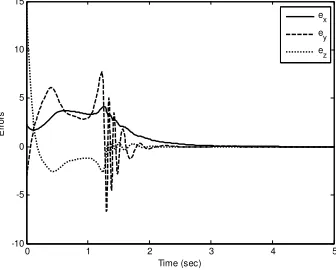
After applying GBM controller, we compare obtained results with the results of active control and backstepping controllers [28]. The states ex,ey,ez are depicted in Fig.3-5 respectively. Control signals for synchronization of these chaotic systems using GBM and Backstepping controllers has been dispalyed in Fig.6-7 and three control signals using Active control [28] are shown in Fig.8.
According to GBM method, a controller was designed for synchronization. Designed controller has gains with positive values. GBM controller possesses different behaviors for each value of these gains which probably conducts system to inconstancy.
In order to find the best values for this controller, genetic algorithm was utilized. Genetic algorithm minimizes fitness function. Also this function is considered based on Total Square Error. Comparing GBM controller with Active control [28] and backstepping [28] controller, we could prove its better usefulness and effectiveness.
0 1 2 3 4 5 6
-2 -1.5 -1 -0.5 0 0.5 1 1.5 2 2.5
Time (sec)
ex
Active Control Backstepping GBM
Fig. 3 Trajectory of error ex
0 1 2 3 4 5 6
-8 -6 -4 -2 0 2 4
Time (sec)
ey
Active Control Backstepping GBM
Fig. 4 Trajectory of error ey
0 1 2 3 4 5 6
-4 -2 0 2 4 6 8 10 12 14 16
Time (sec)
ez
Active Control Backstepping GBM
Fig. 5 Trajectory of error ez
0 1 2 3 4 5
-10 -5 0 5 10 15
Time (sec)
C
o
n
tr
o
l
S
ig
n
a
l
u1
Backstepping GBM
Fig. 6 Control signal 1
0 1 2 3 4 5 -16 -14 -12 -10 -8 -6 -4 -2 0 Time (sec) C o n tr o l S ig n a l u2 Backstepping GBM
Fig. 7 Control signal u1 for synchronization using GBM and BM [28]
0 2 4 6 8 10
-5 0 5 10 15 20 25 Time (sec) C o n tr o l S ig n a l u1 u2 u 3
Fig. 8 Control signals for synchronization using active control
6. Synchronization T-System using Adaptive GBM
The parameters a,b,c in (11) are unknown and 1 1 1,b,c
a are
respectively estimated values of them which are updated by )
( 2 2 1 1
2
1 e e x z x z
a& =− x− y −
2 1 ez
b& =− (17) 2
1
1
e
e
c
&
=
Now by using GBM , we consider virtual control signals as
0
22 21 1211
=
ϕ
=
ϕ
=
ϕ
=
ϕ
(18)Finally, according to (3), control signals are
)] (
[ 1 11 12 1 2 2 1 1
1 ce k e k e a x z xz
u =− x+ y+ z − −
]
)
(
[
21 22 1 2 2 1 12
k
e
k
b
e
x
y
x
y
u
=
−
y+
−
z+
−
(19)Now, using genetic algorithm and according to fitness function in (6), we optimize adaptive GBM controller in (19). For this purpose, we consider gains
22 21 12 11,k ,k ,k
k as genetic algorithm
inputs. After optimization, the best values for these gains are obtained as: 8094 . 8 , 9422 . 7 , 6731 . 1 , 8584 .
9 12 21 22
11 = k = k = k =
k (20)
We assume initial conditions as (16).
7. Brain Emotional Learning Based Intelligent
Controller (BELBIC)
According to this method, learning is based on emotional factors such as excitement and anxiety [31-32]. In this paper, the factors that designer has sensitivity on them, are considered as stimuluses which make system disturbed and control system should decrease system anxiety versus them. BELBIC possesses some sensor inputs selected by designer. BELBIC has two states for each sensor input; amygdala and orbitofrontal output as
i i i i i i
w
s
O
v
s
A
=
=
(21)Where siis th
i sensor input. v,ware two states depended to sensor input and calculated as follow
(
)
(
)
max
(
)
,
0
max
i i i i i i i is
O
A
rew
s
w
A
rew
s
v
−
−
−
−
=
∆
−
=
∆
∑
∑
∑
β
α
(22)Where α,βare learning parameters. rewis reward signal selected as a linear function of system error. Control signal uis obtained as
∑
∑
−
=
A
iO
iu
(23)8. Synchronization T-System using BELBIC
To synchronize, we consider master system as (24) and slave system by adding three control inputs as (25).
(
)
(
)
+ − = − − = − = 1 1 1 1 1 1 1 1 1 1 1 y x bz z z ax x a c y x y a x & & & (24)(
)
(
)
+
+
−
=
+
−
−
=
+
−
=
3 2 2 2 2 2 2 2 2 2 1 2 2 2u
y
x
bz
z
u
z
ax
x
a
c
y
u
x
y
a
x
&
&
&
(25)0 1 2 3 4 5
-6 -4 -2 0 2 4 6 8 10 12 Time (sec) X s ta te t ra je c to ry v a ri a ti o n x1 x2
Fig. 9 Trajectory of statex
0 1 2 3 4 5
-20 -15 -10 -5 0 5 10 15 20 25 30 Time (sec) Y s ta te t ra je c to ry v a ri a ti o n y1 y2
Fig. 10 Trajectory of statey
0 1 2 3 4 5
-5 0 5 10 15 20 25 30 Time (sec) Z s ta te t ra je c to ry v a ri a ti o n z1 z2
0 1 2 3 4 5 -10
-5 0 5 10 15
Time (sec)
E
rr
o
rs
ex
ey
ez
Fig. 12 Error trajectory between slave and master systems
0 1 2 3 4 5
-120 -100 -80 -60 -40 -20 0 20
Time (sec)
C
o
n
tr
o
l
S
ig
n
a
ls
u1
u2
Fig. 13 Control signals for synchronization
We define error between (24) and (25) as
(26)
−
=
−
=
−
=
1 2
1 2
1 2
z
z
e
y
y
e
x
x
e
z y x
Now, Sensor input for BELBIC and reward signal for each control signals
3 2 1,u ,u
u are selected as (27-28) and parameters β
α, are equal to 1 and 3 respectively and initial conditions as (16). (27)
s
i=
[
e
1;
e
2;
e
3]
(28)
[
4
1+
4
;
4
2+
4
;
2
3+
7
]
=
e
e
e
rew
i
After using BELBIC, we compare the results with the results obtained by Active control and Backstepping [28] controllers. Fig.14-16 display error changes between master and slave systems using BELBIC, backstepping [28] and active control [28]. Control signals of BELBIC, backstepping [28] and active control [28] for synchronization are indicated in Fig.17-19 respectively.
9. Conclusions
In this paper, T-chaotic system was studied. Then we addressed the synchronization problem and proposed three methods for it; BELBIC, GBM and adaptive method. By comparing these methods versus active control and BM, we could prove their better usefulness. The results obtained from simulations demonstrated that BELBIC, GBM and adaptive methods synchronize system with higher speed, lower settelling time, lower overshoot and lower control cost against active control and BM.
References
1. Lorenz, Deterministic non-periodic flows, J Atmos Sci, 20, 130–
141, (1963).
2. C. Sparrow, The Lorenz equations: bifurcations, chaos and strange
attractors, New York: Springer-Verlag; (1982).
3. G. Chen and X. Dong, From chaos to order: methodologies, perspectives and applications. Singapore: World Scientific; (1998).
4. OE. Rossler, An equation for continuous chaos, Phys Lett. A, 57,
397–398, (1976).
5. G. Chen and T. Ueta, Yet another chaotic attractor, Int J Bifurcat Chaos,
9, 1465–1466, (1999).
6. J. Lü and G. Chen, A new chaotic attractor coined, Int J Bifurcat Chaos,
12, 659–661, (2002).
7. C. Liu, T. Liu, L. Liu and K. Liu, A new chaotic attractor. Chaos Solitons
and Fractals, 22, 1031–1038, (2004).
0 0.1 0.2 0.3 0.4 0.5 0.6 0.7
-4 0 4 8 12 16
Time (sec)
E
rr
o
rs
e
x
e
y
ez
Fig. 14 Error changes between masterand slave systems using BELBIC
0 1 2 3 4 5 6
-10 -5 0 5 10 15
Time (sec)
E
rr
o
rs
ex
ey
ez
Fig. 15 Error changes using BM [28]
0 1 2 3 4 5 6
-4 -2 0 2 4 6 8 10 12 14 16
Time (sec)
E
rr
o
rs
ex
ey
e
z
Fig. 16 Error changes using active control [28]
0 0.1 0.2 0.3 0.4 0.5 0.6 0.7
-16 -14 -12 -10 -8 -6 -4 -2 0 2
Time (sec)
C
o
n
tr
o
l
S
ig
n
a
ls
u
1
u2
u
3
0 1 2 3 4 5 6 -20
-15 -10 -5 0 5 10 15
Time (sec)
C
o
n
tr
o
l
S
ig
n
a
ls
u1
u2
u
3
Fig. 18 Control signals for synchronization using backstepping [28]
0 1 2 3 4 5 6
-5 0 5 10 15 20 25
Time (sec)
C
o
n
tr
o
l
S
ig
n
a
ls
u1
u2
u3
Fig. 19 Control signals for synchronization using active control [28]
8. G. Qi, G. Chen, et al. Analysis of a new chaotic system, Physica A, 352,
295–308, (2005).
9. L. Liu, Y. Su, et al. A modified Lorenz system, Int J Nonlinear Sci, 7,
187–191, (2006).
10. G. Qi, G. Chen and Y. Zhang, On a new asymmetric chaotic system.
Chaos, Solitons and Fractals, 37, 409–423, (2008).
11. G. Qi, Chen G., et al. A four-wing chaotic attractor generated from a new 3-D quadratic autonomous system. Chaos, Solitons and Fractals, 38:705–21(2008).
12. G. Tigan, Analysis of a dynamical system derived from the Lorenz
system. Sci Bull Politehnica Univ. Timisoara, 50, 61–72, (2005).
13. G. Tigan and O. Dumitru, Analysis of a 3D chaotic system, Chaos,
Solitons and Fractals, 36, 1315–1319, (2008).
14. LM. Pecora and TL., Carroll Synchronization in chaotic systems,
Phys Rev Lett, 64, 821–824, (1990).
15. TL. Carroll and LM. Pecora, Synchronizing chaotic circuits,
IEEE Trans Circ Syst. I, 38, 453–456, (1991).
16. Cuomo and AV.Oppenheim, Circuit implementation of synchronized
chaos with applications to communications, Phys Rev Lett, 71, 65–68,
(1993).
17. G. Perez and H. Cedeira, Extracting messages masked by chaos,
Phys Rev Lett, 74, 1970–1973, (1995).
18. T. Liao and N. Huang, An observer-based approach for chaotic synchronization with applications to secure communications, IEEE Trans
Circ Syst I, 46, 1144–1150, (1999).
19. S. Boccaletti, J. Kurths, et al, The synchronization of chaotic
systems, Phys Rep, 366, 1–101, (2002).
20. F. Wang and C. Liu, A new criterion for chaos and hyperchaos
synchronization using linear feedback control, Phys Lett A, 360, 274–278,
(2006).
21. MT. Yassen, Adaptive control and synchronization of a modified
Chua’s circuit system, Appl Math Comput, 135, 113–128, (2003).
22. C. Wang and S. Ge, Adaptive synchronization of uncertain
chaotic systems via backstepping design, Chaos, Solitons and Fractals, 12,
1199–1206, (2001).
23. Y. Yu, S. Zhang, Adaptive backstepping control of the uncertain
Lü system, Chin Phys, 11, 1249–1253, (2002).
24. F. Wang and C. Liu, Synchronization of unified chaotic system
based on passive control, Physica D, 225, 55–60, (2007).
25. J. Yan, M. Hung, et al. Robust synchronization of chaotic
systems via adaptive sliding mode control, Phys Lett A, 356, 220–225,
(2006).
26. A.R. Sahab, and M. Haddad Zarif, Chaos Control in Nonlinear
Systems Using the Generalized Backstopping Method, American J. of
Engineering and Applied Sciences, 1 (4): 378-383, (2008).
27. Ali Reza Sahab and Mohammad Haddad Zarif, Improve
Backstepping Method to GBM, World Applied Sciences Journal 6 (10):
1399-1403, (2009).
28. Yue Wu, Xiaobing Zhou, Jia Chen, Bei Hui, Chaos
synchronization of a new 3D chaotic system, Chaos, Solitons and Fractals,
42, 1812–1819, (2009).
29. Ali Reza Mehrabian and Caro Lucas, Emotional Learning based
Intelligent Robust Adaptive Controller for Stable Uncertain Nonlinear
Systems, International Journal of Computational Intelligence, 2 (4), (2005).
30. Ali Reza Mehrabian, Caro Lucas, Jafar Roshanian, Aerospace
launch vehicle control: an intelligent adaptive approach, Aerospace Science
and Technology, 10, 149–155, (2006).
31. Saeed Jafarzadeh, Rooholah Mirheidari, Mohammad Reza Jahed
Motlagh, Mojtaba Barkhordari, Designing PID and BELBIC Controllers in Path Tracking Problem, Int. J. of Computers, Communications & Control,
Proceedings of ICCCC, 343-348,(2008).
32. Saeed Jafarzadeh, Rooholah Mirheidari, Mohammad Reza Jahed
Motlagh, Mojtaba Barkhordari, Intelligent Autopilot Control Design for a 2-DOF Helicopter Model, Int. J. of Computers, Communications & Control,
Proceedings of ICCCC, 337-342, (2008).
33. Z. Michalewicz, Genetic Algorithm+Data Structures=Evolution
Programs, 2nd Edition, Springler Verlag (1994).
34. Ali Reza Sahab, Masoud Taleb Ziabari, Seyed Amin Sadjadi
Alamdari, Chaos Control via Optimal Generalized Backstepping Method,
International Review of Electrical Engineering (I.R.E.E.), 5(5), 2129-2140,
![Fig. 7 Control signal u 1 for synchronization using GBM and BM [28]](https://thumb-us.123doks.com/thumbv2/123dok_us/8577716.1718162/3.595.76.251.54.187/fig-control-signal-u-synchronization-using-gbm-bm.webp)
![Fig. 18 Control signals for synchronization using backstepping [28]](https://thumb-us.123doks.com/thumbv2/123dok_us/8577716.1718162/5.595.77.253.216.354/fig-control-signals-synchronization-using-backstepping.webp)
