2019 | VOLUME 15 | 93 © ARCHIVES OF BUDO | HEALTH PROMOTION AND PREVENTION
Effects of long-term multi-task exercise program
on blood pressure, physical function and cognitive
function in mild cognitive impairment elderly women
with hypertension
Jeong Min-Ki
ABCDE
, Lee Seul-Hee
C
,
Ryu Je-Kwang
B
, Kim Yun-Hwan
B
,
Kim Eun-Hee
D
, Hong Ga-Ram
B
, Park Jae-Hyun
B
, Baek Sun-Hong
B
,
Park Sang-Kab
AD
, Jung Hyun-Hun
ABCD
College of Arts and Sports, Dong-A University, Busan, Republic of Korea
Received:
25 February 2019;
Accepted:
07 March 2019;
Published online:
11 April 2019
AoBID:
12709
Abstract
Background and Study Aim: Considering the elderly quality of life (QOL), cognitive functions including memory, flashback, language as well as physical health are highly important. The aim of study is the relationship between blood pressure and cognitive function and physical function through random comparison tests by developing a multi-task exer-cise program including simple and moderate exerexer-cise and cognitive training that can be practiced on a regu-lar basis to the mild cognitive impairment (MCI).
Material and Methods: Twenty subjects with MCI-diagnosed hypertensive elderly women in this study and were randomly divided into one of two groups: multi-task exercise group (n = 10) and control group (n = 10). The multi-task exercise program was conducted in program for 90 minutes, two times a week for 24 weeks. Health care education program was conducted by a specialist once in a two weeks and body composition check and personal con-sultation were done in every other week.
Results: Body weight (p<.05) and Body Mass Index (p<.05) showed a valid difference in the interaction between the group and time. In addition, there was a valid difference in the interaction between the group and time in mod-erate to vigorous physical activity (p<.05), step count (p<.05), short physical performance battery (p<.05), One legged standing time (p<.01), 6-minute walking (p<.05). Moreover, a valid difference in the interaction between the group and time was shown in Korean version of Geriatric Depression Scale-short form (p<.05), Korean ver-sion of Mini Mental State Examination (p<.05) and Korean verver-sion of Montreal Cognitive Assessment (p<.05).
Conclusions: The multi-task exercise program has a positive impact on improving the body composition, physical function, blood pressure and cognitive function. In particular, maintaining the long-term regular physical activity is a critical factor for preventing the decline in cognitive function.
Keywords: body composition • depression assessment • global cognition assessment • kinematic intervention
Copyright: © 2019 the Authors. Published by Archives of Budo
Conflict of interest: Authors have declared that no competing interest exists
Ethical approval: The study was approved by the Ethic Committee of Dong-A University (2-104709-AB-N-01-201712-HR-058-02)
Provenance & peer review: Not commissioned; externally peer reviewed
Source of support: The study was supported by the Ministry of Education of the Republic of Korea and the National Research Foundation of Korea (NRF-2016S1A5B5A01021547)
Author’s address: Jung Hyun-Hun, College of Arts and Sports, Dong-A University, 37, Nakdong-daero 550 beon-gil, Saha-gu, Busan, Republic of Korea; e-mail: [email protected]
Authors’ Contribution: A Study Design
B Data Collection
C Statistical Analysis
D Manuscript Preparation
INTRODUCTION
Considering the elderly quality of life (QOL), cog -nitive functions including memory, flashback,
language as well as physical health are highly
important. In tandem with an increase in elderly population, Alzheimer’s dementia rate is increas-ing rapidly [1], and it is reported that the num-ber of patients with dementia will be increased to 82 million by 2030 and be tripled to 135 million by 2050 [2]. In addition, dementia shows higher prevalence in female than in male, and the rea-son is reported to be a longer life span of female as well as a decline in female hormone, which is one of the dementia factors [3].
The decline in elderly’s cognitive function is a detrimental factor for healthy span and QOL; if one has a hypertension, an inelasticity of blood vessel can cause resistance in cerebrovascu-lar and reduction in cerebral blood flow (CBF), which is known to raise the possibility of incur-ring dementia [4, 5]. Especially for the elderly, the rise in blood pressure changes brain struc-ture and function, and ultimately incurs reduction in cognitive function [6]. For these reasons, the hypertensive elderly are fragile to sustain stable cognitive function.
Although there are some pharmacological treat-ment methods for detreat-mentia, it is hard to delay the progress or to recover fully [7], and it also accompanies high cost. Thus, as a measure to pre-vent dementia, the effort to non-pharmacologi-cal treatments is considered to play an important role in preventing or delaying dementia [8, 9].
As the interventions to prevent dementia with the non-pharmacological treatments to prevent dementia, regular physical activity [10, 11], social network, intellectual activity, participating in pro-duction activities [12-14], music, and art ther-apy [15] are recognized as preventive factors to dementia. However, while these interventions can be effective in cognitive function, the long-term application can expose them to sedentary life – in other words, it can cause some negative effects such as a lack of physical activity; thus kinematic intervention is thought to be an effec-tive measurement to cognieffec-tive function of the hypertensive elderly [16, 17].
Meanwhile, the mild cognitive impairment (MCI) which is a state of a fall in mild cognitive func-tion has been receiving an attenfunc-tion as a prior-stage of preventing dementia [18]. Referring to
a transitional phase between the fall in cognitive function and early dementia induced by normal aging process [19, 20], the MCI shows a state of a rapid decline in memory while there is no reduction in an overall intellectual ability unlike early dementia, with the Active Daily Living (ADL) maintained stable [21, 22]. Thus, the early inter-vention in the MCI can be deduced to be highly important to prevent dementia.
In many research, the kinematic intervention has been emphasized to prevent and improve the MCI and dementia [23, 24]; however, a recent meta-analysis on the MCI has reported that the results of a single exercise have ambiguous effectiveness in treating the risks of the MCI and dementia [25], which contradicted the foregone studies. Moreover, when only physical activities were applied, the cognitive function showed lit-tle difference in large-scale longitudinal study compared to education groups [26] In order to tackle this problem, a multi-application of cog-nitive and exercise intervention has been sug-gested [27, 28].
Therefore, the aim of study is the relationship between blood pressure and cognitive function and physical function through random compari-son tests by developing a multi-task exercise pro-gram including simple and moderate exercise and cognitive training that can be practiced on a reg-ular basis to the MCI.
MATERIAL AND METHODS
Subjects
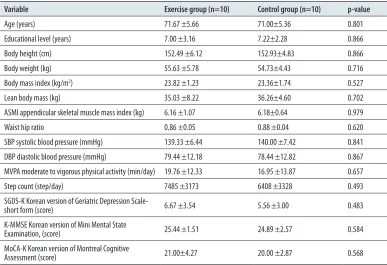
Having the MCI-diagnosed hypertensive elderly women explained about the aims and meth-ods of the study both in writing and orally, the study was conducted 24 voluntary partic-ipants who agreed to a written consent. The study was approved by the Ethics Committee of Dong-A University (2-104709-AB-N-01-201712-HR-058-02). According to random assignment, the subjects were divided into a multi-task exercise group (n = 12) and a con-trol group (n = 12). Four of them were excluded from the study for personal reasons. The final study sample comprised a multi-task group and a control group (n = 10 each), 20 subjects in total (Figure 1). The participants’ physical char-acteristics are shown in (Table 1).
Hypertension – noun arterial blood pressure that is higher than the usual range for gender and age. Also called high blood pressure, hyperpiesia. Compare hypotension [47].
Physical activity – noun
exercise and general movement that a person carries out as part of their day [47].
Exercise program – noun same as fitness program [47].
Cognitive – adjective relating to the process of acquiring knowledge by the use of reasoning, intuition or perception [47].
Appendicular – adjective referring to body parts which are associated with the arms and legs [47].
Kinematics – noun the scientific study of motion [47].
MET – abbreviation metabolic equivalent [47].
Metabolic equivalent – noun
OUTCOME MEASURES
Body composition and blood pressure
The subjects were instructed to maintain fas-tened for eight hours and to attire comfort-ably. The measurement points were before and after the multi-task exercise. Body height, body weight, % body fat, fat mass, lean body mass (LBM), and appendicular skeletal muscle mass (ASM) were measured using the N20 (N20, AIIA Communication Inc., Korea).
Body Mass Index (BMI) was yield by weight/ height (kg/m2) formula, and appendicular
skele-tal muscle mass index (ASMI) was calculated with ASMI/height (kg/m2)formula. Tapeline (Martine’s
body measuring instrument) was used to mea-sure waist and hip circumference, and waist hip ratio (WHR) was calculated with waist/hip ratio formula. The blood pressure was measured two times (both systolic and diastolic), using a CK-E301 mercury blood pressure monitor (Chin Kou Medical Instrument Co., Ltd., Taiwan).
Physical activity measurement
Physical activities were measured using the Lifecoder (Kenz lifecoder, Tokyo, Japan). An accel-erometer’s activity intensity level (i.e., 11 level: 0, 0.5, 1~9; 0 is low activity, 9 is high activity) was measured in every 4 second, and the metrics of physical activity measured intensity (metabolic
equivalents: METs) and daily step count (step/ day) [29] of physical activity (moderate to vig-orous physical activity: MVPA) from moderate-intensity (moderate-moderate-intensity effort 3-6 METs) to high-intensity (high-intensity effort >6 METS) except for low-intensity (low-intensity effort <3 METs).
Physical function measurement
As a combination of balance tests, chair stand test, and gate speed test among well-known elderly physical function assessments, a tool developed by Established Population for Epidemiologic Studies of Elderly (EPESE) – a multi-organization research held by National Institute of Aging (NIA) of the U.S. – Short Physical Performance Battery (SPPB) is composed of 0 point to 4 point, 12 point in total, in each criteria [30]. For grip strength, a digital dynamometer (Grip-D TKK5101, Japan) was used to measure the dominant hand twice and recorded the better results in 0.1kg units. For Time up & Go (TUG), the turnaround time was measured that required for the subjects to walk toward a cone located 2.44 m apart from the start line where the subjects sat still, and to come back to sit on a chair. Open-eyes one-legged standing time was measured from the moment the subjects raised their one leg to the moment they put it back to the ground with their one foot attached to calve and open-eyed. If the
Figure 1. Flow diagram of subjects.
Assessed for eligibility (n = 24)
Randomized (n = 24)
Multi-task exercise group
(n = 12) Control group (n = 12)
Not subject in the post test
Personal reasons (n = 2) Not subject in the post test Personal reasons (n = 2)
Completed (n = 10) Completed (n = 10)
subjects’ leg touched the grounds or the other leg, the time counted the right before, and the subjects rested for a minute for the second trial; the better records were reported.
6-minute walking test was conducted to walk straight 20 m back and forth, as many times as they can within 6 minutes, having them self-reg-ulate the speed and break time. Using G-sensor (BTS BIO ENGINEERING Corp, ITALY), Gait speed test utilized the average of two normal gait speed trial in 7 m, with 4 m of acceleration zone and 1.5 m of deceleration zone.
Depression assessment
Developed by Yasevage et al. [31] and then translated into the Korean version of Geriatric Depression Screening Scale (GDS) by Cho et al. [32], Geriatric Depression Scale-shot form (SGDS-K) was used for the measurement. Having 15 questions in total, each question consists of 0~1 point and the higher scores mean a higher level of depression; 10 points is suggested to be an optimal clinical efficacy to determine depression.
Global cognition assessment
The Korean version of MMSE (K-MMSE), a trans-lated version of Mini-Mental State Examination (MMSE) developed by Folstein et al. [33], was
utilized Kang et al. [34] to make sure Korean elderly use it. K-MMSE can assess the changes in cognitive function with its repeating measures, and the better function records higher points. 30 point in total, it is composed of orientation-time (5 point), orientation-space (5 point), memory registration (5 point), attention function and cal-culation (5 point), memory recall (3 point), and language and space-time composition skills (9 point).
Comprehensive cognition assessment
MoCA-K (Korean version of Montreal Cognitive Assessment) translated by Lee et al. [35], the Korean version of MoCA (Montreal Cognitive Assessment) developed by Nasreddine et al. [36], was used for comprehensive cognition assess-ment. MoCA-K consists the examinations of visuospatial/executive (5 point), naming (3 point), attention (6 point), language (3 point), abstraction (2 point), delayed recall (5 point), and orientation (6 point), 30 point in total.
Interventions
The multi-task exercise program was conducted in program for 90 minutes, two times a week for 24 weeks. Before and after the exercise, stretch-ing and walkstretch-ing were mainly conducted, and vital checks such as blood pressure were carried out
Table 1. Baseline characteristics of socio-demographic, physical characteristic, blood pressure, daily physical activity, mental and cognitive function (means and standard deviation).
Variable Exercise group (n=10) Control group (n=10) p-value
Age (years) 71.67 ±5.66 71.00±5.36 0.801 Educational level (years) 7.00 ±3.16 7.22±2.28 0.866 Body height (cm) 152.49 ±6.12 152.93±4.83 0.866 Body weight (kg) 55.63 ±5.78 54.73±4.43 0.716 Body mass index (kg/m2) 23.82 ±1.23 23.36±1.74 0.527
Lean body mass (kg) 35.03 ±8.22 36.26±4.60 0.702 ASMI appendicular skeletal muscle mass index (kg) 6.16 ±1.07 6.18±0.64 0.979 Waist hip ratio 0.86 ±0.05 0.88 ±0.04 0.620 SBP systolic blood pressure (mmHg) 139.33 ±6.44 140.00 ±7.42 0.841 DBP diastolic blood pressure (mmHg) 79.44 ±12.18 78.44 ±12.82 0.867 MVPA moderate to vigorous physical activity (min/day) 19.76 ±12.33 16.95 ±13.87 0.657 Step count (step/day) 7485 ±3173 6408 ±3328 0.493 SGDS-K Korean version of Geriatric Depression
Scale-short form (score) 6.67 ±3.54 5.56 ±3.00 0.483 K-MMSE Korean version of Mini Mental State
Examination, (score) 25.44 ±1.51 24.89 ±2.57 0.584 MoCA-K Korean version of Montreal Cognitive
between the main exercise (toe rock-paper-scis-sors, walk in line, thera-band exercise, step box, shuttle walking, ladder, body rock-paper-scissors and etc.) and break time. The multi-task included accomplishing other tasks (such as counting, speaking, word chain, clap and etc.) while they were doing exercise.
In order to increase the amount of physical activ-ities beside the exercise program, the study pro-vided an exercise program manual that can be done at home and confirmed the individuals’ activity amounts to each subject to evaluate weekly physical activity by using an acceleration sensor. During physical exercise, the heart rate was measured by wearing the portable wireless
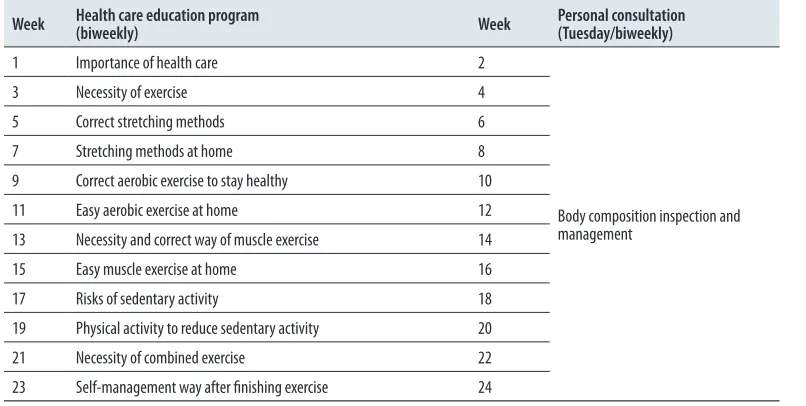
heart rate meter POLAR RS-400™ (Polar Electro Co., Finland). The set-up for exercise intensity was 40~50% of heart rate reserve (HRR) in week 1~6, 45~55% in week 7~12, and 50~60% in week 13~24. Health care education program was con-ducted by a specialist once in a two weeks and body composition check and personal consulta-tion were done in every other week. The multi-task exercise program and health care education program are shown in Table 2 and Table 3.
Statistical analysis
The similarities of the multidimensional exercise group and control groups were verified using SPSS 22.0 for Windows. The descriptive statistics of all variables were calculated as means and standard
Table 3. Health care education program.
Week Health care education program (biweekly) Week Personal consultation (Tuesday/biweekly)
1 Importance of health care 2
Body composition inspection and management
3 Necessity of exercise 4 5 Correct stretching methods 6 7 Stretching methods at home 8 9 Correct aerobic exercise to stay healthy 10 11 Easy aerobic exercise at home 12 13 Necessity and correct way of muscle exercise 14 15 Easy muscle exercise at home 16 17 Risks of sedentary activity 18 19 Physical activity to reduce sedentary activity 20 21 Necessity of combined exercise 22 23 Self-management way after finishing exercise 24 Table 2. Multi-task exercise program.
Item
1~6 week
(HRR 40~50%) 7~12 week(HRR 45~55%) 13~24 week(HRR 50~60%) Time (min)
Contents
Check Check on individual’s daily physical activity amount and health condition 10
Warm-up Sitting on a chair stretching shuttle walking Sitting on a floorStretching. Walking while talking
Standing stretching. Walk while doing addition and subtraction or while doing word chain
15
Main exercise
Walk straight in line. Toe rock-paper-scissors Step box. Ladder. Thera-band (yellow, red)
Body rock-paper-scissors multi-task. Walk straight in line, multi-task step box, multi-task. Ladder.
Thera-band (green)
Body rock-paper-scissors multi-task. Walk straight in line, multi-task. Step box, multi-task. Ladder. Thera-band (blue)
50
Cool-down Sitting on a chairstretching Sitting on a floor stretching Standing stretching 5
deviations. A two-way repeated ANOVA was calcu-lated to determine group differences. Independent and paired t-tests were performed when the effects of group and time were statistically significant. Pearson’s correlation coefficients were calculated to identify associations among variables and the statistical significance was set at 0.05.
RESULTS
Body composition
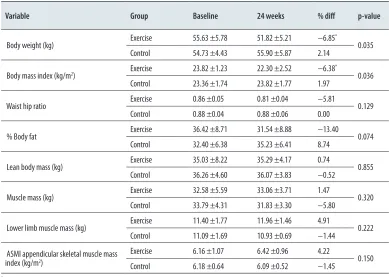
Body weight (p<.05) and BMI (p<.05) showed a valid difference in the interaction between the group and time (Table 4).
Daily physical activity and physical
function
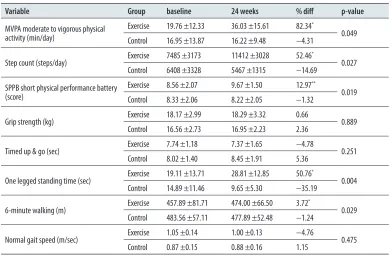
The changes in daily physical activity and physi-cal function are shown in (Table 5). MVPA (p<.05),
step count (p<.05), SPPB (p<.05) and one legged standing time (p<.05) presented a valid increase in multi-task exercise group. In addition, there
was a valid difference in the interaction between the group and time in MVPA (p<.05), step count
(p<.05), SPPB (p<.05), One legged standing time
(p<.01), 6-minute walking (p<.05).
Blood pressure, depression and cognitive
function
In the multi-task exercise group, SBP (p<.05) and DBP (p<.05) decreased validly and K-MMSE (p<.05) increased validly. Moreover, a valid differ-ence in the interaction between the group and time was shown in SGDS-K (p<.05), MMSE-K (p<.05) and MoCA-K (p<.05) (Table 6).
Correlations
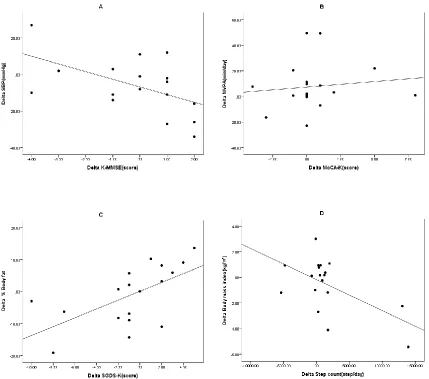
The correlations between K-MMSE and SBP, MoCA-K and MVPA, SGDS-K and % body fat, Step count and BMI are shown in Figure 2. K-MMSE and SBP (r = −.532, p<.05), and Step count and BM I (r = −.570, p<.05) presented a negative correlation while MoCA-K and MVPA (r = .487, p<.05), and SGDS-K and % body fat (r = .606, p<.01) showed a positive correlation. Panel A: r = −.532, p = .023; B: r = .487, p = .041; C: r = .606, p = .008; D: r = −.570, p =.014
DISCUSSION
Dementia incurs a reduction in physical activities followed by the decline in cognition and physical function [37], and the major cause of cognitive
Table 4. The changes of body composition and blood pressure between the groups at baseline and after 24 weeks (means and standard deviation).
Variable Group Baseline 24 weeks % diff p-value
Body weight (kg) Exercise 55.63 ±5.78 51.82 ±5.21 −6.85
*
0.035 Control 54.73 ±4.43 55.90 ±5.87 2.14
Body mass index (kg/m2) Exercise 23.82 ±1.23 22.30 ±2.52 −6.38 *
0.036 Control 23.36 ±1.74 23.82 ±1.77 1.97
Waist hip ratio Exercise 0.86 ±0.05 0.81 ±0.04 −5.81 0.129 Control 0.88 ±0.04 0.88 ±0.06 0.00
% Body fat Exercise 36.42 ±8.71 31.54 ±8.88 −13.40 0.074 Control 32.40 ±6.38 35.23 ±6.41 8.74
Lean body mass (kg) Exercise 35.03 ±8.22 35.29 ±4.17 0.74 0.855 Control 36.26 ±4.60 36.07 ±3.83 −0.52
Muscle mass (kg) Exercise 32.58 ±5.59 33.06 ±3.71 1.47 0.320 Control 33.79 ±4.31 31.83 ±3.30 −5.80
Lower limb muscle mass (kg) Exercise 11.40 ±1.77 11.96 ±1.46 4.91 0.222 Control 11.09 ±1.69 10.93 ±0.69 −1.44
ASMI appendicular skeletal muscle mass index (kg/m2)
Exercise 6.16 ±1.07 6.42 ±0.96 4.22
0.150 Control 6.18 ±0.64 6.09 ±0.52 −1.45
malfunction is reported to be a lack of physical activity, depression, and the increased population of the elderly [38]. One of the characteristics of the MCI is that one can go through physiologi-cal dependence due to the decline in cognitive function and physical activity [39], which accom-panies a risk of physical injuries such as a hurt from a fall and fracture because of an error of judgement induced by the decline in cognitive function [40]. Meanwhile, physical activities and cognitive function exercises are reported to have
a highly beneficial effect not only to the cognitive function of the dementia elderly but to the QOL arisen from the increased living functions [41]. As a result of the study, it presented a noticeable improvement in body weight and BMI between the prior-to multi-task exercise and post-24 weeks of the exercise.
Considering the precedent research that
explained the intimate relationship between the cognitive function and body composition [42], it
Table 5. The changes of daily physical activity and physical function between the groups at baseline and after 24 weeks (means and standard deviation).
Variable Group baseline 24 weeks % diff p-value
MVPA moderate to vigorous physical activity (min/day)
Exercise 19.76 ±12.33 36.03 ±15.61 82.34*
0.049 Control 16.95 ±13.87 16.22 ±9.48 −4.31
Step count (steps/day) Exercise 7485 ±3173 11412 ±3028 52.46
*
0.027 Control 6408 ±3328 5467 ±1315 −14.69
SPPB short physical performance battery (score)
Exercise 8.56 ±2.07 9.67 ±1.50 12.97**
0.019 Control 8.33 ±2.06 8.22 ±2.05 −1.32
Grip strength (kg) Exercise 18.17 ±2.99 18.29 ±3.32 0.66 0.889 Control 16.56 ±2.73 16.95 ±2.23 2.36
Timed up & go (sec) Exercise 7.74 ±1.18 7.37 ±1.65 −4.78 0.251 Control 8.02 ±1.40 8.45 ±1.91 5.36
One legged standing time (sec) Exercise 19.11 ±13.71 28.81 ±12.85 50.76
*
0.004 Control 14.89 ±11.46 9.65 ±5.30 −35.19
6-minute walking (m) Exercise 457.89 ±81.71 474.00 ±66.50 3.72
*
0.029 Control 483.56 ±57.11 477.89 ±52.48 −1.24
Normal gait speed (m/sec) Exercise 1.05 ±0.14 1.00 ±0.13 −4.76 0.475 Control 0.87 ±0.15 0.88 ±0.16 1.15
*p<.05, **p<.01
Table 6. The changes of blood pressure, depression and cognitive function between the groups at baseline and after 24 weeks.
Variable Group baseline 24 weeks % diff p-value
Systolic blood pressure (mmHg) Exercise 139.33 ±6.44 127.00 ±18.83 −8.85 0.075 Control 140.00 ±7.42 140.11 ±16.77 0.08
Diastolic blood pressure (mmHg) Exercise 79.44 ±12.18 74.00 ±8.35 −6.85 0.201 Control 78.44 ±12.82 80.44 ±15.80 2.54
SGDS-K Korean version of Geriatric Depression Scale-short form (score)
Exercise 6.67 ±3.54 3.78 ±2.05 −43.33*
0.025 Control 5.56 ±3.00 6.78 ±2.86 21.94
K-MMSE Korean version of Mini Mental State Examination (score)
Exercise 25.44 ±1.51 26.22 ±0.97 3.07*
0.029 Control 24.89 ±2.57 23.78 ±2.49 −4.46
MoCA-K Korean version of Montreal Cognitive Assessment (score)
Exercise 21.00 ±4.27 22.89 ±3.22 9.00*
0.020 Control 20.00 ±2.87 19.11 ±1.62 −4.45
Original Article
is reasonable to think that improving body com-position through multi-task exercise program can have a meaningful impact on improving cognitive function. In addition, there appeared a valid nega-tive correlation between the BMI and step count, which means the increase in step count had have a positive effect on improving the BMI. On the changes in the daily physical activity amount and physical function, there were valid differences in interaction between the group and time in MVPA, step count, SPPB, One legged standing time and 6-minute walking. Moreover, the study showed a positive valid correlation between the MoCA-K and MVPA; concerning the valid cor-relation between the physical activity amount and cognitive function, the increase in physical activity is thought to be a meaningful result, and the overall increase in physical fitness is consid-ered to have a positive impact on ADL and social
activity of the elderly. In case of the gait speed, while there was no valid difference in the interac-tion between the group and time, there still were some improvements in the multi-task exercise group. Taking the preceding study into account that reported a close relationship among the gait speed, the survival rate of the elderly and the risks of physical injuries [40, 43], improving the gait speed through the increase in LBM and lower muscle mass is concerned to be an important fac-tor. In addition, SBP and DBP have improved val-idly in the multi-task exercise.
As it is reported that the high blood pressure has a close relationship with the cognitive func-tion [4, 5, 44], this study showed a valid nega-tive correlation between the SBP and K-MMS. Thus, it can be said that improving blood pressure has a positive effect on the cognitive function
The correlations between K-MMSE and SBP, MoCA-K and MVPA, SGDS-K and % body fat,
Step count and BMI are shown in Figure 2. K-MMSE and SBP (r =
−
.532, p<.05), and Step
count and BM I (r =
−
.570, p<.05) presented a negative correlation while MoCA-K and
MVPA (r = .487, p<.05), and SGDS-K and % body fat (r = .606, p<.01) showed a positive
correlation. Panel A: r =
−
.532, p = .023; B: r = .487, p = .041; C: r = .606, p = .008; D: r =
−
.570, p =.014
Figure 2.
Correlation between cognitive function and SBP, MVPA and depression and %
body fat and step count and BMI (n = 20)
Notes
: SBP: systolic blood pressure, K-MMSE: Korean version of mini mental state examination, MVPA:
mod-erate to vigorous physical activity, MoCA-K: Korean version of Montreal cognitive assessment, SGDS-K:
Ko-rean version of geri atric depression scale-short form.
DISCUSSION
Dementia incurs a reduction in physical activities followed by the decline in cognition and
physical function [37], and the major cause of cognitive malfunction is reported to be a lack
Figure 2. Correlation between cognitive function and SBP, MVPA and depression and % body fat and step count and BMI (n = 20)
Notes: SBP: systolic blood pressure, K-MMSE: Korean version of mini mental state examination, MVPA: moderate to vigorous physical activity,
of the high blood pressure elderly. The change in depression showed a valid difference in the interaction between SGDS-K and the group and time; and the daily physical activity (step count) and body composition (BMI), and body composi-tion (% body fat) and SGDS respectively showed a valid correlation. Seeing the results of the study, the improvement in the physical activity amount has a positive impact on improving body com-position, and ultimately to easing depression. Considering the report on the negative correla-tion between the physical activity amount and depression and positive correlation between the sedentary life and depression [45], and the study on effective depression prevention from exercises over the moderate-intensity and walk-ing [46], the increase in physical activity amount is thought to be a meaningful result.
On the other hand, the change in the cogni -tive function showed a valid improvement in the interaction between the group and time in K-MMSE and MoCA-K. This showed a
simi-lar result with the report that presented a posi -tive improvement on cogni-tive function of the elderly women by using multi-task cognitive function improvement program [28, 15]; espe-cially, it can be acknowledge that conducting cog-nitive improvement program, including exercise intervention is effective in preventing dementia shown in the elderly. In this study, particularly, the SBP and MMSE-K showed a valid negative correlation and a positive correlation in MVPA and MoCA-K; this means improving body com-position and the physical activity over the moder-ate-intensity has a positive impact on improving
cognitive function. Concerning that the decline in cognitive function works as a critical factor for preventing dementia, the efficacy of the multi-task exercise program is a significant result. Thus, it can be said that the multi-task exercise pro-gram with the exercise and cognitive task can be much more beneficial and effective in improving cognitive function rather than a single bout exer-cise, and the further research needs to verify its effectiveness through a tracer study after the halt of the program.
Wrapping up the results above, the multi-task exercise program has a positive effect on improving physical function, blood pressure and
depression, and especially the increase in physical
activity is highly beneficial in cognitive function.
While this can be a meaningful result when con-sidering the research improving cognitive func-tion through the multi-task exercise program, it appears to be more significant in that practicing physical activity on a regular basis can prevent the decline in cognitive function.
CONCLUSIONS
The result showed that the multi-task exer-cise program has a positive impact on improv-ing the body composition, physical function, blood pressure and cognitive function. In par-ticular, maintaining the long-term regular physi-cal activity is a critiphysi-cal factor for preventing the decline in cognitive function.
REFERENCES
1. Rocca WA, Petersen RC, Knopman DS et al. Trends in the Incidence and Prevalence of Alzheimer’s Disease, Dementia, and Cognitive Impairment in the United States. Alzheimers Dement 2011; 7(1): 80-93
2. World Health Organization. Dementia. Geneva: World Health Organization. 2017 [cited 2018 Jun 18]. Available from: http://www.who.int/ mediacentre/factsheets/fs362/en/ 3. Jhoo JH, Kim KW, Huh Y et al. Prevalence
of dementia and its subtypes in an elderly urban Korean population: results from the Korean Longitudinal Study on Health and Aging(KLoSHA). Dement Geriatr Cogn Disord 2008; 26(3); 270-276
4. de la Torre JC. Critically Attained Threshold of Cerebral Hypoperfusion: The CATCH Hypothesis of Alzheimer’s Pathogenesis. Neurobiol Aging 2000; 21(2): 331-342 5. Kalaria RN. The Role of Cerebra Ischemia in
Alzheimer’s Disease. Neurobiol Aging 2000; 21(2): 321-330
6. Peters R. No clear relationship between anti-hypertensive class and cognitive function over 12 months in a cohort study of community-dwelling adults aged 80 and over. Ther Adv Chronic Dis 2019; 10; 2040622318820849 7. Sanford AM. Mild Cognitive Impairment. Clin
Geriatr Med 2019; 33(3): 325-337
8. Gravitz L. Drugs: A tangled web of targets. Nature 2011; 475(7355): S9-S11
9. Petersen RC, Caracciolo B, Brayne C et al. Mild cognitive impairment: a concept in evolution. J Intern Med 2014; 275(3): 214-228 10. Laurin D, Verreault R, Lindsay J et al. Physical
activity and risk of cognitive impairment and dementia in elderly persons. Arch Neurol 2001; 58(3): 498-504
12. Fratiglioni L, Wang HX, Ericsson K et al. Influence of social network on occurrence of dementia: a community-based longitudinal study. Lancet 2000; 355(9212): 1315-1319 13. Scarmeas N, Levy G, Tang MX et al. Influence of
leisure activity on the incidence of Alzheimer’s disease. Neurology 2001; 57(12): 2236-2242 14. Verghese J, Lipton RB, Katz MJ et al. Leisure
activities and the risk of dementia in the elderly. N Engl J Med 2003; 348: 2508-2516 15. Lee MS, Song NH. The Effects of Cognitive
Function Improvement Programs on the Cognitive Functions and Depression Indexes of Female Dementia Risk senior Groups. J Korean Assoc Phys Educ Sport Girls and Women 2016; 30(3): 253-268
16. Frith E, Loprinzi PD. Physical activity and cog-nitive function among older adults with hyper-tension. J Hypertens 2017; 35(6): 1271-1275 17. Sanders LMJ, Hortobágyi T, la Bastide-van Gemert S et al. Dose-response relationship between exercise and cognitive function in older adults with and without cognitive impair-ment: A systematic review and meta-analysis. PLoS One 2019; 14(1): e0210036
18. Dan S, Doris SFY. Effects of a Moderate-Intensity Aerobic Exercise Programme on the Cognitive Function and Quality of Life of Community-dwelling Elderly People with Mild Cognitive Impairment: A Randomised Controlled Trial. Int J Nurs Stud 2019; 93: 97-105
19. Perneczky R, Pohl C, Sorg C et al. Impairment of activities of daily living requiring memory or complex reasoning as part of the MCI syn-drome. Int J Geriatr Psychiatry 2006; 21(2): 158-162
20. Boyle PA, Buchman AS, Wilson RS et al. Physical frailty is associated with incident mild cogni-tive impairment in community-based older per-sons. J Am Geriatr Soc 2010; 58(2): 248-255 21. Petersen RC, Smith GE, Waring SC et al. Mild
cognitive impairment: Clinical characteriza-tion and outcome. Arch Neurol 1999; 56(3): 303-308
22. Petersen R, Doody R, Kurz A et al. Current concepts in mild cognitive impairment. Arch Neurol 2001; 58(12); 1985-1992
23. Yeon BH, Lee HJ. The Effect of Aquarobics Exercise on Alzheimer’s Disease Dementia Factor and Cognitive Function in Elderly Women. Korea J Sports Sci 2017; 26(1): 983-991
24. Liu C, Herrmann N, Gallagher D et al. Designing a randomized, sham-controlled, parallel-design trial to investigate the effects of a combined exercise priming and transcranial direct cur-rent stimulation intervention in mild cogni-tive impairment and alzheimer’s disease. Brain Stimul 2019; 12(2): 425
25. Gates N, Fiatarone SMA, Sachdev PS et al. The effect of exercise training on cognitive function in older adults with mild cognitive impairment: a meta-analysis of randomized controlled trials. Am J Geriatr Psychiatry 2013; 21(11): 1086-1097
26. Sink KM, Espeland MA, Castro CM et al. Effect of 24-Month Physical Activity Intervention vs Health Education on Cognitive Outcomes in Sedentary Older Adults The LIFE Randomized Trial. JAMA 2015; 314(8): 781-790 27. Alfini AJ, Weiss LR, Nielson KA. Resting
Cerebral Blood Flow After Exercise Training in Mild Cognitive Impairment. J Alzheimers Dis 2019; 67(2); 671-684
28. Kim KH, Song NH. The Effect of the Complex Cognitive Enhancement Program on the Cognitive Functions, Depression Indexes, and the Dementia Risk Factors of Elderly Women. Korean J Phys Educ 2019; 58(1): 259-269 29. Aoyagi Y, Shephard YJ. Steps Per Day: The
Road to Senior Health? Sports Med 2009; 39(6): 423-438
30. Guralnik JM, Ferrucci L, Simonsick EM et al. Lower-extremity performance in person over the age of 70 years as a predictor of subsequent disability. N Engl J Med 1995; 332(9): 556-561 31. Yesavage JA, Brink TL, Rose TL et al.
Development and validation of a geriatric depression screening scale: A preliminary report. J Psychiatr Res 1983; 17(1): 37-49 32. Cho MJ, Bae JN, Suh GH et al. Validation
of Geriatric Depression Scale, Korean Version(GDS) in the Assessment of DSM-III-R Major Depression. J Korean Neuropsychiatr Assoc 1999; 38(1): 48-63
33. Folstein MF, Folstein SE, McHugh PR. Mini-Mental-State: A practical method for grading the cognitive state of patients for the clini-cian. J Psychiatr Res 1975; 12(3): 189-198 34. Kang Y, Na DL, Hahn S. A validity study on
the Korean mini-mental state examination (K-MMSE) in dementia patients. J Korean Neurol Assoc 1997; 15(2): 300-308 35. Lee JY, Lee DW, Cho SJ et al. Brief screening
for mild cognitive impairment in elderly outpa-tient clinic: validation of the Korean version of
the Montreal Cognitive Assessment. J Geriatr Psychiatry Neurol 2008; 21(2): 104-110 36. Nasreddine ZS, Phillips NA, Bedirian V et al.
The Montreal Cognitive Assessment, MoCA: a brief screening tool for mild cognitive impair-ment. J Am Geriatr Soc 2005; 53(4): 695-699 37. American Psychiatric Association. Diagnostic and Statistical Manual of Mental Disorders. 5th edition (DSM-5). Arlington: American Psychiatric Association; 2013
38. Barnes DE, Alexopoulos GS, Lopez OL et al. Depressive symptoms, vascular disease, and mild cognitive impairment: findings from the Cardiovascular Health Study. Arch Gen Psychiatry 2006; 63(3): 273-279
39. Farias ST, Lau K, Harvey D et al. Early func-tional limitations in cognitively normal older adults predict diagnostic conversion to mild cognitive impairment. J Am Geriatr Soc 2017; 65(6): 1152-1158
40. Sungkarat S, Boripuntakul S, Chattipakorn N et al. Effects of tai chi on cognition and fall risk in older adults with mild cognitive impairment: a randomized controlled trial. J Am Geriatr Soc 2017; 65(4): 721-727
41. Coelho FGDM, Andrade LP, Pedroso RV et al. Multimodal exercise intervention improves frontal cognitive functions and gait in Alzheimer’s diease: A controlled trail. Geriatr Gerontol Int 2013; 13(1): 198-203
42. Cronk BB, Johnson DK, Burns JM et al. Body mass index and cognitive decline in mild cog-nitive impairment. Alzheimer Dis Assoc Disord 2010; 24(2): 126-130
43. Studenski S, Perera S, Patel K et al. Gait Speed and Survival in Older Adults. JAMA 2011; 305(1): 50-58
44. Cherubini A, Lowenthal DT, Paran E et al. Hypertension and Cognitive Function in the Elderly. Am J Ther 2007; 14(6): 533-554 45. Lucas M, Mekary R, Pan A et al. Relation
between clinical depression risk and physi-cal activity and time spent watching televi-sion in older women: a 10-year prospective follow-up study. Am J Epidemiol 2011; 174(9): 1017-1027
46. Mammen G, Faulkner G. Physical activity and the prevention of depression: a system-atic review of prospective studies. Am J Prev Med 2013; 45(5); 649-657
47. Dictionary of Sport and Exercise Science. Over 5,000 Terms Clearly Defined. London: A & B Black; 2006