Experimental Performance Evaluation of new
cooling pad material for direct evaporating cooling
for Pune summer conditions
1M.M. Kulkarni,
2K.N. Vijaykumar,
3N.A. Jadhav,
4M.J. Bhor,
5S.S. Shinde
1, 3, 4, 5SKNCollege of Engineering, Vadgaon,Pune, University of Pune, India 411041
2D.J.Sanghavi College of Engineering, Vile-Parle, Mumbai, University of Mumbai, India 400056
Abstract
—
Paper presents performance evaluation of new cooling pad material Coconut fiber Clay and Khus and its comparison with conventional cooling pad material Celdek of evaporative cooler. It is observed that effectiveness of Coconut fiber Clayis found to be 0.84 as that of Khus 0.67and Celdek 0.71 .The cooling capacity forCoconut fiberClay pad is 3.85 kW as that of Khus 3.80 kW and Celdek Pad is 3.2 kW.Water evaporation rate for Coconut- clay is higher than Khus and Celdec while pressure drop is found to be higher for Coconut fiber Clay than Celdek pad. It is concluded that performance of Coconut fiber Clay is better than Celdek for Pune summer condition, along with reduction in initial cost, maintenance and replacement cost.Keywords
—E
vaporative coolers, Coconut fiber clay pad, effectiveness, air velocity, cooling capacity.INTRODUCTION
Air conditioning of residential and small commercial offices is provided by window air conditioner. It operates on vapor compression cycle that uses mechanical refrigeration system to extract heat from space to be conditioned. An exponentially growing requirement of air conditioning in today’s energy shortage scenario has put tremendous burden on electricity demand. However, air conditioning has become need of time and not a luxury. Window air conditioners have COP of 2.5 to 4 and are available in capacities from 0.75 TR to 5 TR for residential purpose. Even though, air conditioner is sophisticated device, its power consumption is an issue. In general 1 TR capacity AC with an average COP 3.5 consumes 1 k-Whr of power. Thus the operating cost of AC is an issue that restricts uses of AC for middle class people. Moreover its contribution in global warming, use of CFC refrigerants, its higher running cost due to elevation tariff plans, poor quality of indoor air due to recirculation are some issues. All these issues call upon some alternatives, which can replace conventional air conditioner without compromising indoor comfort condition.
One alternative is in the form of evaporative cooling is available as it is feasible, offers zero carbon credits, less operational cost and its suitability to dry and hot climate. Evaporating cooling is an ancient technique known to mankind with which air is cooled and humidified by
supplying a thin water film on surface of cooling pads. Hot and dry air supplies the heat required for evaporating of water and thus get cooled and humid.
The effectiveness of evaporating cooling is defined as.
Where T1=Temperature of outside air.
T2=Temperature of room.
Twb=Wet bulb temp of outside air.
The effectiveness of DEC varies from 0.5 to 0.9, based on outdoor conditions of air, fan speeds, pad materials, pad thickness and pad area.
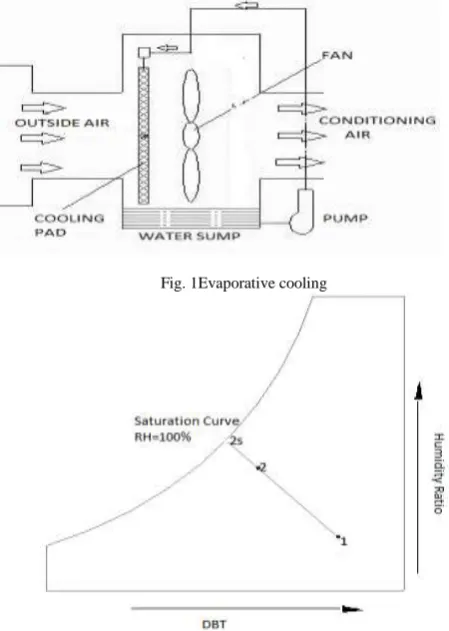
Fig.2 Psychometric representation of Evaporative Cooling
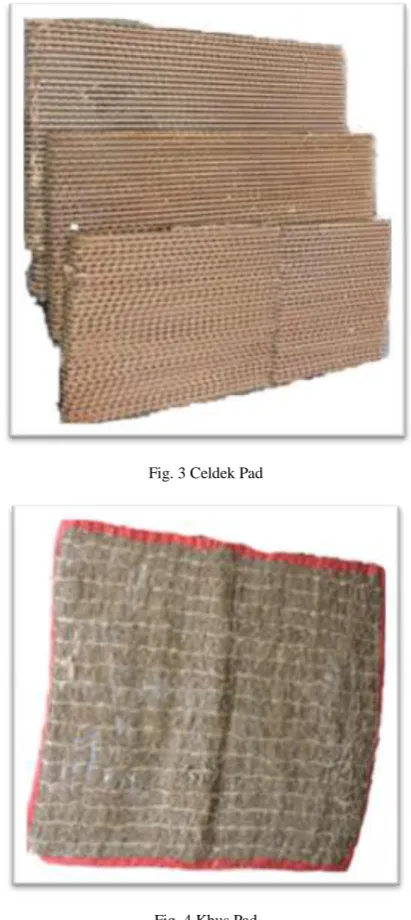
Figure 1 and 2 shows a schematic sketch of direct Evaporative cooler and its process representation on psychometric chart. The evaporative pad material plays a significant role in increasing the effectiveness of coolers. Various pad materials commonly used are Aspen, Celdek, Wood, Straw pad, Aluminum foil, Metal foil, Fired clay, Metal foams. Recently Palash fiber, Coconut fiber are used. This paper presents experimental investigation of two new materials called Khus and Coconut fiber mixed with clay and compares its performance with Celdek pad. The effect of pad thickness, pad materials etc. on various performance parameters like effectiveness, cooling capacity, room temperature and humidity, indoor conditions, pressure drop etc. is experimentally investigated.
Watt (1963) reported a detail analysis of direct and indirect evaporative system and commented on scope and potential of EC[1].J. R. Camairgo proposed three methods used as reference for efficient use of evaporating cooling and subsequently applied to several Brazilian cities. The first method proposed by him is very effective to quickly decide scope and potential of evaporating cooling for specific location under consideration. This method is known as feasibility index method, he concluded that evaporating cooling has large potential to provide indoor comfort condition at reduced operation cost in region where WBT is less than 24oC[2]. R.Navon emphasized the feasibility study, of direct evaporating cooling in residential sectors of Israel. He concluded that evaporating cooling can provide higher level of thermal comfort in humid as well as dry regions[3]. S. Dutta conducted experiment on 8.5 ton indirect evaporating cooling system and found that it is an attractive option in India and Australia with potential energy saving of 75% over AC in climatic zone where WBT is less than 25oC[4]. Abdul Rehman experimentally investigated performance of DEC in hot and humid regions of Malaysia. He found output air temperature between 27.5 to 29.4 while cooling capacity between 1.38 kW to 5.53 kW [5].R. Bonkhanouf presented a computer model and experimental result for porous ceramic materials with outride DBT 45 and proved that, air can be cooled below its WBT with maximum cooling capacity of 280W/ and overall wet bulb effectiveness is found more than unity. He strongly recommended potential of DEC as alternative to conventional AC for dry and hot regions[6].Maqsood investigated ability of EC to provide indoor comfort condition irrespective of outdoor condition. He found that indoor DBT is dropped to 8 to 16 in low RH(10%-30%) and 4 to 5 in higher RH. He proposed on off control system to maintain inside RH within comfort limit[7].
PREPARATION OF PAD MATERIALS
In order to investigate the performance of new materials experiment was conducted in SKN College of Engineering Pune city, India (18.5203o N, 73.8567 o E ).
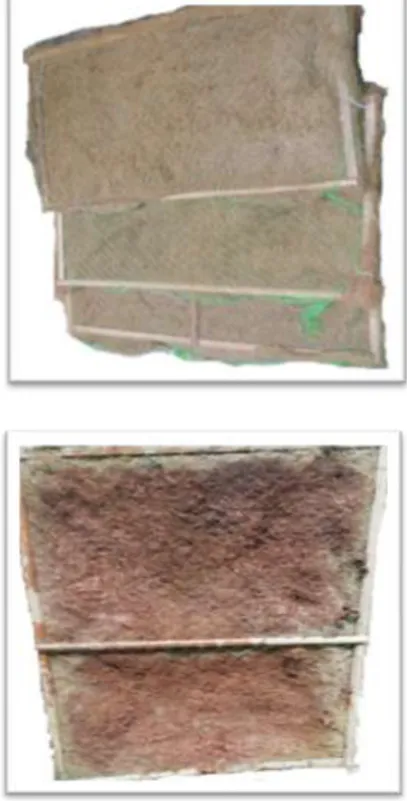
Two material used are coconut fiber mixed with clay. The density of coconut fiber 1000 kg/m3and clay density 1650 kg/m3. Clay is mixed with coconut fiber by volume proportion of 95% and 5% with special binder material .The size of pad material used is 1 x 0.75 m2 and such three sides contribute area of 2.25m2.Thickness of pad material is varied from 25 mm and 50mm. The coconut fiber are prepared by separating, peeling and machined to form random distribution inside wire mesh. The clay available is used to make earthen pots. The water inside the pot get cooled due to evaporation of water that comes on surface due to porous nature. Use of this clay is done first time by placing a layer of clay on surface of coconut pads. The ability of clay to hold the water for evaporation is known to mankind, which is used here. The assembly is fixed on three sides of cooler through angle or net support.
Fig. 3 Celdek Pad
Fig. 5. Coconut fiber and Coconut fiber-clay Pad
EXPERIMENTAL SETUP
The test laboratory is room of 4m x 3m x 3 m having total volume 36m3. The sensible and cooling load 3600W and 750W.The total capacity of heat load is 4250W i.e. 4.25kW.Air enters through 3 sides of a direct evaporative cooler. Sump has dimensions 1m x 0.75 m x 0.25m with capacity 125litres of water accumulation. The direct cooler is emerged in sump and located at outside window of test facility. Water is pumped through immersed pump having capacity 1200LPH of head 1.82m. of 40 W. The fan and motor assembly uses 12 inches fan with maximum speed of 1300 rpm of 120W. Fan used is backward curve blade plastic fan. Cooling pad material on these 3sides of cooler are provided with various thickness hence an arrangement is provided for accommodation of various thickness pad material. The top of evaporative cooler is covered by ply. The experiments were conducted for month of March and April of 2015. The discharge of fan is 750m3/hr. with air velocity
1.25m/s. The three pads namely used Celdek pad, Coconutfiber clay andKhus fiber are tested one by one. The duration is taken from 9 am to 4 pm. The experiments were carried for the same outdoor conditions that are naturally encountered within two months. The instrument used thermometer of sling type, frontier 288 CTH. Temperature humidity indicator with accuracy ± 0.1oC and humidity ± 2%.the air velocity is measured with anemometer Testo-451 thermal anemometerwith accuracy of ± 0.1m/s. Mass flow rate measured with volume flow rate device of 1000cc glass flask and stop watch. The chilled water temperature is measured by standard thermometer.
Fig. 6 Test Facility at SKNCOE
Fig.6 and Fig. 7 shows that test facility and cooler arrangement.
PERFORMANCE PARAMETERS:
The performance evaluation parameters are:
1. Feasibility Index = WBT- ΔT
2. Effectiveness :
3. Cooling Capacity :
Q=mCpΔT
Where,
Q=heat absorbed by outside air. m = mass flow rate of air. Cp=specific heat of air. ΔT= (T1-T2) temperature drop.
4. Rate of water evaporation: m x hfg = mCpΔT
Where,
m =mass of water evaporated. hfg =latent heat of evaporation.
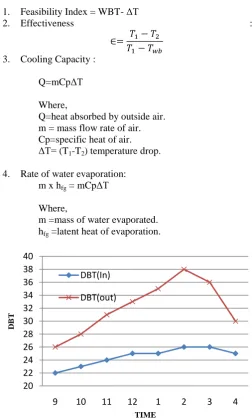
Fig. 8 Variation of outdoor and indoor condition without use of Evaporative Cooling
Fig.8 shows that variation of outdoor and indoor conditions without use of evaporative cooling. It gives us idea about cooling load with respect to time.
Fig. 9 Variation of effectiveness with temperature for different pad material
Fig.9shows that the effectiveness of pad materials is proportional to DBT of outside air. It is found maximum for new Coconut fiber Claypad 0.82, Celdek pad 0.71 and Khus 0.67.
Fig, 10 Variation of pressure drop with respect to pad material.
Fig 10 shows that pressure drop across various pad materials. The pressure drop is function of thickness of pad and tightness of pad (pad density). It is found maximum for coconut clay pad and least to celdek pad.
20 22 24 26 28 30 32 34 36 38 40
9 10 11 12 1 2 3 4
D
B
T
TIME
DBT(In)
DBT(out)
0 0.1 0.2 0.3 0.4 0.5 0.6 0.7 0.8 0.9
20 25 30 35 40 45 50
9:00 AM10:00 AM11:00 AM12:00 PM1:00 PM2:00 PM3:00 PM4:00 PM
E
FFE
C
T
IV
E
N
E
S
S
D
B
T
TIME
DBT
effecvtiveness coconut effectiveness celdek effectiveness of khus
0 5 10 15 20 25 30 35
coconut celdek khus
PR
E
S
S
U
R
E
D
R
OP
IN
m
m
OF
H2
O
Fig 11 Variation in RH with respect to time for different pad material
Fig 12 Variation in DBT with respect to time for different pad material
As seen in Fig 11 and Fig 12 Coconut fiber Claypad has maintained uniform temperature and humidity inside room as compare with Celdek pad and Khus pad throughout the test period irrespective of outdoor conditions.
Fig.13 cooling capacity of pad materials
Fig 13 Show that cooling capacity varies with DBT of outside air. It is found maximum of 3.8 KW for Coconut fiberClay material.
Fig 14 Water evaporation rate with respect to pad material
Fig. 15 Water sump temperature with respect to pad materials
As seen in fig.14 and fig.15water present in sump gets consumed during test hour due to continuous evaporation, hence, the mass of water present in sump is reduced. The heat of evaporation of water on surface of cooling pad is taken by water itself resulting reduction of temperature. It is seen that Coconut fiber Claypad evaporated maximum water during test duration of 6 hr. As result, the sump water temperature was found lowest for coconut – clay. Then followed by Celdekand then Khus pad. The temperature drop of 9oC corresponding to WBT of air that time is achieved. This cool water can be used for indirect cooling during non peak hours to get cooling effect. 30 35 40 45 50 55 60 65 70
10AM11:00 AM12AM 1:00 PM2:00 PM 3PM 4PM
R EL A TIV E H U M ID ITY ( R H ) (% ) TIME (t) celdek pad coconut pad khus pad 20 21 22 23 24 25 26 27 28 29 10:00 AM 11:00 AM 12:00 PM 1:00 PM 2:00 PM 3:00 PM 4:00 PM D BT ( oC) TIME (t) celdek pad coconut pad khus pad 0 0.5 1 1.5 2 2.5 3 3.5 4 4.5 10:00 AM 11:00 AM 12:00 PM
1:00 PM 2:00 PM 3:00 PM 4:00 PM
C O O LIN G C A PA C ITY ( QC ) TIME (t)
celdek pad coconut pad
khus pad 0 2 4 6 8 10 12 Coconut-Clay Pad
Celdek Pad Khus Pad
W AT E R E VA P ORA T IO N RA T E PAD MATERIAL 12 13 14 15 16 17 18 19 20 21 10:00 AM 11:00 AM 12:00 PM 1:00 PM 2:00 PM 3:00 PM 4:00 PM W A T E R S U M P T E M PE R A T U R E
(o C
)
TIME (t)
Fig 16. Variation in air velocity for pad materials.
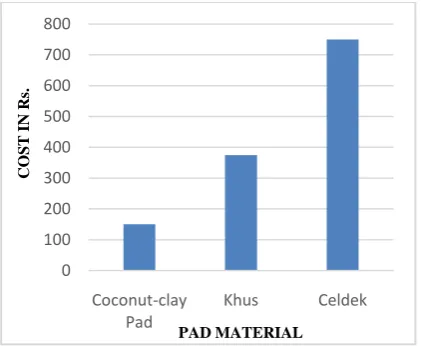
Fig.16 shows that the maximum and minimum pressure drop is caused by Coconut - clay pad and Celdek paper, the maximum velocity at outlet of fan is the function of pad material is shown. It is simply indication of amount of air (mass of air sucked by material). As Celdek is ordered hexagonal woven honeycomb structure, the velocity is found maximum for it. Lastly the cost comparison is significant for large capacity systems. As seen initial cost of coconut clay pad is one third of that of Celdak pad .
Fig 17 Cost of pad materials.
CONCLUSION
Feasibility study of use of DEC for Pune summer condition is investigated and it is found that FI of Pune city for month of April-May is found to be 10 to 12 which indicates good scope for EC. Then, two new pad materials Conconut fiber Clay and Khus are compared for their performance with Celdek material, a common cooling pad material. It is found that Coconut-Clay pad material has maximum effectiveness of 0.82 and cooling capacity of 3.85 kW which are higher than conventional cooling pad material. The rate of water evaporated is also high giving more comfort condition inside room, while pressure drop is found to be on higher side. Thus,
it can be concluded that new cooling pad material Coconut-Clay developed is beneficial to use in evaporative cooling.
ACKNOWLEDGEMENT
The authors are grateful to Department of Mechanical Engineering Head and staff of SKNCOE for providing test facility space and equipment’s.
SUB SCRIPT
AC= Air Conditioner.
DBT = Dry Bulb Temperature.
FI = Feasibility Index.
RH = Relative Humidity.
WBT=Wet Bulb Temperature.
NOMENCLATURE
A = Area in m2.
= Specific heat kJ/kg oK.
=Pressure Drop in mm of H2O.
m = mass in kg.
=Cooling Capacity in kW.
t = thickness in m.
T1= Evaporating inlet DBT in o C.
T2= Evaporating Outlet DBT in o C.
T3= Room Temperaturein o C.
= Evaporating inlet WBTin o C.
V m/s=Air velocity in m/sec.
W= Water Evaporating rate kg/hr.
1.7
3.5
2.1
0 1 2 3 4
Coconut Celdek Khus
A
IR
V
EL
O
C
ITY
(
M
/S
)
PAD MATERIAL
Air Velocity
0 100 200 300 400 500 600 700 800
Coconut-clay Pad
Khus Celdek
C
OS
T
IN
R
s.
REFERENCES
[1] Watt, J.R., 1963, “Evaporative air conditioning”, The Industrial Press, New York. Watt, J. R., Brown, W. K., 1997.
[2] J. R. Camargo, “Three methods to evaluate the use of evaporative cooling for human thermal confort”,Engenharia termica (thermal engineering), Vol. 5 No. 2, Dec.2006.
[3] R.Navon, “Feasibility of Direct – Indirect Evaporative Cooling for Residences, Based on Studies with a Desert Cooler”, Building and Environment Vol. 29, No. 3, pp. 393 - 399,1994.
[4] S.Datta, “Design and Operating Characteristics of Evaporative Cooling Systems”, International journal of Refrigeration, Vol.10, Juley 1987.
[5]Abudalrahman Th. Mohammad, Experimental performance of a direct evaporative cooler operating in kaula lumpur. Thermal and environmental engineering, 6 (2013) Pg 15-20.
[6] R. Boukhanouf, “Investigation of an Evaporative Cooler for Buildings in Hot and Dry Climate”, Journal of clean energy technologies, Vol.2, No. 3, July 2014.
[7] Maqsood Bajwa “The potential of the evaporative cooling techniques in the gulf region of the kingdom of Saudi Arabia” renewable energy vol. 3 no. 1.pp. 15-29, 1993.
BIOGRAPHIES
Prof. M. M. Kulkarni
Obtained masters in Mechanical Engineering from Government College of Engineering, Pune. And currently working as Assistant Professor in S.K.N College of Engineering, Pune Dr. K. N. VijayKumar.
Obtained Ph.D in Mechanical Engineering from Mumbai University. And currently working as Professor and Head of Mechanical Engineering in D.J. Sangvi, Mumbai.
N.A.Jadhav.
Is final year student of mechanical engineering in S.K.N College of Engineering, Pune. And working on final year project on evaporative cooling pad materials.
M.J.Bhor.
Is final year student of mechanical engineering in S.K.N College of Engineering, Pune. And working on final year project on evaporative cooling pad materials.
S.S.Shinde.