http://www.sciencepublishinggroup.com/j/bsi doi: 10.11648/j.bsi.20170204.11
Design and Implementation of an Integrated Result
Processing System in a Networked Environment
Dada Olabisi Matemilayo
1, Raji Ayodele Kamaldeen
1, Oyedepo Femi Samson
1,
Yusuf Ishola Tajudeen
2, Saka Tajudeen Olarenwaju
11
Department of Computer Science, Kwara State Polytechnic, Ilorin, Nigeria 2
Curl Link Technologies, Kwara State Library Complex, Ilorin, Nigeria
Email address:
[email protected] (D. O. Matemilayo), [email protected] (R. A. Kamaldeen),
[email protected] (O. F. Samson), [email protected] (Y. I. Tajudeen), [email protected] (S. T. Olarenwaju)
To cite this article:
Dada Olabisi Matemilayo, Raji Ayodele Kamaldeen, Oyedepo Femi Samson, Yusuf Ishola Tajudeen, Saka Tajudeen Olarenwaju. Design and Implementation of an Integrated Result Processing System in a Networked Environment. Biomedical Statistics and Informatics.
Vol. 2, No. 4, 2017, pp. 131-137. doi: 10.11648/j.bsi.20170204.11
Received: July 30, 2017; Accepted: August 22, 2017; Published: September 18, 2017
Abstract:
Results processing is a continuous process of converting data (scores, grade points, credit units etc) into a definite and meaningful information such as statement of result, transcripts etc. These results are used to check the performance of each student in various courses. The current method of students’ academic results processing was found to be tedious and time consuming, especially when carried out for a large number of students. This makes the entire process cumbersome and error prone. A computer software application was developed to facilitate the automated processing of the results. The software was developed using HTML5, CSS8, Java Script for client side, PHP (Hypertext Pre-Processor) as server side programming language and MySqli (My Structural Query Language Imroved) as relational database. This language was chosen because of its flexibility and features for developing online based applications. WAMP (Window Apache MySql and PHP) server was used for local hosting and testing. The data used for testing was obtained from the Department of Computer Science. The developed software was tested and found to perform well and produced expected results on completion. With this, it was possible to compute Grade Point Average (GPA) and Cumulative Grade Point Average (CGPA) for each student based on examination scores entered or uploaded. The new system offers some qualities such as reduction in the cost of processing of information, reduction in time spent in computing GPA and generating transcripts, increase in accuracy and efficiency, and elimination of redundancies.Keywords:
Result, Examination Scores, CGPA, Transcript, GPA1. Introduction
Results processing can be seen as a continuous process of converting data (scores, grade points, credit units etc) into a definite and meaningful information such as statement of result, transcripts etc [1]. These results are used to check the performance of each student in various courses. A result is an official school report on the academic record of student, listing courses offered and grades received. Student's result is a critical component of admission, transfer credit unit processing, and graduation processing [2]. A student’s result is the criteria for the measurement of the student’s capability in terms of academic work in school. It is also used to measure a
student’s capability in various courses offered by the student [1]. Without an adequate results processing system, the aim for which results are produced may not be achieved, a mistake made during the process might lead to a very big problem.
designing and implementing integrated software for result processing and transcript generation system will minimize these problems. Password was used to grant access to only authorized user(s). Corrections or changes are effected without making the work untidy. Also stress on examination officers and computer operators will be greatly reduced.
A computer software application was developed to facilitate the processing of the results. The software was developed using HTML5, CSS8, PHP (Hypertext Pre-Processor) as server side programming language and MySqli (My Structural Query Language improved). This language was chosen because of its flexibility and features for developing online based applications. WAMP (Window Apache MySql and PHP) server was used for local testing. The data used for testing was obtained from the Department of Computer Science. The software was tested and found to perform well and produced expected results.
Finally, with this, it was possible to compute Grade Point Average (GPA) and Cumulative Grade Point Average (CGPA) for each student based on examination scores entered or uploaded. The new system has some qualities such as reduction in the cost of processing of information, reduction in time spent in computing GPA and generating transcripts, increase in accuracy and efficiency, and elimination of redundancies. The system presents a single platform that can be used to manage the processing of all examination records within the institution.
Errors associated with the existing method of processing of student's results in most polytechnics in Nigeria, make it not only desirable but imperative that a networked-computerized approach be used in measuring students’ progress. The existing methods being employed suffer a number of setbacks; they make the process to be time consuming, cumbersome and prone to error. They lead to examination results being published late, sometimes with wrong grades being entered and students’ grade point averages being wrongly computed as a result, and ultimately leading to wrong conclusions being arrived at the class of degree awarded. Some students could end up with undeserved good class of degree, while others could be unfairly victimized, bringing about frustration and bad blood. Thus an effective, efficient, stress free, speedy access and error free is required
2. Aim and Objectives
The aim of the proposed system is to design and implement computerized students' results processing and management system (that can be managed both offline and online) using Php and MySQLi as database. The objectives of the research are to:
(a)Present a single platform that will be used to manage the processing of all examination records within the Polytechnic.
(b)Design a package with simple and user friendly
interface that will be easy to use by ‘anybody’ with little computer knowledge.
(c)Provide an effective, efficient and error free results processing system for the Polytechnic.
(d)Design an integrated result processing and transcript generation system.
3. Literature Review
There have been several studies on computerized result processing as well as transcript generation some of which are reviewed. Reference [2] designed an automated result processing system that will increase through put and reduce the response time involved in processing students result immediately after they graduate from the institution. The system enables students register courses and in turn, enable lecturers upload students results every semester.
Reference [4] examined the inadequacies involved in the manual method of calculating Students CGPA (cumulative grade point average) and proposes a solution by developed a software Application to facilitate the automated processing of the results. The software was developed using PHP (Hypertext processor) scripting language and employing MYSQL Relational Database Management System in designing the database. The developed software was tested and work as expected.
With the use of computers for information processing, the following are possible: instant access to students’
personal and course information, instant student
information updating, automatic computation of the Grade Point Average (GPA), generation of the graduating students list, monitoring of failed courses, keeping an up-to-date record of the entire student body in the University, storing course information such as course code, course description, course unit, and scores for the purpose of GPA computation, and producing user friendly data entry screens for ease of use [5].
Lastly, the inadequacies involved in the manual method of compiling students’ result in secondary schools in Nigeria. To achieve that, preliminary investigations about the current manual record keeping were carried out at some selected secondary schools of Nasarawa state. The problems with the manual result processing were identified and a new system was proposed, designed, and implemented. In this work, a computer software application was developed to automate the processing of the results. The software was developed using PHP (Hypertext processor) programming language and MYSQL (My Structural Query Language), a relational database management system in designing the database; tested and found to have produced the expected results [1].
Different Programming Languages, Programming
(IKBS), making use of various programming facilities provided by that application (Excel). The programming is hard coded into the cells, and cell referencing which could be applied to monitor and track students’ performances such as cumulative points [6]. Personal Home Page Pre-Processor (PHP) is used to communicate with and manipulate the database. Adobe Dreamweaver, an Integrated Development Environment, is used to create the Graphic User Interface and to write the codes. MYSQL Server, a Relational Database Management System, is used to create the database tables and data. This application, though tested and found to be working as expected, has however not been put to use widely [7].
Java is a programming language used to build programs that can work on stand-alone computers and on the internet, its primary features are object-oriented and a cross platform language. By cross platform, it means that the programs can run across several platforms such as Microsoft Windows, Apple Macintosh, and Linux. MYSQL, a Relational Database Management System (RDBMS) is used to create database tables and data. MySQL is very fast, reliable, and easy to use, and its connectivity, speed, and security make it highly suited for accessing databases [8].
Moreover, there are undoubtedly several other similar Programming Languages and Database management systems in existence. Some previous work has actually been carried out using several of such programming languages and packages which prove to be working fine in this area. There is, however, always room for improvement. This new application is intended to have reduced complexity and greater ease of use, in order to enhance maintainability while still retaining good speed and accuracy.
4. Methodology
The design of the system was done using the structured system analysis and design methodology. The system was built on the web platform. The front-end interface was designed using HTML5, CSS8 and JavaScript, while the backend functionalities are powered by PHP server side scripting language and MySQLi (a relational database management system) in designing the database which runs on a web server. This language was chosen because of its flexibility and features for developing online and offline based applications. System design deals with the coordination of activities, procedures and the utilization of equipment in order to achieve the research objectives.
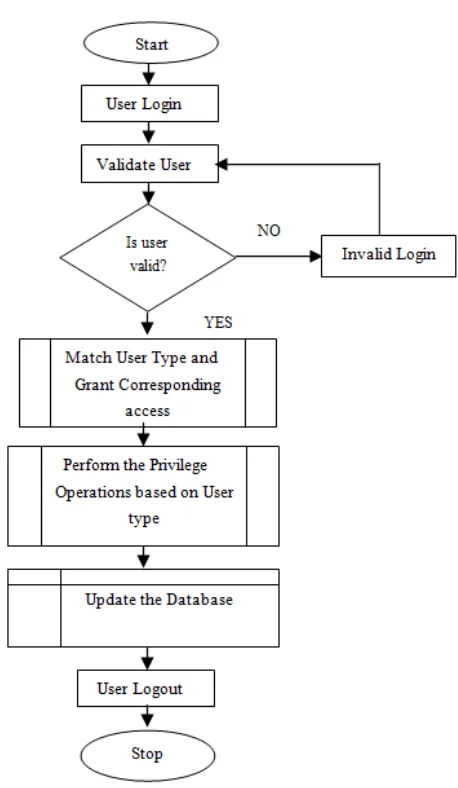
However, in any system design, the output is considered first because it is the desired output that will determine both the input and the procedure. All the components of the program (such as different subprogram/modules designed separately) were integrated together to become a single program and then test run. Figure 1 below gives the overall flowchart of the system.
Figure 1. The program’s flow chart.
4.1. Implementation
The developed software application was run on the system and found to operate as expected. The developed software application was run on two systems networked together with the specifications below:
(a)Microsoft Windows 7, 8, 8.1 and 10 Operating System.
(b)Intel Processor Core i3 with CPU speed of 2.50 GHz.
(c)RAM of 6.00 GB.
(d)Hard Disk of 750 GB.
4.2. System Testing
5. Discussion of Results
The developed software application was run on the system and found to operate as expected. The computer software application is required to be independent of any platform. Figure 1 show the home page when the program is started.
Figure 2. Screenshot showing Home Page.
User needs to login before user can have access to the package. There are different categories of user and the user type determines the operations they can perform. Different privileges are given to different types of users.
Figure 3. Screenshot showing Login Page.
The login window requests a valid username and password from User to be able to gain access into the software.
a. The Directors can create user account for Head of Department in his/her institute and assign role for them. b. The Heads of Departments must have a valid user name
and password and can perform the following functions: 1. Create users account for Examination Officer, Part time
Coordinator and Data Entry Operator in his/her department as well as assigning roles for them.
2. Manage courses offered in the Department, manage students' data in the Department, view results and manage staff data in his/her department.
c. The Departmental Examinations Officer should have the authentication of the HOD. He/she can perform the following functions for Full Time:
1. Enter student’s scores (or bulk upload) and view
students’ grades as it is in the raw score sheet.
2. Process student's results in the department, which includes calculating the GPA and CGPA.
3. View all the students’ results in management approved
format (Agreed marked sheet).
d. The Part Time Coordinator should have the authentication of the HOD. He/she can perform the same functions as Department Examination Officer but only for Part time. e. The Data Entry Operator can only enter student's scores
with the supervision of HOD or Examination Officer. f. The Exams and Record unit can only view available
result and generate transcript when required.
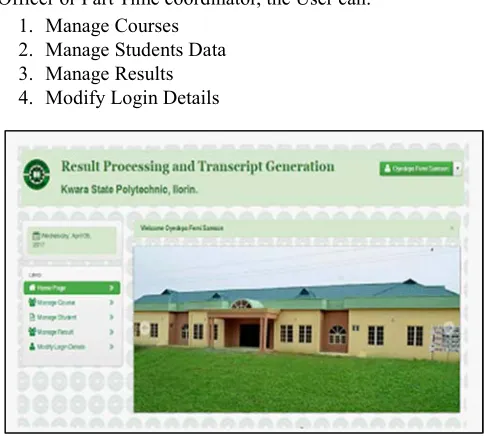
After successful log-in as Departmental Examinations Officer or Part Time coordinator, the User can:
1. Manage Courses
2. Manage Students Data
3. Manage Results
4. Modify Login Details
Figure 4. Screenshot after Successful Login Page.
A. Manage Courses
(a)User can add new course(s) and, (b)View Available courses.
Figure 5. Manage Courses Option.
B. Manage Students Data
(a)User can add new Student Record(s) and,
Figure 6. View Student Record Option.
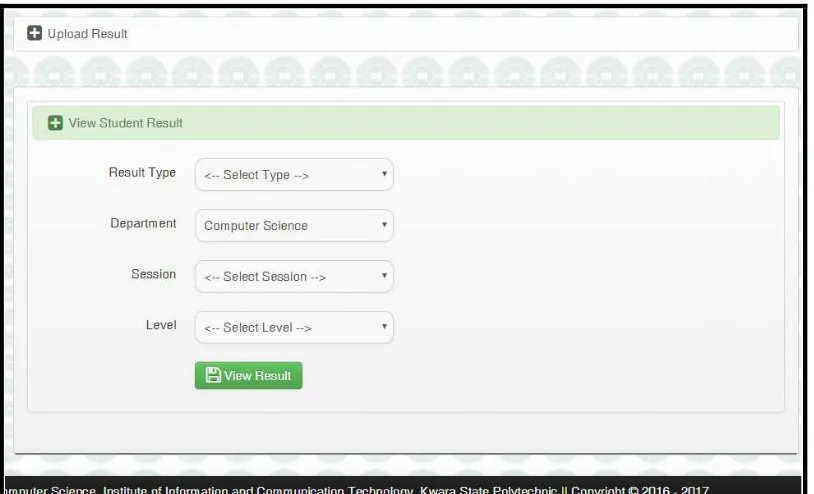
A. Manage Results
(a)User can add new Result(s).
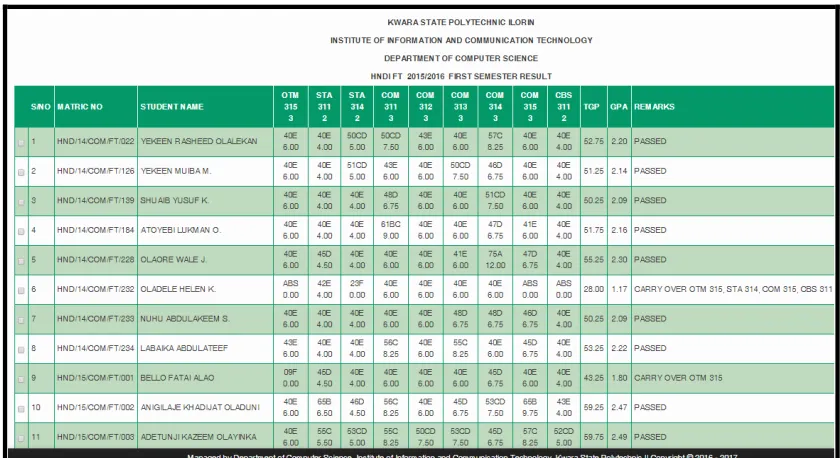
(b)View and Process Available Results in different types for example Semester, Sessional, Diploma, Graduand List, Carry
Over, or Repeaters.
Figure 8. Sample Semester Result.
Figure 9. Sample Sessional Result.
6. Conclusions
An automated information management system makes information management much more convenient and efficient. This application is meant to ease the processing of students’ results in tertiary institutions with similar grading system. The application will be capable of storing and retrieving academic records with high speed and accuracy,
and presenting useful information to its users. Its qualities are the reduction in the cost of processing students results (an example would be the cost of purchase of papers) reduction in the time spent in the computation of student’s grades and the elimination of duplication of resources in terms of manpower and infrastructure.
and other relevant notices to students. As part of its benefits, it is stress-free and speed-up the processing of students’ examination results. Finally, the system is flexible and runs on a web browser. It is reasonably secure, enforces data integrity from the use of a relational database management system, it also minimizes data redundancy and it is user-friendly. With this application, the processing of students’ results is automated, thereby reducing processing time and increasing accuracy.
Acknowledgements
Special gratitude to Tertiary Education Trust Fund (TetFund-Nigeria) for sponsored this research. Thanks also to the Management of Kwara State Polytechnic, Ilorin, Director IICT (Alh. L. Akewusola) and all members of staff of the Department of Computer Science, Kwara State Polytechnic, Ilorin. Finally, we appreciate the effort and understanding of our family members.
References
[1] A. A. Ezenma, B. Emmanuel, and Choji D. N,. “Design and Implementation of result processing system for public secondary schools in Nigeria,” International Journal of Computer and Information Technology, Vol. 3, Issue 1, January 2014.
[2] A. P. Beka & F. T. Beka, "Automated result processing system: A Case study of Nigerian University," International Journal for Research in Emerging Science and Technology, Vol. 2, Issue-9, Sep, 2015.
[3] S. Grey, "Mode of processing result System," Himachal Pradesh University Journal. Pp 127-134, 2010.
[4] B. Emmanuel and D. N. Choji, "A Software application for colleges of education students results processing," Journal of Information Engineering and Applications, Vol. 2, No.11, 2012.
[5] R. E. Okonigene, G. I. Ighalo and E. Ogbeifun, "Developed personal record software," The Pacific Journal of Science and Technology.9(2):407-412, 2008. Available online: http://www.akamaiuniversity.us/PJST.htm.
[6] M. E. Ekpenyong, “A Real-Time IKBS for students' results computation,” International Journal of Physical Sciences (Ultra Scientist of Physical Sciences) Vol. 20, No. 3, September – December, 2008. Available: http://www.mySQL.com.
[7] E. O. Ukem and E. O. Onoyom-Ita, "A Software application for the processing of students results," Global Journal of Pure and Applied Sciences. Vol. 17 No. 4, 2011.
[8] B. O. Ukem. And F. A Ofoegbu, "A Software application for University students results processing," Journal of Theoretical and applied information technology, July, 20 12.
[9] Amar, J. S. and Mohini, B. "Single portal for integrated examination system," Journal of Emerging technologies in e-Governance, pp. 287-293, 2009.
[10] S. O. Anigbogu, "Computer Application and Operation", 1st ed., Vol. 1, No.2, pp. 30-39. Awka: Optimum Press, 2000.
[11] P. Brian, "Oracle Database 11g: PL/SQL Fundamentals", Vol. 10. Redwood City, California: Oracle University Press, 2009.
[12] A. Issah, "Electronic Library Use by Academic Staff at the University of Ilorin, Nigeria," A journal of Library and Information Sciences, A publication of the University Library O. O. U, Ago-Iwoye, Nigeria. Vol. 7 No 1 & 2, pp 138-149, 2010.
[13] B. Mohini and J. S. Amar, "Mode of processing result System," Himachal Pradesh University Journal, Pp 123, 2011.
[14] S. Ngoma, "An Exploration of the Effectiveness of SIS in Managing Student Performance," A final yearDissertation in the School of Post Graduate Studies, Marlboro College, Vermont, USA, 2009. Retrieved from: http://www.marlboro.edu/
[15] E. Ogbeifun and M. E. Ekpeyong, “Packages used in designing result processing,” Volume 9, issue 2:407-412, 2008.