THE PROVIDING OF THE POWER SAVING CONTROL OF ONE OUTPUT
VALUE WITH TWO CONTROLLING CHANNELS HAVING DIFFERENT
EFFECTIVENESS AND COST OF THE CONTROLLING RESOURCE
Prof. Zhmud V., PhD.1, Prof. Dimitrov L., PhD.2
Faculty of Automation and Computers – Novosibirsk State Technical University, Russia 1 Faculty of Mechanical Engineering – Technical University of Sofia, Bulgaria 2
[email protected], [email protected]
Abstract: Controlling of objects with the feedback negative loop is widely used in industry, intelligent technologies, robotics and transport systems. A negative feedback loop by comparing of the prescribed value of the output value with measured value of it generates a control signal, which adjusts the output value of the object. Typically, the number of controlled output values is equal to the number of feedback channels acting on the object, but in some cases, the number of the channel can be more. This situation is especially frequent in transportation systems. In the problem of the design of regulators, they pay the most attention to ensuring the required static and dynamic control accuracy, but recently the attention to the conservation of the resource manager increased. This saves fuel or energy costs, which is especially important, for example, in space technology. The task of saving resources in the control of an object with an excess amount of control channels was not previously considered in the literature. In this paper, the problem is investigated by numerical optimization with simulation. In some cases, the cost of resource of the control by the different channels may vary. At the same time the cheaper resources can have the worst quality of the control, for example, it can has a discrete form or (and) less speed and so on. In this paper, we study such state of the problem and give its solution. It is shown that for a suitable choice of the cost function one can preserve rather high quality of the control, while ensuring saving of the controlling resources. Resource saving can reach in some cases 96%, which is illustrated by an example.
Keywords: CONTROL, ACCURACY, POWER SAVING, REGULATORS, TRANSPORT SYSTEMS, AUTOMATION, ROBOTICS RUCTURE
1. Introduction
In the tasks of transport controlling, as in other tasks of automation, the issues of reaching the required dynamic and static accuracy are most important, especially when external disturbances act. That is why the negative feedback loops are used there.
Among the specific tasks of feedback control is the task of saving the controlling resource (energy, power etc.) [1–4]. Also the important task is to improve the quality of control by use of an excess amount of channels of influence on the object [5–10].
To the best of our knowledge, the joint solution of these problems has not been suggested in literature till now. However, such a situation in which it is necessary to ensure both high precision of the control and to make economy of resources, while the number of the channel of influence on the controlled value increases, often takes place in transport system. An example is the problem of controlling the spacecraft, in which it is equally important both to ensure high precision and to look for fuel economy. A characteristic feature of such a problem can be fundamental difference in the methods of control of various channels, which leads to different costs of different controlling resources with the different efficiency of each of these resources.
Indeed, for example, when moving on water surface one can use various types of thrust: a) an Archimedes screw; b) a reactive method based on the water jet ejection; d) an air propeller, and so on. The strength of each of the impacts will be different, as well as the cost of such impacts. It is obvious that this analogy can be extended to other types of transport systems, including space transportation, in which we know the distribution of impacts at different stages.
In this paper, we investigate the method of modeling and numerical optimization of the possibility of solving the considered problem using simple mathematical models of the impact of the object. In the model elements of various effectiveness are used, which is done by introducing discrete control, using different speed in different channels, as well as by introducing the derivative element at the output of the discrete element, which significantly complicates the management on such a channel.
2. Statement of the problem and solution method
Suppose we have choice between two kinds of impact to the output value of the object y(t). Also suppose that the first channel is faster and has higher cost of the control action, while the second channel, respectively, has lower speed and lower cost of control action to the object. Additionally we can suppose discreteness of action through the second channel. It is required to design the regulator, providing high static accuracy and sufficient dynamic accuracy of the control. In addition it is necessary to look for possible reduction of the cost of controlling resources in accordance with its given specific cost.
To solve this problem we propose to use numerical simulation and optimization program VisSim, for example, VisSim 6.0. In this case, the simulation of the two channel working demands using two different models, the output signals of which are added (common part of the models can be connected at the output of the adder). When simulating the disturbance it can be set equal to zero, and unit step can be used as the control action applied to the system input. These assumptions are quite acceptable for linear systems with feedback, but in this case there is non-linearity. The influence of this non-linearity will be developed in the fact that with increasing of magnitude of the input action the relative magnitude of the nonlinearity step will decrease, that is, the effect of non-linearity will weaken, and alternatively with a decrease in the magnitude the non-linearity will increase. Therefore, it is necessary to choose a value of the test step signal, which is the smallest one among the possible ones, that is, the effect of non-linearity reaches its maximum.
Let the step of nonlinearity be of 0.2 units, i.e. 20% of the used input unit step jump. This makes this type of nonlinearity quite noticeable when the task is being resolved.
3. The results of the regulator optimization
Let us consider the equation of the object in the following operator form:
)
(
)
(
)
(
)
(
)
(
s
W
1s
U
1s
W
2s
U
2s
Y
=
+
. (1)Here, U1, U2 are input signals, Y is output signal, W1, W2 are
related transfer functions, s is Laplace transform operator.
The equation of the regulator in common form is:
)
(
)
(
)
(
1 11
s
p
sd
E
s
U
=
+
. (2))
(
)
(
)
(
2 22
s
p
sd
E
s
U
=
+
. (3))]
(
)
(
[
)
(
s
V
s
Y
s
E
=
−
. (4)Here E is error of control, V is the prescribed value of the output signal, p1, p2, d1 and d2 are unknown coefficients which must be
found with the help of numerical optimization.
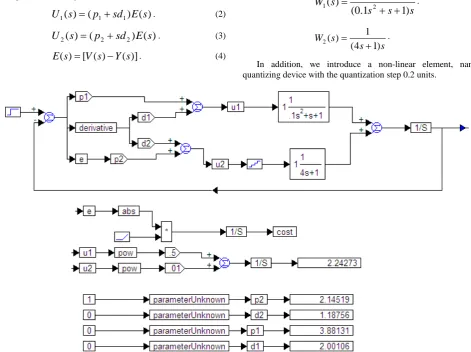
Fig. 1 illustrates a structure for modeling and optimizing a regulator having two control channels.
Example 1. Let the transfer functions in (1) be given by the relations:
s
s
s
s
W
)
1
1
.
0
(
1
)
(
21
=
+
+
. (5)s
s
s
W
)
1
4
(
1
)
(
2
=
+
. (6)In addition, we introduce a non-linear element, namely, quantizing device with the quantization step 0.2 units.
Fig. 1 The structure of the regulator and results of the optimization (coefficients and resource costs) using the objective function, which does not include the
cost of the resource (step of the discrete nonlinear element is 0.2)
We especially recommend using of the energy-efficient control algorithms for objects containing integrator. Therefore, such an object is selected as an example of it. The integrator common for the two channels is described with symbol 1/S. Two different control channels are presented by links between the bus with the marks of the controlling signal, respectively, u1 and u2, and the inputs of the adder marked with the symbol Σ. Two control signals, u1 and u2, are formed by two different regulators having proportional and derivative links. In proportional links coefficients are set by the variables p1 and p2, and in derivative links coefficients are given by the variable d1 and d2. Derivative links are represented by block derivative. The circuit for the cost function calculating contains linearly rising signal generator and rectifier abs, connected to the bus of the error signal e. These two signals are multiplied by the block * and integrated by the block
1/S.
The result of optimizing is shown in the form of values of the found coefficients as well as value of the energy cost. Also as a result of the optimization, transient processes in the system are calculated and plotted, which is shown on Fig. 2 and Fig. 3.
Fig. 3. Controlling signals in the system by Fig. 1
Also in the project there is a unit for calculation of energy consumption. It performs the squaring of each of the controlling signals, calculates the sum of these squares and integrates the result. Wherein different weights are used corresponding to the energy costs, namely 0.5 and 0.01. In addition, there is a block for the optimization containing four elements, denoted by the symbol
parameterUnknown. This block carries out the search procedure for the required controller gains which provide the minimum of the positive value in the input to the unit cost in the end of the transient process.
The resulting transient process of the output value (see. Fig. 2) meets the requirements as it ends with prescribed value, equal to unit value. Overshoot is almost nonexistent. The graphs in the Fig. 3 show the form of control signals that serve to illustrate how the saving energy option operates with these signals. In this example, which is illustrated in Fig. 1–3, an option for power saving was not included because the connection between the output of power costs calculating unit and input of the unit cost was absent.
Example 2. Fig. 4–5 shows similar results when using power saving features. By comparing this result with the result of Example 1, we conclude that the quality of the transient process is almost not affected, only the speed decreased slightly (by 2.5 times), overshoot does not appear, static error does not occur. Energy cost savings amounted to about 96% because of the decreased value of 2.24 to a value of 0.0822. By comparing Fig. 5 and Fig. 3 it can be seen that by introduction of value of the relative contribution of the energy costs of the control signal into the cost function, the relative value of the second channel increased in comparison with the previous result. If earlier this signal was almost half of this of the first channel, then now it has become almost twice as much as the signal in the first channel, which is the channel with greater cost of the control resource.
Fig. 4. Transient process in the system by Example 2
Fig. 5. Controlling signals in the system by Example 2
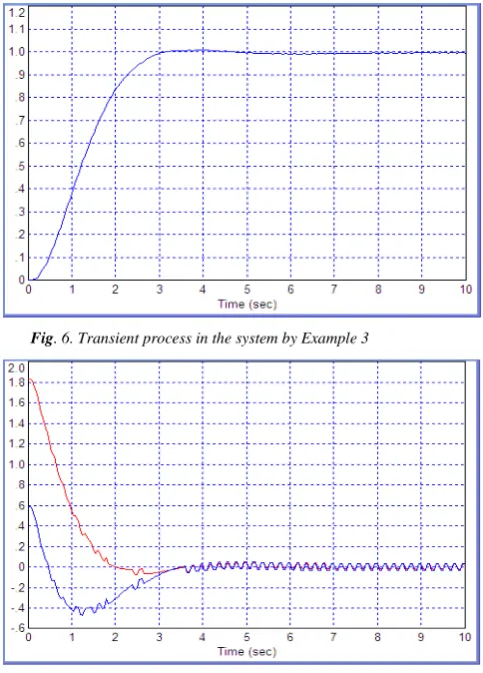
Example 3. Let introduce into the object model derivative link between the output of the nonlinear element and the input of the transfer function. In this case, the second channel can carry out only pulse control, because if the signal at input of the nonlinear device is changed within the same quantization step, the output signal of the nonlinear element is not changed, and the output signal of the derivative link which is connected to this non-linear element, will be zero. Such a channel is not very suitable for the control, but it can also work as an object contained in the integrator. Derivative and integrating link of partially mutually compensate their action, but it weakens the desired effect of integration, which is important for energy savings in the controlling process. We solve the problem in these changed conditions by using a modified structure. Numerical optimization results are shown in Fig. 6 and 7.
Fig. 6. Transient process in the system by Example 3
Fig. 7. Controlling signals in the system by Example 3
Thus the cost of controlling resources flow turns to be about 0.92 units.
Example 4. To compare these results, let us exclude terms equal to energy consumption from the cost function. The cost of energy consumption in this case is 2.53 units. It is more than 2.5 times greater. But the quality control markedly increases, as is shown in the graphs transient processes in Fig. 8 and 9.
Thus in this example, in the considered structure of the object model with the selected regulator structure, the reduction of the cost of controlling resource can be achieved only with the significant deterioration in the quality of controlling, and vice versa, improving the quality of transient processes can be achieved by increasing the cost of the controlling resource.
Fig. 8. Transient process in the system by Example 4
Fig. 9. Controlling signals in the system by Example 4
Example 5. Let us introduce the nonlinear element “dead zone” with the width of the dead zone of 0.2 units into the regulator of the second channel, as shown in Fig. 10. The resulting transient processes are shown in Fig. 11 and 12.
It is evident that although the duration of the transient processes increased slightly (in 1.5 times) compared to the previous result shown in Fig. 10, yet there are no oscillations, steady-state error is decreasing to zero, and thus the cost of the controlling resource is only slightly different from the result obtained with the structure shown in Fig. 7, namely 1.029 comparatively 0.92 units. Therefore, the introduction of an element with dead zone allows us to combine the requirement of cost savings of controlling resource with removal of self-oscillation.
Fig. 10. The structure of the regulator with the use of the element “dead zone” and results of the optimization (coefficients and resource costs) using the objective function, which does not include the cost of the resource
Fig. 11. Transient process in the system by by Example 4
Fig. 12. Controlling signals in the system by Example 4
Conclusion
This paper has confirmed the possibility of dual channel control of single output value of the object while ensuring cost-saving of the controlling resource. Also the paper has proposed the method recommendations for the solving of this task. It has been shown that even with very limited possibilities of alternative control channel with lower cost of the controlling resource in this channel one can provide an effective combination of two types of impact with high-quality astatic control without overshoot and inexpensively control resources.
This work was done in the framework of the project “New structures, models and algorithms for the management of breakthrough technology systems based on high-tech results of intellectual activity”, financially supported by the Russian Ministry of Education and Science, project number 2014/138.
References
[1] V.A. Zhmud, A.V. Kastorny. Concept of Power Sawing Regulators. Automatics & Software Enginery. 2013. N 4 (6). P. 14–21. URL: http://www.nips.ru/images/stories/zhournal-AIPI/7/aipi-4-2013-02.pdf (In Russian)
[2] V.A. Zhmud, A.N. Zavorin. Method of the design of Power Sawing Regulators for the Complex Objects with Partly Unknown Model. In book: Problems of control and modeling in the complex systems. Proc. of XVI International Conference, 30 June – 03 July 2014 г., Samara. Russia. P. 557–567.
[3] V. Zhmud. Design of Robust Energy-Saving Regulators. Automatics & Software Enginery. 2014. N2(8). P. 58 – 65. URL: http://jurnal.nips.ru/en/node/68 .
[4] Modern key technologies in automatics: Structures and numerical optimization of regulators. Zhmud, V., Yadrishnikov, O., Poloshchuk, A., Zavorin, A. 2012. Proceedings - 2012 7th International Forum on Strategic Technology, IFOST 2012.
[5] The design of the feedback systems by means of the modeling and optimization in the program vissim 5.0/6. Zhmud, V., Liapidevskiy, A., Prokhorenko, E. 2010. Proceedings of the IASTED International Conference on Modelling, Identification and Control. PP. 27–32.
[6] V. Zhmud, O. Yadrishnikov. Numerical optimization of PID-regulators using the improper moving detector in cost function. Proceedings of the 8-th International Forum on Strategic Technology 2013 (IFOST-2013), vol. II, 28 June – 1 July. Mongolian University of Science and Technology, Ulaanbaator, Mongolia. IEEE organized. 2013. P. 265 – 270. http://www.must.edu.mn/IFOST2013/
[7] Vadim A. Zhmud, Dashi B. Imekov, Kirill Yu. Lastochkin and Anna V. Lukicheva. New Structure of Regulator for Controlling of Object with Oscillation Features and its Modelling Testing. Proceedings of International Conference on Engineering and Applied Sciences Optimization (OPT-i-2014). Kos Island, Greece, 4-6 June 2014.
[8] Vadim ZHMUD. New Modeling Tested Method for Controlling of Object with Oscillation Features. Proceeding of 2014 International Conference on Mechanical Design, Manufacture and Automation Engineering (MDMAE 2014). ISBN: 978-1-60595-156-0. Thailand, Phuket. Part II. Author statement: Novosibirsk State Technical University, Novosibirsk, Russia. Keywords: Numerical optimization, Regulators, Automation, Modeling, Dynamic systems, Accuracy of control.P.289 – 296.