Open Access
Research
Parameter estimation in biochemical systems models with
alternating regression
I-Chun Chou
1, Harald Martens
2and Eberhard O Voit*
1Address: 1The Wallace H. Coulter Department of Biomedical Engineering at Georgia Institute of Technology and Emory University, 313 Ferst Drive, Atlanta, GA, 30332, USA and 2CIGENE/Norwegian U. of Life Sciences, P.O.Box 5003, N – 1432 Ås, Norway
Email: I-Chun Chou - [email protected]; Harald Martens - [email protected]; Eberhard O Voit* - [email protected]
* Corresponding author
Abstract
Background: The estimation of parameter values continues to be the bottleneck of the computational analysis of biological systems. It is therefore necessary to develop improved methods that are effective, fast, and scalable.
Results: We show here that alternating regression (AR), applied to S-system models and combined with methods for decoupling systems of differential equations, provides a fast new tool for identifying parameter values from time series data. The key feature of AR is that it dissects the nonlinear inverse problem of estimating parameter values into iterative steps of linear regression. We show with several artificial examples that the method works well in many cases. In cases of no convergence, it is feasible to dedicate some computational effort to identifying suitable start values and search settings, because the method is fast in comparison to conventional methods that the search for suitable initial values is easily recouped. Because parameter estimation and the identification of system structure are closely related in S-system modeling, the AR method is beneficial for the latter as well. Specifically, we show with an example from the literature that AR is three to five orders of magnitudes faster than direct structure identifications in systems of nonlinear differential equations.
Conclusion: Alternating regression provides a strategy for the estimation of parameter values and the identification of structure and regulation in S-systems that is genuinely different from all existing methods. Alternating regression is usually very fast, but its convergence patterns are complex and will require further investigation. In cases where convergence is an issue, the enormous speed of the method renders it feasible to select several initial guesses and search settings as an effective countermeasure.
Background
Novel high-throughput techniques of molecular biology are capable of producing in vivo time series data that are relatively high in quantity and quality. These data implic-itly contain enormous information about the biological
system they describe, such as their functional connectivity and regulation. The hidden information is to be extracted with methods of parameter estimation, if the structure of the system is known, or with methods of structure identi-fication, if the topology and regulation of the system are Published: 19 July 2006
Theoretical Biology and Medical Modelling 2006, 3:25 doi:10.1186/1742-4682-3-25
Received: 27 April 2006 Accepted: 19 July 2006 This article is available from: http://www.tbiomed.com/content/3/1/25
© 2006 Chou et al; licensee BioMed Central Ltd.
not known. The S-system format within Biochemical Sys-tems Theory (BST; [1-4]) is recognized as a particularly effective modeling framework for both tasks, since it has a mathematically convenient structure and because every parameter has a uniquely defined meaning and role in the biological system. Due to the latter feature, the typically complex identification of the pathway structure reduces to a parameter estimation task, though in a much higher-dimensional space. Still, like most other biological mod-els, S-system models are nonlinear, so that parameter esti-mation is a significant challenge. Here, we propose a method called alternating regression (AR), which we com-bine with a previously described decoupling technique [5]. AR is fast and rather stable, and performs structure identification tasks between 1,000 and 50,000 times faster than methods that directly estimate systems of nonlinear differential equations (cf. [6]).
Methods
Modeling framework
In the S-system formulation within BST, Xi denotes the concentration of metabolite i, and its change over time, , is represented as the difference between one produc-tion and one degradaproduc-tion term, both of which are formu-lated as products of power-law functions.*
(* Footnote: Throughout the paper, metabolite concentra-tions are represented as upper-case italics (X). An upper-case boldface variable (L) represents a matrix of regressor columns and a lower-case boldface variable (y) represents a regressand column in a linear multivariate statistical regression model.)
The generic form of an S-system is thus
The rate constants αi and βi are non-negative and the kinetic orders gij and hij are real numbers with typical
val-ues between -1 and +2. The S-system format allows the inclusion of independent variables, but because these are typically known in estimation tasks and constant, they can be merged with the rate constants [4]. S-systems have been discussed many times [3,4,7,8] and need no further explanations here.
Decoupling of differential equations
Suppose the S-system consists of n metabolites X1, X2, ..., Xi, ..., Xn, and for each metabolite, a time series consisting of N time points t1, t2, ..., tk, ..., tN has been observed. If we can measure or deduce the slope Si(tk) for each metabolite at each time point, we can reformulate the system as n sets
Thus, for the purpose of parameter estimation, the origi-nal system of n coupled differential equations can be ana-lyzed in the form of n × N uncoupled algebraic equations [4,9].
The uncoupling step renders the estimation of slopes a crucial step. If the data are more or less noise-free, simple linear interpolation, splines [10-12], B-splines [13], or the so-called three-point method [14] are effective. If the data are noisy, it is useful to smooth them, because the noise tends to be magnified in the slopes. Established smooth-ing methods again include splines, as well as different types of filters, such as the Whittaker filter (see [15] for a review), collocation methods [16], and artificial neural networks [17,18]. In order to keep our illustration of the AR method as clean as possible, we assume that true slopes are available and elaborate on issues of experimen-tal noise in the Discussion.
Alternating regression
The decoupling of the system of differential equations allows us to estimate the S-system parameters αi, gij, βi, and hij (i, j = 1,2,...,n) one equation at a time, using slopes and concentration values of each metabolite at time points tk. The proposed method called alternating regres-sion (AR) has been used in other contexts such as spectrum reconstruction and robust redundancy analysis [19,20], but, to the best of our knowledge, not for the purpose of parameter estimation from time series. The overall flow of the method is shown in Figure 1. Adapted to our task of S-system estimation, AR works by cycling between two phases of multiple linear regression. The first phase begins with guesses of all parameter values of the degradation term in a given equation and uses these to solve for the
Xi
Xi i Xj X i n
g j n i j h j n ij ij = − = ( ) = =
∏
∏
α β 1 1 1 , 1 2, ,..., .S t X t X t
S t X
i i j
g j n i j h j n
i i j
g j ij ij ij 1
( )
≈( )
−( )
( )
≈ = = =∏
∏
α β α 1 1 1 1 1 2 , n n i j h j ni k i j
g
j n
k i j
h
t X t
S t X t X
ij ij i
∏
∏
∏
( )
−( )
( )
≈( )
− = =2 β 2
α β 1 1 , i i i jj ij ij j n k
i N i j
g
j n
N i j
h
j n
N
t
S t X t X t
Logistic flow of parameter estimation by alternating regression Figure 1
parameters of the corresponding production term. The second phase takes these estimates to improve the prior parameter guesses or estimates in the degradation term. The phases are iterated until a solution is found or AR is terminated for other reasons.
In pure parameter estimation tasks, the structure of the underlying network is known, so that it is also known which of the S-system parameters are zero and which of the kinetic orders are positive or negative. Thus, the search space is minimal for the problem. Nonetheless, the same method of parameter estimation can in principle also be used for structure identification. In this case, the estima-tion is executed with an S-system where no parameter is a priori set to zero and all parameters have to be estimated. As an intermediate task, it is possible that only some of the structure is known. This information can again be used to reduce the search space. If it is known, for instance, that variable Xj does not affect the production or degradation of Xi, the corresponding parameter value gij or
hij is set equal to zero, or Xj is taken out of the regression. One can thus reduce the regression task either by con-straining the values of some g's or h's throughout the AR or by selecting a subset of regressors at the beginning, i.e., by taking some variables out of the regression. Similarly, if a kinetic order is known to represent an inhibiting (acti-vating) effect, its range of possible values can be restricted to negative (positive) numbers. This constraining of kinetic orders, while not essential, typically improves the speed of the search. It is imaginable that a kinetic order is constrained too tightly. In this case, the solution is likely to show the kinetic order at the boundary, which is subse-quently relaxed.
To estimate the parameters of the ith differential equation,
the steps of the AR algorithm are as follows:
{1} Let Lp denote an (n+1) × N matrix of logarithms of regressors Xi, defined as
Lp is used in the first phase of AR to determine the param-eter values of the production term. Additional informa-tion on the system, if it is available, reduces the width of
Lp. For instance, if X2and X4do not affect the production of X1in a four variable system, Eq. (3) reduces to
Analogous to Lp, let Ld denote the (n+1) × N matrix of regressors used in the second phase of AR to determine the parameter values of the degradation term. Lp and Ld are the same when the variables used in two phases of AR are identical.
{2} Compute the matrices
Cp = (LpTL
p)-1LpT (5)
Cd = (LdTL
d)-1LdT (6)
which are invariant throughout the iterative process. {3} Select values for βi and hij in accordance with
experi-ence about S-system parameters (cf. [4]: Ch. 5) and make use of any available information constraining some or all hij.
{4} For all tk, k = 1, 2, ..., N, compute , using val-ues Xj(tk) from the observed or smoothed time series measurements.
{5} Compute the N-dimensional vector (k = 1, 2, ..., N) con-taining transformed "observations" on the degradation term. Note: It is possible to compute yd for all n traces simultaneously so that Yd becomes an n × N matrix with columns yd.
{6} Based on the multiple linear regression model
yd = Lpbp + εp (7)
estimate the regression coefficient vector bp= [ , , j = 1, 2,..., n]' by regression over the N time points. In other Lp=
( )
(
)
(
( ))
(
( ))
( )(
)
1 1 1log log log log log
X t X t X t
X t X t
i n
i
1 1 1 1
2 22 2
1 ( )
(
)
(
( ))
( )(
)
(
( ))
( ) loglog log log X t
X t X t X t
n
k i k n k
1
((
)
( )
(
)
(
( ))
(
( ))
⎡ ⎣ ⎢ ⎢ ⎢ ⎢ ⎢ ⎢ ⎢ ⎢ ⎢ ⎤ ⎦1 log X1 tN log Xi tN log Xn tN ⎥⎥ ⎥ ⎥ ⎥ ⎥ ⎥ ⎥ ⎥ ⎥
( )3
Lp =
( )
(
)
(
( )
)
( )
(
)
(
( )
)
1 1 11 1 3 1
1 2 3 2
1
log log
log log
log
X t X t X t X t
X tt X t
X t X t
k k N N
( )
(
)
(
( )
)
( )
(
)
(
( )
)
⎡ ⎣ ⎢ ⎢ ⎢ ⎢ ⎢ ⎢ ⎢ ⎢ ⎢⎢ ⎤ ⎦ log log log 3 1 3 1 ⎥⎥ ⎥ ⎥ ⎥ ⎥ ⎥ ⎥ ⎥ ⎥⎥( )4
βi hj j n X ij =
∏
1yd = ⎛
( )
+( )
⎝ ⎜ ⎜ ⎞ ⎠ =
∏
log S ti k i Xhj t
words, this step leads to an estimation of parameters in sets of equations of the type
. Specifically, com-pute bp as
bp = (LpTLp)-1LpTyd = Cpyd (8) according to Eqs. (3–5).
{7} Constrain some or all , if outside information on the model suggests it.
{8} Using the observed values of Xj(tk), compute for all tk, k = 1, 2, ..., N.
{9} Compute the N-dimensional vector containing the trans-formed "observations" associated with the production term.
{10} Based on the multiple linear regression model
yp = Ldbd + εd (9)
and in analogy to step {6}, estimate the regression coeffi-cient vector bd = [ , , j = 1, 2,..., n]' by regression over the N time points as
bd = Cdyp (10)
{11} Constrain some or all , if outside information on the model suggests it.
{12} Iterate Steps {4} - {11} until a solution is found or some termination criterion is satisfied.
At each phase of AR, lack-of-fit criteria are estimated and used for monitoring the iterative process and to define ter-mination conditions. In this paper we use the sum of squared y-errors (SSEd and SSEp) as optimization criteria
for the two regression phases, i.e. we compute
where = L × b, L equals Lp or Ld, and b is the solution vector bp or bd, estimated through regression and modi-fied by constraints reflecting structural information. We use the logarithm of SSE because it is superior in illustrat-ing small changes in the residual error.
It is known that collinearity may affect the efficiency of multivariate linear regressions. We therefore also imple-mented methods of principal component regression (PCR), partial least squares regression (PLSR) and ridge regression [21]. For the cases analyzed here, these meth-ods did not provide additional benefit.
Results and discussion
For illustration purposes, we use a didactic system with four variables that is representative of a small biochemical network [5]. A numerical implementation with typical parameters is
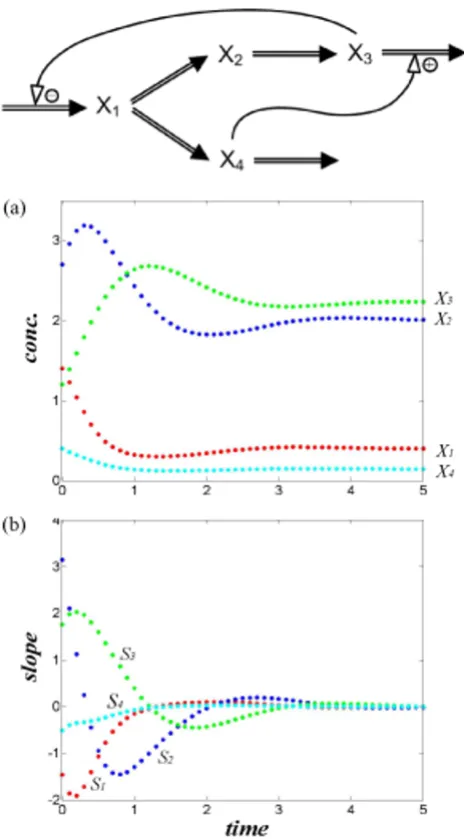
The system is first used to create artificial datasets that dif-fer in their initial conditions (Table S1 of Additional file1). In a biological setting, these may mimic different stimu-lus-response experiments on the same system. For exam-ple, they could represent different nutrient conditions in a growth experiment. Figure 2 shows the branched path-way, along with a selection of time course data (dataset 1) and slopes.
In order not to confuse the features of AR with possible effects of experimental noise, we use true metabolite con-centrations and slopes; we compute the latter directly from Eq. (12) at each time point. We initially assume that we have observations at 50 time points, but discuss cases with fewer points and with noise later.
Performance of AR
Given the time series data of Xi and Si at every time point tk, the AR algorithm is performed for each metabolite, one at a time. Figure S1 summarizes various patterns of con-vergence observed. Generally we can classify the conver-gence patterns into four types: 1) converconver-gence to the true value; 2) convergence to an incorrect value; 3) no conver-gence; typically the value of αi (or βi) continuously
yd k i gij X t
j n
j k i k
, = + log
(
( )
)
+ ,=
∑
α ε 1 ˆ gij ˆ ˆαi jg
j n X ij =
∏
1yp = ⎛
( )
−( )
⎝ ⎜ ⎜ ⎞ ⎠ =
∏
log αi j
g
j n
k i k
X ij t S t
1
ˆ βi hˆij
ˆ
hij
log SSE log
k N ( ) = ⎛
(
−)
⎝ ⎜⎜ ⎞⎠⎟⎟ ( ) =∑
yk yˆk 2 ,1
11
ˆ y
X X X X t X X X X t
1 3 1 1 0
2 1 2 2 0
= −
( )
== −
( )
=−
12 10 1 4
8 3 2 7
0 8 0 5
0 5 0 75
. .
. .
.
.
X X X X X t X X X X t
3 2 3 4 3 0
4 1 4 4 0
= −
( )
== −
( )
=3 5 1 2
2 6
0 75 0 5 0 2
0 5 0 8
increases while all gij (or hij) gradually approach zero,
while in some other cases gij and the corresponding hij increase (or decrease) in a parallel manner; 4) termination during AR, due to some of the observations yd (or yp) tak-ing on complex values.
As is to be expected, the speed of convergence depends on the initial guesses, the variables used as regressors, the constraints, and the data set. After a few initial iterations,
the approach of the true value is usually, though not always, strictly monotonic. In some cases, the error ini-tially decreases rapidly and subsequently enters a phase of slower decrease. It is also possible that convergence is non-monotonic, that the algorithm converges to a differ-ent point in the search space, or that it does not converge at all. Convergence to the wrong solution and situations of no convergence are particularly interesting. In the case of no convergence, the solution arrives at unreasonable parameter values that grow without bound; this case is very easy to detect and discard. By contrast, the search may lead to a solution with wrong parameter values, but a sat-isfactory residual error. Thus, the algorithm produces a wrong, but objectively good solution. It is close to impos-sible with any algorithm to guard against this problem, unless one can exclude wrong solutions based on the resulting parameter values themselves. This is actually greatly facilitated with S-systems because all parameters have a clearly defined meaning in terms of both their sign and magnitude, which may help spot unrealistic solutions with small residual error.
Reasons for AR not to converge are sometimes easily explained, but sometimes obscure. For instance, the slope-minus-degradation or -production expressions in steps {5} and {9} of the algorithm may become negative, thereby disallowing the necessary logarithmic transforma-tion. As a consequence, the regression terminates. If this happens, it usually happens during the first or the second iteration, and the problem is easily solved when the initial β or α is increased. In other cases, AR converges for one dataset, but not for another, even for the same model. This sometimes happens if datasets have low information con-tent, for instance, if the dynamics of a variable is affected by a relatively large number of variables, but the observed time course is essentially flat or simple monotonic. In this case, convergence is obtained if one adjusts the con-straints on some of the parameter values or selects a differ-ent set of regressors (see below). Of importance is that each iteration consists essentially of two linear regressions so that the process is fast. Thus, even the need to explore alternative settings is computationally cheap and provides for an effective solution to the convergence problem. Patterns of convergence
The speed and pattern of convergence depend on a com-bination of several features, including initial guesses for all parameters and the datasets. Overall, these patterns are very complicated and elude crisp analytical evaluations. This is not surprising, because even well-established algo-rithms like the Newton method can have basins of attrac-tion that are fractal in nature (e.g., [22]). A detailed description of some of these issues, along with a number of intriguing color plates describing well over one million ARs, is presented in Additional file 1.
Test system with four dependent variables Figure 2
Effect of initial parameter guesses
Figure 3 combines results from several sets of initial guesses of βi and hij (the results of the second phase of AR are not shown, but are analogous). The data for this illus-tration consist of observations on the first variable of data-sets 4, 5 and 6 (see Table S1 in the Additional file1). These are processed simultaneously as three sets of algebraic equations at 50 time points. Thus, the parameters α1, g13, β1, and h11of the equation
are to be estimated. As a first example, we initiate AR with all variables (X1, ..., X4) as regressors, but constrain the kinetic orders g11, g12, and g14to be zero after the first phase of the regression, and the kinetic orders h12, h13, and
h14after the second phase, in accordance with the known network structure.
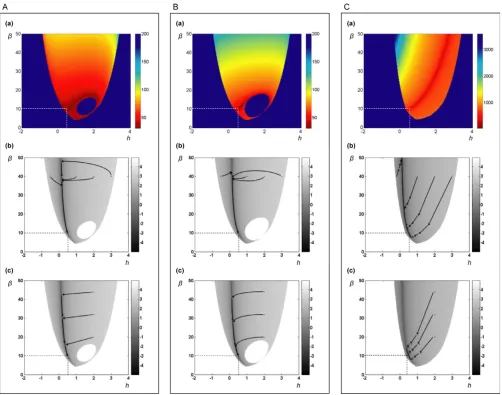
Figure 3A(a) shows the "heat map" of the convergence, where the x- and y-axes represent the initial guesses of h11and β1, respectively, and the color bar represents the number of iterations needed for convergence. Since we
X1 =α1 3Xg13 −β1 1Xh11 ( )13
Summary of convergence patterns of AR Figure 3
use noise-free data, the residual error should approaches 0, which corresponds to -∞ in logarithmic coordinates. We use -7 instead as one of the termination criteria, which corresponds to a result very close to the true value, but allows for issues of machine precision and numerical inaccuracies. Once this error level is reached, AR stops and the number of iterations is recorded as a measure for the speed of convergence. The unusual shape of a "martini with olive" is due to the following. The deep blue outside area indicates an inadmissible domain, where the initial parameter guess causes one or more of the terms in step {5} to become negative, so that the logarithm, yd, becomes a complex number and the regression cannot continue. The line separating admissible and inadmissible domains is thus not smooth but shows the envelope of several pieces of power-law functions where the β-term is smaller than the (negative) slope at some time point. The "olive" inside the glass is also inadmissible. In this case, the chosen ini-tial value causes the term in step {9} to become negative, so that yp becomes complex and AR ter-minates during the second phase. This type of termination usually, though not always, happens during the first itera-tion. In order to prevent it, one may a priori require that
for every tk, such that the logarithm is always defined. This is possible through the choice of a sufficiently large value for the initial guess of β. The magnitude of β should be reasonable, however, because excessive values tend to slow down convergence. As a matter of practically, one may start with a value of 5 or 10 and double it if condition (14) is violated.
Use of different variables as regressors
Panel A in Figure 3 shows results where we initially use all variables as regressors, but constrain their kinetic orders to zero after each iteration, if they are known to be zero. As alternatives, Panels B and C show results of using different variable combinations as regressors under otherwise iden-tical conditions. In Panel B, both phases of AR use all var-iables as regressors that appear in either the production or the degradation term of the equation. In Panel C we make full use of our knowledge of the pathway structure and include in each term only the truly involved variables.
Interestingly, this choice of regressors has a significant effect on convergence.
Compared with the case in of Figure 3A(a), the speed of convergence is slower in Figure 3B(a) and much slower in Figure 3C(a), even though this represents the "best-informed" scenario. The time needed to generate the graphs in Figures 3A(a), 3B(a), and 3C(a) for all shown 60,000 initial values is 72, 106, and 1,212 minutes, respectively. Thus, if we suppose that roughly half of the start points are inadmissible and require no iteration time, the average convergence time in Figure 3A(a) is 0.144 seconds, whereas it is 0.212 seconds in Figure 3B(a) and 2.424 seconds in Figure 3C(a). The pattern of conver-gence is affected by the datasets used. As another example, Figure S2 shows results of regressions with dataset 5. Error surface
Rows (b) and (c) in Figure 3 Panels A, B, and C show heat maps of log(SSE), where darker dots indicate smaller errors. The true minimal value of log(SSE) for our noise-free data is -∞, but for illustration propose, we plot it only to -5. Pseudo-3-D graphs of the error surface are shown in Figure S3 with views from two angles.
Convergence trajectories
Paths toward the correct solution may be visualized by plotting and superimposing the solution at every regres-sion step onto the corresponding heat maps, with arrow-heads indicating the direction of each trajectory (Figures 3A(b,c), 3B(b,c), and 3C(b,c)). For the first set of illustra-tions, four different initial values of h11are chosen, while the value of β1is always 40. For the second set of illustra-tions, four different initial values of β1are chosen, while the value of h11is always 2. Interestingly, independent of the start values, only two iterations are needed to reach a point very close to the valley of the error surface where the true solution is located. After the dramatic initial jump, all solutions follow essentially the same trajectory with small steps toward the true solution. We can also link the obser-vations of Figure 3A(b) and 3A(c) to the result in 3A(a). For the same β1, a start point in the right part the graph causes AR to jump to a more distant location on the tra-jectory, thus requiring more iterations to converge to the true solution.
It might be possible to speed up convergence in the flat part of the error surface, for instance by using history-based modeling history-based on conjugated gradients or partial least squares regression [21]. These options have not been analyzed.
Accuracy and speed of solution
The previous sections focused on the first equation of the S-system model in Eq. (12) and Figure 2. We used the AR
S ti k i Xhj tk k N
j n
ij
( )
+( )
==
∏
β , 1 2, ,...,
1
ˆ ˆ , , ,...,
αi jg
j n
k i k
X ij t S t k N
=
∏
( )
−( )
=1
1 2
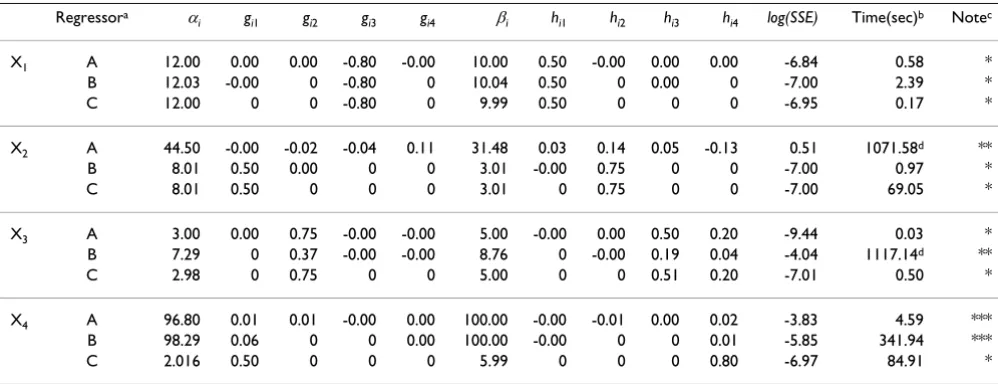
algorithm in the same manner to estimate all other parameters. Again, three sets of regressors were used for every variable. For simplicity of discussion, we describe the results from using dataset 1 of Table S1, always using as initial guesses βi = 15 and hij = 1. The results are listed in Tables 1, S2 and S3.
For every variable, at least one of the three choices of regressors leads to convergence to the correct solution. Convergence is comparably fast, even if we require a very high accuracy for termination (log(SSE) < -20) (see Table S2). If we relax the accuracy to log(SSE) < -7 or log(SSE) < -4, the solution is still very good, but the solution time is noticeably decreased (Tables 1 and S3). However, the false-positive rate increases slightly for log(SSE) < -4. As a compromise, we use log(SSE) < -7 as termination criterion for the remainder of this paper.
Interestingly, the speed of convergence is fastest for the strategy "A" of using all variables as regressors; however, the failure rate in this case is also the highest. In contrast, the slowest speed of convergence is obtained for the cor-rect regressors ("C"), where AR always converges to the right solution. The regressor set "B" is between "A" and "C" in terms of speed and ability to yield the correct opti-mum. For cases that don't converge to the right solution one easily adapts the AR algorithm by choosing different start values, slightly modifying constraints, or choosing different regressors in addition to the three types used above. The probability of finding the correct solution is increased if different datasets are available for sequential
or simultaneous estimation. The same was observed for other estimation methods (e.g., [5]).
Structure identification
The previous sections demonstrated parameter estimation for a system with known structure. Similar to this task is the identification of the unknown structure of a pathway from time series data, if one uses S-systems as the mode-ling framework [5]. The only difference is that very few or no parameters at all can a priori be set to zero or con-strained to the positive or negative half of the search space. A totally uninformed AR search of this type often leads to no convergence. However, since each AR is fast, it is feasible to execute many different searches, in which some of the parameters are allowed to float, while others are set equal to zero.
Table S6 shows the results of exhausting all combinations of constraints to determine those that yield convergence. The total time for this exhaustive search is just over one hour. This is furthermore reduced if some a priori informa-tion is available. As an alternative to an exhaustive search, one may obtain constraining information from a prior linearization of the system dynamics [23]. This method does not identify parameter values per se, but provides very strong clues on which variables are likely to be involved in a given equation and which not. In the exam-ple tested, this method provided an over 90% correct clas-sification of the relevant variables in each equation (see Table S7). Using this inference information, the total time was reduced to 53 minutes.
Table 1: Estimated parameter values of the S-system model of the pathway in Figure 2 using log(SSE) < -7 as termination criterion. a
Regressor: A: all variables used as regressors and subsequently constrained; B: use of "union" variables as regressors (see Text); C: fully informed selection of regressors (see Text). b time (secs) needed to converge to the solution with log(SSE) < -7. c Convergence results
according to AR algorithm: *: convergence to the true solution; **: convergence to different solution; ***: no convergence. d time after
running 1,000,000 iterations. See Eq. (12) for optimal parameter values and the Additional file for further comments.
Regressora α
i gi1 gi2 gi3 gi4 βi hi1 hi2 hi3 hi4 log(SSE) Time(sec)b Notec
X1 A 12.00 0.00 0.00 -0.80 -0.00 10.00 0.50 -0.00 0.00 0.00 -6.84 0.58 *
B 12.03 -0.00 0 -0.80 0 10.04 0.50 0 0.00 0 -7.00 2.39 *
C 12.00 0 0 -0.80 0 9.99 0.50 0 0 0 -6.95 0.17 *
X2 A 44.50 -0.00 -0.02 -0.04 0.11 31.48 0.03 0.14 0.05 -0.13 0.51 1071.58d **
B 8.01 0.50 0.00 0 0 3.01 -0.00 0.75 0 0 -7.00 0.97 *
C 8.01 0.50 0 0 0 3.01 0 0.75 0 0 -7.00 69.05 *
X3 A 3.00 0.00 0.75 -0.00 -0.00 5.00 -0.00 0.00 0.50 0.20 -9.44 0.03 *
B 7.29 0 0.37 -0.00 -0.00 8.76 0 -0.00 0.19 0.04 -4.04 1117.14d **
C 2.98 0 0.75 0 0 5.00 0 0 0.51 0.20 -7.01 0.50 *
X4 A 96.80 0.01 0.01 -0.00 0.00 100.00 -0.00 -0.01 0.00 0.02 -3.83 4.59 ***
B 98.29 0.06 0 0 0.00 100.00 -0.00 0 0 0.01 -5.85 341.94 ***
Finally, it is possible to sort parameter combinations by their empirical likelihood of inclusion in an equation [24]). For instance, a metabolite usually affects its own degradation but usually has no effect on its own produc-tion. Thus, a reasonable start is the parsimonious model with gii = 0 and hii > 0. In subsequent
runs, free-floating variables (parameters) are added, one at a time. This strategy reduced the total time from one hour to under 3 minutes (see Table S8). As illustration, and for a second, independent example, we used the strat-egy of Veflingstad et al. [23] to determine the regulatory structure and parameter values of a gene regulatory net-work model [25] that has become a benchmark in the field. Kikuchi and collaborators [6] identified the struc-ture of this model by using a genetic algorithm acting directly on the five differential equation of the model. Using a cluster of 1,040 CPUs, the solution required about 70 hours. We generated time series data from the model, using 0.5 as initial concentration for all five variables. The solution time needed for exhausting all constraint combi-nations for all variables and an error tolerance of log(SSE) = -7 was 81.2 min on a single PC. Interestingly, the false-positive rate in this case was higher in this system as com-pared to the example above. The time needed for the hier-archical strategy proposed by Marino and Voit [24] was 6.38 mins. The parameter values of metabolites X1, X2, X4, and X5 were found correctly, but the parameters
associ-ated with X3 were not all identified, even though the error satisfied our termination criterion (log(SSE) < -7), indicat-ing that a different solution with essentially zero-error exists in this equation. This result interestingly echoes the result based on linearization, as proposed by Veflingstad et al. [23]. The reason is probably that X2 contributes to both the production term and the degradation term of X3 with the same kinetic order (-1) and that the time course is not very informative. Also similar to Veflingstad's results, when we used different initial concentrations to perturb X2and X3 more strongly, AR yielded the correct
solution.
Conclusion
Biological system models are usually nonlinear. This renders the estimation of parameter values a difficult problem. S-systems are no exception, but we have shown here that their regular structure offers possibilities for restructuring the estimation problem that are uniquely beneficial. Specifically, the combination of the previously described method of decoupling with the alternating regression technique proposed here dramatically reduces
estimation time. Since the AR algorithm essentially con-sists of iterative linear regressions, it is extremely fast. This makes it feasible to explore alternative settings or initial guesses in cases where a particular initiation fails to lead to convergence.
Methods of parameter estimation, and the closely related task of structure identification, naturally suffer from com-binatorial explosion, which is associated with the number of equations and the much faster increasing number of possible interactions between variables, which show up as parameters in the equations. The proposed method of decoupling behaves much better in this respect than most others (cf. [5,24]). In practical applications, the increase in the number of combinations is in most cases vastly less than theoretically possible, because the average connectiv-ity of a biological network is relatively small (<<O(n2);
e.g., [26]).
The patterns of convergence are at this point not well understood. Some issues were discussed in the Results sec-tion and others are detailed in Addisec-tional file 1. From these numerical analyses it is clear that convergence depends in a very complicated fashion on the dataset, the constraints, the choice of regressors, and the structure and parameter values of the system. Given that even the con-vergence features of the Newton algorithm are not fully understood [22], it is unlikely that simple theorems will reveal the convergence patterns of AR in a general manner. The speed of convergence is also affected by the starting guesses, the choice of regressors, the constraints imposed, and the data set. From our analyses so far it seems that if initially more regressors are used than actually needed, and if they are secondarily constrained, AR converges the fastest. However, a loosely constrained selection of regres-sors also has a higher chance of convergence to a wrong solution or never to converge. This is especially an issue if the time series are not very informative; for instance, if the system is only slightly perturbed from its steady state. By contrast, when fewer regressors are used, the speed of con-vergence is slower, but the chance of reaching the optimal solution is increased. A possible explanation of this phe-nomenon is that more regressors offer more degrees of freedom in each regression, which results in more leeway but also in an increased chance for failure. If AR does not converge, choosing different datasets, using different regressors, or slightly relaxing or tightening the con-straints often yields convergence to the correct solution. Most importantly, in all cases of convergence the solution is obtained very quickly in comparison to other methods that attempt to estimate parameters directly via nonlinear regression on the differential equations.
At this stage we have deduced optimized solutions for each metabolite separately. In other words, we have not accounted for constraints among equations, such as stoi-chiometric precursor-product or branch point relation-ships. Also, it seems that similar methods should be efficacious for the estimation of Generalized Mass Action systems [4]. These issues will be the subject of further study. We have also assumed that the data are error-free. This assumption was made to identify advantages and failures of the AR algorithm in a fashion as unobstructed as possible. Also, as we typically smooth raw data before estimating parameter values, the analysis of noisy data seems to depend more on the quality of smoothing than on AR itself. The same is the case for data that do not stem from S-system models, where the quality of the estimation is driven by the accuracy of the S-system representation. Future studies will elucidate how sensitive to experimen-tal error the algorithm is.
Like any other estimation algorithm, AR is not a panacea. However, our studies so far provide strong indication that this algorithm is much faster than nonlinear algorithms that one can afford to test quite a number of false starts and explore multiple combinations of initial guesses.
Competing interests
The author(s) declare that they have no competing inter-ests.
Additional material
Acknowledgements
This work was supported in part by a National Heart, Lung and Blood Insti-tute Proteomics Initiative (Contract N01-HV-28181; D. Knapp, PI), and an endowment from the Georgia Research Alliance. Any opinions, findings, and conclusions or recommendations expressed in this material are those of the authors and do not necessarily reflect the views of the sponsoring institutions.
References
1. Savageau MA: Biochemical systems analysis. I. Some mathe-matical properties of the rate law for the component enzy-matic reactions. J Theor Biol 1969, 25:365-369.
2. Savageau MA: Biochemical systems analysis. II. The steady-state solutions for an n-pool system using a power-law approximation. J Theor Biol 1969, 25:370-379.
3. Savageau MA: Biochemical systems analysis. A study of func-tion and design in molecular biology. Reading, MA, Addison-Wesley; 1976:xvii, 379.
4. Voit EO: Computational analysis of biochemical systems: a practical guide for biochemists and molecular biologists.
Cambridge, U.K., Cambridge University Press; 2000:xii, 531. 5. Voit EO, Almeida JS: Decoupling dynamical systems for
path-way identification from metabolic profiles. Bioinformatics 2004,
20:1670-1681.
6. Kikuchi S, Tominaga D, Arita M, Takahashi K, Tomita M: Dynamic modeling of genetic networks using genetic algorithm and S-system. Bioinformatics 2003, 19:643-650.
7. Voit EO: Canonical nonlinear modeling : S-system approach to understanding complexity. New York, Van Nostrand Rein-hold; 1991:xii, 365.
8. Torres NV, Voit EO: Pathway analysis and optimization in met-abolic engineering. Cambridge, U.K., Cambridge University Press; 2002:xiv, 305.
9. Voit EO, Savageau MA: Power-Law Approach to Modeling Bio-logical-Systems. 3. Methods of Analysis. J Ferment Technol 1982,
60:233-241.
10. de Boor C: A practical guide to splines. In Applied mathematical sciences: 27 New York, Springer-Verlag; 1978:xxiv, 392.
11. de Boor C, Höllig K, Riemenschneider SD: Box splines. In Applied mathematical sciences ; v 98 New York; Hong Kong, Springer-Verlag; 1993:xvii, 200.
12. Green PJ, Silverman BW: Nonparametric regression and gener-alized linear models: a roughness penalty approach. In Mono-graphs on statistics and applied probability ; 58 1st edition. London; New York, Chapman & Hall; 1994:ix, 182.
13. Seatzu C: A fitting based method for parameter estimation in S-systems. Dynam Systems Appl 2000, 9:77-98.
14. Burden RL, Faires JD: Numerical Analysis. 5th edition. Boston, MA, PWS Publishing Co; 1993:pp. 156-167.
15. Eilers PHC: A perfect smoother. Anal Chem Anal Chem 2003,
75:3631-3636.
16. Tsai KY, Wang FS: Evolutionary optimization with data collo-cation for reverse engineering of biological networks. Bioin-formatics 2005, 21:1180-1188.
17. Almeida JS, Voit EO: Neural-network based parameter estima-tion in complex biomedical system. Genome Inform 2003,
14:114-123.
18. Almeida JS: Predictive non-linear modeling of complex data by artificial neural networks. Curr Opin Biotechnol 2002, 13:72-76. 19. Karjalainen EJ: The Spectrum reconstruction problem: use of
alternating regression for unexpected spectral compoments in two-dimensional spectroscopies. Chemom Intell Lab Syst 1989,
7:31-38.
20. Oliveira MR, Branco JA, Croux C, Filzmoser P: Robust redundancy analysis by alternating regression. In Theory and Applications of Recent Robust Methods Edited by: Hubert M, Pison G, Struyf A and Van Aelst S. Basel, Birkhauser; 2004:235-246.
21. Martens H, Naes T: Multivariate Calibration. Chichester, UK, John Wiley & Son Ltd.; 1989:419.
22. Epureanu BI, Greenside HS: Fractal basins of attraction associ-ated with a damped Newton's method. SIAM Rev 1998,
40:102-109.
23. Veflingstad SR, Almeida JS, Voit EO: Priming nonlinear searches for pathway identification. Theor Biol Med Model 2004, 1:8. 24. Marino S, Voit EO: An automated procedure for the extraction
of metabolic network information from time series data. J Bioinform Comp Biol in press.
25. Hlavacek WS, Savageau MA: Rules for coupled expression of reg-ulator and effector genes in inducible circuits. J Mol Biol 1996,
255:121-139.
26. Jeong H, Tombor B, Albert R, Oltval ZN, Barabasi AL: The large-scale organization of metabolic networks. Nature 2000,
407:651-654.