R E S E A R C H
Open Access
Non-coding single nucleotide variants
affecting estrogen receptor binding
and activity
Amir Bahreini
1,2,3, Kevin Levine
3,4, Lucas Santana-Santos
5,6, Panayiotis V. Benos
5, Peilu Wang
3,7,
Courtney Andersen
3,8, Steffi Oesterreich
2,3*and Adrian V. Lee
1,2,3*Abstract
Background:Estrogen receptor (ER) activity is critical for the development and progression of the majority of breast cancers. It is known that ER is differentially bound to DNA leading to transcriptomic and phenotypic changes in different breast cancer models. We investigated whether single nucleotide variants (SNVs) in ER binding sites (regSNVs) contribute to ER action through changes in the ER cistrome, thereby affecting disease progression. Here we developed a computational pipeline to identify SNVs in ER binding sites using chromatin immunoprecipitation sequencing (ChIP-seq) data from ER+ breast cancer models.
Methods:ER ChIP-seq data were downloaded from the Gene Expression Omnibus (GEO). GATK pipeline was used to identify SNVs and the MACS algorithm was employed to call DNA-binding sites. Determination of the potential effect of a given SNV in a binding site was inferred using reimplementation of the is-rSNP algorithm. The Cancer Genome Atlas (TCGA) data were integrated to correlate the regSNVs and gene expression in breast tumors. ChIP and luciferase assays were used to assess the allele-specific binding.
Results:Analysis of ER ChIP-seq data from MCF7 cells identified an intronic SNV in the IGF1R gene, rs62022087, predicted to increase ER binding. Functional studies confirmed that ER binds preferentially to rs62022087 versus the wild-type allele. By integrating 43 ER ChIP-seq datasets, multi-omics, and clinical data, we identified 17 regSNVs associated with altered expression of adjacent genes in ER+ disease. Of these, the top candidate was in the promoter of the GSTM1 gene and was associated with higher expression of GSTM1 in breast tumors. Survival analysis of patients with ER+ tumors revealed that higher expression of GSTM1, responsible for detoxifying carcinogens, was correlated with better outcome.
Conclusions:In conclusion, we have developed a computational approach that is capable of identifying putative regSNVs in ER ChIP-binding sites. These non-coding variants could potentially regulate target genes and may contribute to clinical prognosis in breast cancer.
Keywords:Breast cancer, Estrogen receptor, DNA binding, IGF1R, Non-coding SNVs
* Correspondence:[email protected];[email protected] 2
Department of Pharmacology and Chemical Biology, University of Pittsburgh Cancer Institute, Pittsburgh, PA, USA
1Deparmtent of Human Genetics, University of Pittsburgh, Pittsburgh, PA,
USA
Full list of author information is available at the end of the article
Background
Breast cancer is a major public health issue with an in-creasing incidence over the past decade in the US. Endo-crine therapy, such as the antiestrogen tamoxifen and aromatase inhibitors, are the most successful treatment for breast cancer in which estrogen signaling is active. Estrogen signaling is mediated through estrogen recep-tors (ER), which upon binding the ligand estradiol, is recruited to DNA at estrogen response elements (EREs) and alters transcription of downstream target genes essential for cell growth and proliferation. The develop-ment of chromatin immunoprecipitation (ChIP) assays has allowed a genome-wide analysis of ER ChIP-binding sites. For example, ER binds different sites in tamoxifen responsive versus resistant cell lines and tumors [1]. However, the potential genomic changes underlying unique ER ChIP-binding sites in different models are still unclear.
A number of studies indicate that single nucleotide polymorphisms (SNPs), referred to as germline poly-morphism, associated with breast cancer lie within EREs, such as those in FGFR2 and NRCAM [2–4]. In an in silico study, breast cancer risk-associated SNPs were enriched in ER ChIP-binding sites in a cell-type specific manner [5]. After analyzing these statistically significant SNPs in ER ChIP-binding sites, the authors found a variant suppressing the expression of a downstream gene, TXO3, via modulation of FOXA1 binding to DNA [5]. Clinical studies have also shown that regulatory SNPs in putative EREs can alter endocrine response to anti-estrogen drugs. A genome-wide association study (GWAS) of breast cancer patients in a phase III trial com-paring anastrozole versus exemestane identified a SNP in the second intron of ZNF423 that is associated with re-cruitment of ER in the presence of 4-hydroxytamoxifen [6]. A regulatory SNP was also identified which created an ERE conferring estrogen induction of TCL1A gene ex-pression [7]. These data suggest a role for genomic vari-ation underlying unique ER binding which may affect disease progression and response to anti-estrogen therapy. ChIP followed by high-throughput sequencing is a powerful technique for genome-wide mapping of pro-tein–DNA interactions [8]. Owing to the tremendous technological developments and reduction in the costs of the massively parallel sequencing (MPS), the number of ChIP-sequencing (ChIP-seq) studies has grown rapidly. ChIP-seq is generally utilized to characterize the binding sites of a specific protein through enrichment of the se-quencing reads over the genome. Sese-quencing reads have generally been used to identify binding sites and the strength of binding; however, recent studies have examined the actual sequences themselves, to identify variants that affect DNA binding. BCRANK is an algo-rithm designed to detect regulatory SNPs (regSNPs) in
ChIP-chip data based upon SNP genotyping in DNA-binding sites [9]. More recently, another strategy used ChIP-seq data to nominate regSNPs using the assump-tion that the enrichment of SNPs within transcripassump-tion factor (TF) binding sites indicates their regulatory func-tion [10]. This approach was applied to ENCODE data resulting in the characterization of a panel of SNPs associated with a number of transcription factors. Also, a new tool has been developed that identifies allele-specific binding of transcription factors from aligned ChIP-Seq reads at heterozygous SNVs [11]. These studies, however, lack a connection between regSNPs and the ex-pression of cis target genes, which eventually determine the phenotypic output. Furthermore, appropriate motif detection could fine-tune the detection of biologically relevant variants in genome-wide binding sites.
Here we describe a strategy integrating computational and experimental approaches to detect and validate regulatory single nucleotide variants (regSNVs) defined as germ-line or somatic single base pair changes that can affect TF binding to DNA. Our framework interro-gates ChIP-seq reads and nominates regSNVs affecting transcription factor binding motifs. Using the MCF7 cell line as the most studied model in breast cancer, we ad-dressed whether ER binding is associated with regSNVs resulting in differential expression of downstream genes. We further applied our computational framework to all publicly available ER ChIP-seq data including ER-positive cell lines and tumors. Our strategy is able to identify genomic variation localized in TF binding sites having potential phenotypic significance.
Methods
Extracting genomic variants from ChIP-seq reads
ChIP-seq data were downloaded from the Gene Expression Omnibus (GEO), SRA, and ArrayExpress databases with the following accession numbers: GSE32222, GSE51022, GSE23701, GSE23893, SRA010193, E-TABM-828, GSE24 166, GSE18046, GSE14664, and E-MTAB-223.
with a coverage < 10 reads and/or a phred-score < Q20 and SNVs which were not within binding sites were filtered out by custom perl scripts.
Identifying predicted DNA-binding sites using ChIP-seq data
The Model-based Analysis of ChIP-Seq (MACS) [14] was used to analyze all ER ChIP-seq data in breast cancer prior to July 2014 (Additional file 1: Table S1). MACS models the length of ChIP-seq reads to improve the reso-lution of predicted binding sites. Apvalue cutoff of 1e-5 was used and genome size which matches UCSC human hg18 assembly was used. In datasets which had sequenced untreated genomic DNA as a control, we used this se-quence as input (untreated) control. MACS automatically calculates the tag size based on the reads length in the treatment file. Peak calling was performed in each ChIP-seq dataset first and binding sites from the same cell line were pooled.
Motif analysis andpvalue scoring of the regSNVs
For each identified SNV, sequences containing reference allele and alternative allele were created in silico. Each sequence was independently scanned using the ESR1 human position-specific matrices (PWM) based on JASPAR and TRANSFAC matrices database (JASPAR ID: MA0112.2 and TRANSFAC ID M02261) [15, 16]. Determination of the potential effect of a given SNV in a binding site was inferred using reimplementation of the is-rSNP algorithm [17]. Briefly, the is-rSNP calcu-lates the background distribution of PWM scores, for a given PWM. Sequences containing reference and mu-tated alleles are scored and a p value for each score is calculated. The ratio of reference and mutated sequence
pvalues are calculated and compared to the background distribution ofpvalue ratios. If thepvalue obtained from the background distribution is less than 0.05, then a SNV is considered to affect a binding site. The SNVs are next ranked based on the adjusted pvalue ratio, which shows the significance of motif binding change after the intro-duction of the variant allele in the consensus sequence.
Generating a list of estradiol (E2)-regulated genes
We sought to generate a master list of estrogen-regulated genes in breast cancer cells by querying publicly available array data. Studies were identified by searching the GEO. Search terms included“estradiol,” “estrogen,” “E2,” “breast cancer + E2,” and other variations to locate as many studies as possible. Initially, all studies found with ve-hicle (vhc) and estradiol (E2) treatment groups were compiled into a master list. We applied a data freeze to this list on 1 July 2013. Subsequently, we filtered out studies that only had one biological replicate due to lack of statistical power. We further narrowed the list
by removing studies where estrogen treatment was > 24 h to focus on direct targets of ER. To confirm that these ER targets were also estrogen-regulated in vivo, we over-lapped the union of estrogen-regulated genes from the in vitro studies with an MCF-7 xenograft study and with breast tumor data from The Cancer Genome Atlas (TCGA). For all in vitro and in vivo studies, estrogen-regulated genes were determined by downloading the raw data from the GEO and comparing estrogen and vhc treatments. Estrogen-regulated genes were considered those significantly different in estrogen treatment groups (p< 0.001). For TCGA data, estrogen-regulated genes were defined as those whose expression in ER+ versus ER–tumors was significantly different (p< 0.001). Signifi-cance was determined by unpaired, two-tailed t-tests. Our master list (Additional file 1: Table S2) comprises the intersection of estrogen-regulated genes in vitro, in vivo, and in TCGA data. The final list of studies we included can be found in Additional file 1: Table S3.
TCGA and survival data analysis
SNP array data for 501 TCGA breast cancer cases was ex-tracted from the Pittsburgh Genome Resource Repository (PGRR) (http://www.pgrr.pitt.edu/pgrr). These data were combined with TCGA gene expression profiles down-loaded from the GEO (GSE62944) [18] for 1095 primary breast cancer samples. ER+ disease was defined by immu-nohistochemistry (IHC) staining annotated in TCGA data. The closest 3′and 5′genes to regSNVs were nominated as regSNV target genes. To analyze the correlation between regSNV and target gene expression, the log2 transcripts per million (TPM) expression was downloaded from pre-processed data [18] and compared between wild-type (WT) and variant carriers in ER+ tumors using the Mann– WhitneyUtest followed by a multiple comparison correc-tion using Benjamini–Hochberg.
For the survival analysis of GSTM1, patients with ER+ tumors from the Molecular Taxonomy of Breast Cancer International Consortium (METABRIC) data were used under the IRB protocol (PRO16020311). Data from the KM-Plotter database were accessed via kmplot.com [19]. High expression of GSMT1 (METABRIC: Illumina probe 1762255, KM-Plotter: Affymetrix probe 204550_x_at) was defined by the upper quartile of GSMT1 expression among patients with ER+ tumors.
ChIP
using primers amplifying the rs62022087 locus inIGF1R (Additional file 1: Table S4).
Allele-specific ChIP
ChIP DNA was first amplified by primers amplifying the region around the SNV site (Additional file 1: Table S4). Polymerase chain reaction (PCR) products were TA-cloned into pCR™4-TOPO® (Invitrogen) and plasmid was trans-formed to competent cells according to the manufacturer’s instructions. Thirty bacterial colonies were picked, DNA isolated, and subjected to Sanger sequencing. The WT and variant alleles were counted and the statistical significance of allele enrichment was determined by Chi-square test.
RNA extraction and quantitative PCR (qPCR)
RNA was extracted using Illustra RNAspin Mini kit (GE Health). iScript master mix (Bio-Rad) for cDNA con-version and qPCR reactions were set up on a CFX384 thermocycler (Bio-Rad) at an annealing temperature of 60 °C for 40 cycles.
Cloning and luciferase assay
ER ChIP binding sites with IGF1RSNP and WT alleles were amplified from MCF7 DNA using primers con-taining the restriction sites for EcoRV and HindIII (Additional file 1: Table S4). PCR products and back-bone plasmid pGL4-TATA-luc (pGL4.23 from Promega) were digested and ligated using thermoscientific rapid DNA ligation kit and transformation using TOP10 com-petent cells. The plasmids were isolated using QIAprep Spin Miniprep Kit and further validated by Sanger sequencing.
MCF7 cells were grown in DMEM, supplemented with 10% fetal bovine serum (FBS). Before transfection, cells were estrogen deprived for 3 days with IMEM containing 10% charcoal-stripped FBS. Cells were transfected with pGL4– ER ChIP binding site (IGF1R) -TATA –luc con-taining WT or SNP allele and renilla using Lipofectamine LTX with Plus. A total of 10 nM E2 was added to media 24 h after transfection. Firefly and renilla luciferases were measured sequentially using the Dual-Luciferase Reporter Assay System (Promega).
Results
In silico identification of regSNVs in MCF7 ER ChIP-seq data
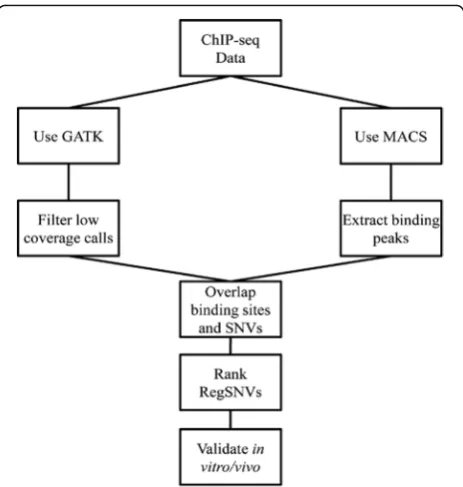
MCF7 is one of the most employed cell lines for studying molecular genetics of breast cancer [21]. Therefore, we se-lected publicly available ER ChIP-seq data from MCF7 (11 datasets) to identify regSNVs in ER ChIP-binding sites. Our computational approach (Fig. 1) consisted of: (1) identifying SNVs from MCF7 ER ChIP-seq data; (2) iden-tifying ER ChIP-binding sites using MACS; (3) overlap-ping SNVs with ER ChIP-binding sites; and (4) rank
regSNVs based upon the predicted alteration of motif binding.
We applied our computational workflow to nine ER ChIP-seq datasets from five different studies of MCF7 cells performed under similar experimental conditions (Additional file 1: Table S1) [1, 22–25]. The datasets were merged by combining the reads and 303,964,039 sequencing reads were mapped to the human genome (hg18) and identified a total of 1,409,406 SNVs and short indels. However, only 163,502 (11.6%) variants had suffi-cient coverage to pass filtering (see“Methods”) and were included in the final list for the analysis.
In parallel to SNV discovery, we used the MACS algo-rithm [14] to map genome-wide ER ChIP-binding sites using the same nine ER ChIP-seq datasets from above and analyzing each dataset independently. The results showed a wide range of variability in the number of binding peaks from 15,677 to 79,978 sites. To build a consensus peak list, we overlapped the ChIP binding sites of all datasets and selected the genomic regions which were common in at least six datasets. This led to the detection of 22,143 ER ChIP-binding sites with an average length of 385 bp. Using this panel of ER binding peaks, we next identified the SNVs which altered con-sensus EREs.
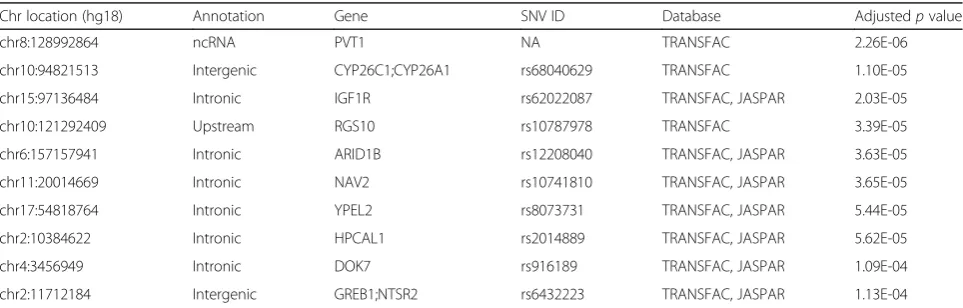
Motif assessment was performed by comparing ER-binding probabilities in the presence and absence of SNVs. The variants that were associated with a statisti-cally significant change (see“Methods”) were selected as putative regSNVs. Our pipeline nominated 4019 motif-altering regSNVs (out of 163,502 variants), among which 2084 (52%) and 1935 (48%) variants were computationally predicted to increase and decrease the binding affinity of their corresponding motifs, respectively (Additional file 1: Table S5). To further refine the list, regSNVs were anno-tated with the closest adjacent genes and this list was compared to a list of estrogen-regulated genes derived from in vitro, in vivo, and TCGA data (see “Methods”). We focused on regSNVs capable of increasing ER binding and being within the proximity of an E2-regulated gene (<5 kb of distance) (Table 1). Interestingly, ten highly ranked statistically significant putative regSNVs (p< 1.0E-03) appeared close to genes previously shown to be oncogenic in breast cancer such as PVT1 [26], IGF1R [27], and GREB1 [28]. Of these, rs62022087, located in IGF1R, was identified by both JASPAR and TRANSFAC matrices, thus increasing the confidence of the call. Moreover, Sanger sequencing showed that this regSNV is heterozygous in MCF7, making it an appropriate candidate for allele-specific binding assays. This prompted us to investigate regulatory function of rs62022087 through further in vitro studies.
An intronic regSNV inIGF1Rcontrols ER binding and activity in an allele-specific manner
Our motif assessment analysis showed that rs62022087 is one of the top three regSNVs putatively modulating ER binding to an ER-regulated gene. This SNV is located within an ERE and the G of the SNV was predicted to alter the ERE from a weak to a strong binding site (Fig. 2a) (pvalue = 2.03E-05). rs62022087, with a minor allele frequency (MAF) of 13.5%, is located centrally in
the second intron of IGF1R (Fig. 2b), which is a region hosting several active histone marks such as H3K29ac and H3k4Me1, and a number of transcription factors including FOXA1, FOXA2, and E2F1, and finally DNase I hypersensitive sites (Additional file 2: Figure S1). Direct genotyping of rs62022087 by Sanger sequencing of MCF7 genomic DNA indicated that the locus is hetero-zygous in contrast to T47D, ZR75, and BT474 cells. We examined whether ChIP-seq data showed an allelic pref-erence towards the regSNV, as would be predicted from the increased ERE motif binding [1]. Supporting this, cell lines (MCF7) and human breast tumors (Tumor_2, Tumor_3, and Met_Tumor, extracted from [1]) which harbor the regSNV showed increased ER ChIP-seq reads in this ER ChIP-binding site (Fig. 2c). In addition, the al-lele frequency of rs62022087 is strongly biased towards the variant allele in the samples carrying the regSNV (MCF7: 100%, Tumor 2: 100%, Tumor 3: 78%, Met Tumor: 100%, derived from [1]), further supporting the concept that the regSNV results in increased ER binding. A similar phenomenon was observed in the ChIP-seq datasets of two other studies (Additional file 2: Figure S2). rs62022087 genotype in T47D, BT474, and Tumor 1 is WT whereas it is heterozygous in MCF7, Tumor 2, and Tumor 3. Collectively, these data suggest that ER has higher affinity for the regSNV allele compared to the wild-type allele.
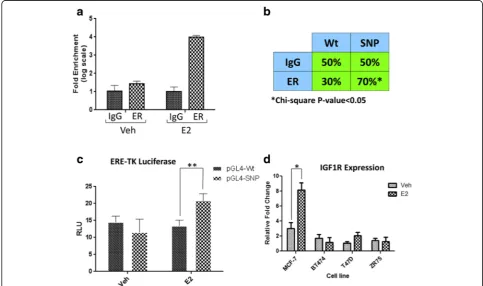
We next performed experiments to directly examine the role of the regSNV in altering ER-mediated induction of IGF1R expression. ER ChIP-qPCR in MCF7 cells showed that ER bound the genomic region containing regSNV in intron 2 of IGF1R with a fourfold enrichment following E2 treatment (Fig. 3a). Allele-specific ChIP showed a sig-nificant enrichment of the regSNV allele (G allele) in the DNA bound to ER (Fig. 3b). Cloning of the ER ChIP-binding site (with or without the regSNV site) upstream of a heterologous promoter and luciferase indicated that the
Table 1Top regulatory SNVs promoting ER binding in proximity of E2-regulated genes in MCF7 cell line
Chr location (hg18) Annotation Gene SNV ID Database Adjustedpvalue
chr8:128992864 ncRNA PVT1 NA TRANSFAC 2.26E-06
chr10:94821513 Intergenic CYP26C1;CYP26A1 rs68040629 TRANSFAC 1.10E-05
chr15:97136484 Intronic IGF1R rs62022087 TRANSFAC, JASPAR 2.03E-05
chr10:121292409 Upstream RGS10 rs10787978 TRANSFAC 3.39E-05
chr6:157157941 Intronic ARID1B rs12208040 TRANSFAC, JASPAR 3.63E-05
chr11:20014669 Intronic NAV2 rs10741810 TRANSFAC, JASPAR 3.65E-05
chr17:54818764 Intronic YPEL2 rs8073731 TRANSFAC, JASPAR 5.44E-05
chr2:10384622 Intronic HPCAL1 rs2014889 TRANSFAC, JASPAR 5.62E-05
chr4:3456949 Intronic DOK7 rs916189 TRANSFAC, JASPAR 1.09E-04
chr2:11712184 Intergenic GREB1;NTSR2 rs6432223 TRANSFAC, JASPAR 1.13E-04
ER ChIP-binding site containing the regSNV showed greater ER-induced luciferase expression upon estradiol treatment (Fig. 3c). This indicates that the G allele is more potent in recruiting ER and subsequently leading to increased induction of IGF1R expression (Fig. 3d).
Consistent with this, estradiol induced IGF1R expres-sion greater in MCF7 cells compared to the cell lines that lack the regSNV and are homozygous for the wild-type allele. Taken together, our in vitro experiments validate that one of the top computational regSNV
Fig. 2The location of rs62022087 in genome and ER ChIP-binding sites.aSchematic viewof DSV genomic position in IGF1R gene.bThe position of IGF1R SNP with regards to canonical ERE sequence. Binding score was calculated by Jaspar database tool (http://jaspar.genereg.net).cThe distribution of ER ChIP-seq reads flanking rs62022087 SNP in different cell line models as well as patient tumors [1]. The numbers inparenthesesare the fraction and percentage of the reads containing mutant allele, respectively
predictions (rs62022087) favors ER binding and results in elevated estradiol induction of IGF1R expression.
Discovery of regSNVs in ER ChIP-seq data from breast cancer
We next applied our workflow to all available ER ChIP-seq data in breast cancer cell lines and tumors comprising a total of 43 datasets from seven independent studies (Additional file 1: Table S5–13) [1, 20, 22–25, 29–31] (GEO numbers provided in “Methods”). RegSNVs were identified within ER ChIP-binding sites and the closest genes to the regSNVs annotated. The genomic position of the regSNVs was annotated based on where they are located in the genome (e.g., exonic, intronic, etc.). Addi-tional file 2: Figure S3 shows the distribution of regSNVs in the analyzed models from available ER ChIP-seq data. The majority of regulatory variants are located in inter-genic areas whose functionality is not well-characterized. Many SNVs are also in intronic areas, suggesting a major role of introns in estrogen regulation of the gene expres-sion. This is not surprising as the majority of ER ChIP-binding sites lie in intergenic and intronic segments of the genome.
To examine the function of these regSNVs, we deter-mined whether their presence was associated with altered gene expression using data from 1045 samples in TCGA. RegSNVs (n= 11,605) are enriched in the proximity of genes differentially regulated between ER+ (n= 808) and
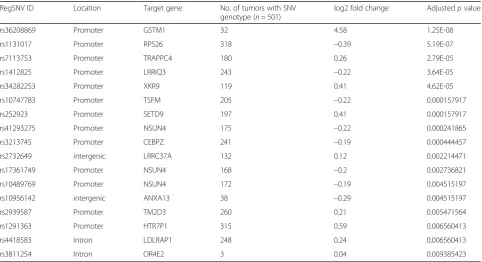
ER– tumors (n= 237) (Chi-square test, p value < 0.01), suggesting a role of these SNVs in estrogen response. Further, to determine if the regSNVs have a functional role, we assessed the correlation of genotype (i.e., regSNV) with neighboring gene expression. Out of 11,605 regSNVs with dbSNP rsIDs, we found 9082 to be present in TCGA SNP array data. We used these data to find the samples with the SNVs and then compared the expression of target genes in SNV versus WT carriers in only ER+ samples. This led to the discovery of 17 regSNVs associated with the expression of their adjacent genes (adjustedpvalue < 0.01, Table 2). Of these, there was sufficient coverage in the ChIP-seq data (>10 reads) to call allele-specific binding for six. All six showed greater than 50% of reads containing the allele with the regSNV, suggesting that the SNVs increase ER binding, as predicted by our pipeline (Additional file 1: Table S14). The majority of the regSNVs (13 out of 17) were located in the promoter of target genes, further showing that they are likely to be functional (Table 2). All the 17 regSNVs were queried at the GWAS catalog database (http://www.ebi.ac.uk/gwas) but no association was found with breast cancer or ER biology in GWAS.
The top candidate in our list is rs36208869 which is an SNV in the promoter of Glutathione S-Transferase Mu 1 gene, GSTM1. Our algorithm predicted an increased binding of ER to the SNP allele and we observed an ap-proximately 16-fold higher expression in tumors carrying the SNP (adjustedpvalue = 1.25E-08) (Fig. 4a, b). GSTM1
Table 2List of regSNVs associated with the expression of their target genes in TCGA primary tumors
RegSNV ID Location Target gene No. of tumors with SNV
genotype (n= 501)
log2 fold change Adjustedpvalue
rs36208869 Promoter GSTM1 32 4.58 1.25E-08
rs1131017 Promoter RPS26 318 –0.39 5.19E-07
rs7113753 Promoter TRAPPC4 180 0.26 2.79E-05
rs1412825 Promoter LRRIQ3 243 –0.22 3.64E-05
rs34282253 Promoter XKR9 119 0.41 4.62E-05
rs10747783 Promoter TSFM 205 –0.22 0.000157917
rs252923 Promoter SETD9 197 0.41 0.000157917
rs41293275 Promoter NSUN4 175 –0.22 0.000241865
rs3213745 Promoter CEBPZ 241 –0.19 0.000444457
rs2732649 intergenic LRRC37A 132 0.12 0.002214471
rs17361749 Promoter NSUN4 168 –0.2 0.002736821
rs10489769 Promoter NSUN4 172 –0.19 0.004515197
rs10956142 intergenic ANXA13 38 –0.29 0.004515197
rs2939587 Promoter TM2D3 260 0.21 0.005471564
rs1291363 Promoter HTR7P1 315 0.59 0.006560413
rs4418583 Intron LDLRAP1 248 0.24 0.006560413
rs3811254 Intron OR4E2 3 0.04 0.009385423
encodes for a member of the glutathione S-transferase family which is responsible for detoxification of chemical compounds including carcinogens and products of oxida-tive stress [32]. A large body of evidence has shown that loss of GSTM1 increases the susceptibility to several types of cancer including lung and bladder [33–35]. Interestingly, we examined the METABRIC and KM-Plotter datasets and found that higher expression of GSTM1 in breast tumors is associated with better survival of patients with ER+ tumors (Fig. 4c, d, logrank
p value for METABRIC = 8.2E-4, logrank p value for KM-Plotter = 5.9E-3).
Discussion
Global genetic variation in TF-binding sites can lead to widespread changes in gene expression among different individuals [36–38]. Analyzing complete genomes of different cancer types has elucidated recurrent muta-tions in the genomic regions potentially regulated by TFs [39–41]. However, deciphering how genome-wide DNA variants affect TF binding remains understudied. We present a computational framework, which analyzes ChIP-seq reads to identify regSNVs in TF-binding sites. We used this strategy, in combination with experimental studies, to validate the impact of regSNVs on corresponding DNA
motifs. While other studies have identified regSNVs in ER ChIP-binding sites using a biased approach involving geno-typing information from resources such as dbSNP and GWAS [5, 9, 10], our approach differs by identifying SNVs directly from ChIP-seq data, thus increasing the likelihood of identifying novel regSNVs in TF-binding sites.
The MCF7 cell line is one of the most studied models for understanding ER biology and results from this cell line have had a fundamental impact upon breast cancer research and patient outcome [42]. Using available ER ChIP-seq data in MCF7, we investigated the genetic vari-ation in ER ChIP-binding sites with this model. The number of binding sites varies significantly between the MCF7 datasets in the range of 15,677–79,978 sites. This high degree of variation may be due to slight differences in technical details, such as culturing conditions or cell line passage numbers, utilized for the ChIP experiments. We used an overlap of ER ChIP-binding sites for this study. Our analysis revealed a functional regSNV (rs62022087) in intron 2 of theIGF1Rgene which was predicted to increase ER binding. We show that the rs62022087 SNP results in increased ER recruitment to intron 2 and increased E2-mediated expression of IGF1R gene in MCF7 cells compared to cell lines carrying the WT allele. IGF1R over-expression has been implicated to play an important role
in the development of breast cancer [43–45] and the crosstalk between IGF1R and estrogen signaling has been well established in malignant breast tissue [46–48]. Fur-thermore, several coding and non-coding polymorphisms have been shown increase the susceptibility to breast can-cer [49, 50]. This prompted us to obtain more information on this SNP from GWAS and correlate it with clinical outcome in breast cancer patients. However, neither rs62022087 nor any of the SNPs in LD with our candidate SNP are genotyped by Affymetrix chips, which are com-monly used in GWAS and TCGA data. Further sequen-cing studies in large cohorts are warranted to characterize the potential role of this regulatory SNP in development and progression of breast cancer.
Our computational framework is able to detect not only germline variants, but also rare somatic mutations which may alter the affinity of TF to DNA. However, the general low coverage of ChIP-seq data makes it challen-ging to perform accurate variant calling. Therefore, in this study we pooled the reads from multiple datasets on the same cell line to improve the confidence of calls. With the decreased costs of sequencing, we expect that increased coverage in ChIP-seq studies will alleviate this problem in the near future.
Applying our pipeline to all available ER ChIP-seq data characterized thousands of regSNV candidates in mul-tiple breast cancer models, which may potentially change the binding of ER. About 96% of these variants are annotated in the dbSNP and 1000 Genome databases and are thus likely to be germline alterations, however, we did not have access to normal matched samples to confirm this. This high rate of germline SNPs may re-flect our inability to detect low allele frequency somatic mutations due to the low read coverage of ChIP-seq data. The majority of regSNVs reside in intronic regions of the genome, similar to the regSNV we have characterized in intron 2 of theIGFIRgene. Several studies have identified regulatory SNPs in genes associated with breast cancer susceptibility and treatment [4–6, 51]. By integrating multi-omics large datasets, we found 17 regSNVs associ-ated with the expression of adjacent genes. The top candidate was a SNP in the promoter of GSTM1 whose expression is associated with survival in breast cancer patients. ChIP-seq reads provided further evidence showing the variant allele is enriched in the ER ChIP-binding sites although we were not able to infer the true reference genotype due to not having access to normal tis-sue information in analyzed samples (Additional file 1: Table S14). Several studies have shown coding and non-coding polymorphisms in GSTM1 could modify the risk for breast cancer suggesting the importance of this gene in this disease [52–55].
The role of non-coding genomic variants in cancer and other diseases has been largely understudied due to the
technological challenges and lack of understanding about the non-coding genome. In this paper, we present a novel pipeline to identify regulatory SNVs by integrating multi-omics data and validate them through in vitro studies. Our methodology is applicable to not only other types of cancer, but also other genetic based diseases. The screen for impactful regulatory variants will soon become part of genetic testing as our knowledge of non-coding genome improves and sequencing costs are reduced. Such genetic tests are of great importance to public health in order to tailor the treatment to the needs of each individual patient.
Conclusions
In this study, we developed a pipeline to identify poten-tial regSNVs in ER ChIP-binding sites which may have downstream transcriptomic changes and therefore, confer phenotpyic impact in ER+ breast cancer. By integrating ChIP-seq, gene expression, and patient survival data in breast cancer, we were able to link regSNVs that may po-tentially cis-regulate target genes and may have prognostic value. We found an intronic SNV in IGF1R is capable of promoting ER binding on DNA and increases the expres-sion of IGF1R gene. Simlarly, a regSNV in the promoter of GSTM1 gene, rs36208869, was predicted in our pipe-line to increase ER binding and was shown to be highly correlated with the expression of GSTM1 whose higher levels in ER+ breast tumors are associated with a better survival. Our findings highlight the role of non-coding regulatory variants in modulating ER binding that may have prognostic value and need to be further studied in the clinical settings.
Additional files
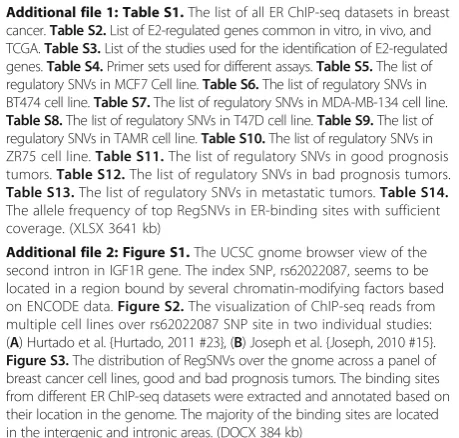
Additional file 1: Table S1.The list of all ER ChIP-seq datasets in breast cancer.Table S2.List of E2-regulated genes common in vitro, in vivo, and TCGA.Table S3.List of the studies used for the identification of E2-regulated genes.Table S4.Primer sets used for different assays.Table S5.The list of regulatory SNVs in MCF7 Cell line.Table S6.The list of regulatory SNVs in BT474 cell line.Table S7.The list of regulatory SNVs in MDA-MB-134 cell line. Table S8.The list of regulatory SNVs in T47D cell line.Table S9.The list of regulatory SNVs in TAMR cell line.Table S10.The list of regulatory SNVs in ZR75 cell line.Table S11.The list of regulatory SNVs in good prognosis tumors.Table S12.The list of regulatory SNVs in bad prognosis tumors. Table S13.The list of regulatory SNVs in metastatic tumors.Table S14. The allele frequency of top RegSNVs in ER-binding sites with sufficient coverage. (XLSX 3641 kb)
Abbreviations
ChIP-seq:Chromatin immunoprecipitation sequencing; ER: Estrogen receptor; ERE: Estrogen response elements; MAF: Minor allele frequency;
METABRIC: Molecular Taxonomy of Breast Cancer International Consortium; PGRR: Pittsburgh Genome Resource Repository; SNP: Single nucleotide polymorphisms; SNV: Single nucleotide variants; TCGA: The Cancer Genome Atlas; TF: Transcription factor; TPM: Transcripts per million; WT: Wild-type
Acknowledgements
We thank David Boone and Ryan Hartmaier for reading and commenting on the manuscript. This project used the Pittsburgh Genome Research Repository developed and funded by the Institute for Precision Medicine (IPM) and University of Pittsburgh Cancer Institute (UPCI) and includes collaboration of faculty and staff from IPM, UPCI, the Department of Biomedical Informatics (DBMI), the University of Pittsburgh Center for Simulation and Modeling (SaM), the Pittsburgh Supercomputing Center (PSC), and University of Pittsburgh Medical Center (UPMC).
Funding
This work was supported in part by funds from the Breast Cancer Research Foundation (AVL, SO), National Cancer Institute of the National Institutes of Health (NIH) award number R01CA94118 (to AVL) and P30CA047904, National Library of Medicine of the NIH award number R01LM012087 (to PVB), Fashion Footwear Association of New York (FFANY), and the Shear Family Foundation. AVL and SO are recipients of Scientific Advisory Council awards from Susan G. Komen for the Cure; and AVL is a Hillman Foundation Fellow. This work used the Data Exacell, which is supported by National Science Foundation award number ACI-1261721 at the Pittsburgh Supercomputing Center (PSC).
Availability of data and materials
The datasets analyzed during the current study are available in the GEO repository, with the following accession numbers: GSE32222, GSE51022, GSE23701, GSE23893, SRA010193, E-TABM-828, GSE24166, GSE18046, GSE14664, and E-MTAB-223. Access to TCGA data was facilitated through the Pittsburgh Genome Resource Repository (PGRR) (http://www.pgrr.pitt.edu/pgrr).
Authors’contributions
AL and SO conceived the study. AB, AL, and SO designed the analysis pipeline and interpreted the results. LS and PB performed the motif analysis. KL analyzed TCGA data. AB and PW performed the in vitro experiments. CA generated the list of E2-regulated genes. All authors read and approved the final manuscript.
Competing interests
Courtney Andersen is an employee of AstraZeneca Pharmaceuticals, LLP. Her work at AstraZeneca is unrelated to this study and did not influence the work. Other authors have no competing interests.
Consent for publication Not applicable.
Ethics approval and consent to participate Not applicable.
Author details
1Deparmtent of Human Genetics, University of Pittsburgh, Pittsburgh, PA,
USA.2Department of Pharmacology and Chemical Biology, University of Pittsburgh Cancer Institute, Pittsburgh, PA, USA.3Womens Cancer Research Center, Magee-Women Research Institute, Pittsburgh, PA, USA.4Department of Pathology, University of Pittsburgh, Pittsburgh, PA, USA.5Department of Computational and Systems Biology, University of Pittsburgh, Pittsburgh, PA, USA.6Department of Biomedical Informatics, University of Pittsburgh, Pittsburgh, PA, USA.7School of Medicine, Tsinghua University, Beijing 100084, People’s Republic of China.8AstraZeneca, Oncology iMED, 35 Gatehouse Drive, Waltham, MA, USA.
Received: 13 September 2016 Accepted: 23 November 2016
References
1. Ross-Innes CS, Stark R, Teschendorff AE, Holmes KA, Ali HR, Dunning MJ, Brown GD, Gojis O, Ellis IO, Green AR, et al. Differential oestrogen receptor binding is associated with clinical outcome in breast cancer. Nature. 2012; 481:389–93.
2. Yu JC, Hsiung CN, Hsu HM, Bao BY, Chen ST, Hsu GC, Chou WC, Hu LY, Ding SL, Cheng CW, et al. Genetic variation in the genome-wide predicted estrogen response element-related sequences is associated with breast cancer development. Breast Cancer Res. 2011;13:R13.
3. Easton DF, Pooley KA, Dunning AM, Pharoah PD, Thompson D, Ballinger DG, Struewing JP, Morrison J, Field H, Luben R, et al. Genome-wide association study identifies novel breast cancer susceptibility loci. Nature. 2007;447: 1087–93.
4. Meyer KB, O’Reilly M, Michailidou K, Carlebur S, Edwards SL, French JD, Prathalingham R, Dennis J, Bolla MK, Wang Q, et al. Fine-scale mapping of the FGFR2 breast cancer risk locus: putative functional variants differentially bind FOXA1 and E2F1. Am J Hum Genet. 2013;93:1046–60.
5. Cowper-Sal Lari R, Zhang X, Wright JB, Bailey SD, Cole MD, Eeckhoute J, Moore JH, Lupien M. Breast cancer risk-associated SNPs modulate the affinity of chromatin for FOXA1 and alter gene expression. Nat Genet. 2012; 44:1191–8.
6. Ingle JN, Liu M, Wickerham DL, Schaid DJ, Wang L, Mushiroda T, Kubo M, Costantino JP, Vogel VG, Paik S, et al. Selective estrogen receptor modulators and pharmacogenomic variation in ZNF423 regulation of BRCA1 expression: individualized breast cancer prevention. Cancer Discov. 2013;3:812–25.
7. Ingle JN, Schaid DJ, Goss PE, Liu M, Mushiroda T, Chapman JA, Kubo M, Jenkins GD, Batzler A, Shepherd L, et al. Genome-wide associations and functional genomic studies of musculoskeletal adverse events in women receiving aromatase inhibitors. J Clin Oncol. 2010;28:4674–82.
8. Park PJ. ChIP-seq: advantages and challenges of a maturing technology. Nat Rev Genet. 2009;10:669–80.
9. Ameur A, Rada-Iglesias A, Komorowski J, Wadelius C. Identification of candidate regulatory SNPs by combination of transcription-factor-binding site prediction, SNP genotyping and haploChIP. Nucleic Acids Res. 2009;37, e85.
10. Bryzgalov LO, Antontseva EV, Matveeva MY, Shilov AG, Kashina EV, Mordvinov VA, Merkulova TI. Detection of regulatory SNPs in human genome using ChIP-seq ENCODE data. PLoS One. 2013;8, e78833. 11. Bailey SD, Virtanen C, Haibe-Kains B, Lupien M. ABC: a tool to identify SNVs
causing allele-specific transcription factor binding from ChIP-Seq experiments. Bioinformatics. 2015;31:3057–9.
12. McKenna A, Hanna M, Banks E, Sivachenko A, Cibulskis K, Kernytsky A, Garimella K, Altshuler D, Gabriel S, Daly M, DePristo MA. The Genome Analysis Toolkit: a MapReduce framework for analyzing next-generation DNA sequencing data. Genome Res. 2010;20:1297–303.
13. Li H, Durbin R. Fast and accurate short read alignment with Burrows-Wheeler transform. Bioinformatics. 2009;25:1754–60.
14. Zhang Y, Liu T, Meyer CA, Eeckhoute J, Johnson DS, Bernstein BE, Nusbaum C, Myers RM, Brown M, Li W, Liu XS. Model-based analysis of ChIP-Seq (MACS). Genome Biol. 2008;9:R137.
15. Matys V, Fricke E, Geffers R, Gossling E, Haubrock M, Hehl R, Hornischer K, Karas D, Kel AE, Kel-Margoulis OV, et al. TRANSFAC: transcriptional regulation, from patterns to profiles. Nucleic Acids Res. 2003;31:374–8. 16. Sandelin A, Alkema W, Engstrom P, Wasserman WW, Lenhard B. JASPAR: an
open-access database for eukaryotic transcription factor binding profiles. Nucleic Acids Res. 2004;32:D91–4.
17. Macintyre G, Bailey J, Haviv I, Kowalczyk A. is-rSNP: a novel technique for in silico regulatory SNP detection. Bioinformatics. 2010;26:i524–30.
18. Rahman M, Jackson LK, Johnson WE, Li DY, Bild AH, Piccolo SR. Alternative preprocessing of RNA-Sequencing data in The Cancer Genome Atlas leads to improved analysis results. Bioinformatics. 2015;31:3666–72.
19. Gyorffy B, Lanczky A, Eklund AC, Denkert C, Budczies J, Li Q, Szallasi Z. An online survival analysis tool to rapidly assess the effect of 22,277 genes on breast cancer prognosis using microarray data of 1,809 patients. Breast Cancer Res Treat. 2010;123:725–31.
20. Sikora MJ, Cooper KL, Bahreini A, Luthra S, Wang G, Chandran UR, Davidson NE, Dabbs DJ, Welm AL, Oesterreich S. Invasive lobular carcinoma cell lines are characterized by unique estrogen-mediated gene expression patterns and altered tamoxifen response. Cancer Res. 2014;74:1463–74.
22. Ross-Innes CS, Stark R, Holmes KA, Schmidt D, Spyrou C, Russell R, Massie CE, Vowler SL, Eldridge M, Carroll JS. Cooperative interaction between retinoic acid receptor-alpha and estrogen receptor in breast cancer. Genes Dev. 2010;24: 171–82.
23. Schmidt D, Schwalie PC, Ross-Innes CS, Hurtado A, Brown GD, Carroll JS, Flicek P, Odom DT. A CTCF-independent role for cohesin in tissue-specific transcription. Genome Res. 2010;20:578–88.
24. Tsai WW, Wang Z, Yiu TT, Akdemir KC, Xia W, Winter S, Tsai CY, Shi X, Schwarzer D, Plunkett W, et al. TRIM24 links a non-canonical histone signature to breast cancer. Nature.
2010;468:927–32.
25. Fullwood MJ, Liu MH, Pan YF, Liu J, Xu H, Mohamed YB, Orlov YL, Velkov S, Ho A, Mei PH, et al. An oestrogen-receptor-alpha-bound human chromatin interactome. Nature. 2009;462:58–64.
26. Guan Y, Kuo WL, Stilwell JL, Takano H, Lapuk AV, Fridlyand J, Mao JH, Yu M, Miller MA, Santos JL, et al. Amplification of PVT1 contributes to the pathophysiology of ovarian and breast cancer. Clin Cancer Res. 2007;13: 5745–55.
27. Werner H, Bruchim I. The insulin-like growth factor-I receptor as an oncogene. Arch Physiol Biochem. 2009;115:58–71.
28. Rae JM, Johnson MD, Scheys JO, Cordero KE, Larios JM, Lippman ME. GREB 1 is a critical regulator of hormone dependent breast cancer growth. Breast Cancer Res Treat. 2005;92:141–9.
29. Joseph R, Orlov YL, Huss M, Sun W, Kong SL, Ukil L, Pan YF, Li G, Lim M, Thomsen JS, et al. Integrative model of genomic factors for determining binding site selection by estrogen receptor-alpha. Mol Syst Biol. 2010;6:456. 30. Welboren WJ, van Driel MA, Janssen-Megens EM, van Heeringen SJ, Sweep FC,
Span PN, Stunnenberg HG. ChIP-Seq of ERalpha and RNA polymerase II defines genes differentially responding to ligands. EMBO J. 2009;28:1418–28. 31. Hurtado A, Holmes KA, Ross-Innes CS, Schmidt D, Carroll JS. FOXA1 is a key
determinant of estrogen receptor function and endocrine response. Nat Genet. 2011;43:27–33.
32. Sheehan D, Meade G, Foley VM, Dowd CA. Structure, function and evolution of glutathione transferases: implications for classification of non-mammalian members of an ancient enzyme superfamily. Biochem J. 2001; 360:1–16.
33. Bell DA, Taylor JA, Paulson DF, Robertson CN, Mohler JL, Lucier GW. Genetic risk and carcinogen exposure: a common inherited defect of the carcinogen-metabolism gene glutathione S-transferase M1 (GSTM1) that increases susceptibility to bladder cancer. J Natl Cancer Inst. 1993;85: 1159–64.
34. Garcia T, Lehrer S, Bloomer WD, Schachter B. A variant estrogen receptor messenger ribonucleic acid is associated with reduced levels of estrogen binding in human mammary tumors. Mol Endocrinol. 1988;2:785–91. 35. McWilliams JE, Sanderson BJ, Harris EL, Richert-Boe KE, Henner WD.
Glutathione S-transferase M1 (GSTM1) deficiency and lung cancer risk. Cancer Epidemiol Biomarkers Prev. 1995;4:589–94.
36. Spivakov M, Akhtar J, Kheradpour P, Beal K, Girardot C, Koscielny G, Herrero J, Kellis M, Furlong EE, Birney E. Analysis of variation at transcription factor binding sites in Drosophila and humans. Genome Biol. 2012;13:R49. 37. Kasowski M, Grubert F, Heffelfinger C, Hariharan M, Asabere A, Waszak SM,
Habegger L, Rozowsky J, Shi M, Urban AE, et al. Variation in transcription factor binding among humans. Science. 2010;328:232–5.
38. Zheng W, Zhao H, Mancera E, Steinmetz LM, Snyder M. Genetic analysis of variation in transcription factor binding in yeast. Nature. 2010;464:1187–91. 39. Fredriksson NJ, Ny L, Nilsson JA, Larsson E. Systematic analysis of noncoding
somatic mutations and gene expression alterations across 14 tumor types. Nat Genet. 2014;46:1258–63.
40. Melton C, Reuter JA, Spacek DV, Snyder M. Recurrent somatic mutations in regulatory regions of human cancer genomes. Nat Genet. 2015;47:710–6. 41. Weinhold N, Jacobsen A, Schultz N, Sander C, Lee W. Genome-wide analysis
of noncoding regulatory mutations in cancer. Nat Genet. 2014;46:1160–5. 42. Wang P, Bahreini A, Gyanchandani R, Lucas PC, Hartmaier RJ, Watters RJ,
Jonnalagadda AR, Trejo Bittar HE, Berg A, Hamilton RL, et al. Sensitive detection of mono- and polyclonal ESR1 mutations in primary tumors, metastatic lesions and cell free DNA of breast cancer patients. Clin Cancer Res. 2015;22:1130–7.
43. Klinakis A, Szabolcs M, Chen G, Xuan S, Hibshoosh H, Efstratiadis A. Igf1r as a therapeutic target in a mouse model of basal-like breast cancer. Proc Natl Acad Sci U S A. 2009;106:2359–64.
44. Sachdev D, Yee D. Inhibitors of insulin-like growth factor signaling: a therapeutic approach for breast cancer. J Mammary Gland Biol Neoplasia. 2006;11:27–39.
45. Yerushalmi R, Gelmon KA, Leung S, Gao D, Cheang M, Pollak M, Turashvili G, Gilks BC, Kennecke H. Insulin-like growth factor receptor (IGF-1R) in breast cancer subtypes. Breast Cancer Res Treat. 2012;132:131–42.
46. Fagan DH, Yee D. Crosstalk between IGF1R and estrogen receptor signaling in breast cancer. J Mammary Gland Biol Neoplasia. 2008;13:423–9. 47. Kahlert S, Nuedling S, van Eickels M, Vetter H, Meyer R, Grohe C. Estrogen
receptor alpha rapidly activates the IGF-1 receptor pathway. J Biol Chem. 2000;275:18447–53.
48. Parisot JP, Hu XF, DeLuise M, Zalcberg JR. Altered expression of the IGF-1 receptor in a tamoxifen-resistant human breast cancer cell line. Br J Cancer. 1999;79:693–700.
49. Kang HS, Ahn SH, Mishra SK, Hong KM, Lee ES, Shin KH, Ro J, Lee KS, Kim MK. Association of polymorphisms and haplotypes in the insulin-like growth factor 1 receptor (IGF1R) gene with the risk of breast cancer in Korean women. PLoS One. 2014;9, e84532.
50. Winder T, Giamas G, Wilson PM, Zhang W, Yang D, Bohanes P, Ning Y, Gerger A, Stebbing J, Lenz HJ. Insulin-like growth factor receptor polymorphism defines clinical outcome in estrogen receptor-positive breast cancer patients treated with tamoxifen. Pharmacogenomics J. 2014;14:28–34.
51. Bojesen SE, Pooley KA, Johnatty SE, Beesley J, Michailidou K, Tyrer JP, Edwards SL, Pickett HA, Shen HC, Smart CE, et al. Multiple independent variants at the TERT locus are associated with telomere length and risks of breast and ovarian cancer. Nat Genet. 2013;45:371–84.
52. Egan KM, Cai Q, Shu XO, Jin F, Zhu TL, Dai Q, Gao YT, Zheng W. Genetic polymorphisms in GSTM1, GSTP1, and GSTT1 and the risk for breast cancer: results from the Shanghai Breast Cancer Study and meta-analysis. Cancer Epidemiol Biomarkers Prev. 2004;13:197–204.
53. Lee KM, Park SK, Kim SU, Doll MA, Yoo KY, Ahn SH, Noh DY, Hirvonen A, Hein DW, Kang D. N-acetyltransferase (NAT1, NAT2) and glutathione S-transferase (GSTM1, GSTT1) polymorphisms in breast cancer. Cancer Lett. 2003;196:179–86.
54. Yu KD, Di GH, Fan L, Wu J, Hu Z, Shen ZZ, Huang W, Shao ZM. A functional polymorphism in the promoter region of GSTM1 implies a complex role for GSTM1 in breast cancer. FASEB J. 2009;23:2274–87.
55. Yu KD, Fan L, Di GH, Yuan WT, Zheng Y, Huang W, Chen AX, Yang C, Wu J, Shen ZZ, Shao ZM. Genetic variants in GSTM3 gene within GSTM4-GSTM2-GSTM1-GSTM5-GSTM3 cluster influence breast cancer susceptibility depending on GSTM1. Breast Cancer Res Treat. 2010;121:485–96.
• We accept pre-submission inquiries
• Our selector tool helps you to find the most relevant journal
• We provide round the clock customer support
• Convenient online submission
• Thorough peer review
• Inclusion in PubMed and all major indexing services
• Maximum visibility for your research
Submit your manuscript at www.biomedcentral.com/submit