R E S E A R C H A R T I C L E
Open Access
The impact of feedback during formative
testing on study behaviour and
performance of (bio)medical students: a
randomised controlled study
D. H. J. Thijssen
2,3*, M. T. E. Hopman
2, M. T. van Wijngaarden
2, J. G. J. Hoenderop
1, R. J. M. Bindels
1and
T. M. H. Eijsvogels
2*Abstract
Background:A potential concern of formative testing using web-based applications (“apps”) is provision of limited feedback. Adopting a randomised controlled trial in 463 first year (bio) medical students, we explored if providing immediate, detailed feedback during“app”-based formative testing can further improve study behaviour and study performance of (bio)medical students.
Methods:Students had access to a formative testing“app”, which involved 7 formative test modules throughout the 4-week course. In a randomised order, subjects received the“app”with (n= 231, intervention) or without (n= 232, control) detailed feedback during the formative test modules.
Results:No differences in app-use was found between groups (P= 0.15), whereas the intervention group more frequently reviewed information compared to controls (P= 0.007). Exam scores differed between non−/moderate
−/intensive- users of the“app”(P< 0.001). No differences in exam scores were found between intervention (6.6 ± 1.1) versus control (6.6 ± 1.1,P= 0.18). Time spent studying was significantly higher compared to previous courses in moderate- and intensive-users (P= 0.006 and < 0.001, respectively), but not in non-users (P= 0.55). Time spent studying did not differ between groups (P> 0.05).
Conclusions:Providing detailed feedback did not further enhance the effect of a web-based application of formative testing on study behaviour or study performance in (bio)medical students, possibly because of a ceiling-effect.
Keywords:Feedback, Formative testing, E-learning, Medical education, Blended learning
Highlights
This study examined whether adding feedback to formative testing using smartphone-based applica-tions (“apps”) can increase knowledge retention. We found that smartphone-based applications
im-prove study performance and increase time spent studying in moderate- and intensive-users of the
“app”.
Providing detailed feedback to“app”-users was not associated with further improvement of study behaviour or study performance, possibly because of a ceiling-effect of the“app”.
Background
Previous studies have demonstrated that knowledge reten-tion can be successfully achieved by performing repeated sessions of studying [1,2]. Formative testing, which refers to the method of test-enhanced learning, adopts the use of frequent tests to improve retention of information. This strategy successfully improves the processes of learning and retention of knowledge through multiple ways [3]. When matched for an equal amount of time, formative
© The Author(s). 2019Open Access This article is distributed under the terms of the Creative Commons Attribution 4.0 International License (http://creativecommons.org/licenses/by/4.0/), which permits unrestricted use, distribution, and reproduction in any medium, provided you give appropriate credit to the original author(s) and the source, provide a link to the Creative Commons license, and indicate if changes were made. The Creative Commons Public Domain Dedication waiver (http://creativecommons.org/publicdomain/zero/1.0/) applies to the data made available in this article, unless otherwise stated. * Correspondence:[email protected];
2Department of Physiology (392), Radboud Institute for Health Sciences, Radboud University Medical Center, PO box 9101, 6500 HB Nijmegen, The Netherlands
testing is more effective in knowledge retention compared to re-studying material [4,5]. Another explanation for the success of formative testing relates to the larger spread of students’ study activities, which allows them to identify (and subsequently specifically focus on) areas of weakness [3].
The frequently reported underuse of formative testing opportunities [6, 7] may be effectively reduced by the introduction and integration of e-learning in higher edu-cation. Indeed, e-based learning tools are both effective and well-appreciated across various settings of (bio)med-ical education [8–11], ultimately enhancing study behav-iour and study performance [12]. One potential concern of internet-based formative testing relates to providing detailed feedback. In addition to simply providing cor-rect answers [13–15], information on why a certain an-swer is (in)correct may improve study performance [16]. Little work explored whether providing detailed feed-back during formative testing can further enhance study results.
Therefore, in this study we build on a recently vali-dated internet-based app for formative testing in first year students (bio)medicine [12], and explored if provid-ing detailed feedback durprovid-ing formative testprovid-ing can further improve study performance of biomedical stu-dents. We hypothesized that students who receive detailed feedback in response to incorrect answers will perform better during the final exam. Since our previous study demonstrated that the app improves study behav-iour [12], our secondary aim was to examine whether providing detailed feedback during formative testing would further stimulate study behaviour.
Methods Population
We included 324 medicine students and 139 biomedical sciences students who registered for the course“ Circula-tion and RespiraCircula-tion”. This 4-week course is part of Year 1 for both medicine and biomedical sciences of the Radboud university medical center. Before the course, all students received information about the study and the app, although students were not informed that some will receive the feedback-option of the app. Prior to partici-pation of our study we received (written) informed con-sent from all our participants. The educational advisory board of the Radboud university medical center provided approval of the proposed study. We adhered to the international guidelines from the Declaration of Helsinki regarding our study design and the collection and ana-lysis of data.
Experimental design
Following a block-randomisation, based on the“working group” (~ 15 students who follow all teaching-related
activities together), students were randomly assigned to using the“Physiomics to the next level”-app with (“ inter-vention”) or without (“control”) receiving feedback. When questions were answered incorrectly, feedback on the background of the specific question was provided. The exam of the 4-week“Circulation and Respiration” --course consisted of a written examination which included multiple-choice questions only. The final exam grades were scored from 1 (i.e. lowest score) to 10 (i.e. highest score), whilst students passed this exam when they obtained a score of ≥5.5. After the exam, all stu-dents were requested to fill in a questionnaire on their study behaviour and the use of the app.
App design
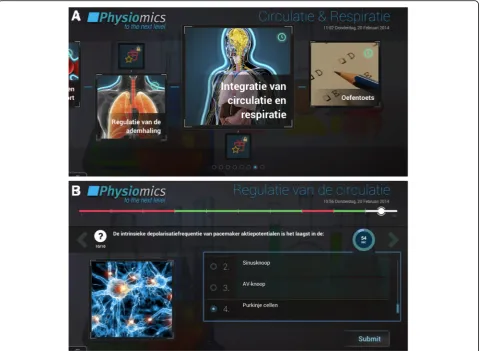
Recruitment for participation in the study was per-formed first prior to the start of the course through sending an email to all students, but also by provid-ing information on the study on the virtual learnprovid-ing environment (i.e., Blackboard). After the start of the course, recruitment was performed by providing infor-mation on the study during the first lecture and first interactive lecture of the course. Upon agreement for participation, an email was sent with a personal pass-word to allow access to the app. The app was de-signed as an open-source HTML-based application (https://eduweb.science.ru.nl). In designing the app, we ensured that access was possible for major operat-ing systems and devices (e.g. cell phones, tablets, desktops and laptops) [12] (www2.physiomics.eu/app). A general impression is provided in Fig. 1. In short, the app provided access to a tutorial course (for familiarization), and to 7 course-specific modules (10 multiple-choice questions + mock examination). The questions of each module could only be answered for 72-h (excluding weekend days) to stimulate students to evenly spread study-load. When students correctly answered 7 out of 10 multiple-choice questions, 5 additional questions were unlocked. Questions remained available for review purposes at later time points.
Data-collection
To provide detailed insight into the use of the app, sev-eral parameters were logged during the 4-week interven-tion (e.g. time spent and answer to each quesinterven-tion, number of questions answered correctly). In addition, since students were allowed to review back previous questions and answers, we also logged the time students spent on reviewing back the answers. Finally, we re-corded the examination grades.
Immediately after the exam, participants were instructed to fill in questionnaires regarding their study behaviour and the app-intervention. Regarding self-assessed study behaviour, students estimated the time (in hours) spent studying per week across the 4-week course. This information on study behaviour was provided for the intervention-course (i.e. Circulation & Respiration), but also for the preceding 4 courses. Im-portantly, the set-up and duration of these 4 preceding courses was comparable. These data were used to assess study behaviour during the 4-week course, but also to compare study behaviour during the present course that
adopted the app versus preceding courses that did not adopt any type of (e-learning based) formal testing.
Statistical methods
Statistical analyses were performed using the Statistical Package for the Social Sciences (IBM SPSS Statistics for Mac, Version 23.0. Armonk, NY: IBM Corp.). To exam-ine the “use” of the app, a student was classified as a “non-user” (0 modules completed),“moderate user” (1– 4 modules completed) or“intensive user” (5–7 modules completed). We presented all quantitative data as means ± standard deviation (SD), whilst categorical variables were presented as a percentage. Differences in study per-formance (i.e. dependent variable) between the interven-tion versus control groups (“feedback”) were compared between the non-, moderate- and intensive users (“user”) using a two-way repeated measures analysis of variance. We adopted Greenhouse-Geisser corrections for mul-tiple comparisons. In addition, we compared study be-haviour (i.e. dependent variable) between both groups (intervention versus control: “feedback”) across the 4
Fig. 1Screenshots of the app adopted by the students.arepresents an overview of some of the topics that were covered in the 4-week course.
week course (“weeks”) using a two-way repeated sures analysis of variance. A three-way repeated mea-sures analysis of variance was used to examine if study behaviour across the 4-week course from “Circulation and Respiration” differed compared to previous courses (“course”). Adopting similar statistical procedures, we tested potential differences in exam grade between user groups. Finally, binary logistic regression analysis was adopted to examine the effect of the app on the risk to fail for the final exam. Odds Ratios are presented with 95% confidence intervals (CI). Results were considered significant whenP< 0.05.
Results Participants
A total of 476 students were eligible to use the app. Stu-dents were equally distributed across the control group (n= 238) and intervention group (n = 238). Students that did not take the final exam were excluded from the data analysis (n = 13), leading to a final study population of 232 and 231 students for the control and intervention group, respectively. The majority of the students was female (65% female, 35% male) and studied medicine (70% medicine, 30% biomedical sciences) (Table 1). No differences between the control and intervention groups were found in sex (66% female vs 63% female, P= 0.44) or the ratio of students medicine vs biomedical science (71% vs 69%, P = 0.62). A total of 71% of the students used the app.
Study behaviour
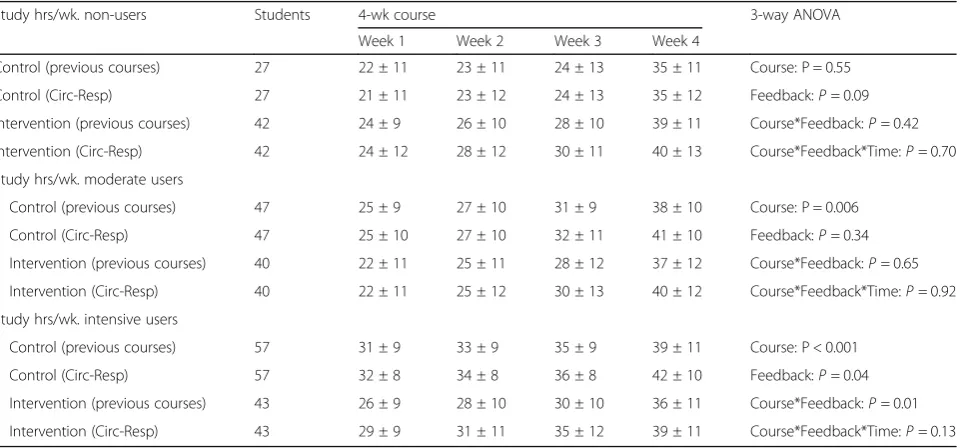
The hours spent on studying gradually increased over the 4-week course (Table 2). For non-users, moderate-users and intensive-users, we found that the increase in hours spent studying was not different between the control ver-sus intervention group (Table2). When compared to pre-vious courses, study hours were not different during the current course for the non-users (Table 3). In contrast, moderate and intensive users of the app spent more time studying during the current course compared to previous courses that did not use formative testing (Table3). Add-ing detailed feedback to the app did not significantly alter study behaviour (Table3).
Study performance
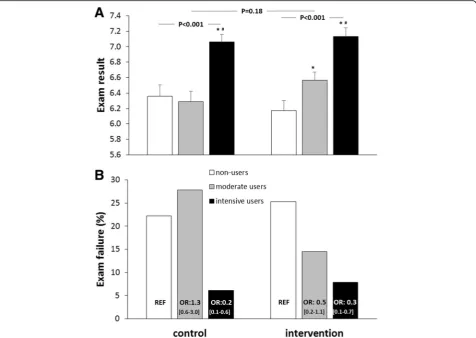
Students achieved a mean score of 6.6 ± 1.1 on the final examination of the course. Intensive users in the control group (P < 0.001), but not moderate users (P = 0.72), scored significantly better compared to non-users dur-ing the final exam (Fig. 2a). In the intervention group (n = 231), both moderate (P < 0.05) and intensive users (P < 0.001) scored significantly higher on the final exam compared to non-users and compared to each other (P = 0.001) (Fig. 2a). When using a 2-way ANOVA, no significant differences were observed in exam results be-tween app- versus app + feedback-users (‘intervention’: P = 0.59), whilst this effect was similarly present between non-, moderate- and intensive- users (intervention*use: P= 0.18, Fig.2a).
In total, 16.6% of all students failed to pass their final exam, which was not different between the intervention (16.0%) and control group (17.2%, P = 0.72). Neverthe-less, we found that non-users more frequently failed their exam (24.1%) compared to moderate users (21.3%; OR 0.85, CI 0.49–1.48) and intensive users (6.9%; OR 0.23, CI 0.11–0.47). Trends were similar for the control and intervention groups (Fig.2b).
Practical use and evaluation
The average use of the app across the 4-week course was not different between the control and intervention groups (27 min:16 s ± 15 min:6 s versus 24 min 52 s ± 14 min 59 s, P = 0.15). However, the intervention group more frequently reviewed information (10 min:31 s ± 10 min:6 s) compared to the control group (7 min 45 s ± 8 min 3 s, P = 0.007). The respondents to the question-naire (n = 264) indicated that they felt that the app im-proved their study behaviour (44.6%) and positively affected their exam preparations (63.6%), whilst 74.8% would like the app to be implemented in future courses. Importantly, the grading of these aspects did not differ between study arms (P = 0.98, 0.73 and 0.78, respectively).
Discussion
The present study reinforces the ability of an internet-based app, providing a series of formative tests
across a 4-week course, to improve exam results and study behaviour compared to non-users in first year (bio)medical students. More importantly, adopting a randomised controlled trial, we explored the impact of adding detailed feedback to the formative tests. In con-trast to our hypothesis, providing feedback during for-mative testing did not alter study performance or study behaviour. Although these data confirm the benefits of internet-based formative testing in (bio)medical stu-dents, a ceiling effect may explain why adding feedback did not further improve study performance and study behaviour when using app-based formative testing.
The internet-based app for formative testing was used by 71% of the students, which is in line with previous work adopting similar technology for formative testing in biomedical teaching [10,12,17–19]. A majority of the students provided positive feedback on the app, in that 3 out of 4 students would like the app to be implemented in future courses. The potency of adding feedback to the app is supported by the observation that the interven-tion group more frequently reviewed informainterven-tion compared to the control group. This further supports and highlights the importance of providing feedback in learning environments. More importantly, the moderate-Table 2Self-assessed study behaviour (presented as the hours per week spent studying) across the 4-week Circulation &
Respiration-course for students using the app (control,n= 133, grey) or app+feedback (intervention,n= 131). Study behaviour was presented for students after being divided into non-users (NU), moderate users (MU) and intensive users (IU) of the app. A 2-way ANOVA was performed to examine whether the time spent studying across the 4-week course differed between controls versus intervention
Table 3Study behaviour (presented as the hours per week spent studying) across previous courses (average of 4 preceding courses) and the Circulation & Respiration-course for students using the app (control,n= 125) or app+feedback (intervention,n= 131). Study behaviour was presented for students after being divided into non-users (NU), moderate users (MU) and intensive users (IU) of the app. A 3-way ANOVA was performed to examine whether the time spent studying differed between the
Circulation&Respiration-course versus previous courses (‘Course’), but also if adding feedback altered study behaviour across the 4-weeks (‘Course*Feedback*Time-interaction)
Study hrs/wk. non-users Students 4-wk course 3-way ANOVA
Week 1 Week 2 Week 3 Week 4
Control (previous courses) 27 22 ± 11 23 ± 11 24 ± 13 35 ± 11 Course: P = 0.55
Control (Circ-Resp) 27 21 ± 11 23 ± 12 24 ± 13 35 ± 12 Feedback:P= 0.09
Intervention (previous courses) 42 24 ± 9 26 ± 10 28 ± 10 39 ± 11 Course*Feedback:P= 0.42
Intervention (Circ-Resp) 42 24 ± 12 28 ± 12 30 ± 11 40 ± 13 Course*Feedback*Time:P= 0.70
Study hrs/wk. moderate users
Control (previous courses) 47 25 ± 9 27 ± 10 31 ± 9 38 ± 10 Course: P = 0.006
Control (Circ-Resp) 47 25 ± 10 27 ± 10 32 ± 11 41 ± 10 Feedback:P= 0.34
Intervention (previous courses) 40 22 ± 11 25 ± 11 28 ± 12 37 ± 12 Course*Feedback:P= 0.65
Intervention (Circ-Resp) 40 22 ± 11 25 ± 12 30 ± 13 40 ± 12 Course*Feedback*Time:P= 0.92
Study hrs/wk. intensive users
Control (previous courses) 57 31 ± 9 33 ± 9 35 ± 9 39 ± 11 Course: P < 0.001
Control (Circ-Resp) 57 32 ± 8 34 ± 8 36 ± 8 42 ± 10 Feedback:P= 0.04
Intervention (previous courses) 43 26 ± 9 28 ± 10 30 ± 10 36 ± 11 Course*Feedback:P= 0.01
and intensive-users of the app spent more hours study-ing per week compared to previous courses. Since this difference was absent in non-users, the larger time spent studying by the app-users is most likely caused by the internet-based formative testing. In addition, the app-users also reported better study results, with inten-sive app-users demonstrating a 13.3% higher score than the non-users. The magnitude of improvement in the in-tensive app-users is in line with previous studies (e.g. 8– 14%) when adopting formative testing under (un)con-trolled conditions [4, 12, 20, 21]. Despite these marked benefits of formative testing, the intensive app-users showed significant baseline differences in the time spent studying. This observation is in agreement with previous work [22, 23], in that (intensive) app-users users are higher achievers than the non-users. Although this base-line difference must be considered, our data confirm the value of adding internet-based formative testing to a blended learning situation in students (bio)medicine to improve study behaviour and study results.
After initial implementation of our formative testing-app in the 4-week course Circulation & Respiration [12], stu-dents frequently commented on the request for de-tailed feedback on the incorrect answers. Supported by previous work on the potential added value of pro-viding detailed feedback [16], the app was updated by providing detailed information in case of incorrect an-swers. However, in contrast to our hypothesis, feedback did not further improve effects on study behaviour, study performance and/or appreciation of the app. Although Wojcikowski and Kirk found a positive impact of detailed feedback, their study was importantly limited by their de-sign since interventions were compared between subse-quent academic cycles (year 1: app, year 2 app+feedback). Subsequent years can lead to different scores, independent of the intervention used. Indeed, we found a 4% higher mean exam score compared to previous year, i.e. when we introduced the “app” (i.e., 6.37). A difference in exam scores during subsequent academic cycles, therefore, should be interpreted with caution.
Fig. 2aGrades on the final exam subdivided by non-users (white bars), moderate users (grey bars) and intensive users (black bars) for the app-users (Control) and app + feedback-app-users (Intervention).Data are presented as means ± SEM.P-value refers to a one-way ANOVA. *p< 0.05 compared to non-users,#p < 0.05 compared to moderate users.bRelative number of students who failed their exam subdivided by non-users
One potential explanation for our findings is that the app already provided sufficient feedback, i.e. the correct answer and reference to the correct answer in case of an incorrect answer. Simply providing the correct answer has been demonstrated to significantly enhance study performance [13–15]. In addition to providing the stu-dents with an incorrect answer with (more) detailed in-formation, no other changes were made in the app and/ or course. Possibly, a ceiling effect may not have been achieved yet in the moderate users. Our study was not properly powered and designed to test this specific hy-pothesis, but future studies seem warranted to explore whether feedback could enhance the learning effects in the moderate-users. Another explanation for our results is that students had regular opportunities for verbal feedback (e.g. interactive lectures), including verbal feed-back on app-based questions. This is relevant, as a previ-ous study indicated that verbal feedback was associated with better study outcomes compared to written feed-back [24]. A final consideration regarding our observa-tion is that the type of feedback may affect its efficacy on learning, although previous work found that the type of feedback is more important during verbal rather than written feedback [25, 26]. At least, our results suggest that, when already providing minimal feedback (i.e., cor-rect answers + references to where in the text books to find the answers), additional detailed feedback did not significantly affect study behaviour and exam results in first year students (bio)medicine, potentially due to a ceiling effect.
Although we adopted a strong design (randomized controlled trial) in a large cohort (n= 463), some limita-tions must be considered. Students were not informed about the aim of this study. During the evaluation, some app-users indicated that they used the app+feedback ver-sion from their friends and/or used the app+feedback together with others. Since we have no information on the exact number of students who followed such approach, we cannot exclude that this affected our main conclusions. Another potential weakness was the pres-ence of baseline differpres-ence in study behaviour between non-, moderate- and intensive-user groups. Students who used the app showed better study behaviour, but also performed better based on historical examination grades compared to the non-users [12]. However, these baseline differences likely similarly affected the results in the control and intervention groups. Finally, from the app-users, one may hypothesize that adding feedback to formative testing may be more beneficial in low-to-mode-rate achievers rather than the high-achievers. For this rea-son, we repeated our analysis and added study behaviour (e.g. hours spent studying during previous courses) as a co-variate, but this did not alter the main outcomes of the analysis (data not shown). This suggests that adding
feedback to the app did not impact study performance, independent of study behaviour in previous courses.
Conclusions
In conclusion, our study further substantiated that 1st year students (bio)medical sciences who use electronic-based application of formative testing spend more hours studying and obtained higher grades on the final exam-ination compared to non-users. More importantly, pro-viding immediate, detailed feedback to students on the questions answered incorrectly (rather than providing information on where to find the correct answer), did not further improve exam performance, study behaviour and/or appreciation. Possibly, a ceiling effect of adding formative testing within a blended-learning environment in (bio)medical teaching may explain why providing additional information did not further enhance study performance and/or study behaviour.
Abbreviation
App:Application
Acknowledgements
The“Physiomics, to the next level”app was programmed by Nymus3D (http://www.nymus3d.nl/).
Funding
The development of the app and its content was financially supported by the Dutch foundation for IT projects (Stichting IT projecten), the Department for Evaluation, Quality and Development of Medical Education of the Radboud university medical center and the Department of Physiology. The Department of Physiology, but not Stichting IT projecten or Department for Evaluation, Quality and Development of Medical Education, contributed to the design of the study and/or collection, analysis, and interpretation of the data or in writing the manuscript.
Availability of data and materials
Data storage is anonymised and following the recommended guidelines from theDeclaration of Helsinki. Although our data is available in publicly available repositories, all data is available upon request to the corresponding author. The App used in this study is free available through the following link:http://www2.physiomics.eu/app/
Authors’contributions
JGJH, RJMB, MW and TMHE designed the study. All authors contributed to the collection of the data. DHJT and TMHE performed the statistical analyses. All authors contributed to data interpretation. DHJT and TMHE drafted the manuscript. MTEH, MW, JGJH and RJMB critically revised the manuscript and contributed to the scientific discussion of the data. All authors have read and approved the final version of the manuscript.
Ethics approval and consent to participate
Ethical approval was received from the educational advisory board of the Radboud university medical center and all students provided written informed consent to participate.
Consent for publication
All students provided consent for participation and publication.
Competing interests
The authors declare that they have no competing interests.
Publisher’s Note
Author details
1Radboud Institute for Molecular Life Sciences, Radboud University Medical Center, Nijmegen, The Netherlands.2Department of Physiology (392), Radboud Institute for Health Sciences, Radboud University Medical Center, PO box 9101, 6500 HB Nijmegen, The Netherlands.3Research Institute for Sport and Exercise Sciences, Liverpool John Moores University, Liverpool, UK.
Received: 17 July 2018 Accepted: 25 March 2019
References
1. Dempster F. Spacing effects and their implications for theory and practice. Educ Psychol Rev. 1989;1(4):309–30.
2. Cepeda NJ, Vul E, Rohrer D, Wixted JT, Pashler H. Spacing effects in learning: a temporal ridgeline of optimal retention. Psychol Sci. 2008;19(11):1095–102. 3. Larsen DP, Butler AC, Roediger HL 3rd. Test-enhanced learning in medical
education. Med Educ. 2008;42(10):959–66.
4. Roediger HL, Karpicke JD. Test-enhanced learning: taking memory tests improves long-term retention. Psychol Sci. 2006;17(3):249–55. 5. Carrier M, Pashler H. The influence of retrieval on retention. Mem Cogn.
1992;20(6):633–42.
6. Karpicke JD, Butler AC, Roediger Iii HL. Metacognitive strategies in student learning: do students practise retrieval when they study on their own? Memory. 2009;17(4):471–9.
7. Kornell N, Bjork RA. The promise and perils of self-regulated study. Psychon Bull Rev. 2007;14(2):219–24.
8. Zollner B, Sucha M, Berg C, Muss N, Amann P, Amann-Neher B, Oestreicher D, Engelhardt S, Sarikas A. Pharmacases.de - a student-centered e-learning project of clinical pharmacology. Med Teach. 2013;35(3):251–3. 9. Cook DA, Steinert Y. Online learning for faculty development: a review of
the literature. Med Teach. 2013;35(11):930–7.
10. Boye S, Moen T, Vik T. An e-learning course in medical immunology: does it improve learning outcome? Med Teach. 2012;34(9):e649–53.
11. Khogali SE, Davies DA, Donnan PT, Gray A, Harden RM, McDonald J, Pippard MJ, Pringle SD, Yu N. Integration of e-learning resources into a medical school curriculum. Med Teach. 2011;33(4):311–8.
12. Lameris AL, Hoenderop JG, Bindels RJ, Eijsvogels TM. The impact of formative testing on study behaviour and study performance of (bio)medical students: a smartphone application intervention study. BMC Med Educ. 2015;15:72.
13. Brame CJ, Biel R. Test-enhanced learning: the potential for testing to promote greater learning in undergraduate science courses. CBE Life Sci Educ. 2015;14(2):14:es14.
14. Butler AC, Roediger HL 3rd. Feedback enhances the positive effects and reduces the negative effects of multiple-choice testing. Mem Cogn. 2008;36(3):604–16.
15. Pashler H, Cepeda NJ, Wixted JT, Rohrer D. When does feedback facilitate learning of words? J Exp Psychol Learn Mem Cogn. 2005;31(1):3. 16. Wojcikowski K, Kirk L. Immediate detailed feedback to test-enhanced
learning: an effective online educational tool. Med Teach. 2013;35(11):915–9. 17. Romanov K, Nevgi A. Do medical students watch video clips in eLearning
and do these facilitate learning? Med Teach. 2007;29(5):484–8. 18. Zakaryan V, Bliss R, Sarvazyan N. Non-trivial pursuit of physiology.
Adv Physiol Educ. 2005;29(1):11–4.
19. Howard MG, Collins HL, DiCarlo SE.“Survivor”torches“who wants to be a physician?”in the educational games ratings war. Adv Physiol Educ. 2002;26(1–4):30–6.
20. Roediger HL, Agarwal PK, McDaniel MA, McDermott KB. Test-enhanced learning in the classroom: long-term improvements from quizzing. J Exp Psychol Appl. 2011;17(4):382–95.
21. McDaniel MA, Agarwal PK, Huelser BJ, McDermott KB, Roediger Iii HL. Test-enhanced learning in a middle school science classroom: the effects of quiz frequency and placement. J Educ Psychol. 2011;103(2):399–414.
22. Karuppan CM. Webbased teaching materials: a users profile. Internet Res. 2001;11(2):138–49.
23. Davies J, Graff M. Performance in e-learning: online participation and student grades. Br J Educ Technol. 2005;36(4):657–63.
24. Aggarwal M, Singh S, Sharma A, Singh P, Bansal P. Impact of structured verbal feedback module in medical education: a questionnaire- and test score-based analysis. Int J Appl Basic Med Res. 2016;6(3):220–5.
25. Olde Bekkink M, Donders R, van Muijen GN, de Waal RM, Ruiter DJ. Explicit feedback to enhance the effect of an interim assessment: a cross-over study on learning effect and gender difference. Perspect Med Educ.
2012;1(4):180–91.