THE JUSTICE THEATER PROJECT:
DEVELOPING A COMPANY AND A CONVERSATION
Deborah Anne Royals
A dissertation submitted to the faculty at the University of North Carolina at Chapel Hill in partial fulfillment of the requirements for the degree of Doctor of Philosophy in the
Department of Communication Studies (Performance Studies)
Chapel Hill 2016
Approved by: Lawrence Grossberg Della Pollock
©2016
ABSTRACT
Deborah Anne Royals: The Justice Theater Project: Developing a Company and a Conversation (Under the direction of Lawrence Grossberg)
This dissertation is a critical ethnographic study of The Justice Theater Project (JTP), an “advocacy activist” theater company in central North Carolina in the Southern United States. It shares the story of how JTP began, identifying the steps the company took, the theoretical perspectives and models it was guided by, and circumstances that allowed the company to engage a community in important conversations concerning life, dignity, embodied participation, choice, solidarity, care and justice for all people. It is intended to serve as a resource for similar efforts.
JTP’s mission is to use the performing arts to “call to the fore of public attention the needs of the poor, the marginalized and the oppressed.” Each year, the company selects a pressing issue of social concern, identifies individuals and organizations engaged with that issue, and partners with them to create original performance projects and theater productions to spark and maintain a season-long discussion of the issue.
The Introduction catalogs and discusses practices, ideas, and models that the
company has integrated. Chapter Two traces how the threads came together in one person’s life and led to the company’s birth. Chapter Three explains how JTP organized itself despite setbacks. Chapter Four shows how the company developed practices it uses to this day.
Chapters Three and Four also describe how the company creates original performance pieces. Its first, Still ... Life, was based on two years of field research with North Carolinians affected by the death penalty. The next two, !Exprésate! and ¡Exprésate!—The Price You Pay!, engaged Latina teenagers from urban Durham’s West End and from migrant farm working families throughout eastern North Carolina to develop and perform “Forum” theater using the methods of Augusto Boal.
ACKNOWLEDGMENTS
There are many to thank.
I extend my deep appreciation to my dissertation committee—to Larry Grossberg, who never gave up, patiently encouraging me to continue to think more deeply and to get down into the weeds; to Della Pollock, who showed me how to better comprehend what is beautiful about our work as Performance Studies scholars, reminding me that there is wisdom in asking the right questions, never letting go of the past and learning to lean into the future; to Renee Alexander Craft, for your motherly care, confidence and love; to Sarah Dempsey who continued to encourage the work and sustain me in the moments when I felt empty; and to Bill McConville who guided me in faith and gently eased my siblings and myself through our father’s transition.
For the people who have provided leadership, friendship and support to The Justice Theater Project: Megan Nerz, my co-founder, whose profound grit and wisdom made a way for the company to happen even when others around us did not see the possibilities; and to the first board members of the company: Dan Kenna, Tim Throndson, Jeanne Tedrow, Mary Pollard, Ellen Gould, Keith Loughlin and Maria Rouphail.
cancer—each made such a profound contribution to the JTP and the clarity provided a path for the company.
To Julio De La Rosa, for agreeing to become a part of The Justice Theater Project when we needed you, coming out of retirement to offer your expertise, guidance and support when we had nothing to offer you, and to your sweet wife Mary for saying yes to this
involvement with the company. I love you both dearly.
To Melissa Zeph, for joining the company as its managing director right at the perfect moment, for always having a knack for stepping in at the right time, and for believing in the “little engine that could.”
To former JTP staff members, Pat Mahoney and Nancy Williams; to the current JTP staff, John Honeycutt, Melissa Reilly, and Slee Arnold; to the Performing Arts Summer Series Camps’ staff, instructors, and counselors, and the Camps’ Yoga for Youth instructors.
To the current board of directors, Mark Baumgartner, Regina Brooks, Jim Falanga, former Superior Court Judge Abe Jones, Marc Kielty, Marguerite LeBlanc, Dr. Sheila Smith McKoy, Kristi Vincent Johnson. And to the current board chair, Tom Wolf—your unselfish commitment and understanding of what this work can do always lightens the weight of the work.
share our time together. To Graduate Student Services Support Specialist, Vilma Berg, you have been one of my angels. And to Joni Brooks for giving the work an extra pair of eyes.
To the Catholic Community of Saint Francis of Assisi in Raleigh North Carolina and The Franciscan Friars of Holy Name Province in New York, your belief in JTP and your generous support provided a foundation for the company and continues to help make a way for the performing arts do important justice work and create necessary conversations.
And to the funding organizations who continue to believe in and support the work of the Justice Theater Project: City of Raleigh Arts Commission, Mary Duke Biddle, North Carolina Arts Council, Paul Green Foundation, United Arts Council of Raleigh and Wake County, Triangle Community Foundation, and Arts Action Research.
To Father David McBriar whose office became the safe place to discuss the proposed work of the company each year; Father Mark Roemer for your friendship and support; Richard Derrenbacher for the love and development you have continued to provide; Paul Ahmrein who believed; Gene Pipas for letting me continue to sing; Gabriel Monetti who always asked how I was and told me to continue to think about the celebration to come. And to my Isla Bella Friends, Sue Mathys, Kate Shiring, Reta Walsh, Hanni Kulman and Carol Derrenbacher, for making me take time for a good glass of red wine. And to Saint Francis staff members: Jim Anderson, Joe Leone, Marie Leone, Kathleen Owen, Diogenes Ruiz, Rob Stachewicz, Trevor Thompson, Jim Wahl, Ben Whitehouse, Gladys Whitehouse, Father Steve Patti and Father Steve Kluge.
Special thanks are also offered to everyone who participated in ¡Exprésate! Father Jacek Orzhechowski and Immaculate Conception Church, who invited me to be a part of healing the pain that grew in their community. The teens in the West End of Durham who trusted me. The staff of Student Action with Farmworkers. The Project Levante teens who invited me to travel with them (the time in my family van will remain in my heart forever). And the Borderlinks Program, for opening my eyes.
Thank you to my friends, old and new, all of my JTP family.
Thank you to the people who continue to support the work by engaging in conversations with us each year around all these important issues of social concern.
To Baba Chuck Davis of the African American Dance Ensemble, who has helped me to cleanse my soul of negativity, seek positive energy and humble myself before the almighty merciful Maker. And to Dr. Burch for helping me to understand that death is only the
beginning.
Deepest gratitude to Patrick Inman, who helped me figure out a way to put the history, research, personal and performance experience that led to the JTP into a format that would help others seeking to do the same find understanding, and to his wife Belinda, for being patient with both of us. I could not have done this without you Pat.
Thank you to my siblings, my four sisters and two brothers. There are no words to describe the ways in which we are tethered to one another and the deep love we continue to share; and to my two sisters-in-law and my husband’s mother and father, who continue to make me laugh and also make me believe that there is indeed “sweet” in this world.
To my mom. You are a rock. You always make me see the reality of what is important in life, how we must be fierce, letting go of fear—and to love the same way.
To my children, Daniel, Noah and Eli, who have sacrificed so much and unselfishly shared their mother with so many. I am so proud of who you are and what you continue to become.
To Dwight, who told me that there was a story here and who made me understand that I had no other alternative but to find my voice and tell that story.
To my husband. You are my fortress and your faith in me is strong and empowering—I love you dearly Joe.
There is a wide range of ways to respond to human need and to issues of social concern. When the goal is to seek justice and make a way toward the common good, all of us have something to contribute. Our unique experiences, knowledge, skill sets, and love, when blended, can create a home where justice might live.
TABLE OF CONTENTS
LIST OF FIGURES ... xiii
CHAPTER 1. INTRODUCTION ... 1
JTP’s Models: Thinkers, Dramatists, other Companies, an Ethnographer ... 3
JTP’s Mission and its Base: Catholic teaching, liberation theology, and St. Francis ... 11
CHAPTER 2. GESTATION: FROM CHILDREN’S THEATER TO DEATH ROW ... 17
Intervening in A Lesson Before Dying, 2004 ... 17
From a Briar Patch to The Best Christmas Pageant Ever, 1960–2004 ... 21
Wandering, 1986–1993 ... 27
Meeting Dwight, Reading Boal, Doing Children’s Theater, 1994–1996 ... 29
Shopping for a Church, Hearing Father Dan Kenna, 1996 ... 39
Teaching and Learning at Polk Youth Prison, 1996–1998 ... 42
Playing Freeze Tag in Slow Motion at Central Prison, 2000–2001 ... 65
Creating the Arts for Justice Ministry, 1999–2004 ... 70
A Prayer for Henry Hunt, September 11, 2003 ... 72
Producing A Lesson Before Dying, 2004 ... 74
Intervening in A Lesson Before Dying, 2004 ... 77
CHAPTER 3. INFANCY: INCORPORATION AND STILL … LIFE ... 83
Incorporating Justice Theater Project, 2004 ... 83
JTP’s first season, 2004–2005 ... 85
Discovering a framework and an initial focus, 2005 ... 89
From research notes to performance, 2006 ... 101
Witnessing the execution vigil for Sammy Flippen, 2006 ... 105
From the death penalty to immigration, 2006–2007 ... 108
Still…Life after Eve Carson’s murder, 2008 ... 110
Excerpts from Still … Life. An exploration of a killing state: North Carolina ... 113
CHAPTER 4. ADOLESCENCE: MANAGING DEMANDS AND ¡EXPRÉSATE! ... 118
¡Exprésate!—Immigrant Teens in Durham, NC ... 120
Trying to Stay Whole While Being Pulled in Multiple Directions ... 123
Can University Students Learn from a Community Theater Project? Fall 2006 ... 126
City Youth Find Freedom Through Performance, Winter 2006–2007 ... 128
A Mixed Community Listens to Its Young People on Stage, Early Spring 2007 ... 133
Looking Beyond Durham to Youth Working in Tobacco Fields, Late Spring 2007 ... 135
Learning to Juggle ... 138
Making Theater with Young Migrant Farmworkers, Summer 2007 ... 139
The border ruptures the futures of two sisters, Summer 2007 ... 142
“Yo valgo más que esto,” 2007 ... 145
Seeing the Wall in Nogales, March 2008 ... 148
Meeting Las Madres, March 2008 ... 156
An Ethic of Love, 2008 ... 159
CHAPTER 5. CONCLUSION: PROVIDING A PLACE TO BEGIN ... 164
APPENDIX. DWIGHT CONQUERGOOD’S COMMENTS TO A STUDENT, JUNE 1995 ... 179
LIST OF FIGURES
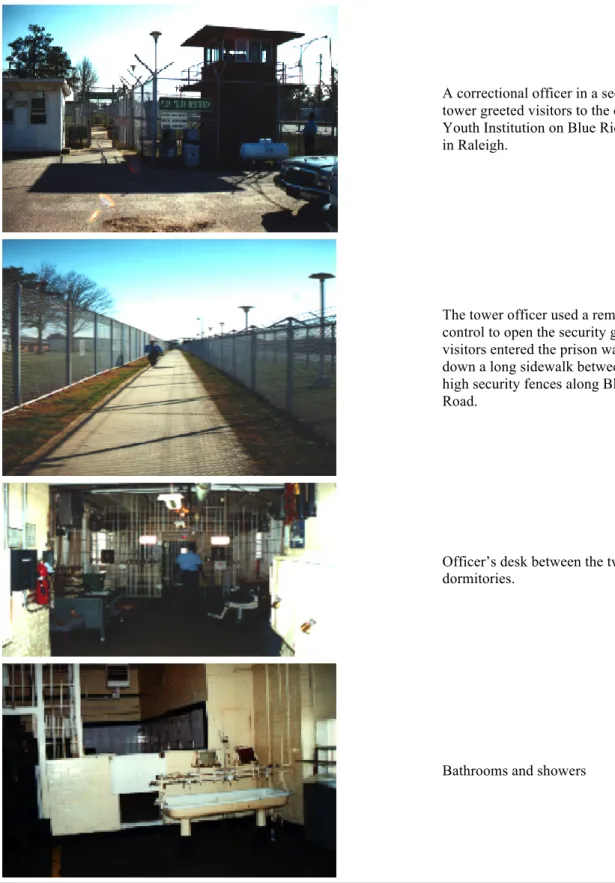
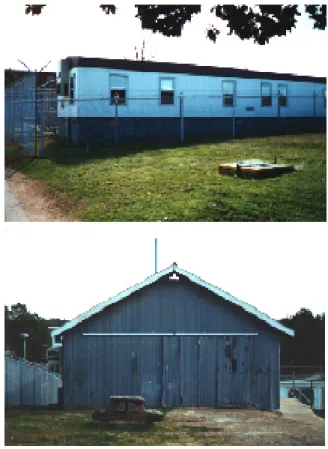
Figure 1: Polk Youth Prison ...60
Figure 2: Polk Youth Prison ...61
Figure 3: Polk Youth Prison ...62
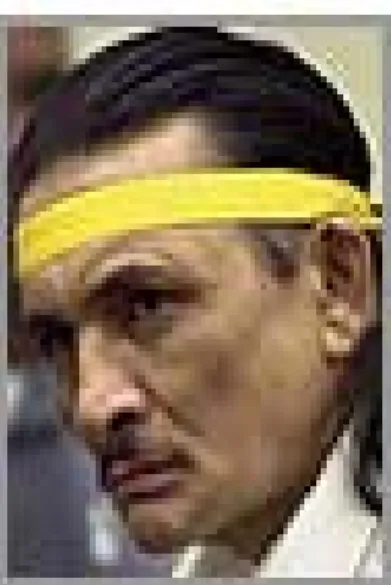
Figure 4: Henry Hunt (Executed September 12, 2003) ...73
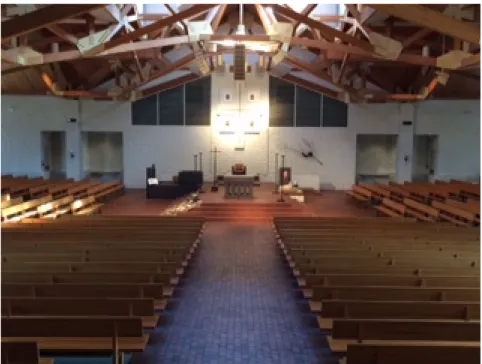
Figure 5: Confrontational seating at St. Francis ...75
Figure 6: Objectives and goals agreed to at initial Justice Theater Project Board Meeting ...87
Figure 7: Ronnie Frye as a child ...96
Figure 8: Ronnie Frye as an adult ...96
Figure 9: Elias Syriani with Meg Eggleston, on the evening before his execution in 2005 ...101
Figure 10: Excerpts of field notes collected while workshopping portions of Still … Life ...104
Figure 11: Samuel Flippen (Executed August 18, 2006) ...108
Figure 12: Workshop performance of Still … Life ...114
Figure 13: Workshop performance of Still … Life ...115
Figure 14: Death Penalty and Immigration Project Timeline, June 2006–August 2007 ...125
Figure 15: The Justice Theater Project: A Year at a Glance, April 2007–April 2008 ...137
Figure 16: The Justice Theater Project: A Year at a Glance, April 2007–April 2008 ...138
Figure 17: Project Levante Students rehearse scripts, September 2007, Benson, NC. ...147
Figure 18: The Border Wall, March 10, 2008, Nogales, Mexico. ...149
CHAPTER 1. INTRODUCTION
Community theater is often identified with the practice of community members getting together to put on shows for the people who live there. There are alternatives. Berthold Brecht drew people in and invited them to participate by thinking. Augusto Boal, inspired by the ideas of Paulo Freire, created theater that would help a community understand itself and change in ways it felt desirable. Dwight Conquergood demanded of the practitioner a work ethic that is both a rigorous analysis of text and an embodied practice. This
dissertation traces the emergence, establishment, and growth of a regional theater company that pursues these ideals in combination with the traditional practices and goals of
community theater.
operations, JTP has demonstrated some mastery of the tools the author struggled for so many years to integrate. It has grown by creating kinship and maintaining connections with each season’s new and returning audiences, cast members, and volunteers, and through continuous efforts to integrate new ideas and engage new partners from many sources, not least through the author’s further graduate education.
The Justice Theater Project combines traditional community theater and innovative performance projects into theatrical, educational, and ethnographic work that draws
audiences and prompts conversations. It builds on the ideas and examples of Brecht, Boal and Conquergood, and by imitating the theater companies its founders looked to as models in its first year, including, among others, Joan Littlewood’s Theatre Workshop, Ted Gilliam’s Dashiki Project, and R.G. Davis and Joan Holden’s San Francisco Mime Troupe. It is supported by the church that is its home, a Franciscan spiritual community that encourages all members to be good stewards and put their time, talents, and treasure to good use. It addresses a different social issue each season by pursuing connection with and developing performances with different communities of stakeholders, thus extending its network and providing an expanding forum for conversation across social boundaries.
This dissertation is a critical ethnographic study of the early development of the Justice Theater Project. It traces the company’s gestation as it emerged through the journey of one of its founders and as it discovered its purpose and evolved its practices in its first years of operation.
It will be helpful beforehand to introduce, briefly, the examples and ideas that
JTP’s Models: Thinkers, Dramatists, other Companies, an Ethnographer
Political theater has historically been used to propagandize theories and ideals. For example, in Soviet Russia, political agitprop theater was used to construct Marxist social ethics. But it has also been used to encourage people to think for themselves; this concept was appealing to the co-founders of the JTP. In Weimar Germany, Piscator and Brecht developed the elaborate aesthetic “epic theater” to address the spectator in a rational way. Epic theater’s goal was to force people to observe reality and inspire action, because it “understood that the radical transformation of the theatre can’t be the result of the artistic whim. It has simply to correspond to the whole radical transformation of the mentality of our time” (Brecht on Theatre 23).
“For Brecht,” as Alan Lovell has explained,
works of art were effectively experiments. They offered models of the world for critical testing on the part of their audiences. … [T]he audience is
analogous to the scientist, who judges whether the experiment is a success or not. … [H]owever, the audience and the scientist differ in a crucial respect. A scientist comes to the experiment with a critical attitude already built in. Brecht made the opposite assumption about the theatre audience. The task of Epic Theatre is to encourage a critical attitude in the audience. … [So] a principal concern was to create the right conditions for learning.
The audience (the scientist) observes a performance (conducts a scientific experiment), considers what it has seen (collects results), and judges it (draws a conclusion), generating new knowledge. Like an experiment, a performance is not a set of instructions that only generates new knowledge once. It evolves over time as many audiences engage critically with it. What different audiences learn from multiple performances is communicated in socially concerned conversations.
Brecht wanted to create understanding through dialogue. To this end, his Lehrstücke or “learning plays” were a series of short experimental works which he did not intend to necessarily culminate in a finished, final product that would be replicated exactly the same way during each performance. The ideal Lehrstücke performance was something of an ongoing rehearsal, one continuous master class. The objective of Lehrstücke was the end result, where the “political, moral and aesthetic influences all radiate from the theatre” (Brecht on Theatre 152).
Since 2005, when Justice Theater Project began developing its first original
opportunities for performers and audience to confront problems together within the framework of its productions and performance work.
In Brazil, and later across Europe and the Americas, beginning in the 1960s, director Augusto Boal also produced short pieces that seek to make audience members non-passive and to call them to action. He developed Brecht’s Lehrstücke into his Theatre of the Oppressed, with its techniques of “forum theatre,” which he designed to be of, by, and for marginalized people and to help them learn ways of resisting oppression in their daily lives (Legislative Theatre 8–9). Boal believed this style of theater could be used to politically and socially engage participants and then to transform personal and social realities.
As JTP worked to develop an atmosphere of family and fellowship for its company of artists, its founders were attracted to the efforts of another person influenced by Brecht. British director, playwright, and producer Joan Littlewood worked fiercely to engage people in constructive political discourses. The vibrant and ingenious approaches she found to develop an ensemble of actors felt similar to the organic acting development methods JTP’s two female leaders were using for the same purpose. Littlewood started the Workshop Project in London in 1959; in 1963, she and her Theatre Workshop created Oh What A Lovely War, a play that was innovative for its blatant denunciation of the incompetence of political leaders during World War I, for its unusual theatrical style, and for how the script and its performance were developed. Littlewood created the piece spontaneously through a process of improvisation with its artists, which she then scripted (Holdsworth). JTP has used a similar process to develop several of its original scripts.1
Organizing a company that seeks to shift communities toward social change is far from being a marginal effort, especially when it is a grassroots, community-based theater looking to its immediate community for purpose. Another theater company served JTP’s founders as an example of a community theater based in a church. Ted Gilliam founded the Dashiki Project in 1965 in the Central City community of New Orleans.2 Its home was St. Francis de Sales Catholic Church, which provided rehearsal and performance space for all its early productions. Dashiki opened itself to all races, even as it sought to “project the truth of the black experience; to foster new works by local writers; and to relate to people from all
1 The scripts JTP has developed through improvisation with performers and community members
include three that will be discussed in this dissertation: Still ... Life (see Chapter 3), ¡Exprésate!, and ¡Exprésate!—The Price You Pay! (see Chapter 4).
2 Stanley R. Coleman has documented how The Dashiki Project grew out of the Black Arts
walks of life although addressed to a segment of the population still considered ‘invisible’ despite a history written in blood, sweat and tears but now without laughter.” Artists working with the project sought to make “sophisticated theatre” that grew out of and was open to non-racially exclusive audiences in an effort to make the work visible (Coleman 68, 63, 97).
The ways in which the Dashiki Project worked to make productions for its audiences both aesthetically sophisticated and familiar found resonance with the JTP founders. Dashiki was the only black theater to grow out of New Orleans in the 1960s and the company fought to make theater of high quality that was not racially exclusive. Ted Gilliam, the company’s driving vision and its Artistic Director, wanted to create a place, a company where his Dillard University theater students would be able to work at their craft before and after graduation. His company embraced anyone who believed in the work.
Justice Theater Project chose the word “Project” as part of its name for the same reason Dashiki did: because this word suggests “a work in progress” (Coleman 61). And the JTP family, like Gilliam and his colleagues, has worked diligently to create an atmosphere of family where no one is turned away from being a part of the company’s productions or operations.
Another productive model for Justice Theater Project’s founders was the San Francisco Mime Troupe; originally a street theater that sprang up in the 1960s, founded by R.G. Davis, a trained mime and dancer. The company began by creating and performing original non-speaking movement pieces that included visual art elements and music. Later it explored the use of spoken word and of masks reminiscent of Renaissance commedia
The Troupe had a much more direct influence on JTP. Shortly following its first production in 2004, JTP invited one of the Troupe’s original members to be a part of JTP’s second production. Joan Holden had been the Troupe’s principal playwright from l967 to 2000, creating, as author or head writer, a new satire every year for the Troupe's annual summer season in the parks. She and JTP’s co-founders created the educational programming and town hall forum events for a production of Nickel and Dimed, on Not Getting By In America, which Holden had adapted from Barbara Ehrenreich’s book. That experience with her has continued to inform the ways in which educational programming is planned and presented for every production of each JTP season.
Littlewood, the San Francisco Mime Troupe, Brecht, and Boal provided explicitly political examples. The Dashiki Project had a more traditional flavor. This blend of influences made sense to us as we continued to shape and grow into our company. Every year the company focuses on one issue of social concern and pushes all that participate with its work to get down into the weeds of that particular social justice issue through thorough research, scholarship, critical ethnography, original performance work and traditional theater pieces that will be familiar to our audience with relevance to the social justice theme being addressed. These ingredients provide multiple opportunities to make audience and
performers alike critically conscious thinkers by seeking education and discourse opportunities that might shift ways of thinking and provide a way toward justice.
The dramatists and companies discussed thus far have provided the Justice Theater Project with methods and models for creating theater, harnessing a sense of informed
to discuss, the glue that led us to create a community theater informed by critical ethnography and performance studies.
I was a student of Dwight Conquergood from 1994 to 1996, while a graduate student at Northwestern University. Dwight taught and practiced an alternative way of knowing and learning. He encouraged his students to practice transgression and in the act of transgressing we began to “travel between two different domains of knowledge: one official, objective, and abstract—‘the map’; the other one practical, embodied, and popular—‘the story.’” In his process, this way of knowing “carries the most radical promise of performance studies research… cut[ting] to the root of how knowledge is organized in the academy.” We moved from being above or detached from the work to being with the work in a visceral practice of “hands-on participation and personal connection: ‘knowing how’ and ‘knowing who’” (“Performance Studies” 33).
We can gain corporeal knowledge by taking our bodies into situations and
At one of The Justice Theater Project’s earliest board retreats, when members of the board were seeking a language to discuss the mission of the company, I struggled to find a way to explain my original intent, what I felt the company’s work should be about if I was artistic director, and why we could teach through performance. I presented them with this quote:
One path to genuine understanding of others, and out of this moral morass and ethical minefield of performative plunder, superficial silliness, curiosity seeking, and nihilism, is dialogical performance. This performative stance struggles to bring together different voices, world views, value systems and beliefs so that they can have a conversation with one another. The aim of dialogical performance is to bring self and other together so they can question, debate, and challenge one another. It is a kind of performance that resists conclusions, it is intensely committed to keeping the dialogue between performer and text open and ongoing. Dialogical understanding does not end with empathy. There is always enough appreciation for difference so that the text can interrogate, rather than dissolve into, the performer. … More than a definite position, the dialogical stance is situated in the space between competing ideologies. It brings self and other together even while it holds them apart. It is more like a hyphen than a period (Conquergood,
“Performing” 75).
“Could you please break this down?” one board member responded. The road that led me to present this set of words to a group of suburban Southern Catholics who had never read anything like this, but who accepted it once we discussed it, and who have worked with me to pursue it, was not straightforward at all. This dissertation seeks to trace it.
document embodied fieldwork, create out of it performance pieces that recreate the
experiences we documented, and then present those original pieces, often performed by the actual people who are the subjects of the research.
JTP’s Mission and its Base: Catholic teaching, liberation theology, and St. Francis
Ideas and examples are not sufficient to explain how this community theater company happened. Before it began its work of informing and calling out to communities in central North Carolina, the Justice Theater Project was first called into existence itself by an existing community that recognized an opportunity and a need.
JTP was encouraged by, and evolved within, the environment of a progressive Franciscan Catholic community, first as the Arts for Justice Ministry and later as the Justice Theater Project. Its home, Saint Francis of Assisi Catholic Church in Raleigh, North
Carolina, has a long history of involvement in matters of social justice. In this, it continues the Franciscan tradition, which values love of all creation, generosity of spirit, simplicity of nature, and the detachment from the “things” that prevent us from loving and forgiving. Franciscans have a tradition of inspiring communities toward peace and the common good. Franciscan contemplation “opens the heart and mind to take in more of the world, its beauty and suffering” (Delio, Warner, and Wood 130). In this spirit and practice, each year, JTP’s artistic committee, its education and action committee, and its artistic director come together to contemplate current issues of social concern, before choosing one which seems most urgently to demand discussion. Then we plan a season of original performance work, traditional productions, and educational programming devoted to that issue.
of constituting what Freire articulates as a “climate of hope,” have each played out in the Franciscan tradition. (They are, for example, taught in organized faith formation classes for adults at St. Francis of Assisi Catholic Church.)
The roots of liberation theology can be found in the religious and social movements that swept across Latin America beginning in the late 1950s. During this same time, the Vatican II documents were completed, the Civil Rights movement in the United States was in full swing, and Paolo Freire was developing his dialogical pedagogy as a tool for teaching and raising consciousness with regard to extreme poverty, poor education, and oppressive political machines.
The Brazilian Franciscan Leonardo Boff recalls, “at the Second General Conference of the Latin American Episcopate, held at Medellín, Columbia, in 1968, the Church made a historic choice. It opted for the people—for the poor, for the base church communities” (11). He explains that this hermeneutic shift within Catholic doctrine asserts that “The Christian faith is not primarily a theory. It is primarily a praxis. The praxis has its theory, yes, but that theory must never, under penalty of desiccation, be developed without reference to praxis— or, in classic terms, without practicing faith, hope and love” (19).
Just before the Medellin Conference, Gustavo Gutierrez defined liberation theology as a “critical reflection on praxis in the light of the word of God” (A Theology of Liberation xxix).3 After Medellin, Gutierrez and others insisted that the historical practice of theology
3 Gutiérrez explained more clearly in a talk the month before the Medellin conference:
The classic meaning of theology is an intellectual understanding of the faith—that is, the effort of human intelligence to comprehend revelation and the vision of faith. But faith means not only truths to be affirmed, but also an existential stance, an attitude, a commitment to God and to human beings. Thus faith understands the whole of life theologically as faith, hope, and charity.
was secondary to a commitment of work among the poor and that it is among the poor that one finds faith. The clergy went on to develop a model for connecting and being with the people, a preferential option for the poor and against their poverty, based on the pedagogical work of Paulo Freire. That praxis is what became known as liberation theology. It
acknowledges “‘the powerful and almost irresistible aspiration that persons have for liberation [as] one of the principal signs of the times that the church has to examine in the light of the gospel,” and that “‘among those who bear the burden of misery and in the heart of the disinherited classes … this aspiration expresses itself with the greatest force’” (xx-xxi, quoting Libertatis nuntius I, 1).
Since the second Vatican Council (1962–1965), Catholic Social Teaching has upheld seven principles:
• Dignity of the Human Person
• Call to Family, Community and Participation • Rights and Responsibilities
• Preferential Option for and with People who are Poor • Dignity of Work and the Rights of Workers
• Solidarity
• Care for God’s Creation
Each principle of Catholic social teaching is designed to analyze economic, political and societal influences and offers a synthesis of the issues with an eye towards creating a society that is more fair and equal. The hope is that by living by these principles people can
If, then, we say that faith is a commitment to God and human beings, we affirm that theology is the intellectual understanding of this commitment. It is an understanding of this existential stance, which includes the affirmation of truths, but from a broader perspective.
Faith is not limited to affirming the existence of God. No, faith tells us that God loves us and demands a loving response. This response is given through love for human beings, and that is what we mean by a commitment to God and to our neighbor.
build a society that resembles God’s kingdom on earth or, as Freire states, ”a learning process might appear whereby the powerful would learn that their privileges, such as that of exploiting the weak, prohibit[ing] the weak from being, denying them hope, are immoral, and as such need to be eradicated” (“Liberation Theology”).
Modern Catholic catechesis addresses the foundational aspects of the Catholic tradition, which includes “scripture” and its relationship to the culture of today. “If I then, your Lord and Teacher, have washed your feet, you also ought to wash one another’s feet, for I have given you an example that you should do as I have done to you. Most assuredly, I say to you, a servant is not greater than his master; nor is he who is sent greater than he who sent him. If you know these things, blessed are you if you do them” (John 13.1-17).
Catholic social teaching is built on the foundations of a church of mystery, mission and doctrine; a challenge to respond to God in gratitude for gifts received; manifestation and living out the sacraments; worship, liturgical life, and virtue and a moral life; seeking the common good and perpetuating a message of human dignity. Post Vatican II practices made great strides in incorporating, as a part of this expression of faith, the arts including music, dance, drama, and the visual. Many contemporary Catholics place an emphasis on the
Catholic Social Teaching and liberation theology are related to “ministerial” efforts like that of The Justice Theater Project where moral and social action is a part of the dialogic because it provides a liminal place within which to engage, perpetuating wisdom and
guidance on dealing with the social issues of our day. Each principle of social teaching is designed to analyze economic, political, and societal influences and offers a synthesis of the issues with an eye towards creating a society that is more fair and equal. Within the realm of faithful action the hope is that the work calls for a society that most resembles God’s
kingdom on earth.
One way that Catholic Social Teaching was foundational for Justice Theater Project was that from early on, the company established its “Social Justice Objectives” “to create programs and design productions with a critical connection to the seven key themes of Catholic Social teaching” and “through a unique theater experience, to build the
community’s understanding of the need to build a just society despite the challenges of modern society” (Royals and Nerz Board Presentation December 11, 2004).
CHAPTER 2. GESTATION: FROM CHILDREN’S THEATER TO DEATH ROW
Intervening in A Lesson Before Dying, 2004
Inside the theater, Alan Gell sat quietly on the front row with his mother. Their bodies were very still and they looked straight ahead, not turning around to watch as people began to fill the theater. Alan’s mother, a small blonde woman laid her right hand on his left arm and they continued to look forward. A sea of people finding their seats moved in and around Alan and his mother and all the time their volume levels continued to grow as more and more of them pushed into the theater and found a place.
character—a prisoner—was walking in through the audience escorted by two actors
portraying a sheriff and a deputy. They ushered the shackled man into the storeroom and then the deputy rearranged the shackles so that the prisoner was now chained to a chair. The prisoner sat there looking at the floor and then he moved his gaze from the floor to the room around him and then he looked right out to the people sitting there in the theater. A voice from off stage began to speak.
Earnest J. Gaines’ book, A Lesson Before Dying, is a historical fiction. As this story started to unfold in front of the audience that afternoon, the words from the story filled the room. Based on the book and adapted by Romulus Linney, the play provides a unique insight into the history of and the ways in which the death penalty affects people. The goal of the performance that afternoon was to create an experience where people could pause and bear witness to what North Carolinians affected by the death penalty had to say and then join in a discussion after the performance with recently exonerated death row inmate, Alan Gell. The hope was that through this performance and discussion experience, people would reflect on the use of the death penalty and the ways in which it had touched the lives of many living in North Carolina.
His request to speak in the middle of the performance was not what had originally been planned, but sensing his urgency and trusting his instinct they agreed that he would speak during the intermission after everyone had returned to their seats and before the second act began.
At the end of the intermission Alan stood with the Artistic Director on the stage inside the set of the makeshift jail cell constructed for the performance. There was a scatter of applause. She introduced Alan and sat down on the front row ready to facilitate. The theater was silent as Alan began to share his personal story, embodying for the audience an understanding of death and death row. His gentle voice was clear in the stillness. As he spoke, he wove in his personal response to A Lesson Before Dying, pointing out the ways this experience connected to his own. In unscripted testimony, he recounted how he had come to be on death row, how forensic science had cleared him, and how he now felt about being freed from death row while others were still there. Their absence from his life outside the prison burdened his conscience. He felt compelled to share not only his story but theirs as well.
taken the life of another human being—why?” Without missing a beat Alan answered, “Because, the convicted murderer is human too, the convicted murderer was once a child and for whatever reason things unfolded in that child’s life that created this path toward prison. Many of the men I know on death row are the most peaceful, gentle men I’ve ever known. Now that they are in prison, they are receiving food, they are no longer addicted to mind altering drugs, and they have a bed to sleep in when they lay down at night.”
Alan Gell was both audience member and actor that afternoon. His request to speak in the middle of “A Lesson Before Dying” was an unexpected surprise. When the performance of Gaines’ story as adapted by Linney evoked his memories and emotions, he interrupted a scripted drama, stepped into it with real-life context that prompted others to discussion, disagreement, fear, anger, empathy, and reflection. The founders of what would become The Justice Theater Project were among those so moved.
What led to Gell’s testimony? Why were the play’s director and producer prepared and willing to postpone the second act and yield the stage at intermission, and facilitate a discussion before the play was even over? What kind of theater goes off-script like this? And what kind of theater company traces its origin to a spontaneous interruption and plans its work to invite more of the same?
company’s productions and their reception, discuss the composition of its membership, leaders, and audiences, examine intentions and plans and grant proposals and budgets.
But first, before there was a company dependent on conscious choices and individual and collective commitment, the stage had to be set, and necessary elements had to gestate. The people who would make the first commitments to the company discovered and nurtured the gifts and character traits they would contribute, came together through common
experiences and shared concerns, developed the relationships and institutions that would provide support, and glimpsed and articulated the ideas and principles and rules of thumb that still guide it. We can trace how things came together by following one participant’s journey.
From a Briar Patch to The Best Christmas Pageant Ever, 1960–2004
the mid 19th century. Graduation in 1996 led to more wandering: her husband took a job back in North Carolina, and they found a spiritual home in a church whose friar’s openness and militant empathy resembled that of her mentor in graduate school. In Raleigh, over the next seven years she found opportunities to act, direct, provide support, and teach performance as she was coming to understand it at local theater companies, through ministries within her church, in teaching jobs at local prisons and homeless shelters, and by offering children’s theater classes in homeless shelters, in rich suburbs, and at churches.
One thing led to another, and through successes and failures, births and miscarriages, exonerations and executions, somehow a theater that invited its community to intervene emerged.
She was born in late 1960, into a time of immense challenge and change, the oldest of seven children, thirteen and a half years older than her baby sister. The five girls and two boys grew up on the family’s farm on Knight Road in Kernersville, North Carolina. Her mother was a community organizer, an archeologist and an antique collector. (She still runs Goat Feathers, an antique store in Winston Salem.) Her dad was a former executive in
advertising and marketing at R.J. Reynolds Tobacco Company in Winston Salem. Theirs was one of the five original families to start Holy Cross Catholic Church in Kernersville.
sheep. The children participated in the local 4-H group and the oldest daughter raised Dutch rabbits that she sold at Easter time as a part of her 4-H project. The children swam in the lake almost everyday during the summer—swimming until they couldn’t stand up and then they would go up to their house and eat fresh tomato sandwiches and fall asleep on the screened porch under an old ceiling fan. In the evenings they would fish for bass and brim out of the lake; if they were lucky enough to catch a couple, their father would help them clean the fish, showing the children how to remove the scales, tail and head. Then they would bake the fish in the over with butter and lemon for dinner.
The people who lived at the end of the road—the Knight family—were intrigued by all these children and the way in which they hung together in a pack, swimming, weeding the garden, climbing trees, fishing and playing in their barn. When the first four children, all girls, were old enough, the Knights asked if they needed jobs, and invited them to work with them to prime tobacco in their family fields. They agreed. When the plants were ready for pulling, the girls would wake up at 5 in the morning and meet in the Knights’ tobacco field to pull the dew heavy leaves starting at the bottom of the stalk and load them on to the open trailers, or work with the older Knight women to string the plants onto sticks that then were hung in the old, well seasoned tobacco barns.
together, empower, educate, help get housing and jobs and be together in solidarity. One of the leaders, a friend of her mom’s, was accused in the late 1960s of being a communist.
She and her sisters were encouraged to take singing, dance and piano lessons. She began ballet when she was three, piano at six, voice at seven. She continued to sing into high school. She auditioned as a voice major for several universities and colleges when she was in her junior year of high school. Among the schools that accepted her were North Carolina School of the Arts and the University of North Carolina at Greensboro (UNCG). She decided to attend UNCG because she really loved the voice teachers there.
Her freshman year, the voice major often sat on the ledge of the practice rooms in the Music School and watched the theater majors coming and going. She met a group of them one day coming out of the music building and they remembered seeing her. They became friends. Her second year, she changed her major to theater. She auditioned for and was accepted into the BFA acting/directing program and continued to study voice privately with one of her voice professors in the music school.
The ideas and practices from the program’s traditional theater training that resonated most with her were Stanislavski’s Method Acting, Viola Spolin’s use of improvisation, and mask work. The curriculum was comprised of classical instruction in acting, movement, voice, and speech, practice in the special techniques of stage combat and mime, and training in the design of sets, lighting, and props.
experience” of a “facial expression” or the shift of the eyes, the sound of the voice, the speech or a specific gesture that might allow the acting observer to enter into the inner world of the person being observed and internally ask the questions: “Why did he do this or that? What did he have in mind?” (91–94)
She started using careful observation as a tool to develop characters, noticing the ways in which people express themselves through the shift of their eyes, a gesture of the hand, the way in which they breath or the pause between words learning how to get a sense of personalities. Emotion memory recall was of great benefit for here as she began to develop roles for performance, rendering authentic emotions that felt genuine.
The methods of Viola Spolin, and especially the “Theater Games” system she created for actors, were accessible and fun. They encourage a spontaneity that frees up the body and elicits physical work that grows organically. This type of training felt honest and often produced insights into ways of thinking about specific roles that she had been cast in, and even into how to develop scenes when directing.
fingers feel the tissue, muscles and hollow spaces underneath, and were encouraged to think about the skeletal aspects under the skin while touching the eye sockets, the hollow area under the chin, and the temples.
Following this they began to make masks, step by step. First, greasing the face with Vaseline. Then layering it with strips of plaster of Paris, avoiding the lips and eyes. After allowing the resulting mask to dry briefly in place, they gently removed the newly formed mask from the face and carefully placed on it on a flat surface to finish drying. When it was dry, they sanded the mask until it was smooth. When the mask was dry they were painted and then each student added props to fit with the mask. Through a series of movement oriented exercises they began to explore how to express sadness, joy, or fear while in the mask.
Each semester she was required to audition for the main stage shows as a part of her program. Her senior year, she expected be cast in one of the big musicals but instead she was cast in the Theater For Young People show. She was not happy about this but she accepted the supporting role of Alice Wendleken in Barbara Robinson’s play, The Best Christmas
Pageant Ever. In the play, the infamous Herdman children take over the small town
Christmas pageant. The Herdman children fight, swear, steal, drink, light things on fire and
look at dirty pictures in magazines. Everyone is afraid of them. When they hear about the
show, they bully their way into the lead roles. It looks like the whole production is going to
be a completely chaotic disaster as a result. But what happens instead is that the Herdmans
become interested in the story they become a part of and reveal their hearts. Everyone in
town and everyone is touched in a fresh new way by the story of the birth of Jesus.
Alice Wendleken’s character was “always Mary in the Christmas pageant.” Alice
Herdman children’s exploits. They were particularly ecstatic when the prim and always
proper character Alice is ousted from her role as Mary and the lead is given to loud, bossy,
very crafty Imogene, the oldest of the Herdman girls. Those same audiences of excitable
children listened quietly when characters in the play shared moments of epiphany.
Wandering, 1986–1993
She spent the next several years wandering, as far as her life in the theater went. Because she had switched her major from music to theater, she was a semester and a half behind. Instead of the traditional June commencement she graduated in December 1986 graduate. Shortly after graduation she began to attend regional auditions hoping to be cast into companies throughout the southeast. In between she waited on tables, stayed up late drinking with friends who also worked with her in the restaurants where she worked. At the South Eastern Theater Conference auditions that were held in the spring of 1987, she was called back to 26 companies. She decided to take the job at the Southern Theater Festival that was held each year at Ole Miss. During that summer she and her sister decided that they were going to move to Chicago to live and work. While she was driving from Ole Miss to Chicago she stopped her truck at the intersection of I-55 and I-40 right below Memphis, lingering there pondering whether to turn right and head east back home or continue north to Chicago. After a couple of hours, she continued north.
she got on the elevator and went up, they broke out the window on the passenger side of her truck, spraying glass all over the seat and the ground below. Every thing that she had in the truck was stolen: toll money, boom box, clothes, books and backpack. Shortly after this happened they moved out of the city to Schaumburg.
She continued to work for restaurants but started putting her resumes out for customer service jobs or entry-level positions close to her apartment because she needed benefits. She got a job at Landis and Gyr Powers, a HVAC company where she started working as a customer service rep in August 1989. The second day she was there met Joe Mizerk. They became very good friends and after some discussion at lunch they realized that they lived close enough to each other to carpool—and so they became carpool buddies. He would make peanut butter toast and coffee for her when she drove and she did the same for him on the days that he drove. The second year at the company, she invited him to come down to North Carolina with her to visit her family at Briar Patch Farm. Shortly after they returned from her trip to Kernersville, North Carolina, she and Joe became more than carpool buddies. After dating for about two years, they were married in Buffalo Grove, Illinois. Their first son, Daniel, was born in October 1991. She continued to work for Landis and Gyr until Daniel was two. She moved into the marketing department with a higher salary in 1992.
Meeting Dwight, Reading Boal, Doing Children’s Theater, 1994–1996
The people, ideas, and practices she encountered in graduate school over the next two years changed her understanding of the purpose, setting, and scope of theater. She met Dwight Conquergood for the first time at the welcome reception. He was a slight man with greying hair, intense eyes and an incredible energy force. She knew that she would study with him. She also met Frank Galati, Dominic Missimi, Mary Zimmerman and Rives Collins that evening. She took classes with all of them during her time at Northwestern.
In addition to the acting, directing and performance studies courses, she registered for a Children’s Theater course and a Storytelling course; Professor Rives Collins taught these two courses. They became fast friends and shortly thereafter he brought her on to a team of folks that were working on a grant from Kraft that would hopefully fund “drama specialists” that would be responsible for working with inner city Chicago youths to prep them for theater experiences. The grant was awarded successfully to the group and she became one of the drama specialists that worked with children in the inner city and throughout the Chicago land area to prep children for theatre experiences. These preparatory workshops included creative drama exercises, discussions about the history of theatre, costumes, sets and prop designs.
Dwight guided the students in the course to become aware of the ways in which performance can underpin viable scholarship. He challenged them to think about the impacts that can be realized with social performance. His course was designed to provide time and opportunity for each student to create a performance to find ways of connecting that
performance work to deep research and contemplative writing with moral outcomes. Dwight invited the students to “imagine, inquire and intervene” (Conquergood, “Performance Studies” 41).
With Dwight’s encouragement, she began to understand the integral importance of her history and the connections that these experiences would have to her own work. He told her to always be on the lookout for a shaman who would be there to “shake” her and guide the way.
A product of her work in his course was a new relationship with the families she worked with at Cabrini Green, in particular with the children. One afternoon following her time there, she shared with Dwight the frustrations she had with the ways in which the reality of life played out there and how she wanted deeply to bring something to the children. She told him about bringing her guitar, teaching them songs and playing theater games with them. Still there must be something more that she could do? Dwight answered her question with a challenge: “Who the hell do you think you are, Maria from the Sound of Music? You show up with your guitar and your music and things are going to get all better?”
She had never been involved with ethnographic fieldwork before the course with Dwight, where she came to understand ways of conducting, collecting and documenting research as well as the importance of placing it within theoretical frameworks. The course included reading and responding to scholarly texts using our experiences in the field as a lens. A large portion of the assigned reading in the course was from Dwight’s own fieldwork, including interviews and research he had collected while working with the Hmong refugees, his time at Big Red and his work with Almighty Latin Kings gang members and their families. Additionally, they read excerpts from the writings of Michael Taussig, bell hooks and Gloria Anzaldúa.
Later when she started doing her own work in the field and began conducting interviews and collecting historical information with the people at Cabrini Green
interviewing and documenting the experience, she learned quickly that more than interviews were needed to satisfy her need to develop a concrete understanding of the community and its world as part of her work for the course. She supplemented the interviews and
Another key aspect of Dwight’s class was the option to create a performance piece as a final project. Hers provided her with an epiphany about her position as
ethnographer/outsider meshing with the people living at Cabrini Green, illuminating differences while also performing the ways in which she had come to be an insider. The audience was able to enter and feel Cabrini Green with her: performance allowed her to share the results of her research work, to bear witness as interlocutor, and to experience what Dwight’s student, Soyini Madison, describes as the “intersubjectivity” that occurs for the ethnographer who moves into the role of performer (175).
Dwight told the students early on that the course could provide a kind of humility in the midst of doing the work. She experienced humility when Dwight challenged her
preconceived notions of idealism and moral superiority by pointing out that this was not a Hollywood movie and that she was not “Maria” from The Sound of Music who would make things better with a song. She came to understand that she was projecting what she thought the world was onto them instead of meeting and being with them in their reality.
Ethnographic fieldwork, experiencing the social and cultural performance,
documenting these in notes, research and performance was making her honest and forcing her to engage. When she did so, she found she also sought to grasp her informant’s “spiritual experience” from their “facial expression,” asking herself Stanislavski’s questions, “Why did he do this or that? What did he have in mind?” just as she had been taught to do as an actor developing a character. Taking the time to ask herself these questions and to observe as well as listen became her habit when conducting interviews (91–94).
required to choose, before class began, an historical figure to delve into, to come to know, and then to perform a one-person show based on that person’s life. She chose Mary Wigman, a German dancer and choreographer, one of the most important figures in the history of modern dance, an iconic figure of Weimar German culture, who had been hailed in her lifetime for bringing a deep existential experience to the stage. Wigman’s conflicted political views drew her in. Wigman was part of the German Expressionism movement; her style spread through Europe and America; the effect of her choreography is visible in the work of Martha Graham. Yet after Hitler came to power her reputation suffered, because she did not publically speak out against his regime and because she continued to perform and teach in Germany.4
A key component of the course included the adaptation of texts. She also learned that adaptation does not have to be confined to texts but could include dance and music. The course included a blend of projects and theoretical writings about Wigman her thoughts, her writings, her politics and actual footage of her most famous dance pieces. Very specific performance projects were assigned over the course of the semester to help further a deeper more corporeal understanding of the person. Many of these smaller project pieces found a way into the final performance. The experience was a blend of adapting texts and
choreography, writing about the work with a theoretical slant and multiple small performance projects that would ultimately result in public performances for students, faculty and
community.
Throughout the semester the class was assigned thoughtful writing and performance experiences that deepened each student’s understanding of the “one person.” She learned
4 The Nazis distrusted Wigman as a leftist. They closed her famous school in Dresden, and its
how Mary ate, how she slept, how she smoked, how she thought about politics. Mary became a part of her dreams. Rigorous performance work and research became the pathway to
understanding, embodying and knowing Mary. Her body became the site of pedagogy both for herself and for the audience.
The course concretized clearly for her that theater and performance studies could live together, side by side producing important research and insight along with performance work that communicates and explores, bringing people into conversation and sometimes to
confrontation.
Dwight said to her, “you have learned that your theater background can live in relationship with this performance studies work.” She was standing there in her Mary Wigman costume trying to figure it all out. She continued to work with Dwight outside the classroom, including going with him to the juvenile detention facility in Blue Island Illinois, where she witnessed the ways the young men there were making performance as a way to talk about their lives.
Dwight at this conference, meeting Della and Soyini, and then attending Richard’s presentation solidified her desire to dig deeper into performance studies.
In addition to the course work, events and projects with Dwight, during this time she was also introduced to the writings and work of Augusto Boal, Paolo Freire and Bert O. States. Several of her peers in the program had begun to read about Boal and spoke about the innovative nature of his performance pedagogy. She was intrigued by the fresh, appealing nature of this work. She purchased Boal’s Games for Actors and Non Actors and Mady Schutzman and Jan Cohen-Cruz’s Playing Boal, Theatre, Therapy, Activism.
In it she encountered descriptions of games somewhat similar to Spolin’s, but Boal explained their use in a way that was new, by contrasting “games” and “exercises”:
I use the word ‘exercise’ to designate all physical, muscular movement (respiratory, motor, vocal) which helps the doer to a better knowledge or recognition of his or her body, its muscles, its nerves, its relationships to other bodies, to gravity, to objects …. Each exercise is a ‘physical reflection’ on oneself. A monologue. An introversion.
The games, on the other hand, deal with the expressivity of the body as emitter and receiver of messages. The games are a dialogue, they require an interlocutor. They are extroversion. (Games 48).
of the person in front of them. They had about twenty seconds to memorize those shoulders, including hairline, shirt, jewelry and so on. After they had the opportunity to do this then they broke away and moved themselves around the room mixing themselves up. Then they had to put the “cobra” back together by finding the shoulders of the person they had memorized.
The conversations that followed the exercise were enlightening including discussion about how hard it was to stay blindfolded or how it was easy to remember the details of what they had been encouraged to memorize about each other. Most illuminating was the way in which this game and others like it created a place for the children to explore their interaction with one another and to discover that they had to figure out ways of working together as a community to find solutions. On multiple occasions, the children playing Glass Cobra seemed to instinctively know when one player was completely lost and needed help. They would work together to bring that person into the circle, sometimes moving the entire circle to that lost person, sometimes helping her find the shoulders of the person she had
memorized. How caring these children could be in the community of the game was astounding given how harsh the environment was that some of the children lived in.
create a mindset that is more attuned to issues of social concern eager to learn ways of creating a more just society.
She began to use the games and exercises as a spring board into short skits that the children at Cabrini Green would act out with minimal props. During the presentation of some of these skits with the children she was sitting on the floor one day watching as they traveled around the space with different colored balloons in front of their faces. They had decided together to work with the balloons, using them like masks holding them in front of their face and talking to each other through the balloon. At one point in the conversation they would pop the balloon and make a remark about the face they now saw without the lens of the balloon mask. One of the girls in the group stopped in front of her during the development of the skit and began to speak through her blue balloon like she was also one of the characters involved with them and then the girl popped the balloon and looked into her face and said, “and now your face is white.”
Collins when she became one of the drama specialists hired to teach in schools in the Chicagoland area.
In addition to her other studies, she continued to take dance courses during graduate school. During her final semester she registered for a dance class entitled: “Improvisation for Music, Dance and Theater.” Robin Lakes taught the class. The course was designed to move the student into the corporeal spectrums of human experience. Lakes also emphasized the importance of returning again and again to the performance work produced throughout the semester, reexamining and reimagining the pieces that they created together.
In her writing and production work, others recognized that she was integrating the ideas and practices of theater and of performance studies. In her second year, Rives Collins approached her and asked her if she would be interested in directing Aurand Harris’s play The Orphan Train. The play is based on one of the most famous episodes of adoption history in the United States. Harris conducted ethnographic field research with long-lived survivors of the roughly quarter million children sent by train from New York and other Eastern cities to towns throughout the Midwest and western United States, Canada and Mexico between 1854 and 1929, as proposed by Charles Loring Brace, the founder of The Children’s Aid Society, in order to “change the futures of orphaned, abandoned and homeless children living on city streets in the mid 1800s by removing them from poverty and placing them in farm families.”(Children’s Aid Society).
A part of the production included research to track down original orphan train riders and invite them to come and speak at the production. She was able to contact around 30 surviving riders; 23 were able to attend the performances. She worked with these folks to create pre- and post-show discussions and audiences stayed to meet and talk to them, intrigued by the journey their lives had taken since their time on the trains; most often audiences wanted to know how their lives had turned out and if they ever got back in touch with their biological parents.
When she graduated in June 1996, she received the Winfred Ward award for her work on The Orphan Train project including the study guide materials that she created for
children, teachers and audience members attending the show and for planning the post show experiences that brought the audience together with the original orphan train riders.
Shopping for a Church, Hearing Father Dan Kenna, 1996
That same month, her husband finished his CPA and was offered a job as a financial analyst with Quintiles in Raleigh, North Carolina. He moved down to Raleigh in late June, while Daniel and she stayed in Chicago until their duplex was sold. She also continued to work at Northwestern as a house manager for the summerfest theater series.
time, nostalgia and memories. She closed the door and joined her son and her mother in the car.
When they reached Raleigh, North Carolina, she met her husband at one of her sister’s homes where they would be living until they could find a home. She started looking for a place to work and continue research. She also started looking for a church.
She visited several local churches before attending Sunday mass at St. Francis of Assisi Catholic Church. One of its friars, Dan Kenna, gave the sermon that day. He spoke about abortion, but not from the traditional perspective. He asked the congregation to consider a different way of thinking about this divisive subject. He didn’t use the typical Catholic rhetoric pushing the pro-life agenda; instead he encouraged the people assembled there to think about how hard the decision to have an abortion must be and, instead of judging, to open their arms and hearts to women in this predicament. Instead of pushing the women away, he encouraged everyone present to open their hearts to the human being in the midst of this pain. Dan, like Dwight, challenged her to seek beyond the typical vantage points when discussing moral decisions and issues of social concern.
Before that Sunday, she was strongly considering leaving the Catholic faith behind because of the ways in which it felt empty and conflicted. Now, she had found a church.
She learned about Father Dan Kenna. His family was part of the wave of Catholics who had migrated from other parts of the country to the south in the 1950s and he had grown up in the heart of the Southern Baptist Bible belt. He shared his feelings of what it felt like when he moved to the south as a young boy in a profile on the Holy Name Province website:
I remember “Whites Only” water fountains and black people always sitting in the back of the city buses. … I found myself identifying with those folks because I too felt like a minority. … I didn’t suffer the horrors of