COLLECTING CULTURE: EXPLAINING SOCIABILITY IN COLLECTIBLES MARKETS
Lucas Matthew Thomas Sherry
A thesis submitted to the faculty of the University of North Carolina at Chapel Hill in partial fulfillment of the requirements for the degree of master of art in the Department of Sociology.
Chapel Hill 2012
ii
ABSTRACT
LUCAS SHERRY: Collecting Culture: Explaining Sociability in Collectibles Markets (Under the direction of Andrew Perrin)
Cultures, like other group-level phenomena, are the result of a complex and iterative
process whereby social environments provide individuals with desires, beliefs, and opportunities that guide individual actions in patterned ways. Actor-Network Theorists have been vocal in their assertion that objects are not passive intermediaries, but rather active
mediators of human action. In markets, patterns in the characteristics of the objects for sale make certain trading behaviors more or less effective, profitable, etc. By analyzing books for
iii
Table of Contents
INTRODUCTION ... 1
CHAPTER ONE: LITERATURE REVIEW ... 4
CULTURAL THEORY: SCRIPTS AND REPERTOIRES ... 4
NETWORK THEORY: EMBEDDEDNESS ... 5
INTERACTION RITUAL THEORY: EMOTIONAL ENERGY ... 7
ACTOR NETWORK THEORY: DEFINITION AND ENROLLMENT ... 8
SYMBOLIC INTERACTION THEORY: SOCIABILITY ... 10
SYNTHETIC THEORY: SINGULARITY AND DISORGANIZATION ... 12
CONTRIBUTION ... 15
CHAPTER TWO: RESEARCH DESIGN ... 18
THE CASE: COLLECTIBLES MARKETS ... 18
THE MEDIUM: ADVICE BOOKS ... 19
CODING ... 20
DATA AND SUBSAMPLES... 26
THE MEASURES: PREVALENCE AND ODDS RATIOS ... 29
CHAPTER THREE: PREDICTIONS AND ANALYSIS ... 31
DISTRIBUTION OF TASK CODES ... 31
DISTRIBUTION OF ADVICE CODES: DESCRIPTIVE STATISTICS ... 35
DISTRIBUTION OF ADVICE CODES: INFERENTIAL STATISTICS ... 38
TESTING MODEL IMPROVEMENT: LIKELIHOOD RATIO TESTS ... 43
CHAPTER FOUR: INTERPRETATION ... 45
CHAPTER FIVE: STRENGTHS, WEAKNESSES, AND LIMITATIONS ... 49
CONCLUSION ... 52
iv List of Tables
TABLE
v
List of Figures FIGURE
INTRODUCTION
“Today is my last day at Goldman Sachs. After almost 12 years at the firm…I believe I have
worked here long enough to understand the trajectory of its culture, its people and its
identity. And I can honestly say that the environment now is as toxic and destructive as I have
ever seen it.” - Greg Smith in the New York Times
Sociologists are primarily interested in producing empirical observations of social
phenomena, and interpreting those observations by comparing them across time, place, or
some other aspect of social setting. Recently, economic sociologists‟ focus on actual, rather
than hypothetical or theoretical, economic behaviors has added important concepts to
economic theory, such as „embeddedness,‟ and renewed interest in others, such as Keynes‟s
„animal spirits.‟ Work in economic sociology has demonstrated the importance of culture,
institutions, and networks of relations for understanding how, when, and why people
exchange goods and services. While most economic sociology focuses exclusively on formal
business and industry, informal exchange offers a window into market cultures less
structured by formal institutions.
Cultures, like other group-level phenomena, are the result of a complex and iterative
process whereby social environments provide individuals with desires, beliefs, and
opportunities that guide individual actions in patterned ways (Hedstrom 2005). Collectively,
2
Greg Smith laments a single firm, much criticism has been directed at capital investment
markets in toto. The message of Occupy Wall Street seemed to be that responsibility for
massive increases in inequality is not individual but structural; that is, the toxic culture of
capital investment markets is the result of the increased opportunity to shape political
processes afforded to the wealthiest persons and those that shuffle their money.
Cultures vary by market. In some markets, vendors display apparently altruistic
behavior when they supply an understocked fellow vendor at a wholesale price, instead of
inflating the price or selling directly to the waiting customer (Varman and Costa 2009;
Graddy 2006). At the Chicago Board of Options Exchange (CBOE), Mckenzie and Millo
(2003) found „conditional cooperators‟ and „willing punishers,‟ people willing to defer
personal gain for the sake of the market‟s long-term viability. These acts appear to result
primarily from the existence of a network of ongoing relationships within these markets,
which Granovetter (1985) calls „embeddedness.‟ However, other markets, like Robert
Maisel‟s (1974) Alameda Penny Market, seem to foster elements of sociability, even among
strangers.
Besides embeddedness, what market characteristic might evoke sociability? Maisel‟s
explanation of sociability as a palliative for boredom (502) does not agree with his
characterization of the flea market as an „action scene‟ (494; see also Goffman 1967), and is
therefore unsatisfying. The objects traded at the flea market tend to be singular in their
quality, condition, and price and the opportunities and desires to purchase particular items are
fairly diffuse. Unlike traders at the CBOE, flea marketers might expect immediate returns on
3
the form of market community. As such, it might be reasonable to expect sociability in
singular, disorganized markets, even among strangers.
Actor-Network Theorists have been vocal in their assertion that objects are not
passive intermediaries, but rather active mediators of human action. Latour (2005) insists that
objects are actors that transform the actions and associations of subjects, „enrolling‟ them
into ongoing „projects‟ from which it is difficult to withdraw. “In addition to „determining‟
and serving as a „backdrop for human action,‟ things might authorize, allow, afford,
encourage, permit, suggest, influence, block, render possible, forbid, and so on (72).”
Humans create and shape objects to fill certain real or imagined needs, but these objects
shape us as well by making certain behaviors, and even whole ways of living, more or less
practical, achievable, affordable, or imaginable (see also Pollan 2001).
In markets, patterns in the characteristics of the objects for sale make certain trading
behaviors more or less effective, profitable, etc. While observing traders in markets provides
data on what people do, books of advice written by expert traders for novices provide a
clearer view of what traders ought to do. By analyzing books for collectibles that vary in the
fungibility of the objects and organization of the markets, I find that the level of market
organization and the fungibility of objects for sale are related to differences in the rates of
„advised sociability,‟ „sociability traps,‟ and „anti-sociability.‟ Although the results do not
fully match the predictions made prior to analysis, I intend to show that variations in market
CHAPTER ONE:
LITERATURE REVIEW
CULTURAL THEORY: SCRIPTS AND REPERTOIRES
Culture is frequently used to explain differences in behavior. National culture
explains patterned differences in voluntary organizations (Camus-Vigué 2000), pre-school
education (Tobin, Hsueh, and Karasawa 2009), the organization of labor and capital
investment (Biernacki 2001) and even conceptions of self, group, and identity (Goleman
1990). Lareau (2003) uses class culture to explain differences in childrearing. Bourdieu‟s
Distinction (1987) focuses on how elites consume high-class cultural goods to distinguish
themselves for non-elites. In the contemporary American context, high-status appetites may
be omnivorous, but the goal, distinction, is the same (Peterson and Kern 1996; Johnston and
Baumann 2007).
Culture shapes action primarily by providing a repertoire, or „toolkit,‟ of behavioral
scripts from which to choose (Swidler, 1986). Individuals select from their toolkit based on
their own goals and expectations (Vaisey 2010), cultural myths linking particular scripts to
success or failure (Swidler 2003), experiences of reward or punishment (Skinner 1938;
Skinner 1974) and the influence of cultural authorities, in the form of „tastemakers‟ (Konzal
1969; Seabrook 2000; see also Johnston and Baumann 2007) or parents and peers (Biddle et
5
they embody are selected or abandoned as a result of reflection upon individual experience.
While it would be a mistake to conclude that each behavioral pattern betrays a clear, obvious,
and straightforward adaptation of culture to environment, the competition inherent in
markets, and the relative clarity of success and failure, should result in an especially high
level of cultural adaptation.
NETWORK THEORY: EMBEDDEDNESS
The primary contribution of economic sociology is recognition of the importance and
an understanding of the effects of interpersonal relationships on economic behavior. Some
economic sociologists (Dyer and Singh 1998; Uzzi 1997; Dore 1983) have emphasized the
functions and importance of embedding economic transactions in interpersonal relationships;
others (Mayer et al 1995; Granovetter 1985) have stressed the importance of preexisting
relationships for initiating, expanding, or sustaining trade.
Granovetter‟s (1985) concept of „embeddedness‟ adds network ties to other concepts,
like price and utility maximization, to explain economic behavior. Networks of interpersonal
relationships may provide tangible benefits to those who eschew opportunistic pricing and
strict price/cost-based decisions in favor of information sharing and reciprocity (Dyer and
Singh 1998; Dore 1983). Understandably, some economic agents embed their economic
exchange within long-term relationships (Uzzi 1997) or alter their economic behavior when
interacting with trusted partners (Gulati 1995). Somewhat paradoxically, the trust that results
from repeated interaction increases both the opportunity for and payoff of malfeasance
(Granovetter 1985).
Rauch and Hamilton (2001) establish two ideal types of exchange systems: markets,
6
“agents pursue repeated, enduring exchange relations” (p. 1). Economic systems often exhibit
characteristics of both networks and markets. Dore (1983) shows that stable interfirm
networks within Japanese textile manufacturing create „goodwill‟ and mutual dependency.
These help firms coordinate their actions, result in more efficient information transfer and
lead to the production of higher quality goods (p. 475). In bazaars and fish markets with
stable vendor populations, intervendor relationships allow understocked vendors to acquire
merchandise from another, often on credit and at wholesale prices (Graddy 2006; Varman
and Costa 2009).
Kinship (Dawkins 2004) and reciprocity (Trivers 1971) are the two most widely
accepted explanations for cooperative behavior in biological organisms (Axelrod and
Hamilton 1981). Cooperating parties, bound by kinship or future expectations of reciprocity,
receive privileged access to certain resources and states of being. “Many of the benefits
sought by living things are disproportionately available to cooperating groups” (p. 1391). By
working together, individuals are able to produce or attain more than they would have been
able to individually. However, it is often the case that any particular individual would benefit
even more if they „defect‟ while others cooperate (Granovetter 1985). In large organizations,
an individual‟s contribution has a negligible effect on the capacity of the organization to
produce collective benefits but has non-negligible costs to those individuals; „free-riders‟
avoid the costs of participation while still benefiting the collective benefits produced (Olson
1965). Under these conditions, participation hinges not only on the expected result of a
collective action, but also the expectation that others will participate rather than defect
7
Maintaining high levels of cooperation requires a trust that others will not defect.
Repeated, successful interactions generate trust among firms (Gulati 1995). Repeated
face-to-face exchange among a stable, defined group creates „conditional co-operators‟ and „willing
punishers,‟ solving problems of collective action (MacKenzie and Millo 2003). Network ties,
particularly non-redundant ties, facilitate information sharing, increasing access to
opportunities (Burt 2004; Granovetter 1973). More generally, market communities counter
the individualizing, atomizing effects of competitive market exchange (Fligstein 2002;
Polanyi 1944), preventing a pathological state of normlessness, „anomie‟, which would
characterize sheer individualized marketeering and encourage „free-riding‟ (see Durkheim
2006; Durkheim and Coser 1997).
The importance of reciprocation and cooperation for stable network formation might
provide one incentive for sociability. However, it is unlikely that the importance of networks
fully explains sociability within collectibles markets. Collectors scour a wide range of venues
for their particular obsession (Belk et al 1991; Mesker 2001; Judy 2008; Cole 1967). A wide
search necessarily means interacting and trading with a host of new and unknown persons.
The possibility of opportunism increases the costs of economic exchange (Williamson 1985).
INTERACTION RITUAL THEORY: EMOTIONAL ENERGY
Strangers exchanging face-to-face must send appropriate signals to their partners to
establish a favorable impression (Goffman 1959). Mimicking a sociable outlook might send
the right signals to partners while avoiding whatever costs might accrue to sociable traders.
However, humans value sincerity in partners (Blau 1964) and concealing character traits and
ambitions over time is a difficult task (Goffman 1959). Keeping up such an act is likely more
8
Prices are socially constructed, and price setting is a social activity (Prus 1985).
People experiencing positive emotional states judge people and objects more favorably,
underestimate risks and overestimate the likelihood of positive outcomes (Aspinwall 1998;
Lane 1991). Subjective emotional estimations, Keynes (1936) „animal spirits,‟ must govern
economic exchange whenever risk cannot be objectively estimated (DiMaggio 2002).
Interaction rituals are one way to generate positive emotional states. Collins (2005) claims
that successful interaction rituals combine „physical copresence‟ and „mutual focus,‟ leading
to „emotional entrainment‟ and the build-up of „emotional energy.‟ Sociability should help
facilitate successful interaction rituals by maintaining „physical copresence‟ and creating
„mutual focus‟ through conversation. These interactions, if performed satisfactorily, lead to
positive emotional states for participants and influence their evaluations of risk and reward.
ACTOR NETWORK THEORY: DEFINITION AND ENROLLMENT
The compatibility with important objects may select for some cultural scripts and
against others. Schinkel (2004) argues that objects place limits on their use and, therefore,
partly determine the behaviors that humans adopt to make use of them.
“[T]he definition of the object consists of a privileging of certain courses of action towards the object over certain alternative courses of action…Practice is defined by the object‟s definition precisely because certain courses of action become more probable than others (P. 405).”
The use, or „practice,‟ of an object is probabilistically constrained by an object‟s
characteristics, or „definition.‟ The „definition‟ of singular objects, for example, resists bulk
sale, since there would be qualitative as well as quantitative differences between different
bulk packages. Singular items mediate the buyer-seller relationship by limiting the practices
9
In addition to defining their use, objects pattern user‟s behavior over time by
„enrolling‟ them into various „projects‟ (Latour 2005). The use of any particular object often
requires adopting many others, or even an entire lifestyle. A speedboat owner must also be
truck and trailer owner, a gasoline consumer, and a member of a marina of yacht club. If she
desires company on a boat, she must associate with others that enjoy being on the water. Just
as discrete actions are bundled into cultural scripts, a particular use of a discrete object is
bundled together with particular ways of using many other objects into a „project‟.
„Enrollment‟ is a path dependent process, as a single association enmeshes one in a
whole web of associations. Activities are path dependent when earlier actions predict later
actions. “[P]ath dependence characterizes specifically those historical sequences in which
contingent events set into motion institutional patterns or event chains that have deterministic
properties” (Mahoney 2000:507). Paths may be periodically disestablished, allowing the
establishment and entrenchment of new paths, but a significant exogenous shock is needed to
disrupt these relatively stable processes (Haydu 2009). Individuals, groups, or even whole
societies adjust their behavior in multiple contexts to suit the expectations and requirements
of particularly entrenched processes, even when presented with seemingly superior
alternatives.
Path dependency is frequently found in the adoption of particular technologies. For
example, Charles Latham Sholes, a Milwaukee printer, replaced his typewriter‟s alphabetical
keyboard with an early QWERTY-type keyboard “in an effort to reduce the frequency of
typebar clashes” (David 1985:333). Sholes licensed his typewriter to E. Remington and Sons,
and millions of typists have since been trained to use the QWERTY keyboard. QWERTY
10
Simplified Keyboard. “But while they are, as we now say, perfectly „free to choose,‟ their
behavior, nevertheless, is held fast in the grip of events long forgotten and shaped by
circumstances in which neither they nor their interests figured” (333). Although the technical
superiority of the QWERTY keyboard over an alphabetical arrangement helped enroll typists
and manufacturers early in the QWERTY project, continued participation in this project does
not depend upon the continued superiority of the QWERTY keyboard over alternatives.
The combination of definition and enrollment is a powerful force for shaping human
behavior and, therefore, the cognitive schemes that provide scripts and orient behavior.
Collectibles „enroll‟ collectors in a „project‟ where success hinges upon specialized
knowledge, a willingness to attend to individual pieces in a thorough manner, and a particular
social network structure. Cultural myths, like the „Edenic myth of sociability,‟ orient
behaviors within particular institutions (Swidler 2003). If relevance is necessary for the
survival of cultural myths, than objects shape not only the actual behaviors enacted, but also
the myths that give meaning to those behaviors.
SYMBOLIC INTERACTION THEORY: SOCIABILITY
Georg Simmel (1949) defined sociability as “association for its own sake” (p. 254).
Participants „play‟ a „game of forms‟ in order to achieve association, rather than to fulfill or
pursue some material need or interest.
Sociability is the art or play form of association, related to the content and purposes of association in the same way as art is related to reality. While sociable interaction centers upon persons, it can occur only if the more serious purposes of the individual are kept out, so that it is an interaction not of complete but of symbolic and equal personalities (P. 254).
An encounter is sociable to the degree that the ends pursued by all parties are associational,
11
always be congenial on the surface (see Schiffrin 1984), in this project „sociability‟ refers to
the „Edenic vision of sociability‟ observed by Maisel at the Alameda Penny Market.
Maisel‟s explanation of the „Edenic vision‟ is both questionable and unsatisfying.
Based on vendor interviews, Maisel categorizes three myths that give meaning to behavior
well-suited to a competitive market and „action scene‟: the rags-to-riches „Horatio Alger‟
myth, the instant profit of „the killing,‟ and the „character contest‟ (p. 501). However, another
myth, the „Edenic vision of sociability,‟ gives meaning to friendly, cooperative association
for its own sake. Maisel explains this myth by citing the market‟s „tedium.‟ “The „sociability
myth‟ influences the conviction that one is having a good time, or, more specifically, a good
day, and thus helps to gloss over the ordinary details of tedium, toil, and poor sales” (p. 502).
Flea markets, it seems, are sociable because so little business is conducted that one requires
sociable interaction to distract from „tedium, toil, and poor sales.‟
Sherry (1990) provides a refinement to Maisel‟s (1974) analysis of sociability by
placing the flea market at the center of two continua representing the function and structure
of interactions in a market. Flea markets are equally festive and economic in function, and
equally formal and informal in structure, resulting in “greater dialectical intensity…That is,
the counterpoised dimensions of the model are brought into such intimate association and are
condensed so tightly that the resulting tension is palpable to participants and seems to
energize them as well” (p. 17). Lacking a universally accepted and enacted set of scripts for
interaction, the flea market is a highly unpredictable, and therefore exciting, place. While
thoroughly descriptive, Sherry‟s continua fail to explain why interactions within a market
12
SYNTHETIC THEORY: SINGULARITY AND DISORGANIZATION
The lack of fungibility in the goods for sale might explain the functional and
structural nature of the flea market. Fungibility, according to Dictionary.com, is legal term
meaning “freely exchangeable or replaceable, in whole or in part, for another of like nature
or kind.” Simply, fungible goods are those that have, or can act as, substitutes for another. A
fungible object, like a new mass-market car or a dollar bill, is qualitatively indistinguishable
from, and therefore substitutable for, many others. Flea market objects are singular; they are
culled from a long span of manufacturing history, vary in their design as well as the quality
of their materials and execution. Even identically produced items experience a differential
history, embodied in the item‟s unique condition.
In addition to the singularity of objects for sale, the flea market is relatively
disorganized. Organization, in this case, is the degree to which supply and demand match
within a market. Just as wholesale distributes manufactured goods among many retailers,
retail spreads individual consumer goods out within a population. Secondhand resale rarely
recreates the concentration of desires and opportunities to buy particular goods found in retail
sale. Locating particular goods is difficult in disorganized markets. Sherry (1990a) observed
fleas using novel methods to overcome those difficulties, like “sporting printed
T-shirts…[and] baseball caps proclaiming their desire to buy…„old fishing gear‟ [or]
„Prohibition gangster items‟ ”(p. 23). Such extreme behaviors would be inappropriate and
unnecessary in more organized markets.
The specialization necessary for collecting suggests that the abstract markets for
13
However, as Mesker (2001) points out, buying in the most organized markets, specialty
auctions and shows, is less strategic and, frankly, less interesting.
Try to avoid getting too caught up in the concern for top quality, pristine condition items. You're not going to have much fun in the hunt. The premium items are available for sale in quantity. All you have to do is pick up an auction catalog or go to prominent Civil War shows and buy the best at the highest dollar with all the guarantees involved. If you're like me, you only have $20. See how much you can get, how far you can stretch that budget, and how much history you can buy (P. 4)
Mesker, it appears, seeks not the best piece but rather the best deal. Unlike „buying the best at
the highest dollar with all the guarantees‟ at auctions and specialized shows, „stretching your
budget‟ requires energy and skill. „Hunting‟ recalls Maisel‟s use of „action,‟ where skill and
energy are applied within a market to produce a satisfactory outcome. Paying „the highest
dollar‟ represents no strategic achievement because it trades money for an expert‟s skill,
discernment, and effort.
Variation between markets in fungibility and organization should predict variation in
sociability. Actor Network Theory suggests that singular objects in disorganized markets will
be traded with greater sociability due to the increase in the knowledge and interpersonal
relationships necessary to trade effectively. Further, DiMaggio‟s (2002) analysis of „animal
spirits‟ suggests that the decreased rational basis for estimating risk in such markets increases
the importance one‟s emotional state. Interaction Ritual theory argues that positive emotional
energy can be created through successful interaction rituals, which sociability would seem to
promote. Together, all of this suggests that sociable behaviors would be most appropriate for
disorganized markets of singular goods.
Collectibles are often individually „picked‟ from thrift stores, junkyards, estate or
garage sales by vendors, and travel up the „resale ladder‟ to specialized dealers and then
collectors (see Stanton 2011). Brokering has been identified as a difficult, but lucrative task
14
objects to move from sources below to customers above them by combining the knowledge
necessary to identify undervalued pieces with a network containing persons willing to pay
the objects „true‟ value.
Brokerage of singular goods should require more knowledge than fungible goods.
Markets of singular objects expose participants to many more different types of objects that
must be identified and appraised, and requiring greater knowledge. Maisel expressed the
importance of this historical-cultural knowledge by categorizing fleas as either
„knowledgeable‟ or „naïve,‟ instead of a more straightforward „vendor‟ and „shopper‟
typology (p. 494). „Knowledgeable‟ fleas, those that are actually „in the action‟ at the flea
market, are those that possess the evaluative scripts necessary to recognize otherwise
unrecognized value.
Disorganization problematizes the matching of buyers and sellers, requiring more
interpersonal ties in order to locate a stocked dealer or interested buyer. Even in the absence
of more or better evaluative scripts, brokerage can succeed through access to a social
network containing more or better buyers. In disorganized markets, one should expect
particularly fat returns on interpersonal relationships in the form of information, referrals,
and personalized, „first look‟ sales. Disorganized markets can be reasonably expected to
reward, if not require, a vast web of interpersonal ties.
Singularity and disorganization also minimize the rational basis for estimating risk.
Singularity, the result of variation in manufacture and history, leads to imperfect substitution
and increases the possibility of misidentification. Rosen (1981) argues that extremely skewed
price distributions in „superstar‟ markets result from imperfect substitution,
15
increases the potential payoff of arbitrage. To exploit the skewed price distribution of
collectibles, dealers must combine the knowledge, or some estimation, of an object‟s value
above its price and access to potential buyers agreeable to that higher price.
Successful collectors of singular objects with disorganized markets face great
difficulties focusing their desires and then locating, evaluating, and modifying desired goods.
They must negotiate and close face-to-face deals with strangers over goods of unclear value.
If they want to sell at a market or show, they must occupy a table with their goods. The
„sociability myth‟ might effectively orient ones actions in this type of market by generating
„sociable acquisitions,‟ information and contacts acquired through sociable interaction, and
„sociable lubrication,‟ the generation of positive emotional energy within a particular
interaction.
CONTRIBUTION
This project opens a new vista in economic sociology by testing a theory of objects
that mediate associations within a market by encouraging the application of particular
cultural scripts. It is not sufficient to assume that the apparent incongruity between a
competitive market and an „Edenic vision of sociability‟ necessarily means that sociability is
irrational or dysfunctional. Instead, analysis should consider possible economic advantages
accrued through behavior inspired by this myth. This project examines the extent to which
sociability characterizes advice given in books on collectibles markets and uses variation in
the fungibility of the collectibles and organization of the market to predict behavior that
either resembles, prompts, or runs counter to sociability. I will use descriptive and inferential
16
orients behavior toward a set of behavioral scripts, which are sociable in content, but also
well adapted to disorganized markets of singular goods.
Economists frequently take objects seriously as, for example, forces constraining
markets through information asymmetry (Akerlof 1973) or the need to clear merchandise
quickly due to spoilage (Graddy 2006). In contrast, sociologists tend to treat objects as
epiphenomenal, passive „intermediaries‟ (Latour 2005). Objects, as intermediaries, are
defined and redefined by humans to suit particular needs within particular contexts. “[T]he
stern advice commonly given those who flirt with the notion that technical artifacts have
political qualities: What matters is not technology itself, but the social or economic system
in which it is embedded” (Winner 2000:19). Objects are set up as receivers or receptacles of
meaning, intention, and action; they make no independent demands. One sees such treatment
in Weber‟s (1946) classic analysis of bureaucracies. Weber defines bureaucracies in part
through their use of files, but fails to explore how those files mediate human relationships,
such as those between bureaucrats and clients; files may even be destroyed without changing
the functioning of the bureaucracy (229). Files simply reflect, rather than propel or interrupt,
the process of rationalization.
Sociologists are better equipped than economists to understand the complex
interactions of subjects and objects in the production of market culture. Sociology lacks
economic‟s ideological commitment to individual instrumental action. Sociologists
understand the fundamental importance of relationships of trust and power (see Granovetter
2002) and interactions rituals (Collins 2005) to economic institutions, and are equipped to
17
markets. However, variation in the „definition‟ of the objects traded represents a largely
CHAPTER TWO
RESEARCH DESIGN
THE CASE: COLLECTIBLES MARKETS
The benefits realized through sociable behavior in singular-disorganized markets are
plausible, but undemonstrated. Demonstration requires comparing the efficiency or
appropriateness of sociable behaviors between markets that vary on one or both of those
dimensions. Flea markets, for example, could be compared to organized handicraft stores,
like Pier 1 Imports, dealing in fungible, albeit handmade, goods (see Wherry 2008). Fish
markets are organized, but fish vary greatly in quality and are not strictly substitutable
(Graddy 2006). Street vendors operate within a disorganized but more highly fungible market
(Duneier 2000). Texts produced by market experts could provide a measure of the
appropriateness of sociability and, if it varies by market, an explanation.
Controlled comparison requires eliminating as many sources of exogenous variation
as possible. The behaviors described in texts on fish and flea markets likely vary simply
because of differences between the authors of and audiences for such descriptions. Ideally, I
would compare texts produced by and for demographics that were similar in all
characteristics except the markets in which they participate. While difficult to accomplish
using scholarly and/or popular writings on divergent sectors of the economy, advice books
19
markets and limit the variation in both authors and audience while providing variation in
fungibility and organization.
Figure 1 shows collectible types arranged by the fungibility of the objects that make
up that collectible and the organization of the market for them. Coding and preliminary
analysis of the singular-disorganized subsample resulted in several predictions about the
content of two other subsamples of fungible collectibles, one of objects with organized and
the other with disorganized markets. Simply, I expect the sociability of the behaviors advised
to decrease with increased organization and fungibility
THE MEDIUM: ADVICE BOOKS
In an analysis of commonly played board and card games, DiCicco-Bloom and
Gibson (2010) identify the behavioral patterns described by players and describe their
emergence from combinations of rules and constraints in order to predict behavior in similar
social settings. They were “less concerned with how a game is played than with how,
according to its master theorists, it ought to be played” (p. 250, emphasis in original). They
chose to analyze the writings of master players because “these theorists have the most to tell
Figure 1: Collectible Types by Subsample
Disorganized Organized
Books Beanie Babies
Fungible Comics Coins
Records Stamps
Trading Cards Swatch Watches
Art Ceramics Singular Civil War Items
Furniture Empty
20
us about the deep implications of the games‟ rules and constraints” (p. 250). Although games
have, and markets lack, clear and unequivocal rules, advice books for collectibles are written
by experts to advise novices on how one ought to behave in the market.
Hochschild (2003) employed a similar method, comparing „traditional‟ and „modern‟
relationship advice books. She found evidence that the shift towards feminism in relationship
advice was only partial. “From the vantage point of the early feminist movement, modern
advice books reaffirm one ideal (equality) but undermine another (emotionally rich social
bonds) (15).” Hochschild and other relationship advice critics (see Kaminer 1993; Simonds
1992; Tavris 1993), use advice as markers for the presence of particular ideological
components, which they critique. In contrast, I conceptualize the advice contained within the
books as a sample of the scripts in an expert collector‟s repertoire. This shift allows advice
books to meaningfully inform our understanding of economic exchange within markets.
Advice books are well suited to market research. They are readily accessible record of
expert opinion on both market context and culture. Their production spans many decades,
allowing for comparative historical work. This method could even be employed to study
other settings for which similar texts are available, like sports (e.g. Long and Czarnecki 2011
on football; Christensen and Demeere 2001 or Barnes 2005 on martial arts).
CODING
Advice books provide descriptions of the tasks a collector will face and the advice of
an expert on how to accomplish the task successfully. A Practical Guide to Collecting Civil
War instructs readers to “pay attention to the strategies described and to the situations
encountered and then apply them to your own collection (Mesker 2001:ix).” A set of task
21
„situations‟ and „strategies‟ described in each text using a repeated, three-step process. First, I
read a single paragraph and determined the task codes that could be assigned to it. Second, I
determined if and where the paragraph should be split into smaller passages. Third, I
assigned any applicable advice codes.
Determining which task codes should be assigned requires abstracting the challenge,
task, or other activity described into one or more of the seven general categories of tasks:
„focusing‟ one‟s interests, „locating‟ pieces for sale, „evaluating‟ a piece‟s worth,
„negotiating‟ a price, „closing‟ a deal, „modifying‟ a piece (i.e. through cleaning, repair,
historical research), and „tableing‟ at a show or sale.
Some paragraphs have multiple task codes assigned to them. When it was a single
task that blurred the lines between two or more of the seven codes, the paragraph was treated
as a single passage with multiple task code assignments. When an author mentions some
sub-class of collectible that might „catch on‟ in the future, the task of considering that sub-class as
worthy of your collecting combines „evaluating‟ worth and „focusing‟ interest. When
confronted with distinct tasks within a single paragraph, I split the paragraph into multiple
passages. For each passage, I scanned the list of advice codes and assigned any that fit the
operationalized definition for the code. I frequently consulted these definitions while coding,
and would often mark passages with an additional „revisit‟ code so that I could re-evaluate
my least confident decisions at a later time.
I produced the final code list in two main stages: first, codes were added to the list as
behaviors were identified in the texts and abstracted into codes that would generalize to other
collectibles. For example, Judy (2008) advises examining the cover and case of each watch,
22
„inspect the movement‟ would not be very useful codes, because they are specific to watches.
Usable codes are abstracted behaviors that are applicable to other types of collectibles.
Abstracting „examine the cover‟ and „inspect the movement‟ results in the code „examine
closely,‟ which sacrifices precision, but not accuracy, for transferability.
Second, all codes without a clear relationship to sociability were eliminated. Those
advice codes labeled „advised sociability,‟ „sociability traps,‟ or „anti-sociability‟ were
retained; all other advice codes were eliminated from the code list. This shortened, and
simplified, the code list resulting in faster coding and, more importantly, a decreased chance
of overlooking an applicable code. While this eliminated many strategies from the data, only
advised sociability, sociability traps, and anti-sociability type behaviors were of substantive
interest for this project.
„Advised sociability‟ codes are behaviors that represent an overlap between advisable
and sociable behaviors. That is, some advisable behaviors are the same as with those
behaviors performed by a hypothetical person for whom “[e]conomic exchange is seen as
incidental to social pleasantry” (Maisel 1974:502). Importantly, this does not mean that the
behavior is non-instrumental or that the author must be advising ignoring the economics of
the situation. Rather, these codes are behaviors advised in the text for any reason that would
also be expected from one whose behavior was guided by the „Edenic vision of sociability.‟
An example of advised sociability is „introduce interests.‟ Introducing your interests
provides an invitation to and material for sociable interaction. Introducing interests also helps
one locate pieces in a disorganized market.
23
Cautious dealers hide valuable or fragile merchandise to avoid damage or theft until a serious
buyer appears. Introducing your interests should lead to additional opportunities to purchase
the kind of collectibles you are interested in.
Most dealers are constantly shopping for new merchandise. An introduction may
recruit a well-connected dealer who is on the prowl for desirable goods to resell. “If you
contact the people who provide estate liquidation services, they can put you on their mailing
list and keep you informed of upcoming estate sales where watches are present. They might
even let you have the first look at them” (Judy 2008:10). Alternatively, you might coax a
seller to dig up a piece that, until the introduction, they thought was not worth putting out for
sale. “A dental collector tells of over 1,000 letters in his files, attempts to track down
descendants of early dentists who just might have old literature or instruments tucked safely
away in an attic” (Fredgant 1981:2). This overlap of advisable and sociable behaviors
rewards sociable collectors for their behavior, even if it is not strategically motivated.
„Sociability traps‟ are actions that create opportunities for others to engage one in
sociable interaction for the purposes of generating a successful interaction ritual. Successful
interaction rituals generate emotional energy (Collins 2005) and would likely increase one‟s
willingness to buy (DiMaggio 2002). These interactions may be unwanted, unwelcome, and
uncomfortable, hence the use of „trap‟. One example of a sociability trap is „handle objects.‟
Picking out a reproduction or fake often requires physically handling an object to feel its
weight. Grading an objects condition might be aided by feeling its surface for cracks or
checking for loose or flimsy pieces. Handling signals an interest and invites sellers to initiate
24
Finally, „anti-sociability‟ codes are behaviors that minimize sociable interaction at the
market. One of the costs of sociability is time, and one anti-sociability code is „be speedy‟. In
a competitive market with imperfect substitution, time is an invaluable resource not to be
squandered. Recognizing this, McCree (2003) advises bargain hunters to
Be as thorough as possible at each stop on your rounds, but be quick to move on once you've made your purchases or decided there's nothing for you. You'll be competing with experienced pros who know exactly what they're looking for, so you must learn to be both speedy and sharp. In fleadom, it's first come, first served; there are rarely any second chances. Check out the merchandise for flaws so you know what you're getting, but don't linger (P. 49).
As the full economic exchange must still be completed while time squeezed for every
possible opportunity, being speedy reduces one‟s ability to „treat economic exchange as
incidental to social pleasantry.‟ The conditions that I have theorized to reward sociability,
singularity and disorganization, also seem to threaten sociability by providing a competitive
advantage to those who „don‟t linger.‟ Therefore, it will be important not only to track
instances of advised sociability and sociability traps, which should encourage sociable
behavior, but also instances of anti-sociability, which might discourage sociable behavior.
Advice codes vary in their relevance to each task. Some advice codes, like „request a
better price,‟ are applicable only to „negotiating.‟ Such a behavior couldn‟t help you
accomplish any of the other tasks. Others codes, like „survey the market,‟ might help focus
one‟s desires by showing the range of goods available or locate a particular piece for sale.. A
task code is „linked‟ when there is a meaningful co-occurrence of one advice and one task
code within the sample. This is operationalized as three co-occurrences or co-occurrence
25
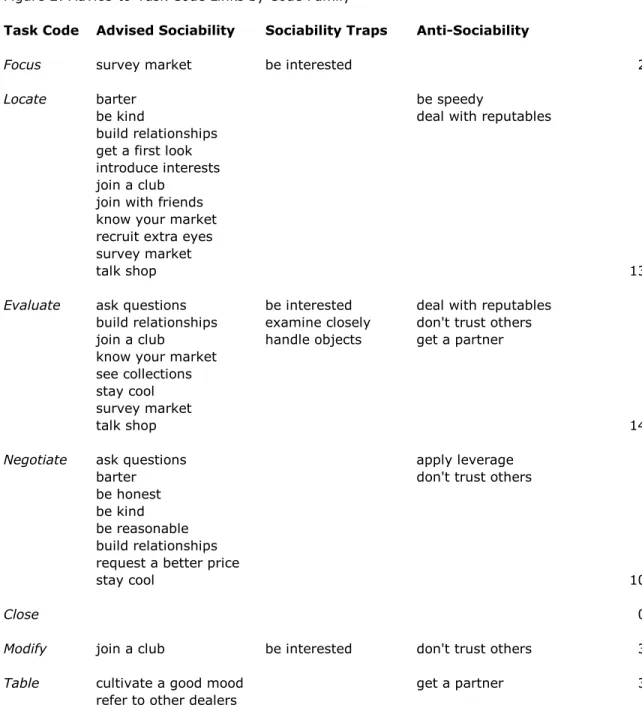
Figure 2 shows the linkages between task and advice codes organized by code family.
The task codes „locate,‟ „evaluate,‟ and „negotiate‟ account for 37 of the 45 total links. This
suggests that the advice codes assigned are concentrated within passages assigned these task
codes. Although „be interested‟ is linked to „focusing,‟ „evaluating,‟ and „modifying,‟ it is a
rare advice code. „Handle objects,‟ and „examine closely,‟ however, are two of the most
frequently assigned codes. Each is linked only to evaluating, making sociability traps
Figure 2: Advice-to-Task Code Links by Code Family
Task Code Advised Sociability Sociability Traps Anti-Sociability
Focus survey market be interested 2
Locate barter be speedy
be kind deal with reputables
build relationships get a first look introduce interests join a club
join with friends know your market recruit extra eyes survey market
talk shop 13
Evaluate ask questions be interested deal with reputables build relationships examine closely don't trust others join a club handle objects get a partner know your market
see collections stay cool survey market
talk shop 14
Negotiate ask questions apply leverage
barter don't trust others
be honest be kind be reasonable build relationships request a better price
stay cool 10
Close 0
Modify join a club be interested don't trust others 3
Table cultivate a good mood get a partner 3
26
particularly concentrated within passages assigned the task code „evaluating.‟ In contrast, the
task code „closing‟ is not linked to any individual advice code. This task code is so
infrequently assigned that no advice code co-occurs with „closing‟ at a meaningful rate.
The use of an etic classification scheme, not found in nor recognized by the advice
book authors themselves, makes coding decisions both subjective and disputable; I was
conservative in including codes in the „advised sociability‟ and „sociability traps‟ families to
avoid overstating the importance of sociability in these markets. Additionally, I marked
questionable codes for later review to minimize the effect of daily mood or disposition.
DATA AND SUBSAMPLES
The data for this project are a set of coded advice books divided into the three
subsamples. These subsamples are shown in Table 1. The first subsample includes ten texts
on singular collectibles with disorganized markets, including antique furniture, ceramics,
antique and vintage watches, and civil war memorabilia. The second subsample includes six
texts on fungible collectibles with organized markets, including books, records, comics, and
trading cards. The third subsample includes four texts on fungible collectibles with organized
markets, including stamps, coins, Beanie Babies™ and Swatch™ watches. The fourth
combination, singular and organized, is an empty cell. I could not come up with a collectible
that was individually produced (or otherwise unsubstitutable) but distributed primarily
through retail or directly from the producer, although it is possible such collectibles exists.
Selection of texts was for range on collectible type and year within each subsample.
Selecting for range limits the possible effect these variables can have on the outcome of the
27
Table 1: Advice Texts by Subsample
Title Year Selections Author Pgs.
Singular-Disorganized Sources
1. Antique Collectors Manual
1952 (1) Detecting Furniture Frauds Raymond F. Yates 22
2. Golden Guide to American Antiques
1967 all Ann Kilborn Cole 100
3. Poor Man's Guide to Antique Collecting
1971 (p5) Reproductions; (p9) All is Vanity; (p47) horsey set
John Mebane 15
4. Medical, Dental and Pharmaceutical Collectibles
1981 Introduction of each section Don Fredgant 10
5. Japanese Antique Furniture
1983 (2) Evaluating; (Appendix 1) Shops
Rosy Clarke 25
6. Idiots Guide to Buying and Selling Collectibles
2000 (21) paintings and drawings Laurie Rozackis 35
7. Practical Guide to Collecting Civil War
2001 all James P Mesker 75
8. Antiques Roadshow 20th Century Collectibles
2002 (1) Ceramics Carol Prissant 30
9. Antique Woodwind Instruments
2005 Intro to Identifying and Valuing Peter Adams 10
10. Watches Warman's Companion
2008 Foreword; Intro; Watch Values and Identification
Dean Judy 25
Fungible-Disorganized Sources
11. How to Identify and Collect American First Editions
1976 All except pgs 20-57 describing specific first edition markings
Jack Tannen 80
12. The Record Collector’s Handbook
1980 Intro plus beginning of chs 1,3,7,12
Allen Leibowitz 35
13. Collecting Comic Books
1983 All chapters but (4) Marcia Leiter 95
14. Idiots Guide to Buying and Selling Collectibles
2000 (10) Cards Laurie Rozackis 20
15. Antiques Roadshow 20th Century Collectibles
2002 (4) Baseball Carol Prissant 30
16. A Guide to Collecting Everyman’s Literature
2005 Everything that wasn’t a bibliographical list
Terry Seymour 80
Fungible-Organized Sources
17. The Complete Book of Coin Collecting
1959 (1) Beginning; (5) Profit; (6) Cleaning and Care
Joseph Coffin 55
18. Stamp Collecting for Fun and Profit
1963 (1) Introduction; (3) XVII-XVIII reprints and forgeries
Fred J Melville 65
19. Complete Idiot's Guide to Beanie Babies
1998 (4) A Little Something Special; (5) Keeping an Eye on Things
Holly Stowe and Carol Turkington
50
20. Swatch: Guide for Connoisseur and Collector
28
histories, and visual dictionaries were excluded, unless they also contained advice for
collectors. Texts came predominantly from the libraries at the University of North Carolina at
Chapel Hill. Others were purchased in bookstores and online.
Some books feature advice for singular and fungible collectibles. Chapters from these
books have been included in each of the samples to further reduce possible confounding
variation. In these cases, chapters are coded and analyzed separately; unspecified chapters
(i.e. a general introduction) are excluded. The fungible subsamples are each smaller than the
singular-disorganized subsample because the singular-disorganized subsample was analyzed
to develop a set of mechanisms linking market objects and advisable behaviors. Theory
testing requires fewer texts than theory development. This design controls for the medium of
the collectibles advice book and the audience of collectors by holding them constant across
the two samples.
Publishing firms act as gatekeepers, designating (and publishing) those they deem
„experts‟ in a field (citation needed). This project assumes that texts are produce by experts
on the subject of the particular market. This assumption is buttressed by biographical claims
about authors that are present on the back covers and within the text of books. For example,
the back cover of The Complete Idiot’s Guide to Beanie Babies® states that one author,
Holly Stowe, “is a regular contributor to Beanie Collector magazine and writes the column
„The Beanie Dance of Joy‟ for Beanie Mania magazine.” Carol Turkington, the other author,
is “the author of two dozen books and magazine articles.” The „About the Author‟ section of
A Guide to Collecting Everyman’s Library announces the author‟s “bachelor‟s degree in
English from Princeton” and boasts that the author‟s collection of Everyman‟s Library books
29
James P. Mesker is “a historical researcher and archivist [that] has been the subject of
articles in the Cleveland Plain Dealer,” has collected for 42 years, won prizes at Civil War
shows, is an active reenactor and is even a “direct descendant of a Civil War veteran.” and
Unfortunately, many of the books were bound for library use, and did not possess the glossy
covers that frequently advertised the expertise of that book‟s author.
THE MEASURES: PREVALENCE AND ODDS RATIOS
The first measure of the relationship between market dimensions and the assignment
of particular codes is the prevalence of those codes within the each subsample. Prevalence
can be absolute or relative. Absolute prevalence is the number of passages within a particular
sample assigned that code. Relative prevalence is absolute prevalence divided by the number
of passages within that subsample with at least one task code „linked‟ to that advice code.
Using relative prevalence is important because the three subsamples contain different
numbers of texts and there may be systematic differences in the length of the books between
samples and the attention given to particular tasks. Relative prevalence corrects for these
imbalances.
While relative prevalence is descriptive and suggestive, it is impossible to assess the
statistical significance of any observed relationships. Logistic (or logit) regression employs
some set of variables to predict a binary outcome for a sample of cases. Using logit models, I
can test the statistical significance of the observed relationships in the data between the
market dimensions of fungibility and organization and whether a passage is assigned a
particular code. The coefficients in the regression equation for „organization‟ and
„fungibility‟ demonstrate the strength and direction of the relationship between that variable
30
However, coefficients are not straightforward to interpret substantively. Coefficients are
transformed into odds ratios by calculating ex where x is the coefficient. In this case, odds
ratios represent the proportional change in odds of a positive outcome if a case were „moved‟
from „0‟ to „1‟ for each variable. The assignment of task codes likely affects the odds of
assigning each of the task codes; if the distribution of tasks differs by subsample, then task
distribution would be a confounding variable. Logit models can include a variable for
CHAPTER THREE:
PREDICTIONS AND ANALYSIS
Based on preliminary coding and analysis of advice books for singular collectibles, I
predicted the following in regards to the contents of the advice books for fungible
collectibles:
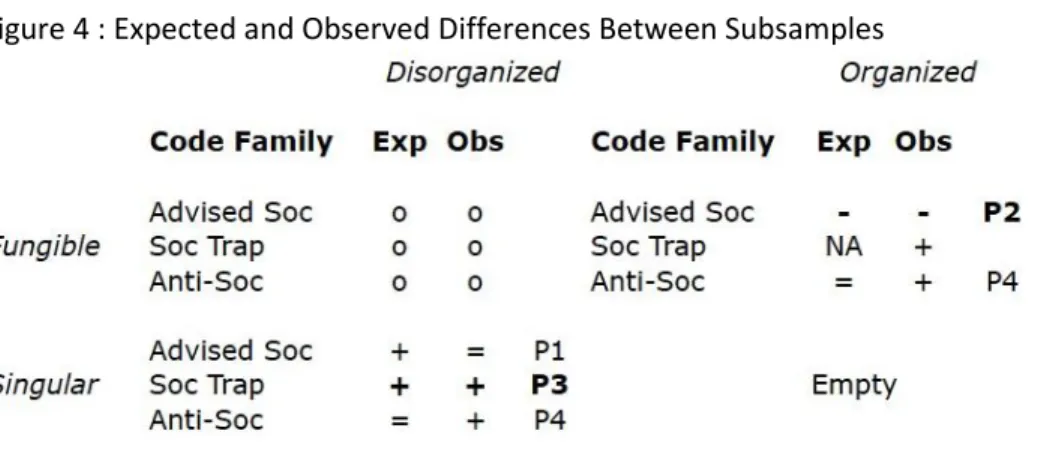
P1: „Advised sociability‟ codes appear more frequently in advice books for singular
collectibles than in advice books for fungible collectibles. This should be
especially true for the „advised sociability‟ codes linked to „evaluating.‟
P2: Within fungible collectibles, „advised sociability‟ codes appear more frequently in
advice books for disorganized than organized collectibles markets.
P3: „Sociability Trap‟ codes appear more frequently in advice books for singular
collectibles, relative to fungible collectibles.
P4: „Anti-sociability‟ codes appear infrequently, with no clear difference between the
two samples
DISTRIBUTION OF TASK CODES
Figure 3 shows the distribution of task codes by subsample and illustrates three
32
collectibles is not even. Second, the distribution of tasks differs by subsample. Third, not all
tasks „contribute‟ equally to the population of advice codes.
Guidebooks brim with advice on evaluating and, to a lesser extent, focusing, locating
and modifying objects. Learning to recognize valuable pieces is key to the one‟s
development as a collector. Heuristics, rules for evaluating objects, also seem well suited to
the medium of the guidebook. They can often be easily expressed in words and are not often
limited to particular geographic regions. Locating pieces, on the other hand, often requires
highly particular knowledge of actual sources in an area. This sample features almost no
advice on closing a deal once a price has been negotiated or on occupying a table or booth for
the purposes of selling. The twelve passages coded for tableing all come from a single text on
Singular Disorg (552 total) Fung Disorg (373)
Fung Org (391) Contribution (477) 0 50 100 150 200 250 300 350 400 355 64 48 16 3 79 0 180 58 46 16 3 90 0 233 46 45 25 0 53 12 330 86 11 41
2 13 4
Sample Freq
Task
Evaluate Locate Modify Negotiate Close Focus Table Singular Disorg (552 total) 355 64 48 16 3 79 0
Fung Disorg (373) 180 58 46 16 3 90 0
Fung Org (391) 233 46 45 25 0 53 12
Contribution (477) 330 86 11 41 2 13 4
Figure 3: Distribution of Task Codes by Subsample
33
collecting beanie babies. This suggests that advice for these tasks is either considered by
authors to be self-evident, too difficult to put down in words, or not important enough to
warrant more coverage.
The distribution of tasks appears to differ by subsample. Even though the
fungible-disorganized subsample has fewer passages overall, it clearly has a lower rate of evaluating
codes and increased rates of focusing and locating codes. I assigned „evaluating‟ to 48.3% of
the fungible-disorganized passages, compared to 64.3% of the singular-disorganized
passages and 59.6% of the fungible-organized passages. I assigned „locating‟ to 15.6% of
passages in the fungible-disorganized subsample, while only 11.6% of singular-disorganized
and 11.8% of fungible-organized passages were coded for locating. I assigned „focusing‟ to
24.1% of fungible-disorganized passages, compared to 14.3% of the singular-disorganized
passages and 13.6% in the fungible-organized passages. For each of these tasks, rates are
roughly similar between the singular-disorganized and fungible-organized subsamples, but
different from the fungible-disorganized subsample. One exception is the task of negotiating,
which is much more common in organized passages than both
fungible-disorganized and singular-fungible-disorganized passages.
Finally, some tasks co-occur with advice codes at higher rates. The number of
passages where a task code co-occurs with any advice codes is its contribution. Negotiation,
a relatively marginal task assigned to only 57 passages, „contributes‟ 41 passages with coded
advice. This is a more than contributions of focusing, closing, modifying and tableing
combined. Only evaluating, locating, and negotiating contribute instances of an assigned
advice code at a rate higher than 1/3. Because the advice codes used in this project cover both
34
or evaluating objects, or negotiating their sale is to be sociable. However, the sociability (or
lack thereof) of one‟s actions appears highly relevant to these tasks.
The overlap of advised sociability codes and the various task codes provide evidence
for the existence of the two mechanisms, sociable „acquisition‟ and „lubrication,‟ proposed to
explain the benefits of sociability. Sociable acquisitions are necessary for tasks of focusing,
locating, evaluating, modifying, and tableing. These tasks require skills, knowledge, contacts,
and perspective that may be accrued through sociable interaction. About 13% of the 1,256
passages assigned at least one of those task codes was also assigned an advised sociability
code. Sociable lubrication is necessary for tasks of negotiation and closing. While at least one
of these task codes were assigned to only 63 passages, 37 were assigned advised sociability
codes. While there is clearly some evidence to support the existence of each mechanism, the
vast differences in the attention paid to these two subsets of tasks makes it difficult to
35
Table 2: Absolute and Relative Prevalence of Advice Codes by Subsample
Code A (0,0) E (0,0) R (0,0) A (1,0) E (1,0) R (1,0) A (1,1) E (1,1) R (1,1) AdvisedSoc 78 549 0.142 63 370 0.17 60 391 0.153 Soc Trap 136 474 0.287 31 299 0.104 60 311 0.193 Anti-Soc 45 478 0.094 8 296 0.027 29 357 0.081
Individual Codes that Favor Fungible Collectibles (strongest to weakest effect)
talk 4 416 0.01 7 236 0.03 3 278 0.011
request 1 16 0.063 3 16 0.188 2 25 0.08 barter 2 80 0.025 5 74 0.068 7 70 0.1 ask 8 371 0.022 9 196 0.046 4 258 0.016 survey 12 487 0.025 15 311 0.048 9 312 0.029 see 7 355 0.02 5 180 0.028 4 233 0.017 intro 8 64 0.125 10 58 0.172 4 46 0.087 build 11 432 0.025 7 252 0.028 3 302 0.01 know 13 416 0.031 8 236 0.034 10 278 0.036
Individual Codes that Favor Singular Collectibles (strongest to weakest effect)
handle 22 355 0.062 1 180 0.006 11 233 0.047 club 7 463 0.015 1 281 0.004 9 321 0.028 don’t 21 418 0.05 3 240 0.013 22 301 0.073 reputable 22 416 0.053 5 236 0.021 7 278 0.025 exam 122 355 0.344 29 180 0.161 48 233 0.206 recruit 7 64 0.109 3 58 0.052 2 46 0.043 first look 4 64 0.063 2 58 0.034 0 46 0 honest 5 16 0.313 4 16 0.25 4 25 0.16
Rare Advice - Absolute Prevelance for whole sample is <5
interest 2 474 0.004 1 299 0.003 1 311 0.003 leverage 2 16 0.125 1 16 0.063 1 25 0.04 friends 0 64 0 1 58 0.017 1 46 0.022 stay cool 2 371 0.005 0 196 0 2 258 0.008 reasonable 1 16 0.063 0 16 0 1 25 0.04 kind 1 80 0.013 0 74 0 1 70 0.014 get partner 1 355 0.003 0 180 0 1 245 0.004 speedy 1 64 0.016 0 58 0 0 46 0 cultivate 0 0 NA 0 0 NA 1 12 0.083
refer 0 0 NA 0 0 NA 1 12 0.083
note: A=absolute prevalence E=exposure R=relative prevalence
DISTRIBUTION OF ADVICE CODES: DESCRIPTIVE STATISTICS
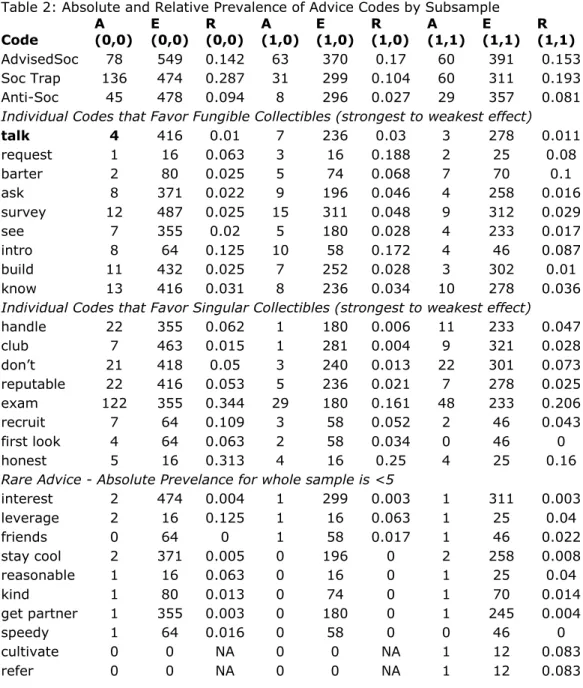
Table 2 shows the absolute and relative prevalence of code families and individual
advice codes within each subsample. For example, „talk shop‟ was assigned to four passages
in the singular-disorganized subsample (highlighted in bold). The code „talk shop‟ is only
36
coded for locating or evaluating (or both). The relative prevalence of talk shop in the
singular-disorganized subsample is about .01, or 1%. The fungible-disorganized subsample‟s
has seven passages assigned this advice code and 236 passages coded for locating or
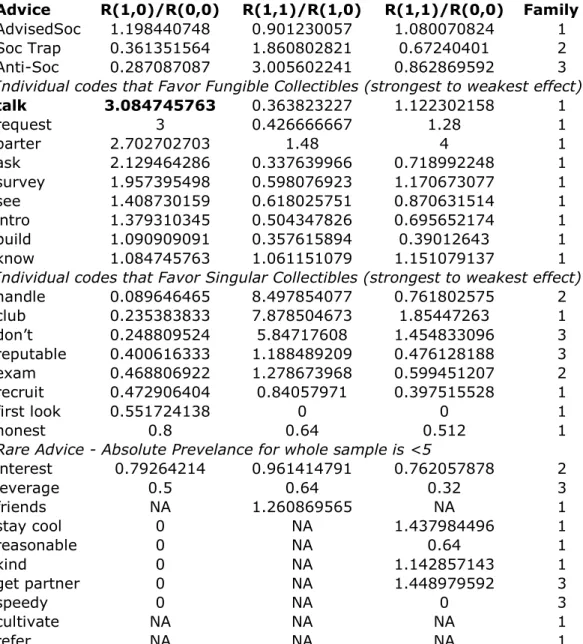
evaluating, for a relative prevalence of about .03. The ratio of relative prevalence (shown in
bold in Table 3) by fungibility is about 3:1 in favor of fungible texts.
Table 3: Relative Prevelance Ratios
Advice R(1,0)/R(0,0) R(1,1)/R(1,0) R(1,1)/R(0,0) Family
AdvisedSoc 1.198440748 0.901230057 1.080070824 1
Soc Trap 0.361351564 1.860802821 0.67240401 2
Anti-Soc 0.287087087 3.005602241 0.862869592 3
Individual codes that Favor Fungible Collectibles (strongest to weakest effect) talk 3.084745763 0.363823227 1.122302158 1
request 3 0.426666667 1.28 1
barter 2.702702703 1.48 4 1
ask 2.129464286 0.337639966 0.718992248 1
survey 1.957395498 0.598076923 1.170673077 1
see 1.408730159 0.618025751 0.870631514 1
intro 1.379310345 0.504347826 0.695652174 1
build 1.090909091 0.357615894 0.39012643 1
know 1.084745763 1.061151079 1.151079137 1
Individual codes that Favor Singular Collectibles (strongest to weakest effect)
handle 0.089646465 8.497854077 0.761802575 2
club 0.235383833 7.878504673 1.85447263 1
don’t 0.248809524 5.84717608 1.454833096 3
reputable 0.400616333 1.188489209 0.476128188 3
exam 0.468806922 1.278673968 0.599451207 2
recruit 0.472906404 0.84057971 0.397515528 1
first look 0.551724138 0 0 1
honest 0.8 0.64 0.512 1
Rare Advice - Absolute Prevelance for whole sample is <5
interest 0.79264214 0.961414791 0.762057878 2
leverage 0.5 0.64 0.32 3
friends NA 1.260869565 NA 1
stay cool 0 NA 1.437984496 1
reasonable 0 NA 0.64 1
kind 0 NA 1.142857143 1
get partner 0 NA 1.448979592 3
speedy 0 NA 0 3
cultivate NA NA NA 1
refer NA NA NA 1