2020. 45 pages. Advisor: Sandra Hughes-Hassell
This study examined themes of diversity within the Strategic Planning documents of academic libraries listed as members of the Association of College and Research
Libraries. A quantitative and qualitative analysis was conducting using a coding scheme designed for identifying diversity themes within academic library diversity statements as well as additional themes relating to actions described as furthering diversity. Results indicate that while many of the academic libraries include diversity as a value and a strategic goal, few are interpreting and contextualizing diversity within the strategic plan, indicating an issue between an ascribed ideal versus policy put into practice.
Headings:
Academic Libraries – Strategic Plans Diversity
FROM CONCEPT TO PRACTICE: THEMES OF DIVERSITY WITHIN THE STRATEGIC PLANNING OF ACADEMIC LIBRARIES
by
Margaret McGuire
A Master's paper submitted to the faculty of the School of Information and Library Science of the University of North Carolina at Chapel Hill
in partial fulfillment of the requirements for the degree of Master of Science in
Library Science.
Chapel Hill, North Carolina April, 2020
Approved by:
Table of Contents
INTRODUCTION ... 2
LITERATURE REVIEW ... 3
STRATEGIC PLANS IN ACADEMIC LIBRARIES ... 3
DEVELOPING DIVERSITY POLICY IN ACADEMIC LIBRARIES ... 5
STATUS OF DIVERSITY INITIATIVES IN ACADEMIC LIBRARIES ... 6
SIGNIFICANCE OF DIVERSITY INITIATIVES ... 9
RESEARCH QUESTION ... 11
RESEARCH METHODS ... 12
DATA COLLECTION ... 13
DATA ANALYSIS ... 15
LIMITATIONS ... 16
RESULTS ... 17
COMMON DIVERSITY THEMES IN STRATEGIC PLANS ... 17
LIBRARY ROLES RELATING TO DIVERSITY WITHIN STRATEGIC PLANS ... 19
IDENTIFIED ACTIONS OF THE LIBRARY RELATING TO DIVERSITY WITHIN STRATEGIC PLANS ... 20
FREQUENCY OF DIVERSITY,INCLUSION,EQUITY WITHIN STRATEGIC GOALS ... 22
DISCUSSION ... 25
COMMON THEMES OF DIVERSITY WITHIN STRATEGIC PLANS ... 25
ROLE OF THE LIBRARY IN RELATION TO DIVERSITY AND STRATEGIC PLANS ... 28
FREQUENCY OF DIVERSITY,INCLUSION, AND EQUITY ... 30
CONCLUSION ... 32
BIBLIOGRAPHY ... 33
Introduction
Diversity has become one of the emerging priorities of universities and college campuses around the United States. Institutions have begun to incorporate goals of diversity into their mission statements, surrounding the campus environment, student body, staff and hiring practices, and into programs. So prevalent have themes of diversity and inclusion become in higher education that it has become difficult to distinguish what the term ‘diversity’ is meant to encompass.
Academic libraries have similarly started to rise to the challenge of making diversity a priority in their collections, services, spaces, and staff. The Association of College & Research Libraries (ACRL) has developed its own document detailing the standards of cultural competency and diversity that are expected within academic libraries. These standards are meant to guide libraries toward reflection upon the role of libraries within their communities, upon the historical systemic oppression that has disadvantaged marginalized groups, and upon the need for cultural pluralism and diverse perspectives to enrich the library and create an environment in which the information needs of every member of the university community are supported.
resource and collection development, in staffing and hiring decisions. How the library conceptualizes these themes of diversity, inclusion, equity, and accessibility are crucial in understanding how academic libraries intend to pursue and develop initiatives that
correspond to these ideals. One method of investigating this is through examining the elements of diversity incorporated into the strategic plans of the academic libraries and assessing how they are expressed, what themes and ideas are conveyed, and if there are specific actions that the library identifies and intends to pursue.
Literature Review
Strategic Plans in Academic Libraries
The academic library resides within the epicenter of the continuously evolving
community of the university. A myriad of trends, developments, and structural reform brought forth by the surrounding university, academic departments, and the needs of a growing, changing, and diverse population contend with budget cuts, sustainability of resources and services, hiring practices and workplace workflow, and expensive contracts with digital resources that have become unsustainable. One way in which academic libraries draw upon resources, develop ideas and strategies to respond to these trends, and then guide the implementation of them is through the strategic plan.
The strategic plan aims to plan for variables within the upcoming future of the academic library that are both reasonably certain and uncertain for years at a time.
planning for academic libraries should include other common themes like a SWOT analysis, analyzing trends and developing strategies, and measuring progress (Morgenstern & Jones, 2012).
There is substantial variety within strategic plans, based upon the current leadership of the library, the trends in technology and practice, and the influences and priorities of the surrounding university and community in which the library is situated. Dillon (2008) asserted that academic libraries must align operations with the mission of their host institutions to thrive and remain relevant in the university community - this stands to reason, as the library is affected by and aims to affect the patron communities visiting the building and accessing resources as well as the overarching guidance of the administration that determines where funding is allocated. However, at the same time, the academic library must also consider resource allocation wisely in terms of short and long term initiatives, standard and experimental services, and staff skill set. Certain trends may seem popular in the moment but could fade within a year or two, while others may grow in prominence and become core services of the library. In 2015, Saunders performed a content analysis of strategic plans: she found that academic libraries at the time were prioritizing traditional services like reference and collections, with less emphasis on data management, digital humanities, and mobile/device neutral environments, which had been identified by the ACRL as emerging trends. Saunders asserted that libraries
continue to hesitate forging into new areas due to limited resources or relative importance to these areas for their campuses and fields - however, it is clear now that data
Indeed, trends continue to affect the academic library’s strategic initiatives and planning, not only in services and collections, but in the physical space of the library, staff and management, and funding allocation. Increasingly within the past few years, diversity has emerged as a growing trend within communication, core values, and administration for academic libraries.
Developing Diversity Policy in Academic Libraries
There have been several recent studies within the field that have examined diversity policies in concept and practice. A primary point of focus appears through examining priorities stated in the diversity policy contrasted with actual outcomes in academic libraries. Alabi (2018) examined discrepancies between the American Library Association (ALA) and Association of Research Libraries (ARL) initiatives to encourage recruitment and retention of a diverse workforce with the lack of substantial impact upon the profession, which has remained predominantly white. Other studies provide detailed descriptions, instructions, and advice for the creation of diversity statements within academic libraries using case studies, as represented by the Edwards (2015) article examining the University of Montana Libraries. These studies provided a framework for gathering support for diversity initiatives, creating a committee and drafting the strategy, and then implementing the policies. While this study does not focus in particular upon the library but for the university as a whole, Louden (2017) describes the process of
developing an initiative for remodeling the bathrooms and lockers on campus to
indicates that academic libraries are still developing diversity policies in different ways and at different levels, but a major theme arising from all of them are the need for careful consideration of the concept of diversity, equity, and inclusion, how those concepts can be operationalized, and outcomes assessments to determine areas of improvement.
Status of Diversity Initiatives in Academic Libraries
From the current literature on diversity initiatives, there is an apparent challenge within sustaining diversity initiatives as long-term services provided by the library. Love (2001) found that from the diversity initiatives in his study, there was a lack of critical assessment and reflection for the initiative at almost every stage of the process: prior research, methodology, and instrumentation. His work argued that behaviors, more than attitudes, were the cause for significant problems in managing diversity initiatives, and that initiatives could not be sustained without critical reflection upon the means and outcomes that would result in improvements. Semeza et al (2017) performed a literature review on diversity initiatives from 2010 to 2015, which investigated the popular areas in which these initiatives were occurring, for example hiring, collections, services,
that the range of visibility ranged from simple diversity statements below the mission statement to subpages devoted to describing initiatives and diversity committee members. Mathuews (2017) asserted that the one solution to this challenge of sustaining diversity initiatives was to instill, foster, and support a spirit of social justice within the
institutional framework of the library.
Cultural Competency has become a growing theme within the current literature on diversity policy, primarily within studies of the workplace in academic libraries. Lazzaro et al (2014) provides the blueprint of how they implemented the ACRL Diversity
Standards on their campuses, including planning, trainings and workshops, outreach, and assessment of cultural competency in staff at the library. Andrade and Rivera (2011) similarly discuss the initiative undertaken by the University of Arizona libraries to perform climate surveys of the current and developing atmosphere surrounding diversity in the workplace, training for cultural competency in hiring and other training processes, and assessing the results and importance. These studies, and many of the case studies within the current literature, reflect initiatives undertaken with the spirit of the diversity statement, which provide more general themes and goals, but were not explicitly stated as planned from the diversity statement itself.
The area of collections and services in academic libraries has seen developments in diversity and initiatives, through physical collections, technology and web tools, and outreach services. Ciszek and Young (2010) investigated how the impact of diversity collection could be measured in large academic libraries and found that impact was difficult to measure from standard methods due to subscription services and bulk
(2015) provided a framework for the creation of diversity collections for library technology, which surrounded on five dimensions: people, content and pedagogy, embeddedness and the global perspective, leadership, and accumulation. While many studies have investigated the monograph, serials, and archival collections of the library within diversity initiatives, Dewey’s framework provides a rare recommendation for technology diversity. Maloney (2012) described a case study of the University of the Pacific in their Diversity Book Display Initiative, which sought to curate displays to promote multicultural learning and inclusivity and build intra-institutional relationships with curricular and co-curricular units engaged in diversity work on campus.
The hiring practices and workplace culture of libraries have received considerable attention from LIS scholarship and research, though the issue with retention and
conversation about how librarianship can meaningfully address systems of structural oppression in order to actualize diversity and inclusion initiatives in academic libraries.
Significance of Diversity Initiatives
Often the actualization of diversity within academic libraries is best seen through investigations into the diversity initiatives that have started from the awareness and assessment of need. Todorinova and Ortiz-Myers (2019) surveyed academic librarians and library administrators to discover more about how librarians were interpreting diversity, how they were supporting Lesbian, Gay, Bisexual, Transgender, and
Questioning (LGBTQ+) resources, programming, and collections on campus, and what factors assisted or acted as barriers to these information needs. Ciszwk (2011)
Interpretation of diversity and diversity-seeking initiatives can take many forms within an academic library environment. Academic libraries have been investigating how to improve services for patrons of color, though most studies tend to focus on
undergraduate students and international students. Everett (2018) describes the implementation and analysis of the Race Card Project initiative at a large academic library, in which a public message board was constructed so that candid anonymous submissions from the public were used to promote multicultural learning and inclusivity. Albarillo (2018) analyzed a survey of foreign-born students and how they use academic and public library services, employing the theory of “super diversity” to discuss how multiple identities and categories of belonging are important variables when engaging public services as well as the ACLR Diversity Standards guidelines for improving services to foreign-born students. Jia (2001) found that causes for library anxiety from international students were predominantly affective barriers (library space) and staff barriers.
professionalism. Awais and Ameen (2015) found that students with disabilities in Pakistan were relying primarily on teachers and families for support accessing information and that libraries and schools were not meeting the requirements for information services for students with disabilities.
The current research, initiatives, and projects ongoing to improve diversity within academic libraries are both inspiring and revealing, both of the commitment that many librarians feel toward furthering diversity, inclusion, equity, and accessibility on campus as well as the clear need for further research and integration into the culture, policies, and future strategy of academic libraries as an institution. However, to ensure long-term development of these ideals, the academic library should be considering in detail how diversity, equity, inclusion, and accessibility feature into their plans for the immediate and distant future. Development of diversity should be continual and exponential rather than as ad-hoc or short term projects on campus or with singular departments with similar goals. Each project, initiative, and partnership should build upon past developments and grow with the institution in order to ensure long-term realization of these goals.
Because strategic plans are one way in which the academic library expresses future goals for services, collections, staff, and community, this study sought to analyze strategic plans for themes of diversity in order to get a better understanding of how academic libraries were incorporating diversity as a concept into actionable policy.
Research Question
Research Methods
A content analysis was applied to the strategic plans of college and university libraries. Content analysis has long been used as a powerful tool for a range of analysis, including determining authorship, identifying and examining trends and patterns, and evaluating change over time amongst documents within the public domain (Stemler, 2001). The ability to code and categorize the data available, which may then form categories and groups for analysis of common themes, is the central motivation for my use of content analysis upon the strategic plans of the available academic libraries.
While investigating appropriate methodologies for this study, there proved little published scholarly work that examined diversity themes within strategic planning at this time. Two works were influential when constructing and evaluating the methodology of this study. Clifton (2019) and Merkl (2011) both examined and codified themes of diversity, the former a master’s thesis of academic library diversity statements, the latter diversity statements from universities. Clifton (2019) adapted the coding scheme and methodology created by Merkl (2011) to apply toward diversity statements from those members of the American Library Association who were also associated with a Library Science program at the university. This study similarly employs an adapted methodology from Merkle (2011) for strategic plans produced by academic libraries, by replacing “university” with “academic library.” Clifton (2019) argues that the construct of the diversity statements produced by academic libraries should resemble those of a university’s and adapted the model to include additional elements more directly
and goal statements toward furthering the future actions and purpose of the academic library. Diversity statements are, by their nature, intrinsically connected to diversity as a core value, but due to the recent prevalence of diversity listed as a core value within strategic plans, applying this coding scheme should reveal new and important information about how academic libraries are conceptualizing and aiming to achieve diversity goals in their community. While not a perfect coding scheme for this type of document, the
parallels between purpose should suffice for an exploratory study interested in assessing themes.
Data Collection
The population for this study is the strategic plans of university libraries in the United States. For the purpose of this study, any document that identified itself as a strategic plan, goals, guideline, frames, etc., essentially a document that conveyed the short to long term goals of the academic library was counted as the strategic plan.
The sample from this population includes all university college libraries listed as members of the Association for College and Research Libraries, access through the ACRL website in January 2020. This included a list of 147 libraries total, which can be viewed in Appendix A.
“strategic plan” or the word “strategic” and review the first two pages of results for relevant materials. On occasion, I searched within the library’s website itself using a search bar. For the purposes of this study, I looked only at the material under the section described as strategic plans/goals/frames – mission, value statements, and guiding
principles were not included in the content analyzed in this study. Many of the university libraries included in this study have separate diversity statements on their websites – unless they were provided within the strategic plan, they were not included in this study.
There were three methods of exclusion within this strategy. The first was whether the library was a member of ACRL and located within the United States. The second was whether the institution existed within a college or university, meaning that government and public libraries would not be included. The final condition was whether the strategic planning document was available publicly. Forty-three of the members met one of these exclusion conditions. Out of the one hundred and twenty-four libraries listed as members of the ACRL, seventy-nine strategic plans were available for viewing through the
library’s home page and two through contact with a librarian at that university, for a total of eighty-one strategic plans. Once the strategic plans were gathered, I compiled the strategic plans into a folder on my computer and assigned numbers to the titles. I then printed out the plans and hand-coded the physical copy.
detailed themes described in the methodology in the strategic plan but do have these themes listed as diversity statements on their website.
Data Analysis
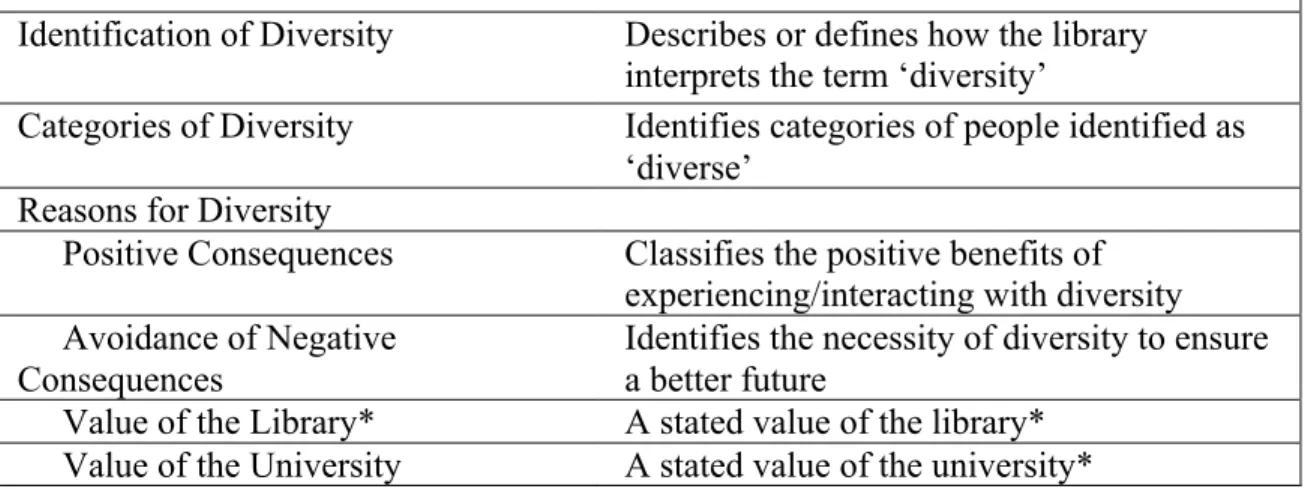
After searching for available coding schemes that would be applicable for this document set, I settled upon the common themes outlined by Merkl (2012), a coding scheme developed through a content analysis of university diversity statements. Because Merkl’s coding scheme focuses on identifying diversity themes within a university context, it should still be applicable for an academic library setting, whose goals and values often mirror those of the university itself and whose conceptual frame of diversity is similar. For this study taking guidance from both Merkl (2012) and Clifton (2019), I have substituted “library” for “university” – I have marked these changes and my additions to the coding scheme with asterisks. Application of this coding scheme will identify common themes and patterns relating to diversity within the library strategic plans.
Table I: Common Themes Within Diversity Statements Diversity
Identification of Diversity Describes or defines how the library interprets the term ‘diversity’
Categories of Diversity Identifies categories of people identified as ‘diverse’
Reasons for Diversity
Positive Consequences Classifies the positive benefits of experiencing/interacting with diversity Avoidance of Negative
Consequences
Identifies the necessity of diversity to ensure a better future
Achievement of Goals Diversity as something that can help the library achieve its goals*
Value of ACRL* A stated value of the Association of College and Research Libraries
Library (Role of the Library)
Actions towards diversity Describes actions the university takes toward diversity
Possessor Identifies the library as possessing diversity
Provider Recognizes the library as a provider of
opportunity
Acknowledging Recognition of past discrimination/exclusion of certain peoples from academia or
academic libraries* Emphasis of Diversity*
Diversity/Diverse
Inclusion/Inclusive/Inclusivity Equity/Equitable
Category of Diversity Action*
Hiring/Recruiting* Identifies hiring/recruiting as an action in the context of diversity planning
Collections* Identifies collection development as an action in the context of diversity planning Services* Identifies services as an action in the context
of diversity planning
Partnerships (Library/Community)* Identifies partnerships within the library and university community as actions in the context of diversity planning
Retention/Career Development* Identifies retention/career development as an action in the context of diversity planning
Limitations
attempted to obscure or anonymize each data entry, but due to the inclusion of university colors, symbols, and title references, it was not possible to completely obscure the identity of the university from which the academic library strategic plan came. I am also familiar with the strategic plan of my current university library as well. Due to the nature of content analysis, best research practice dictates that this method should be
supplemented or triangulated through other methods like interviews or surveys. Due to time and commitment restraints, this study has not included these additional
methodologies.
Results
Common Diversity Themes in Strategic Plans
From the analysis of the data, the context of how diversity is included in strategic plans becomes clear. Reasons for Diversity (See Graph I) accounted for the most frequent theme found within strategic plans (75.3%), with sixty-one of the plans surveyed
accounting for at least one reason for the importance of diversity within the goals of the academic library. Categories of Diversity was the second visible theme, though only eight strategic plans identified specific populations within the context of diversity (9.8%). Only one strategic plan out of eighty-one strategic plans included the academic library’s
Graph I: Common Themes Relating to Diversity in Strategic Plans (n=81)
Graph II: Percentage of Population With Publicly Available Diversity Statements on Website
(n=81)
The Reasons for Diversity included six categories of interest (See Graph III).
Positive consequences accounted for the most frequently indicated reason for diversity in
the strategic plan, with fifty-four plans identifying at least one positive consequence (66.6%). The next reason that appeared most frequently was the recognition of diversity as a Value of the Library with forty-two plans (51.8%). Identifying diversity as a Value of
1 8
61
0 10 20 30 40 50 60 70
Identification of Diversity Categories of Diversity Reasons for Diversity
Common Themes Relating to Diversity in Strategic Plans
49%
51%
Diversity Statement on Library Website
Libraries with Separate Diversity Statement on Website
the University (35.8%) was slightly more frequent than as tied to Achievement of Goals
(28.3%). The two reasons for diversity within strategic plans that were least mentioned were as an Avoidance of Negative Consequence (1.2%) and a Value of the ACRL (1.2%).
Graph III: Reasons for Diversity Within Strategic Plans (n=81)
Library Roles Relating to Diversity within Strategic Plans
When considering the academic library’s role relating to diversity, the strategic plans indicated that Actions Towards Diversity was the most frequent role for the library with forty-nine (60.4%). The second most frequent role mentioned in the strategic plans was Possessor of Diversity (59.2%), followed closely by the role of Provider of
Opportunity at 55.5%. The least frequent role visible was the role of Acknowledging, with
only five (6.1%) of the strategic plans identifying libraries describing the role of the library as acknowledging past discrimination. From the surveyed plans, eighteen (22.2%) did not describe a role of the library relating to diversity at all.
54 1 29 42 23 1 0 10 20 30 40 50 60 Positive Consequences Avoidance of Negative Consequences
Value of the University
Value of the Library Achievement of Goals
Value of the ACRL
Graph IV: Role of the Library Relating to Diversity Within Strategic Plans (n=81)
Identified Actions of the Library Relating to Diversity Within Strategic Plans
From the analysis of the strategic plans, five categories of specific actions relating toward diversity emerged within that the academic library described (See Graph V). These categories included Hiring/Recruitment, Collections, Services,Partnerships, and
Retention/Career Development, specifically within the context of diversity planning.
From these, Services and Partnerships were tied for the highest frequency and appeared within thirty-three strategic plans a piece, both appearing within 40.7% of the total sample. Similarly, Hiring/Recruitment, Collections, and Retention/Career Development
appeared within thirty strategic plans a piece, at 37% of the total sample.
49 48 45 5
18
0 10 20 30 40 50 60
Acting Towards… Possessor Provider Acknowledging None
Graph V: Types of Actions Relating to Diversity Described in Strategic Plans (n=81)
The frequency of diversity-specific action within the strategic plans as defined by the study’s categories are below (See Graph VI). Of the plans surveyed, fifty-seven (70.3%) included at least one category of diversity specific action. Forty-six (56.7%) plans
included two or more categories, thirty (37%) included three or more, and fifteen (18.5%) included four or more categories. Ten plans (12.3%) included all five categories of
diversity-specific action within their strategic plans, while the remaining twenty-four plans (29.6%) from the survey did not include any of the categories at all. Interestingly, of the thirty plans that included the category Hiring/Recruitment as one of the described diversity-specific actions, twenty-four (80%) also included the category Retention/Career
Development, while six (20%) did not (See Graph VII).
28 29 30 31 32 33 34
Hiring Collections Services Partnerships Retention/Career Development
Graph VI: Frequency (Number of Times) in which Strategic Plans Described Diversity Specific
Actions (n=81)
Graph VII: Percentage of Strategic Plans that Included Hiring/Recruitment and Retention/Career
Development (n=81)
Frequency of Diversity, Inclusion, Equity Within Strategic Goals
The analysis of the strategic plans included surveying the frequency of specific diversity-related phrases within the strategic goals described within the plans (note: within the specified goals and initiatives, not the overall plan). Within the total plans
24
57
46
30
15
10
0 10 20 30 40 50 60
None At Least One
Category Two or More Categories Three or More Categories Four or More Categories Five Categories
Frequency of Diversity-Specific Action in Strategic Plans
80% 20%
Hiring & Retention/Career Development
Included
Retention/Career Development Excluded
surveyed, the frequency of the words “diverse” and/or “diversity” are displayed below (See Graph VIII). Eleven (13.5%) of the plans did not include the words at all within the strategic goals. Forty-one plans mentioned the words one to three times, making up 50% of the total sample. Ten plans (12.3%) mentioned the words “diverse” and “diversity” over ten times within the strategic goals, with the highest number of mentions at twenty times within the strategic goals.
Graph VIII: Number of Times “Diverse/Diversity” Mentioned in Strategic Goals (n=81)
Within the analysis of the strategic goals, the frequency of the words “inclusion” and/or “inclusive” were counted (See Graph IX). Thirty-six (44.4%) did not mention one of the two words throughout the strategic goals, with nineteen plans mentioning them once (23.4%) and twelve mentioning them twice (14.8%). Four of the strategic plans (4.9%) surveyed mentioned “inclusion” or “inclusive” eight or more times, with the highest frequency in the strategic goal section at 15 times.
0 2 4 6 8 10 12 14 16 18
0 1 2 3 4 5 6 7 8 9 10 11 12 13 14 15 16 17 18 19 20 Number of Times "Diverse/Diversity" Mentioned
Graph IX: Number of Times “Inclusion/Inclusive/Inclusivity” Mentioned in Strategic Goals
(n=81)
When analyzing the strategic goals within the plans, a third focus was placed upon the frequency of the terms “equity” and/or “equitable” appearing (See Graph X). These terms appeared the least frequent out of the phrases surveyed, with the total number of times across all of the sample at fifty-nine mentions. Fifty-one plans (62.9%) did not mention either of the terms within the strategic goals at all. Seventeen plans (20.9%) mentioned the terms once within the goals, with five plans mentioning one of the terms twice (6.1%) and four mentioning the terms three times (4.9%). The highest frequency of “equity” or “equitable” mentioned within the strategic goals was nine times within one plan.
0 5 10 15 20 25 30 35 40
0 1 2 3 4 5 6 7 8 9 10 11 12 13 14 15 16
Graph X: Number of Times “Equity/Equitable” Mentioned in Strategic Goals (n=81)
Discussion
Common Themes of Diversity Within Strategic Plans
While a majority of the plans included at least one of the common themes of diversity, the distribution of the themes was starkly different. Reasons for Diversity was the most frequent theme, included within sixty-one strategic plans, and primarily
considered the positive consequences of diversity and its value to the library. This makes sense in the context of a strategic plan, as discussion of diversity in relation to goals lends itself to expected positive outcomes from including it within the academic library’s future and more nebulous statements about the library’s values. Strategic plans typically
described these positive consequences in relation to building the community, diversifying collections and services, and creating a diverse staff, with outcomes including closer relationships with the community, deeper understanding of the diverse community that the library serves, and enabling student success. For those plans that identified diversity in terms of a value of the university, this was often phrased in relation to the expressed
0 10 20 30 40 50 60
0 1 2 3 4 5 6 7 8 9 10 11 12 13
value of the university, to the university community, and as linking to the university specific diversity statement or initiative. The category Achievement of Goals, in the context of this study, was treated as an explicit goal within the strategic plan with associated actions and appeared within twenty-three plans – this suggests that while libraries considered diversity an important value of the library, they were not fully incorporating diversity action as a strategic goal within the plan.
The second theme, Categories of Diversity, was meant to show the distribution of strategic plans that specifically address marginalized populations or identified at least one marginalized population within the plan. Only eight strategic plans described the
marginalized community that they wished to reach within their strategic goals, and typically in general terms like “marginalized groups,” “underrepresented populations,” and “Indigenous peoples” rather than identifying specific marginalized communities. Most strategic plans spoke of goals and initiatives in terms of patron type: students, faculty, researchers, visitors, community members.
specific populations that are included within the term diverse, the strategic plan lacks clarity, context, and direction.
The use of the strategic plan as both a guiding document and a promotional message for the public facing image of the library perhaps complicates the situation. Purpose of the strategic plan determines its length, presentation, and depth – one might not expect a strategic plan to be fully explicit of terms and goals if the intent is to attractively and concisely present the guiding principles and values to the public and professional community, rather than as an in-depth and detailed menu for initiatives, budget strategies, and assessment. The variety within the sample included strategic plans with varying degrees of both elements. Another factor complicating this analysis is that many academic libraries have created diversity statements or sections of their website that seek to address definitions and actions, separately from the strategic plan. The necessity of including the definition and categories of diversity within the strategic plan itself, when a diversity statement also exists, is debatable. However, as seen in Graph II, a little under half of the sample academic libraries included a diversity statement on their website. This indicates that a significant portion of the academic libraries represented in this study did not have a diversity statement on their website or defined diversity within their strategic plan, despite the prevalence of the term and the frequency of positive consequences associated with diversity within the strategic plans.
through the prevalence within the strategic plans, but without defining diversity or the specific populations being addressed, the goals lack direction and accountability.
Role of the Library In Relation to Diversity and Strategic Plans
In terms of how the academic library viewed its role in relation to diversity, the strategic plans revealed that the surveyed libraries viewed themselves with the potential to act toward diversity, as possessing diversity, and as providing opportunities for diversity. Sixty percent of the strategic plans viewed the library in the context of how it could act toward diversity and discussed several kinds of action that the library
considered in the strategic goals in the context of diversity. Similarly, fifty-nine percent of the strategic plans expressed an indication that they saw the library’s role as possessing diversity, that the library as a community holds and is characterized by diversity,
community in terms of its current racial disparity. Assertions of diversity within the library community without critical analysis or acknowledgement of past and current discrimination within the strategic plan offer superficial commitment to diversity without truly considering how to improve diversity and inclusion on campus through the strategic goals.
not include any of the categories at all, which indicated that a significant portion of the academic libraries were not discussing diversity in terms of action at all, a notable disparity within a strategic plan, a document meant to outline the academic library’s priorities and goals for years at a time.
In particular, recruitment and retention of librarians from marginalized
populations has been a consistent concern and failure of the profession, and this study indicates that strategic plans are considering these activities as important actions to take toward improving diversity. However, as shown in Graph III, of the thirty plans that mentioned hiring and recruitment in their goals, six of them (20%) did not include retention and career development within the plan alongside that. An important criticism within the profession is that while recruitment of diverse librarians is improving slowly, retention and support for these librarians has continued to be lacking in resources, career and emotional support, and policies. The dissonance between hiring and recruitment in addition to retention and career support are visible through the strategic plans that prioritize recruitment but not retention.
Frequency of Diversity, Inclusion, and Equity
While investigating diversity within strategic plans, this study examines the frequency of relevant terms as they appeared within the strategic goals of the academic libraries. This analysis was specifically conducted on the expressed and itemized goals, not the strategic plan as a whole, to see how diversity, inclusion, and equity were
but the range indicated that a majority of the plans used them one to three times. The terms “inclusion” and “inclusive” were even less frequent, with forty-four percent of strategic plans not using the term at all within the strategic goals. Finally, “equity” and “equitable” were mentioned in thirty-five percent of the strategic goals, with a significant percentage of the sample not mentioning either term at all. Some of this is accounted for by the variation within the plans themselves, which could be relatively simple or
complex.
Paired with the thematic analysis, this indicates that diversity as a concept is mentioned frequently within strategic plans and goals for academic libraries but without context. In addition, without providing a specific definition for diversity within the plan, the case-by-case connotation of the term may be lost or misunderstood. When a strategic plan refers to a “diverse” collection, are they indicating that they are prioritizing the acquisition of a variety of formats and subjects or that they are specifically addressing the representation of underrepresented and marginalized groups within the collection? The more specific paired terms “inclusive” and “inclusion” as well as “equity” and
“equitable” have more direct ties to concepts and ideals relating to marginalized
Conclusion
This study was interested in exploring how themes of diversity were being represented within the strategic plans of academic libraries, particularly those listed as members of the Association for College & Research Libraries within the United States of America. Through application of this mixed method coding scheme, it was revealed that strategic plans were incorporating diversity, particularly in relation to expected positive outcomes and values of the library, but that many were not providing definitive
Bibliography
Alabi, J. (2018). From Hostile to Inclusive: Strategies for Improving the Racial Climate of Academic Libraries. Library Trends, 67(1), 131–146.
https://doi-org.libproxy.lib.unc.edu/10.1353/lib.2018.0029
Albarillo, F. (2018). Super-Diversity and Foreign-Born Students in Academic Libraries: A Survey Study. Portal: Libraries & the Academy, 18(1), 59–91. https://doi-org.libproxy.lib.unc.edu/10.1353/pla.2018.0004
Andrade, R., & Rivera, A. (2011). Developing a Diversity-Competent Workforce: The UA Libraries’ Experience. Journal of Library Administration, 51(7/8), 692–727. Association of College & Research Libraries. 2002. Recruitment, retention and
restructuring: Human resources in academic libraries: A white paper. Chicago: ACRL. Retrieved from:
http://www.ala.org/acrl/sites/ala.org.acrl/files/content/proftools/recruiting/recruiti ng-wp.pdf
Association of College & Research Libraries. 2018. 2018 Top Trends in Academic Libraries: a review of the trends and issues affecting academic libraries in higher education. Research Planning and Review Committee, 79(6). Retrieved from: https://crln.acrl.org/index.php/crlnews/article/view/17001/18750
Science, 20(2): 103-115. Retrieved from: https://mjlis.um.edu.my/article/view/1768
Brown, J.; Ferretti, J.; Sofia, L.; Méndez-Brady, M. L. (2018). We here: Speaking our truth. Library Trends, 67(1): 163-181. Retrieved from:
http://doi.org/10.1353/lib.2018.0031
Ciszek, M.P. and Young, C.L. (2010). Diversity collection assessment in large academic libraries. Collection Building, 29(4): 154-161. Retrieved from:
https://doi.org/10.1108/01604951011088899
Ciszek, Matthew P. (2011) Out on the Web: The Relationship between Campus Climate and GLBT-Related Web-Based Resources in Academic Libraries. The Journal of
Academic Librarianship 37(5): 430–6. Retrieved from:
http://doi.org/10.1016/j.acalib.2011.06.007
Clifton, NMJ (2019). Themes in Diversity Statements of Academic Libraries. Master’s Paper, University of North Carolina, Chapel Hill. Retrieved from:
https://doi.org/10.17615/a15s-rc34
Dewey, B.I. (2015). Transforming knowledge creation: an action framework for library technology diversity. Code4Lib Journal, 28. Retrieved from:
https://journal.code4lib.org/articles/10442?utm_source=feedburner&utm_medium =feed&utm_campaign=Feed%3A+c4lj+(The+Code4Lib+Journal)
Dillon, A. (2008). Accelerating learning and discovery: Refining the role of academic libraries. No brief candle: Reconceiving research libraries for the 21st century.
Edwards, J. (2015) Developing and Implementing a Diversity Plan at Your Academic Library. Library Leadership & Management, 30(2):
https://doi.org/10.5860/llm.v30i2.712
Edwards, J. (2015) Diversity Plans for Academic Libraries: An Example from the University of Montana. Library Leadership & Management, 29(2): 1-15.
Everett, S. (2018). Visualizing the Silent Dialogue About Race: Diversity Outreach in an Academic Library. Journal of Academic Librarianship, 44(4): 518–526.
Retrieved from: https://doi-org.libproxy.lib.unc.edu/10.1016/j.acalib.2018.04.002 Gilbert, J. (2016). Heroes and Holidays: The Status of Diversity Initiatives at Liberal Arts
College Libraries. College & Research Libraries, 77(4), 520–535. Retrieved from: https://doi-org.libproxy.lib.unc.edu/10.5860/crl.77.4.520
Jiao, Q. & Onwuegbuzie, A. (2001). Sources of library anxiety among international students. Urban Library Journal, 11: 16–27.
Lazzaro, A.E., Mills, S., Garrard, T., Ferguson, E., Watson, M. and Ellenwood, D. (2014). Cultural competency on campus applying ACRL’s Diversity Standards.
College & Research Libraries News, 75(6): 332-335. Retrieved from:
http://hdl.handle.net/1773/25566
Lindemann, M. (2013.) Building (and Rebuilding) LGBT Studies at the University of Maryland. Feminist Studies, 39(2): 507–11. Retrieved from:
https://www.jstor.org/stable/23719062
Louden, L & Harrington, M.. (2017) Planning for Diversity: Charting New Territory.
Love, J. B. (2001). The assessment of diversity initiatives in academic libraries. Journal
of Library Administration, 33 (1/2), 73–103. Retrieved from:
https://doi-org.libproxy.lib.unc.edu/10.1300/J111v33n01_07
Maloney, M.M. (2012). Cultivating community, promoting inclusivity: collections as fulcrum for targeted outreach. New Library World, 113 (5/6): 281-289. Retrieved from: https://doi.org/10.1108/03074801211226364
Mathuews, K. (2016). Moving Beyond Diversity to Social Justice: A Call to Action for Academic Libraries. Progressive Librarian, 44: 6–27. Retrieved from:
http://www.progressivelibrariansguild.org/PL/PL44.pdf#page=8
Merkl, L. (2012). Maintaining or disrupting inequality: Diversity statements in the university (Doctoral dissertation). Retrieved from ProQuest Dissertations & Theses Global.
Mestre, Lori. (2011) Visibility of Diversity within Association of Research Libraries Websites. The Journal of Academic Librarianship, 37(2): 101-108. Retrieved from: https://doi.org/10.1016/j.acalib.2011.02.001
Moelle, C. M. (2019). Disability, Identity and Professionalism: Precarity in Librarianship.
Library Trends, 67(3). Retrieved from: https://doi.org/10.1353/lib.2019.0006
Morgenstern, J., & Jones, R. (2012). Library strategic planning: Voyage of Starship Enterprise or spruce goose? Feliciter, 58: 12–14.
Oud, J. (2019). Systemic Workplace Barriers for Academic Librarians with Disabilities.
College & Research Libraries, 80(2): 169–194. Retrieved from: https://doi-org.libproxy.lib.unc.edu/10.5860/crl.80.2.169
Ross, K.M. (2013). Purposeful mentoring in Academic Libraries. Journal of Library
Administration, 53 (7/8): 412-428. Retrieved from:
https://doi.org/10.1080/01930826.2013.882195
Saunders, L. (2015). Academic Libraries’ Strategic Plans: Top Trends and Under-Recognized Areas. The Journal of Academic Librarianship, 41: 285-291. Retrieved from: https://doi.org/10.1016/j.acalib.2015.03.011
Semenza, J., Koury, R. & Shropshire, S. (2017). Diversity at work in academic libraries 2010-2015: an annotated bibliography. Collection Building, 36(3): 89-95. Retrieved from: https://doi.org/10.1108/CB-12-2016-0038
Stemler, S. (2001). An introduction to content analysis. ERIC Clearinghouse on
Assessment and Evaluation. College Park, MD. Retrieved from:
https://files.eric.ed.gov/fulltext/ED458218.pdf
Todorinova, L & Ortiz-Myers, M. (2019). The role of the academic library in supporting LGBTQ students: A survey of librarians and library administrators at LGBTQ-friendly colleges and universities, College & Undergraduate Libraries, 26(1): 66-87. Retrieved from: https://doi.org/10.1080/10691316.2019.1596857
Vinopal, J. (2016). The quest for diversity in library staffing: From awareness to action.
In the Library with a Lead Pipe. Available at
Appendix A – List of Academic Library Members of the Association of
College and Research Libraries, January, 2020
University of Alabama Libraries University at Albany, SUNY, Libraries University of Alberta Libraries
University of Arizona Libraries Arizona State University Libraries Auburn University Libraries Boston College Libraries Boston Public Library Boston University Libraries Brigham Young University Library University of British Columbia Library Brown University Library
University at Buffalo, SUNY, Libraries
University of Calgary – Libraries and Cultural Resources University of California, Berkeley Library
University of California, Davis Library University of California, Irvine Libraries UCLA Library
University of California, Santa Barbara Libraries Case Western Reserve University Libraries Center for Research Libraries
The University of Chicago Library University of Cincinnati Libraries
University of Colorado Boulder Libraries Colorado State University Libraries Columbia University Libraries University of Connecticut Libraries Cornell University Library
Dartmouth College Library University of Delaware Library Duke University Libraries Emory University Libraries University of Florida Libraries Florida State University Libraries
The George Washington University Library Georgetown University Library
University of Georgia Libraries
Georgia Institute of Technology Library University of Guelph Library
Harvard University Libraries
University of Houston Libraries Howard University Libraries
University of Illinois at Chicago Library
University of Illinois at Urbana-Champaign Library Indiana University Libraries Bloomington
The University of Iowa Libraries Iowa State University Library Johns Hopkins University Libraries University of Kansas Libraries Kent State University Libraries University of Kentucky Libraries Bibliothèque de l’ Université Laval Library of Congress
Louisiana State University Libraries University of Louisville Libraries McGill University Library
McMaster University Libraries University of Manitoba Libraries University of Maryland Libraries
University of Massachusetts Amherst Libraries Massachusetts Institute of Technology Libraries University of Miami Libraries
Michigan State University Libraries University of Minnesota Libraries University of Missouri Libraries National Agricultural Library
National Archives and Records Administration National Library of Medicine
University of Nebraska–Lincoln Libraries University of New Mexico Libraries New York Public Library
New York University Libraries
University of North Carolina at Chapel Hill Libraries North Carolina State University Libraries
Northwestern University Libraries
University of Notre Dame, Hesburgh Libraries The Ohio State University Libraries
Ohio University Libraries
University of Oklahoma Libraries Oklahoma State University Library University of Oregon Libraries University of Ottawa Library
Princeton University Library Purdue University Libraries Queen’s University Library Rice University Library
University of Rochester Libraries Rutgers University Libraries
University of Saskatchewan Library Simon Fraser University Library Smithsonian Libraries
University of South Carolina Libraries University of Southern California Libraries Southern Illinois University Carbondale Library Stony Brook University, SUNY, Libraries Syracuse University Libraries
Temple University Libraries
University of Tennessee, Knoxville, Libraries University of Texas Libraries
University of Virginia Library
Virginia Commonwealth University Libraries Virginia Tech Libraries
University of Washington Libraries Washington State University Libraries Washington University in St. Louis Libraries University of Waterloo Library
Wayne State University Libraries Western University Libraries
University of Wisconsin–Madison Libraries Yale University Library