LOOKING BEYOND: A STUDY OF BLOGGING AND WHAT IT TELLS US ABOUT OCCUPATIONS.
Sumita Rege
A dissertation submitted to the faculty of the University of North Carolina at Chapel Hill in partial fulfillment of the requirements for the degree of Doctor of Philosophy in the Division of
Occupational Science
Chapel Hill 2013
Approved by:
ii ©2013 Sumita Rege
iii ABSTRACT
Sumita Rege: Looking beyond: a study of blogging and what it tells us about occupations. (Under the direction of Dr. Ruth Humphry, PhD, OTR/L)
The growing ubiquity of the Internet has changed the way we conduct many of our meaningful activities, occupations, today. Despite the changes in technology, human needs haven’t changed as radically, we still need connection, involvement, information and avenues of expression, but what has changed are the myriad ways in which we do those things. Blogging is an emergent transformative internet-mediated occupation that is used for all of these purposes and has become popular over the last two decades. As an occupational scientist I continue to be fascinated by the almost viral nature of blogging and the consequences it has on other occupations we do.
iv
v
vi
ACKNOWLEDGEMENTS
This project would never have come to fruition without the generous support and advice of my committee members, family, friends and study participants.
First of all I would like to thank the study participants for all their work and effort, which helped me to understand blogging. And also because they put up with me a lot through this process, yet became and remained friends with me and did not take me off their Facebook friends list. You guys are awesome!
I thank all my committee members for sharing their time and expertise through the process of this dissertation. I particularly thank my committee chair Dr. Ruth Humphry, for all her support and encouragement through this process and for helping me to clarify ideas, edit my work and then repeating the whole process over and over again. I am grateful especially to Dr. Virginia Dickie for her thought-provoking questions and Dr. Glenn Hinson for his “so what?” question which has haunted me through this whole process.
vii
remain indebted to Mary Dean for all those wonderful dissertating sessions which helped to spur so many more ideas than I could possibly have managed by myself.
Also, I would like to say thank you to my roommates for helping me get through this dissertation, whether it was listening to my whining or laughing with me about silly incidents, tolerating my occasional lapses of memory while keeping me grounded through this whole process.
viii
TABLE OF CONTENTS
LIST OF TABLES ... viii
Chapter 1. INTRODUCTION ...1
1.1. Brief review of the literature………3
1.2. Purpose of study ...9
1.3. Conclusion ...…….10
1.4. Organization of chapters……….10
2. THEORETICAL ORIENTATION ...….12
2.1. What is occupation? ...13
2.2. The occupational lens ...14
2.3. Transactional perspectives of occupation………...17
2.4. Conclusion………..19
3. METHODOLOGY ...20
3.1. Why ethnography? ...20
3.2. What I did ...24
3.3. Understanding the data ...39
3.4. Summary and Conclusion ...42
4. SETTING THE STAGE ...43
4.1. Main cast ...44
ix
5. FINDINGS ...54
5.1. Fluidity of occupations ...57
5.2. Participation in occupations ...72
5.3. Serendipity of change and creativity...96
6. DISCUSSION ...109
6.1. Summary of findings...111
6.2. How the transactional perspective set the stage for this discussion ...113
6.3. How the hidden world of occupations unfolded ...120
7. CONCLUSION ...123
7.1. Personal Reflections...124
7.2. Limitations ...125
7.3. Implications and contributions ...126
7.4. Future directions ...127
APPENDIX A: Guiding questions...129
APPENDIX B: List of participants blog urls ...130
APPENDIX C: Definitions of terms ...131
APPENDIX D: Email invitation letters………...132
APPENDIX E: Consent Forms………134
APPENDIX F: Guiding questions for focus groups………139
x
LIST OF TABLES
3.1 Codes used to describe the findings……….41
4.1 Participant Profiles………...44
4.2 Secondary Ensemble………52
Chapter 1 Introduction
I am fascinated by the Internet and how it mediates so many aspects of people’s lives. During my time as a graduate student in a foreign country, the Internet has been my savior many times over. Having access to the Internet helps me to look for any kind of information, keep in touch with family and friends in my home country, learn about a new country and its culture, and decide where/how to shop, in addition to academic work. Such has been the dominance of the Internet in my life that not being connected to it is one of my worst nightmares. For most of us in the Internet-connected world, the Internet mediates many of our occupations (e.g., banking, socializing, shopping etc.). As humans, connectedness is one major reason for using the Internet; and the most common way to do so is through social media (i.e., Internet-based applications that allow the creation and exchange of user-generated content). Social media include a range of applications like Facebook, Twitter, Pinterest, and others. Web-logs, also known as blogs, were among the first social media (Kaplan & Haenlein, 2010); as such they set trends for newer media.
time-2
3 1.1. Review of Literature
In keeping with the proposed ideas of the dissertation, specifically to understand more about Internet-mediated occupations, the following brief literature review is related to the two primary topics of interest for the study, occupational science and blogging, and develops additional strands for each. The first is a critique of Occupational Science literature to situate this study while the second part of this section deals with blogging, the occupation which is the focus of the research.
1.1.1. Occupational Science.
4
interviews may prevent occupational scientists from getting a fuller picture of occupations. For blogging, however, the presence of the almost-permanent observable artifact of blogging and the connections in the blogosphere enabled me to conduct a research study that incorporated various ways to gather research data rather than an exclusive reliance on interviews.
Given that blogging is a relatively new occupation without a significant multi-generational history (unlike other commonly studied occupations such as cooking, quilting, dancing, etc.), it is a uniquely situated occupation through which to understand practices that develop in an essentially social context. Transformations that occur within an occupation are rarely touched upon in the occupational science literature, with the exception of a few studies of cooking in multiple cultures (Hocking, Wright-St. Clair, & Bunrayong, 2002) and one theoretical article (Russell, 2008) that attempted to trace historical changes in tagging. Internet-mediated occupations such as blogging are relatively novel and without a long history and tradition, so they take on an emergent form as different people engage in the activity, shaping the production, and share the content. How these changes occur or what these changes are, are not clear at this point. This is also a potential lacuna which a study of a newer occupation such as blogging, which has developed through technological advances and globalization, could contribute to and thereby broaden our understanding of changes that are occurring in other occupations.
5
was I struck by her approach of answering questions based on the parameters, but this particular work has also continued to be influential in terms of how I began my dissertation and the questions I thought the current study could answer. In the paper, in which she described the things people do, Hocking proposed a strand of occupational science research dedicated to generating knowledge of occupation, rather than a focus on people’s engagements in occupation, and suggested nine parameters for the investigation of occupations:
capacities, knowledge and skills required for participation
who participates and what is done
rules, norms or processes governing participation
where and when participation occurs and what resources are used
regularity, duration, tempo, and steps involved
history of an occupation
the function and outcome of an occupation and the kinds of meanings it holds
the sociocultural, political, economic, geographic and historical context of an occupation
how occupations influence health
6
1.1.2. Research about Blogging and what it tells us about the activity.
In this sub-section, I first provide a brief history of blogging to foreground why blogging was selected as the focus of study and to set the context for the study. This history is followed by a brief section on the literature about how blogging has been thought of and researched. Although this literature review is necessarily brief, I will weave more of the literature into the dissertation text where it is relevant to the findings.
7
The first blogs, which were logs of websites, functioned as signposts left by a previous navigator to those who might want to follow his or her path and trace links (Dean, 2010). The compiler of the list, the blogger, presented links to sites or articles he or she found particularly noteworthy. What made such a list most useful was the blogger’s commentary, which included a description of the site or explanation as to why a given link was included. Commentary was the value-added new content that made a blog worth visiting and allowed blog readers to know if they could trust the blogger. Blogging picked up slowly over the next few years but the real explosion started in 1999 and 2000 with sites such as Live Journal and Blogger. These sites offered free blog hosting and accessible blogging technology to everyone who was interested in having their say in the blogging world. Currently many blog hosting websites are available; the most active are Wordpress and Blogger.
1.1.1.2. Research about blogging. Blogging is, first and foremost, a medium for the practice of communication. The first bloggers usually provided succinct commentaries along with hyperlinks that made it simple for readers to trace the original sources of the posts. With time, the potential for connectivity of the time stamp and permalink formats of blogging software was recognized and utilized as a means to help develop relationships and allow for human connectedness to grow and flourish (Dean, 2010).
8
educational tools (Williams & Jacobs, 2004), discussing blogs as a community of practice (Dennen, 2009), identity and self-presentation using Goffman’s theories (Hogan, 2010) and analyzing blogs in terms of social networking (Schmidt, 2007), among other topics. Today, blogs are not considered to have an isolated online presence; instead, as Jurgenson (2012) proposed, the online and offline could be viewed as enmeshed. This exciting idea of the coming together of online and offline signals a significant shift in thinking about Internet-mediated activities but has not been fully explicated.
Another intriguing concept proposed by Toffler (as cited by Ritzer & Jurgenson, 2010), prosumption, is finding increasing support among Internet researchers (because the participatory nature of the Internet has translated into opportunities for the consumer to also become a producer of content, the term “prosumption” is favored over “consumption”). In addition, Web 2.0 is considered to be one of the most participatory inventions of recent times. Its implication for blogging is that individuals can now not just read (consume) blogs but can also contribute to their production (producers) through technology that enables comments and linking. These ideas of the enmeshing of the online-offline and producer-consumer made the idea of studying blogging as an occupation fascinating as they provided a distinctive opportunity to study an occupation which straddled the online and offline in unique ways.
1.1.3. Some Conclusions from This Literature Review.
9
a relatively new and emergent occupation is not limited by how scholars have theorized it and thus provides an avenue to explore and understand the relatively under-theorized and under-studied internet occupations.
This study was partly prompted by Dickie’s (2003) call for studying occupations in their entirety rather than only as individuals’ experience of them. Studying blogging from the perspective of mediation of technology and socio-historical contexts brought a novel perspective to my research and will help expand the occupational science literature. Furthermore, this project is among the first in-depth studies to be conducted about the Internet through an occupational lens, which potentially provides an avenue for further studies of a medium that is here to stay and through which people conduct a growing number of activities. The approach to the study of blogging as proposed in this dissertation will generate significant understandings about occupations and the linkages of occupations between online and offline while also helping us to look beyond what is traditionally accepted about occupations.
1.2. Purpose of Study
10 1.3. Conclusion
As a practicing occupational therapist, I was often asked, “What do you do?” Any answer I gave seemed inadequate, because I never felt as if I could do justice to the term “occupation.” This uncertainty was part of what pushed me to pursue my doctoral project to understand the complexity of occupations. In addition, almost everyone I know has used social media in some form; this growing popularity of social media further inspired me to take on the challenge of studying an occupation that I think plays an important role in the lives of people who are connected by the Internet. As previously mentioned blogging is a popular online activity and has been credited with popularizing many characteristics of social media (e.g., posts that are visible in reverse chronology, back-tracks and links, etc.). Blogs can be used by anyone with an Internet connection and they are inherently interactive. This interactive nature of the blogosphere and the practices and procedures surrounding blogging constitute a fascinating avenue by which to explore many underdeveloped concepts in occupational science, including participation, change in occupations, and more.
The ideas with which I began this research have undergone numerous changes; these were driven mainly by the differences between what I expected and what I found, as well as the literature about blogging and occupations. My ideas about occupations and how occupational scientists conceive them underwent dramatic changes that made this journey of “dissertating” exciting albeit challenging.
1.4. Organization of Chapters
11
Chapter 2 Theoretical orientation
Like all research, this study is structured in terms of theoretical constructs. In my case, in addition to my disciplinary background of occupational science, these theoretical constructs are influenced by the sensibilities I have developed through being an occupational therapist. The first signs of this influence became obvious when I stepped into the blogosphere wearing a researcher’s hat; I was intrigued by blogs that were about “doing” everyday activities, not others with clearly defined topics (e.g., politics, information, finance, etc.). As I reflected on this preference, I realized that my interest in blogs about daily, mundane activities was connected with being an occupational therapist. However, it took me a while to understand this slant on how I think of occupations; when I did understand it, I realized that my particular viewpoint about research was significantly a product of my training both as an occupational therapist and an occupational scientist.
13
descriptions of my understanding of occupation and the occupational lens are followed by a brief description of the transactional perspectives as related to this study on blogging.
2.1. What is occupation?
As an occupational therapist, I am fascinated by activities of daily living––those routine activities we perform daily. It has not ceased to amaze me that activities like blogging, of whose existence people were unaware until about two decades ago, are today firmly entrenched as a part of these routines. As I mentioned in Chapter 1, there is no clear consensus even among occupational therapists and scientists about a definition for occupation. Therefore, I must now discuss what I mean when I use the word occupation, in order to provide an understanding of this concept before proceeding with details of my research.
14
physical and cultural context” (p. 85), I felt an immediate sense of connection with that understanding.
To elaborate on how I see this conceptualization as fitting with my thinking about occupation, I offer the well-known example from the occupational science literature about occupations as personally meaningful (Pierce, 2001), which implies that such meanings are static as well as individualistic. While I agree that any occupation has to be meaningful to an individual to engage in, my understanding of this meaning is that it neither resides in the individual nor remains unchanged. Instead, it evolves over time and is negotiated through participation in the act. This participation is in turn shaped by and shapes the socio-cultural forces involved in the occupation; thus, occupation is rarely, if ever, individual in nature (Humphry, 2005; Dickie, et al 2006). The meaning of occupation develops through “doing” and, as Cutchin (2004) observed, doing the occupation can itself be the “end” of the occupation rather than there being separate means and ends. Thus, for this study I came to rely on Cutchin, Aldrich, Bailliard, and Coppola’s (2008) definition of occupation as “a type of relational action through which habit, context, and creativity are coordinated toward a provisional yet particular meaningful outcome that is always in process” (p. 164).
2.2. The Occupational Lens
15
research. The approaches they advocate suggest that, in contrast to a focus on the individual or the context in which the individual acts, the occupational lens will enable a look at the “doing of occupation.”
Although Laliberte Rudman, Hebert, and Reid (2005) stated that “a comprehensive understanding of occupation and its enablement demands that we take on the responsibility of conducting research framed within an occupational perspective” (p. 150), no consensus has been reached among occupational scientists about what the occupational perspective is. Recently, Njelsani, Tang, Jonsson, and Polatajko (2012) conducted a review of how the occupational perspective has been defined in the occupational science literature; after pointing out that there was no one universally accepted way to define the occupational perspective, they offered a new definition of the occupational perspective as “a way of looking at or thinking about human doing” (p. 8).
16
Having realized that to study an occupation meant I would have to “embrace occupation in all its rich, situated messy complexity” (Hocking, 2012, p. 62), I began to be assailed by doubts about how I was going to do that and what did it really mean to do that. I wondered whether it was just the doing that should be the main focus or whether the study should include the factors that go into the doing, as well as how I could do justice to a study of blogging that focused on the individuals who engaged in the occupation and the context in which it occurred. These thoughts and reflections pushed me to look for a theoretical perspective that took them into consideration not as separate entities but as a whole––not as an aggregate of discrete elements but rather as an unorganized and self-organizing system of parts in which each part is defined by its relations to other parts and to the whole (Overton, 2006).
17
Cutchin, & Humphry, 2006). I use this perspective to define occupation; moreover, it is the foundational theoretical idea on which this study is based.
2.3. Transactional Perspectives of Occupation
This perspective was proposed by Dickie, Cutchin, and Humphry (2006) as a way to think about occupations. It is a relational theory that highlights occupation as a functional relationship that joins the individual and the environment (Cutchin & Dickie, 2013) and views the organism in environment as whole, thereby overcoming the dualism of separation between person and environment (Dickie et al.2006). Accordingly, analyses of individual occupational engagement can never be conducted in isolation from the situational elements within which an individual transacts. In terms of blogging and the complex interconnected elements involved in that process, this approach suggests a focus on the relationship between these elements and offers a holistic view that emphasizes the study of that relationship.
18
However, the idea of “transaction” is somewhat amorphous because it contains no clear description of where and how transactions begin and end. Although this amorphousness facilitates analysis of transactions at multiple levels, it becomes problematic for the construction of any graphical representations or models to map out the process of an occupation (Aldrich, 2008). Despite these limitations, the transactional perspective offers a way to conceptualize occupations that could bring new understandings to the study of the occupation of blogging. In keeping with the transactional perspective, occupations can be construed as being a set of relational acts by an individual through which he or she is connected to the environment. It naturally follows from this construction that occupation is not a solo act.
The theoretical perspectives I have chosen to guide this research requires being mindful of the virtually unlimited array of contexts in which people find themselves in everyday lives. My position as a researcher is similar to a pragmatist’s position in that it is relativist, pluralist, and developmental in its emphasis (Prus & Puddephat, 2009). As a result, the knowledge generated from this research will simultaneously be a product of the past, an enabling device in the present, and an ever-emergent set of comprehensions aimed toward the future. My choice of methodology is clearly derived from this understanding of knowledge.
19
allowed my questions to be fixed to the occupation, flexible enough to not delimit potential situations and areas of study, and flexible enough to account for the unpredictable (Bailliard, Aldrich, & Dickie, 2013).
2.4. Conclusion
Chapter 3 Methods
This study is designed to understand blogging from an occupational perspective. The theoretical orientation and methodological predilections of the transactional perspectives particularly inform the way I think about occupations. In addition, my proclivities as a researcher connected to my past and present and to where I envisioned this research going, have strongly influenced my choices throughout this study, including who to talk to, which blogs to focus on, and where to go through the research. All of this meant that my personal understandings about the occupation, who I am in relation to the occupation, and how the study unfolded came to be a major part of this research.
In this chapter I provide a view of how these decisions were made and how they influenced the findings. I first present a rationale for the use of ethnographic methods, followed by a brief review of a pilot study that includes a section on lessons learned, how these were applied, what was done to collect data (participant observation, interviews, document reviews, focus groups), the challenges and difficulties I faced, and how these were surmounted. I end the chapter by summarizing the data analysis procedures.
3.1. Why ethnography?
21
viewpoint based on the understanding that everything I was studying was of relatively equal importance and could lead me in directions that were, at best, unclear. The study’s initial findings would then determine what direction the research would take. Thus I needed to employ a research strategy that would enable me to move from as wide-angled a view as needed to as narrow-angled a view as needed, all while retaining the ability to move anywhere along this spectrum of research as the situation warranted.
Another consideration was the fact that the research field, blogging, is close to my heart. Since I moved away from my home country a little more than four years ago, the Internet has been my primary medium of maintaining communication with those I left behind. I am a regular reader of blogs and a somewhat proficient user of other social media that are similar to blogging. Because my familiarity with the medium made it difficult for me to approach the culture as a total newcomer, I became aware that who and where I am would play a major role in determining the focus and the path of the study. This realization meant that the methodological approach I chose would have to let my voice be a part of the findings.
22
demarcate the field of study. The various modalities that could be employed in ethnography (e.g., participant observation, interviews, focus groups, document reviews, etc.) meant that I could employ a wider variety of techniques rather than rely solely on interviews.
Embracing the transactional perspective implied that I should adopt a method that focused on the experience and dynamics of the research situation. Ethnography has been used to study culture; taking a cue from Kumar (2011) that “culture emerges through occupation” (p. 46), it appears well suited to the study of occupations. In addition, ethnography promised to accommodate experience as it unfolded while also providing structure and rigor to the research process (Schwandt, 2007; Whyte, 1984). A method that would enable me to study the occupation of blogging in its entirety while also providing the flexibility required for this study, I felt, could prove to be a great advantage in this process of research.
23
through being in a particular field site, but by engaging in relevant practices wherever they might be found” (p. 12). Therefore, even before I began a formal study of blogging, I spent a lot of time reading blogs, trying to make connections between various blogs as well as among blogs and other social media, and thinking about how blogs influenced what I did when not online.
I have also been guided by the principles of collaborative ethnography (Lassiter, 2005), which I believe best enable the reciprocal involvement that is necessary for eliciting participants’ perspectives. The basic beliefs that underlie collaborative ethnography are that research understandings would be impossible without the input and guidance of willing consultants and that, therefore, their active and influential contribution to the knowledge gained through research should be acknowledged. Enacting this belief meant that I would have to be responsible to the participants in ways I hadn’t considered. In keeping with the principles of collaborative ethnography, from the beginning of the study I invited participants to shape the findings of this ethnography. However, I didn’t think anybody took this invitation seriously until I put up my first blog post and one of the participants commented on it. My repetition of this invitation to participate in shaping the study’s findings, at multiple points during the research has been met with varying responses, from subtle ways of changing directions of the questions I was asking to overt comments on the blog to the occasional emailed questions about how the research was progressing.
24
participated in the study have shaped its findings and the directions it has taken. Although the levels of contribution have differed, we have all participated in the creation of this ethnography. In the rest of this chapter I describe what I did and how the flexible nature of ethnography allowed me to adapt to the challenges that arose while also providing rigor to the study and maintaining its research orientation.
3.2. What I Did
25 3.2.1. Pilot study.
I recruited three bloggers: Riha, Pranjal, and Abha. Pranjal and Riha are individuals in my social network; Abha is Pranjal’s co-blogger. Riha is a graduate student in Chapel Hill who loves to cook. When I received IRB approval for this pilot study, she had just begun blogging after first declaring on Facebook that she thought she could blog about cooking. Pranjal is a professional working in Mumbai who had been blogging for almost three years when he agreed to participate in the pilot study. Abha, also a professional based in Mumbai, joined Pranjal’s blog a year before she agreed to participate in the pilot study. Unlike Riha’s blog, Pranjal and Abha’s blog does not have a specific theme; they characterize their blogs as “writing what we feel strongly about.” After obtaining their consent, I began to review their blogs and make field notes about them. These field notes included general comments as well as comments on their choice of particular pictures and topics for blogging, when they blogged, and so forth. These were used during the interviews, which were guided by questions about their blogging practices. In addition to face-to-face interviews, emails, chat conversations, and video chats were all employed for conducting interviews. In this section I discuss some of the challenges I encountered while conducting this pilot study and how these further shaped what I did.
26
contacts list for Facebook and Gmail, so every time we were logged into these sites, we would chat. I had known them for some time before they agreed to formally participate in the research. As the content of conversation became more focused on the research project and how things were progressing, I began to feel uneasy and wondered if they felt I was being intrusive. A conversation with Pranjal allayed my doubts and we soon began to converse as before (i.e., about other things in addition to the research).
27
In a later conversation, Riha casually remarked that this is not how she ever blogs. As a newcomer to ethnographic research she had decided to go along when I asked if I could observe her blogging, probably because she assumed that as an “expert researcher” I knew what I was doing. Her remark sowed the first seeds of doubt regarding my role as a participant observer; by the time I first met Abha they had become a sapling. Abha and I had been engaging in a slow-paced email exchange for a few months, followed by a telephone conversation when I was in Mumbai. I then met her and Pranjal in a coffee shop; it was during this meeting that I asked Abha if I could observe her blogging. Looking at me strangely, she asked, “How do you mean?” and went on to explain that she blogged in different places, using different computers at, at different times, basically “…whenever the fancy takes me.” Her explanation further confused me about how I was going to be a true participant observer in the culture.
28
by my dissertation committee’s questions as well as by my own reflections. These questions and many similar ones have given me some sleepless nights and some answers––but not all. My response to these particular ethical situations follows.
29
exposed under the gazes of anonymous comrades and critics. They did not want any sort of anonymity but instead wanted their names and blog URLs (uniform resource locators) to be shared as part of the research.
I also had to consider that people have a right to know that they are participating in a research situation. In my various roles as a researcher, participant observer, lurker, and follower, I had to be both visible and honest. Although the blogosphere does not always allow for visibility, I strove for honesty. Because people have a right to know that they are participating in a research situation, I wrote to the bloggers whose blogs I viewed as ‘probables’ for this research and invited them to participate in the study. I didn’t always get responses to these emails; perhaps these bloggers had abandoned their blogs or didn’t consider them a big priority anymore. A lack of response, however, did not necessarily mean that a blogger had stopped blogging.
These challenges and issues gave rise to the following questions, which have guided subsequent stages of the research:
How can you follow interactions when they occur seamlessly between media?
How did the media for interviews influence the responses and further shape this study?
What is the role of observation when the occupation itself is so fluidly dispersed, both spatially and temporally?
What are the issues about privacy as related to this study?
30
My position was that of an almost-insider in this world of blogging: was neutrality necessary or even a goal for this enquiry?
Although I do not have all of the answers to all of these questions, they have critically framed this project at every turn. So instead of trying to offer answers, I will repeat the questions as this dissertation unfolds. I will also highlight some of the ways that I managed or mismanaged them, and the lessons I learned from trying.
3.2.2. Dissertation research.
Six months into the pilot study, I resubmitted an IRB application to expand the pilot study for my dissertation. The inclusion criteria were:
Adult bloggers who had blogged anytime in the past two years. This duration was selected primarily to provide a wide range of participants.
The blogs were written primarily in English, but could contain posts written in other languages (e.g., Hindi or Marathi––Indian languages in which I have adequate literacy skills and therefore could analyze the collected data).
The blogs primarily addressed topics about general life activities but were not limited by the topics the bloggers chose to blog about.
There were no significant exclusion criteria for this study.
31
didn’t want to be invested in it because it seemed too demanding, while others politely thanked me for reading their blogs and declined to participate in research. Such responses dampened my enthusiasm for recruitment at times, but the positive replies helped to keep the enthusiasm alive. I have continued to read and comment on some of the blogs whose authors declined to participate in the study; they seem happy to have me as a reader-commenter. This step of emailing bloggers helped by allowing me to continue reading blogs, while at the same time, it helped me to be honest about my role as a researcher while continuing to pursue an activity I enjoy.
Using these multiple recruitment methods, I was able to recruit a total of 11 bloggers (5 males and 6 females). All the bloggers were in their mid-20s to mid-30s with at least a bachelor’s degree. All of them were fluent in English. Four wrote in multiple languages; the rest wrote only in English. In keeping with the previously mentioned ethical dilemmas, I asked the participants if they would prefer to be known by their names or their pseudonyms. Only one, Sara, chose to use a pseudonym. In addition, all of the participants except Sara were using Blogger.com; she used Wordpress. Pranjal and Abha’s blog was initially hosted on Wordpress but crashed during the course of this study; Pranjal then moved it to Blogger.com. I mention this situation because I revisit it in more detail in the findings chapter.
32
for this modification, I asked the participant bloggers if they would be willing to share my contact details on their blogs so potential readers could contact me. Most of the participants who were enrolled in the study at that time either did not respond to this request or promised to add my details to their site but failed to do so. This was a disquieting experience for me, when on the one hand they were happy to participate in the study but on the other they were unwilling to acknowledge their participation. One of my committee members, Dr. Hinson (personal communication, September 2012), helped to put this contradiction in perspective when he pointed out that the nature of these participants’ blogging was personal, which meant that revealing they were in a research situation would probably also mean a change in the dynamics between them and their readers; because they were writing for a particular audience, they may not have wanted to change the status quo.
I then decided to try another approach. I asked some of the participants to introduce me to a few of their readers privately via email. The participant bloggers’ responses to this request varied. Some didn’t feel comfortable sharing their readers’ email IDs, while others gave me names and email IDs of their readers and one, Riha, even wrote to a couple of her readers on my behalf. I contacted the readers whose information I had gathered and got consent from four to participate. Of these four, two stopped responding to my emails after sending me the consent form. I continued my attempts to recruit in this fashion until two readers told me that talking about their friends’ blogs felt like passing judgment on their blogging. Despite my many reassurances that this was not the case, they were reluctant to participate in the study.
33
also changed the manner in which I talked to reader participants and decided to employ focus groups, because these were likely to reduce the feeling of “passing judgment.” In this way I was able to recruit a total of 24 readers. Their demographics were similar to the bloggers in that they all had at least bachelor’s degrees and lived in the same geographical areas. Of the 24, 5 were males; 7 lived in the U.S while the rest lived in India; 7 were students; 2 were unemployed; and the rest worked as professionals in various fields. The participants decided how they would be interviewed: 11 were interviewed individually and the rest were interviewed in focus groups of 2, 3 or 4. In the next section I describe in detail the modalities I employed to study blogging. These included participant observation, semi-structured interviews, focus groups, and the use of blogging as a method for participant collaboration.
34
As a participating observer in the initial days of this research and even before, I sought opportunities to spend time and carry out activities with members of the blogosphere. I would post an occasional comment to blogs, send emails to bloggers, and talk to blogger friends about their blogs. These activities helped me become a participant in the blogging culture. Because enculturation takes place at the same time as participation (Schensul et al., 1999), I was also developing a tacit understanding of the experience of blogging. In addition to reading blog posts, I explored blogrolls1 and would often end up reading blog posts by random individuals through backlinks and blogroll options. This direct experience soon enhanced my understanding of what was meant by the immersive nature of the Internet letting me get as much information as I liked about anything I cared to (Rose, 2011). I would lose track of time and end up spending way more time in the blogosphere than I had anticipated. However, my assumption that being able to hang out in the blogosphere would translate into becoming a fully immersed participant observer did not work out as I had conceptualized. Mann (2000) warned Internet researchers that the online world has its quirks and hidden areas: I came face-to-face with some of these in the early days of this research. As previously mentioned, in the first few days of research I discarded the idea that I could observe the “doing” of blogging. So, to better understand the “doing,” I took up blogging. This blog, which I still maintain, has served many functions for this research that I discuss in detail in this and other chapters.
Traditionally, keeping field notes means that the researcher adequately distances him- or herself from the field prior to writing these (Hammersley & Atkinson, 2007). But in my case, because the field resided in part on my computer, I could not get an adequate sense of
1
35
distance from blogging and therefore had difficulties with typing up my field notes. The field, blogging, was always right there for me to look at––even when I was typing up field notes. As a result, many times I did not write field notes in the prescribed traditional form but instead covered the walls of my room with random jottings and post-it notes. After being repeatedly cautioned against this informal manner of keeping field notes, I took to writing them in a book after spending a reasonable amount of time away from my computer. Often this approach meant that I wrote my field notes sitting at my dining table after eating a dinner that had been prepared from a recipe I found on a blog. The blogosphere was drawing me in through invisible webs, influencing what I did even when my computer was switched off. This notion of inter-relatedness complemented many of the study’s findings, as I shall discuss in the findings chapter.
36
busy,” whereas synchronous chats often consisted of unstructured conversations directed mainly by the participants. Responses during these chats were usually short; however, according to Hine (2000) it is not the length of the response that is important but rather the repeated nature of the communication. In any case, these conversations helped keep the thoughts going. Synchronous, text-based responses allowed for rapid exchanges of information that I often used, to develop quick connections with individuals.
Although text-based media are considered to be deprived of many of the cues present in face-to-face interactions, such media have proven to be valid and reliable in research (Hine, 2000; Kozinets, 2010). Whereas some of the participants wrote very carefully-thought-out reflections, others seemed uncomfortable replying to my emails and generally wrote brief, to-the- point responses. My field notes about these emails provide an interesting account in which I repeatedly wrote about my own shortcomings about interviewing via email and also marveled at how some participants had provided deep reflections to questions that others had answered in a single line. When I asked one of the participants about the time he spent on blogging, he simply replied: “Can’t say much.” The same question elicited a totally different response from another participant, who wrote that reading blogs was a total “time-suck” but was also “so much fun” and provided a list of her favorites.
37
I met the participants in India on multiple visits to Mumbai and met those in North Carolina many times over the year. I have had numerous in-person conversations with the blogger participants; although not all of these were audio-recorded, I maintained detailed field notes and confirmed via emails that I would not misrepresent them and their ideas. With the readers it was a completely different story, because only two (Dipti and Rachita) were initially enthusiastic participants. Nonetheless, I have had repeated email exchanges with them in addition to in-person conversations. With the other reader participants who preferred individual interviews, I have had only one face-to-face conversation and a maximum of two email exchanges. I deemed that these were enough, however, because my preliminary analysis of these exchanges and the related field notes did not seem to bring out any new ideas. I had a synchronous text-based conversation with one reader participant (Aditya), who preferred to talk to me only on the phone (because he lived in a different city from where I was) prior to our telephone interview.
38
interviews. The first two were in conducted in Raleigh and Chapel Hill, North Carolina, and three were conducted in Mumbai. In Raleigh I interviewed four individuals who were familiar with each other, but not with me. The next interview, in Chapel Hill, was with two individuals who were friends and known to me as well. In Mumbai I conducted two group interviews using conference calling. Again, the individuals were familiar with each other but not with me. The last group interview was conducted in my house with three individuals, two of whom knew each other; the third was an acquaintance, whom the other two didn’t know. Interview duration ranged from a maximum of one hour for the first and last interviews to a minimum of 45 minutes. The interviews were transcribed and field notes maintained. Follow-up emails were sent only to one groFollow-up, with whom I had a telephone conversation to clarify some parts of the interview.
39
possibility for deliberations. Last, it provides a way to increase the depth of findings that emerge from this study.
After writing my first two posts, I sent emails to all of the participants indicating that this blog had been created for the purpose of encouraging them to help shape the findings of the ethnography. Reponses have varied; although there have been some comments, most of the readers have lurked. I expected as much and so am not disappointed; the purpose of starting the blog was for me to maintain fidelity to the principles of collaborative ethnography by inviting participants to share in the making of this ethnography. My experiences with this blog are detailed in the next chapter.
3.3. Understanding Data
This study generated various types of data including interviews, online texts (blogs and their linkages) and an extensive review of literature about blogging and related activities. The collected data were analyzed through a process that was both recursive and iterative (LeCompte & Schensul, 1999) through the collection phase until I began to see similar patterns. After this I immersed myself in the data using inductive coding and thematic analysis (Marshall & Rossman, 2011). In order to maintain the collaborative nature of this study, I involved consultants as much as possible in data analysis (Lassiter, 2005). The blog I created as part of this study provided additional opportunities for the involvement of consultants as it also created an opportunity for the development of a multi-vocal ethnography. Following LeCompte, Schensul, and Schensul’s (1999) suggested strategies, data were analyzed in the following manner.
40
guiding questions was about ‘the blogging routine’ but as the study proceeded this question was not a primary one, because of participants’ differing attitudes towards when blogging occurred. The move away from this question emerged from the initial analysis as well as conversations both with the participants and my advisor. To become more familiar with the data, I personally transcribed each interview. I highlighted and wrote notes at points that seemed interesting, thus creating rich data points (Marshall and Rossman, 2011). The more I listened to the recorded interviews, the more I realized that many times their focus changed halfway through and became directed by what the participants thought. Although this type of change is normal during ethnography, the changes that resulted from these interviews sometimes proved to be dramatic (for example, the map and site-views tools of blogging led me to a greater understanding of the social nature of technology). These changes will be further discussed in the findings chapter; for now, let it suffice to say that my carefully-thought-out strategies and questions often changed in ways I hadn’t anticipated—all of which made this project just that much more interesting and challenging. At the same time, conversations with my advisor helped me to keep these ideas going.
41
discussing this with my advisor, I reviewed the data again to gain a better understanding of this aspect.
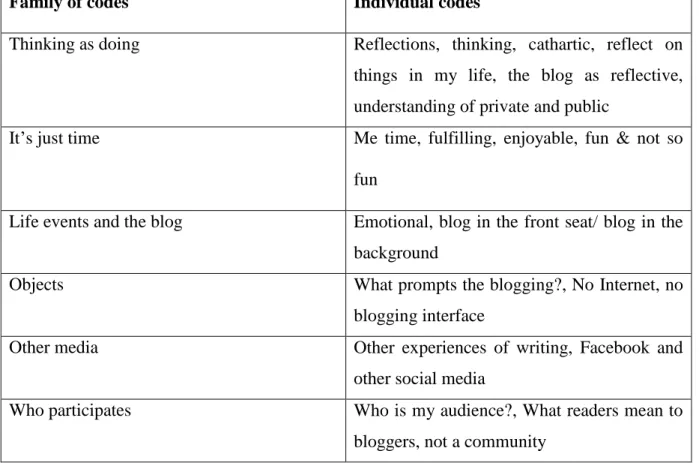
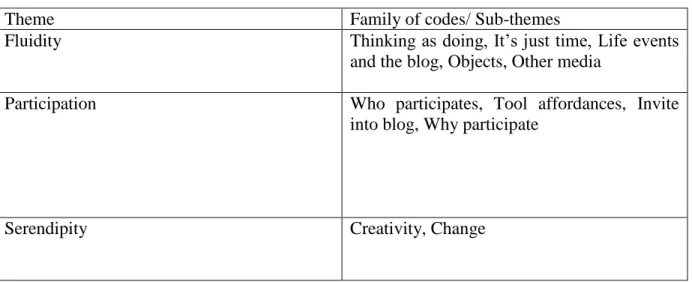
Through discussions with my advisor and some of the participants in the study, as well as through careful reflection, I began to group the codes into thematic families. This work of developing final themes was augmented through multiple iterations rather than a single, linear process. To continue synthesizing the data, I began to link the quotations with codes to the various themes that had been generated. The fact that some quotes and notes were linked to multiple codes allowed me to look at these data through different thematic lenses, which in turn enabled me to link the various themes with each other. Table 1 lists the family of codes along with the individual codes that were part of each one.
Table 3.1 Codes Used to Describe the Findings
Family of codes Individual codes
Thinking as doing Reflections, thinking, cathartic, reflect on things in my life, the blog as reflective, understanding of private and public
It’s just time Me time, fulfilling, enjoyable, fun & not so fun
Life events and the blog Emotional, blog in the front seat/ blog in the background
Objects What prompts the blogging?, No Internet, no
blogging interface
Other media Other experiences of writing, Facebook and
other social media
Who participates Who is my audience?, What readers mean to
42
Tool affordances Store and share, unequal participation, tool-Google-habit, Google this & google that, knowing who reads, permanence of blog posts
Invite into blog How to reach readers, when don’t you
comment, connect with blogger
Why participate Need to connect, needs-based reading,
hobby, as a means of expression
Change Change in life situation, dynamic nature, it
just happened
Creativity Creative outlet, when to hit publish?, actual doing, esthetics
3.4. Summary and Conclusion
Chapter 4 Setting the Stage
The purpose of this chapter is to shed light on the study’s participants in terms of who they are and what their blogging practices involve. A total of 36 individuals participated in the study. Some were bloggers––that is, individuals (11) who maintained their own blogs–– while others (25) were readers and commenters. Although I have referred to the individuals who maintain their own blogs as “bloggers,” this was done only for the sake of expedience; in practice, they are also active in other parts of the blogosphere as readers and commenters. I have chosen to foreground some participants as the main cast and others as the supporting ensemble, because not all participants played equal roles in the shaping of this study. This does not imply that their contributions were insignificant, however. Instead, this choice was made only for the purpose of clarity.
44
initial guide on which to base his or her understanding about the participants’ blogging practices.
4.1. Main cast
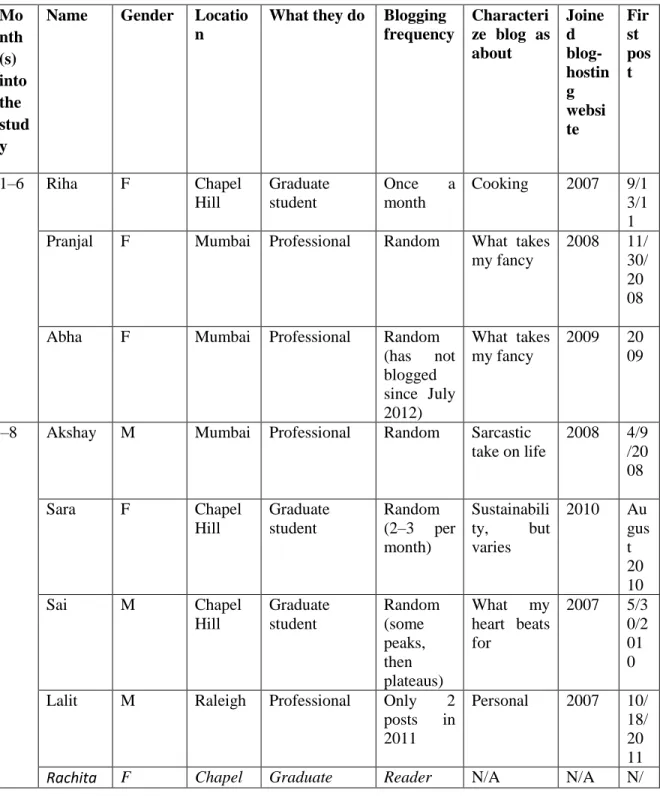
Table 4.1 Participant Profiles Mo nth (s) into the stud y
Name Gender Locatio n
What they do Blogging frequency
Characteri ze blog as about Joine d blog- hostin g websi te Fir st pos t
1–6 Riha F Chapel
Hill
Graduate student
Once a month
Cooking 2007 9/1 3/1 1 Pranjal F Mumbai Professional Random What takes
my fancy
2008 11/ 30/ 20 08
Abha F Mumbai Professional Random (has not blogged since July 2012)
What takes my fancy
2009 20 09
6–8 Akshay M Mumbai Professional Random Sarcastic take on life
2008 4/9 /20 08
Sara F Chapel
Hill
Graduate student
Random (2–3 per month)
Sustainabili ty, but varies
2010 Au gus t 20 10
Sai M Chapel
Hill Graduate student Random (some peaks, then plateaus)
What my heart beats for
2007 5/3 0/2 01 0
Lalit M Raleigh Professional Only 2 posts in 2011
Personal 2007 10/ 18/ 20 11
45
* Hill student A
Dipti F Mumbai Professional Reader N/A N/A N/
A 8–
12
Suruchi F Mumbai Professional 4–5 times per week
Personal 2012 Jun e 20 12 Suman F Mumbai Professional Random
(2–3 per month)
My blog is called Roving Eye
because I blog about whatever catches my eye and fascination.
2009 8/8 /20 09
Atamaj M Mumbai Professional Once a month (last post 9/12/12)
My thoughts
2011 4/1 6/2 01 1
Aditya M Chennai Professional Reader N/A N/A N/
A
Smita F Mumbai Unemployed Reader N/A N/A N/
A
Namrat a
F Mumbai Homemaker Reader N/A N/A N/
A
Ashley F Chapel
Hill
Graduate student
Random Reflection 2009 9/9 /09
Sumita F Chapel
Hill/ Mumbai
Graduate student
Random (1–2 per month)
Reflections on this study
2012 11/ 20 12 *The use of italic type in this table indicates that these individuals are readers and do not
maintain their blogs.
N/A: Not Applicable for the reader participants
then-46
acquaintance, Riha, stated: “I think I can blog…” This was a public admission of her interest in setting up a blog, which she did in September 2011. When I received IRB approval for this study, in October 2011, I contacted her and asked if she would be willing to participate. She was enthusiastic and became my first enrolled participant. Like me, she is also a graduate student of Indian origin at UNC-CH. Her blog, which is mainly about food and is hosted on Blogger.com and contains links to other blogs she follows. The tone is conversational; as she says, writing her blog is like discussing what she is doing with a group of friends. She publishes once a month or less on average.
The next two participants, Pranjal and Abha, have a group blog that is hosted on Wordpress. They are both professionals, working in Mumbai, who love to blog. As Pranjal writes on his blog: “blogging gives me a platform to speak up my opinions and reach out to a part of the society.” Writing to express his opinions and creative writing, in particular, are activities Pranjal has always enjoyed (he occasionally writes for news magazines as well). Abha, by contrast, likes to write about “normal things…the little things in our lives which we sometimes overlook, forget, hide or break…” I have met both Abha and Pranjal several times over the last two years, but most of our communications have been Internet-mediated. They both enjoy blogging, but for Abha it has recently become less of a priority: she has not published a post in more than a year. This kind of variation in blogging frequency was a common occurrence that I observed regularly through the data collection.
Among other interesting occurrences during the collection phase, one that strongly influenced the findings of this study was a variation of the following conversation.
47
Me: I am studying blogging. It is a qualitative study using ethnographic techniques to understand blogging.
Person: Oh, that is so interesting. Have you read ______blog? It is such a fun blog and then there is this one ___________that I follow. You should read it. Although no blogger ever came forward to talk about his or her blog in this way, numerous recommendations were provided about whose work I should read and who I should talk to. I followed up on these recommendations the next time I met these individuals. This situation also brought up an interesting idea for me about the shared nature of blogging that I discuss in the findings chapter.
Months 6–8. One recommender, Rachita, suggested that I talk to Akshay, whose blog she followed. Akshay is a professional based in India who maintains a blog on Blogger. Akshay is part of a group of bloggers who enjoy writing and find this to be an easy way to be creative and get feedback on what they care enough about to write. His blog, which is written through his alter ego’s viewpoint, concerns the trials and tribulations he goes through in some humorous situations. Akshay also occasionally blogs about current events in India.
48
she posts photos or recipes. She says her blog is the best place to store these recipes because she can always find them when she needs them.
Another participant who maintains a blog to “store” his ideas is Sai, a graduate student of Indian origin at UNC-CH. His blog, which is hosted on Blogger, has the tagline “what my heart beats for.” Sai describes his blog as “therapy” and although he doesn’t have many followers, he shares it with selected friends. Sai writes in three languages (English, Hindi, and Telugu) and sometimes asks friends to proofread his Hindi posts for grammatical issues because he is least proficient in this language. Riha and Sai know each other and follow each other’s blogs.
Lalit is similar to Sai in terms of his blog use. A professional working in Raleigh, he is also of Indian origin. Lalit has always enjoyed writing and, as he writes on his blog, “The blog is to share some personal thoughts, ideas and experiences as I go about figuring out something called ‘life.’” He has posted on his blog only twice and says he would love to write more but is unable to find the time. Lalit was instrumental in helping me talk to some blog readers who I interviewed as part of a focus group and describe further in Section 4.2 (secondary cast).
49
Months 8–12. The next blogger I spoke to, Suruchi, lives in Mumbai. Suruchi follows multiple bloggers and was responsible for getting me in touch with Suman and Atamaj, who are fellow bloggers. Suruchi, who works as a freelance trainer, conducts corporate training workshops and similar programs. Among the participants, she was the latest one to join the blogosphere; at one time she was the most regular blog-poster. The changes in her style of blogging from long to much shorter posts were the most dramatic in this group. Initially she posted once in a fortnight but gradually began to post two or three line quotes almost daily, explaining that she felt she had so much to say and could say it much better in this fashion. I was also able to speak to two of her blog’s followers, Smita and Namrata. After an initial meeting with each of them, I scheduled conversations with each them and since then we have communicated via email.
50
Aditya, Smita, and Namrata were the only recommended readers/ followers who agreed to participate in this study. All three were not only readers of the recommenders’ blogs but also followed other blogs for informational purposes. For example, Namrata and her family traveled to Europe and she looked at many blogs to help her plan this trip. Smita felt connected with Suruchi through reading her blog posts and felt that similar things were going on in their lives. Aditya read blogs written by his friends as well as some other blogs with which he feels a connection. Their blog reading was also influenced by specific situations, for example a popular Indian political movement in 2011 (all of them were following blogs related to that movement).
Aatmaj, the next blogger who enrolled in the study, used his blog to “share with people my experiences good and bad, both…” His blog is also hosted on Blogger; his last post was in September 2012. Blogging has lost its ranking on his list of priorities since he got a new job and became a father. Aatmaj also loves to write and posts something on either Twitter or Facebook almost every day. He was hesitant to provide me with any references for readers although he always spoke about “an audience” for his blog.
51
I am the final blogger participant in this study. After struggling with the idea of being a participant in the study where I am the principal investigator, much reflection and discussions with my advisor convinced me that because my views about the research have shaped much of the findings, I too am a participant. My introduction to blogging took place in 2008; my move to Chapel Hill made me more reliant on blogs as a way to keep connected with friends and family. But I also spent a lot of time simply reading for fun and as a way to gather information about the new place I had moved to. Throughout the time that I was collecting data, I spent a lot of time simply perusing blogs. My own blog, which I began in November 2012, is a space for me to reflect on the findings that emerged from this study. 4.2. Secondary Cast
52 Table 4.2 Secondary Ensemble: Participant Profiles
Focus Group Name Gender Occupation Frequency of reading
Regular blogs Focus Group I
(Raleigh)
Laura F IT professional Several times a day
7–10
Mohan M IT professional 2–3 times a week
3–4
Shannon F Teacher Every day 5–6
Deepa F Nurse Every day 6–10
Focus Group II (Chapel Hill)
Heather F PhD student Occasional 3–5
Mackenzi F PhD student Occasional 2–5
Focus Group III (India)
Parul F Homemaker Several times
a day
12–15
Neeraj M Entrepreneur Occasional 2–3
Focus Group III (India)
Manju F Trainee in
Administrative position
2–3 times per week
12–15
Rukmini F Managerial
position
4–5 times per week
10–15
Focus Group IV
(India)
Amee F Executive Once a
fortnight
4–7
Kunjal F Unemployed Every day 7–10
Poonam F Homemaker Every other
week
1–2
53
The next set of group interviews I conducted, via conference calls, was in India. They included two groups of two each (Neeraj and Parul, Manju and Rukmini). In both cases the participants knew each other, which made these interviews very easy to conduct. Neeraj and Parul are husband and wife. Parul used to write multiple blogs, but gave up due to time constraints and the fact that “life takes precedence…” Some of this conversation was sentimental, especially when Parul spoke about how she had written a very “mushy post” and Neeraj spoke about his “embarrassment” that it was publicly available for anyone to see. During the conversation with Manju and Rukmini, which was very short, they spoke about how they read and share blogs mainly for learning about new things (e.g., communication skills). The last focus group I conducted, a face-to-face one, was especially long and laden with unexpected scenarios. Kunjal and Amee knew each other but did not know the third participant, Poonam. As they were describing their blog-reading habits, it turned out that they had a friend in common who is based in Europe and maintains a general everyday blog. In fact this was the blog that they had spoken about before I met them, but because neither of them had given me the URL, I didn’t know. The conversation mainly focused on this friend’s blog and the pictures she had posted.
Chapter 5 Findings Overview
The aim of this study was to understand the occupation of blogging, using guiding questions that were derived from an in-depth reading of how occupations are conceptualized in the OS literature. The questions with which I began the study were primarily descriptive, for example “defining the occupational domain of blogging” and “describing the changes and transformations which occur in the process of blogging.” However, similar to what Hammersley and Atkinson (2007) have suggested, the initial questions were fine-tuned as this study progressed and the emphasis became more clearly focused on a specific set of interesting concepts that emerged during the data gathering. In addition, as with all research, this project began with some foundational ideas. Some of these evolved further while others fell by the wayside but have also played an important role in shaping the outcome of this ethnography. For example, my reading of the Occupational Science and blogging literature led me to frame the study through three theoretical perspectives: transactional perspectives of occupation, communities of practice, and mediated action theories.
55
focus continued as I began a more formal data analysis phase and continued further as I wrote the dissertation. Thus, the outcome of this ethnography was continuously shaped by how it was conducted. This chapter details the journey of these changes and the process of refinement that led to the particular conclusions I have drawn at this point in time.