Gold(I)-Catalyzed Addition of Aldehydes to Cyclopropylidene
Bearing 6-Aryl-1,5-Enynes
†Christina A. Roselli and Michel R. Gagné
Department of Chemistry. University of North Carolina at Chapel Hill, Chapel Hill, NC 27599-3290, USA
Michel R. Gagné: [email protected]
Abstract
A diastereoselective, gold-catalyzed cascading cycloisomerization of alkylidene cyclopropane bearing 1,5-enynes that terminates in a cyclo-addition of aldehydes has been developed. This diastereoselective reaction provides convergent access to novel polycyclic molecular structures (18 examples), and tolerates a diverse scope of aldehydes. Mechanistic studies reveal that the catalytic cycle rests at a digold off-cycle intermediate, one of which was isolated.
Introduction
Transition metal catalyzed enyne cycloisomerizations proceeding via novel reaction pathways have enabled the construction of complex molecular scaffolds to be realized.1–7 The effectiveness of electrophilic gold(I) complexes for activating unsaturated carbon-carbon bonds8 is key to initiating and guiding the reactivity of these fragments. Coupling enyne cycloisomerization processes to the addition of heteronucleophiles, including alcohols9–11 and aldehydes,12–16 in enyne cycloisomerization reactions has created new transformations that multiply the molecular complexity of the products.
Alkylidene cyclopropanes (ACPs) are versatile and reactive building blocks in organic synthesis, and several groups have been instrumental in developing their unique reactivity profiles.17–22 A key property is the inherent ring strain in the ACP moiety (ca. 40 kcal/mol), relief of which can provide a thermodynamic driving force for otherwise unfavorable reactions. Our contributions to this area have explicitly sought strategic strain release protocols,23–25 and in one recent example, we realized a gold-catalyzed enantioselective cycloisomerization of ACP-containing 1,5-enynes to yield the bicyclo[4.2.0]octadiene core, (e.g. 2, Scheme 1).26 The proposed mechanism for this transformation begins with an ionic 6-endo-dig cyclization of 1a, to yield a transient cyclopropyl methyl carbenium ion27–29 that ring expands to a putative auro allyl cation (A, Scheme 1). As shown, this species can also be described as a cationic vinyl carbene, which rationalizes the electrophilic centers in the structure. The reaction turns over with a net 1,2-hydrogen shift to yield the cycloisomer 2
Author manuscript
Org Biomol Chem
. Author manuscript; available in PMC 2017 November 29.Published in final edited form as:
Org Biomol Chem. 2016 November 29; 14(47): 11261–11265. doi:10.1039/c6ob02128j.
and the electrophilic catalyst. Tests for a trappable A revealed the suitability of methanol to generate the 6-4 bicyclo methoxy 3.26 These results coupled with the precedent established by Helmchen (vide infra), suggested that A might also be trapped by aldehydes, to yield oxo-carbenium ions that are poised to annulate to novel terpene-like ring structure. The convergence of these approaches, coupled with their rigid features and parallels to the terpenoids, suggests a role in diversity-oriented synthesis.30,31
The most typical coupling reactivity of 1,n-enynes (n = 6,7) with carbonyl compounds are formal [2 + 2 + 2] cycloadditions to yield O-heterocycles.14,15 Helmchen and later Echavarren in particular have studied the gold(I) catalyzed reaction of aldehydes with 1,6-enynes.12–14 DFT studies support addition of aldehydes to an electrophilic allyl carbene intermediate (e.g. Scheme 2, top).13 We hypothesized that auro-allyl cation A might be
sufficiently electrophilic to also be trapped by an aldehyde to generate a versatile
oxocarbenium ion poised to annulate a THP ring (Scheme 2, bottom). Herein we report the successful implementation of this notion in addition to mechanistic studies suggesting that multimetallic species once again influence catalyst speciation in the cycle.
To test our hypothesis, enyne 1a and propionaldehyde (5 equiv.) were treated with 10 mol% Ph3PAuNTf232 in CH2Cl2. Unfortunately, these conditions only provided the cycloisomer 2;
lower reaction temperatures (0 and −30°C) did not change the outcome. Suspecting that the cause of this was an insufficiently nucleophilic aryl ring, we next tested 3,5–dimethoxy enyne 1b.
Results and Discussion
To our delight, the combination of 1b, propionaldehyde (5 equiv.) and Ph3PAuNTf2 (10 mol
%) at RT, provided a single diastereomer of 4 as the major product, along with a lesser quantity of 5 (3:1, Table 1, entry 1). We envision a competition for intermediate B as shown in Scheme 3.33 Complete selectivity for 4 (>99:1) could, however, be achieved at 0 °C with 10 equivalents of aldehyde.34
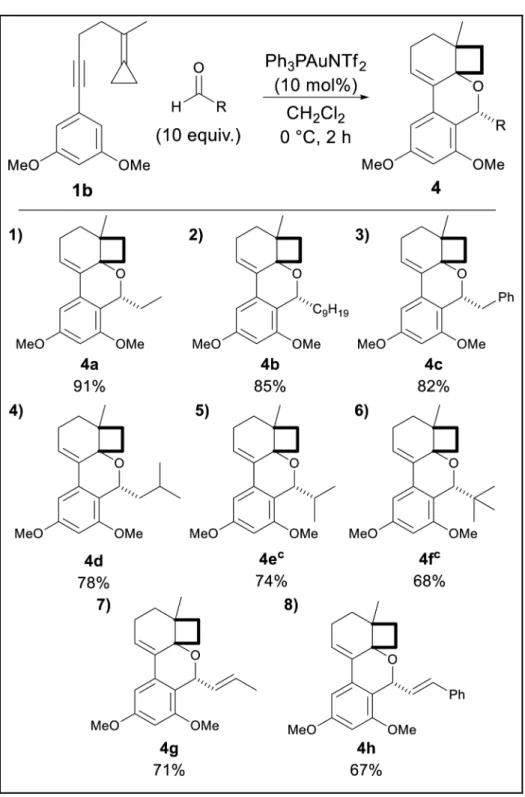
These latter optimized conditions were used to evaluate the scope with respect to the aldehyde partner. As shown in Table 1, a variety of aliphatic aldehydes were successfully incorporated, including aldehydes with linear and branched chains, as well as unsaturated moieties. With bulkier aldehydes, including pivaldehyde and isobutyraldehyde,
cycloisomerization became increasingly competitive and required an additional lowering of the temperature to −35 °C. In each case the products were isolated in good to excellent yields and as a single diastereomer. NMR analysis along with an X-ray structure of an aromatic aldehyde derivative (vide infra) led to the indicated diastereomer.
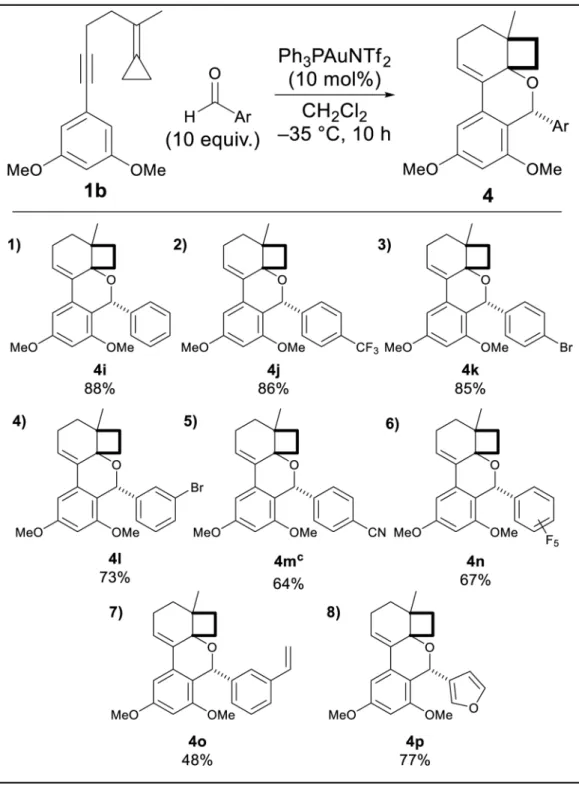
In contrast, aromatic aldehydes were found to not add to B as efficiently (1:1 mixture of 4:5) under the conditions in Table 1, though cooling to −35 °C returned high chemo- and
diastereoselectivities. In each case selectivities for the trapped product were >95% (Table 2). Meta and para substituted arenes bearing electron-withdrawing groups showed excellent
The meta-methoxy enyne 1c was also tested, and under the optimized conditions for each class of aldehydes a single regio- and diastereomer of the polycycle was formed (6a and 6b, Equation 1). The requirement of at least a single activating group on the nucleophilic arene suggests that this addition may be product determining (c.f. 1a). A similar reaction with a m-tolyl group was not successfully trapped and only provided the cycloisomerization product.
(1)
To confirm the relative stereochemistry of the products an X-ray structure of crystalline 4k was obtained. The relative stereochemistry suggested the indicated orientation of the oxocarbenium ion on attacking the arene (C, Figure 1). The single isomer of product obtained from the remaining aldehydes were assigned by analogy to 4k and in the cases of
4a and 4j, were confirmed by comparative 1D-NOE experiments (see SI).
Our methodological studies sparked a number of mechanistic questions about additions to the putative auro-allyl cation, B (Scheme 3). A competition experiment between
benzaldehyde and p-CF3-benzaldehyde (5 equiv. each) with enyne 1b and Ph3PAuNTf2 (10
mol%) revealed that the more electron rich aldehyde was slightly favored (2:1 4i:4j). Competing p-anisaldehyde (which is not viable in Table 3) and p-CF3-benzaldehyde,
however only provides the p-CF3-benzaldehyde trapped product 4j. These data combined with the need for an electron-rich arene (Equation 1) show that electron rich aldehydes can better trap the auro-allyl cation but the resulting oxo-carbenium ion is proportionately less electrophilic, and for very electron rich aldehydes (p-OMe, etc), effectively incapable of competing with the 1,2-shift. If the addition to B is reversible, then the product determining step is the Friedel-Crafts annulation.
An analysis of the competing manifolds for the formation of 4 versus 5 in Scheme 3
suggested that the partitioning of B might be sensitive to protic additives as we reasoned that the net 1,2-H shift might be the result of an allylic proton loss followed by
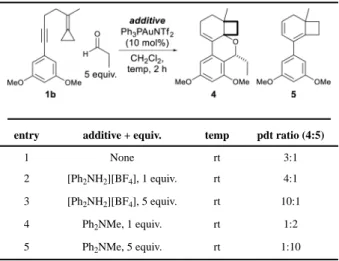
protodemetallation. To test this notion, the relatively strong, CH2Cl2 soluble, acid [Ph2NH2]
[BF4] (pKaH2O ~1)35 was added to gauge its influence on selectivity. As shown in entries 2
and 3 of Table 3, increasing equivalents of acid enhanced the trapping efficiency (up to 10:1), while N-methyldiphenylamine (entries 4 and 5) shifted the selectivity towards cycloisomerization. Inhibiting proton loss from B thus enhances the formation of 4 and suggests that the competing 1,2-shift does indeed initiate with a proton loss.
(2)
Information on the catalyst’s resting state was obtained by in situ monitoring using 31P
NMR spectroscopy (−35 °C). These spectra revealed the presence of a single catalyst species, with two distinct singlets in a 1:1 ratio (33 and 38 ppm). Evidence supporting the assignment of this species to a geminally diaurated vinyl intermediate36 was obtained from stoichiometric reactions of 1b with Ph3PAuNTf2 (2 equiv), 4-Br-benzaldehyde (10 equiv.),
and a polymer-bound 2,6-di-tert-butylpyridine, which yielded a product with the same two distinct peaks as observed in the in situ 31P NMR experiments. A combination of HRMS
and NMR spectroscopy suggested di-gold vinyl complex 7, which we and others have previously shown to be prevalent in gold-vinyl36–43 and aryl44–46 reactivity (Equation 2). Isolated 7 was always contaminated by traces of protodemetallated product 4k and
(Ph3P)2Au+. Several gold complexes and bases (to arrest protodemetallation) were screened,
however the purity of the isolated 7 (upon removal of excess aldehyde) could not be improved above ~90% (see SI for details).
The proposed mechanism for this transformation is shown in Scheme 4. Au activation of alkyne 1b triggers a 6-endo-dig cyclization to 9, which ring expands to form the more stable auro-allyl cation 10 (equivalent to B). Distal attack of the aldehyde generates oxocarbenium intermediate 11, which cyclizes facilitated by the electron-rich methoxy groups. Re-aromatization affords gold-vinyl intermediate 12, which may be directly protodemetallated to form 4 or trapped by [Au]+ to yield the digold resting state 8. Previous investigations in collaboration with the Widenhoefer group40 have shown that digold intermediates are usually off-cycle and that trapping of monogold vinyls by [Au]+ is fast and can be competitive with protodemetallation.43
Conclusions
In summary, we have developed a regio- and diastereoselective gold(I)-catalyzed addition of aldehydes to 1,5-enynes that sequences a series of C–C and C–O bond forming reactions to convergently create novel terpene-like polycyclic scaffolds. The scope with respect to aldehydes is significant, and once again digold structures dominate the speciation of reactions generating a vinyl gold intermediate.
Supplementary Material
Refer to Web version on PubMed Central for supplementary material.
Acknowledgments
The National Institutes of Health (GM-60578) is gratefully acknowledged. We thank Drs. Peter White and Philippa Payne for assistance acquiring and analyzing crystallographic data. Dr. Mee-Kyung Chung and the UNC Dept. of Chemistry Mass Spec Core Laboratory are thanked for HRMS analyses.
References
1. Obradors C, Echavarren AM. Acc. Chem. Res. 2014; 47:902–912. [PubMed: 24175907] 2. Dorel R, Echavarren AM. Chem. Rev. 2015; 115:9028–9072. [PubMed: 25844920] 3. Zhang L, Sun J, Kozmin SA. Adv. Synth. Catal. 2006; 348:2271–2296.
4. Michelet V, Toullec PY, Genêt JP. Angew. Chem. Int. Ed. 2008; 47:4268–4315. 5. Diver ST, Giessert AJ. Chem. Rev. 2004; 104:1317–1382. [PubMed: 15008625] 6. Fürstner A. Chem. Soc. Rev. 2009; 38:3208. [PubMed: 19847352]
7. Fensterbank L, Malacria M. Acc. Chem. Res. 2014; 47:953–965. [PubMed: 24564512] 8. Gorin DJ, Toste FD. Nature. 2007; 446:395–403. [PubMed: 17377576]
9. Nieto-Oberhuber C, Muñoz MP, López S, Jiménez-Núñez E, Nevado C, Herrero-Gómez E, Raducan M, Echavarren AM. Chem. Eur. J. 2006; 12:1677–1693. [PubMed: 16358351]
10. Buzas AK, Istrate FM, Gagosz F. Angew. Chem. Int. Ed. 2007; 46:1141–1144. 11. Genin E, Leseurre L, Toullec PY, Genêt JP, Michelet V. Synlett. 2007:1780–1784.
12. Schelwies M, Dempwolff AL, Rominger F, Helmchen G. Angew. Chem. Int. Ed. 2007; 46:5598– 5601.
13. Schelwies M, Moser R, Dempwolff AL, Rominger F, Helmchen G. Chem. Eur. J. 2009; 15:10888– 10900. [PubMed: 19746480]
14. Escribano-Cuesta A, López-Carrillo V, Janssen D, Echavarren AM. Chem. Eur. J. 2009; 15:5646– 5650. [PubMed: 19388041]
15. Huple DB, Liu R-S. Chem. Commun. 2012; 48:10975–10977. 16. Dorel R, Echavarren AM. J. Org. Chem. 2015 ASAP. 17. Mack DJ, Njardarson JT. ACS Catal. 2013; 3:272–286.
18. Zhang DH, Tang XY, Shi M. Acc. Chem. Res. 2014; 47:913–924. [PubMed: 24168021] 19. Masarwa A, Marek I. Chem. Eur. J. 2010; 16:9712–9721. [PubMed: 20607773] 20. Pellissier H. Tetrahedron. 2010; 66:8341–8375.
21. Pellissier H. Tetrahedron. 2014; 70:4991–5031. 22. Yu L, Guo R. Org. Prep. Proced. Int. 2011; 43:209–259.
23. Felix RJ, Weber D, Gutierrez O, Tantillo DJ, Gagné MR. Nat. Chem. 2012; 4:405–409. [PubMed: 22522261]
24. Felix RJ, Gutierrez O, Tantillo DJ, Gagné MR. J. Org. Chem. 2013; 78:5685–5690. [PubMed: 23663099]
25. Zheng H, Adduci LL, Felix RJ, Gagné MR. Angew. Chem. Int. Ed. 2014; 53:7904–7907. 26. Zheng H, Felix RJ, Gagné MR. Org. Lett. 2014; 16:2272–2275. [PubMed: 24684491] 27. Olah A, George, Reddy VP, Prakash GKS. Chem. Rev. 1992; 92:69–95.
28. Sethofer SG, Staben ST, Hung OY, Toste FD. Org. Lett. 2008; 10:4315–4318. [PubMed: 18759435]
29. Pitaval A, Leboeuf D, Ceccon J, Echavarren AM. Org. Lett. 2013; 15:4580–4583. [PubMed: 23962171]
30. Burke MD, Schreiber SL. Angew. Chem. Int. Ed. 2004; 43:46–58.
31. Garcia-Castro M, Zimmermann S, Sankar MG, Kumar K. Angew. Chem. Int. Ed. 2016; 55:2–22. 32. Mézailles N, Ricard L, Gagosz F. Org. Lett. 2005; 7:4133–4136. [PubMed: 16146370]
33. An alternate mechanism for the conversion of B to 5 invokes a gold-carbene followed by a 1,2 H shift to form the product.
34. It is worth noting that carbonyl insertion into Au-C bonds is not facile, see: Hashmi ASK, Ramamurthi TD, Rominger F. J. Organomet. Chem. 2009; 694:592–597.
35. Stewart R, Dolman D. Can. J. Chem. 1967; 45:925–928.
36. Weber D, Tarselli MA, Gagné MR. Angew. Chem. Int. Ed. 2009; 48:5733–5736. 37. Weber D, Gagné MR. Top. Curr. Chem. Homog. Gold Catal. 2015; 357:167–211. 38. Seidel G, Lehmann CW, Fürstner A. Angew. Chem. Int. Ed. 2010; 49:8466–8470. 39. Hashmi ASK. Angew. Chem. Int. Ed. 2010; 49:5232–5241.
40. Brown TJ, Weber D, Gagné MR, Widenhoefer RA. J. Am. Chem. Soc. 2012; 134:9134–9137. [PubMed: 22621418]
41. Hashmi ASK, Braun I, Rudolph M, Rominger F. Organometallics. 2012; 31:644–661. 42. Weber D, Gagné MR. Chem. Sci. 2013:335–338. [PubMed: 23914295]
43. Brooner REM, Brown TJ, Chee MA, Widenhoefer RA. Organometallics. 2016; 35:2014–2021. 44. Weber D, Jones TD, Adduci LL, Gagné MR. Angew. Chem. Int. Ed. 2012; 51:2452–2456. 45. Larsen MH, Houk KN, Hashmi ASK. J. Am. Chem. Soc. 2015; 137:10668–10676. [PubMed:
26258807]
46. Braun I, Asiri AM, Hashmi ASK. ACS Catal. 2013; 3:1902–1907.
A
uthor Man
uscr
ipt
A
uthor Man
uscr
ipt
A
uthor Man
uscr
ipt
A
uthor Man
Figure 1.
ORTEP representation of the solid state molecular structure of 4k; ellipsoids drawn at 50% probability, only one enantiomer of the asymmetric unit, and majority of the hydrogen atoms omitted for clarity.
A
uthor Man
uscr
ipt
A
uthor Man
uscr
ipt
A
uthor Man
uscr
ipt
A
uthor Man
uscr
Scheme 1.
Proposed reaction pathway for the (a) cycloisomerization, (b) carbocation-trapping control experiment, and (c) proposed reaction with aldehydes with our 1,5-enyne
A
uthor Man
uscr
ipt
A
uthor Man
uscr
ipt
A
uthor Man
uscr
ipt
A
uthor Man
Scheme 2.
Helmchen’s aldehyde trapping of a proposed gold carbene intermediate (top) and proposed aldehyde trapping reaction of vinyl gold carbene A (bottom)
A
uthor Man
uscr
ipt
A
uthor Man
uscr
ipt
A
uthor Man
uscr
ipt
A
uthor Man
uscr
Scheme 3.
Acid/base-dependent competition from intermediate B.
A
uthor Man
uscr
ipt
A
uthor Man
uscr
ipt
A
uthor Man
uscr
ipt
A
uthor Man
Scheme 4.
Proposed catalytic cycle. [Au]+=Ph3PAu+; counterion [NTf2−] omitted for clarity.
A
uthor Man
uscr
ipt
A
uthor Man
uscr
ipt
A
uthor Man
uscr
ipt
A
uthor Man
uscr
A
uthor Man
uscr
ipt
A
uthor Man
uscr
ipt
A
uthor Man
uscr
ipt
A
uthor Man
Table 1
Gold(I)-catalyzed cyclo-coupling of 3 and aliphatic aldehydes.a,b
a
A
uthor Man
uscr
ipt
A
uthor Man
uscr
ipt
A
uthor Man
uscr
ipt
A
uthor Man
uscr
A
uthor Man
uscr
ipt
A
uthor Man
uscr
ipt
A
uthor Man
uscr
ipt
A
uthor Man
Table 2
Substrate scope with aromatic aldehydes.a,b
a
A
uthor Man
uscr
ipt
A
uthor Man
uscr
ipt
A
uthor Man
uscr
ipt
A
uthor Man
uscr
c
A
uthor Man
uscr
ipt
A
uthor Man
uscr
ipt
A
uthor Man
uscr
ipt
A
uthor Man
Table 3
Reaction optimization to favor the aldehyde trapped product 4.
entry additive + equiv. temp pdt ratio (4:5)
1 None rt 3:1
2 [Ph2NH2][BF4], 1 equiv. rt 4:1
3 [Ph2NH2][BF4], 5 equiv. rt 10:1
4 Ph2NMe, 1 equiv. rt 1:2