Full Terms & Conditions of access and use can be found at
http://www.tandfonline.com/action/journalInformation?journalCode=cher20
Download by: [Universiteit Leiden / LUMC] Date: 17 May 2017, At: 01:22
Higher Education Research & Development
ISSN: 0729-4360 (Print) 1469-8366 (Online) Journal homepage: http://www.tandfonline.com/loi/cher20
Peer feedback on college students’ writing:
exploring the relation between students’ ability
match, feedback quality and essay performance
Bart Huisman, Nadira Saab, Jan van Driel & Paul van den Broek
To cite this article: Bart Huisman, Nadira Saab, Jan van Driel & Paul van den Broek (2017): Peer feedback on college students’ writing: exploring the relation between students’ ability match, feedback quality and essay performance, Higher Education Research & Development, DOI: 10.1080/07294360.2017.1325854
To link to this article: http://dx.doi.org/10.1080/07294360.2017.1325854
© 2017 The Author(s). Published by Informa UK Limited, trading as Taylor & Francis Group
Published online: 15 May 2017.
Submit your article to this journal
View related articles
Peer feedback on college students
’
writing: exploring the
relation between students
’
ability match, feedback quality and
essay performance
Bart Huismana, Nadira Saaba, Jan van Drielband Paul van den Broekc a
Graduate School of Teaching (ICLON), Leiden University, Leiden, Netherlands;bMelbourne Graduate School of Teaching, The University of Melbourne, Melbourne, VIC, Australia;cDepartment of Educational Science, Leiden University, Leiden, Netherlands
ABSTRACT
There does not appear to be consensus on how to optimally match students during the peer feedback process: with same-ability peers (homogeneously) or different-ability peers (heterogeneously). In fact, there appears to be no empirical evidence that either homogeneous or heterogeneous student matching has any direct effect on writing performance. The current study addressed this issue in the context of an academic writing task. Adopting a quasi-experimental design, 94 undergraduate students were matched in 47 homogeneous or heterogeneous reciprocal dyads, and provided anonymous, formative peer feedback on each other’s draft essays. The relations between students’ individual ability or dyad composition, feedback quality and writing performance were investigated. Neither individual ability nor dyad composition directly related to writing performance. Also, feedback quality did not depend on students’individual ability or dyad composition, although trends in the data suggest that high-ability reviewers provided more content-related feedback. Finally, peer feedback quality was not related to writing performance, and authors of varying ability levels benefited to a similar extent from peer feedback on different aspects of the text. The results are discussed in relation to their implications for the instructional design of academic writing assignments that incorporate peer feedback.
ARTICLE HISTORY
Received 11 October 2016 Accepted 28 March 2017
KEYWORDS
Peer feedback; academic writing; higher education; feedback quality; student ability match
Introduction
Research on peer feedback in education has expanded in the last two decades. This has increased our knowledge on the reliability and validity of peer feedback in primary,
sec-ondary and post-secsec-ondary education (Cho, Schunn, & Wilson, 2006; Gielen, Peeters,
Dochy, Onghena, & Struyven, 2010; Topping, 2009), and with respect to the variables
that are important for the design and implementation of peer feedback (e.g., Topping,
1998; van Zundert, Sluijsmans, & van Merriënboer,2010). However, regarding structural
© 2017 The Author(s). Published by Informa UK Limited, trading as Taylor & Francis Group
This is an Open Access article distributed under the terms of the Creative Commons Attribution-NonCommercial-NoDerivatives License (http://creativecommons.org/licenses/by-nc-nd/4.0/), which permits non-commercial re-use, distribution, and reproduction in any medium, provided the original work is properly cited, and is not altered, transformed, or built upon in any way.
features such as feedback group composition (see van Gennip, Segers, & Tillema,2009), there does not yet appear to be consensus on how to optimally match students in terms of ability.
This study focuses on the ability match between students during peer feedback on aca-demic writing in a higher education context. There are three reasons for this focus. First, it seems fair to conclude from the literature that peer feedback can be beneficial to higher
education students’learning, and that students can perceive these benefits (Hanrahan &
Isaacs,2001). Students can expect reliable and valid assessments from each other regarding
the quality of their work (Cho et al.,2006; Falchikov & Goldfinch,2000). Also, the process
of providing feedback can help students improve their writing performance (Lundstrom &
Baker, 2009). Providing peer feedback prompts a reviewer to go beyond mere problem
detection, engaging him or her in problem diagnosis and in suggesting solutions
(Patchan & Schunn, 2015). Second, being able to provide feedback to peers and utilize
feedback from peers can be considered important skills in students’subsequent academic
or professional career. Importantly, both students’ peer assessment skills and their
atti-tudes towards it can be positively influenced through preparation and practice (van
Zundert et al.,2010). Third, academic writing skills are considered important across
dis-ciplines and are an integral part of higher education curricula. Given the sometimes large student-to-staff ratios in higher education institutes, however, adequate instructor feed-back on academic writing tasks can be a challenge. One aid comes from (web-based)
appli-cations that facilitate the peer feedback process (see Luxton-Reilly,2009, for an overview).
With the increasing availability and usability of such applications, the peer feedback process becomes easier to design and implement for academic teaching staff. This may increase the extent to which peer feedback is implemented within academic writing tasks.
Student ability matching
Another benefit of applications that facilitate the implementation of peer feedback is the potential array of possibilities in terms of instructional design. For example, it should be possible to automatically match students on certain criteria, such as ability. Although the potential benefits of student matching have already been discussed in 1998 by Topping, there does not appear to be a clear consensus on whether students should be matched with similar ability peers (homogeneously) or with peers or different ability (heterogeneously).
Regarding the homogeneous matching of students, Topping (2009) prescribes
match-ing students with same-ability peers. In addition, Kmatch-ing (1997) argues that beneficial
socio-cognitive conflict is more likely between equal peers and that higher level learning is more likely to be accomplished when ideas are exchanged on an equal basis. Also, a mindful, critical appraisal of received feedback may be critical to its effectiveness, which could be
stimulated by the uncertainty that the peer’s status induces (Gielen et al.,2010). An
exper-imental study by Strijbos, Narciss, and Dünnebier (2010) investigated the relation between
peer feedback content and sender’s (perceived) competence, on the one hand, and feed-back perceptions and revision, on the other hand. Their results suggest that status differ-ences between peers may have negative effects; receiving elaborate, specific feedback from high-ability peers was related to more negative affect and less effective text revision. One possible explanation suggested by the authors is that elaborate, specific feedback from
high-competence peers rendered students to become passive and overly reliant on the feedback they received. These theoretical arguments and empirical findings support the suggestion to match students in a homogeneous manner. However, they do not provide empirical evidence for a direct relation between homogeneous matching with peer feed-back and writing performance.
Regarding the heterogeneous matching of students, it has been found that higher ability authors tend to focus more on global issues, detect more problems, and are more likely to use effective strategies for revision than lower ability authors (e.g., Patchan & Schunn,
2015). As a result, they may provide more critical peer feedback than lower ability
authors do. Patchan, Hawk, Stevens, and Schunn (2013) differentiated between feedback
comments that focused on ‘high prose’ (flow, logic or insight), ‘low prose’ (lower level
writing issues such as grammar) or‘substance’ (issues fixable only with content
knowl-edge). They found that the feedback received by low-ability authors was qualitatively different when they were matched with a high-ability reviewer (heterogeneous match), compared to a low-ability reviewer (homogeneous match). Specifically, low-ability
authors received and implemented more ‘low prose’ and ‘substance’ feedback from
high-ability reviewers. High-ability authors received similar types of feedback, irrespective of reviewer ability. A similar trend was reported for provided solutions. Because feedback containing explicit criticism and suggestions for improvement is likely to contribute to
feedback implementation and performance (Nelson & Schunn, 2009), these arguments
support matching students heterogeneously. Here too, however, they do not provide empirical evidence for a direct relation between heterogeneous matching with peer
feed-back and students’writing performance.
Defining student ability and feedback quality
Student ability
Student ability has been defined in different ways in prior research. Generally, a distinction
can be made between students’task-related ability (e.g., writing skills) and students’ability
to provide peer feedback and/or assess others’work (e.g., use of criteria, see, for example,
van Zundert et al.,2010). The current study matched students in terms of task-related
ability, that is, their scores on a preceding essay assignment, for four reasons: availability, similarity, proximity and validity. First, this ability indicator was both available and prac-tically applicable. Moreover, comparable ability indices are likely to be available in other higher education institutes. Second, this preceding academic writing assignment was similar to the academic writing assignment central to the current study. Third, the assign-ment was part of an immediately preceding course in the same curriculum, making it an
up-to-date indicator of students’academic writing ability. Fourth and finally, although it is
not self-evident that an able writer also is an able reviewer, it is plausible that writing and reviewing ability are interrelated. A rationale for this is provided by Patchan and Schunn
(2015), who identified conceptually identical elements between writing and providing
feedback on writing: task definition, problem detection and diagnosis, and selection or revision strategy. This overlap in cognitive processes supports the notion that students’
ability to write and students’ ability to review each other and provide feedback indeed
Peer feedback quality
As is the case with student ability, feedback quality has been defined in multiple ways in the literature. Definitions range from relatively simple categorizations such as holistic
feedback versus specific feedback (Lin, Liu, & Yuan,2001) to more elaborate
categoriz-ations such as proposed by Nelson and Schunn (2009) differentiating between
summar-ization, specificity, explanation and scope. The current study adopts the definition of
feedback quality as used by van den Berg, Admiraal, and Pilot (2006), which includes
the aspect of the text to which the feedback relates (content, structure, style) and the func-tion the feedback comments serve in relafunc-tion to the text (analysis, evaluafunc-tion, explanafunc-tion, revision). An important reason for this choice is that the feedback aspects were aligned with both task instructions and assessment criteria.
In summary, theoretical accounts and empirical findings on how to optimally match stu-dents in terms of ability vary and sometimes appear contradictory. To our knowledge, there are no studies that address the direct link between student matching, feedback quality and writing performance. Specifically, there appears to be no empirical evidence that either homogeneous or heterogeneous student matching has any effect on writing performance. Moreover, there is a need for (quasi-)experimental studies investigating the effects of
peer assessment (Strijbos & Sluijsmans, 2010). Adopting an exploratory approach, the
current quasi-experimental study specifically focuses on the relation between the students’ ability match, peer feedback quality and their performance on an academic writing task.
Research questions
This issue was investigated in the context of an essay assignment within a first-year intro-ductory course Education and Child Studies. In this context, student matching was reci-procal, meaning that the students within a particular dyad provided feedback to their dyad member and received feedback from that dyad member. Three main research questions
are formulated. Research question 1 is:‘to what extent is student ability in, and dyad
com-position of reciprocal dyads related to authors’ increase in essay performance?’Research
questions 2 and 3 explore this relation in more detail. Specifically, research question 2 is: ‘to what extent is student ability in reciprocal dyads related to peer feedback quality?’Here,
two sub-questions are formulated. The first focuses on reviewers’ individual ability: (a)
‘what is the relation between reviewer ability and the quality of the peer feedback they
provide?’ The second sub-question takes into account the interdependence of authors
and reviewers within the dyads: (b)‘to what extent does provided peer feedback quality
vary between differently composed dyads?’ Finally, research question 3 focuses on the
relation between peer feedback quality and essay performance:‘to what extent is received
feedback quality related to essay performance, and to what extent is this relation moder-ated by author ability?’
Methods
Participants and procedure
Participants were undergraduate students in a first-year introductory course Education
and Child Studies (N= 220) at a large research-intensive university in the Netherlands.
In total, 121 students both agreed to participate and submitted all assignments. Ninety-four students were included in the study, as they were part of a dyad in which both
stu-dents participated. The mean age was 19.8 years (SD= 1.67), with 88 females and six
males. Students had three weeks to work on a draft essay assignment, followed by one week for peer feedback and another week to produce a final version based on the draft and received peer feedback. Peer feedback was formative, and was provided anonymously and reciprocally within dyads through a virtual learning environment (Turnitin; e.g.,
Buckley & Cowap,2013).
Essay assignment, criteria and grading
The essay assignment was instructed to be about 500–750 words excluding references.
Stu-dents were free to choose one of two essay topics: one in the field of Family Pedagogy (‘FP’) or one in the field of Educational Sciences (‘ES’). For each topic, two scientific articles were provided. The submission of a (serious) draft essay, a final essay and the provision of ade-quate peer feedback were mandatory course requirements.
Peer feedback guidelines and criteria were provided through a plenary meeting and digital handouts. Essay grades were assigned by the teaching staff according to the follow-ing assessment criteria: Content (30%), Structure (20%), Writfollow-ing style (20%), Referencfollow-ing (20%), and Presentation and spelling (10%). Within the context of this study, writing style, referencing and spelling were taken together and categorized as elements of Style. Grades ranged from 1 (lowest possible score) to 10 (highest possible score), and grades on the final essay versions were communicated with the students, whereas draft essays were graded for research purposes only.
Essay grading
Draft essays were graded by one trained research assistant, whereas final essays were graded by four teaching assistants. The research assistant was trained by one of the teach-ing assistants and the first author. Inter-rater agreement between the trained research assistant and the teaching assistant was calculated, based on a subset of 26 draft essays,
resulting in high inter-rater agreement (r= .80,p< .001). Moreover, average scores were
similar (t(25) = 0.07,p= .375). Thus, grades assigned by these two raters provided
compar-able measures of essay quality. Both graders were blind to the matching condition of the students, but were aware of the manuscripts being drafts or final versions. This was not considered problematic, however, because all graders were instructed to grade the manu-scripts using the same standards, and the analyses focused on relative improvement across
students (cf. Cho & MacArthur,2010).
Participant grouping
Dyads were formed by matching students in terms of their ability, defined as students’
per-formance on a similar essay assignment from a directly preceding introductory course in the same curriculum. In the remainder of this study, this ability indicator will be used in
relation to students’role both as author and as reviewer.
condition (to be matched with a similar ability peer) or a heterogeneous condition (to be matched with a peer of different ability). Following this procedure, students in the two Matching Type conditions were optimally comparable in terms of ability, both containing high- and low-ability students across the entire range of ability. Next, within the homo-geneous condition, dyads were formed by pairing students adjacent on ability. Within the heterogeneous condition, a split-half procedure was conducted to differentiate
between higher and lower ability students. A ‘moving window’ procedure was applied
to pair students from the top and bottom half, thereby keeping the ability difference within heterogeneous dyads as constant as possible.
Between topic groups, irrespective of Matching Type, higher ability students in the FP
group (N= 32,M= 7.75,SD= 0.75) and the ES group (N= 15,M= 7.64,SD= 0.73) scored
similarly on the preceding essay (t(45) = 0.49, p= .629). For the lower ability students,
mean scores for those in the FP group (N= 30,M= 5.54, SD= 0.90) and those in the
ES group (N= 17, M= 5.30, SD= 1.08) were similar as well (t(45) = 0.82, p= .419).
Within topic groups, higher and lower ability students significantly differed in both the
FP group (t(60) = 10.47,p< .001) and the ES group (t(30) = 7.25,p< .001).
Measures and instrumentation
Feedback qualitywas defined in terms of feedback aspects and feedback functions, in line
with van den Berg et al. (2006).Feedback aspectsconcerned the aspects of the text to which
the feedback related, distinguishing between content, structure and style. Here,‘Content’
referred to clarity of the problem, argumentation and the relevance of the presented
infor-mation.‘Structure’referred to the internal consistency of the text, such as that between the
problem statement, the presented arguments and the discussion. ‘Style’ referred to
grammar, spelling, language use and referencing.Feedback functionsconcerned the
func-tion that feedback comments served in relafunc-tion to the essay in quesfunc-tion, distinguishing
between‘Analysis’,‘Evaluation’,‘Revision’and‘Explanation’(Flower, Hayes, Carey,
Schri-ver, & Stratman,1986; van den Berg et al.,2006). Feedback comments were coded‘
Analy-sis’if they concerned the meaning of the text or the reviewer’s perceived understanding
thereof. These reviewer comments were regularly phrased as questions, such as ‘What
do you mean with […]?’. Furthermore,‘Evaluation’ referred to feedback comments that
included explicit or implicit quality statements.‘Revision’referred to explicit suggestions
for improvement of the text, or implicit suggestions for improvement that included at least
a direction for a solution (e.g., ‘these references are not adhering to APA guidelines’).
Finally,‘Explanation’referred to arguments that supported evaluative comments or
sug-gestions for improvement.
Coding procedure
Feedback quality was coded in two steps. First, the peer feedback was coded in terms of feedback aspects. Second, every aspect-segment was also coded as having one or more feedback functions (thus allowing for multiple feedback functions per feedback aspect). Inter-rater agreement for both feedback aspects and functions was determined based on the judgement of two coders. Randomly chosen draft essays on which peer feedback was provided were independently coded for feedback aspects, and agreement was
calculated. Having reached acceptable agreement, the remaining peer feedback was coded for feedback aspects by one coder. This procedure was repeated for feedback functions.
Inter-rater agreementfor feedback aspects was calculated based on a random sample of
17 essays. Agreement was moderate for Structure (k= .59, 95% CI [.38, .80]) and
substan-tial for Content (k= .64, 95% CI [.50, .78]) and Style (k= .78, 95% CI [.69, .87]). Using the
coded feedback aspects as units of analysis, inter-rater agreement for feedback functions was calculated on another random sample of 10 essays. Agreement was moderate for
Explanation (k= .57, 95% CI [.33, .81]), substantial for Analysis (k= .70, 95% CI [.51,
.90]) and Evaluation (k= .73, 95% CI [.61, .84]), and almost perfect for Revision
(k= .85, 95% CI [.76, .93]) (Landis & Koch,1977).
Analyses
Research question 1: To what extent is student ability in and dyad composition of reciprocal dyads related to authors’increase in essay performance?First, the direct relation between Performance Increase, on the one hand, and Author Ability or Reviewer Ability, on the other hand, was explored. Performance Increase was defined as the difference between an author’s score on the draft essay and the final version of the essay. Two linear regressions were performed with Performance Increase as dependent variable and either Author Ability or Reviewer Ability as independent variable. In terms of the ability match between authors and reviewers, an analysis of variance (ANOVA) was performed with Performance Increase as dependent variable and Dyad Composition as independent variable. Dyad Composition was defined as one of four types of ability matches between an author and a reviewer. With homogeneously matched students, this refers either to a match between two higher ability students or to two lower ability students. With hetero-geneously matched students, this refers either to a low-ability author matched with a high-ability reviewer or vice versa. In case a significant relation with Dyad Composition was found, post hoc comparisons were performed to identify differences in Performance Increase for the differently composed dyads.
Research question 2: To what extent is student ability in reciprocal dyads related to peer feedback quality? To test the effect of Reviewer Ability on provided feedback quality, a multivariate analysis of variance (MANOVA) was performed with Reviewer Ability (high versus low) as independent variable and Feedback Quality as dependent variable. Feedback Quality was defined as the frequency in which the 12 combinations of feedback aspects (Content, Structure, Style) and functions (Analysis, Evaluation, Explanation,
Revi-sion) occurred. See Table 1for an overview. Subsequent ANOVAs on specific Aspect–
Function combinations were performed where appropriate. To test the effect of the ability match between authors and reviewers on feedback quality, a MANOVA was per-formed with Dyad Composition as independent variable and Feedback Quality as depen-dent variable. Again, subsequent ANOVAs on specific Aspect–Function combinations were performed where appropriate.
Table 1.Providedfeedback aspects and feedback functions.
Functions
(1) Analysis (2) Evaluation (3) Explanation (4) Revision (5) Total
Reviewer abilitya Low High Total Low High Total Low High Total Low High Total Low High Total
Aspects (A)Content 43 64 107 96 135 231 66 104 170 60 118 178 265 421 686
(B)Structure 3 5 8 63 75 138 46 44 90 35 38 73 147 162 309
(C)Style 8 9 17 59 75 134 108 119 227 379 375 754 554 578 1132
Total 54 78 132 218 285 503 220 267 487 474 531 1005 966 1161 2127
Note: Frequencies based on 1568 feedback Aspects, with multiple feedback functions allowed per aspect. a
Low-ability reviewer,N= 46, High-ability reviewer,N= 48.
8
B.
H
U
ISMAN
E
T
A
received feedback comments on aspects of Content, Structure and Style in step 2. In the third and final step, the interaction terms between, on the one hand, Author Ability and, on the other hand, the received feedback comments on aspects of Content, Structure and Style were added to assess the extent to which the relation between feedback quality
and essay performance is moderated by author ability.1
Results
Manipulation check
Overall, the preceding essay assignment appeared to be significantly related to the
quality of students’ draft essays before the peer feedback phase (rs= .24, p= .020).
With respect to student ability matching, the intention was to create homogeneous and heterogeneous dyads. The average ability difference between students in
homo-geneous dyads (N= 25, M= 0.12, SD= 0.17) was significantly smaller than that
between students in heterogeneous dyads (N= 22, M= 2.27, SD= 0.39), t(45) = 24.82,
p< .001. However, the difference within homogeneous dyads did not equal zero (t
(24) = 3.57, p= .002). Thus, the two Matching Type conditions differed from each
other as intended, although, on average, there still was a minimal difference in ability within homogeneous dyads.
Feedback quantity and quality
For the 94 included draft essays, 1568 peer feedback segments were coded as distinct
feedback aspects, averaging 16.68 segments per essay (see Table 1). In terms of the
average number of provided feedback segments, higher ability students (N= 48, M=
17.48, SD= 12.10) and lower ability students (N= 46, M= 15.85, SD= 8.71) did not
differ (t(92) =−0.75, p= .456). In general, analytical feedback comments were rare,
whereas suggestions for improvement occurred frequently. Students predominantly made such suggestions for improvement about aspects of writing style, however, and to a much lower extent about content-related or structural aspects of the essays. Whereas feedback comments about the content or structure of the text were generally evaluative, feedback comments about stylistic aspects predominantly were suggestions for improvement.
Student ability, dyad composition and performance increase
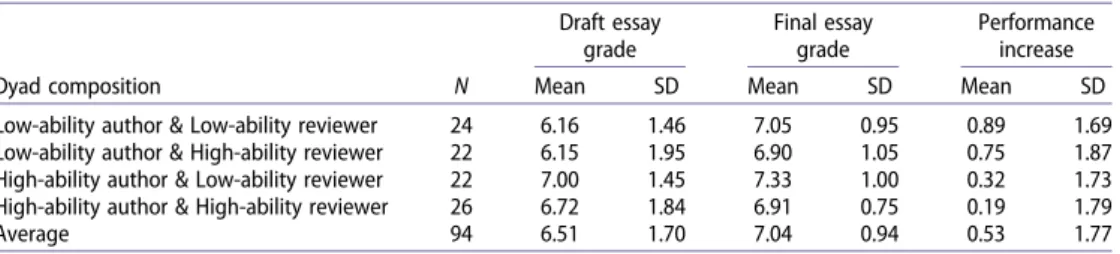
In general, there was improvement between scores for draft versions (M= 6.51,SD= 1.70)
and scores for final essays (M= 7.04,SD= 0.94),t(93) = 2.91,p= .005.Table 2appears to
indicate that the academic writing performance of lower ability students may increase more than that of higher ability students, irrespective of dyad composition. However,
per-formance increase did not depend directly on author ability (β=−0.16, p= .117, ΔR2
= .03) or reviewer ability (β=−0.02,p= .837,ΔR2= .00). Most importantly, dyad
compo-sition appeared unrelated to students’ essay performance increase (F(3, 90) = 0.850, p
= .470,h2
p= .03). Thus, performance increase was neither related to authors’or reviewers’
Student ability in reciprocal dyads and feedback quality
In general, reviewer ability was not directly related to provided feedback quality (V=
0.10,F(12, 81) = 0.77,p= .672,h2
p= .10). However, visual inspection ofTable 1suggests
that higher ability reviewers provide more content-related feedback. Specifically, univari-ate tests suggested that higher ability reviewers provide more content-relunivari-ated suggestions
for improvement (F(1, 92) = 6.23,p= .014,h2p= .06) and more content-related
explana-tory feedback (F(1, 92) = 4.19, p= .043, h2
p= .04). Given the exploratory nature of our
research question, however, the risk for Type I errors needed to be addressed. Hence, a Bonferroni correction was applied, after which these results no longer remained significant.
In general, dyad composition also was not related to feedback quality (V= 0.28,F(36,
243) = 0.69,p= .908,h2p= .09). Only the univariate analysis regarding content-related
sug-gestions for improvement suggested a potential difference between differently composed
dyads (F(3, 90) = 3.44, p= .002, h2p= .10). On average, 3.00 (SD= 3.27) content-related
suggestions for improvement were provided within high-ability homogeneous dyads. In contrast, such feedback comments appeared to be less common in low-ability
homo-geneous dyads (M= 1.54, SD= 1.50), heterogeneous dyads with high-ability reviewers
(M= 1.82, SD= 2.19), and heterogeneous dyads with low-ability reviewers (M= 1.05,
SD= 0.99). As with the relation between student ability and feedback quality, however,
a Bonferroni correction rendered this univariate effect non-significant.
Thus, at first glance, peer feedback quality appears unrelated to either individual reviewer ability or dyad composition. However, a closer look reveals trends suggesting that high-ability reviewers may provide more content-related explanations and sugges-tions for improvement, and that such suggessugges-tions for improvement occur more frequently in homogeneous, high-ability dyads than in dyads of other compositions.
Received feedback quality, author ability and essay performance
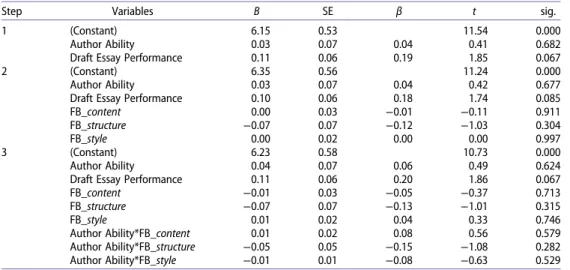
Final Essay Performance did not depend on the number of feedback comments that
stu-dents received on either content-related aspects (β=−0.01,t(87) =−0.11,p= .911),
struc-ture-related aspects (β=−0.12,t(87) =−1.03,p= .304), or style-related aspects (β= 0.00,t
(87) = 0.00,p= .997) of their draft essay. Moreover, author ability did not significantly
interact with feedback comments on these content-related aspects (β= 0.08, t(84) =
0.56, p= .579), structure-related aspects (β=−0.15, t(84) =−1.08, p= .282), and
style-related aspects (β=−0.08,t(84) =−0.63,p= .529). SeeTable 3for an overview.
Table 2.Essay performance and dyad composition.
Draft essay grade
Final essay grade
Performance increase
Dyad composition N Mean SD Mean SD Mean SD
Low-ability author & Low-ability reviewer 24 6.16 1.46 7.05 0.95 0.89 1.69 Low-ability author & High-ability reviewer 22 6.15 1.95 6.90 1.05 0.75 1.87 High-ability author & Low-ability reviewer 22 7.00 1.45 7.33 1.00 0.32 1.73 High-ability author & High-ability reviewer 26 6.72 1.84 6.91 0.75 0.19 1.79
Average 94 6.51 1.70 7.04 0.94 0.53 1.77
Note: Grades range from 1 (lowest) to 10 (highest).
Thus, feedback quality did not relate to Final Essay Performance, and no significant moderating (interaction) effect of author ability was found, suggesting that this is the case for all authors irrespective of their individual ability.
Conclusions and discussion
The central aim of this study was to assess whether homogeneous or heterogeneous student matching during the peer feedback phase has an effect on peer feedback quality
and students’ performance on an academic writing task. In the following section, we
discuss our findings in the order of the three main research questions.
Student ability, dyad composition and performance increase
Research question 1 addressed the direct relation between students’ability in reciprocal
dyads and authors’ essay performance increase. Authors’ essay performance increase
neither was directly related to their own ability, nor was it directly related to the ability of their reviewing peer. Most importantly, no relation was found between dyad
compo-sition and students’ essay performance increase. Based on these data, it apparently does
not matter how students are matched on ability during the peer feedback phase of an aca-demic writing assignment.
These findings contradict prior research that advocates matching students in any par-ticular way, be it homogeneous or heterogeneous matching. Possibly, the anonymous dis-tribution of essays provided a sufficient degree of uncertainty regarding their peer’s status to induce a mindful and critical appraisal of the received peer feedback (Gielen et al.,
2010). This may suggest that, conditional on students’(perceived) anonymity,how
stu-dents are matched becomes less relevant, emphasizing the role of student perceptions
in the peer feedback process (Strijbos et al.,2010).
Table 3.Hierarchical regression analysis (research question 3).
Step Variables B SE β t sig.
1 (Constant) 6.15 0.53 11.54 0.000
Author Ability 0.03 0.07 0.04 0.41 0.682 Draft Essay Performance 0.11 0.06 0.19 1.85 0.067
2 (Constant) 6.35 0.56 11.24 0.000
Author Ability 0.03 0.07 0.04 0.42 0.677 Draft Essay Performance 0.10 0.06 0.18 1.74 0.085
FB_content 0.00 0.03 −0.01 −0.11 0.911
FB_structure −0.07 0.07 −0.12 −1.03 0.304
FB_style 0.00 0.02 0.00 0.00 0.997
3 (Constant) 6.23 0.58 10.73 0.000
Author Ability 0.04 0.07 0.06 0.49 0.624 Draft Essay Performance 0.11 0.06 0.20 1.86 0.067
FB_content −0.01 0.03 −0.05 −0.37 0.713
FB_structure −0.07 0.07 −0.13 −1.01 0.315
FB_style 0.01 0.02 0.04 0.33 0.746
Author Ability*FB_content 0.01 0.02 0.08 0.56 0.579 Author Ability*FB_structure −0.05 0.05 −0.15 −1.08 0.282 Author Ability*FB_style −0.01 0.01 −0.08 −0.63 0.529 Note:
Dependent variable: final essay performance
Step 1:R2= .043 (p= .133). Step 2:R2= .059,ΔR2= .016 (
Student ability in reciprocal dyads and feedback quality
Research questions 2a and 2b addressed the relation between reviewer ability and provided feedback quality, and the relation between dyad composition and provided feedback
quality, respectively. In line with prior research (e.g., Snowball & Mostert, 2013), peer
feedback primarily focused on issues relating to writing style. In general, however, reviewer ability was not related to the quality of the provided peer feedback. A closer look suggested that high-ability reviewers may provide more content-related suggestions for improvement and content-related explanations, but this effect disappeared when a Bonferroni correction was applied to control for false positives (Type I errors). Similarly, dyad composition and provided peer feedback quality appeared unrelated, with a possible exception worth mentioning being homogeneous, high-ability dyads: when high-ability students were matched with each other, the number of content-related suggestions for improvement appeared to be higher compared to differently composed dyads. Here too, a Bonferroni correction rendered these differences insignificant. However, because of the rather conservative nature of the Bonferroni correction (it may increase the risk for false negatives, Type II errors), we think these trends deserve a closer look in future research.
If future research would indicate that these trends are reliable, then they may reflect the possibility that high-ability reviewers had a deeper understanding of the assigned theoretical content than the low-ability reviewers. If higher ability reviewers indeed are better at diagnosing problems and selecting strategies for revision (Flower et al.,
1986; Patchan et al., 2013), this would explain why they provided somewhat more
explanatory feedback and suggestions for improvement on content-related aspects of the texts. These trends could also represent ability differences within a restricted range: in the Dutch higher education context, students typically have completed sec-ondary school at pre-university level, which makes them relatively similar in terms of educational background, age and probably also in terms of writing ability. Regarding the interpretation of these trends, this similar background is important for at least two reasons. On the one hand, it may simultaneously explain why in the current study only non-significant trends were found and justify to consider these trends informative. After all, if these trends become apparent in a (homogeneous) sample that is fairly
similar in terms of students’ ability, they may become more salient as samples
become more heterogeneous (i.e., open or online educational contexts such as
MOOCs; see Huisman, Admiraal, Pilli, van de Ven, & Saab, 2016). On the other
hand, it suggests that academic teaching staff may not have to worry too much about the ability matching of higher education students in on campus courses, at least when these students are relatively similar in terms of ability.
Received feedback quality, author ability and performance increase
Research question 3 addressed the relation between received feedback quality, essay
performance and authors’ ability. Authors’ essay performance was not related to
received peer feedback quality. Specifically, it did not matter whether peer feedback comments focused on content-related, structure-related, or stylistic aspects of
authors’ drafts. This was the case for all authors, irrespective of their individual
ability level.
Whether a student benefits from received (peer) feedback is contingent on his or her mindful reception of, engagement with, and utilization of the feedback (Handley, Price,
& Millar,2011). This study focused directly on authors’ summative essay performance,
and not on the preceding step of feedback utilization. If we would assume that making revisions based on received peer feedback would generally increase writing performance
(although this assumption is debatable, see Flower et al.,1986), our results appear to
con-tradict those of Patchan et al. (2013). Among others, these authors found that, compared
to high-ability authors, low-ability authors received and implemented more feedback on
‘substance’ (issues fixable with content knowledge) from high-ability reviewers. We did
not find such a significant relation between dyad composition, content-related feedback and content-related essay performance increase. If anything, a contradicting trend was found in which high-ability authors received more content-related suggestions for improvement than low-ability authors when matched with high-ability reviewers. Poss-ibly, the drafts of high-ability authors were already perceived somewhat better in terms of structure and style, allowing the high-ability reviewers to focus more on content-related aspects.
Limitations and implications
Some remarks are in place. First, we did not take into account students’ perceptions
regarding the adequacy of the received peer feedback. As such, it remains an open question how the peer feedback was perceived, and how this is related to student ability matching, feedback quality and essay performance. Future research may focus on these relations by
incorporating students’ responses on questionnaires (e.g., Strijbos et al.,2010) or
inter-views (e.g., Hanrahan & Isaacs,2001). Second, as is the case in many studies on peer
feed-back, the students in this study were simultaneously feedback provider and receiver. Hence, it was not possible to disentangle what the effects on providing versus receiving
peer feedback were on students’essay performance. Because the act of providing peer
feed-back may be as effective as receiving peer feedfeed-back (Lundstrom & Baker,2009),
investi-gating these separate effects in relation to student ability seems an interesting topic for future research.
No differences were found in terms of writing performance for homogeneously and heterogeneously matched students. This suggests that ability matching is not related to
students’ essay performance and that students may very well be matched randomly.
Because random student-matching is a feature of many web-based peer feedback appli-cations, this may simplify at least one decision that academic teaching staff have to make when designing anonymous feedback processes.
Note
aspects). Therefore, an additional residualizing procedure was conducted in which three sep-arate dependent variables were created: content-related, structure-related and style-related Final Essay Performance. This allowed for a comparison of the separate effects that the feed-back comments on aspects of Content, Structure and Style had on students’ Final Essay Performance on those particular aspects of the texts. Because no significant relations were found, the different weights of these aspects were not further attended to in the principal analyses.
Acknowledgements
We would like to thank Kim Stroet for facilitating this study. Furthermore, we would like to thank Wilfried Admiraal and Ralph Rippe for their help with the analyses. Thanks also to Reginald Boersma, Alissa Bakker –van den Berg, and Valerie Robeer for their help with the grading of the assignments and the coding of the peer feedback. Finally, we thank Kirsten Ran for her help with the questionnaires. The underlying (anonymized) research materials for this article can be accessed at osf.io/3b48u.
Disclosure statement
No potential conflict of interest was reported by the authors.
References
Buckley, E., & Cowap, L. (2013). An evaluation of the use of Turnitin for electronic submission and marking and as a formative feedback tool from an educator’s perspective.British Journal of Educational Technology,44(4), 562–570.doi:10.1111/bjet.12054
Cho, K., & MacArthur, C. (2010). Student revision with peer and expert reviewing.Learning and Instruction,20(4), 328–338.doi:10.1016/j.learninstruc.2009.08.006
Cho, K., Schunn, C. D., & Wilson, R. W. (2006). Validity and reliability of scaffolded peer assess-ment of writing from instructor and student perspectives.Journal of Educational Psychology,98
(4), 891–901.doi:10.1037/0022-0663.98.4.891
Falchikov, N., & Goldfinch, J. (2000). Student peer assessment in higher education: A meta-analysis comparing peer and teacher marks.Review of Educational Research,70(3), 287–322.doi:10.2307/ 1170785
Flower, L., Hayes, J. R., Carey, L., Schriver, K., & Stratman, J. (1986). Detection, diagnosis, and the strategies of revision+composition. College Composition and Communication, 37(1), 16–55.
doi:10.2307/357381
Gielen, S., Peeters, E., Dochy, F., Onghena, P., & Struyven, K. (2010). Improving the effectiveness of peer feedback for learning.Learning and Instruction,20(4), 304–315.doi:10.1016/j.learninstruc. 2009.08.007
Handley, K., Price, M., & Millar, J. (2011). Beyond‘doing time’: Investigating the concept of student engagement with feedback.Oxford Review of Education,37(4), 543–560.
Hanrahan, S. J., & Isaacs, G. (2001). Assessing self- and peer-assessment: The students’ views.
Higher Education Research & Development,20(1), 53–70.doi:10.1080/07294360123776
Huisman, B., Admiraal, W., Pilli, O., van de Ven, M., & Saab, N. (2016). Peer assessment in MOOCs: The relationship between peer reviewers’ ability and authors’ essay performance.
British Journal of Educational Technology.doi:10.1111/bjet.12520
King, A. (1997). ASK to THINK-TEL WHY: A model of transactive peer tutoring for scaffolding higher level complex learning. Educational Psychologist, 32(4), 221–235. doi:10.1207/ s15326985ep3204_3
Landis, J. R., & Koch, G. G. (1977). Measurement of observer agreement for categorical data.
Biometrics,33(1), 159–174.doi:10.2307/2529310
Lin, S. S. J., Liu, E. Z. F., & Yuan, S. M. (2001). Web-based peer assessment: Feedback for students with various thinking-styles.Journal of Computer Assisted Learning,17(4), 420–432.doi:10.1046/ j.0266-4909.2001.00198.x
Lundstrom, K., & Baker, W. (2009). To give is better than to receive: The benefits of peer review to the reviewer’s own writing.Journal of Second Language Writing,18(1), 30–43.doi:10.1016/j.jslw. 2008.06.002
Luxton-Reilly, A. (2009). A systematic review of tools that support peer assessment.Computer Science Education,19(4), 209–232.doi:10.1080/08993400903384844
Nelson, M. M., & Schunn, C. D. (2009). The nature of feedback: How different types of peer feed-back affect writing performance.Instructional Science,37(4), 375–401. doi:10.1007/s11251-008-9053-x
Patchan, M. M., Hawk, B., Stevens, C. A., & Schunn, C. D. (2013). The effects of skill diversity on commenting and revisions. Instructional Science, 41(2), 381–405. doi:10.1007/s11251-012-9236-3
Patchan, M. M., & Schunn, C. D. (2015). Understanding the benefits of providing peer feedback: How students respond to peers’ texts of varying quality. Instructional Science. doi:10.1007/ s11251-015-9353-x
Snowball, J. D., & Mostert, M. (2013). Dancing with the devil: Formative peer assessment and aca-demic performance. Higher Education Research & Development, 32(4), 646–659.doi:10.1080/ 07294360.2012.705262
Strijbos, J. W., Narciss, S., & Dünnebier, K. (2010). Peer feedback content and sender’s competence level in academic writing revision tasks: Are they critical for feedback perceptions and efficiency?
Learning and Instruction,20(4), 291–303.doi:10.1016/j.learninstruc.2009.08.008
Strijbos, J. W., & Sluijsmans, D. (2010). Unravelling peer assessment: Methodological, functional, and conceptual developments. Learning and Instruction, 20(4), 265–269. doi:10.1016/j. learninstruc.2009.08.002
Topping, K. J. (1998). Peer assessment between students in colleges and universities.Review of Educational Research,68(3), 249–276.
Topping, K. J. (2009). Peer assessment.Theory into Practice,48(1), 20–27.
van den Berg, I., Admiraal, W., & Pilot, A. (2006). Designing student peer assessment in higher edu-cation: Analysis of written and oral peer feedback.Teaching in Higher Education,11(2), 135–147.
doi:10.1080/13562510500527685
van Gennip, N. A. E., Segers, M. S. R., & Tillema, H. H. (2009). Peer assessment for learning from a social perspective: The influence of interpersonal variables and structural features.Educational Research Review,4(1), 41–54.