REPORT
Whole-Exome Sequencing Identifies Loci Associated with
Blood Cell Traits and Reveals a Role for Alternative
GFI1B
Splice Variants in Human Hematopoiesis
Linda M. Polfus,1,38 Rajiv K. Khajuria,2,3,4,38 Ursula M. Schick,5,38 Nathan Pankratz,6
Raha Pazoki,7 Jennifer A. Brody,8 Ming-Huei Chen,9 Paul L. Auer,10 James S. Floyd,8
Jie Huang,11 Leslie Lange,12 Frank J.A. van Rooij,7 Richard A. Gibbs,13 Ginger Metcalf,13
Donna Muzny,13 Narayanan Veeraraghavan,13 Klaudia Walter,11 Lu Chen,11,14 Lisa Yanek,15
(Author list continued on next page)
Circulating blood cell counts and indices are important indicators of hematopoietic function and a number of clinical parameters, such as blood oxygen-carrying capacity, inflammation, and hemostasis. By performing whole-exome sequence association analyses of hema-tologic quantitative traits in 15,459 community-dwelling individuals, followed by in silico replication in up to 52,024 independent sam-ples, we identified two previously undescribed coding variants associated with lower platelet count: a common missense variant inCPS1 (rs1047891, MAF¼0.33, discoveryþreplication p¼6.3831010) and a rare synonymous variant inGFI1B(rs150813342, MAF¼0.009, discoveryþreplication p¼1.7931027). By performing CRISPR/Cas9 genome editing in hematopoietic cell lines and follow-up
tar-geted knockdown experiments in primary human hematopoietic stem and progenitor cells, we demonstrate an alternative splicing mechanism by which theGFI1Brs150813342 variant suppresses formation of a GFI1B isoform that preferentially promotes megakaryo-cyte differentiation and platelet production. These results demonstrate how unbiased studies of natural variation in blood cell traits can provide insight into the regulation of human hematopoiesis.
Human genetic studies have provided important insights into hematopoiesis. Genome-wide association studies (GWASs) performed in large, population-based samples have identified associations of genomic regions and com-mon genetic (usually non-coding) variants with inter-indi-vidual differences in blood cell traits1–5, though the causal DNA variants and their functional mechanisms often remain elusive. Whole-exome and targeted sequencing approaches have been used to identify rare, sometimes pri-vate, loss (or gain)-of-function coding variants segregating within families with hematologic traits at the extremes of the phenotypic distribution6–12. As of yet, whole-exome sequencing has not been applied to large population-based cohorts well-phenotyped for hematologic traits to identify rare, functional variation with moderate-to-large pheno-typic effects and to provide new biologic insight.
To this end, we performed exome sequencing in 15,459 unrelated European ancestry (EU) and African American (AA) individuals enrolled in six population-based cohort studies (seeSupplemental Note). Replication of significant
findings was performed in up to 52,024 additional samples via a combination of whole-exome-based or genome-based sequencing, genotyping, and imputation (Supplemental Note). Our a priori hypothesis was that systematic evalua-tion of coding variaevalua-tion detected by exome sequence analysis in samples unselected for blood cell traits would identify low-frequency variants influencing hematologic traits and could provide functional insights into hemato-poiesis. We analyzed platelet count and 12 other blood cell traits (Table S1). The means of the traits were as ex-pected in a sample of unselected healthy individuals from the population (Table S1). Association results from single-variant and from gene-based burden and sequence kernel association tests (SKATs) meeting our a priori signif-icance thresholds in either EU, AA, or trans-ethnic discov-ery meta-analyses are summarized for both previously known and novel (which we define as those not reported in the available literature) loci inTable 1andTables S2–S5and described further in the Supplemental Note. Lambda values showed no significant inflation (Table S6).
1Human Genetics Center, School of Public Health, University of Texas Health Science Center at Houston, Houston, TX 77030, USA;2Division of Hematol-ogy/Oncology, Boston Children’s Hospital and Department of Pediatric Oncology, Dana-Farber Cancer Institute, Boston, MA 02115, USA,;3Broad Institute of Harvard and MIT, Cambridge, MA 02142, USA;4Berlin-Brandenburg School for Regenerative Therapies, Charite´ Universita¨tsmedizin Berlin, Berlin 13353, Germany;5The Charles Bronfman Institute for Personalized Medicine, Icahn School of Medicine at Mount Sinai, New York, NY 10029, USA; 6Department of Laboratory Medicine and Pathology, University of Minnesota, Minneapolis, MN 55454, USA;7Department of Epidemiology, Erasmus Uni-versity Medical Center, Rotterdam 3000, the Netherlands;8Cardiovascular Health Research Unit and Department of Medicine, University of Washington, Seattle, WA 98195, USA;9Department of Neurology, School of Medicine, Boston University, Boston, MA 02118, USA;10School of Public Health, University of Wisconsin-Milwaukee, Milwaukee, WI 53205, USA;11Human Genetics, Wellcome Trust Sanger Institute, Hinxton CB10 1HH, UK;12Department of Ge-netics, University of North Carolina, Chapel Hill, NC 27599, USA;13Human Genome Sequencing Center, Baylor College of Medicine, Houston, TX 77030, USA;14Department of Haematology, University of Cambridge, Cambridge CB2 0AH, UK;15GeneSTAR Research Program, Division of General Internal Med-icine, Department of MedMed-icine, School of MedMed-icine, Johns Hopkins University, Baltimore, MD 21205, USA;16Center for Human Genetic Research,
Four gene-based associations were discovered for red blood cell (RBC) traits (ACTN4,MMACHC,MYOM2, and
MRPL43). Trans-ethnic discovery meta-analyses are sum-marized for both previously identified loci, which we verify in this study, and previously unreported loci. A summary of these findings, and driving variants, are provided in
theSupplemental NoteandTable S3. None of these
gene-based SKAT or burden findings could be replicated in inde-pendent samples. Nonetheless, a few of the individual rare variants driving the gene-based associations in the discov-ery sample showed suggestive evidence of association in the replication sample (Supplemental NoteandTable S3). Among the three single-variant associations we identified (Table 1), two coding variants were associated with lower platelet count in our discovery sample:CPS1rs1047891, a common missense variant encoding p.Thr1412Asn (EUþ AA minor-allele frequency [MAF] ¼ 0.33, EU þ AA p ¼ 5.73 108) andGFI1B rs150813342, a rare synonymous variant encoding p.Phe192 and located in alternatively spliced exon 5 (EU MAF¼0.009, EU p¼4.73108; EUþ AA MAF¼0.008, EUþAA p¼2.643108). One
single-nucleotide variant (SNV) result (rs9656446; EU þ AA MAF¼0.03, EUþAA p¼1.483107) associated with
baso-phils in trans-ethnic analyses was in the ATP/GTP binding protein-like 3 (AGBL3) gene. However, the allele frequencies in the discovery sample differed by ethnicity (EU MAF¼ 0.001 and AA MAF¼0.08), and replication in samples of EU ethnicity from the UK10K project was not significant (EU p ¼ 0.71). In our combined replication sample, we replicated the associations of CPS1rs1047891 (EU þ AA
MAF ¼ 0.328, EU þ AA p ¼ 1.02 3 104) and GFI1B
rs150813342 (EUþAA p¼5.7131021) with lower platelet counts. In the combined discovery and replication samples, the p values for CPS1rs1047891 andGFI1Brs150813342 were 6.3831010and 1.7931027, respectively. A Manhat-tan plot for single-variant associations with platelet count and quantile-quantile (Q-Q) plots are shown inFigures S1– S3. Forest plots of the discovery cohorts for the two repli-cated findings (GFI1B rs150813342 andCPS1 rs1047891) are provided in Figures S4 and S5, as well as regional plots calculating linkage disequilibrium of SNVs in the gene with respect to index SNVs (Figures S6andS7).
AGBL3is a metallocarboxypeptidase involved in process-ing tubulins of the blood cell cytoskeleton.CPS1encodes carbamoyl-phosphate synthase 1, a mitochondrial enzyme involved in the urea cycle. TheCPS1variant (or its LD prox-ies) has been associated with various cardiometabolic traits, including high-density lipoprotein (HDL) choles-terol, homocysteine, fibrinogen, serum metabolite levels, and kidney function.13–17GFI1Bis a known transcriptional repressor and a key regulator of platelet and red blood cell development. There was no evidence that either CPS1
rs1047891 orGFI1Brs150813342 were significantly associ-ated with other hematologic traits assessed in the discovery sample (Tables S7A and S7B). Moreover, neither GFI1B
rs150813342 nor CPS1 rs1047891 was associated with mean platelet volume, platelet aggregation, or expression of platelet surface markers, though these analyses were limited to much smaller numbers of individuals (
Supple-mental Note,Tables S8and S10). However, a decrease in
Massachusetts General Hospital, Boston, MA 02114, USA;17Estonian Genome Center, University of Tartu, Tartu, 51010, Estonia;18Department of Genome Sciences, University of Washington, Seattle, WA 98195, USA;19College of Public Health, the University of Iowa, Iowa City, IA 52242, USA;20Department of Medicine, School of Medicine, University of North Carolina, Chapel Hill, NC 27599, USA;21Department of Surgery, University of Texas Health Science Center at Houston, Houston, TX 77030, USA;22Department of Clinical Chemistry, Fimlab Laboratories and University of Tampere School of Medicine, Tampere 33520, Finland;23Department of Clinical Physiology, Tampere University Hospital and University of Tampere School of Medicine, Tampere 33521, Finland;24Department of Clinical Physiology and Nuclear Medicine, Turku University Hospital and Research Centre of Applied and Preventive Car-diovascular Medicine, University of Turku, Turku 20520, Finland;25Department of Clinical Epidemiology, Leiden University Medical Center, Leiden RC 2300, the Netherlands;26Epidemiology Section, Department of Biostatistics, Epidemiology, and Scientific Computing Department, King Faisal Specialist Hospital and Research Centre, Riyadh 11211 Saudi Arabia;27Montreal Heart Institute and Universite´ de Montre´al, Montreal, QC H1T 1C8, Canada; 28Department of Internal Medicine, Erasmus University Medical Center, Rotterdam 3000, the Netherlands;29Center for Public Health Genomics, Univer-sity of Virginia, Charlottesville VA 22908, USA;30Department of Physiology and Biophysics, University of Mississippi Medical Center, Jackson MS 39216, USA;31Group Health Research Institute, Group Health Cooperative, Seattle, WA 98101, USA;32Departments of Medicine and Biostatistics, Schools of Med-icine and Public Health, Boston University, Boston, MA 02118, USA;33Cardiovascular Epidemiology and Human Genomics Branch, Framingham Heart Study, National Heart, Lung, and Blood Institute, Framingham, MA 01702, USA;34Framingham Heart Study, National Heart, Lung, and Blood Institute, Framingham, MA 01702, USA;35Bloodworks Northwest, Seattle, WA 98102, USA;36Women’s Health Initiative Clinical Coordinating Center, Public Health Sciences Division, Fred Hutchinson Cancer Research Center, Seattle, WA 98109, USA;37Division of Cardiovascular Medicine, Departments of Internal Med-icine and Human Genetics, University of Michigan, Ann Arbor, MI 48109, USA
38
These authors contributed equally to this work 39These authors contributed equally to this work *Correspondence:[email protected](V.G.S.)
http://dx.doi.org/10.1016/j.ajhg.2016.06.016.
Lewis C. Becker,15Gina M. Peloso,16Aoi Wakabayashi,2,3Mart Kals,17Andres Metspalu,17To˜nu Esko,17
Keolu Fox,18Robert Wallace,19Nora Franceshini,20Nena Matijevic,21Kenneth M. Rice,8Traci M. Bartz,8
Leo-Pekka Lyytika¨inen,22Mika Ka¨ho¨nen,23Terho Lehtima¨ki,22Olli T. Raitakari,24Ruifang Li-Gao,25
Dennis O. Mook-Kanamori,25,26Guillaume Lettre,27Cornelia M. van Duijn,28Oscar H. Franco,7
Stephen S. Rich,29Fernando Rivadeneira,28Albert Hofman,28Andre´ G. Uitterlinden,28James G. Wilson,30
Bruce M. Psaty,8,31Nicole Soranzo,11,14Abbas Dehghan,7Eric Boerwinkle,1Xiaoling Zhang,32
Andrew D. Johnson,33Christopher J. O’Donnell,34Jill M. Johnsen,35Alexander P. Reiner,36,39
the median fluorescence intensity of large, platelet-marker positive (CD41þCD61þ) events18was detected by flow cy-tometry in GFI1B variant carriers even after adjustment for circulating platelet count (p < 0.0001), which could reflect a decrease in circulating platelet aggregates or a skew-ing of a platelet subpopulation with regards to platelet-sur-face-marker expression or size (seeSupplemental Note).
We conducted bioinformatic and functional analyses to understand the impact of theGFI1Bexon 5 synonymous variant and the CPS1 rs1047891 variant (p.Thr1412Asn) on gene and protein function. The CPS1 p.Thr1412Asn amino acid substitution is predicted to be benign and toler-ated by SIFT and PolyPhen. Moreover, according to the GTEx Portal database, there is no evidence of an expression quantitative trait loci (eQTL) effect for rs1047891. None-theless, the CPS1 p.Thr1412Asn missense substitution is located within a region critical for N-acetyl-glutamate binding and has been reported to result in 20%–30% higher enzymatic activity19and to influence vascular function.15
We initially assessed the association of rs150813342 with
GFI1B expression by using Affymetrix GeneChip Human Exon 1.0 ST Array data on whole-blood RNA available from 881 Framingham Heart Study participants.20There was no
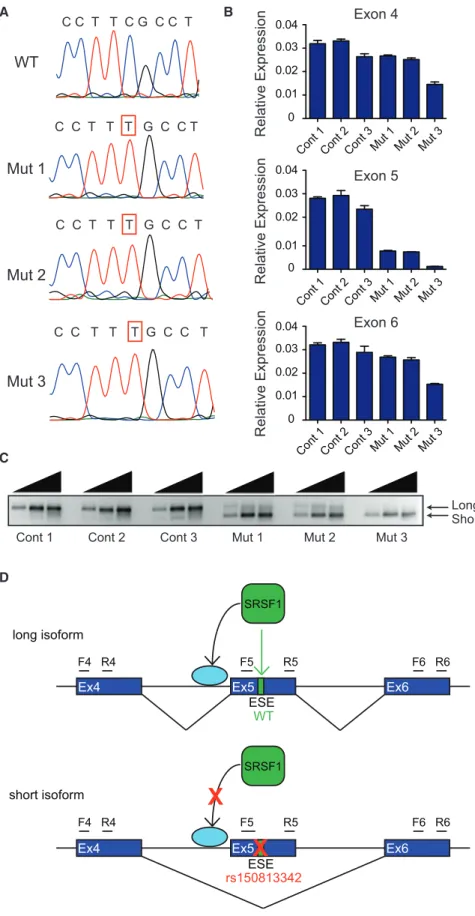
evidence for association of the rs150813342 genotype with expression of anyGFI1Bexon, though statistical power is likely limited by the low frequency of the rs150813342 variant allele, which was present in only 7 of the 881 individ-uals. According to SPANR,21rs150813342 had a predicted effect on splicing (difference in the percentage of transcripts with the exon spliced in [dPSI] score of4.6). rs150813342 was predicted to disrupt a putative exon splicing enhancer (ESE) in exon 5 that contains a consensus SRSF1 binding motif.22To functionally evaluate the impact of this variant on GFI1B transcript splicing in a relevant cell type, we used CRISPR/Cas9 genome editing to create multiple indepen-dent isogenic K562 hematopoietic cell lines harboring the
GFI1B synonymous single-nucleotide change (Figure 1A). These cell lines were homozygous for the variant and ex-hibited inclusion of less than 30% of exon 5 relative to other surrounding exons in theGFI1BmRNA (Figure 1B). Semi-quantitative RT-PCR showed that the presence of the synonymous variant resulted in reduced formation of the
GFI1B isoform containing exon 5 (herein referred to as the long isoform), as well as preferential formation of the iso-form lacking exon 5 (herein referred to as the short isoiso-form) (Figures 1C and 1D). No other isoforms or intron inclusion events were detected (Figure 1C,Figure S8).
AlthoughGFI1Bhas been implicated in both RBC and platelet production (erythropoiesis and megakaryopoiesis, respectively),23–25 only a role for the short isoform in
erythroid cells has been suggested previously.26We next
assessed the effect of the altered splicing ofGFI1Bon line-age-specific hematopoietic differentiation. We chemically induced differentiation of the isogenic K562 cell lines with either hemin (to promote erythroid differentiation) or phorbol 12-myristate 13-acetate (PMA, to promote mega-karyocytic differentiation) (Figure 2A). Although erythroid
Table 1. Single-Variant Association Findings Trait Discovery Ethnicity Gene SNP Chromosome Position, rs Number, and Function
Discovery pValue Replication pValue Discovery MAF Replication MAF Discovery Beta Coefficient (SE)
Replication ZScore
differentiation appeared to proceed normally, as assessed morphologically (Figure 2B), and with expression of the surface marker GYPA (CD235a) (Figure 2C) and ter-minal erythroid marker genes (Figure 2D), megakaryocyte
Cont 1Cont 2Cont 3 Mut 1 Mut 2 Mut 3
0 0.01 0.02 0.03 0.04
Cont 1 Cont 2 Cont 3 Mut 1 Mut 2 Mut 3
0 0.01 0.02 0.03 0.04 0 0.01 0.02 0.03 0.04
Cont 1Cont 2Cont 3 Mut 1 Mut 2 Mut 3 Cont 1Cont 2Cont 3 Mut 1 Mut 2 Mut 3 C C T T C G C C T
C C T T T G C C T
C C T T T G C C T
C C T T T G C C T
Exon 4
Exon 5
Exon 6
Relative Expression
Relative Expression
Relative Expression
Long Short
WT
Mut 1
Mut 2
Mut 3
A B
C
SRSF1
SRSF1 ESE
ESE
Ex4 Ex5 Ex6
Ex4 Ex5 Ex6
WT
rs150813342
F4 R4 F5 R5 F6 R6
F4 R4 F5 R5 F6 R6
long isoform
short isoform
X
X
D
Figure 1. The Variant rs150813342 Re-sults in Reduced Formation of the Long
GFI1BIsoform and Preferential Formation of the Short Isoform
(A) Chromatograms of the sequence sur-rounding the altered nucleotide inGFI1B exon 5 showing the wild-type (WT) se-quence and sese-quences of isogenic hemato-poietic K562 cell mutant clones (Mut 1, Mut 2, and Mut 3) harboring the C>T sin-gle-nucleotide variant (SNV) generated via CRISPR/Cas9 mediated homologous repair. (B) qRT-PCR ofGFI1Bexons 4, 5, and 6 measured from isogenic control (Cont) and mutant K562 cell clones showing inclusion of less than 30% ofGFI1Bexon 5 relative to the surrounding exons in GFI1BmRNA from mutant clones (n¼3 per group). Error bars show SD.
(C) Semi-quantitative RT-PCR withGFI1B exon 4 forward and exon 6 reverse primers with progressively increasing cycle numbers (26, 28, and 30 cycles) demonstrates reduced formation of the longGFI1B isoform and preferential formation of the short isoform, as well as no other intermediate isoforms in the clones harboring the SNV.
(D) rs150813342 is predicted to disrupt a pu-tative exon splicing enhancer (ESE) in exon 5 that contains a consensus SRSF1 binding motif. Disruption of this binding motif results in reduced inclusion of exon 5 and preferential formation of the short isoform. The promotion of alternative splicing by SRSF1 through the spliceosome complex is indicated by an arrow to a light blue circle. Forward (F) and reverse (R) PCR primers of the respective exon are indicated.
differentiation appeared severely impaired; the cells retained an imma-ture blast-like morphology and failed to upregulate the surface marker of megakaryocyte differentiation, CD41a (encoded by ITGA2B), and mRNAs whose expression is characteristic of terminal megakaryopoiesis (Figures 2B–2D,Figure S9). The megakaryocyte genesPPBP,SELP, andPF4were down-regulated by an average of 8.6-, 6.7-, and 41.1-fold, respectively, in the isogenic clones (p ¼ 0.0001, 0.0013, and 0.0459, respectively) versus in the controls (Figure 2D). These results sug-gest that the long isoform of GFI1B is necessary for normal megakaryocyte differentiation.
To confirm a preferential role for this long GFI1B isoform in megakar-yocyte differentiation, we identified two independent short hairpin RNAs (shRNAs) that specifically targeted
lentiviral-mediated shRNA delivery in primary human adult mobilized peripheral-blood hematopoietic stem and progenitor cells (HSPCs), which are capable of differ-entiation toward the erythroid and megakaryocyte line-ages under appropriate culture conditions.27We observed a knockdown efficiency of the GFI1B long isoform by ~50% for both shRNAs, whereas the short isoform levels increased conversely (Figures 3A and 3B), which resulted in a 1.5- to 1.8-fold reduction in the formation of CD41aþ megakaryocytic cells (relative to lineage-marker negative cells) in HSPCs undergoing differentiation (Figure 3C). In contrast, CD235aþerythroid cells appeared to be present in comparable percentages and numbers
(Figure 3C). Moreover, whereas numerous
morphologi-PPBP SELP PF4
0 1 2 3
Relat
iv
e
m
RNA
ex
pr
es
s
ion
ALAS2 RHCE KEL
0.0 0.5 1.0 1.5 2.0 2.5
Relat
iv
e
m
R
NA
ex
pr
es
s
ion
PMA 72 hr Hemin 24–96 hr
Erythroid Differentiation
Megakaryocytic Differentiation Isogenic
K562 Clones
Unstained = 214
Cont = 1211
Mut = 457
CD41a
Unstained = 19
Cont = 2745
Mut = 2143
CD235a
A B Control Mutant
Baseline
Ery.
Mega.
C D
Control clones Mutant clones
Megakaryocyte Genes
Erythroid Genes
Figure 2. Impaired Megakaryopoiesis and Retained Erythropoiesis in K562 Cells Harboring the rs150813342 SNV inGFI1B
Exon 5
(A) Scheme of phorbol 12-myristate 13-ac-etate (PMA)-induced megakaryocytic dif-ferentiation and hemin-induced erythroid differentiation of the hematopoietic K562 cell models.
(B) Representative May-Gru ¨nwald-Giemsa-stained cytospin images of 72 hr PMA-induced and 96 hr hemin-PMA-induced isogenic control and mutant clones showing mega-karyocytic differentiation that appears severely impaired, with the cells retaining an immature blast-like morphology in the mutant clones, whereas the erythroid dif-ferentiation appears unaffected.
(C) Representative flow cytometry anal-ysis of the megakaryocyte marker CD41a and the erythroid marker CD235a further confirmed the impaired megakaryopoiesis and the retained erythropoiesis as shown by the histogram plots with the mean fluorescence intensity (MFI) for each marker in unstained cells, control, and mutant clones, respectively.
(D) Gene expression analysis by qRT-PCR of the megakaryocyte markersPPBP,SELP, andPF4after 72 hr of PMA-induced differ-entiation and of the erythroid markers ALAS2, RHCE, and KEL after 24 hr of hemin-induced differentiation (n¼3 per group). Error bars show SD.
cally mature erythroblasts could be readily visualized in both groups, fewer mature megakaryocytic cells were seen with knockdown of the long isoform than in the controls (Figure 3D, Figure S10). Overall cell growth appeared comparable be-tween the knockdown and control cells (Figure S10). These findings are in line with our exome-sequence association findings, in which no significant effect was seen on circu-lating RBC levels.
GFI1B private, loss-of-function mutations (nonsense, frameshift) in the DNA-binding fifth and sixth zinc (Zn)-finger domains have recently been identified in families with an autosomal-dominant form of Gray Platelet syn-drome (GPS) or related forms of thrombocytopenia, which are characterized by dysmegakaryopoiesis, thrombocyto-penia, large platelets, and platelet a-granule deficiency (MIM: 187900)28,29. The truncatingGFI1B mutations
an exonic splicing enhancer, resulting in the skipping of exon 5, containing the first and second Zn-finger domains. Heterozygous carriers of the synonymous exon 5 variant in
GFI1B have an average platelet count that is reduced by 25,000 to 30,000 platelets per microliter, which would be a clinically detectable effect. We also provide additional support for distinct roles of GFI1B long- and short-isoforms, which are differentially expressed at various stages of differentiation during normal hemato-poiesis.23,30 The long GFI1B isoform is expressed in HSPCs and lineage-committed myeloid, erythroid, and megakaryocytic progenitors. The abnormalities in mega-karyocyte maturation with reduced formation of the
GFI1Blong isoform in the isogenic K562 cell clones con-taining the rs150813342 variant and in primary HSPCs with targeted suppression of the long isoform are consis-tent with an essential role for the GFI1B long isoform in megakaryopoiesis and platelet production. This finding is also congruent with prior work showing that the GFI1B short isoform is required for erythropoiesis26 and provides insight into how these different splice variants function in distinct aspects of human hematopoiesis.
In summary, whole-exome sequence association analysis performed in over 15,000 samples discovered SNVs associ-ated with a lower platelet count in community-dwelling in-dividuals, including a common variant inCPS1and a rare, synonymous variant inGFI1B. Follow-up genome editing and targeted knockdown experiments identified a mecha-nism by which alternative splicing associated with the
GFI1Brs150813342 variant allele suppresses formation of a specific GFI1B long isoform that is required for line-age-specific megakaryocyte differentiation, while being dispensable for erythropoiesis. Functional studies coupled with an association finding demonstrated a previously un-appreciated splicing-based mechanism for lineage-specific blood cell production, providing important insights into human hematopoiesis. Genes regulated by the long GFI1B isoform could provide additional understanding of down-stream transcriptional events and molecular pathways required for megakaryocyte specification and platelet pro-duction. These findings hold promise for the development of therapeutics for altering platelet count without adverse effects on other blood lineages. Further characterization of the role of GFI1B isoforms could have clinical or therapeutic implications for disorders of platelet and other blood cell
B A
D C
Figure 3. The LongGFI1BIsoform is Critical for Megakaryopoiesis in a Human Primary Cell Model
(A) qRT-PCR ofGFI1Bexons 4, 5, and 6 on day 4 after infection showing the identification of two short hairpin RNAs (shRNAs) that specifically targetGFI1Bexon 5 and thereby selectively downregulate the long isoform by ~50%, but not the short isoform (n¼3 per group). Error bars show SD.
(B) Semi-quantitative RT-PCR withGFI1Bexon 4 forward and exon 6 reverse primers with progressively increasing cycle numbers (26, 28, and 30 cycles) demonstrates reduced formation of the longGFI1Bisoform and increased formation of the short isoform, as well as no other intermediate isoforms in cells with targeted knockdown of GFI1B exon 5.
(C) Representative flow cytometry analysis of thrombopoietin (TPO)- and erythropoietin (EPO)-stimulated primary human hematopoi-etic stem and progenitor cells on day 11 of differentiation with assessment of CD41aþmegakaryocytic (Meg) cells and CD235aþ erythroid (Ery) cells.
production or function, as well as for the prospect of improving the manufacture of ex vivo cell therapies.31–33
Supplemental Data
Supplemental Data include a Supplemental Note, ten figures, nine tables, and Supplemental Acknowledgments and can be found with this article online athttp://dx.doi.org/10.1016/j.ajhg.2016. 06.016.
Acknowledgments
The work described in this manuscript was supported in part by NIH grants HL122684 to S.K.G. and DK103794 and HL120791 to V.G.S. N.S. is supported by the Wellcome Trust (grant codes WT098051 and WT091310), the EU 7thFramework Programme
(EPIGENESYS grant code 257082 and BLUEPRINT grant code HEALTH-F5-2011-282510) and the NIH Research (NIHR) Blood and Transplant Research Unit (BTRU) in Donor Health and Geno-mics at the University of Cambridge in partnership with NHS Blood and Transplant (NHSBT).
Received: March 14, 2016 Accepted: June 20, 2016 Published: August 4, 2016
Web Resources:
OMIM,http://www.omim.org/
References
1. Okada, Y., and Kamatani, Y. (2012). Common genetic factors for hematological traits in humans. J. Hum. Genet.57, 161–169. 2. Ganesh, S.K., Zakai, N.A., van Rooij, F.J., Soranzo, N., Smith,
A.V., Nalls, M.A., Chen, M.H., Kottgen, A., Glazer, N.L., Deh-ghan, A., et al. (2009). Multiple loci influence erythrocyte phenotypes in the CHARGE Consortium. Nat. Genet. 41, 1191–1198.
3. Soranzo, N., Spector, T.D., Mangino, M., Ku¨hnel, B., Rendon, A., Teumer, A., Willenborg, C., Wright, B., Chen, L., Li, M., et al. (2009). A genome-wide meta-analysis identifies 22 loci associated with eight hematological parameters in the Haem-Gen consortium. Nat. Haem-Genet.41, 1182–1190.
4. Auer, P.L., Teumer, A., Schick, U., O’Shaughnessy, A., Lo, K.S., Chami, N., Carlson, C., de Denus, S., Dube´, M.P., Haessler, J., et al. (2014). Rare and low-frequency coding variants in CXCR2 and other genes are associated with hematological traits. Nat. Genet.46, 629–634.
5. Ulirsch, J.C., Nandakumar, S.K., Wang, L., Giani, F.C., Zhang, X., Rogov, P., Melnikov, A., McDonel, P., Do, R., Mikkelsen, T.S., and Sankaran, V.G. (2016). Systematic Functional Dissec-tion of Common Genetic VariaDissec-tion Affecting Red Blood Cell Traits. Cell165, 1530–1545.
6. Shiohara, M., Shigemura, T., Saito, S., Tanaka, M., Yanagisawa, R., Sakashita, K., Asada, H., Ishii, E., Koike, K., Chin, M., et al. (2009). Ela2 mutations and clinical manifestations in familial congen-ital neutropenia. J. Pediatr. Hematol. Oncol.31, 319–324. 7. Minelli, A., Maserati, E., Rossi, G., Bernardo, M.E., De Stefano,
P., Cecchini, M.P., Valli, R., Albano, V., Pierani, P., Leszl, A., et al. (2004). Familial platelet disorder with propensity to
acute myelogenous leukemia: genetic heterogeneity and pro-gression to leukemia via acquisition of clonal chromosome anomalies. Genes Chromosomes Cancer40, 165–171. 8. Sankaran, V.G., and Gallagher, P.G. (2013). Applications of
high-throughput DNA sequencing to benign hematology. Blood122, 3575–3582.
9. Albers, C.A., Cvejic, A., Favier, R., Bouwmans, E.E., Alessi, M.C., Bertone, P., Jordan, G., Kettleborough, R.N., Kiddle, G., Kostadima, M., et al. (2011). Exome sequencing identifies NBEAL2 as the causative gene for gray platelet syndrome. Nat. Genet.43, 735–737.
10. Johnsen, J.M., Nickerson, D.A., and Reiner, A.P. (2013). Massively parallel sequencing: the new frontier of hematolog-ic genomhematolog-ics. Blood122, 3268–3275.
11. Giani, F.C., Fiorini, C., Wakabayashi, A., Ludwig, L.S., Salem, R.M., Jobaliya, C.D., Regan, S.N., Ulirsch, J.C., Liang, G., Stein-berg-Shemer, O., et al. (2016). Targeted Application of Human Genetic Variation Can Improve Red Blood Cell Production from Stem Cells. Cell Stem Cell18, 73–78.
12. Sankaran, V.G., Ghazvinian, R., Do, R., Thiru, P., Vergilio, J.A., Beggs, A.H., Sieff, C.A., Orkin, S.H., Nathan, D.G., Lander, E.S., and Gazda, H.T. (2012). Exome sequencing identifies GATA1 mutations resulting in Diamond-Blackfan anemia. J. Clin. Invest.122, 2439–2443.
13. Ko¨ttgen, A., Pattaro, C., Bo¨ger, C.A., Fuchsberger, C., Olden, M., Glazer, N.L., Parsa, A., Gao, X., Yang, Q., Smith, A.V., et al. (2010). New loci associated with kidney function and chronic kidney disease. Nat. Genet.42, 376–384.
14. Pare´, G., Chasman, D.I., Parker, A.N., Zee, R.R., Ma¨larstig, A., Seedorf, U., Collins, R., Watkins, H., Hamsten, A., Miletich, J.P., and Ridker, P.M. (2009). Novel associations of CPS1, MUT, NOX4, and DPEP1 with plasma homocysteine in a healthy population: a genome-wide evaluation of 13 974 participants in the Women’s Genome Health Study. Circ Car-diovasc Genet2, 142–150.
15. Summar, M.L., Gainer, J.V., Pretorius, M., Malave, H., Harris, S., Hall, L.D., Weisberg, A., Vaughan, D.E., Christman, B.W., and Brown, N.J. (2004). Relationship between carbamoyl-phosphate synthetase genotype and systemic vascular func-tion. Hypertension43, 186–191.
16. Pearson, D.L., Dawling, S., Walsh, W.F., Haines, J.L., Christ-man, B.W., Bazyk, A., Scott, N., and Summar, M.L. (2001). Neonatal pulmonary hypertension–urea-cycle intermediates, nitric oxide production, and carbamoyl-phosphate synthetase function. N. Engl. J. Med.344, 1832–1838.
17. Sabater-Lleal, M., Huang, J., Chasman, D., Naitza, S., Dehghan, A., Johnson, A.D., Teumer, A., Reiner, A.P., Folkersen, L., Basu, S., et al.; VTE Consortium; STROKE Consortium; Wellcome Trust Case Control Consortium 2 (WTCCC2); C4D Con-sortium; CARDIoGRAM Consortium (2013). Multiethnic meta-analysis of genome-wide association studies in >100 000 subjects identifies 23 fibrinogen-associated Loci but no strong evidence of a causal association between circulating fibrinogen and cardiovascular disease. Circulation128, 1310– 1324.
18. Catellier, D.J., Aleksic, N., Folsom, A.R., and Boerwinkle, E. (2008). Atherosclerosis Risk in Communities (ARIC) Carotid MRI flow cytometry study of monocyte and platelet markers: intraindividual variability and reliability. Clin. Chem. 54, 1363–1371.
(2004). Environmentally determined genetic expression: clin-ical correlates with molecular variants of carbamyl phosphate synthetase I. Mol. Genet. Metab.81(Suppl 1), S12–S19. 20. Zhang, X., Joehanes, R., Chen, B.H., Huan, T., Ying, S.,
Mun-son, P.J., JohnMun-son, A.D., Levy, D., and O’Donnell, C.J. (2015). Identification of common genetic variants controlling transcript isoform variation in human whole blood. Nat. Genet.47, 345–352.
21. Xiong, H.Y., Alipanahi, B., Lee, L.J., Bretschneider, H., Merico, D., Yuen, R.K., Hua, Y., Gueroussov, S., Najafabadi, H.S., Hughes, T.R., et al. (2015). RNA splicing. The human splicing code reveals new insights into the genetic determinants of dis-ease. Science347, 1254806.
22. Cho, S., Hoang, A., Sinha, R., Zhong, X.Y., Fu, X.D., Krainer, A.R., and Ghosh, G. (2011). Interaction between the RNA binding domains of Ser-Arg splicing factor 1 and U1-70K snRNP protein determines early spliceosome assembly. Proc. Natl. Acad. Sci. USA108, 8233–8238.
23. Foudi, A., Kramer, D.J., Qin, J., Ye, D., Behlich, A.S., Mordecai, S., Preffer, F.I., Amzallag, A., Ramaswamy, S., Hochedlinger, K., et al. (2014). Distinct, strict requirements for Gfi-1b in adult bone marrow red cell and platelet generation. J. Exp. Med. 211, 909–927.
24. Randrianarison-Huetz, V., Laurent, B., Bardet, V., Blobe, G.C., Huetz, F., and Dume´nil, D. (2010). Gfi-1B controls human erythroid and megakaryocytic differentiation by regulating TGF-beta signaling at the bipotent erythro-megakaryocytic progenitor stage. Blood115, 2784–2795.
25. Saleque, S., Cameron, S., and Orkin, S.H. (2002). The zinc-finger proto-oncogene Gfi-1b is essential for development of the erythroid and megakaryocytic lineages. Genes Dev.16, 301–306.
26. Laurent, B., Randrianarison-Huetz, V., Frisan, E., Andrieu-Soler, C., Andrieu-Soler, E., Fontenay, M., Dusanter-Fourt, I., and Du-me´nil, D. (2012). A short Gfi-1B isoform controls erythroid
differentiation by recruiting the LSD1-CoREST complex through the dimethylation of its SNAG domain. J. Cell Sci. 125, 993–1002.
27. Ludwig, L.S., Gazda, H.T., Eng, J.C., Eichhorn, S.W., Thiru, P., Ghazvinian, R., George, T.I., Gotlib, J.R., Beggs, A.H., Sieff, C.A., et al. (2014). Altered translation of GATA1 in Dia-mond-Blackfan anemia. Nat. Med.20, 748–753.
28. Stevenson, W.S., Morel-Kopp, M.C., Chen, Q., Liang, H.P., Bromhead, C.J., Wright, S., Turakulov, R., Ng, A.P., Roberts, A.W., Bahlo, M., and Ward, C.M. (2013). GFI1B mutation causes a bleeding disorder with abnormal platelet function. J. Thromb. Haemost.11, 2039–2047.
29. Monteferrario, D., Bolar, N.A., Marneth, A.E., Hebeda, K.M., Bergevoet, S.M., Veenstra, H., Laros-van Gorkom, B.A., MacK-enzie, M.A., Khandanpour, C., Botezatu, L., et al. (2014). A dominant-negative GFI1B mutation in the gray platelet syn-drome. N. Engl. J. Med.370, 245–253.
30. Chen, L., Kostadima, M., Martens, J.H., Canu, G., Garcia, S.P., Turro, E., Downes, K., Macaulay, I.C., Bielczyk-Maczynska, E., Coe, S., et al.; BRIDGE Consortium (2014). Transcriptional diversity during lineage commitment of human blood pro-genitors. Science345, 1251033.
31. Vassen, L., Khandanpour, C., Ebeling, P., van der Reijden, B.A., Jansen, J.H., Mahlmann, S., Du¨ hrsen, U., and Mo¨ro¨y, T. (2009). Growth factor independent 1b (Gfi1b) and a new splice variant of Gfi1b are highly expressed in pa-tients with acute and chronic leukemia. Int. J. Hematol. 89, 422–430.
32. Koldehoff, M., Zakrzewski, J.L., Beelen, D.W., and Elmaagacli, A.H. (2013). Additive antileukemia effects by GFI1B- and BCR-ABL-specific siRNA in advanced phase chronic myeloid leukemic cells. Cancer Gene Ther.20, 421–427.