REPORT
Mutations in
WNT10B
Are Identified
in Individuals with Oligodontia
Ping Yu,1,10 Wenli Yang,2,10 Dong Han,3,10 Xi Wang,2,10 Sen Guo,1 Jinchen Li,1 Fang Li,3
Xiaoxia Zhang,3 Sing-Wai Wong,3,4 Baojing Bai,5 Yao Liu,6 Jie Du,7 Zhong Sheng Sun,8 Songtao Shi,6 Hailan Feng,3,* and Tao Cai1,9,*
Tooth agenesis is one of the most common developmental anomalies in humans. Oligodontia, a severe form of tooth agenesis, is genet-ically and phenotypgenet-ically a heterogeneous condition. Although significant efforts have been made, the genetic etiology of dental agenesis remains largely unknown. In the present study, we performed whole-exome sequencing to identify the causative mutations in Chinese families in whom oligodontia segregates with dominant inheritance. We detected a heterozygous missense mutation (c.632G>A [p.Arg211Gln]) inWNT10Bin all affected family members. By Sanger sequencing a cohort of 145 unrelated individuals with non-syn-dromic oligodontia, we identified three additional mutations (c.569C>G [p.Pro190Arg], c.786G>A [p.Trp262*], and c.851T>G [p.Phe284Cys]). Interestingly, analysis of genotype-phenotype correlations revealed that mutations inWNT10Baffect the development of permanent dentition, particularly the lateral incisors. Furthermore, a functional assay demonstrated that each of these mutants could not normally enhance the canonical Wnt signaling in HEPG2 epithelial cells, in which activity of the TOPFlash luciferase reporter was measured. Notably, these mutant WNT10B ligands could not efficiently induce endothelial differentiation of dental pulp stem cells. Our findings provide the identification of autosomal-dominantWNT10Bmutations in individuals with oligodontia, which increases the spectrum of congenital tooth agenesis and suggests attenuated Wnt signaling in endothelial differentiation of dental pulp stem cells.
Our recent survey in China showed that the prevalence of tooth agenesis was approximately 5.89% among 6,015 adolescent individuals between 10 and 26 years old.1
How-ever, the occurrence of oligodontia is relatively rare and has been estimated to be approximately 0.25% in the Chi-nese population2and 0.14%–0.30% in various populations
of Western countries.3
Oligodontia (ICD-10 diagnosis code K00.0) is the agenesis of six or more permanent teeth (excluding third molars), whereas absence of fewer than six teeth is referred to as hypodontia. Mutations in at least eight genes, including
WNT10A (wingless-type MMTV integration site family, member 10A [MIM: 606268]), PAX9 (paired box gene 9 [MIM: 167416]),EDA(ectodysplasin A [MIM: 300451]),
MSX1 (muscle segment homeobox 1 [MIM: 142983]),
AXIN2 (axis inhibition protein 2 [MIM: 604025]),
EDARADD(edar-associated death domain [MIM: 606603]),
IKBKG(inhibitor of kappa light polypeptide gene enhancer in B-cells, kinase gamma [MIM: 300248]), andKRT17 (kera-tin 17, type I [MIM: 148069]) in order of decreasing frequency of mutant alleles, have been identified in individ-uals with non-syndromic oligodontia.4Recently, multiple mutations inLRP6(low density lipoprotein receptor-related protein 6 [MIM: 603507]), encoding a co-receptor in the Wnt pathway, were also found to cause autosomal-domi-nant oligodontia.5
By Sanger sequencing of these oligodontia-associated genes, we have previously identified mutations in most of these genes in Chinese individuals with non-syndromic oligodontia.6–10 However, no mutations were detected in
nearly half of the examined affected individuals, suggest-ing the existence of unidentified genetic etiologies. Pre-sumably, additional crucial components in several defined canonical pathways (such as BMP, FGF, NF-kB, P53, PAX, and Wnt, which involve tooth development) could be the candidates.11In the present study, we applied whole-exome sequencing (WES) and Sanger sequencing to identify potential genetic defects in a large cohort of indi-viduals with oligodontia. We also explored the potential effects of the identified mutations on cellular differentia-tion of dental pulp stem cells (DPSCs).
Our previous study detectedWNT10Avariants in 15.8% (75/474) of unrelated individuals with one to three missing teeth and 51.6% (16/31) of individuals with four or more missing teeth.8Four families who are affected by inherited
oligodontia and in whom the WNT10Agenetic test had failed to detect a mutation were examined by WES as pre-viously described.12Informed consent was obtained from each of the individuals or from their parents in the case of minors. This study and associated research protocols were approved by the ethics committees of Wenzhou Med-ical University and Peking University.
1
Institute of Genomic Medicine, Wenzhou Medical University, Wenzhou 325000, China;2Stomatological Hospital, Zhengzhou University, Zhengzhou 450052, China;3Department of Prosthodontics, Peking University School and Hospital of Stomatology, Beijing 100081, China;4Oral Biology Curriculum,
School of Dentistry, University of North Carolina at Chapel Hill, Chapel Hill, NC 27599, USA;5Department of Prosthodontics, Beijing Stomatology
Hos-pital, Beijing 100050, China;6Department of Anatomy & Cell Biology, School of Dental Medicine, University of Pennsylvania, Philadelphia, PA 19104,
USA;7Beijing Anzhen Hospital, Capital Medical University, Beijing 100000, China;8Beijing Institutes of Life Science, Chinese Academy of Sciences, Beijing
100000, China;9National Institute of Dental and Craniofacial Research, NIH, Bethesda, MD 20982, USA 10These authors contributed equally to this work
*Correspondence:[email protected](H.F.),[email protected](T.C.)
In family ZZWX-1 (affected by inherited non-syndromic oligodontia), WES and Sanger sequencing identified a previously undescribed frameshift deletion mutation
(c.289_296del [p.Ile97Leufs*217]) in PAX9 (GenBank: NM_006194.3) in the proband (II-1; Figure S1A) and the affected mother (I-2;Figure S1A). This mutation results in the agenesis of almost all molars and several incisors (selec-tive tooth agenesis 3 [MIM: 604625]; Figures S1A–S1D). MutationTaster analysis predicted that it is a disease-causing mutation because more than 70% of the encoded amino acid sequence (97–341) is replaced by a fragment of 217 amino acids with unknown functions. Two frameshift deletions (c.59delC and c.230_242del13), compared to 27 missense and nonsense mutations in PAX9, were previ-ously identified to cause tooth agenesis (HGMD).13These mutations might disturb dental bud morphogenesis and thus result in tooth agenesis.14
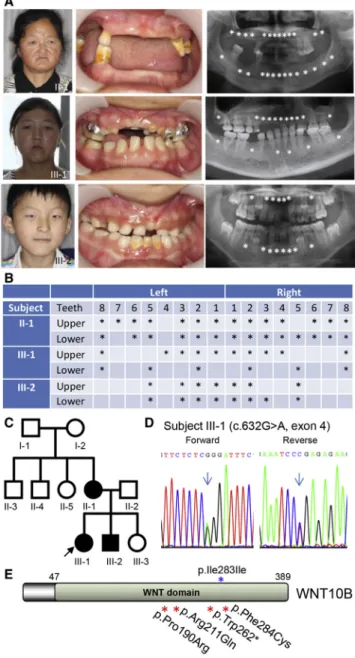
Because no mutations in known oligodontia-associated genes were found in the remaining families, we focused on the identification of mutations in other undetermined gene(s) by performing extensive bioinformatics analysis and analyzing pathways associated with tooth develop-ment. In family ZZYWL-2, three affected individuals were found to have autosomal-dominant congenital oligodon-tia (Figures 1A and 1B) accompanied by mild ectodermal dysplasia involving hair and eccrine sweat glands ( Ta-ble S1). No obvious developmental abnormalities were seen in the ears, hands, or feet of the affected individuals (Figure S2).
WES analyses of five members of the nuclear family, including three affected and two unaffected individuals (Figure 1C), generated an average of 56.34 Mb of aligned base reads per sample, of which 97.45% reads reached
R103coverage. A total of 38,125 single-nucleotide vari-ants (SNVs; missense, nonsense, and splice-site mutations) and 1,378 indels (short coding insertions or deletions) were identified from the three affected individuals.
The pathogenic cause of the disorder was assumed to be the same heterozygous mutation in a single gene. No dele-terious variant in known oligodontia-associated genes was found in this family. All known variants (present in normal family members, the Exome Aggregation Consortium [ExAC] Browser, or an in-house Han Chinese exome database containing 2,200 individuals at a minor allele frequency [MAF] > 0.0005) and non-deleterious SNVs determined by several commonly used algorithms (SIFT, PolyPhen-2, MutationTaster, and GERPþþ) were removed. Finally, a mutation predicted to be deleterious inWNT10B (Wnt family member 10B [MIM: 601906]), encoding a ligand for activation of canonical Wnt signaling, was prior-itized for further analysis.
Using Sanger sequencing with specific primers (Table S2), we verified that the heterozygous mutation (c.632G>A) in
WNT10B (GenBank: NM_003394.3) segregates with the affected individuals (chromatogram of proband III-1 is shown inFigure 1D), but not the unaffected family mem-bers. This missense mutation changed wild-type codon 211 from CGG to CAG, replacing arginine with glutamine (p.Arg211Gln) in the Wnt domain (Figure 1E) and thereby turning the positive charge of the side chain to neutral.
Figure 1. Autosomal-Dominant Oligodontia and Identification of theWNT10BMutation
(A) Front views and panoramic radiographs of dentitions of three affected individuals (II-1, III-1, and III-2 in C). Missing teeth are de-noted by asterisks.
(B) Schematic analysis shows the positions of missing teeth in each of the affected individuals. Missing teeth are denoted by asterisks. (C) The ZZYWL-2 pedigree. Filled circles and squares represent affected female and male family members, respectively. Subjects I-1, I-2, II-3, II-4, and II-5 were not available for clinical evaluation or DNA analysis. WES and Sanger sequencing were performed for five family members (II-1, II-2, III-1, III-2, and III-3).
(D) Representative Sanger chromatograms show the heterozygous missense mutation c.632G>A, resulting in the p.Arg211Gln substitution.
One allele of the variant was present in 60,669 individuals in the ExAC Browser and also in the in-house exome data-base. It is worth noting that these exome databases are use-ful sources for variant classifications because they contain both normal and pathogenic or likely pathogenic variants in disease-associated genes.15
Multiple-sequence alignment of WNT10B showed that the residue Arg211 is evolutionarily conserved in all of the compared species and is also conserved in almost all members of the Wnt ligand family (Figures S3A and S3B). On the basis of 3D structural analysis of the WNT10B
pa-ralog in Xenopus,16 Arg211 was predicted to locate to helix D, which appears to interact with the cysteine-rich domain of Frizzled-8 (Figure S3C) and thus involve the binding affinity of the ligand with the domain. In addi-tion, the c.632G>A (p.Arg211Gln) mutation was predicted to be disease causing by several major algorithms, including MutationTaster, PolyPhen-2 and GERPþþ.
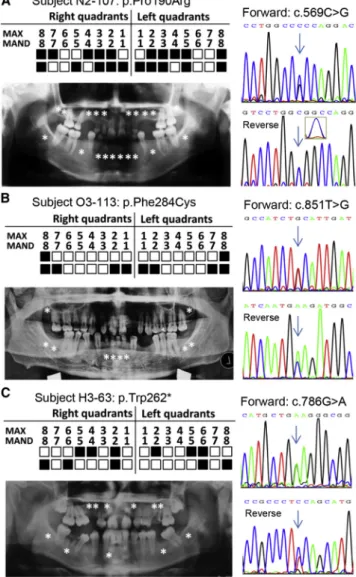
To evaluate the prevalence of theWNT10Bmutations in unrelated individuals with oligodontia, we screened the whole coding region and the intron-exon boundaries of the gene (primer sequences are provided inTable S2) in a large cohort of 145 affected individuals who had not been screened for other candidate genes. As a result, we identified three additional mutations, including one nonsense and two missense mutations (Figure 1E and
Figure 2).
The c.569C>G (p.Pro190Arg) mutation, identified in subject N2-107 (Figure 2A), was predicted to be disease causing by MutationTaster because the residue Pro190 is evolutionarily conserved (Figure S4A). This variant was also seen in the ExAC Browser (4/121,292 alleles; MAF¼ 3.298e5), but not in the in-house exome database. Another missense mutation, c.851T>G (p.Phe284Cys), identified in subject O3-113 (Figure 2B), was also conserved according to multiple-sequence alignment (Figure S4B) and predicted to be disease causing by several algorithms. Four alleles of c.851T>G were shown in the ExAC Browser (4/119,494 alleles; MAF¼ 3.347e5), and one was in the in-house exome database (1/4,400 alleles; MAF¼0.00022).
Notably, a nonsense mutation (c.786G>A [p.Trp262*];
Figure 2C) was identified in subject H3-63. This mutation was predicted to produce a truncated protein (missing 128 amino acids at the C terminus) and thereby disrupt the protein’s function. The residue Trp262 was found to be conserved in different species (Figure S4C). One allele of this variant was found in the ExAC Browser (1/118,298 alleles; MAF¼0.00011647), and none was pre-sent in the in-house exome database.
In addition, we detected a SNP (c.849C>A [p.Ile283Ile]) in four unrelated affected persons among 145 individuals (MAF¼0.0138;Figure S5) but only four such variants in 2,200 individuals from the in-house exome database (MAF ¼0.0009), suggesting that this recurrent variant is associated with the oligodontia phenotype (p ¼ 0.0003, exact binomial test). Also, this variant was predicted to be disease causing by MutationTaster (probability score ¼1), e.g., phyloP and PhastCons scores were rated highly positive, reflecting an evolutionarily conserved nucleotide and flanking columns in genome sequences of 46 different species. Until recently, at least 50 human diseases have been associated with synonymous mutations affecting mRNA splicing, stability, and other properties.17
As an example, two synonymous mutations in catechol-O-methyltransferase (COMT [MIM: 116790]) were found to affectCOMTmRNA stability and thus protein expres-sion and enzymatic activity.18Therefore, further studies
Figure 2. Genetic Screen of WNT10B Mutations in Unrelated Individuals with Oligodontia
(A) Subject N2-107. A panoramic radiograph (left) and the corre-sponding mutation in Sanger chromatograms (right) are shown. The positions of each of the missing teeth are indicated by aster-isks in the radiograph or filled boxes in schematic maxillary (MAX) and lower mandible (MAND) locations. Also, double peaks of the heterozygous variant c.569C>G in a reverse Sanger chro-matogram can be recognized in the amplified inset.
are needed to investigate whether the synonymous SNP c.849C>A is able to cause changes in expression, confor-mation, or function of the encoded protein.
MurineWnt10bexpression was first detected at embry-onic day 11.5 (E11.5), a stage showing a slight thickening of presumptive incisor epithelium,19,20which is the key feature of early tooth development. In later stages (i.e., the bud stage at E13.5, the cap stage at E14.5, and the early bell stage at E15.5),Wnt10bexpression was gradu-ally upregulated and extended distgradu-ally from the midline in the incisor domain toward the molar primordia.19To
examine the temporal and spatial expression pattern of
Wnt10b in whole-mount mouse embryos, we analyzed images of in situ hybridization from E11.5 to E15.5 (Allen Brain Atlas and Eurexpress). Compared to other embry-onic tissues, the developing tooth field showed specific expression of Wnt10b, particularly high in the incisors at the E14.5 cap stage (Figure 3A). Because LRP5 and LRP6 are the receptors of WNT10B, the expression of
Lrp6 partially overlapped that of Wnt10b (Figure 3B). Expression of two additional crucial components (Figures 3C and 3D), Axin2 and dishevelled 1 (Dvl1 [MIM: 601365]), which involve tooth agenesis in the canonical Wnt pathway (Figure 3E), was also detectable at the cap stage.
To investigate the effects of the WNT10B mutations identified here on Wnt signaling, we established four mutated WNT10B constructs by using the GeneArt SiteDirected Mutagenesis System (Thermo Fisher Scienti-fic), specific primers (Table S2), and the template of wild-type WNT10B cDNA.21 To obtain the conditioned
medium containing each of the WNT10B proteins from stable cells, we transfected COS-7 kidney fibroblast cells (CRL-1651, ATCC) with each of the plasmids by using Lipofectamine 2000 (Invitrogen) and selected stable transfectants in medium containing G418 (500 mg/ml, Invitrogen) for 4 weeks. Translational expression of these constructs was further confirmed by western blot (Figure S6). Wild-type WNT10B and each of the mutated WNT10B proteins were collected from the supernatant of the stable cells as described previously.22
Effects of WNT10B on canonical Wnt signaling can be measured by the TCF reporter system (TCF is encoded by lymphoid enhancer binding factor 1 [LEF1 (MIM: 153245)]; Figure 3E).23Human hepatocellular carcinoma HEPG2 epithelial cells (HB-8065, ATCC), which have constitutive canonical Wnt signaling,24were transfected with 2 mg of the plasmid pTOPFLASH luciferase reporter containing four TCF-responsive elements or with the pFOPFLASH luciferase reporter containing the dominant-negative TCF-binding sequence. The b-galactosidase (b-gal) expression plasmid (pCMV-b-gal) was co-trans-fected as an internal control. Four hours later, culture medium was replaced with the COS-7-supernatant-condi-tioned medium containing wild-type or mutant WNT10B. After 48 hr of incubation, the cells were lysed with the Dual-Luciferase Reporter Assay System (Promega) for measurement of luciferase activity and were normal-ized byb-gal levels.
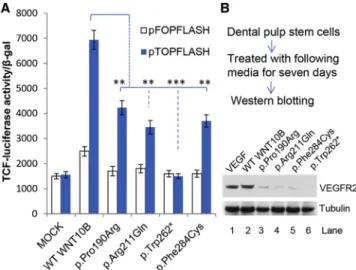
Further statistical analysis showed that the luciferase activity in each of the cells treated with mutant WNT10B supernatant was significantly lower than that in cells
Figure 3. Expression ofWnt10b in Em-bryonic Mice and the Wnt Pathway
(A)Wnt10bexpression was detected in the developing tooth region by in situ hybrid-ization, as indicated by arrows in the sagittal section of an E14.5 embryo (Eurex-press). The region of interest is shown in the inset.
(B)Lrp6expression is shown as in (A). (C) Analysis ofAxin2expression is shown as in (A).
(D) Expression ofDvl1is shown as in (A). All expression data in Eurexpress are publi-cally available; users can retrieve informa-tion tailored to their own needs.
(E) The binding of WNT10B ligand to a dual-receptor complex comprising the Wnt co-receptors LRP5 and LRP6 and one of the seven transmembrane receptors of the FZD family (e.g., Frizzled-8 [encoded byFZD8(MIM: 606146)]) initiates Wnt-b-catenin signaling. AXIN2 moves to the LRP5-LRP6 tail at the membrane through its interaction with dishevelled (DVL1), which is recruited by FZD. Glycogen syn-thase kinase 3b (encoded by GSK3B
treated with wild-type WNT10B (Figure 4A). In particular, cells treated with p.Trp262* mutant supernatant did not show any luciferase activity, suggesting that the truncated protein failed to activate Wnt signaling.
In humans, WNT10B was significantly expressed in pulpal tissue (GEO Profile: 21100839) and DPSCs (GEO Profile: 111538043). Immunostaining and qRT-PCR showed that WNT10B was one of the key molecules involved in initiating epithelium invagination and epithe-lial-mesenchymal interaction when human DPSCs and oral epithelial cells were co-cultivated.27
Intriguingly, Wnt-b-catenin signaling was shown to inhibit rather than activate odontoblastic differentiation of DPSCs.28 In contrast, the WNT1-b-catenin pathway was recently found to determine the vasculogenic fate of post-natal DPSCs.26This is consistent with the observation
that blood capillaries and vascularization are detected by immunostaining and electron microscopy in the mouse embryonic molar mesenchyme.29
Considering the critical role of vascular endothelial cells, as well as odontoblasts, to the success of dental pulp tissue engineering, we were prompted to examine whether the mutated WNT10B affected differentiation of DPSCs.25 The cells were treated with conditioned media containing either wild-type or mutant WNT10B for 7 days and then harvested for western blot analysis. As a result, VEGF recep-tor 2 (encoded byKDR[MIM: 191306]), an endothelial dif-ferentiation marker of vasculogenesis, was activated by wild-type WNT10B, but not p.Trp262* WNT10B. Three media conditioned with missense mutant WNT10B could also activate VEGFR2, but to a lesser extent than media conditioned with wild-type WNT10B (Figure 4B). The impaired endothelial differentiation of the cultured DPSCs probably resulted from the p.Trp262* null allele and three hypomorphic alleles. However, whether these alleles have dominant-negative effects on endothelial differentiation cannot be entirely excluded.
Sequence analysis showed that WNT10B shares 60% identity and 72% similarity with WNT10A and also shares a similar localization pattern in the dental epithelium at the bud and cap stages, when tooth morphogenesis is first apparent.19 However, WNT10A expression gradually shifted to the underlying mesenchyme in later stages and was continuous in the process of odontoblast differentia-tion.30We thus analyzed whether mutations in these two homolog Wnt ligands cause oligodontia at the same or at different positions. Genotype-phenotype analysis of indi-viduals with WNT10Amutations by our previous study and others revealed that premolars were the most commonly missing teeth (62.5%–68.8%), whereas incisors were missing only 18.8%–31.3% of the time.8,31,32 In contrast, the most frequently missing permanent teeth in the affected individuals with WNT10Bvariants were the lateral incisors (83.3%; Table 1), whereas premolars were missing only 51.4% of the time, a pattern clearly different from the oligodontia patterns resulting fromWNT10A mu-tations. Given that the most commonly affected teeth in
Figure 4. Functional Assessment of Mutant WNT10B in Wnt Signaling
(A) Effects of mutant WNT10B on luciferase activity. The Wnt signaling in HEPG2 cells was assessed with TCF reporter plasmids. HEPG2 cells were transiently transfected with either pTOPFLASH or pFOPFLASH and then cultured in no supernatant (Mock), wild-type WNT10B supernatant, or each of the four indicated mutant WNT10B supernatants. Error bars depict SDs; **p<0.01, ***p<0.001. The results are from three independent experiments performed in triplicate.
(B) Impact of WNT10B on endothelial differentiation of DPSCs. DPSCs were isolated and cultured as described in our previous study.25Cells were treated with medium conditioned with wild-type or mutant WNT10B (containing 50 ng/ml of each of the recombinant WNT10B proteins) for the purpose of inducing endothelial cell differentiation. Recombinant human VEGF-C (50 ng/ml, Sigma) served as a positive control. After 7 days, cells were lysed and prepared26 for western blots (ECL system, GE
Healthcare Life Sciences) with anti-VEGFR2 polyclonal antibody (5mg/mL, Invitrogen). The amount of tubulin, used as a loading control, was detected by monoclonal anti-a-tubulin antibody (1:500, Sigma).
Table 1. Analysis of Missing-Tooth Patterns in Individuals withWNT10BVariants
Quadrant
Central Incisor (%)
Lateral
Incisor (%) Canine (%)
First Premolar (%)
Second
Premolar (%) First Molar (%)
Second Molar (%) Maxillary 8/18 (44.4) 15/18 (83.3)a 12/18 (66.7) 9/18 (50.0) 10/18 (55.6) 4/18 (22.2) 6/18 (33.3) Mandibular 12/18 (66.7) 15/18 (83.3)a 8/18 (44.4) 4/18 (22.2) 14/18 (77.8) 4/18 (22.2) 5/18 (27.8)
The numerator is the number of missing teeth in the nine individuals, and the denominator is the total number of teeth that these nine individuals should have at each position. The third molar (wisdom tooth) is not included. The tooth number on the left side is combined with that on the right side because no significant difference, in terms of the number of missing teeth, was found at any of the corresponding positions.
individuals with hypodontia were mandibular second pre-molars, followed by maxillary lateral incisors, as reported in a recent meta-analysis,33it is likely that there is an over-lapping phenotype in some of the individuals with
WNT10AandWNT10Bmutations.
The selective pattern in WNT10B mutants is also different from that of mutations in other oligodontia-asso-ciated genes, such asMSX1(missing second premolar) and
PAX9(agenesis of molars), as described previously7,10,11,34
and currently in the individuals with the p.Ile97Leufs*217 variant (Figure S1). Regardless, protein-protein-interaction and genetic studies have shown crosstalk between PAX9 and the Wnt pathway (e.g., AXIN2) or MSX1 in dental tis-sues,11 which are essential for the establishment of the odontogenic potential of the mesenchyme. However, the underlying mechanism of different genotype-phenotype correlations observed here remains elusive.
Other significant homologs of human WNT10B, such as WNT4 (39% identity and 54% similarity) and WNT3A (38% identity and 52% similarity), were also found to be specifically expressed in the tooth developing region (Eur-express). In particular, Wnt4 was found to stimulate mesenchymal expression of Msx1 during early tooth organogenesis.35These observations could prompt further
genetic screening of additional Wnt ligands in individuals with tooth agenesis.
It is worth noting that several homozygous mutations in
WNT10Bwere previously detected in multiple individuals with a split-hand and/or split-foot malformation and other conditions (Table S3).36However, no tooth agenesis was re-ported in those cases. One of the assumptions is that those mutations are either located at the 30end of the gene or derived from duplication events, and these are clearly different from the mutations we identified. Likewise, whereas heterozygous mutations inLRP6 were found to be responsible for oligodontia, homozygous deletions of
Lrp6in mice also resulted in limb malformation.37
There-fore, it is conceivable that mutations in other promising candidate genes in the canonical Wnt pathway (see the re-view by Baron and Kneissel)38—mutations that might show a phenocopying of the WNT10B mutants—could be identified in individuals with oligodontia or other anomalies involving ectodermal dysplasia.
In conclusion, our findings provide genetic and func-tional evidence that heterozygous mutations inWNT10B are a previously unidentified genetic cause of tooth agen-esis. Our findings also reveal a potential genotype-phe-notype correlation between WNT10B variants and the positions of missing teeth. Gene-disease pathway analysis suggests that more genetic defects in the canonical Wnt pathway, as well as other interacting pathways, could be identified from individuals with tooth agenesis. Further research of how the Wnt pathway regulates the decision between the odontoblastic fate and the vasculogenic fate of dental stem cells is warranted for shedding light on the pathogenesis of tooth agenesis and tooth regeneration and repair.
Supplemental Data
Supplemental Data include six figures and three tables and can be found with this article online athttp://dx.doi.org/10.1016/j.ajhg.
2016.05.012.
Acknowledgments
We are indebted to the individuals with tooth agenesis and their families for their participation in this study. We thank Dr. Curtis Harris’s lab for the wild-typeWNT10Bplasmid, Dr. DeeDee Smart’s lab for the pTOPFLASH and pCMVb-gal plasmids, and Qianzhi Shao for bioinformatics analysis. We wish to thank Drs. Yan Jin and Weidong Li for thoughtful suggestions. Research reported in this publication was supported by the Wenzhou Medical Uni-versity Research Fund (to P.Y.), the Beijing Collaborative Innova-tive Research Center for Cardiovascular Diseases (PXM2014_ 014226_000002 to D.J.), and National Natural Science Foundation of China grant 81110114 (to Z.S.S.).
Received: March 15, 2016 Accepted: May 6, 2016 Published: June 16, 2016
Web Resources
Allen Brain Atlas,http://www.brain-map.org/
Eurexpress,http://www.eurexpress.org/ee/
ExAC Browser,http://exac.broadinstitute.org/
GEO Profiles,http://www.ncbi.nlm.nih.gov/geoprofiles
HGMD,http://www.biobase-international.com/product/hgmd
MutationTaster,http://www.mutationtaster.org/
OMIM,http://www.omim.org
RefSeq,http://www.ncbi.nlm.nih.gov/refseq/
References
1. Zhang, J., Liu, H.C., Lyu, X., Shen, G.H., Deng, X.X., Li, W.R.,
Zhang, X.X., and Feng, H.L. (2015). Prevalence of tooth agen-esis in adolescent Chinese populations with or without
ortho-dontics. Chin. J. Dent. Res.18, 59–65.
2. Feng, H.L. (2011). [Prosthodontic treatment of congenital
tooth agenesis I. The classicfication, prevalence and etiology of congenital tooth agenesis]. Zhonghua Kou Qiang Yi Xue
Za Zhi46, 54–57.
3. Dhanrajani, P.J. (2002). Hypodontia: etiology, clinical
fea-tures, and management. Quintessence Int.33, 294–302.
4. Ruf, S., Klimas, D., Ho¨nemann, M., and Jabir, S. (2013).
Ge-netic background of nonsyndromic oligodontia: a systematic
review and meta-analysis. J. Orofac. Orthop.74, 295–308.
5. Massink, M.P., Cre´ton, M.A., Spanevello, F., Fennis, W.M.,
Cune, M.S., Savelberg, S.M., Nijman, I.J., Maurice, M.M., van den Boogaard, M.J., and van Haaften, G. (2015). Loss-of-Func-tion MutaLoss-of-Func-tions in the WNT Co-receptor LRP6 Cause
Auto-somal-Dominant Oligodontia. Am. J. Hum. Genet. 97,
621–626.
6. Liu, H., Ding, T., Zhan, Y., and Feng, H. (2015). A Novel AXIN2
Missense Mutation Is Associated with Non-Syndromic
Oligo-dontia. PLoS ONE10, e0138221.
7. Zhang, X.X., Wong, S.W., Han, D., and Feng, H.L. (2015).
EDA Mutation in One Chinese Family with Non-syndromic
Oligodontia. Chin. J. Dent. Res.18, 229–234.
8. Song, S., Zhao, R., He, H., Zhang, J., Feng, H., and Lin, L.
(2014). WNT10A variants are associated with non-syndromic
tooth agenesis in the general population. Hum. Genet.133,
117–124.
9. Song, S., Han, D., Qu, H., Gong, Y., Wu, H., Zhang, X., Zhong,
N., and Feng, H. (2009). EDA gene mutations underlie
non-syndromic oligodontia. J. Dent. Res.88, 126–131.
10. Wang, Y., Wu, H., Wu, J., Zhao, H., Zhang, X., Mues, G.,
D’Souza, R.N., Feng, H., and Kapadia, H. (2009). Identification and functional analysis of two novel PAX9 mutations. Cells
Tissues Organs (Print)189, 80–87.
11. Yin, W., and Bian, Z. (2015). The Gene Network Underlying
Hypodontia. J. Dent. Res.94, 878–885.
12. Cai, T., Yang, L., Cai, W., Guo, S., Yu, P., Li, J., Hu, X., Yan, M.,
Shao, Q., Jin, Y., et al. (2015). Dysplastic spondylolysis is caused by mutations in the diastrophic dysplasia sulfate
trans-porter gene. Proc. Natl. Acad. Sci. USA112, 8064–8069.
13. Stockton, D.W., Das, P., Goldenberg, M., D’Souza, R.N., and
Patel, P.I. (2000). Mutation of PAX9 is associated with
oligo-dontia. Nat. Genet.24, 18–19.
14. Thesleff, I. (2014). Current understanding of the process of
tooth formation: transfer from the laboratory to the clinic.
Aust. Dent. J.59(Suppl 1), 48–54.
15. Song, W., Gardner, S.A., Hovhannisyan, H., Natalizio, A., Weymouth, K.S., Chen, W., Thibodeau, I., Bogdanova, E., Le-tovsky, S., Willis, A., and Nagan, N. (2015). Exploring the landscape of pathogenic genetic variation in the ExAC popu-lation database: insights of relevance to variant classification. Genet. Med. Published online December 17, 2015.http://dx.
doi.org/10.1038/gim.2015.180.
16. Janda, C.Y., Waghray, D., Levin, A.M., Thomas, C., and Garcia,
K.C. (2012). Structural basis of Wnt recognition by Frizzled.
Science337, 59–64.
17. Sauna, Z.E., and Kimchi-Sarfaty, C. (2011). Understanding the
contribution of synonymous mutations to human disease.
Nat. Rev. Genet.12, 683–691.
18. Nackley, A.G., Shabalina, S.A., Tchivileva, I.E., Satterfield, K.,
Korchynskyi, O., Makarov, S.S., Maixner, W., and Diatchenko, L. (2006). Human catechol-O-methyltransferase haplotypes modulate protein expression by altering mRNA secondary
structure. Science314, 1930–1933.
19. Dassule, H.R., and McMahon, A.P. (1998). Analysis of
epithe-lial-mesenchymal interactions in the initial morphogenesis of
the mammalian tooth. Dev. Biol.202, 215–227.
20. Sarkar, L., and Sharpe, P.T. (1999). Expression of Wnt
signal-ling pathway genes during tooth development. Mech. Dev.
85, 197–200.
21. Yoshikawa, H., Matsubara, K., Zhou, X., Okamura, S., Kubo, T.,
Murase, Y., Shikauchi, Y., Esteller, M., Herman, J.G., Wei Wang, X., and Harris, C.C. (2007). WNT10B functional dualism: beta-catenin/Tcf-dependent growth promotion or independent suppression with deregulated expression in
can-cer. Mol. Biol. Cell18, 4292–4303.
22. Ouji, Y., Yoshikawa, M., Shiroi, A., and Ishizaka, S. (2006).
Wnt-10b promotes differentiation of skin epithelial cells
in vitro. Biochem. Biophys. Res. Commun.342, 28–35.
23. Nguyen, P., Lee, S., Lorang-Leins, D., Trepel, J., and Smart, D.K.
(2014). SIRT2 interacts with b-catenin to inhibit Wnt
signaling output in response to radiation-induced stress.
Mol. Cancer Res.12, 1244–1253.
24. Shibata, T., and Aburatani, H. (2014). Exploration of liver
can-cer genomes. Nat. Rev. Gastroenterol. Hepatol.11, 340–349.
25. Gronthos, S., Mankani, M., Brahim, J., Robey, P.G., and Shi, S.
(2000). Postnatal human dental pulp stem cells (DPSCs)
in vitro and in vivo. Proc. Natl. Acad. Sci. USA 97, 13625–
13630.
26. Zhang, Z., Nor, F., Oh, M., Cucco, C., Shi, S., and No¨r, J.E. (2016). Wnt/b-catenin signaling determines the vasculo-genic fate of post-natal mesenchymal stem cells. Stem Cells
http://dx.doi.org/10.1002/stem.2334, Published February
11, 2016.
27. Xiao, L., and Tsutsui, T. (2012). Three-dimensional epithelial
and mesenchymal cell co-cultures form early tooth epithe-lium invagination-like structures: expression patterns of
rele-vant molecules. J. Cell. Biochem.113, 1875–1885.
28. Scheller, E.L., Chang, J., and Wang, C.Y. (2008).
Wnt/beta-cat-enin inhibits dental pulp stem cell differentiation. J. Dent.
Res.87, 126–130.
29. Yuan, G., Zhang, L., Yang, G., Yang, J., Wan, C., Zhang, L.,
Song, G., Chen, S., and Chen, Z. (2014). The distribution and ultrastructure of the forming blood capillaries and the ef-fect of apoptosis on vascularization in mouse embryonic
molar mesenchyme. Cell Tissue Res.356, 137–145.
30. Yamashiro, T., Zheng, L., Shitaku, Y., Saito, M., Tsubakimoto,
T., Takada, K., Takano-Yamamoto, T., and Thesleff, I. (2007). Wnt10a regulates dentin sialophosphoprotein mRNA expres-sion and possibly links odontoblast differentiation and tooth
morphogenesis. Differentiation75, 452–462.
31. Bohring, A., Stamm, T., Spaich, C., Haase, C., Spree, K.,
Hehr, U., Hoffmann, M., Ledig, S., Sel, S., Wieacker, P.,
and Ro¨pke, A. (2009). WNT10A mutations are a frequent
cause of a broad spectrum of ectodermal dysplasias with sex-biased manifestation pattern in heterozygotes. Am. J.
Hum. Genet. 85, 97–105.
32. Arzoo, P.S., Klar, J., Bergendal, B., Norderyd, J., and Dahl, N.
(2014). WNT10A mutations account for 1/
4 of
population-based isolated oligodontia and show phenotypic correlations.
Am. J. Med. Genet. A.164A, 353–359.
33. Khalaf, K., Miskelly, J., Voge, E., and Macfarlane, T.V. (2014).
Prevalence of hypodontia and associated factors: a systematic
review and meta-analysis. J. Orthod.41, 299–316.
34. Xuan, K., Jin, F., Liu, Y.L., Yuan, L.T., Wen, L.Y., Yang, F.S.,
Wang, X.J., Wang, G.H., and Jin, Y. (2008). Identification of a novel missense mutation of MSX1 gene in Chinese family
with autosomal-dominant oligodontia. Arch. Oral Biol. 53,
773–779.
35. Kettunen, P., Løes, S., Furmanek, T., Fjeld, K., Kvinnsland, I.H.,
Behar, O., Yagi, T., Fujisawa, H., Vainio, S., Taniguchi, M., and Luukko, K. (2005). Coordination of trigeminal axon naviga-tion and patterning with tooth organ formanaviga-tion: epithelial-mesenchymal interactions, and epithelial Wnt4 and Tgfbeta1 regulate semaphorin 3a expression in the dental
mesen-chyme. Development132, 323–334.
36. Wend, P., Wend, K., Krum, S.A., and Miranda-Carboni, G.A.
(2012). The role of WNT10B in physiology and disease. Acta
Physiol. (Oxf.)204, 34–51.
37. Kelly, O.G., Pinson, K.I., and Skarnes, W.C. (2004). The Wnt
co-receptors Lrp5 and Lrp6 are essential for gastrulation in
mice. Development131, 2803–2815.
38. Baron, R., and Kneissel, M. (2013). WNT signaling in bone
ho-meostasis and disease: from human mutations to treatments.