Do black lives matter in public health research
and training?
Molly Rosenberg1☯*, Shabbar I. Ranapurwala2, Ashley Townes3, Angela M. Bengtson2☯
1 Department of Epidemiology and Biostatistics, Indiana University School of Public Health-Bloomington,
Bloomington, Indiana, United States of America, 2 Department of Epidemiology, Gillings School of Global Public Health, University of North Carolina-Chapel Hill, Chapel Hill, North Carolina, United States of America,
3 Department of Applied Health Sciences, Indiana University School of Public Health-Bloomington,
Bloomington, Indiana, United States of America
☯These authors contributed equally to this work.
Abstract
Objective
To examine whether investments made in public health research align with the health bur-dens experienced by white and black Americans.
Methods
In this cross-sectional study of all deaths in the United States in 2015, we compared the dis-tribution of potential years of life lost (PYLL) across 39 causes of death by race and identified key differences. We examined the relationship between cause-of-death-specific PYLL and key indicators of public health investment (federal funding and number of publications) by race using linear spline models. We also compared the number of courses available at the top schools of public health relevant to the top causes of death contributor to PYLL for black and white Americans.
Results
Homicide was the number one contributor to PYLL among black Americans, while ischemic heart disease was the number one contributor to PYLL among white Americans. Firearm-related violence accounted for 88% of black PYLL attributed to homicide and 71% of white PYLL attributed to homicide. Despite the high burden of PYLL, homicide research was the focus of few federal grants or publications. In comparison, ischemic heart disease garnered 341 grants and 594 publications. The number of public health courses available relevant to homicide (n = 9) was similar to those relevant to ischemic heart disease (n = 10).
Conclusions
Black Americans are disproportionately affected by homicide, compared to white Ameri-cans. For both black and white Americans, the majority of PYLL due to homicide are fire-arm-related. Yet, homicide research is dramatically underrepresented in public health research investments in terms of grant funding and publications, despite available public
a1111111111 a1111111111 a1111111111 a1111111111 a1111111111 OPEN ACCESS
Citation: Rosenberg M, Ranapurwala SI, Townes
A, Bengtson AM (2017) Do black lives matter in public health research and training? PLoS ONE 12 (10): e0185957.https://doi.org/10.1371/journal. pone.0185957
Editor: Albert Lee, The Chinese University of Hong
Kong, HONG KONG
Received: June 2, 2017 Accepted: September 24, 2017 Published: October 10, 2017
Copyright:©2017 Rosenberg et al. This is an open access article distributed under the terms of the Creative Commons Attribution License, which permits unrestricted use, distribution, and reproduction in any medium, provided the original author and source are credited.
Data Availability Statement: Data used in
statistical analyses is publically available from the Centers for Disease Control and Prevention, National Center for Health Statistics (https://www. cdc.gov/nchs/data_access/VitalStatsOnline. htm#Mortality_Multiple), NIH Reporter (https:// projectreporter.nih.gov/reporter.cfm) and PubMed (https://www.ncbi.nlm.nih.gov/pubmed/). The SAS program used for this analysis has been included as a supplemental file.
Funding: The author(s) received no specific
health training opportunities. If left unchecked, the observed disproportionate distribution of investments in public health resources threatens to perpetuate a system that disadvantages black Americans.
Introduction
The goal of public health is to protect and promote the health of all people.[1] The existence of persistent racial health disparities between black and white Americans is at stark odds with this goal. Racial health disparities occur when the distribution of health conditions and health outcomes is uneven by race, exemplified in the intractable life expectancy gap between black and white Americans.[2] The Healthy People 2010 and 2020 initiatives,[3] designed to elimi-nate health disparities in the US, have been largely ineffective in reducing racial disparities in many areas like physical activity, substance abuse, and healthcare access.(4) Racial disparities in areas like injury and violence have actually increased over time.[4] To reduce racial health disparities and to improve the misalignment between public health goals and the reality of the American public health landscape, it is critical to identify and address the underlying struc-tural reasons that disadvantage black American’s health, as compared to white American’s health.[5]
A key structural indicator of public health priorities is the investments we make in public health research. Investments in public health research could contribute to racial health dispari-ties if they systematically advantage or disadvantage certain racial groups. Public health research creates the evidence base for effective health policy[6] and for medical breakthroughs that can lead to rapid improvements in disease and injury treatment and prevention.[7–9] However, not all health conditions are studied equally and conditions that represent larger public health burdens tend to receive more attention. Further, external forces such as funding opportunities and training experiences could direct the focus of public health research towards or away from specific health conditions that may be disproportionately distributed across racial groups. Recently the Black Lives Matters movement has advocated against institutional racism that disadvantages black lives and health. Against that backdrop, several in the public health community have questioned if our research and research applications protect the health of all Americans equally.[10,11]
In this analysis, we examine whether investments in public health research, in terms of fed-eral grant funding and publications, accurately reflect the health issues of both black and white Americans. We quantify the relative importance of different health issues with potential years of life lost (PYLL), a measure that gives greater weight to the burden of premature deaths, and examine how PYLL for a range of causes of death (COD) relate to investments in public health research funding and publications.
Methods
We calculated PYLL for each US death in 2015, reported by the Centers for Disease Control and Prevention (CDC).[12] Potential years of life lost (PYLL) measures the number of years a person would have lived if they had not died of a particular cause.[13] PYLL is a useful tool for comparing the burden of specific causes of death between groups, and highlights the burden premature deaths—which often have the greatest impact on a community. There are many measures that can be used to quantify the relative importance of different health outcomes (i.e. PYLL, crude mortality, and cause-specific morbidity), each with its own advantages and
Competing interests: The authors have declared
disadvantages. We chose to focus our analysis on PYLL because of its emphasis on premature death. In contrast, crude mortality rates are dominated by the health issues of the elderly with-out penalty for lengthy lifespan before death. Morbidity measures like prevalence and inci-dence do not take into account when death occurs in a person’s lifespan, making relative comparisons between conditions difficult. We posit that PYLL is reasonable measure for this paper’s focus because preventing premature death is a key public health goal with a direct impact of extending life expectancy and it should play a major role in setting research priorities.
PYLL was calculated for each death by subtracting the age at death from 75[13] and then summed by black and white race separately for each of the 39 CODs, defined by ICD-10 codes. [14] We present results for white and black racial categories inclusive of ethnic backgrounds, as results from analyses restricting to non-Hispanic white and black categories revealed similar findings. Eight ‘other’ causes of death were removed from some analyses to make comparisons across specific CODs. Homicide-attributed PYLL were further categorized as firearm-related or not. We compared the COD-specific PYLL for white and black Americans. To further understand the disparities in premature death among black and white Americans, we also cal-culated the average PYLL per death for each COD and the difference in average PYLL per death by race. The differences in PYLL per death between black and white Americans were ranked from highest to lowest.
To identify public health investments for each COD, we searched the Pubmed database to identify the number of publications associated with each specific COD. We excluded eight ‘other’ categories for a total of 31 causes of death searched. We used the Advanced search func-tion to build our search strings, including the MeSH term(s) associated with each cause of death, a publication timeframe from January 1, 2015 to December 31, 2015, and a ‘United States’ MeSH term for each search so that the search results reflected publications relevant to US populations. The search string for homicide specifically excludes the MeSH term ‘Euthana-sia.’ The MeSH terms we used for deaths due to ‘pregnancy, childbirth, and the puerperium’ were ‘maternal death’ OR ‘maternal mortality’. All search strings are recorded inS1 Table.
We also measured federal research funding investments by searching COD-specific key-words in National Institutes of Health (NIH) RePORTER[15] for R01 grants funded in 2015. We excluded eight ‘other’ categories for a total of 31 causes of death searched. NIH REPORTER is not cataloged according to MeSH terms, so we identified keywords to search adapted from the MeSH terms we used in the Pubmed search or from the major components of each category. We searched for all funded R01-level grants in the fiscal year 2015. We attempted to exclude research on non-US study populations by including ‘US,’ ‘United States,’ or ‘American’ search terms. All search fields are recorded inS1 Table.
We assessed the relationship between COD-specific PYLL with public health investments in federal research funding and publications by fitting linear regression models, coding PYLL using linear splines with knots at tertiles determined by the overall contribution to PYLL made by each COD. Graphical representations of these findings were stratified by race, plotting (i) PYLL per COD by the number of publications per COD and (ii) PYLL per COD by the number of R01s per COD. In these scatterplots, we compared the regression line predictions from the linear spline model to reference lines illustrating a 1% increase in PYLL correspond-ing to a 1% increase in publications and R01 grants.
ischemic heart disease (top contributor to PYLL among white Americans) if they included ‘ischemic heart disease,’ ‘myocardial ischemia’, ‘coronary heart disease’, or ‘coronary artery disease’ in the course description. Courses were counted as related to gun violence/homicide (top contributor to PYLL among black Americans) if they included ‘homicide,’ ‘gun violence,’ or ‘firearm,’ anywhere in the course description. All calculations and analyses were conducted in SAS (v9.4). A copy of the SAS code used to produce the results of the analysis is included as a supplemental file (S1 File). All mortality data used were de-identified and publically available from the CDC. As such this analysis was deemed as non-human subjects research by the Indi-ana University Office of Research Compliance (#1705637870).
Results
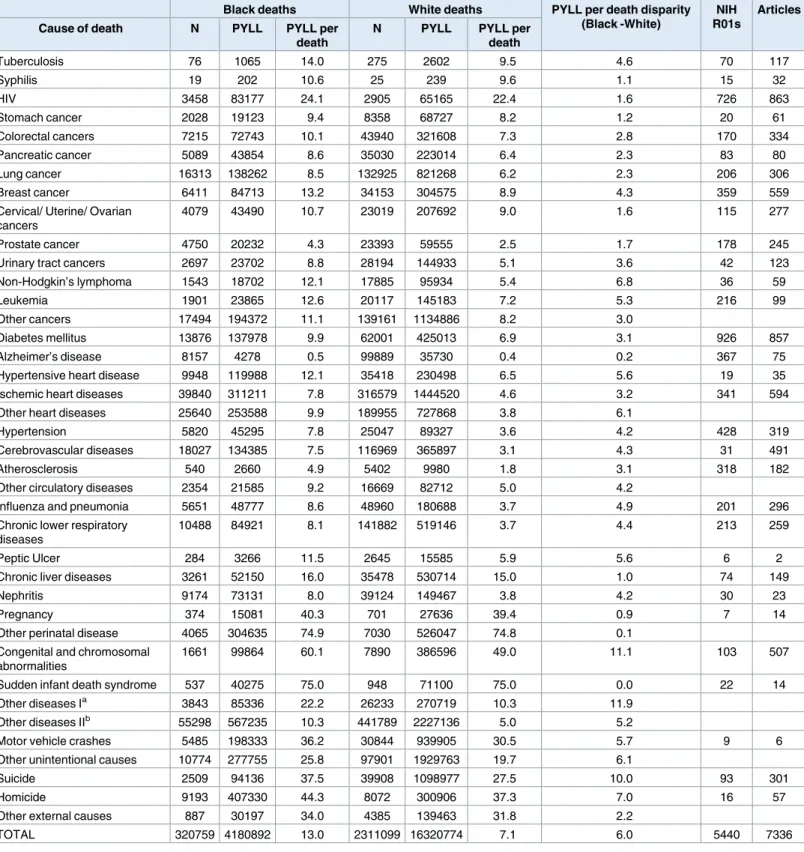
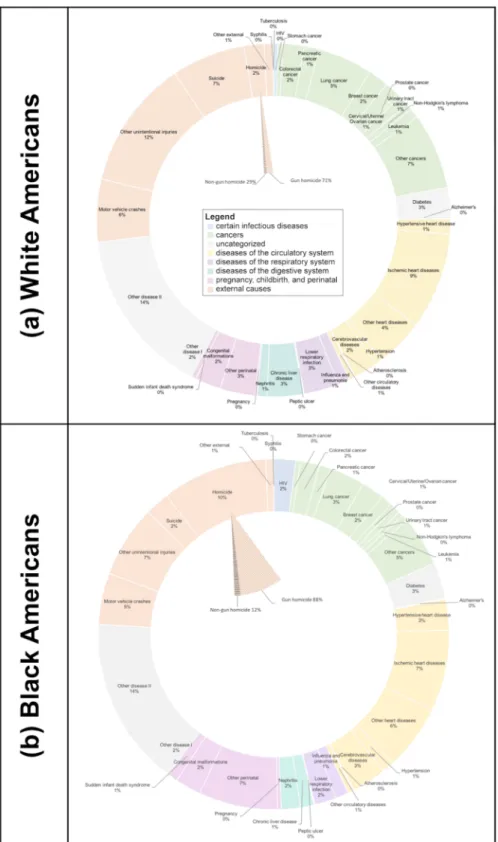
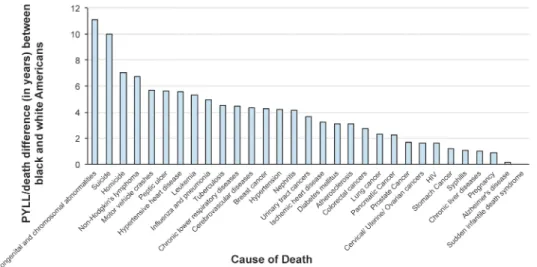
In 2015, there were 2,718,198 deaths in the US accounting for 21,396,995 total PYLL before the age of 75 years (Table 1). Over three-quarters (76%) of PYLL were among white Americans. Black Americans accounted for 20% of PYLL, despite representing only 13% of the 2015 popu-lation.[17] The top PYLL contributor was ischemic heart disease (9%) for white Americans and homicide (10%) for black Americans (Fig 1). Ischemic heart disease (IHD) was the second leading cause of death among black Americans and homicide was the 12thleading cause of PYLL (out of 31) for white Americans. Firearm-related violence accounted for 88% of PYLL due to homicide in black Americans and 71% of PYLL due to homicide in white Americans. Disparities existed in the number of PYLL per death between black Americans and white Americans for all CODs, cause-specific (n = 30) and non-specific (n = 8), except sudden infan-tile death syndrome (SIDS). SIDS only occurs in infants (age = 0 years), thus PYLL/death = 75 for both black and white infants (Table 1). The CODs that resulted in the largest disparities in average age at death between black and white Americans were congenital and chromosomal abnormalities, followed by suicide and homicide (Fig 2), both of which resulted in a greater absolute number of deaths and PYLL than congenital and chromosomal abnormalities (Table 1). The average black American dying from a congenital abnormality died at 15 years of age, compared to the average white American who died at age 26 from a similar condition. The average black American committing suicide was 10 years younger than the average white American (38 years old versus 48 years old). Homicide, the leading contributor to PYLL among black Americans, had the third highest racial disparity in average age at death (30 years old in black Americans versus 37 years old in white Americans). IHD, the leading contributor to PYLL among white Americans, ranked 17thin terms of racial disparity in average age at death. Black Americans died on average 3 years earlier from IHD (average age at death 67 years), compared to white Americans (average age at death 70 years).
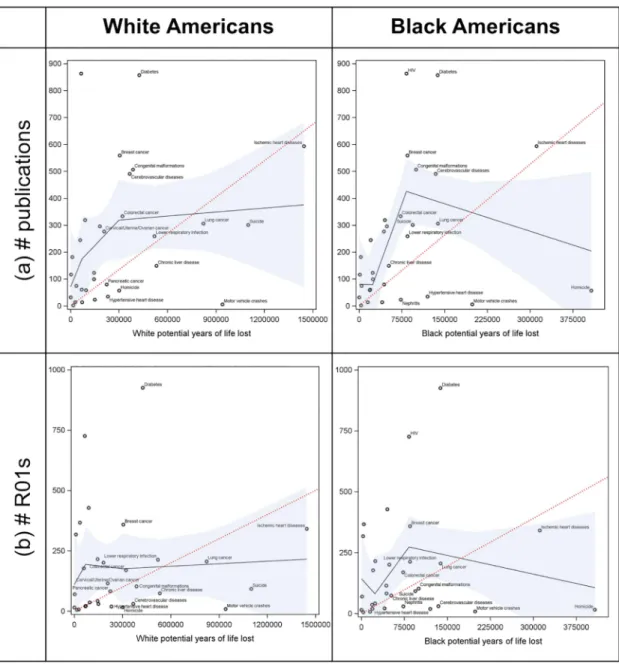
The relationship between COD-specific PYLL and number of publications differed by race (Fig 3). Across the highest ranked CODs, the number of publications increased by 5 per 100,000 PYLL for white Americans, but decreased by 68 per 100,000 PYLL for black Ameri-cans. This difference is driven largely by homicide, the highest contributor to black PYLL but with few publications (n = 57). The highest contributor to white PYLL, IHD, garnered a large number (n = 594) of publications.
Table 1. Number of deaths and potential years of life lost attributed to each of 39 causes of death in all Americans in 2015. Number of National
Insti-tute of Health R01 grants and scientific articles published on each specific cause of death (n = 31) in 2015 are also noted.
Black deaths White deaths PYLL per death disparity
(Black -White)
NIH R01s
Articles
Cause of death N PYLL PYLL per
death
N PYLL PYLL per
death
Tuberculosis 76 1065 14.0 275 2602 9.5 4.6 70 117
Syphilis 19 202 10.6 25 239 9.6 1.1 15 32
HIV 3458 83177 24.1 2905 65165 22.4 1.6 726 863
Stomach cancer 2028 19123 9.4 8358 68727 8.2 1.2 20 61
Colorectal cancers 7215 72743 10.1 43940 321608 7.3 2.8 170 334
Pancreatic cancer 5089 43854 8.6 35030 223014 6.4 2.3 83 80
Lung cancer 16313 138262 8.5 132925 821268 6.2 2.3 206 306
Breast cancer 6411 84713 13.2 34153 304575 8.9 4.3 359 559
Cervical/ Uterine/ Ovarian cancers
4079 43490 10.7 23019 207692 9.0 1.6 115 277
Prostate cancer 4750 20232 4.3 23393 59555 2.5 1.7 178 245
Urinary tract cancers 2697 23702 8.8 28194 144933 5.1 3.6 42 123
Non-Hodgkin’s lymphoma 1543 18702 12.1 17885 95934 5.4 6.8 36 59
Leukemia 1901 23865 12.6 20117 145183 7.2 5.3 216 99
Other cancers 17494 194372 11.1 139161 1134886 8.2 3.0
Diabetes mellitus 13876 137978 9.9 62001 425013 6.9 3.1 926 857
Alzheimer’s disease 8157 4278 0.5 99889 35730 0.4 0.2 367 75
Hypertensive heart disease 9948 119988 12.1 35418 230498 6.5 5.6 19 35
Ischemic heart diseases 39840 311211 7.8 316579 1444520 4.6 3.2 341 594
Other heart diseases 25640 253588 9.9 189955 727868 3.8 6.1
Hypertension 5820 45295 7.8 25047 89327 3.6 4.2 428 319
Cerebrovascular diseases 18027 134385 7.5 116969 365897 3.1 4.3 31 491
Atherosclerosis 540 2660 4.9 5402 9980 1.8 3.1 318 182
Other circulatory diseases 2354 21585 9.2 16669 82712 5.0 4.2
Influenza and pneumonia 5651 48777 8.6 48960 180688 3.7 4.9 201 296
Chronic lower respiratory diseases
10488 84921 8.1 141882 519146 3.7 4.4 213 259
Peptic Ulcer 284 3266 11.5 2645 15585 5.9 5.6 6 2
Chronic liver diseases 3261 52150 16.0 35478 530714 15.0 1.0 74 149
Nephritis 9174 73131 8.0 39124 149467 3.8 4.2 30 23
Pregnancy 374 15081 40.3 701 27636 39.4 0.9 7 14
Other perinatal disease 4065 304635 74.9 7030 526047 74.8 0.1
Congenital and chromosomal abnormalities
1661 99864 60.1 7890 386596 49.0 11.1 103 507
Sudden infant death syndrome 537 40275 75.0 948 71100 75.0 0.0 22 14
Other diseases Ia 3843 85336 22.2 26233 270719 10.3 11.9
Other diseases IIb 55298 567235 10.3 441789 2227136 5.0 5.2
Motor vehicle crashes 5485 198333 36.2 30844 939905 30.5 5.7 9 6
Other unintentional causes 10774 277755 25.8 97901 1929763 19.7 6.1
Suicide 2509 94136 37.5 39908 1098977 27.5 10.0 93 301
Homicide 9193 407330 44.3 8072 300906 37.3 7.0 16 57
Other external causes 887 30197 34.0 4385 139463 31.8 2.2
TOTAL 320759 4180892 13.0 2311099 16320774 7.1 6.0 5440 7336
a
–includes symptoms, signs, and abnormal clinical and laboratory findings, not elsewhere classified.
b
–includes all other residual causes of death.
Fig 1. Proportion of potential years of life lost attributable to each of 39 causes of death, stratified by white and black race: United States 2015.
While there were large disparities in the funded research and publications pertaining to homicide and IHD, there were fewer apparent differences in the number of training opportu-nities relevant to these top contributors of PYLL for black and white Americans, respectively. Across the 41 departments in the top five schools of public health, nine courses mentioned homicide, gun violence, or firearms in the course description. Ten courses mentioned ische-mic heart disease in the course description (Table 2).
Discussion
In this study, we found that homicide was the largest contributor to black PYLL and the 12th leading contributor to white PYLL. The majority of homicides for both black and white Amer-icans were firearm-related. Racial disparities in average age at death were observed across all 39 COD assessed but were among the largest for homicide-related deaths. Despite the high PYLL burden of homicide overall and the racial disparity observed, the number of publications and federally funded grants for homicide research were among the lowest we assessed.
Our findings align with long-standing disparities in life expectancy between black and white Americans.[2,18] As far back as the 1980s, homicide has been noted as a major source of the racial disparities in life expectancy.[18] Like homicide, suicide may also be firearm-related. While suicides rates are lower among racial minorities, compared to white Americans, [19,20] our findings highlight that suicide is also an important cause of premature death among black Americans. The gap in life expectancy between white and black Americans is shrinking; however, it remains at 5.4 years for men and 3.8 years for women.[2] While there are disparities between black and white Americans across all CODs, our results make clear that public health efforts to reduce US life expectancy disparities must include homicide and firearm research and prevention. This is supported by a recent study that suggests lack of fund-ing for gun violence research relative to other causes of death.[21]
Lack of homicide research reflects the scarce federal funding for firearm violence research. [21] In 1996, in response to a CDC-funded study demonstrating that having a gun in the home increased the risk of homicide, pro-gun advocates successfully lobbied congress to reduce the CDC budget by $2.6 million—the exact amount devoted for firearm research the previous year.[22]. In 2012, this funding caveat was extended to the NIH, which continues to
Fig 2. Disparity in PYLL per death attributed to each of 31 specific causes of death between black and white Americans in 2015.
fund a small portfolio of firearm violence research. Congress further mandated that federal funds to the CDC not “be used to advocate or promote gun control”.[23] Despite calls for more firearm violence research funding, no specific funds have been appropriated by Congress to the CDC.[22] The lack of funding is likely a major factor in why homicide and firearm vio-lence have not been seen as major public health problems.
However, we did not find evidence to suggest homicide research is poorly represented in public health coursework compared to ischemic heart disease, the top contributor to PYLL in white Americans. Although courses were available relevant to homicide and firearm violence,
Fig 3. The relationship between the number of potential years of life lost (PYLL) due to 31 causes of death in all 2015 US deaths and (a) the number of journal articles written about the cause of death and (b) the number of NIH funded R01 grants about the cause of death, stratified by black and white race. Solid black line shows predicted
relationships from linear spline regression models with nodes at tertiles and 95% confidence limits in blue. Dotted red reference line shows hypothetical relationship if every 1% increase in PYLL corresponded with a 1% increase in (a) publications and (b) funded grants. Top 15 race-specific contributors to PYLL are labeled in each panel.
these were primarily injury epidemiology courses with broad course descriptions that included homicide or firearm violence but were not exclusively limited to the subject. A larger training issue is that public health students, even those trained in injury epidemiology, likely get very little hands-on experience with homicide or firearm research in mentored training environ-ments given the limited amount of publications and R01 grants for homicide research we observed. That said, across the US, there are a handful of leading programs that conduct fire-arm-related violence research, including the Violence Prevention Research Program at University of California, Davis, the Johns’ Hopkins Center for Gun Policy and Research, and the Harvard Injury Control Research Center, in addition to initiatives like ‘Cure Violence’ (University of Illinois, Chicago). These programs and initiatives are primarily funded by foundations.
We chose PYLL as our key measure to identify the relative importance of causes of death; it has both advantages and disadvantages relative to other measures. In terms of disadvantages, PYLL does not capture morbidity, non-fatal injuries, or the value of lives lost after age 75. Other measures such as disease incidence, prevalence, or cause-specific crude mortality rates may well produce different patterns of results than we observed and should be evaluated in future research. Indeed, in examining the cause-specific crude mortality rates in our study, we find they differ from the top contributors to PYLL, and that the racial disparities are less appar-ent. However, a key strength of PYLL compared to other measures is its focus on premature death. Premature death, among its many negative consequences, exacts a toll of unreached potential societal productivity. The more premature a death, the greater the loss in economic productivity for the family, community, and society left behind.[24] For example, the esti-mated value of remaining lifetime productivity for a 31 year old American (the average age at homicide death for black Americans) is $1,521,239. In comparison, the estimated value of remaining lifetime productivity for a 70 year old American (the average age at ischemic heart disease death for white Americans) is $140,804.[24] Thus, in highlighting premature deaths, PYLL calls attention to deaths with high societal and economic impact.
To capture key population-level trends, our analysis was conducted with some broad cate-gorizations that merit more granular study in future research. First, the categorization of all black Americans into one category does not recognize the diversity within this population nor the differences that may exist between other races. Second, even though we examined the number of IHD and homicide-related courses offered in the top schools of public health, we did not measure the number of enrolled students or available faculty in these areas, which may also be relevant measures of subject matter emphasis. Finally, important differences in homi-cide PYLL may also exist by gender or socioeconomic status and race, unexamined here.
Table 2. Number of courses offered at the top five American schools of public health with mention of firearm violence/homicide in course description.
School Number of
departments
Number of courses related to firearm violence/homicide
Number of courses related to ischemic heart disease
Johns Hopkins Bloomberg School of Public Health 10 2 3
Harvard T.H. Chan School of Public Health 9 1 2
University of North Carolina-Chapel Hill Gillings School of Global Public Health
8 3 4
University of Michigan School of Public Health 7 2 1
Columbia University Mailman School of Public Health
7 1 0
TOTAL 41 9 10
Homicide-related deaths in America constitute a public health crisis. Black Americans are disproportionately affected by homicide and the majority of homicide PYLL for both black and white Americans is attributed to firearm-related violence. In addition to lives lost, large PYLL captures the loss of human potential that can push families into poverty and societies toward heightened inequality. There is a pressing need to increase funding for homicide and firearm research and to increase use of publicly available data to understand firearm-related homicide and its downstream consequences. Along with more funding, we recommend expanded training opportunities in homicide and firearm research to prepare the next genera-tion of public health professionals to address this urgent public health need. Unless addressed, the lack of funding and training for homicide research will perpetuate a system that specifically disadvantages the health of black Americans.
Supporting information
S1 Table. Search strings used to identify number of publications and number of R01 grants for each of 31 specific causes of death.
(DOCX)
S1 File. SAS code used to produce the results of study analysis.
(SAS)
S1 Fig. The one-year lagged relationship between the number of potential years of life lost (PYLL) due to 31 causes of US deaths in 2014 and (a) the number of journal articles written about the cause of death in 2015 and (b) the number of NIH funded R01 grants about the cause of death in 2015, stratified by black and white race. Solid black line shows predicted
relationships from linear spline regression models with nodes at tertiles and 95% confidence limits in blue. Dotted red reference line shows hypothetical relationship if every 1% increase in PYLL corresponded with a 1% increase in (a) publications and (b) funded grants. Top 15 race-specific contributors to PYLL are labeled in each panel.
(TIFF)
Acknowledgments
The authors wish to thank Lisa Berkman, Stephen Marshall, and Rory James for their generos-ity in providing critical reviews on an early draft of this manuscript.
Author Contributions
Conceptualization: Molly Rosenberg, Shabbar I. Ranapurwala, Angela M. Bengtson.
Data curation: Molly Rosenberg, Ashley Townes, Angela M. Bengtson.
Formal analysis: Molly Rosenberg, Shabbar I. Ranapurwala, Angela M. Bengtson.
Investigation: Molly Rosenberg, Ashley Townes, Angela M. Bengtson.
Methodology: Molly Rosenberg, Shabbar I. Ranapurwala, Angela M. Bengtson.
Project administration: Angela M. Bengtson.
Supervision: Molly Rosenberg, Angela M. Bengtson.
Validation: Angela M. Bengtson.
Writing – original draft: Molly Rosenberg, Shabbar I. Ranapurwala, Ashley Townes, Angela
M. Bengtson.
Writing – review & editing: Molly Rosenberg, Shabbar I. Ranapurwala, Ashley Townes,
Angela M. Bengtson.
References
1. American Public Health Association. What is Public Health 2017 [February 2, 2017].http://apha.org/ what-is-public-health.
2. Harper S, MacLehose RF, Kaufman JS. Trends in the black-white life expectancy gap among US states, 1990–2009. Health affairs (Project Hope). 2014; 33(8):1375–82. Epub 2014/08/06.https://doi. org/10.1377/hlthaff.2013.1273PMID:25092839.
3. U.S. Department of Health and Human Services; Office of Disease Prevention and Health Promotion. Healthy People 2020 Washington, DC [May 26, 2017].https://www.healthypeople.gov/.
4. National Center for Health Statistics. Healthy People 2010 Final Review. Hyattsville, MD: 2012.
5. Bailey ZD, Krieger N, Age´nor M, Graves J, Linos N, Bassett MT. Structural racism and health inequities in the USA: evidence and interventions. The Lancet. 2017; 389(10077):1453–63.
6. Brownson RC, Fielding JE, Maylahn CM. Evidence-based public health: a fundamental concept for pub-lic health practice. Annual review of pubpub-lic health. 2009; 30:175–201.https://doi.org/10.1146/annurev. publhealth.031308.100134PMID:19296775
7. Control CfD, Prevention. Decline in deaths from heart disease and stroke—United States, 1900–1999. MMWR Morbidity and mortality weekly report. 1999; 48(30):649. PMID:10488780
8. Control CfD, Prevention. Impact of vaccines universally recommended for children—United States, 1990–1998. MMWR Morbidity and mortality weekly report. 1999; 48(12):243. PMID:10220251
9. Jones B, Dellinger A, Wallace D. Achievements in public health, 1900–1999. Motor Vehicle Safety; a 20th century public health achievement. MMWR Morb Mortal Wkly Rep. 1999; 48:369–74.
10. Hardeman RR, Medina EM, Kozhimannil KB. Structural Racism and Supporting Black Lives—The Role of Health Professionals. N Engl J Med. 2016; 375(22):2113–5. Epub 2016/10/13.https://doi.org/10. 1056/NEJMp1609535PMID:27732126.
11. Garcia JJ, Sharif MZ. Black Lives Matter: A Commentary on Racism and Public Health. Am J Public Health. 2015; 105(8):e27–30. Epub 2015/06/13.https://doi.org/10.2105/AJPH.2015.302706PMID: 26066958
12. Centers for Disease Control and Prevention, National Center for Health Statistics. Vital Statistics Data Available Online, Mortality Multiple Cause Files 2017 [January 3, 2017].https://www.cdc.gov/nchs/ data_access/VitalStatsOnline.htm - Mortality_Multiple.
13. Gardner JW, Sanborn JS. Years of potential life lost (YPLL)—what does it measure? Epidemiology. 1990; 1(4):322–9. Epub 1990/07/01. PMID:2083312.
14. US Department of Health and Human Services, Centers for Disease Control and Prevention, National Center for Health Statistics. ICD-10 Cause-of-Death Lists for Tabulating Mortality Statistics (Updated March 2009 to include WHO updates to ICD-10 for data year 2009). Hyattsville, Maryland: 2009.
15. US Department of Health and Human Services. NIH Research Portfolio Online Reporting Tools (RePORTER) 2017 [February 2, 2017].https://projectreporter.nih.gov/reporter.cfm.
16. US News & World Report. Best Grad Schools: Public Health 2015 [February 2, 2017].http://grad-schools. usnews.rankingsandreviews.com/best-graduate-schools/top-health-schools/public-health-rankings.
17. U.S. Census Bureau. Quickfacts: United States. 2015 [cited 2017 March 3, 2017].https://www.census. gov/quickfacts/table/PST045216/00.
18. Harper S, Lynch J, Burris S, Davey Smith G. Trends in the black-white life expectancy gap in the United States, 1983–2003. Jama. 2007; 297(11):1224–32. Epub 2007/03/21.https://doi.org/10.1001/jama. 297.11.1224PMID:17369405.
19. Crosby AE, Ortega L, Stevens MR. Suicides—United States, 2005–2009. MMWR supplements. 2013; 62(3):179–83. Epub 2013/11/23. PMID:24264512.
20. Parks SE, Johnson LL, McDaniel DD, Gladden M. Surveillance for violent deaths—National Violent Death Reporting System, 16 states, 2010. Morbidity and mortality weekly report Surveillance summa-ries (Washington, DC: 2002). 2014; 63(1):1–33. Epub 2014/01/17. PMID:24430165.
22. Rubin R. Tale of 2 Agencies: CDC Avoids Gun Violence Research But NIH Funds It. Jama. 2016; 315 (16):1689–91. Epub 2016/04/07.https://doi.org/10.1001/jama.2016.1707PMID:27050067.
23. Office UGP. Omnibus Consolidated Appropriations Bill. HR 3610, Public Law Number 104–208. US Government; 1996.