Published by
LOT
phone: +31 30 253 6006
Trans 10
3512 JK Utrecht
e-mail: [email protected]
The Netherlands
http://www.lotschool.nl
Cover illustration: The Crucial Search In Argungu. Copyright © 2010: Irene
Becker. (A scene from the 2009 Argungu Fishing Festival.)
ISBN: 978-94-6093-071-3
NUR 616
Pluractionality in Hausa
PROEFSCHRIFT
ter verkrijging van
de graad van Doctor aan de Universiteit Leiden,
op gezag van Rector Magnificus prof.mr. P.F. van der Heijden,
volgens besluit van het College voor Promoties
te verdedigen op woensdag 14 december 2011
klokke 15:00 uur
door
Kateřina Součková
geboren te Brandýs nad Labem, Tsjechoslowakije
Promotiecommissie:
Promotor: Prof.dr. J.E.C.V. Rooryck
Co-promotor: Dr. J.S. Doetjes
Overige Leden: Dr. M. Buba (Usmanu Ɗanfodiyo University, Nigeria)
Prof.dr. M.P.G.M. Mous
Prof.dr. M. Zimmermann (Universität Potsdam)
Table of contents
Acknowledgements ix
List of figures xiv
List of tables xv
List of languages discussed in this thesis xvi
List of abbreviations xviii
1. Delimiting pluractionality 1
1.1. Introduction 1
1.2. Relation to nominal number 9
1.3. Relation to aspect 17
1.3.1. Terminological issues 17
1.3.2. Pluractionality vs. aspect in the literature 20 1.3.3. Pluractionality is independent of viewpoint aspect and the
bounded vs. unbounded distinction 22
1.3.4. Habitual readings 23
1.3.5. Sources of iterative readings 24
1.3.6. Durative readings 26
1.3.7. Conclusion 28
1.4. Relation to degree 28
1.4.1. Degree expressions and plurality 29
1.4.2. Intensive verbs? 32
1.4.3. Intensification in addition to event plurality 33 1.4.4. Detensification in addition to event plurality 35
1.4.5. Conclusion 37
1.5. Distributive and collective interpretations 38
1.5.1. Distributive interpretations 38
1.5.2. Collective interpretations 41
1.6. Internal distinctions 44
1.6.1. Event number vs. participant number 45 1.6.2. Event-external vs. event-internal pluractionality 47
1.7. Limits of pluractionality 52
1.8. Theoretical accounts of pluractionality 55
1.8.1. Cusic (1981) 56
1.8.2. Lasersohn (1995) 59
1.8.3. Van Geenhoven (2004, 2005) 62
1.8.4. Ojeda (1998) 65
1.9. Conclusion 68
2. Pluractionality in Hausa 71
2.2. Hausa 73
2.2.1. General information 73
2.2.2. Sentence structure 74
2.2.3. Verb grades 77
2.2.4. Deverbal categories 79
2.2.5. Nominal system 81
2.2.5.1. Dynamic nouns 82
2.2.5.2. Number 82
2.2.5.3. Determiners and modifiers 84
2.2.6. Reduplication 86
2.2.7. Pluractional formation 89
2.3. Plurality and individuation 93
2.3.1. Pluractional vs. single action readings 93 2.3.2. Pluractional vs. true collective readings 96 2.3.3. Pluractionality vs. distribution to atoms 97
2.3.4. Plural arguments 98
2.3.5. Singular count and mass arguments 99
2.3.6. High individuation: separateness and diversity 101 2.3.7. Pluractional vs. continuous readings 103
2.4. Iteration 105
2.4.1. Repetitive events 105
2.4.2. Repeated events 107
2.4.3. Conative and tentative readings 109
2.5. Large quantity and vagueness 110
2.6. Degree readings 114
2.6.1. High degree 114
2.6.2. Low degree 116
2.7. Interaction between large number, high degree and high individuation 117
2.8. Further issues 119
2.8.1. Exhaustivity 119
2.8.2. Unexpressed arguments 121
2.8.3. Pluractional statives and verbal nouns 122
2.8.4. Variation 124
2.9. Conclusion 125
3. Analysis 127
3.1. Introduction 127
3.2. Some preliminaries 128
3.3. Outline of the proposal 134
3.4. The core meaning of pluractionality in Hausa 141
3.5. Event individuation through anchoring 143
3.5.2. Possible anchors 145
3.5.3. Collective interpretations 152
3.5.4. Distribution to parts and subquantities 156
3.5.4.1. Parts as anchors 156
3.5.4.2. Event-internal status of ‘distribution-to-parts’ cases and
tentative interpretations 164
3.5.5. Related proposals in the literature 171
3.5.6. Conclusion 177
3.6. Event individuation through natural atomicity 178 3.6.1. Naturally atomic predicates: no anchoring needed 178 3.6.2. Event-internal status of ‘repetitive’ cases and conative
interpretations 181
3.6.3. Conclusion 185
3.7. Meaning effects of special plurality 186
3.7.1. Large number 187
3.7.2. High individuation 188
3.7.3. Intensification 190
3.7.4. Compensation effects 193
3.7.5. Other special effects 195
3.7.6. Conclusion 197
3.8. Inter-speaker variation 198
3.8.1. Sources of variation 198
3.8.2. Examples of idiolects 203
3.9. Comparison with other theories 206
3.10. Conclusion 210
Bibliography 213
Samenvatting in het &ederlands 223
Acknowledgements
I consider myself generally very lucky. The fact that I ended up doing my PhD in Leiden is just another confirmation of that. Being a PhD student at LUCL means, among other things, having the luxury of being surrounded by excellent linguists who are nice people at the same time. If, in addition, you become part of a research project that is both very interesting and has members who are a pleasure to spend time with – work- or otherwise – what else can you wish for? Thus, the first thank you goes to my supervisor Jenny Doetjes for creating the Degree project and accepting Camelia Constantinescu and me as her PhD students. A lot of things have happened as a consequence of that, not just the eventual emergence of this dissertation.
The topic of my dissertation turned out to be only partly related to gradability but that didn’t make my involvement in the project any less fun. Working with Jenny and Camelia was always very enjoyable and it led, among other things, to discoveries like ‘a Czech can be a brain twin of a Romanian’. Whether reading a paper together, preparing a joint talk or organizing a workhop, it always seemed easy to work as a team.
From the beginning, it was also very clear how lucky I was to have Jenny as my supervisor. In every stage of the process I got all the advice, support and freedom that I needed. Things couldn’t have been smoother for me in this respect. In the final stages of my writing, my promotor Johan Rooryck was an immense help. Without Johan’s critical reading, this dissertation would have been much less readable. Thank you, Jenny and Johan! In addition, I would like to thank Willem Adelaar for reading part of an earlier version of the manuscript and giving me invaluable comments and suggestions.1
It goes without saying that many other people had an influence on me and my linguistic thinking and thus directly or indirectly contributed to the shape this dissertation has taken. Making the partly arbitrary decision of putting the beginning point of my interest in linguistics in my university years in Prague, I would like to thank two of my Prague teachers specifically: Jarmila Panevová and Oldřich Uličný. Jarmila Panevová inspired some of the first passionate linguistic discussions I engaged in – with Jakub Dotlačil, until late at night in our student dorm in Prague. Oldřich Uličný deserves credit for informing me (and Jakub, again) about the possibility of studying general linguistics in Norway and thus effectively sending me on a path that eventually took me to Leiden. Thank you both so much!
Moving to Tromsø changed my life. I learned a lot in the two years I spent there. I would like to thank my Tromsø teachers for that, especially Gillian Ramchand, Peter Svenonius, Øystein Nilsen and Tarald Taraldsen.
1 My thanks go also to Malami Buba for checking the tones and vowel length in my Hausa examples and
After coming to the Netherlands, the number of people who had an impact on me as a linguist suddenly became too large for me to even try to come up with a reasonably complete list. It is a great thing about the Netherlands that the individual institutes are not very far from each other and thus it is not a problem to attend linguistic events at other institutes than one’s own and meet linguists from other Dutch universities as well as from abroad. I’m giving up on mentioning concrete names now for the fear that I forget someone. However, apart from all LUCL members, who created such a friendly and stimulating environment, I would like to thank especially the Utrecht linguists, since the Leiden – Utrecht connection was an especially important one to me.
For the development of the ideas put forward in this thesis, certain events and people outside the Netherlands were also important. First, I would like to mention the Nominal and Verbal Plurality workshops that took place in Paris in the years 2007-2009. I would like to thank the organizers (Patricia Cabredo Hofherr and Brenda Laca), as well as the speakers and the audience. Many of the talks presented there contributed substantially to my understanding of plur(action)ality. Second, I would like to thank Katharina Hartmann for inviting me to give a talk at ZAS in June 2009. It not only helped me formulate some of the ideas presented in this dissertation but it was also nice to get in touch with other formal linguists working on Chadic languages (apart from Katharina Hartmann and Malte Zimmerman also Andreas Haida and Mira Grubic), and to work with their informant (who later turned out to be a great companion in Nigeria).
A big portion of the time and energy devoted to this dissertation went into collecting the data. When I started my PhD, I knew nothing about Hausa. It was thus a long journey to the stage when I thought I’d finally understood what is going on with Hausa pluractionals and there were many people involved in the process. I would like to thank them here.
Within LUCL, my thanks go to Maarten Kossman who first introduced me to Hausa in his Hausa structure course and provided me with study material and Stanly Oomen who did his best to make my Hausa tolerable (unfortunately largely unsuccessfully) by texting me in the language and providing me with Hausa books and links to various Hausa websites. I would also like to thank all LUCL members who helped me find native speakers of Hausa in the Netherlands or elsewhere in Europe.
Outside LUCL, there are many people to thank for helping me in Hausa-related matters: those who helped me understand the Hausa grammar, learn aspects of the Hausa culture, find native speakers and those who shared their judgments on pluractional verbs with me. Everyone’s help is truly appreciated.
August and September 2009 he also took care of me during my field-trip to Sokoto, Nigeria. His ‘all-in-one’ package deal including accommodation, food, transportation and arranging sessions with informants, among other things, made everything much easier for me. He was also my guide into the Hausa culture and made it possible for me to have a fuller contact with the locals. My thanks also go to Malami’s wife Norma, his Sokoto-based family and friends, who welcomed me warmly in their homes.
In Sokoto, there was one more person who contributed greatly to my enjoyment of my stay there: Mu’awiya Jibir, a.k.a. MJ. Having met a few months earlier in Berlin, it was a pleasure to meet again. Without all the thick sweaters this time (June 2009 was quite cold in Berlin), Mu’awiya took me around, introduced me to his friends and made sure I saw what there was to see and ate what I didn’t get a chance to eat elsewhere, despite the fact that he himself, like everyone else, was fasting. I miss you, Mu’awiya!
Clearly, this dissertation could not have been written without me having access to the relevant data, that is, without the help of my informants. Apart from the native speakers of Hausa that I interviewed in Sokoto, I would like to thank those that I met and had a chance to talk to all around Europe. Whether based in Nigeria, the Netherlands, Great Britain, the Czech republic or Germany, all the Hausa speakers I had a chance to work with were very friendly, helpful and willing to consider all the strange scenarios I asked them to imagine, even though it was often hard for them to conceal their amusement at the kinds of things some linguists want to know. My thanks go naturally also to all those people who helped me find native speakers of Hausa in Europe, which was an unexpectedly difficult job. Thank you all!
– on trains, at Turkish dinners, at yoga... You’re not likely to read these lines but in case you do, I hope you know I’m talking about you!
Camelia has been mentioned several times already but I would like to do it one more time. One of the lucky consequences of my coming to Leiden is that I met a friend of a kind that one can probably find only once in a lifetime. Thank you for coming into my life and everything that has followed from that!
Apart from the ‘new’ people in my life, I would like to thank all my old friends who stayed in touch with me throughout my Leiden years. I might not have been able to see especially my Czech friends as often as I would have wanted to but the mere fact that they were (and are) still there made a huge difference to me.
List of figures
Figure 3.1.: Number-neutral denotation Figure 3.2.: Proper plurals
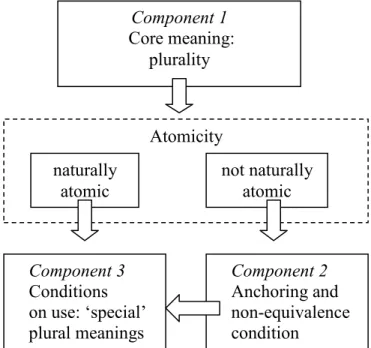
Figure 3.3.: The core meaning of Hausa pluractionals Figure 3.4.: The three-component system
Figure 3.5.: The core meaning of Hausa pluractionals Figure 3.6.: Anchoring
List of tables
Table 1.1.: Parallels between nominal and verbal number forms Table 2.1.: TAMs
Table 2.2.: Forms of the verb sàyaa ‘buy’
Table 2.3.: Verb stem say- ‘buy’ in different grades
List of languages discussed in this thesis
Language Genus, (Subfamily,) Family
Arabic Semitic, Afro-Asiatic
Armenian Armenian, Indo-European
Berbice Dutch Creole Creoles and Pidgins
Bole West Chadic, Chadic, Afro-Asiatic Brazilian Portuguese Romance, Indo-European
Chechen Nakh, Nakh-Daghestanian
Cuzco Quechua Quechuan, Quechuan
Czech Slavic, Indo-European
Daba Biu-Mandara, Chadic, Afro-Asiatic
Dutch Germanic, Indo-European
English Germanic, Indo-European
Fasu Kutubuan, Trans-New Guinea
French Romance, Indo-European
Georgian Kartvelian, Kartvelian
Hausa West Chadic, Chadic, Afro-Asiatic
Huichol Corachol, Uto-Aztecan
Hungarian Ugric, Finno-Ugric, Uralic
Ilocano Northern Philippines, Western Malayo-Polynesian, Austronesian
Indonesian Sundic, Western Malayo-Polynesian, Austronesian
Italian Romance, Indo-European
Itonama Itonama, Itonama
Jamaican Creole Creoles and Pidgins
Kaqchikel Mayan, Mayan
Karitiana Arikem, Tupian
Kiwai Kiwaian, Kiwaian
Klamath Klamath-Modoc, Penutian
Koasati Muskogean, Muskogean
Konso East Cushitic, Cushitic, Afro-Asiatic
Korean Korean, Korean
Kwakiutl Northern Wakashan, Wakashan Kwarandzyey Songhay, Nilo-Saharan?
Luiseño Takic, Uto-Aztecan
Malay Sundic, Western Malayo-Polynesian, Austronesian
Mandarin Chinese, Sino-Tibetan
Modern Hebrew Semitic, Afro-Asiatic Modern Hindi Indic, Indo-European
Mohawk Northern Iroquoian, Iroquoian
Mono Lake Pauite Numic, Uto-Aztecan
Nahuatl Aztecan, Uto-Aztecan
Ndyuka Creoles and Pidgins
Ngamo West Chadic, Chadic, Afro-Asiatic Ngizim West Chadic, Chadic, Afro-Asiatic
Niuean Oceanic, Eastern Malayo-Polynesian, Austronesian Nukuoro Oceanic, Eastern Malayo-Polynesian, Austronesian
Papago Tepiman, Uto-Aztecan
Pangasinan Northern Philippines, Western Malayo-Polynesian, Austronesian
Podoko Biu-Mandara, Chadic, Afro-Asiatic
Pomo Pomoan, Hokan
Punjabi Indic, Indo-European
Quileute Chimakuan, Chimakuan
Russian Slavic, Indo-European
Saho Eastern Cushitic, Cushitic, Afro-Asiatic Sierra Nahuat Aztecan, Uto-Aztecan
Spanish Romance, Indo-European
Squamish Central Salish, Salishan St’át’imcets (Lillooet Salish) Interior Salish, Salishan
Tangale West Chadic, Chadic, Afro-Asiatic Tubatulabal Tubatulabal, Uto-Aztecan
Turkish Turkic, Altaic
Tümpisa Shoshone Numic, Uto-Aztecan
Vedic (Sanskrit) Indo-Aryan, Indo-Iranian, Indo-European West Greenlandic Eskimo-Aleut, Eskimo-Aleut
Yakan Sama-Bajaw, Western Malayo-Polynesian, Austronesian
Yuma Yuman, Hokan
Yurok Yurok, Algic
Zamboangeño Creoles and Pidgins
List of abbreviations
1 first person 2 second person 3 third person
DEL delimitative DEM demonstrative
DIR directed DISTR distributive F feminine FREQ frequentative
FUT future TAM HAB habitual TAM IMP impersonal
IMPF imperfective TAM
INF infinitive
IPFV imperfective aspect M masculine
NEG negation
NEGIMPF negative imperfective TAM NEGPF negative perfective TAM NONDIR non-directed
PF perfective TAM
PFV perfective aspect PL plural
PLC pluractional
PREF prefix
PREP preposition PST past
RED reduplication
RELIMPF relative imperfective TAM
RELPF relative perfective TAM SG singular
ST stative STAB stabilizer
SUBJ subjunctiveTAM SUF suffix
Chapter 1: Delimiting pluractionality
1.1. Introduction
Terms like ‘singular’ and ‘plural’ are normally used in connection with the category of number in the nominal domain. It is intuitively very clear what the singular (a) dog
means, as opposed to the plural dogs. On the other hand, the notion of ‘plural verbs’
seems to be much less transparent. In spite of that, plural or ‘pluractional’ verbs are more than common in the languages of the world and they fully deserve the growing attention in the literature. Examples from several languages are given below:1
(1) a. Wa’kenatahrónnion’ [Mohawk]2
wa’-k-nata-hr-onnion’
FACTUAL-1SG.AGENT-visit-ANDATIVE-DISTRIBUTIVE.PRF
‘I went visiting here and there’
b. X-in-ru-chap-acha’ [Kaqchikel]3
CP-A1s-E3s-touch-PLRC
‘He touched me repeatedly’
c. ʔinanta-siʔ ʔana ʔi=ʛom-t-i [Konso]4
girl-DEF.M/F me 3=bite[PL]-3.SG.F-PF
‘The girl bit me in many places.’
d. Yârân sun rur-rùuɗee [Hausa] children.the 3PL.PF RED-be.confused
‘The children are (all) very confused’
1 I adopt the following conventions for example sentences and word forms. The language of the example is
given in square brackets. A list of languages discussed in this thesis, including the information on the genus and family they belong to, is given on page xvi. The source of the example is indicated in a footnote. If the square brackets are not followed by a footnote reference, the example is my own.
The form of the example sentences taken from the literature is generally preserved (with minor exceptions such as capitalizing the beginnings of the sentences, replacing capitals in glosses by small caps etc.). However, emphasis in the form of underlined or bold text is removed. If the examples do contain emphasis, the emphasis is my own. If other changes to the examples have been made, this is indicated in the footnote associated with the example. Abbreviations used in examples taken from the literature, if not completely transparent, are given in their respective footnotes, unless they are not provided by the author. The list of abbreviations used in the glosses of my own examples is given on page xviii.
In case the translation of an example is not sufficient and additional comments are required, they are added in a fourth line, introduced by ‘N.B.’.
e. Ysh niaxar ullie hittira [Chechen]5 they door by stand.PLR.WP
‘They assumed a standing position by the door’
What all these examples have in common is the fact that they refer to events that are plural in some sense. Sentence (1a) refers to a plural event of visiting different people in different places; (1b) describes a situation involving repeated touching. Example (1c) involves many bites. Sentence (1d) refers to different events (states) of being confused as experienced by different children. In example (1e), several events of assuming a standing position, each by a different person, are described.
The observation that verbs like those given in (1) above refer to situations involving multiplicity of events is reflected in the way Lasersohn (1995:240) characterizes pluractional verbs, summarizing descriptive work of many linguists: “The basic idea, I think, is clear; pluractional markers attach to the verb to indicate a multiplicity of actions, whether involving multiple participants, times, or locations”. Thus, pluractionality is not a kind of agreement. It is often stressed in the literature that even though the use of a pluractional form might convey information about the number of individuals involved in the event, pluractionality is essentially about the events themselves being plural.6
From the geographical or typological point of view, pluractionality is widespread. In fact, its virtual absence in European languages looks rather like an exception than the rule. Pluractional verbs are found in many languages of the world: they are very common in American languages, all four major families of Africa (Afroasiatic, Niger-Congo, Nilo-Saharan, Khoisan), but they are also found in various languages of Asia (e.g. Paleoasiatic, Austronesian, Papuan) and Australia (cf. Corbett 2000 and the references therein). As for the formal means used to express pluractionality, reduplication, other affixation and stem alternation seem to be the most common (cf. Wood 2007). Moreover, it is generally agreed that pluractional marking is derivational by nature, rather than inflectional. This is in contrast to number marking in the nominal domain, at least as we know it from languages like English (cf. esp. Mithun 1988).
The term ‘pluractional verbs’ was introduced in Newman (1980) and is now widely used. Newman coined the term as a replacement for the older term ‘intensive verbs’, used by most Chadicists at that time, and as a better alternative to the term ‘pluralverbs’, which is problematic because it might be misunderstood as referring to plural agreement. Newman did not consider the term ‘intensive verbs’ adequate because, as he puts it, “the essential semantic component of these forms [is] plurality and not intensification” (Newman 2000:423). In his definition, pluractional verbs “indicate multiple, iterative, frequentative, distributive, or extensive action” (Newman 2000:423). Newman was not the first one to recognize the plural semantics of these verbs, however: he himself
5 Yu (2003:296). PLR – pluractional, WP – witnessed past.
6 See Durie (1986:357-62) and Corbett (2000:252-7) for the diagnostics for verbal number, as opposed to
mentions works as old as Westermann (1911). An important early work discussing verbal plurality in general is Dressler (1968). For an extensive overview of the pluractional concept as well as the history of the term see Newman (to appear). Other works that offer a cross-linguistic survey of pluractionality include Wood (2007) and Cabredo Hofherr (2010).
The present thesis belongs to the line of research that focuses on the semantics of pluractionality. In particular, I will provide an analysis of the meaning of pluractional verbs in Hausa (Chadic). Hausa will become the focus of the discussion only in Chapter 2 and 3. Chapter 1 is devoted to a general discussion of pluractionality: its purpose is to delimit pluractionality and discuss possible approaches to it. Before delving deep into the intricacies of the phenomenon, however, a working definition of pluractionality will be given. The purpose of this definition is not to cover all possible cases of pluractionals. Rather, it represents what I consider to be typical properties of pluractional verbs. (2) Typical properties of pluractionals
- form: morphological marking
- meaning: (a) basic meaning – plurality of events: temporal readings
participant readings (b) additional meanings:
large number of events
high individuation/ diversification
intensification (and other degree-like effects)
A typical pluractional has the plurality encoded in the form of the verb. The typical meaning contribution can be described as consisting of two parts. The first part is the basic meaning of pluractionality, which is event plurality. Event plurality can be manifested in more than one way. It seems to be characteristic for pluractionals that they can be interpreted as referring either to iterated events (temporal readings; cf. (1b)), or events distributed to different participants (participant readings; cf. (1e)).7 Even though
the ability to express both temporal and participant-based readings is not a necessary feature of pluractionals, I will suggest below that at least some of the markers labeled as pluractional in the literature that give rise exclusively to temporal readings should be analyzed as aspectual. Similarly, a subset of the participant-based cases will be argued to represent a different phenomenon.8
7 Spatial readings (the plural events are distributed over different locations) could be either considered a
subtype of participant readings or they could represent a third type of readings. It is not important at this point which way of dealing with spatial cases is more adequate. What is important at this point is that whether spatial readings are separate or not, a typical pluractional is not restricted to one way of expressing event plurality. Rather, it can be used for all these different meanings.
A fuller discussion of spatial readings – for Hausa only – will be given in Chapter 3.
In addition to event plurality, pluractionals often express various additional meanings. Most often, these additional meanings are ‘large number’ and ‘high individuation’/ ‘diversification’. This means that pluractionals typically refer to events that are many, rather than simply plural, and differentiated (cf. (1a)). Another possible additional meaning – less common, however – is intensification (cf. (1d)).9
The term ‘pluractional’ has also been used to describe cases that do not fit the characterization given above. One of the main goals of this chapter is to explore to what extent the notion of pluractionality can be extended without losing its content. This is particularly important in connection with the relatively large number of recent proposals that analyze phenomena that would traditionally be considered aspectual as pluractional in nature. However, the relation between aspect and pluractionality is not the only area where it is necessary to be careful about where the boundaries are drawn. Before a more adequate definition of pluractionality can be proposed, more research is also needed to determine, for example, which properties of pluractionals are defining and which are only typical. The present thesis cannot answer all possible questions related to how pluractionality should be delimited. Nevertheless, I will argue for a specific position in some of the issues and, in general, I will defend a rather restricted use of the term ‘pluractional’.
In the rest of this introduction, I will briefly discuss several issues. They all have to do with how pluractionality should be delimited. First, I will elaborate somewhat on the relation between pluractionality and aspect and pluractionality and gradability since some of the meaning effects associated with the use of pluractionals could be attributed to these other phenomena as well. Iterativity, for example, traditionally belongs to the domain of aspect. Intensification, on the other hand, is more naturally understood as having to do with gradability, rather than (event) plurality.10 In relation to that, I will also briefly discuss reduplication as a way of marking plurality, aspectual categories and intensification alike and as such representing a natural connection between these notions. Finally, I will discuss a possible strategy that can be used in determining what should be included in pluractionality and what represents a different phenomenon.
Starting with the connection between pluractionality, aspect and degree, I have stated that the basic meaning of pluractionality is event plurality. However, when looking more closely at the various cases labeled as ‘pluractional’ in the literature, one often encounters examples that could in principle be found in the literature on aspect or gradability. For instance, the habitual and iterative interpretations in (3a-b) would traditionally belong to the realm of aspect:
9 In some cases the degree effect seems to be the opposite: detensification. Cf. section 1.4.
10 The relation between pluractionality and aspect, and pluractionality and degree will be discussed in detail in
(3) a. krgrtk- krtk- [Yurok]11 ‘to fish habitually/ repeatedly’ ‘to fish for trout’
b. hìhìnɗâ hìnɗâ [Ngamo]12 ‘he stood up repeatedly’ ‘he stood up’
Similarly, one can find examples of pluractional verbs where the event seems to be intensified, as in the following example:
(4) Ku k’-uuk skuuwoksi’m ku pekoyoh [Yurok]13 ART 2SG-child like.ITR.SG ART red
‘Your kids really like the candy (red licorice)’
Put in a non-pluractional context, this example could be taken to illustrate gradability in the verbal domain.
Notice that the boundaries between the three phenomena can be blurred not only in languages that are claimed to have pluractionals. The English example in (5) illustrates how a single expression can give rise to different interpretations that, when considered separately, could be potentially analyzed as plurality (5a), aspect (5b) and gradability (5c):
(5) a. a lot of furniture ~ many pieces b. to go to the cinema a lot ~ frequently
c. to appreciate a lot ~ intensively
The same degree expression a lot can give rise to different meaning effects depending on
the type of predicate it combines with (cf. Doetjes 1997, 2004, 2007; Abeillé, Doetjes, Molendijk & de Swart 2004).14 Example (5a) has an interpretation involving a large
number of pieces of furniture (a plural-like effect). In example (5b), a lot seems to be
contributing the meaning of high frequency, which resembles aspect. Finally, example (5c) illustrates the ability of a lot to bring about intensification with the right type of
predicate. Looking at cases like these separately might create the wrong impression of what the underlying phenomenon is in each particular case. The examples in (5) thus illustrate that the boundaries between plurality, aspect and gradability might in some cases be less clear and separating these phenomena requires caution.
In addition to the existence of (presumably unambiguous) expressions like a lot, where
the actual meaning effect depends on the nature of the modified predicate, there is a formal means that is used to express a number of often related but separate meanings:
11 Wood (2007:143).
12 Newman (to appear, referring to Schuh, p.c.). 13 Wood (2007:167).
ART – article, ITR – iterative.
14 The basic idea is that degree expressions like a lot require the presence of a scale and the predicates in (5)
reduplication.15 Reduplication is very common in the languages of the world. It is also one of the most common means of deriving pluractionals. From the examples below, it can be seen that reduplication can be used to express plurality ((6a-b), (6e)), aspectual notions (6f-g) and meanings connected to gradability ((6c-d), (6h-i)) alike. Note that it applies to many different lexical categories.
(6) nouns
a. amimígo amígo PLURAL [Pangasinan]16
‘friends’ ‘friend’ adjectives
b. na-lulukmeg na-lukmeg PLURAL [Ilocano]
‘fat.distr’ ‘fat’
c. nikkaa nikkaa nikkaa INTENS. [Punjabi]
‘very small’ ‘small’
d. yelo-yelo yelo DETENS. [Jamaican Creole] ‘yellowish’ ‘yellow’
verbs
e. sseni seni PL. PARTICIP. [Nukuoro] ‘sleep, pl actor’ ‘sleep, sg actor’
f. dewduddag duddag ITERATIVE [Yakan] ‘repeatedly fall off’ ‘fall off’
g. mangi-mangi mangi CONTINUOUS [Berbice D. Cr.] ‘keep running’ ‘run’
h. kyére-kyére kyére INTENS. [Zamboangeño] ‘desire intensely’ ‘desire’
i. lon-lon lon APPROX. [Ndyuka] ‘be kind of running’ ‘to run’
Thus, on the one hand, the fact that plurality, various aspectual and degree-like meanings can all be expressed by reduplication can be taken as support for the idea that the links between these notions are very natural. On the other hand, the fact that reduplication can have all these uses might also explain why certain meaning effects are sometimes put together despite the fact that they represent separate meanings.
In the paragraphs above I have given some indication as to how and why the boundaries between pluractionality and other phenomena are often unclear. Below I suggest a
15 Naturally, there are different types of reduplication. However, for reasons of space I cannot discuss any finer
distinctions here. For an overview of the various types and meanings of reduplication, see e.g. Moravcsik (1978), Niepokuj (1997), Regier (1998), Rubino (2005).
16 All examples, except for (d) and (i), are from Rubino (2005). Examples (d) and (i) are from Kouwenberg &
strategy that can be used in determining whether a marker is or is not pluractional. In particular, I will suggest that looking at languages that have a single marker for all pluractional uses is of special importance. The reasons are the following. First, if a language has a marker that can be used to express several different ‘meanings’, e.g. iterative and participant-based readings, it is quite safe to conclude that it is a genuine pluractional marker. This is true both in cases in which the given marker is the only pluractional marker of the language and in cases in which the language has other pluractional markers as well. The second reason why studying these ‘general’ pluractional markers is of special importance is a consequence of the first one: they can be used to restrict the range of possible pluractional meanings. This information can then be used when evaluating markers that express more specialized meanings. In particular, I suggest that only those markers could potentially be considered pluractional that express meanings which are also reported as possible meanings of at least some of these ‘general’ pluractional markers. This can be illustrated on durative interpretations. Consider the following description from Newman’s discussion of pluractionality in various Chadic languages (Newman 1991:55):
“Daba [...] has two different constructions of a pluractional nature. It has a reduplicated “iterative” construction that marks action repeated or extended over a period of time, and it has a suffixal “durative” construction which is used for “une action qui a déjà commencé et qui va continuer” [an action that has started and that will continue] (Lienhard & Wiesemann 1986:46).”
Durative readings are not in any obvious sense plural. Yet they are sometimes reported as possible meanings of pluractionals. I suggest that when deciding whether durative interpretations are possible pluractional interpretations, what should be looked at is whether there is a language whose general pluractional marker has also a durative reading. If there is no such marker, then there is no reason to assume that a marker that is used exclusively to express durativity is pluractional, rather than aspectual.17
From the perspective of what has just been said, Hausa is an ideal language to study since it has a single (reduplicative) pluractional marker for all pluractional ‘meanings’.18
Apart from Hausa, another language with a single pluractional formation for all uses is Chechen. In Chechen, pluractional verbs are formed by ablaut and receive different interpretations depending on the type of the verb stem (Yu 2003). Klamath also has a reduplicative marker that, according to Lasersohn (1995, relying on the description in
17 One such case (Chechen) will be considered in section 1.3.
18 Strictly speaking, there is more than one way to derive the pluractional form: either by means of a
Barker 1964), can have temporal as well as participant-based and, apparently, spatial readings. Unlike Hausa and Chechen, however, Klamath is reported to have a number of other pluractional markers.
Languages that have a number of specialized pluractional markers are naturally very important to study as well. Their importance lies e.g. in providing support for various distinctions made within pluractionality.19 There are languages that are reported to have
two or three pluractional markers (Bole, Yurok),20 but some have been claimed to have
up to nine different markers of pluractionality (Cuzco Quechua, Itonama).21 The general
strategy that should be adopted when a language has a number of highly specialized potentially pluractional markers is to examine each marker carefully to exclude the possibility that some of them represent different phenomena in fact.
This thesis is divided into three chapters. Chapter 1, investigates pluractionality in its various aspects with the goal of delimiting the phenomenon with respect to related phenomena. Several theoretical accounts of pluractionality are presented. Chapter 2 presents the Hausa pluractional data. Chapter 3, the main chapter of the thesis, presents my analysis of pluractionality in Hausa.
In this chapter, the phenomenon of pluractionality and its various aspects will be examined step by step. As already mentioned, the main goal of this thesis is to offer a detailed analysis of Hausa pluractionals. The present chapter will prepare the ground for such an endeavor by delimiting the phenomenon and making it clear what the issues are that need to be addressed whenever an in-depth investigation of the semantics of pluractional verbs is attempted. Nevertheless, this chapter can also be read independently of the rest of the thesis as a hopefully useful, even though necessarily subjective, guide into the intricacies of the phenomenon of pluractionality.
19 Cf. the discussion in section 1.6.
20 Bole, has three different ways of marking pluractionality (gemination, infixation and reduplication: the first
two are used exclusively for distributive readings, the last one can also be used to express repetition; Schuh & Gimba in preparation). Yurok also has more than one affix that can be considered pluractional. According to Wood & Garrett (2002) and Wood (2007) there are two pluractional markers in the language, the so-called ‘iterative’ (‘intensive’ in Wood & Garrett 2002) and ‘repetitive’, which contribute different meanings. (In addition, the form that Wood calls ‘collective’ could probably be considered pluractional too; cf. the discussion in section 1.5.2.)
21 Faller (2008, drawing heavily from Cusihuaman 2001) claims that Cuzco Quechua has a number of distinct
The discussion will begin by addressing the obvious question of the relation between verbal number and nominal number (section 1.2.). Sections 1.3. and 1.4. will be dedicated to the complicated task of teasing apart aspect, plurality and degree. Section 1.5. contains a discussion of the use of the terms ‘distributive’ and ‘collective’, both of which are frequently used in connection with pluractionality. Section 1.6. will deal with two distinctions that are often made within pluractionality: the opposition between event number and participant number, and the distinction between external and event-internal plurality. Section 1.7. will be devoted to a discussion of how broad the notion of pluractionality should be, as the literature has lately witnessed an explosion of the use of the term. Four theoretical accounts of pluractionality are presented in section 1.8. Section 1.9. concludes the chapter.
1.2. Relation to nominal number
The mere existence of verbal plurality next to nominal plurality brings about certain questions. Is it necessary to talk about verbal number separately from nominal number? Are the facts in the two domains different to such an extent that they require a separate treatment? Or should the notion of plurality be generalized so that it fits both nouns and verbs? In the present section, I will argue that the same distinctions can often be found with both nouns and verbs but verbal plurality is still better treated as a separate phenomenon. One of the reasons is that verbal plurality has certain properties that seem to be more typical for the verbal domain than for the nominal domain. Another reason is that the complexity of the facts is higher in the case of verbs due to the nature of events as semantic objects. Note, however, that while this type of approach will allow a better understanding of the specifics of verbal plurality, the importance of generalizing the notion of number across domains remains.22
There exists a large literature on parallels between the nominal and verbal domains. In particular, the mass/ count distinction in nouns is often compared to the unbounded/ bounded distinction in verbal predicates. In other words, number in nouns is compared to aspect in verbs (e.g. Mourelatos 1978, Bach 1986, Krifka 1989, 1992).23 In this
section, I will not discuss parallels of this type, however. The relation between plurality and aspect will be discussed in section 1.3. The present section focuses on comparing the types of distinctions that can be found in the category of number in the two domains, with the goal of determining to what extent the number systems in the two domains are comparable.
22 The analysis of Hausa pluractionality given in Chapter 3 will in fact make the connection between verbal
and nominal plurality rather transparent.
23 According to Krifka (1992), the similarity between nominal and verbal distinctions was observed already by
Starting the comparison with the number of values the category of number can offer, nouns seem to have more options than verbs. According to Corbett (2000) nominal number can have up to five values (the possibilities being e.g. singular, dual, trial, paucal, plural), while verbal number is usually restricted to the singular vs. plural opposition.24
Actually, as Corbett points out, singular vs. plural (i.e. one vs. more than one) might not be the appropriate distinction. The opposition seems to be often rather ‘one vs. several’ or ‘one vs. many’, as illustrated by the following example from the Papuan language Fasu:25
(7) a. pari popari [Fasu]26 ‘one stays’ ‘many stay’
b. mara mora ‘get one’ ‘get many’
Judging from these differences only, it could seem that verbal and nominal number are rather different from each other. Nevertheless, there are also forms in the nominal domain with properties often found with pluractional verbs. In particular, these are forms that I will be calling ‘special plurals’.27 Special plurals can be contrasted with simple
plurals, an example of which are English nominal plurals. In English, singular count nouns are generally assumed to refer to singularities/ atoms. Plural count nouns then refer to pluralities formed by two or more such atoms (alternatively, to atoms and all the pluralities formed from them).28 Nevertheless, some languages have number-neutral
forms for count nouns (cf. e.g. Rullman & You 2006, Doetjes to appear among others). Indonesian is an example of such a language: buku can refer to both one book and plural
24 Some verbs in some (e.g. North-American) languages seem to have dual forms as well (Mithun 1988, 1999;
Corbett 2000). It should be said, however, that these forms might be better analyzed as so-called ‘plural-argument verbs’. These verbs are analyzed as distinct from true pluractionals by Wood (2007). This view is adopted also in this thesis (cf. the discussion in 1.6.1.). As for other number values that are rare in the verbal domain, Konso is a very interesting language to look at. The following example seems to represent a verbal paucal (Ongaye Oda 2010):
(i) ʛimayta-siʔ innaa-siniʔ ʔi=ʛo-ʛoʄʄ-ay
old.man-DEF.M/F child-DEF.P 3=RDP-pinch.SG-PF[3.SG.M] ‘The old man pinched the child a few times.’
The verb form exemplified in (i) is a plural derived from a (derived) singulative (ʛo-ʛoʄʄ ‘pinch a few times’ is
derived from ʛoʄʄ ‘pinch once’, which is in turn derived from ʛoʄ ‘pinch many times’). For a comparison to
parallel nominal forms in Arabic see footnote 42.
25 Some languages seem to have an opposition ‘one/two vs. more than two’ (cf. Mithun 1999, Corbett 2000).
As for the fact that the non-singular form of verbs is usually not specific about the precise threshold value that is required for the form to be felicitous (it is ‘several’, or ‘many’), Corbett views this “indeterminacy of the number value” as something typical for verbal number. It can be seen, for example, from the fact that the number of participants needed for the appropriate use of a plural form differs from verb to verb.
26 Foley (1986:128-9), as quoted by Corbett (2000:250).
27 Cf. Al-Hassan’s (1998) distinction between simple and special plurality.
28 On the debate concerning the question whether atoms should be included in the plural denotation see e.g.
books. It is possible to form an unambiguously plural form, by full reduplication: buku-buku. It is not entirely clear what the meaning of these reduplicated forms is. It seems
that it can be either simple plurality or ‘plurality and variety’:29,30
(8) buku-buku buku [Indonesian]31
‘books, or different kinds of books’ ‘book, or books’
Forms that express the ‘plurality and variety’ meaning are found in many languages, usually under the label ‘distributive plurals’.32 More examples of this type of special
plurality are given in (9). The form in (9a) is distributive in the sense of referring to different kinds, the form in (9b) in the sense of spatial distribution:
(9) a. otsikhe’ta’shòn:’a otsikhè:ta’ [Mohawk]33
‘various candies’ ‘sugar, candy, candies’
b. tutkô·yo’ tukô·yo’ [Quileute] ‘snow here and there’ ‘snow’
The situation found with pluractional verbs is often very similar. The simple form of the verb is typically number-neutral (it can be used to refer both to singular and plural events) and the pluractional form refers exclusively to plural events.34 In addition,
pluractionals often express that the events are distributed ‘here and there’, affect different kinds of participants etc. Consider the following examples of ‘verbal distributives’ from Mohawk:
(10) a. Wa’kenatahrónnion’ [Mohawk]35
wa’-k-nata-hr-onnion’
FACTUAL-1SG.AGENT-visit-ANDATIVE-DISTRIBUTIVE.PRF
‘I went visiting here and there’
29 Whether the reduplicated form receives a simple plural or a ‘variety’ meaning seems to depend on the given
lexical item (animate nouns probably tend to be interpreted as simply plural in the reduplicated form, e.g.
orang-orang ‘people’, in contrast to nouns referring to inanimate objects where the simple form might be preferred if simple plurality is the intended meaning), but it can also vary with the area (Macdonald 1976) and it seems to be subject to historical change (Rafferty 2002, referring to Gonda 1949).
30 Not all languages that have number-neutral forms necessarily have plurals with special meanings. Turkish
(Göksel & Kerslake 2005) and Hungarian (Rounds 2001) have number-neutral forms of nouns but if the plural form is used it is to convey a simple plural meaning.
31 Macdonald (1976:34).
32 Distributive plurals are used not just to express ‘variety’. It is perhaps more appropriate to characterize
distributive plurals as expressing generally higher individuation, separation, or distinctiveness (cf. Mithun 1988, 1999). The issue of individuation, especially individuation of events, will be discussed in more detail in Chapter 3. As for the term ‘distributive’ and its different uses, see section 1.5.1.
33 Example (9a) is from Andrade (1933:187), as quoted by Mithun (1999:88), (9b) from Mithun (1999:88). 34 There do exist genuine singular forms in the verbal domain, however. Two examples of languages with
genuinely singular verb forms are Konso (Ongaye Oda 2010) and Papago (Ojeda 1998; to be discussed in section 1.8.4.)
b. Wa’khninónnion’ wa’-k-hninon-nion’
FACTUAL-1SG.AGENT-buy-DISTRIBUTIVE.PRF
‘I bought different things’
The example in (10a) involves distribution over various locations, the example in (10b) distribution over “assorted objects”: the buying was distributed over an assortment of groceries in a shopping cart.
Distributive plurals are not the only kind of special plurals. Another type of special plurals are the so-called ‘plurals of large number’ (Cusic 1981), or ‘plurals of abundance’ (Cowel 1964):
(11) ašja:r šajar [Arabic]36
‘lots of trees’ ‘tree’ (generic/ collective)
In (11), the additional meaning contribution is that of large quantity. Again, in the verbal domain plurality often indicates large quantity or many repetitions, rather than simple plurality in the sense ‘more than one’:
(12) a. As q’iigashna twop-qissira [Chechen]37
1SG crow.PL.DAT gun-throw.PLR.WP
‘I shot crows many times’
b. mənanu mənu [Ngizim]38 ‘spend many years’ ‘spend a year’
Augmentation seems to be another possibility, as illustrated by the following example: (13) buyu:ta:t bayt/buyu:t [Arabic]39
‘big, important houses’ ‘house’/‘houses’
A possible verbal counterpart of this type of plural are cases where plurality (of participants in this case) combines with intensification:
(14) Yâraa sun rur-rùuɗee [Hausa] children 3PL.PF RED-be.confused
‘The children were very confused’
The first two types, plurals with the ‘various kinds’ and ‘large quantity’ meaning effects, can be found rather easily. The third type, representing plurality in combination with augmentation/ intensification, seems to be much less common, both in the nominal and verbal domain. Furthermore, the ‘various kinds’ and ‘large quantity’ meaning effects
36 Cusic (1981:18).
37 Yu (2003:294).
often combine in a single form. Al-Hassan (1998) uses the term ‘ample pluralization’ for forms that can express either (or both). ‘Ample pluralization’ in nouns involves cases in which the noun is not just plural but rather contributes meanings like ‘very many’ or ‘many and varied’.40,41 This type of interpretation has been reported e.g. for Syrian
Arabic (the forms are parallel to those in (11)):
(15) ʔasmāk samak [Syrian Arabic]42
‘many or various fish’ ‘fish’
Again, the combination of ‘large quantity’ and ‘variety’ are found with pluractionals as well:
(16) Naa sàs-sàyi lìttàttàfai [Hausa] 1SG.PF RED-buy books
‘I bought many different books’
After discussing the different types of special plurals, it should be mentioned that despite the fact that verbal plurals are typically of the ‘special plural’ type, apparently there are also languages whose plurals are of the ‘simple plural’ type, comparable to English nominal plurals. Consider the following example from Karitiana:
(17) Õwã nakokonat sypomp opokakosypi [Karitiana]43
kid 3-DECL-break-REDUPL-VERB-NFUT two-OBL egg ‘The kid broke two eggs (one at a time)’
40 An example of ‘ample pluralization in nouns’ in Hausa is wàaƙé-wàaƙé (Al-Hassan 1998:180; no translation
given) from wáaƙàa ‘song’. Al-Hassan also discusses ‘ample pluralization in adjectives’, an example of which
could be Hausa forms bábbáƙúu ‘very black or evil’ (from báƙíi ‘black’) or gàjàjjèerúu ‘very many and very short’ (from gàjèerúu ‘short.pl’; Al-Hassan 1998:194).
41 Special plurals can co-exist with other plurals and (genuine) singular forms. For example, triples like the
following can be found in Hausa:
(i) mafar͂kii màfàr͂kai/mafar͂kookii màfàr͂ke-màfàr͂ke ‘dream’ ‘dreams’ ‘all kinds of dreams’
Forms like màfàr͂ke-màfàr͂ke are sometimes called “pseudoplurals of diversity” (Newman 2000; cf. section 2.2.5.2.)
42 Cowel (1964:369). Note that the plural is derived from a ‘collective’ (and not singular) form. There is a
singular (singulative) form (samake ‘a fish’) as well, which has its own corresponding plural (samakāt). This
plural is also referred to as the ‘plural of paucity’ (“it [...] usually implies that the things referred to are few in number and individually discriminated”; Cowel 1964:369). It is generally the ‘collective’ vs. ‘plural of abundance’ contrast that corresponds to the number-neutral vs. pluractional contrast in the verbal domain. Note, however, that Konso seems to have what could be called ‘pluractionals of paucity’, in addition to other kinds of verbal number forms. These plurals are derived from (derived) singulatives. Notice the analogy with the singulative vs. ‘plural of paucity’ contrast in the Arabic nominal system. For a discussion of the verbal number system of Konso see Ongaye Oda (2010). For more discussion on the so-called ‘broken’ vs. ‘sound’ plurals (where ‘broken’ plurals are derived by a base pattern change, e.g. Ɂasmāk, and the ‘sound’ plurals are derived
by suffixation, e.g. samakāt) see Ojeda (1992).
The use of the pluractional in (17) does not require the events to be highly individuated, very many or intensified. It is sufficient if there is more than one event of egg-breaking. Needless to say, Karitiana pluractionals are rather exceptional in this respect.
Finally, apart from special plurals, which exhibit the interpretations described above, descriptions of ‘collective’ forms of both nouns and verbs can also be found in the literature. The term ‘collective’ requires some caution, however, as it is used in many different senses. For instance, in the discussion above the term ‘collective’ was used to refer to number-neutral forms in Arabic. The type of ‘collectives’ relevant for the present discussion is illustrated below:
(18) a. háiwañ [Papago]44
‘one or more head of cattle belonging to the same herd’ b. cíkpan
‘to work (once or more than once) at one location’
The ‘collective’ form indicates that the objects belong together in a certain way. In Papago, collective forms of nouns express that the entities referred to belong to the same household or group (18a). Collective forms of verbs can be used to indicate that the events take place in the same location (18b) (Ojeda 1998).45 Collectives in this sense can
be considered the opposite of distributives as exemplified in (9) and (10) (cf. Corbett 2000:117ff).46
The discussion above shows that even though there are number forms in the nominal domain that do not seem to have a direct counterpart in the verbal domain (e.g. trials), it is possible to find interesting and rather extensive parallels between the two domains. This is especially the case of forms that I call ‘special plurals’, which are mainly plurals of the ‘many and/or varied’ type. Apart from those, some languages also have both nominal and verbal ‘collectives’ (non-distributives). A summary of the parallels is given in Table 1.1.:
44 Ojeda (1998:248, 251).
45 Mathiot (1973, 1983) describes the nominal and verbal non-distributive forms in Papago as referring to
entities or actions belonging to or taking place at a single ‘locus’.
Table 1.1.: Parallels between nominal and verbal number forms
type of ‘plural’ nouns verbs
simple plurals ‘more than one N’
(English) e.g. ‘V more than once’ (Karitiana; (17)) special plurals
a) distributives
b) plurals of abundance
c) augmented/ intensified plurals
e.g. ‘various Ns’ (Mohawk; (9a)) ‘many Ns’ (Arabic; (11))
e.g. ‘big/ important Ns’ Arabic; (13))
e.g. ‘V here and there’ (Mohawk; (10a)) e.g. ‘V many times’ (Chechen; (12a)) e.g. ‘pl. subj V very much’ (Hausa (14)) collectives e.g. ‘N(s) belonging to one
herd’ (Papago; (18a)) e.g. ‘V at one location’ (Papago; (18b))
Coming back to the questions posed at the beginning of this section, let us consider now the possibility of treating nominal and verbal number uniformly. Nouns often express number values that are generally not found with verbs. On the other hand, in some languages the situation in the nominal and verbal domain is very similar and therefore a single analysis for both could be considered.
Papago is a language whose nominal and verbal number systems are very much parallel. It has indeed been proposed that nominal and verbal number could be treated uniformly in this language (Ojeda 1998). Papago has singular, ‘collective’ (non-distributive) and distributive forms with both verbs and nouns, with parallel meanings. This has already been illustrated for the non-distributive forms. As for the singular and distributive forms, an illustration of the parallels is given in (19):
(19) unitive/singular
a. dáikuḍ [Papago]47
‘a single chair from a single household’ b. héhem
‘to laugh once (at one location)’ c. habcéʔi
‘to say something for the first time once (at one location)’
distributive
d. dáḍḍaikuḍ
‘several chairs from several households’ e. cíckpan
‘to work (more than once) at more than one location’ f. habcécce
‘to say something for the first time more than once at more than one location’ Ojeda assumes that individuals and events can both form mereological structures (cf. Bach 1986, Krifka 1989, who extend Link’s 1983 proposal to events) and as such they can be assigned essentially the same analysis.48 Similarly to Ojeda (1998), Bar-el (2008)
proposes a uniform semantics for nominal and verbal plurality in Squamish. The plural marker itself is identical (CVC- reduplication; Bar-el 2007, 2008, van Eijk 1998).49
(20) a. mex-míxalh míxalh [Squamish]50
‘bears’ ‘bear’
b. Chen tl’ex-tl’exwenk Chen tl’exwenk 1S.SG REDUP-win.INTR 1S.SG win.INTR
‘I’m winning all the time’ ‘I won’
Bar-el assumes that the CVC-reduplicant in Squamish is simply a plural marker, which does not specify the domain to which it applies. As such, it creates either plural individuals or plural events (Bar-el 2007, 2008).
To summarize, there do exist proposals that assign a uniform semantics to nominal and verbal plurals. However, languages in which the nominal and verbal number systems are sufficiently similar are probably very rare. Usually, the differences between the two domains are rather substantial. In Hausa, for example, the plurality in the verbal domain is clearly not simple plurality, in the sense of ‘more than one’. By contrast, nominal plurals are generally simple plurals.51 In addition, there are other differences between the
two domains, e.g. in the obligatoriness of plural marking. In general, it is to be expected that different languages will have different combinations of nominal and verbal number systems. As a consequence, for most languages, the idea of a uniform analysis for both nominal and verbal plurality is not very plausible. In addition, there are other reasons for treating pluractionality as a phenomenon in its own right. In particular, this kind of approach allows for focusing on the interesting issue of the relation between pluractionality and aspect, which is often touched upon in the literature. This issue is specific to verbs. The relation to aspect will be the topic of the following section. Before
48 A more detailed discussion of Ojeda’s proposal is given in section 1.8.4.
49 Cf. also Mithun (1988) for other North American languages, in some of which the same marker can be found
also on adjectives.
50 Bar-el (2008:33,38).
moving on there, however, it is worth stressing that despite the fact that pluractionality is probably best treated as a separate phenomenon, the study of pluractionality should be seen as contributing to our understanding of plurality in general.
1.3. Relation to aspect
The issue of the relation between aspect or Aktionsart and pluractionality is an important but also a complicated one, which is reflected by the lack of clarity on the distinction between these notions in the literature. This lack of clarity starts with the terminology, since various researchers use the terms aspect and Aktionsart differently. Therefore, I will start by trying to get some of the terminological confusion out of the way (subsection 1.3.1.). Subsection 1.3.2. will then review how the connection between pluractionality and aspect has been described in the literature. One of the main points of this section will then be that event plurality, including iterativity, is independent of the perfective vs. imperfective and bounded vs. unbounded distinctions (subsection 1.3.3.). As the other main point of this section has to do with iterative readings, I will first separate them from habitual readings, which are necessarily unbounded (subsection 1.3.4.). The claim will then be that iterative readings can have more than one source and, as a result, do not necessarily involve pluractionality. Basically, both aspectual categories and pluractionality, while representing separate phenomena, can give rise to iterative interpretations (subsection 1.3.5.). At the end of the section, I will extend the discussion to the issue of durative/ continuous readings (subsection 1.3.6.). Subsection 1.3.7. concludes the discussion.
1.3.1. Terminological issues
Let us start by looking at how aspect and Aktionsart are defined and how different authors relate pluractionality to these notions. Comrie (1976:3) gives the following definition of aspect (which is based on the definition given by Holt 1943): “As the general definition of aspect, we may take the formulation that ‘aspects are different ways of viewing the internal temporal constituency of a situation’.” Comrie adds to this in a footnote that the distinction between aspect and Aktionsart is drawn in two different ways, depending on the tradition. In both traditions aspect involves grammaticalization of the relevant semantic distinctions and Aktionsart represents lexicalization of the distinctions. The difference is that for Slavicists Aktionsart involves lexicalization by means of derivational morphology, while in the non-Slavicist tradition it is not important how the distinctions are lexicalized (Comrie 1976:6-7). To that it should be added that also the ‘relevant semantic distinctions’ are not the same, which will be made more explicit in the following paragraphs.
‘semelfactive’ etc., which are derived from the basic verb by means of various affixes, mainly prefixes.52 A possible classification of different Aktionsart meanings can be
found in Isačenko (1968). Isačenko distinguishes Aktionsarten with phase meaning, quantitative meaning, distributive meaning, and iterative meaning. Unlike aspect, which Isačenko considers a grammatical category with two values (perfective and imperfective),53 Aktionsart is not ‘binary’. Verbs of different Aktionsarten do not form
pairs, they are generally either perfectiva or imperfectiva tantum, as illustrated below (the relevant affixes are underlined):54
(21) aspectual pairs [Czech]
a. imperfective perfective
vař-i-t > u-vař-i-t
cook-SUF-INF PFV-cook-SUF-INF
‘to cook/ to be cooking’ ‘to cook’
b. perfective secondary imperfective
za-vař-i-t > za-vař-ova-t
PREF-cook-SUF-INF PREF-cook-IPFV-INF
‘preserve (e.g. fruits)’ ‘to be preserving’ (22) Aktionsarten
a. perfectivum tantum
po-vař-i-t DELIMITATIVE DEL-cook-SUF-INF ‘cook for a little while’
52 Cf. Isačenko (1968).
53 The claim is not completely unproblematic for Slavic languages, where the perfective vs. imperfective
distinction is only partly ‘grammatical’ or ‘inflectional’ (cf. Dickey 2000; also e.g. de Swart’s 2011b observation that the distinction between lexical and grammatical aspect is not always easy to establish in languages like Russian). Every verb is either perfective or imperfective and there are clear diagnostics for (im)perfectivity but pure aspectual pairs are rather rare. Perfective verbs are commonly derived from imperfective ones by prefixation. However, most prefixes carry some lexical meaning as well so they cannot be considered pure markers of perfectivity. In Czech, pure aspectual pairs are either pairs where the perfective form is derived by a purely perfectivizing prefix, where the imperfective form is derived from an underived perfective form, or where the imperfective form is derived from a derived perfective form (these are called secondary imperfectives). Nevertheless, even though the opposition between the perfective and imperfective aspect is not instantiated by pure aspectual pairs throughout the verbal system, aspect is still to be considered a grammatical category. By contrast, different Aktionsarten are lexical categories (cf. also Petr 1986, Grepl et al. 1995).
54
SUF - stem suffix, INF – infinitive suffix, PFV – purely perfectivizing prefix, PREF – lexical prefix, IPFV –
imperfectivizing suffix, DEL – delimitative prefix. Notice that the form in (22b) can be analyzed as being derived by a circumfix consisting of po- and –áva- (one of the reasons for not considering this a secondary