Expressing the
Geobacter metallireducens
PilA in
Geobacter sulfurreducens
Yields
Pili with Exceptional Conductivity
Yang Tan,
a*
Ramesh Y. Adhikari,
b*
Nikhil S. Malvankar,
b*
Joy E. Ward,
aTrevor L. Woodard,
aKelly P. Nevin,
aDerek R. Lovley
aDepartment of Microbiology, University of Massachusetts—Amherst, Amherst, Massachusetts, USAa; Department of Physics, University of Massachusetts—Amherst, Amherst, Massachusetts, USAb
ABSTRACT
The electrically conductive pili (e-pili) of
Geobacter sulfurreducens
serve
as a model for a novel strategy for long-range extracellular electron transfer. e-pili
are also a new class of bioelectronic materials. However, the only other
Geobacter
pili previously studied, which were from
G. uraniireducens
, were poorly conductive.
In order to obtain more information on the range of pili conductivities in
Geobacter
species, the pili of
G. metallireducens
were investigated. Heterologously expressing
the PilA gene of
G. metallireducens
in
G. sulfurreducens
yielded a
G. sulfurreducens
strain, designated strain MP, that produced abundant pili. Strain MP exhibited
phe-notypes consistent with the presence of e-pili, such as high rates of Fe(III) oxide
re-duction and high current densities on graphite anodes. Individual pili prepared at
physiologically relevant pH 7 had conductivities of 277
⫾
18.9 S/cm (mean
⫾
stan-dard deviation), which is 5,000-fold higher than the conductivity of
G. sulfurreducens
pili at pH 7 and nearly 1 million-fold higher than the conductivity of
G.
uraniiredu-cens
pili at the same pH. A potential explanation for the higher conductivity of the
G. metallireducens
pili is their greater density of aromatic amino acids, which are
known to be important components in electron transport along the length of the
pilus. The
G. metallireducens
pili represent the most highly conductive pili found to
date and suggest strategies for designing synthetic pili with even higher
conductivi-ties.
IMPORTANCE
e-pili are a remarkable electrically conductive material that can be
sustainably produced without harsh chemical processes from renewable feedstocks
and that contain no toxic components in the final product. Thus, e-pili offer an
un-precedented potential for developing novel materials, electronic devices, and
sen-sors for diverse applications with a new “green” technology. Increasing e-pili
con-ductivity will even further expand their potential applications. A proven strategy is
to design synthetic e-pili that contain tryptophan, an aromatic amino acid not found
in previously studied e-pili. The studies reported here demonstrate that a productive
alternative approach is to search more broadly in the microbial world. Surprisingly,
even though
G. metallireducens
and
G. sulfurreducens
are closely related, the
conduc-tivities of their e-pili differ by more than 3 orders of magnitude. The ability to
pro-duce e-pili with high conductivity without generating a genetically modified product
enhances the attractiveness of this novel electronic material.
L
ong-range electron transport along the length of the electrically conductive pili
(e-pili) of
Geobacter sulfurreducens
(1–5) is a property unprecedented in biology. The
e-pili confer exceptional capabilities to
G. sulfurreducens
in extracellular electron
trans-port for Fe(III) oxides (6), to other cells (7, 8), and for electron transtrans-port through biofilms
(1, 9, 10). Furthermore, e-pili represent a new form of electronic material that can be
sustainably produced from inexpensive feedstocks (3, 5).
Received5 December 2016Accepted7 December 2016 Published17 January 2017 CitationTan Y, Adhikari RY, Malvankar NS, Ward JE, Woodard TL, Nevin KP, Lovley DR. 2017. Expressing theGeobacter metallireducens
PilA inGeobacter sulfurreducensyields pili with exceptional conductivity. mBio 8:e02203-16.
https://doi.org/10.1128/mBio.02203-16. EditorEleftherios T. Papoutsakis, University of Delaware
Copyright© 2017 Tan et al. This is an open-access article distributed under the terms of theCreative Commons Attribution 4.0 International license.
Address correspondence to Derek R. Lovley, [email protected].
*Present address: Yang Tan, Department of Pharmacology, University of North Carolina, Chapel Hill, North Carolina, USA; Ramesh Y. Adhikari, Department of Physics, Jacksonville University, Jacksonville, Florida, USA; Nikhil S. Malvankar, Department of Molecular Biophysics and Biochemistry, Molecular Sciences Institute, Yale University, New Haven, Connecticut, USA.
This article is a direct contribution from a Fellow of the American Academy of Microbiology. External solicited reviewers: Haluk Beyenal, Washington State University; Liang Shi, China University of Geoscience; Michaela TerAvest, Michigan State University.
crossm
As recently reviewed (11–14), various theoretical modeling approaches have
sug-gested different mechanisms to account for this unique long-range conductivity in a
biological protein. Final resolution of the actual mechanism is likely to require
exper-imental determination of the e-pilus structure. However, resolution of the
G.
sulfurre-ducens
e-pilus structure will be technically challenging for such a thin (3-nm)
filamen-tous structure.
A major impetus for developing a better understanding of the mechanisms for e-pili
conductivity is the possibility that this will lead to strategies for developing synthetic
e-pili with enhanced functions, such as higher conductivity. For example, experimental
evidence has clearly demonstrated the important role of aromatic amino acids in
promoting e-pili conductivity. X-ray diffraction demonstrated
-
stacking of aromatic
amino acids, which has been proposed to confer metallic-like conductivity along the
length of e-pili (1, 13). Altering the degree of
-
stacking by changing pH (1, 3) or
genetic manipulation (2) leads to changes in e-pili conductivity directly related to the
degree of
-
stacking (13). Eliminating the
-
stacking of aromatic amino acids with
genetic manipulation eliminates the charge propagation along the pili, which can be
documented with electrostatic force microscopy (15). From these experimental results,
it was possible to devise strategies to either tune down the conductivity of
G.
sulfurre-ducens
e-pili by removing aromatic amino acids from the e-pilus monomer PilA (2, 16)
or to substantially increase the conductivity by adding tryptophan (5).
An alternative approach to genetic manipulation of PilA for producing e-pili with
different conductivities is to examine the conductivity of pili of other microorganisms.
The pili of
Geobacter uraniireducens
are more than 100-fold less conductive than
G. sulfurreducens
pili (17). This was attributed to the much longer length of the PilA
monomer of
G. uraniireducens
, which may prevent aromatic amino acids from packing
sufficiently tight for effective electron transport. A similar explanation has been
sug-gested for the poor conductivity of
Pseudomonas aeruginosa
pili (18).
The poor conductivity of
G. uraniireducens
pili is associated with phenotypes for
extracellular electron transfer that are markedly different than those for
G.
sulfurredu-cens
. Whereas
G. sulfurreducens
requires direct contact to reduce Fe(III) oxides (19),
G. uraniireducens
produced an electron shuttle for long-range electron transport (17).
Furthermore,
G. uraniireducens
was not capable of producing high current densities
(20).
G. sulfurreducens
requires conductive e-pili to produce high current densities (9, 10,
21). These results suggested that
G. uraniireducens
does not utilize e-pili for long-range
electron transport. However, PilA sequence analysis has suggested that other
Geobacter
species and closely related microorganisms may have pili that are electrically
conduc-tive (22).
It has been indirectly inferred that the pili of
Geobacter metallireducens
are
electri-cally conductive, as a mutant strain in which the gene for PilA was deleted was
ineffective in extracellular electron transfer to Fe(III) oxides (23, 24) or other cells (8, 25,
26).
G. metallireducens
was the first
Geobacter
species isolated (27) and is one of the
most effective Fe(III) oxide-reducing
Geobacter
species (28). It can produce high current
densities (20), and it has the ability to forge direct electrical connections with
metha-nogenic microorganisms (25, 26) for direct interspecies electron transfer (DIET). Specific
expression of pili during growth of
G. metallireducens
on Fe(III) oxides, but not on
chelated Fe(III), was the first indication that pili might be important in Fe(III) oxide
reduction in
Geobacter
species (29). Here, we report that the pili of
G. metallireducens
are much more conductive than the
Geobacter
pili that have been previously examined
and even more conductive than currently available synthetically designed pili.
RESULTS AND DISCUSSION
A
G. sulfurreducens
strain that produces
G. metallireducens
pili.
Heterologous
expression of pili from other organisms in
G. sulfurreducens
has been shown to facilitate
rapid screening of the conductivity of diverse pili via evaluation of current densities
produced on an anode in a common host, and to provide an abundant source of pili
for additional analysis (2, 17, 18). Therefore, the PilA gene of
G. sulfurreducens
was
replaced with the PilA gene of
G. metallireducens
via methods previously developed for
heterologous expression of other PilA sequences (2, 17, 18). The
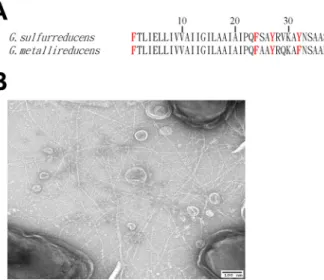
G. metallireducens
PilA
contains two fewer amino acids than the PilA of
G. sulfurreducens
and has a higher
content of aromatic amino acids, with a tyrosine at position 50, a histidine at position
54, and a phenylalanine at position 56, positions where there are nonaromatic amino
acids in the
G. sulfurreducens
PilA (Fig. 1A). In addition, there is a phenylalanine in the
G. metallireducens
PilA at position 32, whereas there is a tyrosine at this position in the
G. sulfurreducens
PilA.
The strain of
G. sulfurreducens
expressing
G. metallireducens
pili was designated
G. sulfurreducens
strain MP (for metallireducens pili). As expected from previous studies
(2, 5, 17, 18), strain MP produced abundant pili (Fig. 1B).
G. sulfurreducens
requires conductive pili in order to produce high current densities.
Strain MP produced current densities (Fig. 2A) comparable to the previously reported
(2) current densities generated under similar conditions for a control strain expressing
the
G. sulfurreducens
wild-type PilA gene. The high current densities were associated
FIG 1 Geobacter metallireducenspili. (A) Alignment of PilA amino acid sequences ofGeobacter sulfurre-ducens and Geobacter metallireducens. The aromatic amino acids (F, phenylalanine; H, histidine; Y, tyrosine) are marked in red. (B) Transmission electron micrograph of G. sulfurreducensstrain MP expressing abundantG. metallireducenspili.with thick biofilms, with a staining response suggesting that the cells were viable
throughout (Fig. 2B). This result is consistent with the need for metabolically active cells
at a distance from the anode to contribute electrons to the anode in order to produce
high current densities, and this is only possible when there is long-range electron
transport through the biofilms.
G. sulfurreducens
also requires conductive pili for Fe(III) oxide reduction (2, 6, 17, 18).
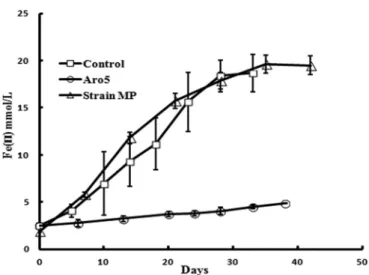
Strain MP reduced Fe(III) oxide at rates comparable to that of the control strain (Fig. 3).
Pilus conductivity.
Individual pili bridging the nonconductive gap between
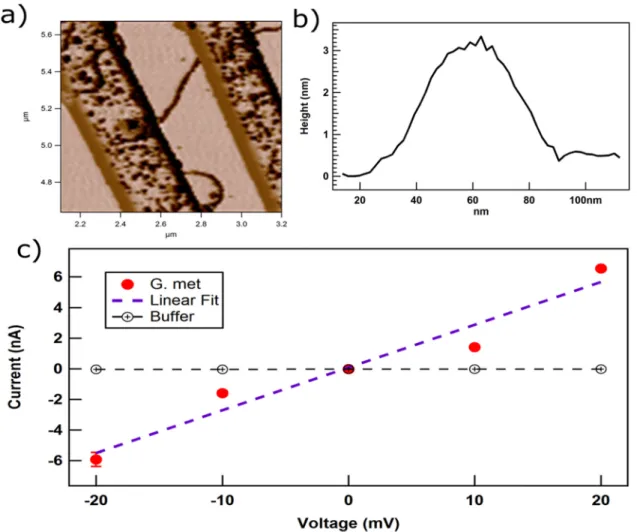
elec-trodes on an electrode array (Fig. 4A) had a height of 3 nm (Fig. 4B). This diameter is
comparable to that of the e-pili of
G. sulfurreducens
(3). Conductivity was determined at
pH 7 for physiological relevance. The individual pili had a linear ohmic response to
current over a small, physiologically relevant voltage span (Fig. 4C). The relatively high
currents (nanoamperes) through the pili necessitated that conductivity be evaluated
over a lower voltage range than in previous studies (3) to avoid damaging the sample.
The conductivity of the pili was 277
⫾
18.9 S/cm (mean
⫾
standard deviation for three
pili).
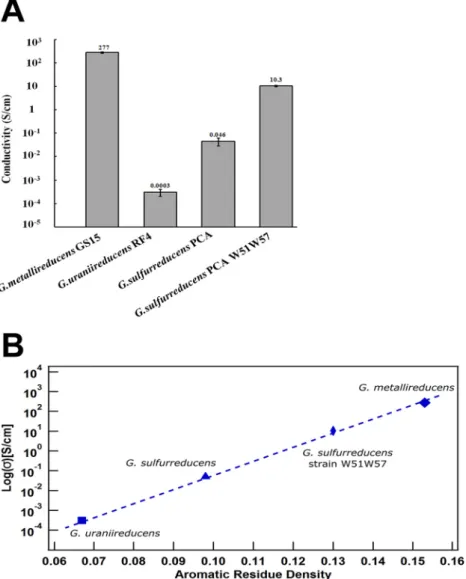
The conductivity of the
G. metallireducdens
pili at pH 7 was 5,000-fold higher than
the conductivity of
G. sulfurreducens
pili prepared under similar conditions and nearly
1 million-fold higher than the conductivity of
G. uraniireducens
pili (Fig. 5A). It was also
higher than the previously reported (5) conductivity of a synthetic pilus in which a
phenylalanine and a tyrosine in the
G. sulfurreducens
PilA were replaced with
trypto-phan (Fig. 5A). Chemical treatments of pili, such as preparing them at pH 2, can
dramatically increase their conductivity (3), but even at pH 7 the pili of
G.
metalliredu-cens
are more conductive than the
G. sulfurreducens
pili prepared at pH 2 (0.2 S/cm) and
nearly as high as the conductivity of synthetic pili (391 S/cm) at pH 2. Estimates of
conductivity along the length of
G. sulfurreducens
pili prepared in solvents and dried (4)
were somewhat higher (2.85 S/cm) than the estimate for
G. sulfurreducens
obtained
without such harsh chemical conditions (Fig. 5A) but were still orders of magnitude
lower than the conductivity of the
G. metallireducens
pili.
Rhodopseudomonas palustris
filaments of unknown composition that are thought to be involved in extracellular
electron transfer (30) had much lower conductivities (0.053 S/cm), but these filaments
were also chemically fixed and dried, which may have affected their conductivity.
Implications.
These results demonstrated a remarkable nearly million-fold range in
the conductivity of pili within
Geobacter
species and suggest that the density of
aromatic rings in the pilus structure is a key factor in determining pilus conductivity.
FIG 3 Fe(III) oxide reduction byG. sulfurreducensstrain MP and previously reported (2) rates of Fe(III) oxide reduction for strain Aro-5, which produces poorly conductive pili, and the control strain ofG. sulfurreducens expressing the wild-typeG. sulfurreducens sequence. Results are the means and standard deviations of triplicate determinations.
These findings provide a basis for predicting the conductivity of other pili and for
the design of synthetic pili with even higher conductivity. The high conductivity of the
G. metallireducens
e-pili suggests that they may be an attractive material for the
construction of conductive materials, electronic devices, and sensors that may be
developed with e-pili.
Previous studies have demonstrated that aromatic amino acids contribute to the
conductivity of
G. sulfurreducens
pili (1–5, 13). The substantially higher conductivity of
the
G. metallireducens
pili is consistent with this concept. There is a clear relationship
between the conductivity along the length of individual pili estimated with the same
method and the density of aromatic rings in the pili (Fig. 5B). The additional aromatic
amino acids may provide more or better paths for electron transport. The
conductivity-aromaticity relationship suggests that the design of synthetic e-pili with even more
aromatic amino acids could yield an even better conducting material. It is also possible
that nature has already produced e-pili that are more aromatic amino acid dense than
G. metallireducens
pili. Thus, further prospecting for e-pili in the microbial world is
warranted.
The physiological advantage, if any, to
G. metallireducens
of expressing e-pili that are
more conductive than those of
G. sulfurreducens
is not yet clear. It has been estimated
that
G. sulfurreducens
pili are sufficiently conductive that just two e-pili could
accom-modate maximum rates of extracellular electron transfer to Fe(III) oxides, and cells
typically produce more than 20 e-pili (17). Therefore, it is not surprising that expression
of
G. metallireducens
e-pili in
G. sulfurreducens
did not yield a strain that reduced Fe(III)
oxide faster than the control strain constructed in the same manner but expressing the
wild-type
G. sulfurreducens
pili. However, there is a minimum e-pili conductivity that is
required for long-range electron transport to Fe(III) oxides, as evidenced by the fact that
G. sulfurreducens
did not effectively reduce Fe(III) oxides when expressing poorly
conductive pili from
G. urannireducens
(17),
Pseudomonas aeruginosa
(18), or
synthet-ically designed pili (2).
It also appears that increasing the conductivity of e-pili beyond some minimum
threshold does not increase the capacity for current production. Neither
G.
metallire-ducens
(20) nor the
G. sulfurreducens
MP strain (this study) produced higher current
densities than
G. sulfurreducens
expressing the wild-type PilA. However, some e-pili
conductivity is required for high current densities, as evidenced by the fact that
G. sulfurreducens
expressing poorly conductive pili (2, 17, 18) or no pili (9, 31) produces
low current densities.
It is possible that higher pili conductivities could be beneficial for DIET. For example,
a more conductive electrical connection between electron-donating
Geobacter
species
and electron-accepting methanogens (25, 26) could facilitate the delivery of electrons
at potentials low enough to support methanogenesis. Detailed studies on the role of
pili conductivity in DIET are under way.
FIG 5 Comparison of pili conductivities. (A) Comparison of the conductivity ofG. metallireducenspili (this study), wild-typeG. sulfurreducenspili (3),G. uraniireducenspili (17), and synthetic pili W51W57 expressed in
G. sulfurreducens(5). (B) Relationship between conductivity along the length of unfixed individual pili at pH 7 versus aromatic density (number of aromatic rings in PilA divided by the total number of amino acids in PilA).
MATERIALS AND METHODS
Bacterial strains, plasmids, and culture conditions.All bacterial strains and plasmids used in this study are summarized in Table S1 in the supplemental material.G. sulfurreducenswas routinely cultured at 30°C under strict anaerobic conditions (80/20 N2/CO2) in mineral-based medium containing acetate (15 mM) as the electron donor and fumarate (40 mM) as the electron acceptor, as previously described (32). Chemically competent Escherichia coliTOP10 cells (Invitrogen, Grand Island, NY) were used for cloning and were cultured at 37°C in Luria-Bertani medium. The appropriate antibiotic was added to cultures when necessary for selection.
Construction ofG. sulfurreducensstrain MP.Strain MP was constructed fromG. sulfurreducensby using a previously described approach for the expression of heterologous PilA genes (2). Three DNA fragments were generated independently by PCR with the primers designated in Table S2. Primer pair GspilAf/GsmpilAr amplified the promoter region of theG. sulfurreducens pilAgene, with pPLT174 (2) serving as the template for the generation of fragment 1. For the generation of fragment 2, primer pair GmpilAf/ GmpilAr amplified pilA-N (locus tag Gmet_1399) and pilA-C (locus tag Gmet_1400) with
G. metallireducensGS15 genomic DNA as the template. In addition, primer pair GmpilACf/GspilACr amplified 500 bp downstream of thepilAgene, usingG. sulfurreducensstrain PCA genomic DNA as the template for the generation of fragment 3. Three independent fragments for strain MP were combined via recombinant PCR with primer pair GspilAf/GspilACr as previously described (18).
Plasmid pYT-1 was constructed as follows. One fragment containing the 3=part of GSU1495 and a gentamicin resistance gene was amplified from pPLT173 with the primer pair Gen-F and upstream-Gen-R. The fragment was digested with SalI and BspHI (New England Biolabs), and the generated fragment was ligated with pACYC184 digested by the SalI and BspHI enzymes. The recombinant PCR products for strain MP were digested with XhoI and ApaI and ligated with pYT-1 digested by XhoI and ApaI. The generated pYT-1-MP was linearized with ScaI (New England Biolabs) and electroporated into strain PCA competent cells (32). The transformant selection and verification were performed as previously described (18).
Current production and Fe(III) oxide reduction.Current production was determined as previously described (31) in flowthrough, two-chambered H-cell systems with acetate (10 mM) as the electron donor, and graphite stick anodes (65 cm2) poised at 300 mV versus Ag/AgCl as the electron acceptor. For Fe(III) oxide reduction studies, poorly crystallized Fe(III) oxide (100 mmol/l) served as the sole electron acceptor, and Fe(II) production was measured with a ferrozine assay (2).
Pili preparation. Biofilms were gently scraped from the graphite anode surface with a plastic spatula, and isotonic wash buffer (20.02 mM morpholinepropanesulfonic acid, 4.35 mM NaH2PO4· H2O, 1.34 mM KCl, 85.56 mM NaCl, 1.22 mM MgSO4· 7H2O, and 0.07 mM CaCl2· 2H2O). The cells were collected by centrifugation and resuspended in 150 mM ethanolamine buffer (pH 10.5). The pili were sheared from the cells in a Waring blender at low speed for 1 min. Cells were removed by centrifugation at 13,000⫻
g. The pili in the supernatant were precipitated with 10% ammonium sulfate overnight, followed by centrifugation at 13,000 ⫻ g (33). The precipitate was resuspended in ethanolamine buffer, and additional debris were removed with centrifugation at 23,000⫻g(33). The pili were collected with a second 10% ammonium sulfate precipitation and subsequent centrifugation at 13,000⫻g. The final pili preparation was resuspended in ethanolamine buffer and stored at 4°C.
Transmission electron microscopy and confocal scanning laser microscopy.Cells were examined with transmission electron microscopy by placing anode-grown cells on 400-mesh carbon-coated copper grids. After 4 min, to facilitate adsorption of cells to the grid, the grids were negatively stained with 2% uranyl acetate. Samples were examined with a JEOL 2000fx transmission electron microscope operated at 200-kV accelerating voltage.
Anode biofilms were imaged with confocal laser scanning microscopy using the LIVE/DEAD BacLight viability stain kit from Molecular Probes (Eugene, OR) as previously described (34).
Pili conductivity measurements.As previously described (3), pili preparations in ethanolamine buffer (2l) were drop casted on a gold electrode array. The pili were allowed to settle for several minutes, and then the residual solution was withdrawn with a micropipette. The pili were washed with deionized water to remove residual ethanolamine buffer, the pH was adjusted to pH 7, and then the samples were gently air dried at room temperature (22°C) for analysis.
Pili were localized on the electrode array by using atomic force microscopy (AFM). Then, the chip containing the electrode array with pili was placed in a double-shielded box for low-current measure-ments (3). The current-voltage (I-V) curve of individual pili was characterized with a Keithley 4200 semiconductor characterization system (SCS) as previously described (3).
Conductivity calculation.Conductivity () was calculated with the equation⫽(G⫻L)/A, where
Gis the conductance value from the linear fit of the current-voltage (I-V) curve andLis the length of the pilus between the electrodes.A(or⫻r2)is the cross-sectional area of the pilus, withrderived from the height profile from the AFM image of the pilus.
SUPPLEMENTAL MATERIAL
Supplemental material for this article may be found at
https://doi.org/10.1128/
mBio.02203-16
.
ACKNOWLEDGMENTS
This research was supported by grant N000141310549 from the Office of Naval
Research. Nikhil S. Malvankar holds a Career Award at the Scientific Interfaces from the
Burroughs Wellcome Fund.
REFERENCES
1. Malvankar NS, Vargas M, Nevin KP, Franks AE, Leang C, Kim BC, Inoue K, Mester T, Covalla SF, Johnson JP, Rotello VM, Tuominen MT, Lovley DR. 2011. Tunable metallic-like conductivity in microbial nanowire networks. Nat Nanotechnol 6:573–579. https://doi.org/10.1038/ nnano.2011.119.
2. Vargas M, Malvankar NS, Tremblay PL, Leang C, Smith JA, Patel P, Snoeyenbos-West O, Synoeyenbos-West O, Nevin KP, Lovley DR. 2013. Aromatic amino acids required for pili conductivity and long-range extracellular electron transport in Geobacter sulfurreducens. mBio 4:e00105-13.https://doi.org/10.1128/mBio.00105-13.
3. Adhikari RY, Malvankar NS, Tuominen MT, Lovley DR. 2016. Conductivity of individual Geobacter pili. RSC Adv 6:8354 – 8357.https://doi.org/ 10.1039/C5RA28092C.
4. Lampa-Pastirk S, Veazey JP, Walsh KA, Feliciano GT, Steidl RJ, Tes-smer SH, Reguera G. 2016. Thermally activated charge transport in microbial protein nanowires. Sci Rep 6:. https://doi.org/10.1038/ srep23517.
5. Tan Y, Adhikari RY, Malvankar NS, Pi S, Ward JE, Woodard TL, Nevin KP, Xia Q, Tuominen MT, Lovley DR. 2016. Synthetic biological protein nanowires with high conductivity. Small 12:4481– 4485.https://doi.org/ 10.1002/smll.201601112.
6. Reguera G, McCarthy KD, Mehta T, Nicoll JS, Tuominen MT, Lovley DR. 2005. Extracellular electron transfer via microbial nanowires. Nature 435:1098 –1101.https://doi.org/10.1038/nature03661.
7. Summers ZM, Fogarty HE, Leang C, Franks AE, Malvankar NS, Lovley DR. 2010. Direct exchange of electrons within aggregates of an evolved syntrophic coculture of anaerobic bacteria. Science 330:1413–1415. https://doi.org/10.1126/science.1196526.
8. Shrestha PM, Rotaru AE, Summers ZM, Shrestha M, Liu F, Lovley DR. 2013. Transcriptomic and genetic analysis of direct interspecies electron transfer. Appl Environ Microbiol 79:2397–2404.https://doi.org/10.1128/ AEM.03837-12.
9. Reguera G, Nevin KP, Nicoll JS, Covalla SF, Woodard TL, Lovley DR. 2006. Biofilm and nanowire production leads to increased current in Geobac-ter sulfurreducens fuel cells. Appl Environ Microbiol 72:7345–7348. https://doi.org/10.1128/AEM.01444-06.
10. Malvankar NS, Tuominen MT, Lovley DR. 2012. Lack of cytochrome involvement in long-range electron transport through conductive bio-films and nanowires of Geobacter sulfurreducens. Energy Environ Sci 5:8651– 8659.https://doi.org/10.1039/c2ee22330a.
11. Lovley DR, Malvankar NS. 2015. Seeing is believing: novel imaging techniques help clarify microbial nanowire structure and function. En-viron Microbiol 17:2209 –2215. https://doi.org/10.1111/1462-2920 .12708.
12. Feliciano GT, Steidl RJ, Reguera G. 2015. Structural and functional in-sights into the conductive pili of Geobacter sulfurreducens revealed in molecular dynamics simulations. Phys Chem Chem Phys 17: 22217–22226.https://doi.org/10.1039/c5cp03432a.
13. Malvankar NS, Vargas M, Nevin K, Tremblay PL, Evans-Lutterodt K, Nykypanchuk D, Martz E, Tuominen MT, Lovley DR. 2015. Structural basis for metallic-like conductivity in microbial nanowires. mBio 6:e00084-15. https://doi.org/10.1128/mBio.00084-15.
14. Xiao K, Malvankar NS, Shu C, Martz E, Lovley DR, Sun X. 2016. Low energy atomic models suggesting a pilus structure that could account for electrical conductivity of Geobacter sulfurreducens Pili. Sci Rep 6:23385. https://doi.org/10.1038/srep23385.
15. Malvankar NS, Yalcin SE, Tuominen MT, Lovley DR. 2014. Visualization of charge propagation along individual pili proteins using ambient elec-trostatic force microscopy. Nat Nanotechnol 9:1012–1017. https:// doi.org/10.1038/nnano.2014.236.
16. Vargas M, Tremblay P-L, Malvankar NS, Leang C, Patel P, Nevin KP, Lovley DR. 2014. Impact of single amino site directed mutagenesis of PilA on extracellular electron transfer in Geobacter sulfurreducens, abstr 2306. Abstr 114th Gen Meet Am Soc Microbiol. ASM, Washington, DC. 17. Tan Y, Adhikari RY, Malvankar NS, Ward JE, Nevin KP, Woodard TL,
Smith JA, Snoeyenbos-West OL, Franks AE, Tuominen MT, Lovley DR. 2016. The low conductivity of Geobacter uraniireducens pili suggests a diversity of extracellular electron transfer mechanisms in the genus Geobacter. Front Microbiol 7:. https://doi.org/10.3389/fmicb.2016 .00980.
18. Liu X, Tremblay PL, Malvankar NS, Nevin KP, Lovley DR, Vargas M. 2014. A Geobacter sulfurreducens strain expressing Pseudomonas aeruginosa type IV pili localizes OmcS on pili but is deficient in Fe(III) oxide reduc-tion and current producreduc-tion. Appl Environ Microbiol 80:1219 –1224. https://doi.org/10.1128/AEM.02938-13.
19. Smith JA, Tremblay PL, Shrestha PM, Snoeyenbos-West OL, Franks AE, Nevin KP, Lovley DR. 2014. Going wireless: Fe(III) oxide reduction with-out pili by Geobacter sulfurreducens strain JS-1. Appl Environ Microbiol 80:4331– 4340.https://doi.org/10.1128/AEM.01122-14.
20. Rotaru AE, Woodard TL, Nevin KP, Lovley DR. 2015. Link between capacity for current production and syntrophic growth in Geobacter species. Front Microbiol 6:744. https://doi.org/10.3389/fmicb.2015 .00744.
21. Malvankar NS, Lovley DR. 2014. Microbial nanowires for bioenergy ap-plications. Curr Opin Biotechnol 27:88 –95. https://doi.org/10.1016/ j.copbio.2013.12.003.
22. Holmes DE, Dang Y, Walker DJF, Lovley DR. 2016. The electrically con-ductive pili of Geobacter species are a recently evolved feature for extracellular electron transfer. Microb Genom 2.https://doi.org/10.1099/ mgen.0.000072.
23. Tremblay PL, Aklujkar M, Leang C, Nevin KP, Lovley D. 2012. A genetic system for Geobacter metallireducens: role of the flagellin and pilin in the reduction of Fe(III) oxide. Environ Microbiol Rep 4:82– 88.https:// doi.org/10.1111/j.1758-2229.2011.00305.x.
24. Smith JA, Lovley DR, Tremblay PL. 2013. Outer cell surface compo-nents essential for Fe(III) oxide reduction by Geobacter metalliredu-cens. Appl Environ Microbiol 79:901–907. https://doi.org/10.1128/ AEM.02954-12.
25. Rotaru A-E, Shrestha PM, Liu F, Shrestha M, Shrestha D, Embree M, Zengler K, Wardman C, Nevina KP, Lovley DR. 2014. A new model for electron flow during anaerobic digestion: direct interspecies electron transfer to Methanosaeta for the reduction of carbon dioxide to meth-ane. Energy Environ Sci 7:408 – 415. https://doi.org/10.1039/ C3EE42189A.
26. Rotaru AE, Shrestha PM, Liu F, Markovaite B, Chen S, Nevin KP, Lovley DR. 2014. Direct interspecies electron transfer between Geobacter metalli-reducens and Methanosarcina barkeri. Appl Environ Microbiol 80: 4599 – 4605.https://doi.org/10.1128/AEM.00895-14.
27. Lovley DR, Stolz JF, Nord GL, Phillips EJP. 1987. Anaerobic production of magnetite by a dissimilatory iron-reducing microorganism. Nature 330: 252–254.https://doi.org/10.1038/330252a0.
28. Lovley DR, Phillips EJ. 1988. Novel mode of microbial energy metabolism: organic carbon oxidation coupled to dissimilatory reduc-tion of iron or manganese. Appl Environ Microbiol 54:1472–1480. 29. Childers SE, Ciufo S, Lovley DR. 2002. Geobacter metallireducens
ac-cesses insoluble Fe(III) oxide by chemotaxis. Nature 416:767–769. https://doi.org/10.1038/416767a.
30. Venkidusamy K, Megharaj M, Schröder U, Karouta F, Mohan SV, Naidu R. 2015. Electron transport through electrically conductive nanofilaments in Rhodopseudomonas palustris strain RP2. RSC Adv 5:100790 –100798. https://doi.org/10.1039/C5RA08742B.
31. Nevin KP, Kim BC, Glaven RH, Johnson JP, Woodard TL, Methé BA, DiDonato RJ, Jr, Covalla SF, Franks AE, Liu A, Lovley DR. 2009. Anode biofilm transcriptomics reveals outer surface components essential for high density current production in Geobacter sulfurreducens fuel cells. PLoS One 4:e5628.https://doi.org/10.1371/journal.pone.0005628. 32. Coppi MV, Leang C, Sandler SJ, Lovley DR. 2001. Development of a genetic system for Geobacter sulfurreducens. Appl Environ Microbiol 67:3180 –3187.https://doi.org/10.1128/AEM.67.7.3180-3187.2001.
33. Brinton C, Bryan J, Dillon J, Guerina N, Jacobson L, Labik A, Lee S, Levine A, Lim S, McMichael J. 1978. Uses of pili in gonorrhea control: role of bacterial pili in disease, purification and properties of gonococcal pili, and progress in the development of a gonococcal pilus vaccine for gonorrhea, p 155–178.InBrooks GF (ed), Immunobiology of Neisseria gonorrhoeae: proceedings of a conference held in San Francisco,
Cali-fornia, 18 –20 January 1978. American Society for Microbiology, Wash-ington, DC.