Metabolic diseases and CVDs are caused by the effects and interactions of multiple genetic variants and lifestyle/ environmental factors. Obesity, T2D, and coronary artery disease (CAD) are currently important causes of morbidity and mortality worldwide. Therefore, understanding the etiology and pathophysiology of these diseases is of great interest.
Genome-wide association studies (GWASs) have sub-stantially increased our knowledge about the genetic basis of metabolic diseases and CVDs. Advances in next-genera-tion sequencing techniques have made it possible to ac-cumulate detailed genetic information at the level of the exome and genome. By contrast, the development in phe-notyping has been considerably slower in recent years. Deep phenotyping of large randomly selected population-based studies is crucial for the success of genetic studies. Especially before the era of GWASs, population samples tended to be too small and poorly phenotyped with re-spect to clinical traits and laboratory measurements.
The Finnish population is a homogeneous isolate that has experienced a bottleneck in the 16th century in the settlement of Eastern Finland. A recent study demon-strated that Finns carry a significant enrichment of low fre-quency (1–5%) (1) and loss-of-function variants (frefre-quency 0.5–5%) compared with other European and Asian popu-lations (2). This offers advantages for studying rare variants in complex diseases. Distribution of common alleles in Finns, both synonymous and nonsynonymous, is unchanged by Abstract The Metabolic Syndrome in Men (METSIM) study
is a population-based study including 10,197 Finnish men ex-amined in 2005–2010. The aim of the study is to investigate nongenetic and genetic factors associated with the risk of T2D and CVD, and with cardiovascular risk factors. The protocol includes a detailed phenotyping of the participants, an oral glu-cose tolerance test, fasting laboratory measurements including proton NMR measurements, mass spectometry metabolomics, adipose tissue biopsies from 1,400 participants, and a stool sample. In our ongoing follow-up study, we have, to date, reex-amined 6,496 participants. Extensive genotyping and exome sequencing have been performed for essentially all METSIM participants, and >2,000 METSIM participants have been whole-genome sequenced. We have identified several nonge-netic markers associated with the development of diabetes and cardiovascular events, and participated in several genetic as-sociation studies to identify gene variants associated with dia-betes, hyperglycemia, and cardiovascular risk factors. The generation of a phenotype and genotype resource in the MET-SIM study allows us to proceed toward a “systems genetics” approach, which includes statistical methods to quantitate and integrate intermediate phenotypes, such as transcript, protein, or metabolite levels, to provide a global view of the molecular architecture of complex traits.—Laakso, M., J. Kuusisto, A. Stančáková, T. Kuulasmaa, P. Pajukanta, A. J. Lusis, F. S. Collins, K. L. Mohlke, and M. Boehnke. The Metabolic Syndrome in Men study: a resource for studies of metabolic and cardiovas-cular diseases. J. Lipid Res. 2017. 58: 481–493.
Supplementary key words type 2 diabetes • cardiovascular risk factors • metabolic disease • coronary artery disease • METSIM
The studies included in this work were funded by grants from the National Insti-tutes of Health, the Academy of Finland, the University of Eastern Finland, the Juselius Foundation, the Finnish Diabetes Research Foundation, and the Finnish Foundation for Cardiovascular Research. The content is solely the responsibility of the authors and does not necessarily represent the official views of the National Institutes of Health.
Manuscript received 11 October 2016 and in revised form 15 January 2017. Published, JLR Papers in Press, January 24, 2017
DOI 10.1194/jlr.O072629
The Metabolic Syndrome in Men study: a resource for
studies of metabolic and cardiovascular diseases
Markku Laakso,1,*,† Johanna Kuusisto,*,† Alena Stančáková,* Teemu Kuulasmaa,* Päivi Pajukanta,§,†† Aldons J. Lusis,§,** Francis S. Collins,§§ Karen L. Mohlke,*** and Michael Boehnke†††
Institute of Clinical Medicine,* Internal Medicine, University of Eastern Finland, Kuopio, Finland;
Department of Medicine,† Kuopio University Hospital, Kuopio, Finland; Departments of Human Genetics§ and Medicine,** David Geffen School of Medicine at University of California, Los Angeles, Los Angeles, CA; Molecular Biology Institute,†† University of California, Los Angeles, Los Angeles, CA; National Human Genome Research Institute,§§ National Institutes of Health, Bethesda, MD; Department of Genetics,***
University of North Carolina, Chapel Hill, NC; and Department of Biostatistics and Center for Statistical
Genetics,††† University of Michigan, Ann Arbor, MI
Abbreviations: ALT, alanine aminotransferase; CAD, coronary ar
-tery disease; eQTL, expression quantitative trait locus; GCKR,
glucoki-nase regulatory protein gene; GLP1R, glucagon-like peptide-1 receptor; GWAS, genome-wide association study; HMDP, Hybrid Mouse Diversity Panel; IL-1RA, interleukin 1 receptor antagonist; METSIM, Metabolic Syndrome in Men; miRNA, microRNA; NASH, nonalcoholic steatohep
-atitis; OGTT, oral glucose tolerance test.
1 To whom correspondence should be addressed.
e-mail: [email protected]
the bottleneck and, consequently, genetic association stud-ies have reported similar associations of common variants with clinical and laboratory traits in Finns as in other
Euro-pean populations, as presented in this review. However, a
strong influence of the bottleneck, particularly the propor-tional enrichment of rare deleterious variants, is also influ-enced by the unique history of the Finnish population and will not necessarily apply to all populations influenced by a bottleneck (2).
There are benefits to carrying out population-based epi-demiological studies among Finns. The participation rate in these studies has been high (60–80%) during recent de-cades. Additionally, access to electronic nationwide health records (hospital discharge, mortality, cancer, and drug reimbursement registries) in Finland makes it possible to follow-up essentially all participants of any population-based study with respect to morbidity, mortality, and drug treatment of different diseases. Given this ideal setting to investigate nongenetic and genetic factors influencing the risk of different chronic diseases in Finns, we initiated the
Metabolic Syndrome in Men (METSIM) study in 2005.
METSIM STUDY
Cross-sectional study
The METSIM study includes 10,197 men, aged from 45
to 73 years at entry, randomly selected from the population register of the Kuopio town, Eastern Finland, and exam-ined in 2005–2010 (3). The aim of the study is to investi-gate nongenetic and genetic factors associated with T2D and CVD, and with cardiovascular risk factors in both
cross-sectional and longitudinal settings. The METSIM study
protocol includes, e.g., collection of data on drug treat-ment, CVD risk factors [smoking, exercise, diet, history of chronic diseases (including CAD, stroke, cardiac fail-ure, medication, history of diabetes or early onset CAD in
the family)], a questionnaire on the FINDRISC score (4),
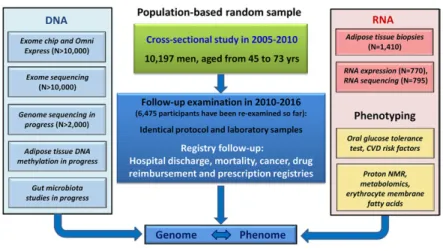
and measurement of height, weight, waist, hip, blood pres-sure, and fat percentage. Figure 1 presents the METSIM
cross-sectional and follow-up study designs, including deep
phenotyping and extensive DNA- and RNA-based genetic
studies. Table 1 lists the diseases and traits investigated in
the METSIM study, including nongenetic markers and ge -netics of the corresponding diseases/traits.
Laboratory studies include the following measurements obtained after a minimum of 10 h fasting: lipids, lipopro-teins, apolipoprolipopro-teins, adiponectin, bilirubin, alanine ami-notransferase (ALT), bile acids, high sensitivity C-reactive
protein, interleukin 1 receptor antagonist (IL-1RA), inter -leukin 1, HbA1c, mass spectrometry metabolomics (Me
-tabolon, Durham, NC), and proton NMR measurements
(lipids and lipoproteins, amino acids, fatty acids of differ-ent lengths, and other low molecular weight metabolites). Additionally, an oral glucose tolerance test (OGTT) is per-formed to evaluate glucose tolerance (samples for glucose, insulin, proinsulin, and free fatty acids measured at 0, 30, and 120 minutes) (5). We also obtained subcutaneous
adi-pose tissue samples from 1,410 participants. We assessed
insulin sensitivity and insulin secretion using markers that we validated in a separate sample of 287 nondiabetic Finn-ish individuals from the region of Kuopio. We validated our insulin secretion markers against measures from the intravenous glucose tolerance test, and insulin sensitivity markers against the gold standard method to evaluate insu-lin sensitivity, the euglycemic-hyperinsuinsu-linemic clamp (6).
Follow-up study
The protocol of 5 year follow-up study is identical to that of the cross-sectional study. To date, we have reexamined
6,496 participants (participation rate 64%) and identified 693 new cases of T2D (a total of 2,106 incident and preva -lent cases). The follow-up study will be finished in 2017. Diagnoses of myocardial infarction, stroke, and peripheral vascular disease (amputations) are verified from medical records against internationally accepted criteria for these diseases (7, 8). We also collect data from medical records on coronary angiograms, balloon angioplasty, by-pass cor-onary artery surgery, heart failure, and diabetic micro-vascular (retinopathy, nephropathy) and macromicro-vascular complications. Participants signed a consent that allows us
Fig. 1. Description of the cross-sectional and
longi-tudinal METSIM study. The cross-sectional study in
-cluded 10,197 Finnish men, aged from 45 to 73 years.
Phenotyping included several laboratory
measure-ments in fasting, an OGTT, and proton NMR measure
-ments from all participants. DNA-based genotyping
includes OmniExpress for common and exome chip for low-frequency and rare variants, exome and
ge-nome sequencing, DNA methylation analysis in adi -pose tissue, and gut microbiome sequencing. Adi-pose
tissue biopsies have been taken from 1,410 partici
-pants, RNA sequencing performed for 795 partici
-pants and RNA expression determined for 770
participants. The protocol of the follow-up study is
identical to the cross-sectional study, and so far 6,496
to use several Finnish registries: hospital discharge registry (includes all diagnoses of hospital admission), drug reim-bursement and prescription registry (includes informa-tion on drug therapy for major chronic diseases, including diabetes, CAD, hypercholesterolemia, etc.), cancer regis-try, and mortality registry. Therefore, the coverage of the follow-up data of the participants is nearly 100% with re-spect to diagnoses of different diseases.
Genotyping, mRNA expression, and RNA sequencing
OmniExpress (Illumina) genotyping, exome chip (Illu -mina) genotyping genotyping, and exome sequencing have
been performed for essentially all METSIM participants (9), and >2,000 METSIM participants have been whole-genome sequenced. Subcutaneous adipose tissue mRNA expression (Affymetrix) and RNA sequencing have been performed for 770 and 795 METSIM participants, respectively (10).
Ethics approval
The Ethics Committee of the University of Eastern Fin
-land and Kuopio University Hospital approved the MET
-SIM study, and this study was conducted in accordance with the Declaration of Helsinki. All study participants gave
written informed consent.
Limitations of the METSIM study
The METSIM cohort includes only Finnish men. There
-fore, the results reported in the METSIM participants need
to be replicated in women and in other ethnic groups. The rationale to include only men was that in the age group
from 45 to 73 years, the prevalence and incidence of T2D
and CAD are higher in Finnish men than in Finnish women.
NON-GENETIC BIOMARKERS
T2D and hyperglycemia
A major interest in our studies based on the METSIM co -hort has been to investigate the predictors for the develop-ment of hyperglycemia and the conversion to T2D. T2D is
often preceded by a long period of prediabetes, character-ized by insulin resistance and elevation of fasting (impaired fasting glucose) or 2 h glucose (impaired glucose tolerance) in an OGTT (11). Conversion to diabetes happens when the pancreas is no longer able to increase insulin secretion in a manner sufficient to compensate for insulin resistance in pe-ripheral insulin-sensitive tissues. Characteristic findings of individuals with prediabetes and T2D are impaired insulin
secretion and insulin resistance. Insulin resistance also plays
a major role in the development of CVD (11).
We have identified several biomarkers as predictors for T2D and hyperglycemia (Table 2). We demonstrated that branch-chain amino acids (leucine, isoleucine) and aromatic amino acids (phenylalanine, tyrosine) were associated with increased risk of T2D and hyperglycemia, whereas glutamine was associated with decreased risk of T2D and hyperglycemia (12), confirming previous findings (13). Adjustment for in-sulin sensitivity abolished the significance of these associa-tions, demonstrating for the first time in a longitudinal setting that insulin resistance is a major mechanism by which amino acids increase the risk of T2D (12). We also demon-strated for the first time that ketone bodies predict the
conversion to T2D by impairing insulin secretion (14). Non -cholesterol sterols (desmosterol, avenasterol) (15), glycerol, free fatty acids, and monounsaturated and saturated fatty ac-ids predicted incident T2D (16). Palmitoleic acid increased and linoleic acid measured from plasma (17) or erythrocyte
membranes (18) decreased the risk of T2D. High proinsulin level (19) and apolipoprotein/lipoprotein ratios (20) also
predicted the conversion to T2D.
Summary point. Identification of biomarkers predicting
the conversion to T2D is of great importance, especially for the prevention of diabetes. We, and others, have identified several nongenetic biomarkers (amino acids, ketone bod-ies, noncholesterol sterols, fatty acids) associated with the risk of T2D that improve the prediction for the conversion to diabetes beyond and above the classical risk factors for this disease (obesity, age, family history of diabetes, etc.). These findings need to be replicated in other ethnic groups and in women.
Nonalcoholic steatohepatitis
Non-alcoholic fatty liver disease is rapidly becoming the
most common cause of liver disease, characterized by he-patic lipid accumulation contributing to insulin resistance,
T2D, and hyperlipidemia. It can lead to nonalcoholic ste
-atohepatitis (NASH) and liver cirrhosis, and ultimately to
liver failure (21). Pathophysiological mechanisms leading
to NASH have remained unclear, and noninvasive diagno
-sis of NASH is challenging. Therefore, finding simple labo
-ratory markers for NASH is important. We hypothesized that increased IL-1RA serum levels in subjects with a high
ALT level reflect increased inflammation in the liver.
Indeed, we found that IL-1RA levels were associated with
liver inflammation and ALT, independent of obesity,
alco-hol consumption, and insulin resistance in the METSIM study. Moreover, we found that liver expression of IL1RN, a gene encoding IL1-RA, correlated with liver steatosis and
TABLE 1. Diseases and traits investigated in the METSIM study
Disease or Traita MeasurementsNon-genetic Genetic Association Studies
T2D (3) Yes Yes
Fasting or 2 h glucose Yes Yes
Glycated hemoglobin A1c Yes Yes
Insulin processing or insulin
secretion Yes Yes
Insulin resistance Yes Yes
NASH Yes No
Height Yes Yes
BMI Yes Yes
Adiposity and fat distribution Yes Yes
Fat mass Yes Yes
Metabolic syndrome Yes Yes
Adiponectin Yes Yes
Dyslipidemia Yes Yes
Blood pressure Yes Yes
CAD (7, 8) Yes Yes
CVD (7, 8) Yes Yes
inflammation. Thus, increased IL1-RA levels in individuals with NASH could be directly linked to liver disease. Our findings suggest that IL-1RA is an important noninvasive inflammatory marker for NASH (22).
Dysregulation of the cholesterol synthesis pathway and accumulation of cholesterol in the liver play an important
role in the pathogenesis of NASH. We measured serum
and liver levels of three cholesterol precursor sterols (cholestenol, desmosterol, lathosterol) as serum surrogate markers of cholesterol synthesis in 110 obese individuals with detailed liver histology. We found that desmosterol in
serum and liver associated with NASH. These results sug -gest that serum desmosterol is a marker of disturbed cho-lesterol metabolism in the liver and a potential biomarker
for NASH (23).
Summary point. NASH can be diagnosed accurately only
by liver biopsy. Therefore, several laboratory measure-ments have been proposed as surrogate biomarkers, but no
consensus about the best biomarker for NASH has been reached. IL-1RA and desmosterol as potential biomarkers for NASH need further validation studies.
GENETICS OF T2D, HYPERGLYCEMIA, INSULIN SECRETION, AND INSULIN RESISTANCE
T2D
GWASs. The first replicated gene variant associated with T2D was the Pro12Ala amino acid substitution in the
PPARG gene (24, 25). Interestingly, we demonstrated, using
a Pro12Ala knock-in model, that, on chow diet, the Ala12Ala mice were leaner, had increased insulin sensitivity, and
lon-ger lifespans. High-fat feeding eliminated the beneficial
effects of the Pro12Ala variant on adiposity and insulin sen-sitivity, demonstrating strong gene-environment interac-tions for this variant (26). Since 2007, GWASs and sequenc-ing studies have provided new insights into the genetic basis
of T2D, and currently about 90 loci for T2D and over 80 loci
for glycemic traits have been published (27). The METSIM
study has been an important European cohort in the iden-tification and replication of several loci for T2D and for studies aiming to define causal mechanisms at the T2D
sus-ceptibility loci (28–34). However, these studies in aggregate
explain only about 10–15% of the heritability of T2D.
Protective gene variants. The METSIM study has been a
part of three studies reporting protective gene variants for T2D. A study that combined sequence and genotype data on 150,000 individuals across five ancestry groups showed that two protein-truncating variants of SLC30A8 (p.Arg138* and p.Lys34Serfs*50) encoding zinc ZnT8 transport pro -teins are associated with T2D protection, suggesting that
ZnT8 inhibition could be a therapeutic strategy in T2D pre -vention (35). Similarly, by whole-genome sequencing of
2,630 Icelanders, a low-frequency (1.5%) variant in intron 1
of CCND2 was found that reduced the risk of T2D by half
(36). This finding was replicated in 29,956 individuals, in
-cluding the participants of the METSIM cohort (37). A re -cent exome sequencing study reported that a low-frequency missense variant in the gene encoding glucagon-like pep-tide-1 receptor (GLP1R), the target of GLP1R agonists, was associated with decreased fasting glucose levels and the risk of T2D, consistent with GLP1R agonist therapies (38).
Low frequency variants. The most recent study evaluated how much low-frequency variants (0.005 < minor allele fre-quency < 0.05) explain of the heritability of T2D. This study included whole-genome sequencing data from 2,657 European individuals with and without diabetes, and
exome sequencing data from 12,940 individuals from five ancestry groups, including the METSIM cohort. This study
did not support the notion that low-frequency variants
ex-plain a substantial portion of T2D heritability (39).
Hyperglycemia. Several studies, including the METSIM cohort, have shown that common (40–43) and low-fre
-quency/rare variants assayed by the exome array (44, 45)
are associated with fasting or 2 h glucose concentrations
TABLE 2. Association of different metabolites and laboratory measurements with T2D and hyperglycemia in the
prospective METSIM study
Marker T2D Hyperglycemia
Amino acids (11) Alanine↑, leucine↑, isoleucine↑, tyrosine↑, phenylalanine↑, glutamine↓
NA
Ketone bodies (13) Acetoacetate↑, -hydoxybutyrate↑ Acetoacetate↑
Non-cholesterol sterols (14) Desmosterol↑, campesterol↓,
avenasterol↑ Desmosterolavenasterol↑↑, campesterol↓,
Glycerol, FAs (proton NMR) (15) Glycerol↑, free FAs↑, n-3 FAs↓, n-6 FAs↓, monounsaturated FAs↑,
saturated n-7 and n-9 FAs↑
Glycerol↑, free FFAs↑, n-6 FAs↓, monounsaturated FAs↑, saturated
n-7 and n-9 FAs↑
Plasma FAs in phospholipids, cholesteryl esters, and triglyceride fractions (16)
Dihomo--linoleic acid↑ Saturated FAs↑, palmitoleic acid↑, dihomo--linolenic acid↑, linoleic acid↓
Erythrocyte membrane FAs (17) Palmitoleic acid↑, linoleic acid↓ Palmitoleic acid↑, linoleic acid↓
Proinsulin (18) Fasting and glucose-stimulated
proinsulin↑ Fasting and glucose-stimulated proinsulin↑
Lipoproteins and
apolipoproteins (19) ApoB/LDL cholesterol ratioApoA1/HDL cholesterol ratio↑, ↑ ApoB/LDL cholesterol ratioApoA1/HDL cholesterol ratio↑, ↑
(46, 47). Moreover, not all of 80 loci identified for hyper -glycemia are risk loci for the conversion to T2D. The
MET-SIM cohort has also been a part of the studies reporting common variants for glycated hemoglobin levels (48).
Summary point. GWASs and exome and genome
sequenc-ing have identified close to 200 gene variants associated with T2D and hyperglycemia. Larger sample sizes of population studies will increase the number of gene variants even fur-ther, but genetic variants do not explain the epidemic of T2D observed today worldwide. Environmental and lifestyle fac-tors and their interaction with genetic variants are the key to understanding the etiology and pathophysiology of T2D. Lifestyle factors also modify gene expression and methylation
of DNA, which are likely to play an important role in the risk
of T2D and other chronic diseases.
Insulin secretion and insulin resistance
Common variants. Most of the common variants known
to be associated with the risk of T2D affect insulin process-ing and insulin secretion and only a few affect insulin
sen-sitivity (49–51). The METSIM cohort was important for this
collaborative work given the large size of our cohort, as well as validated markers for insulin secretion and insulin
sensi-tivity (52). Three studies, including the METSIM cohort,
have searched for variants regulating insulin resistance
(53–55). A common variant, rs11603334, was associated with T2D and proinsulin levels in the METSIM study. The
T2D-risk allele increased transcriptional activity and was as-sociated with increased ARAP1 expression in a small sam-ple of human pancreatic islets, suggesting that increased
ARAP1 expression may contribute to T2D susceptibility
(56), although the T2D-risk allele at this locus is also associ-ated with decreased STARD10 expression in larger studies of human pancreatic islets (57).
Low frequency and rare variants. We were the first to re-port exome array results for insulin processing and
secre-tion (9). We identified low-frequency coding variants
associated with fasting proinsulin concentrations at the
SGSM2 and MADD GWAS loci, and three new genes with
low-frequency variants associated with fasting proinsulin or insulinogenic index (TBC1D30, KANK1, PAM) in 8,229 nondiabetic participants of the METSIM study. Of these
genes, SGSM2, MADD, TBC1D30, and KANK1 regulate or function in G-protein signaling (Fig. 2). Our study demon-strated that, by exome array, it is possible to identify low-frequency variants that contribute to complex traits.
Summary point. Genetic studies have given important information about the etiology and pathophysiology of
T2D. It is now clear that the most important pathophysio -logical mechanism leading to T2D is impaired insulin secretion, largely attributable to multiple gene variants regulating insulin secretion. By contrast, only a few gene variants regulating insulin sensitivity have been found, sug-gesting that insulin resistance is more likely to be an ac-quired trait (obesity, lack of exercise, unhealthy diet) than an inherited trait.
FINDING NEW FUNCTIONS FOR COMMON GENE VARIANTS ASSOCIATED WITH DIFFERENT
CLINICAL AND LABORATORY MEASUREMENTS
In recent years, genetic studies have become much
larger and technologies developed to identify low fre-quency and rare gene variants across the whole exome and genome have made it possible to identify causal variants for
different diseases and traits. Understanding the biology be -hind genetic association is, however, the key for the under-standing of the pathophysiology of different diseases. T2D is a good example of the problem of imprecise phenotypes because the pathophysiology of this disease involves several tissues, including pancreas, liver, skeletal muscle, fat, and brain. Phenotyping that goes beyond what is typically re-corded in medical records or routine laboratory measure-ment is needed to dissect out mechanisms behind diseases of interest (58). Such “deep phenotyping” is possible in small clinical and family studies. The authors of a recent study performed detailed physiological (euglycemic clamp, insulin secretion) and in vitro characterization (insulin sig-naling in adipose tissue and skeletal muscle) in a limited number of carriers of the PTEN mutation (59). They were
able to show that mutation carriers had decreased risk of
T2D owing to enhanced insulin sensitivity (59).
Deep phenotyping is more challenging in large popula-tion-based studies for several reasons. First, deep pheno-typing is expensive and time consuming. Second, large Fig. 2. Roles of described genes in G protein signaling [small G pro-tein signaling modulator 2 (SGSM2), MAP kinase activating death do-main (MADD), TBC1 domain family member 30 (TBC1D30), and KN
motif and ankyrin repeat domains 1 (KANK1)] have been shown to regulate or function in G protein signaling. GTP-binding proteins (G proteins) are characterized by their ability to bind and hydrolyze GTP and include members of Rab, Rac, Rho, Rap, and other families. G proteins are active when bound to GTP, but inactive when bound to GDP. Guanine nucleotide exchange factors (GEFs) catalyze the disso-ciation of GDP and the binding of GTP, thus promoting to active G protein state. When bound to GTP, G proteins remain active briefly and can activate G proteins by promoting GTP hydrolysis and a return
population-based cohorts have been collected several years ago when the significance of deep phenotyping in studies aiming to identify genes for complex diseases was not deemed practical. Third, deep phenotyping is successful only if study participants are willing to undertake time-con-suming protocols (e.g., biopsies from tissues of interest, metabolic studies lasting for hours).
Deep phenotyping offers many advantages for genetic studies, and it could improve, for example, the classification
of a disease of interest into the subtypes. In the majority of
cases, T2D occurs especially in obese individuals who are typi-cally insulin resistant, but this disease can also occur in nor-mal weight individuals whose primary defect in glucose metabolism is impaired insulin secretion. Large sample sizes are needed to obtain statistically significant association of gene variants with T2D, a heterogenous disease defined by fasting and 2 h glucose concentrations. Deep phenotyping at the tissue, metabolite, and pathway levels related to the pathophysiology of T2D is likely to improve the understand-ing of the function of gene variants associated with T2D, and has the potential to reduce, to some extent, the sample sizes
required to detect association. In the METSIM study, we have applied deep phenotyping, including proton NMR spectros -copy, to measure several metabolites for association studies with T2D risk gene variants. We found that the
glucose-in-creasing alleles of rs780094 in glucokinase regulatory protein
gene (GCKR) and rs174550 in fatty acid desaturase 1 (FADS1) were significantly associated with lipoprotein particles (5).
The glucose-increasing allele of rs780094 of GCKR was addi-tionally associated with decreased levels of the amino acids, alanine and isoleucine, and elevated levels of glutamine (12) and -hydroxybutyrate (14). Thus, GCKR regulates not only glucose metabolism, but also lipoprotein and ketone body metabolism, and demonstrates that deep phenotyping offers a tool to identify new functions for the genes of interest.
Summary point
Phenotyping has been underdeveloped compared with genotyping in genetic studies. Recent studies applying
pro-ton NMR and mass spectrometry-based metabolomics, in
-cluding the METSIM study, have shown the potential of
deep phenotyping to identify new functions and pathways for the gene variants of interest. By contrast, proteomics, another essential tool for the understanding of the func-tions of cellular systems in human diseases, has not yet been widely applied because of many methodological
chal-lenges. New technological developments are urgently
needed to advance the proteomics approach so that it may also be applied in genetic studies.
GENETICS OF ANTHROPOMETRIC TRAITS
Obesity and height
Obesity is heritable (60) and an important risk factor for
T2D and CVD. The METSIM study has been a replication
cohort for several GWASs aiming to identify common
vari-ants for height (61, 62) and BMI (63–66). The most recent
meta-analysis included 339,224 individuals and identified 97 BMI-associated loci accounting for 2.7% of BMI varia -tion. Genome-wide estimates suggested that common
vari-ants account for >20% of BMI variation (66).
Adiposity
The METSIM study has participated as a replication co -hort for meta-analyses for adiposity and fat distribution
(67–71). Interestingly, we found that the body-fat-decreas -ing allele near IRS1 was paradoxically associated with in-sulin resistance, dyslipidemia, and decreased adiponectin
levels. We demonstrated, using the data from the METSIM
study, that the variant near IRS1 is likely to have its primary effect on body fat percentage and that the association with decreased insulin sensitivity is partly mediated by changes
in body fat percentage (69).
Summary point
Obesity and, especially, central obesity are important risk factors for T2D, CAD, hypertension, and certain can-cers. Recent studies, including observations from the
MET-SIM cohort, have shown that the gene variants associated with BMI are primarily expressed in the central nervous
system, whereas gene variants associated with adiposity are primarily expressed in fat tissue (63–66). These findings from genetic studies have greatly contributed to better un-derstanding of the etiology of obesity and adiposity.
GENETICS OF DYSLIPIDEMIA
Measurements
In the METSIM study, we have measured lipids (total cholesterol and triglycerides), lipoproteins (HDL, LDL,
VLDL), and apolipoproteins (apoA1 and apoB).
Addition-ally, we determined lipoprotein subclasses by proton NMR
in native serum samples that provide quantitative
molecu-lar data on 14 lipoprotein subclasses and their lipid con -centrations and composition (72).
GWASs
The METSIM study has been included in many GWAS
meta-analyses identifying gene variants regulating LDL
cholesterol, HDL cholesterol, and triglycerides. The first such study including the METSIM cohort reported 11 new
variants for these traits, suggesting that the cumulative ef-fect of several common variants contribute to polygenic dyslipidemia (73). Metabochip analysis, including trans-ethnic high-density genotyping, demonstrated the pres-ence of allelic heterogeneity and the identification of
62 new loci, 38 included genes whose role in the regulation of blood lipid levels has support from previous literature or
databases, but for 24 loci such evidence has not been
documented.
Functional studies
It has been challenging to convert GWAS data into mechanistic insights. The METSIM study data has been
helpful in generating functional information for some
GWAS variants, e.g., a variant rs7575840 in the APOB gene region associated with LDL cholesterol level. Adipose
tis-sue RNA expression analysis indicated that rs7575840 al -ters the expression of APOB and a regional noncoding
RNA (BU630349) (76). Another study examined the func -tional regulatory effects of 25 noncoding variants at the
GALNT2 locus associated with HDL cholesterol in the METSIM cohort. This study demonstrated that at least two
noncoding variants play key roles in influencing GALNT2
expression (77). We identified a gene locus for high serum triglycerides in Mexicans on chromosome 18q11.2
harbor-ing a regulatory gene variant (rs17259126), and demon
-strated that it disrupts normal hepatocyte nuclear factor 4 binding and decreases the expression of the TMEM241
gene in 795 adipose RNAs from the METSIM cohort. Our
findings suggest that decreased transcript levels of
TMEM241 contribute to increased triglyceride levels in Mexicans (78).
Summary point
Lipid-associated loci have been shown to associate
strongly with CAD, T2D, BMI, and blood pressure (75).
Therefore, genetic studies have greatly contributed not only to the understanding of the pathways that modify lipid and lipoprotein levels in humans, but also to the under-standing of the links between lipids and lipoproteins and other chronic diseases. These studies may also facilitate the design of new therapies for cardiovascular and metabolic diseases. More mechanistic studies are needed, especially
for those 24 new gene variants that have recently been as -sociated with lipids and lipoproteins, having no support from previous literature or databases (75).
GENETICS OF BLOOD PRESSURE AND OTHER CARDIOVASCULAR RISK FACTORS
Blood pressure
Elevated blood pressure is a heritable trait and an
impor-tant risk factor for CVD. The METSIM study participated in
the first GWAS meta-analysis for elevated blood pressure
in-cluding a total of 34,433 subjects of European ancestry in
which eight common variants were found to be associated
with systolic or diastolic blood pressure (79). A second GWAS
meta-analysis including 200,000 individuals of European descent identified sixteen new loci (80). A genetic risk score
based on 29 genome-wide significant variants was associ -ated with hypertension, stroke, and CAD (80). Only three of the loci associated with blood pressure in Europeans were
replicated in African Americans (81). A recent study
includ-ing 192,000 individuals identified 30 new blood pressure or
hypertension-associated genetic regions. This study also iden-tified three rare missense variants in RBM47, COL21A1, and
RRAS with larger effects than common variants (82).
Metabolic syndrome
We conducted a GWAS on the metabolic syndrome and its component traits in four Finnish cohorts consisting of
2,637 cases and 7,927 controls, both free of diabetes. A pre -viously known lipid locus, the APOA1/C3/A4/A5 gene clus-ter region, was associated with the metabolic syndrome in
all four study samples. However, we did not find evidence
for a common genetic basis for clustering of metabolic syn-drome traits (83). We have also identified a variant in
SIRT3 that is suggestive of a genetic association with the
metabolic syndrome (84).
Adiponectin
Circulating levels of adiponectin, a hormone produced predominantly by adipocytes, are highly heritable. The
METSIM study has contributed to a GWAS meta-analysis of 39,883 individuals of European ancestry where eight novel
loci were identified for adiponectin level. The genetic risk score, including several common risk variants for adipo-nectin level, showed an association with T2D, increased triglycerides, obesity markers, fasting insulin, and
insu-lin resistance (85). However, a Mendelian randomization
study did not support the conclusion that the association of adiponectin levels with insulin resistance and T2D is causal (86).
Summary point
Several new gene variants have recently been associated with blood pressure. More importantly, these studies have proved the causal link between elevated blood pressure and stroke and CAD, given the fact that the genetic risk score for blood pressure was associated directly with CVD endpoints. Our study has not found evidence for a com-mon genetic basis of the metabolic syndrome (83), and similarly there is no causal link between adiponectin and insulin resistance and T2D.
GENETICS OF CAD
CAD is a major disease causing morbidity and mortality worldwide. Therefore, it is important to understand the
ge-netic basis of CAD. The METSIM study participated in a GWAS meta-analysis of 63,746 CAD cases and 130,681 con -trols that identified new loci for CAD. Fifteen loci reached
genome-wide significance and all 46 putative susceptibility
loci explained approximately 10.6% of CAD heritability. The four most significant pathways mapping to these net-works were linked to lipid metabolism and inflammation, underscoring the causal role of these pathways in the
The METSIM cohort was involved in another study inves -tigating specifically the possibility that increased
triglycer-ide levels are causally associated with CAD. Using 185
common variants mapped for plasma lipids, the study dem-onstrated that total triglyceride levels correlated with the magnitude of its effect on CAD risk, taking into account
the effects on LDL cholesterol and/or HDL cholesterol
levels. This study suggests that triglyceride-rich lipopro-teins can causally influence the risk for CAD (88).
Summary point
Accumulating evidence from genetic studies demonstrates that the levels of LDL cholesterol and triglycerides are caus-ally associated with the risk of CAD, whereas this causality is
missing for HDL cholesterol level. These results have had im -portant implications for the treatment of dyslipidemia.
TRANSCRIPTOMICS AND MicroRNA
Transcriptomics and RNA sequencing
The GWAS approach has been highly successful in the identification of common genetic variation contributing to
normal and pathological traits. However, the mechanistic
steps between genetic variation and different traits often
remain poorly understood (89). Only a limited number of
large-scale human population studies are available where extensive genotyping, phenotyping, and transcriptomics have been performed to obtain information on the func-tionality of the gene variants.
The first large study including samples from peripheral
blood (N = 1,002) and subcutaneous fat (N = 673) was pub
-lished from the Icelandic population. The study showed
that more than 50% of all gene expression traits in adipose tissue strongly correlated with clinical traits related to
obe-sity, compared with only about 10% in blood (90). Herita -bility was a highly significant contributor to variation in gene expression, and there was an approximately 50%
over-lap of genetic signals between the two tissues (90). Given
the fact that adipose tissue is very important for metabolic diseases and CVDs, we collected subcutaneous abdominal
adipose tissue biopsies from 1,410 randomly selected MET
-SIM participants who did not have chronic diseases or
chronic medication. Expression profiling using the
Affyme-trix U219 microarray expression quantitative trait locus (eQTL) mapping was performed for 770 METSIM individu -als with both genotype and expression data available. We
provided evidence for >100 loci for which eQTLs are coin -cident with GWAS loci, suggesting that these genes may be
involved in human metabolic traits (91).
We also compared the results with those in 100 diverse
commercially available inbred strains of mice, called the Hy
-brid Mouse Diversity Panel (HMDP), and found consistent
associations between the traits and the expression of 25 genes
in humans and mice (91). The HDMP is a collection of ap -proximately 100 well-characterized inbred strains of mice that can be used to analyze the genetic and environmental
factors underlying complex traits (92, 93). There are several
benefits of the HMDP. It makes it possible to control environ -mental factors, guarantees the access for global molecular phenotyping, and makes it possible to integrate separate
studies. All published data of the HMDP are available (92). In another study, we sequenced 600 adipose tissue RNA samples from METSIM participants (Illumina TrueSeq RNA Prep kit and the Illumina Hiseq 2000 platform) and
implemented a new method to identify genes whose ex-pression is significantly associated with complex traits in individuals without directly measured expression levels. This method integrates gene expression measurements with summary association statistics from large-scale GWASs to identify genes whose cis-regulated expression is
associ-ated with complex traits. We identified 69 new genes sig
-nificantly associated with obesity-related traits (BMI, lipids,
and height). Many of these genes were also associated with
relevant phenotypes in the HMDP (10).
MicroRNA
MicroRNAs (miRNAs) are small noncoding RNAs that
regulate gene expression and determine how genetic
vari-ants affect different phenotypes. Information about ge
-netic factors contributing to miRNA expression is limited; therefore, we examined variation of miRNA expression in adipose tissue in 200 METSIM participants. We reliably quantified 356 miRNA species expressed in human adi -pose tissue using genome-wide expression arrays and
next-generation sequencing. Genetic variation of miRNA expression was substantially less than that of mRNAs. Twenty-four miRNAs were significantly associated with the traits of the metabolic syndrome (94).
Summary point
Adipose tissue gene expression studies have been
impor-tant to reveal eQTLs that contribute to the understanding of the function of the genes. However, adipose tissue gene
expression studies also have limitations. Gene expression in a single tissue may not be relevant for the mechanisms of some of the cardiometabolic traits, and the colocalization
of an eQTL with a disease locus may be coincidental. Ad -ditionally, adipose tissue includes several cell types affect-ing gene expression profile, and adipose tissue gene expression is also influenced by gender, diet, and other
environmental factors (91).
FUTURE PLANS
Genome sequencing
Extensive genotyping and exome sequencing have been
performed for essentially all participants of the METSIM
study. Genome sequencing has been performed for >2,000
METSIM study participants with and without CVD events,
and continues in 2017–2018. (Fig. 3)
Prediction models
The METSIM follow-up study and registry follow-up allow
genetic and nongenetic prediction models for T2D,
cardio-vascular complications, and cardiovascular risk factors. How -ever, observational studies do not prove causality of a given risk factor. Therefore, we will apply Mendelian randomiza-tion methods by using genetic variants to estimate the causal contribution of a given risk marker to the risk of a given
dis-ease (95). This information is crucial for the planning of pre -vention of complex diseases, including T2D and CVD.
Omics
Recent major advances in omics technologies (metabo-lomics, proteomics, etc.) have enabled high-throughput analysis of a variety of molecular processes. We will con-tinue our deep phenotyping by applying these technolo-gies, as well as epigenomics and microbiota studies aiming to associate these phenotypes with common, low frequency,
and rare gene variants. Integrative analyses across multiple
omics platforms are important as we investigate the etiolo-gies of complex diseases.
Metabolome and proteome
Proton NMR and mass spectrometry allow high through
-put analysis of multiple metabolites. In the METSIM study, we have proton NMR data for >10,000 participants and
mass spectrometry-based metabolomics results currently
for 2,292 participants. These data make it possible to cor -relate metabolite concentrations with clinical traits and adipose tissue gene expression data, and to identify gene variants that regulate metabolite concentrations. Pro-teomics allows studies of the entire set of proteins, the pro-teome, by mass spectrometry and other methods. Recent advances in mass spectrometry and computational analysis of the results have made this technology an attractive
method to characterize the proteome (96). As shown in
Fig. 4, we have RNA sequencing (N = 795) and adipose tissue methylation data (N = 758) especially from those
METSIM study participants who also have mass spectrom
-etry-based metabolomics data (N = 2,292). Additionally, we have so far collected stool samples from 532 METSIM
participants for gut microbiota sequencing and about 50% of them also have metabolomics data.
Microbiome
Diet plays an important role in obesity, metabolic syn-drome, and other metabolic diseases, especially in T2D. Re-cently, the gut microbiota has become a focus of interest because it is at the intersection of diet and metabolic health. Both animal models and human studies have accumulated data to show that the gut microbiota mediates the effects of
the diet on the host metabolic status (97). In 2017–2018, we
aim to collect additional stool samples from about 500
METSIM participants for microbiota studies.
Epigenetics
Methylation of DNA cytosine bases plays an important role in the regulation of gene expression. DNA methylation
is variable among human populations, in part heritable, and controlled by genes both in cis and in trans (98). To examine the methylation pattern in the METSIM cohort,
we have constructed reduced representation bisulfite quencing libraries from adipose tissue biopsies. The se-quences obtained from bisulfite sequencing libraries are enriched in genes and CpG islands, and cover approxi-mately two million CpGs out of the 30 million CpGs in the
human genome. The Illumina HiSeq platform is used for
sequencing of the libraries. We aim to sequence about 800
adipose tissue DNA samples in 2017–2018.
CONCLUSIONS
The METSIM study provides a resource for nongenetic and genetic studies of metabolic diseases and CVDs. It is a
Fig. 3. A roadmap for the genome and phenome analyses in the
METSIM study. The whole-genome sequencing and extensive pheno -typing are ongoing. Pheno-typing includes metabolomics, proteomics, epigenomics, adipose tissue transciptomics, and microbiome analysis. The interaction between the genome and phenome will be extensively investigated as well as the interaction between the genome and life-style/environmental factors and aging. Prediction models will be de-veloped using the Mendelian randomization approach by using genetic variants to estimate the causal contribution of a given risk marker to the risk of a given disease (especially T2D and CAD).
Fig. 4. The number of the METSIM participants having data on adipose tissue RNA sequencing (N = 795), adipose tissue methyla
-tion (N = 758), and gut microbiota (N = 532) in relation to mass spectrometry-based metabolomics (N = 2,292). About 90% of par
-ticipants who have RNA sequencing and methylation results and
randomly selected large population-based sample of men
(N = 10,197) from Eastern Finland having unique genetic
background and extensive genetic data (OmniExpress chip, exome chip, and exome sequence in nearly all, ge-nome sequence in many). We have performed deep phe-notyping of this cohort and are currently expanding the
phenotype further to include data on microbiota, RNA se -quencing, adipose tissue methylation, and mass spectrom-etry for metabolites and proteins. Our findings, so far, suggest that we are able to identify new nongenetic bio-markers for T2D, insulin secretion, and insulin sensitivity. Additionally we have been able to find new low-frequency
and rare variants in the METSIM study alone and in col -laboration with others, and we have reported their associa-tion with proinsulin levels and insulin secreassocia-tion. The
METSIM study data have been useful in several meta-anal -yses to identify new common variants for T2D, hyperglyce-mia, anthropometric traits, and cardiovascular risk factors.
The METSIM study is a part of the Accelerated Medi -cines Partnership Type 2 Diabetes (AMP T2D) project
supported by the Foundation for the National Institutes of Health (99). This project is designed to create a knowl
-edge portal by building a database of DNA sequence,
functional genomic and epigenomic, and clinical data from T2D studies with cardiac and renal complications. A broad range of genetic and phenotype data from the
METSIM study will soon be available from the database
of genotypes and phenotypes (dbGaP). The generation
of a phenotype and genotype resource in the METSIM
study allows us and other investigators to proceed toward a “systems genetics” approach (100), which includes sta-tistical methods to quantitate and integrate intermediate phenotypes, such as transcript, protein, or metabolite levels to provide a global view of the molecular architec-ture of complex traits.
REFERENCES
1. Lim, E. T., P. Wurtz, A. S. Havulinna, P. Palta, T. Tukiainen, K. Rehnstrom, T. Esko, R. Magi, M. Inouye, T. Lappalainen, et al. 2014. Distribution and medical impact of loss-of-function variants
in the Finnish founder population. PLoS Genet.10: e1004494.
2. Lek, M., K. J. Karczewski, E. V. Minikel, K. E. Samocha, E. Banks,
T. Fennell, A. H. O’Donnell-Luria, J. S. Ware, A. J. Hill, B. B.
Cummings, et al. 2016. Analysis of protein-coding genetic varia-tion in 60,706 humans. Nature.536: 285–291.
3. Stancáková, A., M. Javorský, T. Kuulasmaa, S. M. Haffner, J. Kuusisto, and M. Laakso. 2009. Changes in insulin sensitivity and
insulin release in relation to glycemia and glucose tolerance in
6,414 Finnish men. Diabetes.58: 1212–1221.
4. Lindström, J., and J. Tuomilehto. 2003. The diabetes risk score:
a practical tool to predict type 2 diabetes risk. Diabetes Care.26:
725–731.
5. Stančáková, A., J. Paananen, P. Soininen, A. J. Kangas, L. L.
Bonnycastle, M. A. Morken, F. S. Collins, A. U. Jackson, M. L. Boehnke, J. Kuusisto, et al. 2011. Effects of 34 risk loci for type 2
diabetes or hyperglycemia on lipoprotein subclasses and their com-position in 6,580 nondiabetic Finnish men. Diabetes.60: 1608–1616.
6. Laakso, M., J. Zilinskaite, T. Hansen, T. W. Boesgaard, M. Vanttinen, A. Stancakova, P. A. Jansson, F. Pellme, J. J. Holst, T. Kuulasmaa, et al; EUGENE2 Consortium. 2008. Insulin sensitivity,
insulin release and glucagon-like peptide-1 levels in persons with impaired fasting glucose and/or impaired glucose tolerance in the
EUGENE2 study. Diabetologia.51: 502–511.
7. Thygesen, K., J. S. Alpert, A. S. Jaffe, M. L. Simoons, B. R.
Chaitman, and H. D. White; Writing Group on behalf of the Joint ESC/ACCF/AHA/WHF Task Force for the Universal Definition of Myocardial Infarction. 2012. Third universal definition of myo -cardial infarction. Glob. Heart.7: 275–295.
8. European Stroke Initiative Executive Committee; EUSI Writing Committee, T. S. Olsen, P. Langhorne, H. C. Diener, M. Hennerici, J. Ferro, J. Sivenius, N. G. Wahlgren, and P. Bath. 2003. European Stroke Initiative recommendations for stroke management-update
2003. Cerebrovasc. Dis.16: 311–337.
9. Huyghe, J. R., A. U. Jackson, M. P. Fogarty, M. L. Buchkovich, A. Stancakova, H. M. Stringham, X. Sim, L. Yang, C. Fuchsberger, H.
Cederberg, et al. 2013. Exome array analysis identifies new loci and low-frequency variants influencing insulin processing and se-cretion. Nat. Genet.45: 197–201.
10. Gusev, A., A. Ko, H. Shi, G. Bhatia, W. Chung, B. W. Penninx, R. Jansen, E. J. de Geus, D. I. Boomsma, F. A. Wright, et al. 2016. Integrative approaches for large-scale transcriptome-wide associa -tion studies. Nat. Genet.48: 245–252.
11. Laakso, M., and J. Kuusisto. 2014. Insulin resistance and hypergly -caemia in cardiovascular disease development. Nat. Rev. Endocrinol. 10: 293–302.
12. Stancáková, A., M. Civelek, N. K. Saleem, P. Soininen, A. J. Kangas, H. Cederberg, J. Paananen, J. Pihlajamaki, L. L. Bonnycastle, M. A. Morken, et al. 2012. Hyperglycemia and a common variant of GCKR are associated with the levels of eight amino acids in 9,369
Finnish men. Diabetes.61: 1895–1902.
13. Wang, T. J., M. G. Larson, R. S. Vasan, S. Cheng, E. P. Rhee, E. McCabe, G. D. Lewis, C. S. Fox, P. F. Jacques, C. Fernandez, et al. 2011. Metabolite profiles and the risk of developing diabetes. Nat. Med.17: 448–453.
14. Mahendran, Y., J. Vangipurapu, H. Cederberg, A. Stancakova, J.
Pihlajamaki, P. Soininen, A. J. Kangas, J. Paananen, M. Civelek,
N. K. Saleem, et al. 2013. Association of ketone body levels with hyperglycemia and type 2 diabetes in 9,398 Finnish men. Diabetes. 62: 3618–3626.
15. Cederberg, H., H. Gylling, T. A. Miettinen, J. Paananen, J. Vangipurapu, J. Pihlajamaki, T. Kuulasmaa, A. Stancakova, U. Smith, J. Kuusisto, et al. 2013. Non-cholesterol sterol levels predict
hyperglycemia and conversion to type 2 diabetes in Finnish men.
PLoS One.8: e67406.
16. Mahendran, Y., H. Cederberg, J. Vangipurapu, A. J. Kangas, P. Soininen, J. Kuusisto, M. Uusitupa, M. Ala-Korpela, and M. Laakso.
2013. Glycerol and fatty acids in serum predict the development of hyperglycemia and type 2 diabetes in Finnish men. Diabetes Care. 36: 3732–3738.
17. Lankinen, M. A., A. Stancakova, M. Uusitupa, J. Agren, J. Pihlajamaki, J. Kuusisto, U. Schwab, and M. Laakso. 2015.
Plasma fatty acids as predictors of glycaemia and type 2 diabetes.
Diabetologia.58: 2533–2544.
18. Mahendran, Y., J. Agren, M. Uusitupa, H. Cederberg, J. Vangipurapu, A. Stancakova, U. Schwab, J. Kuusisto, and M. Laakso. 2014. Association of erythrocyte membrane fatty acids with
changes in glycemia and risk of type 2 diabetes. Am. J. Clin. Nutr. 99: 79–85.
19. Vangipurapu, J., A. Stancakova, T. Kuulasmaa, J. Kuusisto, and
M. Laakso. 2015. Both fasting and glucose-stimulated proinsu-lin levels predict hyperglycemia and incident type 2 diabetes:
a population-based study of 9,396 Finnish men. PLoS One.10: e0124028.
20. Fizelova, M., M. Miilunpohja, A. J. Kangas, P. Soininen, J. Kuusisto, M. Ala-Korpela, M. Laakso, and A. Stancakova. 2015. Associations of multiple lipoprotein and apolipoprotein measures with worsen-ing of glycemia and incident type 2 diabetes in 6607 non-diabetic Finnish men. Atherosclerosis.240: 272–277.
21. Lallukka, S., and H. Yki-Jarvinen. 2016. Non-alcoholic fatty liver
disease and risk of type 2 diabetes. Best Pract. Res. Clin. Endocrinol. Metab.30: 385–395.
22. Pihlajamäki, J., T. Kuulasmaa, D. Kaminska, M. Simonen, V. Karja, S. Gronlund, P. Kakela, M. Paakkonen, S. Kainulainen, K. Punnonen, et al. 2012. Serum interleukin 1 receptor antagonist as an independent marker of non-alcoholic steatohepatitis in hu-mans. J. Hepatol.56: 663–670.
23. Simonen, M., V. Mannisto, J. Leppanen, D. Kaminska, V. Karja, S.
Venesmaa, P. Kakela, J. Kuusisto, H. Gylling, M. Laakso, et al. 2013.