140. Stakeholder View of Enterprise System Knowledge Management
Process
Darshana Sedera
Queensland University of Technology [email protected]
Abstract
Knowledge Management (KM) has been identified as one of the most important antecedents of ES success. Managing an Enterprise System is a knowledge intensive task that necessarily draws upon the experience and involvement of a wide range of stakeholders with diverse knowledge capabilities. These stakeholders, ranging from top executives to data entry operators, have multiple and often conflicting objectives and priorities and rarely agree on a set of common aims. Using a four-phased Knowledge Management process, this paper seeks to identify common and specific requirements for the stakeholders in an Enterprise System Knowledge Management initiative. The empirical investigation, analyzing 310 responses, amplified the specific needs of stakeholders in relation to transfer of knowledge. Moreover, all stakeholders unanimously agreed on the importance of knowledge retention strategies and end-user training, when assessing the goodness of a KM initiative.
Keywords:Knowledge Management, Enterprise System, Stakeholders
Introduction
The importance of gathering perceptions of success at multiple levels in organizations has been discussed among academics for several decades (e.g. (Cameron and Whetten 1983; Leidner and Elam 1994; Tallon, Kraemer et al. 2000; Sedera and Gable 2004). An Enterprise System, unlike a traditional Information System, entails many ‘users’ ranging from top executives to data entry operators. These stakeholders (henceforth referred to as the employment cohorts due to the intra-organizationalfocus) typically have multiple and often conflicting objectives and priorities and rarely agree on a set of common aims (e.g. (Cameron and Whetten 1983; Quinn and Rohrbaugh 1983; Yoon 1995). Thus, gathering data from multiple employment cohorts enhance our understanding of the unique requirements, issues and benefits of each employment cohort. The purported differences are seldom investigated for theantecedentsof Enterprise Systems (ES), where the focus of employment cohorts is as equally important.
The broad objective of this research is to better understand the ostensible differences of multiple employment cohorts associated with an Enterprise System Knowledge Management initiative. Managing knowledge – commonly referred to as Knowledge Management(KM) – has been identified as one of the most important antecedents of ES success (Davenport 1998; Markus, Axline et al. 2003). Many researchers have identified managing knowledge as a critical success factor of ES (Davenport 1996; Davenport 1998; Davenport 1998; Gable, Scott et al. 1998; Bingi, Sharma et al. 1999; Sumner 1999). Employing the knowledge classification of (Swanson 1994), (Sadagopan 2003) categorized ES projects as the most demanding innovation domains. Using qualitative methods, (Lee and Lee 2000; Pan, Newell et al. 2001; Jones and Price 2004) observed a positive relationship between effective ES-related KM and the maximization of positive ES impacts.
This paper has following specific objectives: (1) to investigate incongruent views of employment cohorts on a KM initiative, (2) to identify specific aspects of KM that stakeholders may differ their opinions on, (3) to allude to possible reasons for observed differences, (4) to assess whether all employment cohorts are sufficiently informed to comment on all aspects of KM, and broadly (5) whether a study of employment cohorts increase our understanding of KM for management and research purposes. The study results would also increase our understanding of the unique requirements of employment cohorts in KM initiatives that may be generalized into other antecedents of ES. The paper begins with a review of literature. The a-priori model is described next, with a succinct description of the KM construct. The research context is discussed next, followed by the details of the survey instrument. Next, the paper reports the data analyses focusing on the five aforementioned research objectives. The paper concludes with a summary of findings and a discussion on future research directions.
Literature Review
The literature review focuses on employment cohorts and knowledge management (KM). The historical perspective of employment cohorts identifies the appropriate employment cohorts for the study context, while the review of KM studies aims to derive an appropriate framework for KM-process.
Review of Employment Cohorts
Anthony (1965) provided the main foundations for employment cohort classification in management science. He referred to three levels of employment in an organization; (1) Strategic, (2) Management and (3) Operational. The Strategic level focuses on deciding organizational-wide objectives and allocates necessary resources to achieve the objectives. The Strategic level is involved in complex, irregular decision making and focuses on providing policies to govern the entire organization. At the Strategic level, information requirements are ad-hoc in nature and there is reliance on predictive information for long term organizational goals. At the management level, information requirements are focused on assuring that the resources, both human and financial, are used effectively and efficiently to accomplish goals stated at the Strategic level. The characteristics of information required by the management level are different to those required at the Strategic level. The management level deals with rhythmic (but not repetitive) and prescribed procedures. Managers tend to prefer integrated, procedural information that is for a precise task. Furthermore, managers tend to prefer ‘goal congruent’ information systems. At the Operational level, employees are involved in highly structured and specific tasks that are routine and transactional. Tasks carried out at the Operational level are precise and are governed by the organizational rules and procedures. The Operational level tends to deal with real time data focused on individual events with little or no emphasis on key organizational performance indicators. The three levels of employment introduced by (Anthony 1965) tend to be hierarchical on several dimensions: (1) time span of decisions (i.e. long, medium and short term), (2) importance of a single action (i.e. critical, important and common) and (3) the level of judgment (i.e. strong, moderate and modest).
(Singleton, Mclean et al. 1988) used the employment classification of Anthony (1965) and concluded that contemporary organizations need a ‘shared vision’ across the ranks of employment. Furthermore, they emphasized the importance of gathering information from all
employment levels to evaluate a portfolio of Information Systems. (Alloway and Quillard 1983) reported that 79% of frequently used management support systems relied heavily on underlying transaction processing systems. (Cheney and Dickson 1982) found differences in levels of satisfaction across the employment cohorts. (Vlahos and Ferratt 1995) studied perceived value, use of information systems and satisfaction levels across employment cohorts. They found that the ‘line employees’ (similar to Operational level of Anthony, 1965) have a higher satisfaction levels compared to the management and Strategic levels. Furthermore, the (Vlahos and Ferratt 1995) study found higher satisfaction levels among Technical support staff. In the Enterprise Systems implementation success literature, (Bancroft, Seip et al. 1998) identified, (1) effective communication across the employees of the organization, (2) selecting a balanced implementation team, and (3) providing adequate training for employees at all level of the organization as important success factors, emphasizing the importance of full representativeness across the employment cohorts. (Wu, Wang et al. 2002) examined satisfaction levels of Enterprise System users in Taiwan. They identified two main classes of stakeholders in Enterprise Systems implementations: an internal project team and an external contractor. Their research was conducted within the internal implementation team focusing on top managers, key users, end users and the MIS staff. (Wu, Wang et al. 2002) found that in several areas, key users and end users have relatively low levels of satisfaction. Singletary et al. (2003) analyzed qualitative data to illustrate the importance of gathering views on ES-success at different levels in organizations. The three Enterprise Systems employment cohorts they established were (1) managers, (2) IT professionals and (3) end users. (Shang and Seddon 2000; Shang and Seddon 2002) introduced one of few existing Enterprise Systems benefits frameworks after completing in-depth case studies of four Australian utility companies. The Shang and Seddon framework classifies potential Enterprise Systems benefits into 21 lower level measures organized around 5 main categories: Operational benefits, managerial benefits, strategic benefits, IT infrastructure benefits and organizational benefits. The strategic benefits in the Shang and Seddon (2000) ERP benefits framework relate to the Strategic level of Anthony’s (1965) classification, while the operational and managerial benefits are related to the Operational and Management levels. The identification of the IT infrastructure benefits is an important contribution of the Shang and Seddon ERP benefits framework, highlighting the IT benefits that Enterprise Systems generate to an organization. Shang and Seddon (2000; 2002) and (Singletary, Pawlowski et al. 2003) identify Technical staff as a distinct and important employment cohort in Enterprise Systems evaluations. Furthermore, literature suggests that the management level employees as the most appropriate cohort from which to gather perceptions of Enterprise Systems benefits. To the contrary, (Tallon, Kraemer et al. 2000) highlighted the importance of capturing intangible benefits of Enterprise System, proposing Strategic managers as the most appropriate single employment cohort.
In summary, the review of related literature identified four employment cohorts applicable to IS: (1) Strategic, (2) Management, (3) Operational and (4) Technical. The review strongly advocated gathering data from all employment cohorts in IS-success. Moreover, the literature review provided characteristics of each employment cohort and helped to derive guidelines for identifying them in a large multi-respondent data analysis similar to this study. (Sedera, Tan et al. 2006) empirically identified significant differences between the four employment cohorts on Enterprise Systems performance.
Review of Knowledge Management
Literature on Knowledge Management and Enterprise Systems are mainly classified into two broad streams: (1) Enterprise Systems for KM, whereby the implemented ES offers KM tools and new organisational knowledge; and (2) KM for Enterprise Systems, where emphasis is on understanding the impact of KM that is required for ES lifecycle-wide health and longevity. This study focuses on the latter stream of research.
In the past years, there has been a growing interest in treating knowledge as a significant organizational resource. The knowledge-based perspective, which emerged in the strategic management literature (Nonaka and Takeuchi 1995; Spender 1996), postulates that the services rendered by tangible resources depend on how they are combined and applied, which is in turn a function of the firm’s knowledge (Nelson and Winter 1982; Grant 1996; Spender 1996). This knowledge (i.e. know-how) is embedded in and carried through multiple entities. Horwitch and Armacost (2002) suggests that managing Knowledge can be viewed as the process of creating, capturing, transferring, and accessing the right knowledge and information when needed to make better decisions, take actions, and deliver results in support of the underlying business strategy.
(Walker 1998) suggests that KM is a process of taking better advantage of a organizational data to determine such things as best practices, to retain tacit knowledge of individuals, to identify field experts, and to enable corporations to react more quickly and more decisively to problems and their competitors. (Hibbard 1997) defines KM as the process of capturing a collective expertise of the organization from different sources (i.e. databases, paper, people), and distributing it to areas to produce the biggest payoff. From a different viewpoint, (O'Dell and Grayson 1998) define KM as a systematic approach to finding, understanding, and using knowledge to create value. Similarly, (Davenport 1998; Davenport 1998) suggests KM as a process consisting of generation, codification, transfer, and application of knowledge. Adopting a control perspective, van der Speek and Spijkervet (1997) defined KM as the explicit control and management of knowledge within an organization aimed at achieving the objectives of the firm. On a similar note, Wiig (1997) asserts that KM is the systematic, explicit, deliberate building, renewal, and application of knowledge to maximize knowledge-related effectiveness and returns from all knowledge assets of the organization. Taking a technological incline, Raisinghani (2000) describes KM as a process that creates structures which combines the most advanced elements of technological resources and the indispensable input of human response and decision-making. Though technology could certainly facilitate KM, Ponelis and Fairer-Wessels (1998), point out that placing a higher emphasis on technology may lead to failures in KM initiatives.
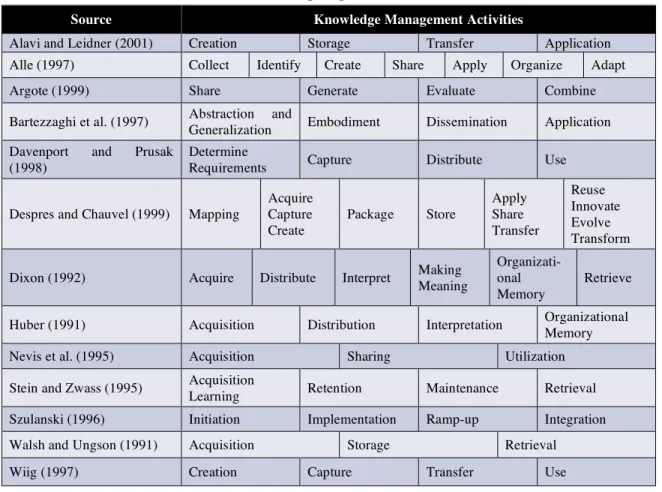
Alavi and Leidner (2001) interpret KM as a four-staged process of related activities, including: knowledge creation, storage, transfer and application. (O'Dell and Grayson 1998) argue that many organizations commence KM efforts by focusing on identifying, collecting, and organizing their best practices and internal knowledge. Table 1, akin to Lai and Chu (2000), makes the following observations. The results are intended to present the frameworks without imposing any meta-structure. This is done with the objective of showing the diverse and sometimes conflicting thoughts on KM activities. First, though the level of detail described in each of the above studies differ substantially – with some studies encompassing the entire gamut of KM activities – the others provide a high level overview. Secondly, while there is some agreement with how the KM-process begins of, there is lack of consent on what
activities mark the end of the cycle. With the granularity of the frameworks varies and the number of phases ranging from seven (e.g. Allee 1997) to three (e.g. Walsh and Ungson 1991), fourkey phasesare derived that are common to all literature: (1) acquisition / creation / generation, (2) retention / storage / capture, (3) share / transfer / disseminate and (4) application / utilization / use. Alavi and Leidner (2001) argue that four phases (creation, retention, transfer and use) formthe KM-process.
Table 5: Determining the phases of KM-Process
Source Knowledge Management Activities
Alavi and Leidner (2001) Creation Storage Transfer Application
Alle (1997) Collect Identify Create Share Apply Organize Adapt
Argote (1999) Share Generate Evaluate Combine
Bartezzaghi et al. (1997) Abstraction and
Generalization Embodiment Dissemination Application
Davenport and Prusak
(1998)
Determine
Requirements Capture Distribute Use
Despres and Chauvel (1999) Mapping
Acquire Capture Create Package Store Apply Share Transfer Reuse Innovate Evolve Transform
Dixon (1992) Acquire Distribute Interpret Making
Meaning
Organizati-onal Memory
Retrieve
Huber (1991) Acquisition Distribution Interpretation Organizational
Memory
Nevis et al. (1995) Acquisition Sharing Utilization
Stein and Zwass (1995) Acquisition
Learning Retention Maintenance Retrieval
Szulanski (1996) Initiation Implementation Ramp-up Integration
Walsh and Ungson (1991) Acquisition Storage Retrieval
Wiig (1997) Creation Capture Transfer Use
The a-priori model
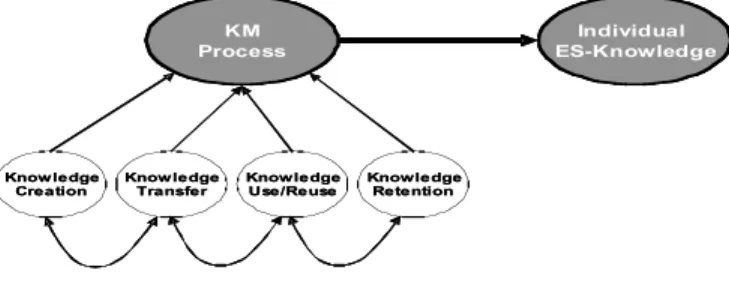
Derived from the review of literature and summarized in table 1, the a-priori model is conceptualized using four constructs to depict the four phases of the KM-process: (1) knowledge creation, (2) knowledge transfer, (3) knowledge retention and (4) knowledge Use / Re-use (See figure 1). The four constructs are operationalized using the ‘KM-process’ of Alavi and Leidner’s (2001), and were adapted from the framework of sociology of knowledge1(Berger and Lickman 1967; Gurvith 1971, Holzner and Marx 1979). It is argued that the goodness of KM-process facilitates to increased individual Enterprise Systems knowledge. The development phase (knowledge creation) of the KM-process corresponds with the planning and implementation stages of the ES lifecycle and entails all three key players - consultant, vendor and client (Gable, Heever et al. 1997). It involves developing new content and replacing existing content within the organization’s tacit and explicit
knowledge base (Alavi and Leidner, 2001). The external players bring new knowledge on the software and business processes (Davenport, 1998) to the client organization, and the client organization shares organizational knowledge (including business process knowledge) with the external parties.
Individual ES-Knowledge KM Process Know ledge Creation Know ledge Transfer Know ledge Use/Reuse Know ledge Retention Individual ES-Knowledge KM Process Know ledge Creation Know ledge Transfer Know ledge Use/Reuse Know ledge Retention
Figure 3: The a-priori model
(Sedera, Gable et al. 2003) combine (2) and (3) and suggest 6 main ES knowledge sources, illustrating a 3x2 matrix cross-referencing the 3 key players with 2 knowledge types. (Gupta and Govindarajan 2000) conceptualized knowledge transfer in terms of five elements and emphasized the importance and the richness of the channels of knowledge transfer2. Knowledge transfer channels can be informal or formal (Holtham and Courtney 1998). Unscheduled meetings, informal gatherings, and coffee break conversations are examples of the informal transfer of ES related knowledge. Although informal transfer promotes socialization and could be effective in small organizations, it precludes wide dissemination (Alavi and Leidner 2001; Holtham and Courtney 1998). Formal transfers, such as training programs, may ensure wider distribution of knowledge and suits highly context specific knowledge. In this study, the focus of knowledge transfer is limited to the formal knowledge transfer through training programs. Knowledge retention comprises organizational and personal knowledge retention. The individual’s knowledge retention is developed based on one’s observations, experiences and actions (Sanderlands and Stablein 1987). (Markus 2001) suggests that the source of competitive advantage resides not in the knowledge itself, but in the application of the knowledge (its use/re-use). In terms of the level of ES-success, knowledge re-use plays a vital role in every phase of the ES lifecycle, particularly in maintenance and upgrades. However, the effective reuse of knowledge is arguably a more frequent organizational concern and one that is clearly related to ES-success (Dixon, 2000).
The Study Context
The empirical data collection was conducted across 27 Queensland Government agencies that had implemented SAP R/3 in the late 1990s. Queensland is the first Australian state to implement common financial management software state-wide namely; The Queensland Government Financial Management System. In 1995 the state Government of Queensland commenced implementation of SAP Financials across all state Government agencies (later followed by Controlling, Materials Management and in some agencies Human Resources) and Queensland Government is one of the largest SAP installations in Australia. The Queensland Government provided an ideal context, being ‘relatively’ simple and homogenous: all Agencies were implementing the same ES (SAP R/3); all Agencies
2The other elements discussed by Gupta and Govindarajan (2000) include (1) perceived value of the source unit’s
knowledge, (2) motivational disposition of the source (i.e. their willingness to share knowledge), (3) motivational disposition of the receiving unit, (4) the absorptive capacity of the receiving unit
implemented around the same time and had been operational for approximately 4 years, and thus were at a similar point in the ES lifecycle, even more so given all are Agencies of the same State Government.
The Survey
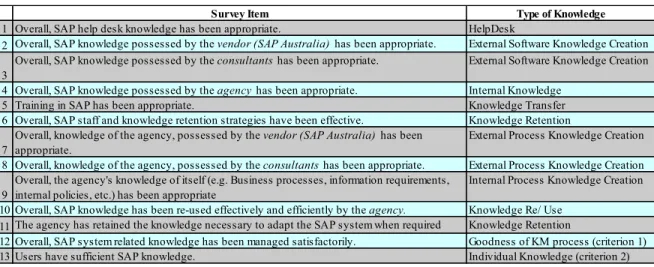
A survey instrument was designed to operationalize constructs of KM-process of figure 1 using the items depicted in table 2 (The construct validity of items established by (Sedera and Gable 2006). All items were scored on a seven-point Likert scale with the end values (1) ‘Strongly disagree’ and (7) ‘Strongly Agree’, and the middle value (4) ‘Neutral’. The survey gathered additional demographic details on respondents’ employment title (e.g. Director, Business Analyst, ABAP consultant). Furthermore, the respondents were asked to provide a brief description of their involvement with the SAP system. Supplementary information on the organizational structure, characteristics of the SAP system and the number of users was gathered from more objective sources. In addition to the items of table 2, the questionnaire included two criterion items aimed at gauging the respondent’s perception of overall KM-process: (1) ‘Overall, SAP system related knowledge has been managed satisfactorily’ and the gauging the adequacy of knowledge of employees: (2) ‘Users have sufficient SAP knowledge’.
Table 6: Measures employed in the study
Survey Item Type of Knowledge
1 Overall, SAP help desk knowledge has been appropriate. HelpDesk
2 Overall, SAP knowledge possessed by thevendor (SAP Australia)has been appropriate. External Software Knowledge Creation
3
Overall, SAP knowledge possessed by theconsultantshas been appropriate. External Software Knowledge Creation
4 Overall, SAP knowledge possessed by theagencyhas been appropriate. Internal Knowledge
5 Training in SAP has been appropriate. Knowledge Transfer
6 Overall, SAP staff and knowledge retention strategies have been effective. Knowledge Retention
7
Overall, knowledge of the agency, possessed by thevendor (SAP Australia)has been appropriate.
External Process Knowledge Creation
8 Overall, knowledge of the agency, possessed by theconsultantshas been appropriate. External Process Knowledge Creation
9
Overall, the agency's knowledge of itself (e.g. Business processes, information requirements, internal policies, etc.) has been appropriate
Internal Process Knowledge Creation
10 Overall, SAP knowledge has been re-used effectively and efficiently by theagency. Knowledge Re/ Use 11 The agency has retained the knowledge necessary to adapt the SAP system when required Knowledge Retention
12 Overall, SAP system related knowledge has been managed satisfactorily. Goodness of KM process (criterion 1) 13 Users have sufficient SAP knowledge. Individual Knowledge (criterion 2)
The Analysis
Using statistical analyses, this section addresses the following objectives: (1) whether the employment cohorts have different views on the phases of KM-process, (2) whether all employment cohorts have sufficient knowledge to comment on the phases of the KM-process, and (3) whether certain employment cohorts place a greater emphasis on some phases of the KM-process.
Descriptive Statistics
The survey received a total of 319 responses representing 27 organizations. Nine responses were removed from the data analysis due to perceived frivolity, yielding 310 valid responses for analysis purposes. Using the characteristics identified in the literature review, respondents were classified into four employment cohorts (i.e. Strategic, Management, Operational and Technical) based on their employment title and the demographic information pertaining to their involvement with the SAP system.
Table 7: Classification of Respondents # % Strategic 35 11% Management 122 39% Operational 108 35% Technical 45 15% Total 310 100%
In order to minimize individual errors of judgment, three academics and two senior business analysts from surveyed organizations, participated in the classification of respondents into cohorts. Participants individually mapped a sample of respondents into the four employment cohorts and compared results. Guidelines were designed to increase the systemisation, repeatability and the validity of the process. Comparison of the individual classifications revealed an average inter-coder agreement of 80%3(Krippendorff 1980). The classification exercise revealed (See table 3) 11% of respondents were from the Strategic level, 39% from Management level, 35% were from the Operational levels and 15% represented Technical staff. All indications suggest that this distribution is representative of users of the SAP system in Queensland Government. Table 4 and figure 2 demonstrate the mean values of the phases of KM-process across the four employment cohorts.
Table 8: Mean Scores of the phases of KM- Process
Strategic Management Operational Technical
4.30 3.99 4.02 4.09 3.80 3.84 3.89 3.49 4.19 4.18 4.12 4.00 4.10 4.01 4.01 3.86 4.34 4.05 3.68 3.56 4.31 4.05 4.01 3.58 4.31 4.03 3.94 3.79 4.06 3.99 4.04 3.89 4.11 3.84 3.62 3.36 4.74 4.40 4.40 4.58 Transfer Creation Goodness of KM Process Creation-External-Software Creation-External-Process Creation-Internal ReUSe Retention HelpDesk Individual Knowledge
Following broad observations are made from results in table 4 and figure 2. It is observed that forall phases of KM-process(see highlighted area “A”), mean values ascend according to the employment hierarchy, from the highest level of employment cohort (strategic) with the highest mean value, followed by management, and operational with the lowest mean score. Moreover, it is observed that the criterion item that assesses the knowledge of the uses (i.e. “users have adequate knowledge of SAP”), demonstrates the lowest mean score within each of the employment cohorts (see highlighted area “B”). To the contrary, the ‘appropriateness of help desk knowledge’ reports the highest mean score within each employment cohort (See highlighted area C). Furthermore, figure 2 alludes to the possible differences in opinions in relation to knowledge transfer across all employment cohorts (see highlighted area “D”). This prompted the importance of conducting a thorough statistical analysis to determine whether there are significant differences on Knowledge transfer, across the employment cohorts.
3 Krippendorf (1980) recommends inter-coder reliability of at least 70% and suggests that any significant discrepancies should be discussed until consensus on the mappings is reached.
Strategic Management Operational Technical 3.36 3.56 3.76 3.96 4.16 4.36 4.56 4.76
Creation Transf er ReUSe Retention Goodness of KM Process
Individual Know ledge
HelpDesk
Know ledge M anagem ent Process
Mean
Strategic Management Operational Technical
Figure 4: Graphical depiction of cohort perceptions on KM-Process
Comparative Statistics
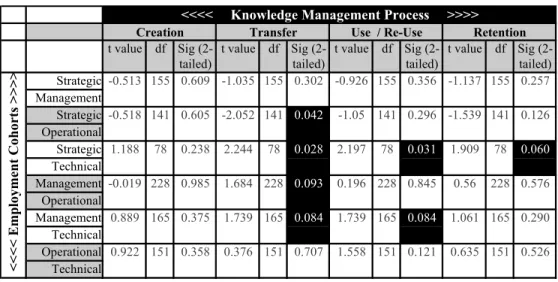
In order to assess whether the employment cohorts demonstrate different views across the phases of the KM-process and especially to investigate preliminary findings on knowledge transfer, paired t-test for the four employment cohorts across the phases was carried out. Table 6 depicts the results of the analysis, with significant differences highlighted. Confirming the exploratory findings of figure 2, table 5 demonstrates significant differences in perceptions on knowledge transfer (i.e. training programs)between all employment cohort pairs, except between strategic and management. Moreover, it is shown that Strategic and Management cohorts do not demonstrate any differences in opinions on any phases of KM-process. Conversely, table 5 demonstrates significant differences between Strategic and Technical staff in relation to all phases of the KM-process, but one (knowledge creation). The two criterion items did not demonstrate any significant differences between employment cohorts.
Table 9: Results of paired t-test
t value df Sig (2-tailed) t value df Sig (2-tailed) t value df Sig (2-tailed) t value df Sig (2-tailed) Strategic Management Strategic Operational Strategic Technical Management Operational Management Technical Operational Technical
<<<< Knowledge Management Process >>>>
0.635 151 0.526 0.290 0.922 151 0.358 0.376 151 0.707 1.558 151 0.121 165 0.084 1.061 165 0.56 228 0.576 0.889 165 0.375 1.739 165 0.084 1.739 1.909 78 0.060 -0.019 228 0.985 1.684 228 0.093 0.196 -1.539 141 0.126 1.188 78 0.238 2.244 78 0.028 2.197 -1.137 155 0.257 -0.518 141 0.605 -2.052 141 0.042 -1.05 Retention -0.513 155 0.609 -1.035 155 0.302 -0.926 155 0.356 <<<< Employment Cohorts >>>>
Creation Transfer Use / Re-Use
141 0.296 78 0.031 228 0.845
Correlation Analysis
Next, in order to assess whether the four employment cohorts place equal emphasis on every phase of process, the two criterion items were correlated with the four phases of
KM-A
B C
process across the employment cohorts. Arguably, the correlation coefficients demonstrate the ‘relative emphases’ that each cohort place on the phases of the KM-process.
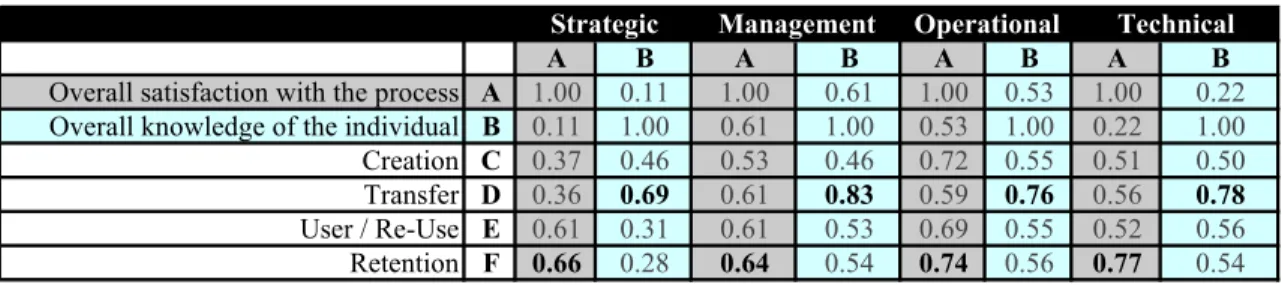
Table 10: Correlation Analysis
A B A B A B A B
Overall satisfaction with the process A 1.00 0.11 1.00 0.61 1.00 0.53 1.00 0.22
Overall knowledge of the individual B 0.11 1.00 0.61 1.00 0.53 1.00 0.22 1.00
Creation C 0.37 0.46 0.53 0.46 0.72 0.55 0.51 0.50
Transfer D 0.36 0.69 0.61 0.83 0.59 0.76 0.56 0.78
User / Re-Use E 0.61 0.31 0.61 0.53 0.69 0.55 0.52 0.56
Retention F 0.66 0.28 0.64 0.54 0.74 0.56 0.77 0.54
Management
Strategic Operational Technical
Analyzing the correlations between the dimension averages and the two criterion items (marked as A and B in table 6), it is evident that all employment cohorts place a relatively greater emphasis on knowledge retentionwhen evaluating the goodness of a KM-process (A with F). However, the relative emphasis shifts to knowledge transfer, when the respondents evaluate the individual knowledge where it demonstrates the highest correlation across all employment cohorts (B with D). Moreover, all employment cohorts demonstrate significant correlations with all other phases of KM-process.
Observations and Interpretations
Though past IS studies have reported anecdotal evidence of a relationship between KM and ES performance, understanding of multiple stakeholder (referred in this study as ‘employment cohorts’) perspective have been lacking. With the main objective of investigating the purported differences of employment cohorts in ES KM initiatives, this study analysed data gathered from 310 respondents representing 27 organizations that had implemented SAP R/3 in 1990s. The KM-process, based on Alavi and Leidner (2001), was extended through a review of 13 relevant studies, while the four employment cohorts were derived inductively from the study data. The following observations and interpretations are made using the descriptive and the comparative statistics.
Overall Assessment: As discussed earlier, the main purpose of this research was to investigate the purported differences between the key employment cohorts across the phases of the KM-process. It was observed that the employment cohorts posses differentiating views on certain phases of the KM-process. Knowledge transfer was identified as the only phase where the employment cohorts have significant differences in perceptions (demonstrated using the independent sample t-tests), possibly implying that every employment cohort requires a special training program rather than a standard knowledge transfer process. This is consistent with the literature on employment cohorts (e.g. Anthony, 1965) where it amplifies the distinctly different requirements from an Enterprise System. This also demonstrates the importance of gathering perceptions from multiple stakeholders.
KM-Phases: The correlation analysis demonstrated that when assessing the goodness of the KM-process, all employment cohorts place a higher importance on knowledge retention than other phases. Similarly, knowledge transfer was perceived more important than other phases, when assessing the individual knowledge. . The significant correlations between all phases and the two criterion items across the four employment cohorts demonstrate that all employment cohorts are reasonably informed to comment on all aspects of a KM initiative.
Lack of Formal Training for operational staff: The correlations analysis – where knowledge transfer had the highest correlation for criterion item 2 – and descriptive statistics – where the strategic and management cohorts report above-median mean values for knowledge transfer – demonstrate inadequate training for operational and technical staff at the sampled organizations. As suggested in many studies (Markus and Tanis 2000; Sumner 2000), and attested by the strongest correlation that knowledge transfer demonstrated in measuring the ES-knowledge possessed by an individual, these organizations should aim to address issues by providing appropriate training on Enterprise Systems.
Knowledge Retention: When assessing the goodness of the overall KM initiative, all employment cohorts placed a stronger emphasis on knowledge retention, compared to the other phases. As (Gable, Heever et al. 1997) identified ‘staff poaching’ and ‘knowledge drain’ due to skill-shortage of ES experience and expertise in the marketplace may have contributed to the given importance to the adequate knowledge retention strategies.
Conclusion
In conclusion, this paper addressed several key questions pertaining to stakeholder perspective of KM initiatives. The study empirically demonstrated that different employment cohorts possess differentiating views on certain phases of KM-process. It highlighted that all employment cohorts place a stronger emphasis on knowledge transfer (i.e. training), when assessing the knowledge they possess. The study also emphasized the importance of knowledge retention for the overall success of the KM initiative. It is observed that the respondents’ ‘Perspective on measurement’ is an important design consideration in such evaluation, especially, when the breadth of contemporary Information Systems is not limited a single employment cohort. The researchers should be cautious in specifying the employment cohorts to avoid any perplexing results. Though the results of this study are heartening, the present study has several limitations. First, the data analyzed was gathered only from public sector organizations using a single type of Enterprise System application (i.e. SAP R/3), which could affect the generalizability of the findings (Messick 1995). Second, operationalization of the KM-process is rather restricted in the current study and should be expanded to facilitate further understanding.
References
Alavi, M. and D. E. Leidner (2001). "Review: Knowledge Management And Knowledge Management
Systems: Conceptual Foundations And Research Issues." MIS Quarterly25(1): 107-136.
Allee, V. (1997). The Knowledge Evolution: Expanding Organizational Intelligence. Newton, MA, Butterworth-Heinemann.
Alloway, R. M. and J. A. Quillard (1983). "User Managers' Systems Needs." MIS Quarterly7: 27-41. Anthony, R. N. (1965). Planning and Control Systems: A Framework For Analysis. Boston, Harvard
University.
Argote, L. (1999). Organizational Learning: Creating, Retaining and Transferring Knowledge. Boston, MA, Kluwer Academic Publishers.
Bancroft, N. H., H. Seip, et al. (1998). Implementing SAP R/3: How To Introduce A Large System Into A Large Organization. Greenwich, CT, Manning Publications.
Bartezzaghi, E., M. Corso, et al. (1997). "Continuous Improvement And Inter-Project Learning In
New Product Development." International Journal of Technology Management14(1): 116-138.
Bingi, P., M. K. Sharma, et al. (1999). "Critical Issues Affecting An ERP Implementation."
Information Systems Management16(3): 7-14.
Cameron, K. S. and D. A. Whetten (1983). Some Conclusions About Organizational Effectiveness.
Organizational Effectiveness: A Comparison Of Multiple Models. New York, Academic Press:
261-277.
Cheney, P. H. and G. W. Dickson (1982). "Organizational Characteristics And Information Systems:
An Exploratory Investigation." Academy of Management Journal25(1): 170-184.
Davenport, T. H. (1996). Holistic Management Of Mega-Packaging Change: The Case Of SAP.
Proceedings of the 2nd Americas Conference on Information Systems, Phoenix, Arizona,
Association for Information Systems.
Davenport, T. H. (1998). Living with ERP. CIO Magazine.
Davenport, T. H. (1998). "Putting The Enterprise Into The Enterprise System." Harvard Business
Review76(4): 121-131.
Davenport, T. H. and L. Prusak (1998). Working Knowledge: How Organizations Manage What They Know. Boston, Massachusetts, Harvard Business School Press.
Davenport, T. H. a. P., L. (1998). Working Knowledge: How Organizations Manage What They Know. Boston, Massachusetts, Harvard Business School Press.
Despres, C. and D. Chauvel (1999). "Knowledge Management(s)." Journal of Knowledge
Management3(2): 110-120.
Dixon, N. M. (1992). "Organizational Learning: A Review Of The Literature With Implications For
HRD Professionals." Human Resource Development Quarterly3: 29-49.
Gable, G., J. Scott, et al. (1998). Cooperative ERP Life Cycle Knowledge Management. Proceedings
of the 9th Australasian Conference on Information Systems, Sydney, New South Wales,
Australia, Association for Information Systems.
Gable, G. G., R. v. D. Heever, et al. (1997). Large Packaged Software: The Need For Research.
Proceedings of the 3rd Pacific Asia Conference on Information Systems, Brisbane, Australia,
Association for Information Systems.
Grant, R. M. (1996). "Towards A Knowledge-Based Theory Of The Firm." Strategic Management
Journal17(Winter): 109-122.
Gupta, A. K. and V. Govindarajan (2000). "Knowledge Flows Within Multinational Corporations."
Strategic Management Journal21(4): 473 - 496.
Hibbard, J. (1997). Information Week:46-55.
Holtham, C. and N. Courtney (1998). The Executive Learning Ladder: A Knowledge Creation
Process Grounded In The Strategic Information Systems Domain. Proceeings of the 4thAmericas
Horwitch, M. and R. Armacost (2002). "Helping Knowledge Management Be All It Can Be." Journal of Business Strategy23(3): 26-31.
Huber, G. P. (1991). "Organizational Learning: The Contributing Processes And The Literatures."
Organization Science2(1): 88-115.
Jones, M. C. and R. L. Price (2004). "Organizational Knowledge Sharing in ERP Implementations: Lessons from Industry." Journal of Organizational and End User Computing16(1): 21-40. Krippendorff, K. (1980). Content Analysis: An Introduction To Its Methodology. Beverly Hills, CA,
Sage.
Lee, Z. and J. Lee (2000). "An ERP Implementation Case Study from a Knowledge Transfer Perspective." Journal of Information Technology12(2): 281-288.
Leidner, D. E. and J. J. Elam (1994). "Executive Information Systems: Their Impact On Executive
Decision-Making." Journal of Management Information Systems10(3): 139-156.
Markus, L. (2001). "Toward A Theory Of Knowledge Reuse: Types Of Knowledge Reuse Situations
And Factors In Reuse Success." Journal of Management Information Systems18(1): 57-93.
Markus, L., S. Axline, et al. (2003). Learning From Adopters Experiences With ERP: Problems Encountered And Success Achieved. Second-Wave Enterprise Resource Planning Systems. G.
Shanks, P. B. Seddon and L. Willcocks. Cambridge, UK, Cambridge University Press:23-55.
Markus, L. and C. Tanis (2000). The Enterprise Systems Experience - From Adoption To Success. Framing The Domains Of It Management: Projecting the Future Through the Past. R. W. Zmud.
Cincinnati, OH, Pinnaflex Educational Resources, Inc:173-207.
Messick, S. (1995). "Validity Of Psychological Assessment: Validation Of Inferences From Persons' Responses And Performances As Scientific Inquiry Into Score Meaning." American Psychologist
50(9): 741-749.
Nelson, R. R. and S. G. Winter (1982). An Evolutionary Theory Of Economic Change. Cambridge, MA, Belknap Press.
Nevis, E. C., A. J. DiBella, et al. (1995). "Understanding Organizations As Learning Systems." Sloan
Management Review36(2): 73-85.
Nonaka, I. and H. Takeuchi (1995). The Knowledge-Creating Company. Oxford, Oxford University Press.
O'Dell, C. and C. J. Grayson (1998). "If Only We Knew What We Know: Identification And Transfer Of Internal Best Practices." California Management Review40(3): 154-174.
Pan, S. L., S. Newell, et al. (2001). Knowledge Integration as a Key Problem in an ERP
Implementation. Proceedings of the 22ndInternational Conference on Information Systems, New
Orleans, Louisiana, Association for Information Systems.
Ponelis, S. and F. A. Fairer-Wessels (1998). "Knowledge Management: A Literature Overview."
South African Journal of Library and Information Science66(1): 1-9.
Quinn, R. E. and J. Rohrbaugh (1983). "A Spatial Model Of Effectiveness Criteria: Towards A
Raisinghani, M. S. (2000). "Knowledge Management: A Cognitive Perspective On Business And Education." American Business Review18(2): 105-112.
Sadagopan, S. (2003). Enterprise Resource Planning, Elsevier Science.
Sanderlands, L. E. and R. E. Stablein (1987). The Concept Of Organization Mind. Research In The Sociology Of Organizations. S. B. Bacharach, P. Bamberger, P. Tolbert, D. Torres and E. J.
Lawler. Greenwich, CT, JAI Press.5:135-161.
Sedera, D. and G. Gable (2004). A Factor and Structural Equation Analysis of the Enterprise Systems Success Measurement Model. International Conference of Information Systems, Washington, D.C.
Sedera, D. and G. Gable (2006). Identifying the Knowledge Management Structures in Enterprise Systems Projects. Pacific Asian Conference on Informartion Systems, Kuala Lumpur, Malaysia.
Sedera, D., G. Gable, et al. (2003). Knowledge Management For ERP Success. Proceedings of the 7th
Pacific Asia Conference on Information Systems, Adelaide, Australia, Association for Information Systems.
Sedera, D., F. Tan, et al. (2006). Identifying and evaluating the importance of multiple stakeholder perspective in measuring ES-success. European Conference on Information Systems, Goteborg, Sweden, Association of Information Systems.
Shang, S. and P. B. Seddon (2000). A Comprehensive Framework For Classifying Benefits Of ERP
Systems. Proceedings of the 6th Americas Conference on Information Systems, Long Beach,
California, Association for Information Systems.
Shang, S. and P. B. Seddon (2002). "Assessing And Managing The Benefits Of Enterprise Systems: The Business Manager's Perspective." Information Systems Journal12(4): 271-299.
Singletary, L., S. D. Pawlowski, et al. (2003). What Is Applications Integration? Understanding The
Perspectives Of Managers, IT Professionals, And End Users. Proceedings of the 9th Americas
Conference on Information Systems, Tampa, Florida, USA, Association for Information Systems.
Singleton, J. P., E. R. Mclean, et al. (1988). "Measuring Information Systems Performance: Experience With The Management By Results System At Security Pacific Bank." MIS Quarterly
12(2): 324.
Spender, J. C. (1996). "Making Knowledge The Basis Of A Dynamic Theory Of The Firm." Strategic
Management Journal17(Winter Special Issue): 45-62.
Stein, E. W. and V. Zwass (1995). "Actualizing Organizational Memory With Information Systems."
Information Systems Research6(2): 85-117.
Sumner, M. (1999). Critical Success Factors In Enterprise Wide Information Management Systems
Projects. Proceedings of the 5th Americas Conference on Information Systems, Milwaukee,
Wisconsin, Association for Information Systems.
Sumner, M. (2000). "Risk factors in enterprise-wide/ ERP projects." Journal of Information
Swanson, E. B. (1994). "Information Systems Innovation Among Organizations." Management
Science40(9): 1069-1092.
Szulanski, G. (1996). "Exploring Internal Stickness: Impediments To The Transfer Of Best Practice Within The Firm." Strategic Management Journal17(Winter Special Issue): 27-43.
Tallon, P. P., K. L. Kraemer, et al. (2000). "Executives' Perceptions Of The Business Value Of Information Technology: A Process-Oriented Approach." Journal of Management Information
Systems16(4): 145-173.
van der Speek, R. and A. Spijkervet (1997). Knowledge Management: Dealing Intelligently With Knowledge. Knowledge Management and Its Integrative Elements. J. Liebowitz and L. C. Wilcox. Boca Raton, FL, CRC Press.
Vlahos, G. E. and T. W. Ferratt (1995). "Information Technology Use By Managers In Greece To Support Decision Making: Amount, Perceived Value, And Satisfaction." Information &
Management29(6): 305-315.
Walker, C. (1998). "New Ways To Make Data Pay." PC Week15(34): 14-19.
Walsh, J. P. and G. R. Ungson (1991). "Organizational Memory." Academy of Management Review
16(1): 57-91.
Wiig, K., M. (1997). "Integrating Intellectual Capital And Knowledge Management." Long Range
Planning30(3): 399-405.
Wiig, K., M. (1997). "Knowledge Management: Where Did It Come From And Where Will It Go."
Journal of Expert Systems with Applications13(1): 1-14.
Wu, J.-H., Y.-M. Wang, et al. (2002). An Examination Of ERP User Satisfaction In Taiwan.
Proceedings of the 35thAnnual Hawaii International Conference on System Sciences, Big Island,
Hawaii.
Yoon, Y., and Guimaraes (1995). "Assessing Expert Systems Impact on Users' Jobs." Journal of