Constructing Services with Interposable Virtual Hardware
Andrew Whitaker, Richard S. Cox, Marianne Shaw, and Steven D. Gribble
University of Washington
{andrew,rick,mar,gribble}@cs.washington.edu
Abstract
Virtual machine monitors (VMMs) have enjoyed a resur-gence in popularity, since VMMs can help to solve difficult systems problems like migration, fault tolerance, code sand-boxing, intrusion detection, and debugging. Recently, several researchers have proposed novel applications of virtual ma-chine technology, such as Internet Suspend/Resume [25, 31] and transparent OS-level rollback and replay [13]. Unfortu-nately, current VMMs do not export enough functionality to budding developers of such applications, forcing them either to reverse engineer pieces of a black-box VMM, or to reim-plement significant portions of a VMM.
In this paper, we present the design, implementation, and evaluation ofµDenali, an extensible and programmable
vir-tual machine monitor that has the ability to run modern oper-ating systems. µDenali allows programmers to extend the
vir-tual architecture exposed by the VMM to a virvir-tual machine, in effect giving systems programmers the ability to dynamically assemble a virtual machine out of either default or custom-built virtual hardware elements. µDenali allows programmers
to interpose on and modify events at the level of the virtual architecture, enabling them to easily perform tasks such as manipulating disk and network events, or capturing and mi-grating virtual machine state. In addition to describing and evaluating our extensible virtual machine monitor, we present an application-level API that simplifies writing extensions, and we discuss applications of virtual machines that we have built using this API.
1
Introduction
Virtual machine monitors (VMMs) such as VM/370[8], Disco[6], and VMware [35] have demon-strated that is feasible to implement the hardware interface in software efficiently, making it possible to multiplex several virtual machines (VMs) on a single shared physical machine. Researchers have recognized that VMMs are a powerful platform for introducing new system services, including VM migration [25, 31], intrusion detection [18], trusted computing [17], and replay logging [13]. These services all exploit the unique ability of a VMM to observe and capture all of the events and state of a complete software system, including that of the virtual hardware, the operating system, and applications.
In addition to having this “whole-system” perspec-tive, VMMs have the advantage that the interface they expose is simple in comparison to a operating system API. Virtual hardware events such as disk reads and writes, MMU faults, and network events have a narrow and stable interface, whereas operating systems tend to expose a large number of semantically complex system calls. The virtual hardware interface is an ideal place for deploying many kinds of services: the “whole-system” perspective makes these services powerful, and the sim-ple virtual hardware interface makes them easy to build and able to operate on legacy software.
1.1
The VMM as a Service Platform
A VMM is a compelling platform for deploying an in-teresting class of system services. Unfortunately, today’s VMMs provide precious little support for developing newvirtual machine services. Because VMMs were not designed to be programmable or extensible, developers have had to reverse-engineer pieces of black-box VMMs to discover or expose the interfaces they need [25], or in extreme cases, they have had to reimplement significant portions of the VMM [13]. Worse, because there is no standard interface or extension framework supported by today’s VMMs, VM service authors have not been able to cooperate with each other or re-use developed com-ponents. For example, ReVirt’s replay ability [13] and Hypervisor-based fault tolerance [5] are both based on a similar logging primitive, but it would be difficult for these two projects to share this common functionality.
The current state of virtual machine services is sim-ilar to the distributed computing era before the advent of standardized transport protocols and remote proce-dure calls [4]. In this era, programmers used a variety of ad-hoc, home-grown techniques and services to commu-nicate across machine boundaries, resulting in brittle, unreliable, and non-interoperable systems. Standard-ized transport and RPC allowed distributed systems pro-grammers to focus on the logic of their systems, relying on underlying plumbing to solve common issues of reli-able communications, naming, and type marshalling.
In this paper, we attempt to advance the state of VM service construction by exploring two questions. First, what should the programmatic interface exposed
by VMMs to VM services look like? Second, what struc-ture and mechanisms within a VMM are needed to sup-port this interface well?
To address the first question, we propose a high-level software toolkit that allows programmers to build ser-vices in one VM thatinterposeon the events generated by another VM’s virtual hardware devices, or toextend the virtual hardware exposed to virtual machines by im-plementing new virtual hardware devices. These two abilities (interposition and extension) allow program-mers to develop software services that manipulate the virtual machine interface without worrying about the un-derlying virtualization mechanisms and plumbing. Be-cause our toolkit exposes a well-defined API, extensions and interposition services would work on any VMM that exposes the same API.
To address the second question, we describe the de-sign and implementation of a virtual machine monitor that supports virtual device interposition and extension. Our VMM, which we callµDenali, is built around a flex-ible virtual hardware event routing framework that bor-rows significant pieces of its design from Mach ports [12]. In our framework, virtual hardware events are defined as typed messages, and virtual hardware devices are sim-ply sets of ports. Interposition is achieved by re-routing messages from one virtual machine to another. Extensi-bility is achieved by allowing a VM to expose ports that send and receive appropriately typed messages.
The remainder of this paper is structured as follows. In Section 2, we briefly describe the Denali VMM [36], which we modified to build µDenali. Section 3 gives an architectural overview of µDenali, describing the basic structure of the system and a high-level view of the ex-tensibility and interposition interface which it exposes. In Section 4, we focus on the port-based routing frame-work within µDenali, and we describe the virtual hard-ware underlying VMs in terms of the message types and ports that define each virtual device. In Section 5, we describe a number of virtual hardware device exten-sions and virtual machine services which we have imple-mented. We present an evaluation of µDenali in Sec-tion 6, we discuss related work in SecSec-tion 7, and we con-clude in Section 8.
2
Denali Overview
The Denali isolation kernel [36] is an x86-based vir-tual machine monitor whose goal is to support a large number of concurrent virtual machines. Denali is a type-I VMM, meaning that it runs directly on physical hard-ware, as opposed to type-II VMMs (such as VMware workstation [35] or user-mode Linux [11]) which run as applications on a host operating system.
Denali relies on a technique called
para-d is k N IC C P U ti m e r M M U swap virtual machine VM VM •••• •••• •••• VM Denali VMM (a) (b) x86 hardware virtual device 1 virtual device 2 physical device 1 physical device 2 virtual device 3 physical device 3
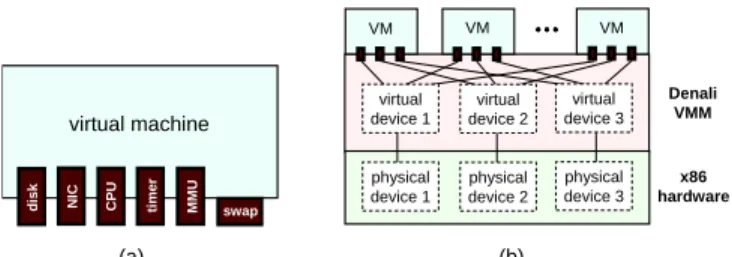
Figure 1: Denali virtual machine monitor architec-ture. The “old” pre-extensible architecture. Each virtual machine interacts with the virtual machine monitor through virtual hardware devices; each hardware device is hard-wired to a virtual device implementation inside the Denali kernel.
virtualization to enhance its performance, scalability, and simplicity. Rather than exposing a virtual architec-ture that faithfully reproduces the underlying physical architecture, Denali strategically modifies the virtual architecture, retaining the performance advantages of direct instruction execution but modifying key features of the virtual architecture such as interrupt processing, handling non-virtualizable instructions, and timers.
The Denali implementation has progressed signif-icantly since what was reported in [36]. Most no-tably, because of the addition of a virtual MMU de-vice, Denali is now able to run full-fledged operat-ing systems in a manner similar to Xen [2]. Most modern OSs run on multiple architectures, isolating the architecture-dependent pieces of the implementation from the architecture-independent pieces. We success-fully ported the NetBSD operating system to Denali by implementing architecture-dependent components ap-propriate for the Denali virtual architecture. Because of differences between our virtual MMU and the x86 MMU, we cannot run x86 binaries directly, but with recompila-tion we can run NetBSD and any of its applicarecompila-tions.
2.1
Denali’s Architecture
Figure 1 illustrates the Denali virtual architecture. The interface between each virtual machine and Denali is a set of virtual hardware devices. Within the Denali VMM, these virtual devices are “hard-wired” to virtual device implementations that (1) multiplex the virtual devices of the many VMs onto their physical counterpart (including namespace virtualization) and (2) implement physical resource management policies. Denali supports the following virtual devices:
Virtual CPU: The virtual CPU executes the instruc-tion streams of virtual machines, emulates privileged in-structions, exposes virtual interrupts, and handles vir-tual programmed I/Os. The virvir-tual CPU also exposes a number of purely virtual registers, such as a register which contains the current wall-clock physical time. Virtual MMU: The Denali virtual MMU exposes a
software-loaded TLB with a fixed number of virtual address-space IDs (ASIDs). The virtual MMU is a com-pletely different abstraction than the underlying x86 hardware-based page tables; we made this design choice to simplify the virtualization of virtual memory. Borrow-ing terminology from Disco [6], we refer to true physical memory asmachine memory, virtualized physical mem-ory as physical memory, and virtualized virtual mem-ory as virtual memory. The virtual MMU allows guest OSs to implement multiple virtual address spaces, and to page or swap between virtual memory and physical mem-ory. Denali itself overcommits physical memory and im-plements swapping between machine and physical mem-ory transparently to VMs.
Virtual timers: Denali exposes a virtual timer that supports an “idle-with-timeout” instruction, allowing virtual machines to relinquish their virtual CPUs for a bounded amount of time.
Virtual network: The Denali virtual NIC appears to guest OSs as a simple Ethernet device. The NIC sup-ports packet transmission and reception at the link level. Virtual disk: Stable storage is exposed to guest OSs as a block-level virtual disk. Guests can query the size of the disk, and read and write blocks to disk.
Because it supports neither extensibility nor interpo-sition, implementing the VM services that have appeared in recent literature would be difficult using Denali. For example, to checkpoint and migrate a virtual machine, all virtual device state must be captured, including vir-tual registers, physical memory pages (whether resident in machine memory or swapped to physical disk by De-nali), virtual MMU entries, virtual disk contents, and any virtual disk operations that are in flight. However, none of this state is exposed outside of the VMM. In the next section of this paper, we describe the architecture ofµDenali, a significant reimplementation of the Denali VMM which supports both extensibility and interposi-tion to support these kinds of services.
3
µ
Denali: an Extensible VMM
A VMM provides three basic functions: it virtualizes the namespace of each hardware device in the physical architecture, it traps and responds to virtual hardware events to implement virtual hardware device abstrac-tions, and it manages the allocation of physical resources to virtual machines. In the Denali VMM, these three functions were co-mingled. The major insight ofµDenali is that these functions can be separated from each other, and by doing so, virtual hardware event interposition and extensibility become a simple matter of routing one VM’s virtual hardware events to another VM.
Physical resource management: µDenali bor-rows significant code from Denali to interact with and manage physical devices. We utilize low-level code and device drivers provided by the Flux OSKit [15], and we implement our own global resource management poli-cies across VMMs, such as round-robin CPU schedul-ing across VMMs, fair queuschedul-ing of received and transmit-ted Ethernet packets, and a static allocation of physical disk blocks. These global resource management policies, which we do not allow to be extended or overridden, provide performance isolation between VMs.
Device namespace virtualization: Each virtual device in the Denali architecture is capable of generating and receiving several device-specific events. For exam-ple, virtual disks receive disk read and write requests, and generate request completion events. As another ex-ample, virtual CPUs generate interrupts and faults. In
µDenali, we associate a typed message with each of these device-specific events. Implicit in the message type defi-nitions are the namespaces associated with devices: disk event messages contain block offsets, and CPU faults contain the memory address of the faulting instruction. Virtual hardware event trapping and routing: Denali directly executes the instructions of virtual ma-chines, but privileged instructions and virtual hardware device interactions are trapped to and emulated by the VMM. In µDenali, we borrow Denali code to trap on these events, but instead of directly handing them off to virtual device implementations within the VMM, we en-code these events within typed messages and route the messages to an endpoint. µDenali contains a routing infrastructure which associates destination ports with events generated by the hardware devices of each VM. Default virtual hardware devices within µDenali have ports, as do special interposition devices associated with each VM. By binding a hardware device of one VM (the child) to the interposition device of another (the parent), the parent VM gains the ability to interpose on the child’s virtual device. The parent VM can either reroute the events back to µDenali’s default virtual de-vice implementation, or handle them itself, in which case the parent becomes an extension to the virtual architec-ture of the child.
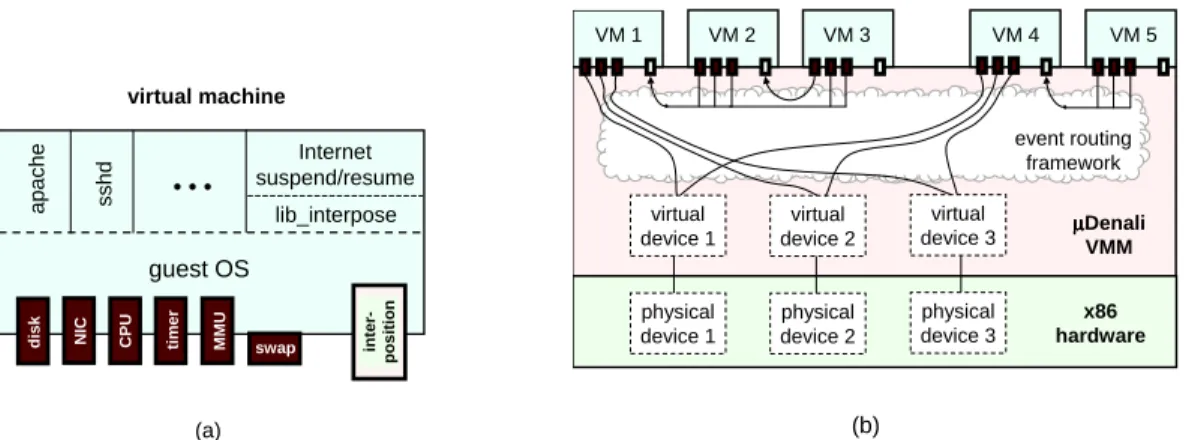
Figure 2 illustrates theµDenali architecture. In Fig-ure 2(a), we show the structFig-ure of a virtual machine. Each VM sees a collection of virtual hardware devices with which it interacts, similar to Denali. Unlike Denali, aµDenali VM can also interact with its interposition de-vice. A parent VM receives virtual hardware events from children VMs on which it interposes, and the parent can send response events (either toµDenali or to the child) over this device. Additionally, the interposition device exposes various control functions to a parent, such as the ability to instantiate a new child VM, suspend or
d is k N IC C P U ti m e r M M U swap inte r-p o s it io n guest OS a p a ch e ssh d • • • lib_interpose Internet suspend/resume (a) virtual machine VM 1 µµµµDenali VMM x86 hardware virtual device 1 virtual device 2 physical device 1 physical device 2 virtual device 3 physical device 3 VM 2 VM 3 VM 4 VM 5 event routing framework (b)
Figure 2: µDenali virtual machine monitor architecture. (a) A new virtual hardware device, the “interposition device”, is visible to each VM. The guest OS exposes events routed through this interposition device to user-level virtual
machine services, like Internet suspend/resume, with the help of a C library calledlib interpose. (b) A VM’s virtual hardware
devices can be bound to other VMs’ interposition devices, or to default virtual devices implemented in the VMM. An event routing framework (based on Mach ports [12]) routes virtual device events to appropriate endpoints, enabling both event interposition and virtual device extensions.
resume execution of a running child VM, or extract the hardware state of a child VM fromµDenali.
The guest operating system within a virtual machine can choose to handle virtual hardware and interposition device events as it sees fit. In our port of the NetBSD operating system to µDenali, we have written NetBSD device drivers for the “regular” virtual hardware devices, and we have exposed the interposition device to user-level applications through a high-user-level interposition li-brary written in the C programming language. Using this interposition library (lib interpose), user-level appli-cations can implement virtual machine services, such as Internet Suspend/Resume, which manipulate the device state and events generated by other VMs.
In Figure 2(b), we show the µDenali VMM archi-tecture. Similar to Denali,µDenali runs directly on x86 hardware, and contains a set of default virtual device im-plementations. µDenali also contains an event routing framework, which manages bindings between ports as-sociated with virtual hardware devices of running VMs, and routes typed messages according to these bindings. The figure shows five virtual machines. VM1 is the par-ent VM of two children (VM2 and VM3). VM1 receives and handles all events generated by all virtual devices of VM2, and some virtual devices of VM3. VM2 is a par-tial parent of VM3, receiving events from the remaining virtual devices of VM3. VM1 has no parent, meaning that all of its virtual device events are bound to default virtual devices within µDenali. Similarly, VM4 is the parent of VM5.
3.1
The NetBSD Interposition Library
The µDenali interposition device defines the set of extensibility and interposition operations that a parent
VM can perform on a child. The interface to this device consists of a set of downcalls that a parent initiates when it wishes to perform an action on a child (for example, to instantiate a new child VM), and a set of events and responses that are exchanged between the parent and
µDenali when an event of interest happens within the child VM.
The interposition device interface is implemented in terms of architecture-level programmed I/O operations and interrupts. Our NetBSD interposition library, with the help of the NetBSD guest OS, exposes this interface to applications in terms of function calls in the C pro-gramming language. In the remainder of this section, we describe the key components of the interposition de-vice interface by showing fragments of the interposition library API.
One key design decision we made was to focus on
local extensibility and interposition—that is, the inter-position device only exposes events generated by child virtual machines. We do not expose global events, such as µDenali scheduler decisions or machine memory al-location and dealal-location events. Because of this, the
µDenali extensibility framework does not suffer from security issues plaguing extensible operating systems, which permit extensions to modify global system behav-ior [3]. µDenali extensions are isolated from theµDenali VMM and from other VMs as a side-effect of being imple-mented inside their own virtual machine, and extensions can only affect children VMs.
3.1.1 Virtual Machine Control
The control API allows a parent VM to create, de-stroy, start, and stop child virtual machines. Figure 3 shows a subset of the NetBSD C library functions and
typedef struct {
// the swapDevice provides backing store for the // child’s physical pages when Denali swaps. SwapDevice *swapDevice;
// a Disk provides block-addressable storage. Disk *disk;
// (other virtual devices omitted, for brevity.) } VirtualMachine;
// create and destroy child VMs.
int createVM(VirtualMachine *vm, char *macAddr); int destroyVM(VirtualMachine *vm, char *macAddr); // associate a local /dev/virtethX block device // with a new virtual Ethernet in the child. int createEthernet(VirtualMachine *vm); // suspend and resume a child VM. int suspendVM(VirtualMachine *vm); int resumeVM(VirtualMachine *vm);
Figure 3: Virtual machine control functions. The VM control portion of the interposition API allows parent VMs to create, destroy, start, and stop child VMs.
structures associated with these control operations. The create and destroy operations permit a parent to dynamically assemble a child out of constituent virtual hardware devices, and then causeµDenali to instantiate and begin executing the assembly. For each device type, the parent must either provide callback functions to han-dle messages associated with that device, or provide an alternate routing port (such as a parent VM’s port, or
µDenali default device ports) for the device to bind to. The suspend and resume operations act on already active virtual machines. These commands are often used in conjunction with other interposition commands. For example, a checkpoint application would stop a virtual machine before extracting the checkpoint to ensure that it obtains a consistent snapshot of virtual device state. 3.1.2 I/O Device Interposition
The I/O device API allows a parent VM to interpose on virtual device events raised by child VMs, and to either re-route or respond to those events. This API allows parents to interact with virtual disks, Ethernets, and swap store backing (virtual) physical memory. As in Denali,µDenali device events are simplified idealizations of the underlying physical devices. For example, the virtual disk interposition interface supports two principle operations: reading and writing disk blocks. Figure 4 shows a representative subset of the I/O device API.
We chose to special-case the interposition interface
// the virtual Disk device callback functions typedef struct {
// the child generated a write event. int (*diskWrite)(char *buffer, int offset,
int num_sectors);
// the child generated a read event. If the
// parent chooses to handle the event, it // puts the appropriate data in "buffer". int (*diskRead)(char *buffer, int offset,
int num_sectors);
// the child is asking the disk to report // how many sectors it contains.
int (*getSectorSize)(void); } Disk;
Figure 4: I/O device interposition functions. The I/O device interposition API permits parents to interpose on and respond to their children’s device operations. In this figure, we show only the interface associated with the virtual disk; other devices have similar interfaces.
to children’s virtual Ethernet devices. The interposed Ethernet is exposed to the parent as a network device within NetBSD, (e.g., /dev/virteth0). This allows us to reuse existing networking software like NAT proxies, routers, and intrusion detection systems within a virtual machine service. From the point of view of the parent VM, it is connected to its child over a a dedicated net-work interface.
3.1.3 ExposingµDenali Internal State
In practice, not all virtual machine state can be di-rectly exported through the interposition device. For performance reasons, we chose to cache run-time state such as hardware registers, MMU mappings, in-flight virtual device operations, and the status of swap buffers inside theµDenali kernel itself. However, to implement services such as checkpoint and migration, parent virtual machines must be able to flush and access this state upon request. In practice, only “hard” state must be saved. For example, Ethernet packets that are queued for trans-mission or delivery insideµDenali can be discarded, be-cause doing so is consistent with the best-effort semantics of Ethernet networks.
Because much of this run-time state is platform spe-cific, µDenali encapsulates it inside in an opaque data structure. Extensions such as debuggers that require low-level access to platform-specific structures must ma-nipulate this run-time state with knowledge ofµDenali’s encapsulation syntax. Figure 5 shows a subset of the flush and state-capture functions that are exposed by the interposition device.
// functions to flush cached state from // Denali, and extract/restore kernel // internal associated with a VM. int flushSwap(VirtualMachine *vm); int extractMMUmappings(VirtualMachine *vm, MMUState *ms); int restoreMMUmappings(VirtualMachine *vm, MMUState *ms); int extractCPUstate(VirtualMachine *vm, CPUState *cs); int restoreCPUstate(VirtualMachine *vm, CPUState *cs);
Figure 5: Flushing and extracting VMM state.
µDenali internal state associated with a VM can be flushed
and extracted using this part of the API. Here, we only show a portion of the full API.
3.1.4 Tracking Non-Determinism
Tracking and logging non-deterministic events is necessary to implement replay services such as Re-Virt [13]. We have not yet finished the implementation of this functionality, but we have a complete design that takes advantage ofµDenali’s message routing layer.
To facilitate logging and replay services, µDenali must expose two types of information: the precise instruction-level timing of asynchronous events (such as virtual interrupts), and the content of events that are obtained from external input, such as user keystrokes or network packets. Both types of information are read-ily available in theµDenali architecture. Asynchronous events are defined to occur when the message routing in-frastructure delivers an event to a VM, and the content of external events can be observed through interposition. For example, an external Ethernet packet arrives when a virtual Ethernet packet message is delivered to a virtual Ethernet device, and the content of that message can be observed and logged by a parent through interposition.
In our design, µDenali assists with the logging of non-deterministic events by recording the timing of mes-sages delivered to a child VM, and periodically flush-ing this log to the parent’s interposition interface. Each log entry contains a three-tuple: a unique event ID, the event type (which is simply the type of the message de-livered to the child port), and a delivery time. As with ReVirt, delivery time is measured by a software instruc-tion counter [27] which includes the instrucinstruc-tion address and a counter of the number of backward branches exe-cuted during the lifetime of the child VM.
Replay requires the ability to interrupt a child VM before the execution of a logged non-deterministic event. To support this, the parent VM must be able to pass a
previously recorded log file to µDenali, which uses the log to trap the child VM at the precise moment that a logged non-deterministic event should occur. Our im-plementation of logging and replay is underway, but not complete.
3.2
Summary
In this section, we described the architecture of the
µDenali extensible virtual machine monitor, and pre-sented the high-level interposition and extension inter-face that it exposes. This interinter-face, which can be ac-cessed through an application-level library implemented in the C language, provides programmers with a power-ful and natural way to implement new virtual machine services. In the following section of the paper, we drill down into the design of the message routing infrastruc-ture insideµDenali.
4
Event Routing in
µ
Denali
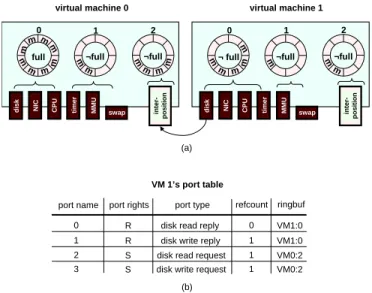
As described in the previous section, µDenali con-tains an event routing framework that is responsible for receiving, routing, and delivering virtual device events. In essence, the event routing framework is a virtual bus that provides a communication channel between a VM’s virtual devices and the implementation of those devices. Our routing framework design was inspired by Mach ports and messages [12]. A port is an abstraction of a protected communication channel that facilitates the re-ception and transmission of typed messages and port capabilities. Each virtual device in each virtual machine has a set of ports associated with it, and ports corre-spond to operations supported by virtual devices. By binding a virtual device port from a child VM to the interposition device port of a parent VM, events gen-erated by that child’s virtual device are converted into typed messages and delivered to the parent. Figure 6 illustrates the routing framework design.
4.1
Port Capabilities and the Port Table
Ports are protected by capabilities. Like Mach,µDenali defines three types of capabilities: the receive right allows the holder to receive messages delivered to that port, the send right allows the holder to send mes-sages to the port, and the send-once right allows the holder to send a single message to the port (for example, to allow a message recipient to send a reply). A capa-bility can be transmitted over ports in order to grant a privilege to the recipient. Only send rights can be copied; if a send-once right is passed in a message, the sender loses that right. The holder of a receive right (defined to be the port owner) may create send and send-once capabilities for that port.
d is k N IC C P U ti m e r M M U swap inte r-p o s it io n m m m m m m m m full ¬full m m ¬full m m mm virtual machine 0
port name port rights port type refcount ringbuf
d is k N IC C P U ti m e r M M U swap inte r-p o s it io n mm m m m
¬ full m ¬full ¬full m m virtual machine 1
0 R disk read reply 0
0 1 2 0 1 2
VM1:0 1 R disk write reply 1 VM1:0 2 S disk read request 1 VM0:2 3 S disk write request 1 VM0:2
VM 1’s port table
(a)
(b)
Figure 6: µDenali port tables. (a) VM1’s virtual disk is managed by VM0. (b) A subset of VM1’s port table. Because VM1 can generate virtual disk read and write requests, VM1 has send rights on the ports associated with those operations (ports 2 and 3). VM0 manages the associated receive ports, and uses its ring buffer #2 to buffer messages arriving on it. Because VM0 manages the disk, it needs to be able to send disk read and write replies back to VM1. VM1 has receive ports (ports 0 and 1) to receive these replies, and it uses its ring buffer #0 to buffer disk reply messages.
TheµDenali VMM maintains a table of port capabil-ities on behalf of each virtual machine. Because this port table is managed inside the VMM, port capabilities are unforgeable, similar to UNIX file descriptors. From the point of view ofµDenali, a virtual machine is sim-ply a port table. Much like a MCS capability list [10] or Hydra local name spaces [37], a port table simulta-neously defines the operations that can be performed on an object (virtual devices) and the namespace in which those objects are embedded (the virtualized namespaces of virtual devices).
When a parent VM creates a new child VM, the par-ent sets up the initial port table of the child. To do this, the parent creates individual ports in the child’s port ta-ble, grants port capabilities as necessary, and binds the ports as appropriate. A parent can bind a child’s port to its own interposition device, to the interposition device of another VM for which it has a port send capability, or to the port associated with the default virtual device implementations insideµDenali.
4.2
Port Queues and Message Buffers
Like hardware buses, the µDenali event routing framework itself never stores messages. All message queuing must be implemented by the virtual device which owns the port which receives the message. To accomplish this, each virtual machine maintains one or
more ring buffers associated with its ports. When a mes-sage arrives on a port, µDenali atomically delivers and advances the ring buffer. If the ring buffer is full, all ports associated with it enter the “full” state, and error messages are returned to source ports on future message delivery attempts. When the ring buffer is drained by the virtual machine, the receive ports associated with it leave the full state, and notifications are sent to all send ports bound to them.
Because the event routing framework has no storage, providing atomic message delivery is simple: the rout-ing framework promises either successful delivery, or an immediate error. This lack of storage also means that the routing framework itself is stateless, meaning that it need not be involved in the checkpoint or recovery of a virtual machine. Note, however, that port tables and ring buffers must be included in checkpoints.
µDenali messages contain a small amount of in-band data (16 32-byte words). For several of our devices, such as virtual MMUs, this suffices. For those that deal with larger blocks of data (e.g., virtual disks), µDenali pro-vides an out-of-band data passing mechanism to transfer up to 64KB of data with each message. This out-of-band channel is similar in spirit and usage to direct memory access (DMA) on modern physical hardware devices.
4.3
Example Virtual Devices, Ports, and
Message Types
µDenali defines a standard set of virtual devices and associated operations and events. Operations and events are exposed to virtual machines by the routing frame-work by ports and message types, respectively. We now discuss a few virtual devices and their ports and mes-sage types. Note that there is a one-to-one correspon-dence between ports and messages in µDenali’s event routing framework, and function calls and arguments in the lib interpose interposition library described in Sec-tion 3.1. Though we only discuss a subset of the virtual devices supported byµDenali, the other virtual devices have similar and consistent designs.
4.3.1 Virtual CPU
A VM’s virtual CPU device (vCPU) is responsible for executing the instructions of the guest operating sys-tem and its applications, managing the registers of VMs, and exposing ports and messages to VMs. All virtual machines currently rely on the default vCPU implemen-tation inside µDenali.
The vCPU shares most of its specification with the underlying x86 physical CPU. With the exception of a handful of non-virtualizable instructions [29] which have undefined (though secure) results, all unprotected in-structions are available to the guest. All of the un-protected x86 registers are also available to the guest.
µDenali augments the x86 CPU with a set of purely virtual instructions and registers that have no physical counterpart, as discussed below.
The vCPU maintains each VM’s port table, and also handles the transmission and reception of messages on ports. To transmit a message, a VM places the message and destination port-descriptor in a fixed memory loca-tion and invokes a virtual instrucloca-tion. The vCPU device traps this instruction, type-checks the message against the port table, swizzles any port references in the mes-sage, converts the physical addresses referring to out-of-band data into machine addresses, and attempts to place the message in the receive port ring buffer. From the point of view of the VM transmitting the message, this process corresponds to a single atomic instruction (al-beit a high latency one). On reception of a message, the vCPU interrupts the receiver VM and jumps to a guest-specified interrupt handler, assuming virtual interrupts are enabled.
The vCPU provides the mandatory implementation of all VMs’ virtual MMU devices. We implemented this device inµDenali because it is the most frequently used device in the system, and its implementation is closely intertwined with physical page table and machine mem-ory management. We have not yet considered whether it is possible or pragmatic to permit virtual MMUs to be interposed on or extended by parent VMs.
4.3.2 Virtual Swap Device
Interposing on the virtual swap device permits a par-ent VM to manage the swap file backing a child VM’s physical memory pages. µDenali decides when to reclaim a machine page that is bound to a physical page of a VM, and when it does so, it generates swap events on behalf of the child. A swap device is conceptually similar to external pagers in Mach and V [38, 7]. By interposing on a swap device, a parent has the ability to checkpoint all of the physical memory of its child.
A swap device has three ports, and supports four message types. Whenever a VM generates a physical-to-machine page fault withinµDenali, the VMM generates a fault message and sends it to the VM’s fault receive port. The handler is responsible for processing the mes-sage and sending a reply back when the fault has been serviced. When µDenali needs to swap out a physical page, it generates a swap-out message and sends it to the swap receive port of the VM. Finally, a parent VM can generate aflushorflush-allmessage to flush one or all dirty physical pages back to the swap device. 4.3.3 Virtual Ethernet Device
The virtual Ethernet device manages the transmis-sion and reception of Ethernet packets. A virtual Eth-ernet device has two ports, and supports one message
type. When an Ethernet frame arrives for an Ethernet device, anEthernet packetmessage is created and sent to the virtual Ethernet device’s receive port. When a VM transmits an Ethernet frame, another Ethernet packet
message is created and sent on the virtual Ethernet de-vice’s send port.
A VM’s virtual CPU facilitates the creation of new virtual Ethernet devices. A parent VM can send acreate new virtual Ethernet message to the Ethernet creation port of the virtual CPU, causing a new virtual Ethernet device to be created with a specific MAC address.
4.4
Summary
In this section, we described µDenali’s event rout-ing framework, whose design borrows heavily from Mach ports and messages. We also described the ports and message types associated with virtual devices supported byµDenali. In the next section of the paper, we describe several virtual device extensions and virtual machine ser-vices that we have implemented on µDenali.
5
Application Case Studies
In this section of the paper, we demonstrate how
µDenali’s extensibility and interposition mechanisms can be used to develop powerful virtual device extensions and virtual machine services.
5.1
Internet Suspend/Resume
The Internet Suspend/Resume project [25] uses the Coda file system to migrate checkpointed VMware virtual machines across a network. We have re-implemented this functionality in µDenali, albeit using the less efficient NFS rather than Coda.
Migrating a VM consists of three phases: check-pointing and gathering the complete state of the VM, transmitting this state over the network, and unpack-aging the state into a new VM on the remote host. In
µDenali, we use virtual device extensions to maintain and gather the state of a child VM’s virtual devices (for example, a swap disk extension maintains the complete physical memory image of the child), and we rely on the state extraction routines in the interposition library to extract µDenali internal hard state associated with the child.
To transmit VM state over a network, we rely on the NFS file system. The parent stores all gathered state inside an NFS file system also accessible to the remote host on which the VM will be resumed.
We found the development of migration on top of
lib interposeto be straightforward. The entire imple-mentation consists of 289 C source lines. The bulk of this complexity is dedicated to serializing C structures
into a byte stream, a task handled automatically by more modern languages such as Java.
5.2
“Drop-in” Network Services
As an example of a virtual machine service that ex-ploits network device interposition, we have created a dynamically-insertable network intrusion detection tem (IDS) embedded within a virtual machine. Our sys-tem (which we call VM-snort) acts as a parent that in-terposes on other VMs’ virtual Ethernet devices. Any network packet flowing in or out of a child VM must pass through VM-snort. We developed VM-snort using the Snort network intrusion detection system.
Because VM-snort is embedded in a virtual ma-chine checkpoint, it is possible for a third party to cre-ate a “pre-packaged” IDS image that can be dynam-ically instantiated at customer sites, using the check-point/restore functionality we previously described. Thus, VM-snort is the virtual equivalent of a dedicated physical intrusion detection appliance.
This model of embedding a network service inside a VM is generalizable to other network services. Many ac-tive services (i.e., those that modify in addition to mon-itor packets) are possible, such as drop-in VPN servers, transparent Web proxy caches, or application-level fire-walls. Other passive services besides VM-snort are also possible (i.e., services that only passively monitor pack-ets), such as a dynamically deployed distributed worm detector or an Internet weather service sensor.
5.3
Continuous Rejuvenation
In practice, it is extremely difficult to remove all bugs from complex software systems. Many bugs in pro-duction systems are “heisenbugs” [20], which depend on intricate sequences of low-probability events. Other er-rors like memory leaks can emerge slowly, thereby defeat-ing many testdefeat-ing procedures. Researchers have proposed pro-active restarts to forestall the effect of these latent errors [22]. However, simply restarting a machine creates short-term unavailability, which may be unacceptable for some services. Another alternative is to replicate the ser-vice across physical machines, but this can increase cost and administrative overhead.
By using restartable virtual machines, we can achieve many of the benefits of software rejuvenation without the accompanying downtime. To demonstrate this, we have constructed a service calledApache*, which serves web requests from a (virtual) web server farm. The system consists of K child nodes, each running a standard copy of the Apache web server. The parent VM acts as a layer-3 switch, redirecting incoming requests to the child that is active at any given time. After a con-figurable time period, the parent VM redirects requests
to the next child in the pipeline, and reboots the child1. Apache* leverages µDenali’s interfaces for disk, swap, and network interposition. Our implementation was greatly simplified by leveraging NetBSD’s built-in NAT functionality to handle request distribution. We use an implementation of copy-on-write disks (described below) to isolate state changes inside the Apache virtual machines. The entire implementation (including COW disks) required 1131 lines of C code.
5.4
Disk and Swap Device Extensions
BecauseµDenali virtual swap devices are extensible, implementing novel bootloaders is simple. As a demon-stration of this, we implemented a network boot loader, which fetches the child’s swap image over HTTP. The boot loader saves the swap image in the NetBSD file sys-tem of the parent. When swap-in or swap-out events are generated by the child’s virtual swap device, the boot-loader serves the appropriate frames from this file. Our bootloader makes use of thewgetUnix program to fetch files from Web servers. We implemented the portion of the bootloader that handles swap events and serves frames from a file; this required 94 lines of C code.
Using µDenali’s disk interposition mechanism, we built a simple copy-on-write (COW) disk extension. Our COW disk extension permits multiple VMs to share a base disk image, but exposes the abstraction of a pri-vate mutable disk per VM. Like all standard COW im-plementations, our extension maintains a file containing differences between the base disk image and each VM’s current disk image. A COW disk is useful in many sit-uations, including efficiently creating multiple “cloned” virtual machines on a single physical machine. Our copy-on-write disk extension consists of 675 lines of C code.
We are currently working on a “time-travel” disk implementation, which records all disk updates to a log. This provides a recovery mechanism that allows a system to roll back to a previous working state.
6
Evaluation
Our evaluation explores three aspects of µDenali’s performance. First, we measure the basic overhead in-troduced by µDenali’s virtualization and extensibility. Next, we measure the performance of interposed virtual hardware devices (such as interposed disks and Ether-nets), and compare it to non-interposed virtual devices. Finally, we measure the performance of our Internet Sus-pend/Resume and VM-snort services.
For our experiments,µDenali ran on a 3.2 GHz Pen-tium 4 with 1.5 GB of RAM, an Intel PRO/1000 PCI
1Actually, there is a delay before rebooting a virtual machine
7.2 µsec virtualization overhead of µDenali’s virtual Ethernet
(send, with interposition)
2.0 µsec virtualization overhead of µDenali’s virtual Ethernet
(send, without interposition)
1.2 µsec µDenali NetBSD null system call
0.38 µsec native NetBSD null system call
latency operation
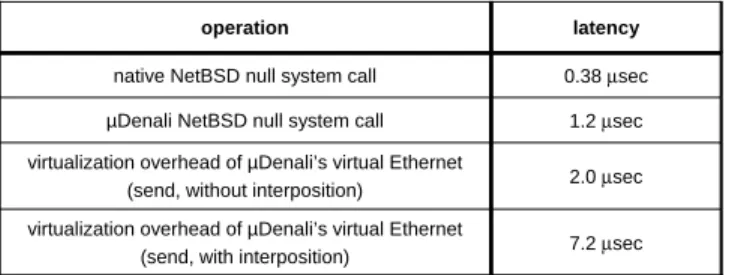
Figure 7: VMM overhead. This table compares mi-crobenchmarks run on Linux executing directly on physical
hardware, and on our ported NetBSD executing onµDenali.
The “virtualization overhead ofµDenali’s virtual Ethernet”
latencies show the overhead introduced when packets are sent through a virtual Ethernet device, excluding the physical Ethernet send costs. The cost of the interposition machinery is shown by comparing the “without interposition” and “with interposition” cases.
gigabit Ethernet card connected to an Intel 470T Eth-ernet switch, and an 80 GB IDE hard drive running at 7200 RPM. For any experiment involving the network, we used a 1500 byte MTU. We used the httperf [28] Web workload generation tool.
Our Ethernet card is not well-supported by conven-tional NetBSD on physical hardware. Therefore we com-pare µDenali’s NetBSD performance with Linux in the results that follow.2 We do not believe this qualitatively
changes our results.
6.1
Basic Overhead
A major source of overhead for VMMs is the trap-ping and emulation of privileged instructions. For
µDenali, these instructions include virtual hardware de-vice programmed I/O instructions and system calls is-sued by a guest OS. The event routing framework in
µDenali imposes additional overhead on interposed vir-tual device operations.
Figure 7 shows the cost of commonly used op-erations. Null system calls (getpid) are more than three times as expensive on µDenali as on conventional NetBSD. In addition to trapping on the original system call,µDenali must trap on the system call return. Our trap handling code is based on old Mach code, and has not been as carefully optimized as NetBSD.
Network communication is more expensive on a VMM because packet send operations must be trapped and emulated. µDenali incurs an overhead of 2.0 mi-croseconds to send a 1400 byte packet through a (non-interposed) virtual Ethernet, relative to a physical Eth-ernet driver. This overhead includes the cost of a ker-nel trap and packet copy. For interposed Ethernets, the
2Note that NetBSD running onµDenali can exploit our physical
gigabit card, since our VMM interacts with the true physical device and has the correct drivers, while a NetBSD VM interacts with a simple virtual device.
214 Mb/sec 116 req/sec 344 req/sec 1350 req/sec µDenali NetBSD, Snort interposed Ethernet 387 Mb/sec 684 Mb/sec 728 Mb/sec Bulk TCP 325 req/sec 880 req/sec 2200 req/sec µDenali NetBSD, null interposed Ethernet 550 req/sec 1400 req/sec 3200 req/sec µDenali NetBSD, no interposition 614 req/sec 2300 req/sec 6700 req/sec Linux Apache, 128KB Apache, 64KB Apache, 2KB
Figure 8: µDenali network overhead. Moving from left to right, these tests transition from system-call intensive to
packet-intensive. µDenali performs better in the
packet-intensive regime. The 3x system call penalty we previously described contributes to a substantial performance loss for small transfers, and a moderate performance loss for large transfers.
message routing framework within µDenali introduces an additional cost of 5.2 microseconds, which includes the cost of a message transfer, a context switch to the “parent” VMM, and message reception. This value rep-resents an upper bound because µDenali is capable of batching multiple messages per receive operation.
6.2
Device Interposition Overhead
In this section, we evaluate the performance of
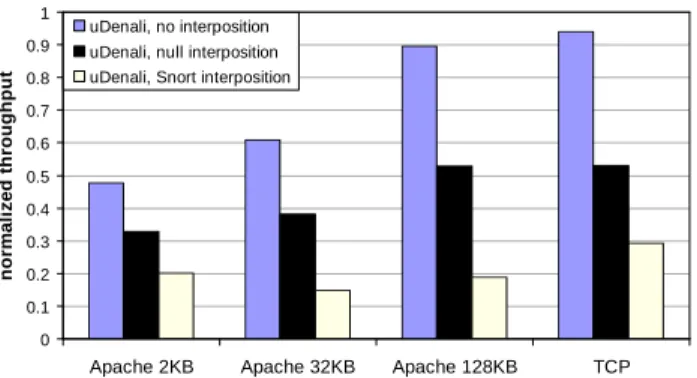
µDenali’s virtual network and disk devices, and com-pare the performance of these devices with and with-out interposition. To evaluate network performance, we benchmarked the Apache Web server serving static doc-uments of various sizes. We also measured bulk TCP throughput. Figure 8 shows results for four configu-rations: 1) Native Linux, 2) µDenali NetBSD without Ethernet interposition, 3) µDenali with “null” Ethernet interposition, which provides simple packet forwarding via a parent VM, and 4)µDenali with Snort running in-side the interposing VM. We use the default Snort rule set. Our generated traffic stream consisted of normal (non-malicious) Web requests, so Snort performed very little logging.
Figure 9 shows the same network performance re-sults graphically by normalizing µDenali’s performance against Linux. Without interposition,µDenali’s perfor-mance degrades relative to Linux as the TCP transfer size decreases. µDenali obtains 94% of Linux’s bulk TCP bandwidth, but only 48% of Linux’s 2k Web throughput. This discrepancy arises because TCP connection setup is more expensive on µDenali, owing to the 3X system call performance gap. For bulk TCP throughput and large Web documents, there are fewer system calls, and
µDenali performs competitively with Linux.
Although the virtualization overhead is highest for short TCP transfers requests, the additional overhead
0 0.1 0.2 0.3 0.4 0.5 0.6 0.7 0.8 0.9 1
Apache 2KB Apache 32KB Apache 128KB TCP
n o rm a li z e d t h ro u g h p u t uDenali, no interposition uDenali, null interposition uDenali, Snort interposition
Figure 9: Network interposition overhead: Results are normalized against a native Linux machine. For small trans-fers, system call costs dominate. For large transtrans-fers, per-packet costs dominate. Interposing on network devices adds to per-packet latencies, resulting in a relative performance drop for large transfers.
45 MB/sec
Linux
37 MB/sec
µDenali NetBSD, interposed disk
39 MB/sec
µDenali NetBSD, native disk
Sequential Read Throughput
Figure 10: Disk interposition overhead. This table
shows the performance overhead of µDenali’s virtual disks,
with and without interposition.
due to interposition is smallest for short transfers. For example, the additional overhead for null interposition versus no interposition is 16% for 2k web requests and 41% for bulk TCP transfers. µDenali only imposes addi-tional overhead on packet delivery, and therefore system call-intensive workloads are less affected by interposition. For Snort interposition, the per-packet overhead is large due to Snort’s data copies and packet inspection rou-tines. Snort is known to carry a high per-packet cost; even well-tuned installations can have difficulty keeping up with a heavily utilized 100 Mb/s Ethernet.
To evaluate disk performance, we used the UNIX dd utility to perform large, contiguous disk reads. In Fig-ure 10, we compare the throughput of Linux, µDenali using a native (non-interposed disk), andµDenali using an interposed disk. The interposed disk is implemented as a file inside the parent VM’s local file system. The parent’s file system was initially empty, and therefore the child’s blocks are likely to be nearly contiguous on disk. The sequential read workload is highly disk-bound, and thereforeµDenali’s numbers (with or without inter-position) do not differ significantly from Linux.
6.3
Virtual Machine Services
We evaluated our Internet Suspend/Resume service using an Apache Web server as the migrating VM. We
0 100 200 300 400 500 600 700 800 0 5 10 15 20 25 time (seconds) 3 2 K B r e q s /s e c
Figure 11: Migrating an Apache server. This timeline shows the behavior of an Apache Web service, before, during and after migration.
0 100 200 300 400 500 600 0 10 20 30 40 50 time (seconds) s e rv e d l o a d ( 3 2 K B r e q u e s ts ) 200 reqs/sec offered load 500 reqs/sec offered load
Figure 12: Apache* service performance. This time-line shows the behavior of Apache before, during and after migration. The two lines correspond to two different work-loads: 500 requests per second (open loop), and 200 requests per second (open loop).
configured a Web client to submit requests for a 32 kilo-byte document 200 times per second. As shown in Fig-ure 11, the Web server satisfies these requests before and after its migration. The instability that is evident imme-diately after migration is due to a batch of requests that are waiting inside the VM’s Ethernet ring buffer. The long migration latency (12 seconds) is primarily due to our use of NFS as a transport mechanism.
We evaluated ourApache* service using a three vir-tual machine Apache cluster. The parent VM was con-figured to garbage collect the active child VM after 10 seconds. Figure 12 shows the time-varying performance ofApache* against offered loads of 200 requests per sec-ond and 500 requests per secsec-ond for a 32KB Web doc-ument. For 200 requests per second, the throughput remains constant over time, which indicates no service disruption across VM restarts. At 500 requests per sec-ond, the system is less stable, suggesting the system is near its performance limit.
7
Related Work
µDenali is related to research into applications of vir-tual machines, novel virvir-tual machine architectures, and extensible systems.
7.1
Virtual Machine Applications
Many researchers have been building novel applica-tions that make use of virtual machine monitors. In-ternet Suspend/Resume [25] utilizes the checkpoint and resume functionality within VMware [35] to migrate vir-tual machines across a network. Sapuntzakis et al. [31] build a similar system, and show how to optimize perfor-mance with novel compression techniques. ReVirt [13] provides efficient logging and replay of virtual machines, and using this, King and Chen show how to identify se-quences of events that lead to an intrusion [24]. The Stanford Collective project [30] uses VMMs to imple-ment virtual appliances that facilitate software deploy-ment and maintenance.
To implement these virtual machine services, the au-thors have had to reverse engineer relevant interfaces from a black-box VMM, or reimplement significant por-tions of the VMM in order to provide the interfaces they require. The goal of the µDenali VMM is to facilitate these kinds of services by exposing a carefully designed interposition and extension interface.
7.2
Novel Virtual Machine Monitors
Several research projects have focused on building novel virtual machine monitors. The Denali isolation kernel [36] relies on paravirtualization to implement lightweight virtual machines; µDenali is an enhance-ment to Denali. Xen [2] provides similar functionality to Denali, and focuses on providing high performance and strong isolation. Many user-level ports of Linux exist, including UMLinux [11]. Commercial virtual ma-chine monitors have existed for several decades for main-frame computers [8], and have recently begun to achieve widespread usage on desktop workstations [35]. None of these virtual machine monitors provide comparable extensibility and interposition abilities toµDenali.
7.3
Extensibilty and Interposition
Numerous systems have injected novel functionality at the hardware interface. The storage device interface has been particularly fruitful. Petal virtual disks [26] of-fer a block-based 64-bit storage abstraction implemented on a cluster of workstations. Logical disks [9] provide an abstract disk interface based on logical block numbers and block lists, designed to support many different file system implementations. These systems do not attempt to be extensible or complete: they provide a fixed imple-mentation of one virtual hardware device.
Other systems have explicitly dealt with adding extensibility to the hardware interface. User-mode pagers [7, 38] can be viewed as interposing on the im-plementation of the memory abstraction exposed to pro-cesses or operating systems. In particular, µDenali’s virtual swap device closely resembles Mach’s extensible paging for memory regions.µDenali moves beyond these systems to allow interposition on a much more complete spectrum of hardware abstractions.
Alpha PALCode [34] provides the ability to modify or extend the behavior of the Alpha instruction set archi-tecture. Although this is a powerful primitive, PALCode faces several severe restrictions. PALcode is designed for small, low-level handlers such as TLB refills. PALCode is not suitable for implementing complex abstractions such as copy-on-write disks. A second limitation is that PALCode offers no abstraction: PALCode routines are architecture-dependentandimplementation dependent. Finally, PAL instructions are differentiated from normal instructions in the instruction set, and therefore, it is impossible to interpose on arbitrary functionality.
The Java [19] virtual machine architecture is similar to µDenali at a high level, as it exposes a hardware-like architecture that is backed by a software-based implementation. As a result, Java VMs can support novel implementations, such as a distributed virtual ma-chines [33]. However, JVMs are less complete than VMMs. They do not virtualize I/O devices such as Eth-ernet adapters or disks. As a result, JVMs do not sup-port software systems with non-Java components. Addi-tionally, applications such as migration that require the clean extraction of all I/O device state will be no easier to implement in a JVM than in a conventional OS.
µDenali’s use of interposition as a means for achiev-ing extensibility has been used by many previous sys-tems, including interposition agents [23], Fluke’s recur-sive virtual machines [16], and Mach’s interposition en-abled ports [12]. µDenali differs from previous systems in that we apply interposition to the virtual hardware interface exposed by a VMM. Thus, the class of applica-tions and services enabled byµDenali is fundamentally different from previous systems, whose aim has been to interpose on the user/kernel boundary of a conventional operating system.
µDenali’s architecture is similar to that of many microkernel-based operating systems, such as Mach [1] and L4 [21]. µDenali’s port-based event routing frame-work is similar to the IPC mechanisms in these systems. Modern microkernels are able to run entire operating systems inside user-mode servers, includingL4linux [21].
µDenali differs from microkernels in many respects, pro-viding the ability to extract full virtual hardware state, the ability to interpose on all virtual hardware events, and (currently in design only) the ability to log and
reply non-deterministic events. In spirit, there is little difference between a microkernel and a VMM; both ex-pose a virtual machine architecture. In practice, though, microkernels have been designed to provide extensible OS services such as user-mode pagers and file systems, whereas virtual machine monitors are being used to pro-vide whole-machine services such as consolidation and migration.
There has been considerable past research into ex-tensible operating systems [3, 14, 32]. SPIN [3] allows untrusted operating system extensions written in a type-safe language to be downloaded into the operating sys-tem. Unlike SPIN, we do not attempt to graft extensions into our kernel to override global system policies and mechanisms, but rather concentrate on extensions local to a single virtual machine. The Exokernel [14] allows programmers to build library operating systems that are safely multiplexed on a thin OS layer that exposes phys-ical names. Instead of exposing physphys-ical names,µDenali exposes virtual names, sacrificing some performance to virtualization overhead in return for simplicity and po-tentially stronger isolation.
8
Conclusions and Future Directions
Virtual machine monitors have proven ideal for im-plementing a variety of system services, including migra-tion, intrusion detecmigra-tion, and replay logging. All of these virtual machine services leverage the unique ability of a VMM to observe and interpose on the functionality and state of a complete software system. We believe there are many compelling applications of VMMs that are waiting to be discovered.
To facilitate these new services, we have redesigned the Denali VMM with the explicit goal of extensibil-ity in mind. The resulting VMM, µDenali, has been architected to allow parent virtual machines to inter-pose functionality on behalf of their children. µDenali is structured on top of an event routing framework in-spired by Mach ports. Using a high-level C library that exploits the extensibility features of µDenali, we imple-mented several virtual device extensions and virtual ma-chine services that run in our framework, including In-ternet Suspend/Resume, a “drop-in” network intrusion detection virtual appliance, and a continuous rejuvena-tion framework for the Apache web server.
An exciting aspect ofµDenali is that its extensibil-ity mechanisms open up several avenues for future re-search. We are particularly interested in two future di-rections: using µDenali’s checkpoint primitives to sim-plify the management of machines and networks, and using ReVirt-style logging to monitor for bugs like race conditions, which are otherwise difficult to analyze.
9
Acknowledgements
We are grateful for the feedback of our shepherd, Mendel Rosenblum, and our reviewers. We would also like to thank Brian Bershad, Ed Lazowska, and Hank Levy for their thoughts. Brian Youngstom’s support in our lab was invaluable. This work was supported in part by NSF Career award ANI-0132817, funding from Intel Corporation, and a gift from Nortel Networks.
References
[1] Mike Accetta, Robert Baron, William Bolosky, David Golub, Richard Rashid, Avadis Tevanian, and Michael Young. Mach: A new kernel foundation for UNIX
devel-opment. In Proceedings of the USENIX Summer
Con-ference, 1986.
[2] Paul Barham, Boris Dragovic, Keir Fraser, Steven Hand, Tim Harris, Alex Ho, Rolf Neugebauer, Ian Pratt, and Andrew Warfield. Xen and the art of virtualization. In
Proceedings of the 19th Symposium on Operating System Principles(SOSP 2003), Bolton Landing, NY, October 2003.
[3] Brian Bershad, Stefan Savage, Przemyslaw Pardyak, Emin Gun Sirer, David Becker, Marc Fiuczynski, Craig Chambers, and Susan Eggers. Extensibility, safety, and
performance in the SPIN operating system. In
Proceed-ings of the Fifteenth ACM Symposium on Operating Sys-tem Principles, Dec 1995.
[4] Andrew D. Birrell and Bruce Jay Nelson. Implementing
remote procedure calls.ACM Transactions on Computer
Systems, 2(1):39–59, February 1984.
[5] Thomas C. Bressoud and Fred B. Schneider.
Hypervisor-based fault tolerance. ACM Transactions on Computer
Systems, 14(1):80–107, 1996.
[6] E. Bugnion, S. Devine, and M. Rosenblum. Disco: run-ning commodity operating systems on scalable
multipro-cessors. InProceedings of the Sixteenth ACM Symposium
on Operating Systems Principles, October 1997.
[7] David Cheriton. The V distributed system.
Communi-cations of the ACM, 31(3):314–333, March 1988. [8] R.J. Creasy. The origin of the VM/370 time-sharing
sys-tem. IBM Journal of Research and Development, 25(5), 1981.
[9] Wiebren de Jonge, M. Frans Kaashoek, and Wilson C. Hsieh. The logical disk: A new approach to improving
file systems. InProceedings of the Fourteenth Symposium
on Operating Systems Principles (SOSP’93), Asheville, NC, December 1993.
[10] Jack B. Dennis and Earl C. Van Horn. Programming
semantics for multiprogrammed computations.
Commu-nications of the ACM, 9(3):143–155, March 1966. [11] Jeff Dike. A user-mode port of the Linux kernel. In
Proceedings of the Fourth Annual Linux Showcase and Conference, Atlanta, GA, October 2000.
[12] Richard Draves. A revised IPC interface. InProceedings
[13] George W. Dunlap, Samuel T. King, Sukru Cinar, Mur-taza Basrai, and Peter M. Chen. ReVirt: Enabling in-trusion analysis through virtual-machine logging and
re-play. InProceedings of the 2002 Symposium on
Operat-ing Systems Design and Implementation (OSDI 2002), Boston, MA, December 2002.
[14] D.R. Engler, M.F. Kaashoek, and J. O’Toole Jr. Exok-ernel: An operating system architecture for
application-level resource management. In Proceedings of the
15th ACM Symposium on Operating Systems Principles, 1995.
[15] Bryan Ford, Godmar Back, Greg Benson, Jay Lepreau, Albert Lin, and Olin Shivers. The Flux OSKit: A
sub-strate for kernel and language research. InProceedings of
the 16th ACM Symposium on Operating Systems Prin-ciples, St.-Malo, France, October 1997.
[16] Bryan Ford, Mike Hibler, Jay Lepreau, Patrick Tull-mann, Godmar Back, Shantanu Goel, and Steven Claw-son. Microkernels meet recursive virtual machines. In
Proceedings of the Second Symposium on Operating Sys-tems Design and Implementation, October 1996. [17] Tal Garfinkel, Ben Pfaff, Jim Chow, Mendel
Rosen-blum, and Dan Boneh. Terra: A virtual machine-based
platform for trusted computing. In Proceedings of the
19th Symposium on Operating System Principles(SOSP 2003), Bolton Landing, NY, October 2003.
[18] Tal Garfinkel and Mendel Rosenblum. A virtual machine introspection based architecture for intrusion detection. In Proceedings of the Tenth Annual Network and Dis-tributed Systems Security Symposium, San Diego, CA, February 2003.
[19] J. Gosling, B. Joy, and G. Steele. The Java Language
Specification. Addison-Wesley, Reading, MA, 1996. [20] Jim Gray. Why do computers stop and what can be
done about it ? InProceedings of the 5th Symposium on
Reliablity in Distributed Software and Database systems, January 1986.
[21] Hermann H¨artig, Michael Hohmuth, Jochen Liedtke,
Se-bastian Sch¨onberg, and Jean Wolter. The performance
of µ-kernel-based systems. In Proceedings of the 16th
ACM Symposium on Operating Systems Principles, St.-Malo, France, October 1997.
[22] Y. Huang, C. Kintala, and N. Kolettis. Software
reju-venation: analysis, module and applications. In
Pro-ceedings of the 25th International Symposium on Fault-Tolerant Computing, June 1995.
[23] Michael B. Jones. Interposition agents: Transparently
interposing user code at the system interface. In
Proceed-ings of the 14th ACM Symposium on Operating Systems Principles (SOSP’93), Asheville, NC, December 1993. [24] Samuel T. King and Peter M. Chen. Backtracking
intru-sions. InProceedings of the 19th Symposium on
Oper-ating System Principles(SOSP 2003), Bolton Landing, NY, October 2003.
[25] M. Kozuch and M. Satyanarayanan. Internet
sus-pend/resume. InProceedings of the fourth IEEE
Work-shop on Mobile Computing Systems and Applications, Callicoon, NY, June 2002.
[26] E. K. Lee and C. Thekkath. Petal: Distributed
vir-tual disks. In Proceedings of the Seventh International
Conference on Architectural Support for Programming Languages and Operating Systems, October 1996. [27] J. M. Mellor-Crummey and T. J. LeBlanc. A software
instruction counter. InProceedings of the 3rd
Interna-tional Conference on Architectural Support for Program-ming Languages and Operating Systems, Boston, Mas-sachusetts, April 1989.
[28] D. Mosberger and T. Jin. httperf—a tool for
measur-ing web server performance. InProceedings of the First
Workshop on Internet Server Performance (WISP ’98), Madison, WI, June 1998.
[29] J.S. Robin and C.E. Irvine. Analysis of the intel pen-tium’s ability to support a secure virtual machine
mon-itor. InProceedings of the 9th USENIX security
sympo-sium, August 2000.
[30] Constantine Sapuntzakis, David Brumley, Ramesh Chandra, Nickolai Zeldovich, Jim Chow, Monica S. Lam, and Mendel Rosenblum. Virtual appliances for
deploy-ing and maintaindeploy-ing software. In Proceedings of the
Seventeenth Large Installation Systems Administration Conference (LISA 2003), October 2003.
[31] Constantine P. Sapuntzakis, Ramesh Chandra, Ben Pfaff, Jim Chow, Monica S. Lam, and Mendel Rosen-blum. Optimizing the migration of virtual computers. InProceedings of the 5th Symposium on Operating Sys-tems Design and Implementation (OSDI 2002), Boston, MA, December 2002.
[32] Margo Seltzer, Yasuhiro Endo, Christopher Small, and Keith Smith. Dealing with disaster: Surviving misbe-haved kernel extensions, October 1996.
[33] Emin Gun Sirer, Robert Grimm, Arthur J. Gregory, and Brian N. Bershad. Design and implementation of a dis-tributed virtual machine for networked computers. In
Proceedings of the 17th ACM Symposium on Operating Systems Principles (SOSP’99), Kiawah Island, SC, De-cember 1999.
[34] Richard L. Sites. Alpha architecture reference manual, 1992.
[35] VMware, Inc. Vmware virtual machine technology.
http://www.vmware.com/.
[36] Andrew Whitaker, Marianne Shaw, and Steven D. Grib-ble. Scale and Performance in the Denali Isolation
Ker-nel. In Proceedings of the 5th Symposium on
Operat-ing Systems Design and Implementation (OSDI ’02), Boston, MA, December 2002.
[37] W. Wulf, E. Cohen, W. Corwin, A. Jones, R. Levin, C. Pierson, and F. Pollack. HYDRA: the kernel of a
multiprocessor operating system. Communications of
the ACM, 17(6):337–345, June 1974.
[38] Michael Young, Avadis Tevanian, Richard Rashid,
David Golub, Jeffrey Eppinger, Jonathan Chew,
William Bolosky, David Black, and Robert Baron. The duality of memory and communication in the
implemen-tation of a multiprocessor operating system. In
Pro-ceedings of the Eleventh ACM Symposium on Operating Systems Principles, Austin, Texas, November 1987.