Appl
i
c
at
i
on
of
GA
i
n
Opt
i
mi
zat
i
on
of
Modi
fied
Benzene Alkylation Process
A. Nejad Ebrahimi1, A. Zolfaghari Sharak1, S. A. Mousavi1, A. Zolfaghari Shahrak2, and F. Aghazadeh3 1. Department of Chemical and Petroleum Engineering, Sharif University of Technology
2. 1000 E University Ave, Department of Chemical and Petroleum Engineering, University of Wyoming, Laramie 3. Petroleum Research Technology Laboratory, Department of Applied Chemistry & Chemical Engineering, University
of Tabriz [email protected]
Abstract
A genetic algorithm is used to optimize the modified benzene alkylation process. Based on the previous studies, the modified process increases ethylbenzene selectivity and decreases energy consumption at the same time. The inlet ethylene flow rate of each alkylation reactor is optimized in order to reduce the chance of transalkylation reactions but increase ethylbenzene selectivity. The byproduct trans-eth-ylbenzene concentration is used as the fitness variable in the optimization process to confine undesired reactions throughout the process. The obtained optimal values of ethylene flow rate for the adiabatic re actors are 3.50, 2.94, 2.58, and 0.36 m3/hr. The ethylbenzene selectivity has been increased by applying the optimized values indicating the current unit is not operating under optimal conditions. Temperature profile within the alkylation reactors and temperature and concentration profiles through the towers of the fraction unit under the optimized conditions of the modified process are also presented.
Key words: Ge
netic Algorithm, Optimization, Modified Process, Temperature Profile, EthylbenzeneIntroduction
The alkylation of aromatic hydrocarbons with olefins is applied on a large scale in the chemical industry [1]. Benzene alkylation is one of the most important process-es for ethylbenzene (EB) production. The production of EB in 2010 was about 34 million metric tons [2]. EB is an important raw material in the petrochemical industry for the manufacture of styrene. Styrene monomer is used in the production of synthetic rubber, synthetic plastics, and resins. Also, EB has a limited use as a solvent in the production of dyes [3].
Several alkylation processes have been proposed to en-hance the benzene alkylation processes [4-7]. Degnan et al. provided an overview of various industrial alkylation processes for the production of EB and cumene [1]. They proposed that zeolite catalysts have begun to displace the conventional aluminum chloride and solid phosphoric acid.
The effects of operational parameters and process vari-ables have been investigated by many researchers. For instance, the effects of temperature and feed composition on the catalytic activity and product distributions were studied by Li et al. [5]. Craciun et al. proposed a liquid phase alkylation of benzene over three USY zeolites [8].
They showed that the alkylation rate will increase when the average acid strength is higher. Cavani et al. investi-gated the effects of temperature, contact time, and feed composition on the catalytic performance of transalkyl-ation of diethylbenzene with benzene [9]. Sharanappa et al. studied the selective alkylation and disproportion-ation of EB in the presence of other aromatics [10]. Xu et al. developed a composite catalyst of ZSM-5/ZSM-11 co-crystallized zeolite for the alkylation of dilute ethyl-ene with benzethyl-ene in EB production [11]. Al-Kinany et al. have shown that trifluoromethanesulfonic (triflic) acid could be used for the transalkylation of o-diethylbenzene with benzene to EB at low temperatures and atmospheric pressure [12]. Many other attempts have been made to study the effects of operational parameters on alkylation process [13-16].
where kept at their maximum allowable temperature.
Production Process Description
The simulated EB production unit is an industrial work-ing unit. The unit provides the needed EB for the juxta-posed styrene monomer unit. In this commercial process, the alkylation reactors are designed for the 100% conver-sion of ethylene. EB synthesis could be done based on the following alkylation reaction:
C6H6 + C2H4 → C6H5−C2H5, (1)
A complete benzene alkylation could be occurring un-der the atmospheric pressure and at a temperature of 500
°C [17]. However, side reactions, especially successive
alkylation, cause trans-ethylbenzene production. Due to these restrictions, the industrial alkylation processes should be done in a catalytic bed and at low tempera-tures.
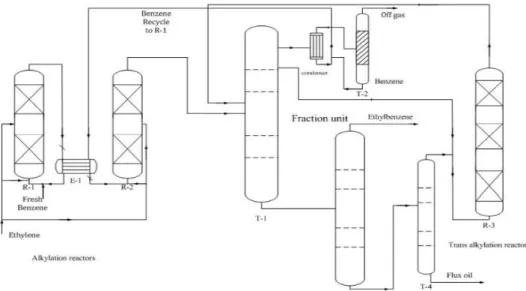
Figure 1 shows a simple diagram of the EB production process in a real working unit. As it can be seen from Figure 1, the process encompasses three packed bed adi-abatic reactors in series. The first two reactors (R1 and R-2) both have two Y type zeolite packed beds used as catalysts for the alkylation of benzene. The third reactor (R-3) with three packed beds is used for the transalkyl-ation processes.
The fraction unit has four towers. The first one is the ben zene column, (T-1), which is used for the separation of benzene from EB. There is a benzene drag tower, (T-2), for the treatment of benzene from undesired lighter prod-ucts. EB is taken out from the third tower, (T-3), where EB is separated from trans-ethylbenzene and other un-desired heavier products. In the last tower, (T-4), trans-ethylbenzene is separated from the flux oil products and recycled to the transalkylation reactor for EB production.
The input ethylene is ramified into four streams and each is fed to the each bed of R-1 and R-2. The R-1 outlet stream is cooled down to the R-2 feed temperature in a heat exchanger (E-1). The input benzene is a mixture of fresh benzene and the recycled stream from the T-1 in the fraction unit. The ratio of the recycled benzene to the benzene required for a stoichiometric alkylation is 6:1. The excess benzene helps regulate the temperature and reduce the transalkylation reactions.
Rate expressions are vital for the simulation, analysis, and design of chemical reactors. Therefore, they should be carefully selected for an accurate simulation. Reac-tions 1-3 and EquaReac-tions 4-5 are the main reacReac-tions and reaction rates in the alkylation of benzene with ethylene [18].
C6H5C2H5+C2H4→C2H5-C6H4-C2H5 (2) (3) C2H5-C6H4-C2H5+C2H4→C2H5
C 6H4
C2H5 C2 H5
(4)
(5) where, r1 and r2 are the rates of reactions 1 and 2 respec-tively. kr is the rate constant and kEB is the adsorption coefficient for EB. R, T, CEt, and CEB are the ideal gas constant, temperature, and ethylene and EB concentra-tions respectively. It must be mentioned that the amount of produced three-EB is negligible, so the reaction rate for Equation 3 is overlooked.
R-2 outlet stream is sent to T-1 in the fraction unit. The transalkylation reactions are carried out in R-3. A mix-ture of benzene stream, which is taken out from T-1 and transethylbenzene flow from T4, is fed to R3 for the transalkylation reactions purpose. The R-3 outlet stream is then sent to T-1 in the fraction unit. Equations 6 and 7 are the main transalkylation reactions and the relevant rate expression [17].
C2H5 - C6H4 - C2 H5 + C6 H6 → 2C6 H5 - C2 H5 (6)
(7)
where, r3 is the rate of Reaction 6 and CBZ and CDEB are the EB and DEB concentrations respectively.
Optimization
Recently, we have proposed a modified benzene alkyla tion process to reduce the total energy consumption [13]. The modified process is shown in Figure 2.
In this study, the genetic algorithm is applied to reduce the transalkylation reactions by the simultaneous regula-tion of ethylene flow rate to each backed bed.
Genetic Algorithm
Inspired by Darwin’s theory of survival of the fittest, Ge netic Algorithm (GA) was developed to find the approxi mate solution to optimization and search problems as a global search technique [18].
In genetic algorithm, an initial set of random candidate solutions called population is postulated in the begin-ning. Each individual in the population, which is called a chromosome, is a set consisting of various segments or
genotypes.
A so called fitness function evaluates the fitness of chro mosomes at each generation. Different chromosomes are sorted based on their fitness values. Now for the genera tion of offspring, two chromosomes from a set of chro-mosomes (called mating pool) are chosen. The higher fitness of chromosome, the better chance of selection for that chromosome. This assures that chromosomes with better fitness value have priority to participate in the cre ation of offspring [19]. Using crossover and/or mutation operators, two selected chromosomes produce two new offsprings.
Exchanging information between parent chromosomes to create two new chromosomes is the basis for cross-over operator, while making random changes on the selected genes of each newly obtained chromosome is done by mutation operator [20].
Results and Discussion
The goal of any optimization problem is to either maxi-mize or minimaxi-mize the objective function. In GA, a par-ticular type of objective function called fitness variable is used. Fitness variable quantifies the optimality of a so lution (chromosome). Since in GA better chromosomes should have a higher chance in creating offspring, sort-ing out all chromosomes based on the fitness variable is an important step in optimization. In this paper, the fitness variable is the concentration of the byproduct trans-ethylbenzene. This concentration should be kept as minimum as possible throughout the process. Table 1 shows GA parameters used in this study.
Figure 2- Diagram of the modified EB production process
Table 1- Applied GA parameters
Population Max No of Generations Crossover Type Crossover Rate Mutation Rate Hybrid
The inlet ethylene flow rate to each alkylation reactor in the modified process is used as a decision variable in order to reduce the transalkylation reactions and increase EB selectivity. Figure 3 illustrates fitness values for all generations.
As it can be seen from Figure 3, the mean fitness value reaches a steady state condition after 9 iterations. How-ever, the best fitness remains constant after the fourth generation. The oscillations in the mean fitness curve are caused by the mutation parameter.
As it was mentioned before, the inlet ethylene flow rates are used as decision variables to minimize the trans-eth-ylbenzene production and increase EB selectivity. The operational and optimal ethylene flow rates for each al kylation reactor are presented in Table 2.
The operational ethylene flow rates are constant for the first pair of the alkylation reactors. However, the opti
mal ethylene flow rates decrease monotonically through reactors. Since there is no EB in the inlet stream of first reactor, there is no chance for transalkylation reactions and as a result, the maximum ethylene flow rate is as signed to R-1. Table 3 compares the output compositions of the optimal conditions of the modified process results with those obtained from the simulation of the modified process.
As it can be seen from Table 3, under the optimal con-ditions of the modified process, there is a considerable reduction in the trans-ethylbenzene production while the EB concentration increases a little bit. As a result, EB selectivity increases when GA is applied for the optimi-zation. Temperature profile within the alkylation reactors under the optimal conditions of the modified process are demonstrated in Figure 4.
Figure 3- Best and mean fitness values for all generations
Table 2- Operational and optimal value of ethylene flow rate (m3/hr)
.Reactor No Operational Value Optimal Value
R-1 2.81 3.50
R-2 2.81 2.94
R-3 1.87 2.58
R-4 1.87 0.36
Table 3- Comparison between the outlet compositions of the modified process and its optimal conditions
Component Modified process
(mole fraction %)
Optimal conditions (mole fraction %)
Trans-ethylbenzene 0.326 0.151
EB 34.243 34.563
The desired operational temperature range for the al-kylation reactors in the real unit is 250–270 °C. Since alkylation reactions are exothermic, temperature rise in-creases EB selectivity [13]. The final temperatures are still within the desirable operational ranges. As it can be seen from Figure 4, the first three alkylation reactors are
working at their maximum allowable temperature. How-ever, since the ethylene flow rate for the last alkylation reactor is low, the reactor temperature reaches the
maxi-mum value at 255 °C. The temperature and
concentra-tion profiles through the towers of the fraction unit are shown in Figures 5 and 6 respectively.
(T-2)
(T-3) (T-4)
(T-1)
Figure 5- Temperature profile through the towers of the fraction unit under the optimal conditions of the modified process
(T-1) (T-2)
(T-3)
Figure 6- Concentration profile through the towers of the fraction unit under the optimal conditions of the modified process
As mentioned before, the fraction unit has four towers. T-1 is used for the separation of benzene from EB. It has 49 equilibrium stages beside reboiler and condenser. It must be mentioned that the trays are numbered from bottom to top. The main feed stream with the
tempera-ture of 258 °C enters tray 21 and increases the benzene
concentration (see Figure 6-a). The temperature curve shows a sharp increase at the bottom of the tower where reboiler is located (Figure 5a). The temperature profile within the benzene drag tower is plotted in Figure 5-b. The tower has 13 trays and since there is no reboiler, mass transfer causes a smooth temperature change at the top of column. Benzene is completely separated from the lighter products at the bottom of tower (Figure 6-b). The separation of EB from trans-ethylbenzene is done in T3 with 55 equilibrium stages. Temperature profile and concentration variation of T-3 are shown in Figures 5c and 6c respectively. Temperature profile has a sharp trend in the vicinity of reboiler while there is a constant temperature decrease for the remaining trays. Also, the feed stream of the third tower, with a temperature of 234
°C, enters at 16th tray causing an oscillation in both tem-perature and concentration profiles.
In the last tower, trans-ethylbenzene is separated from the flux oil products and is recycled to the transalkylation reactor for EB production. As it can be seen from Figure 5d, the temperature profile is sharpened when it reaches the vicinity of reboiler or condenser. However, mass transfer and heat of mixing are the major factors for the heat transfer in the middle of tower where temperature profile is smooth (Figure 6b).
Conclusion
In this paper, GA is used to obtain the optimal values of the ethylene flow rate to increase EB selectivity in a modified EB production process. The desired opera tional temperature range for the alkylation reactors is 250–270 °C. It is found that EB selectivity could reach its maximum value when the first three alkylation reac tors work at their maximum allowable temperature and the ethylene flow rates for the adiabatic reactors are fixed at the values of 3.50, 2.94, 2.58, and 0.36 m3/hr for
re-actors 1-4 respectively. The EB selectivity increases by applying the optimal values indicating current unit is not working under the optimal conditions. The temperature profiles within the alkylation reactors show a sharp in crease due to being in contact with fresh catalyst at the beginning of each reactor. Also, temperature and con-centration profiles through the towers of the fraction unit under the optimal conditions of the modified process are presented.
References
[1]. Thomas F. Degnan Jr., C. Morris Smith and Chaya R. Venkat, “Alkylation of aromatics with ethylene and pro-pylene: recent developments in commercial processes”, Applied Catalysis A: General 221 pp. 283–294, 2001. [2]. Sun L., Guo X., Liu M. and Wang X., “Ethylation
of coking benzene over nano scale HZSM-5 zeolites: ef-fect of hydrothermal treatment”, calcinations and La2O2 modification, Appl. Catal. A: Gen. 355, pp. 184–191, 2009.
[3]. Barman S., Pradhan N.C. and Basu J.K., Kinetics of alkylation of benzene with ethyl alcohol catalyzed by Ce-exchanged NaX zeolite, Indian Chem. Eng. A 48 (1 Jan.–Mar., 2006.
[4]. Abu I.I., et al., “Studies on platinum-promoted sul-fated zirconia alumina: effects of pretreatment environ-ment and carrier gas on n-butane isomerization and benzene alkylation activities”, Journal of Colloid and Interface Science, 267, pp. 382–390, 2003.
[5]. Yongxin Li and Yantao Yang B.X., “Synthesis of ethylbenzene by alkylation of benzene with diethyl oxa-late over HZSM-5. Fuel Processing Technology 90”, pp. 1220-1225, 2009.
[6]. Fonseca J.D.L., Faro A.D., Grau J.M and Rangel M.D., “Ethylbenzene production over platinum catalysts
supported on modified KY zeolites”, Applied Catalysis A: General, 386, pp. 201-210, 2010.
[7]. G.C. Laredo, Castillo J. and Armendariz-Herrera H., “Benzene reduction in gasoline by alkylation with ole fins: Effect of the experimental conditions on the product selectivity”, Applied Catalysis A: General, 384, pp. 115 121, 2010.
[8]. Craciun I., et al., “Effects of acid properties of Y zeolites on the liquid-phase alkylation of benzene with 1-octene: A reaction path analysis”, Journal of Molecu lar Catalysis A: Chemical, 277, pp. 1–14, 2007.
[9]. Cavani F., Bencini E. and Goffredi G., “ Liquid-phase transalkylation of diethylbenzenes with benzene
over ß-zeolite: effect of operating parameters”, 226, pp. 31-40, 2002.
[10]. Sharanappa N. and Bokade V.V., “Selective alkyla-tion and disproporalkyla-tionaalkyla-tion of ethylbenzene in the pres-ence of other aromatics”, Journal of Molecular Catalysis A: Chemical, 217, pp. 185-191, 2004.
[11]. Longya Xu J.L., Wang Q., Liu S., Xin W. and Xu Y., “Coking kinetics on the catalyst during alkylation of FCC offgas with benzene to ethylbenzene”, Applied Ca talysis A: General. 258, pp. 47–53, 2004.
[12]. Al-Kinany M.C., Al-Khowaiter S.H., Al-Dosari M.A., Al-Megren H.A., Al-Zahrani S.M. and Al-Hu-maizi K.I., “Low temperature transalkylation of
o-dieth-ylbenzene with benzene to ethylbenzene using triflic acid
as a catalyst, Chemical Engineering and Processing, 44 () 841-846, 2005.
[13]. Ebrahimi A.N., Sharak A.Z., Mousavi S.A., Aghazadeh F. and Soltani A., “Modification and optimi
zation of benzene alkylation process for production of ethylbenzene”, Chemical Engineering and Processing 50 pp. 31–36, 2011.
[14]. Odedairo T. and AlKhattaf S., “Kinetic analysis of
benzene ethylation over ZSM5 based catalyst in a flu
idized-bed reactor”, Chemical Engineering Journal 157, pp. 204–215, 2010.
of benzene with ethylene over faujasite zeolite investi-gated by the ONIOM method”, Journal of Catalysis 225 ,pp. 523–530, 2004.
[16]. Perego C. and Ingallina P., “Corrigendum to “Re
cent advances in the industrial alkylation of aromatics: new catalysts and new processes”, Catalysis Today 73, pp. 3-22, 2002.
[17]. Namuangruk S., Pantu P., and Limtrakul J., “ Al-kylation of benzene with ethylene over faujasite zeolite investigated by the ONIOM method”, Journal of Cataly sis 225, pp. 523–530, 2004.
[18]. Jamshidi S., Boozarjomehry R.B., and Pishvaie M.R., “Application of GA in optimization of pore net-work models generated by multi-cellular growth algo-rithms Advances in Water Resources”, 32, pp. 1543– 1553, 2009.
[19]. Sivanandam S.N. and Deepa S.N., Introduction to Genetic Algorithms., New York: Springer Berlin Heidel-berg, 2008.
[20]. Katare S., Bhan A. and Caruthers J.M., “A hybrid genetic algorithm for efficient parameter estimation of