Comparative Study of Alternative
Computing Technologies for Speed
and Density
Tarik Ozkul
Computer Engineering Division, American University of Sharjah, Sharjah, UAE
As we design faster and denser silicon hardware to in-crease computing performance, some limitations started to appear. It is apparent that these limitations will stifle the growth of performance in the near future. In order to overcome these limitations, alternative computing technologies started to emerge. Among many attempts, biological computing, DNA computing, quantum com-puting and optical comcom-puting emerged as promising technologies. In this present paper we give state of the art of alternative computing technologies and compare them from the viewpoint of speed and density and classify the type of problems they can help to solve. The driving force behind the search for alternative technologies and the major trends are also explained.
Keywords: DNA computing, biological computing, whole cell computing, quantum computing, reversible computing, optical computing, high performance com-puting.
1. Introduction
In accordance with the Moors law, the den-sity of IC chips keep increasing at a steady rate. So far the rule has worked very well and it seems that, using better photolithographic tools, we can keep reducing the size of the IC chips. As of 2002, some IC manufac-turers have started using 193 nm ultraviolet light for deep-ultraviolet lithography to manu-facture very dense microchips. Some manufac-turers have been developing extreme ultraviolet lithography (EUV) which will utilize 13 nm
light wavelength. With this technology it is ex-pected to have the ability to print 40 atom wide transistors on silicon chip1].
Even though it will be physically possible to pack more and more transistors on a VLSI
pack-age, heat dissipation and energy consumption of the chip is likely to limit the number of tran-sistors to pack in a chip. As more and more transistors/devices get packed on a chip, the
power consumption and heat generated will in-crease. Even if more efficient technologies can be developed to reduce the power consump-tion and increase the packing density to 1017 logic devices in a cubic centimeter, theoretical power consumption of such a device will be enormously high2,3]. According to the
under-lying physics, an ideal conventional device must dissipate at least ln(2)x kT joules in switching;
so an ideal device packing 1017 transistors, op-erating at room temperature at a frequency of 10 gigahertz, would dissipate > 3,000,000 watts:
ln(2)x kT at T =300 Kelvin
1017X3X10;21
X10X109=3 000 000 watts
Performances of the actual conventional devices seem to be much lower than the ideal theoretical figures given above4]. With the current
tech-nology 55x106 transistor count Pentium IV chip operating at 2 Ghz consumes about 60 watts of power. With this type of energy consumption rate – which is far from ideal – any device with 1017 transistor count will be consuming around 160,000,000 watts. Obviously, with this type of energy consumption it makes no sense to in-crease the transistor count any more.
which may change the shape of computing in the near future.
2. Basic Requirements from Alternative Computing Technologies
Traditional digital computing architecture uses logic gates for decision making. Extending the same concept to the alternative technologies, we can state the following are the requirements for any technology to be used for computing.
1) Should have a mechanism for decision
mak-ing.
2) Should be able to pack large quantities of
decision making devices in a small physical space,
3) Should have reasonable power consumption.
The following technologies satisfy the above conditions and seem promising as alternative computing technologies.
3. Alternative Technologies
Currently, there are three different technologies emerging as promising competitors to become the mainstream technology of the future com-puting, promising to meet the requirements of high density, high performance and low power consumption. All technologies are at their in-fancy and still much work needs to be done be-fore the technology becomes mainstream pro-duction technology. The technologies and the class of problems they are suitable for are dis-cussed below.
3.1. Biocomputing
Biocomputing is emerging as an alternative for high density, high performance computing of computationally difficult problems. Massive developments in this area indicate that biocom-puting is indeed possible and may very well be manufactured like the silicon technology in the near future. A visionary talk by Richard Feynman in 1959 described the dream of con-structing micro scale computers. It seems that the dream of Feynman is turning into reality day by day. By observing the nature carefully,
we have noticed that biological systems are far more efficient and compact than anything that is humanly engineered. As an example, a single cell of Escherichia coli bacteria with a diameter of 1 micrometer has a digital storage capacity of a high density floppy disk. When we look at biological systems at nanoscale, it is possible to find analogues of all engineering tools that we use; programmable control systems, wires, shafts and even motors5].
In order for any system to perform computing function it should have the ability to select a path exercising its decision. In a traditional comput-ing device this function is performed by logic gates. Event though a logic gate performs a very simple function, collection of these simple gates can perform very complex tasks as computing machines. Biological sensing and computing using nucleic acids, enzymes and whole cells are successfully tried recently6,7]. It is known
that individual cells can perform very complex tasks such as searching for nutrients.
There are two major trends for biological com-puting. One of the trends uses DNA, which is the information storage element available in every cell, for computing purposes. The other trend uses biological cells as a whole to perform computational operations.
DNA Computing
DNA(deoxyribonucleic acid)is a genetic
stor-age element available in every living cell. DNA computing relies on devising algorithms for solving equations using the encoded informa-tion stored in DNA. Computing through DNA makes use of the following facts8].
A natural DNA strand is a succession of four different building blocks called bases ordered in a specific way. These bases are known as Adenine, Guanine, Thymine and Cytosine or as A,G,T and C in short. DNA is made up of sequences of these bases and the ordering is unique for every living organism. Currently it is possible to synthesize these bases synthetically in a test tube.
There exists a set of molecular biology tools to manipulate DNA strands. These tools are as follows:
2. Mixing: Combining different size DNA strands in a test tube.
3. Annealing: Bonding together different DNA sequences.
4. Melting: Breaking double stranded DNA apart into single strands.
5. Copying: Making copies of DNA strands.
6. Separating: Separating the strands.
7. Extracting: Extracting a pattern of sequence from the whole string.
8. Cutting: Cutting DNA strands at specific points.
9. Ligating: Pasting DNA strands together.
10. Substituting: Substituting, inserting or delet-ing a sequence.
11. Detecting: Reading a DNA sequence from the solution.
DNA computing is done by generating a DNA sequence to represent a question and allow-ing all possible combinations of solutions to be generated by natural replication mechanism of DNA. After all possible solutions are generated in the form of different DNA strings, the class of solutions which needed to be eliminated are filtered by using the molecular biology tools mentioned above. After elimination, what is
left over represents the class of solutions to the problem posed.
It should be noted that DNA computing is not suitable for all types of computing. The class of problems that can be solved by DNA comput-ing effectively are problems that require massive parallelism and extensive number of trials. A good source for the type of problems suitable for DNA computing is given in8].
Even though the speed of DNA replication itself is not very high, massive parallelism of DNA computing makes the overall data processing very efficient. The speed of DNA replication is 500 base pairs per second. Considering 2 dis-tinct base possibilities for every base, this rate amounts to 1000 bits/second processing speed
in terms of conventional computing terms. As soon as the replication of a base ends, the fin-ished base starts being replicated as well. So the number of base pairs replicated increases expo-nentially. In conventional terms, this means in-creasing processing speed with every iteration. As an example, at the 30 th iteration the process-ing speed is 2>30 X 1000=1000 Gbits/sec.
The bases in a DNA are spaced at every 0.35 nanometers. According to this, DNA has a lin-ear data density of 18 Mbits/inch. Extending
the calculation to two dimensions, assuming a space of 1 nm between the pairs, data density becomes 1 million gigabits per square inch.
Whole Cell Computing
Another form of biological computing is whole cell computing. In this approach, enzymes and cells are used to perform logic like functions. Unlike DNA computing, computing with whole cells and enzymes generates decision path sim-ilar to conventional computers9].
A basic biological equivalent of a logic gate has been constructed successfully by using biolog-ical transistor 10]. In silicon-based
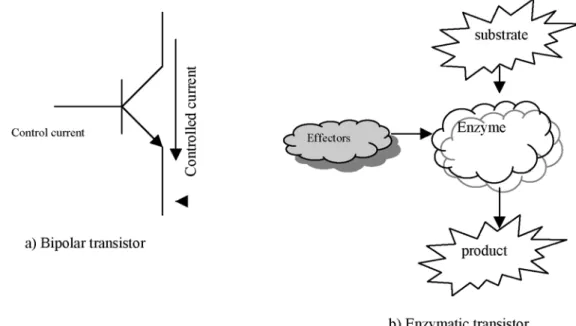
computa-tional logic, gates are constructed using elec-trical transistors which have base, emitter and collector terminals. The base current injected to the base terminal controls the current that flows from collector terminal to the emitter ter-minal. The control current injected to the base terminal is several orders of magnitude smaller than the controlled current of collector-emitter terminals.
In a biological transistor, there is no current in-volved. An enzyme, which is the biological equivalent of transistor, converts one kind of substrate into a different kind of product. The rate of conversion is controlled by effectors in Figure 1 11]. An OR gate made from this
type of enzymatic transistor is effected by two or more kinds of effectors. A logic gate of this kind is constructed by using biolumincense10].
A cell called Pseudomonas putida(TVA8)
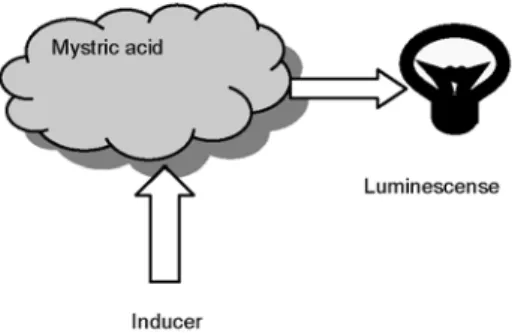
con-verts Myristic acid into light in the presence of inducer toluene or trichloroethylene(TCE).
In this example myristic acid is the input sub-stance of the biological transistor, light is the output substance and toluene or TCE is the in-put trigger that controls the conversion process. In this case the generation of light is controlled by either one of these inducer effectors. The overall behavior of this setup acts like an OR
Fig. 2. Bioluminescence is controlled by the inducer.
gate generating output (light) if either one of
the inputs(TCE or toluene)is present.
In order to solve complicated problems one needs many logic gates to function together. Es-tablishing interconnectivity between different biological logic gates can be done by employ-ing mechanism of intercellular communication. An example of this type of communication is known as AHL and it is used for controlling population of the colony. Normally, every cell produces certain amount of AHL and releases it to the surrounding. When the concentration of the AHL reaches a level due to the increased number of cells, the cell production is supposed to be stopped. This sort of intercellular commu-nication is the natural way cells communicate. A similar mechanism can be used for intercon-nectivity of cells to make up bigger system12].
Contrary to expectations biological computing elements can be remarkably fast. A simple bac-teria called Halobacterium halobium functions as a light driven proton pump and can be used to make a bistable red/green light switch which
operates at 500 femtoseconds5].
3.2. Quantum Computing
Another technology which promises extraordi-nary computational speed for special class of problems is quantum computing. Just like DNA computing, quantum computing is suitable for problems that require massive parallel process-ing.
connected back to back and turned on and off to implement complicated operations. The opera-tion of a quantum computer is given in Figure 3. to indicate the operation of a quantum computer.
Currently, there are only few problems that can take advantage of the massive parallelism of quantum computers13].
Fig. 3. Quantum computer gates.
Computing with quantum computers require initialization, processing and reading of cubits. There are currently more than one way of re-alizing cubits in hardware and this is likely to increase in the near future. Presently, the speed of a spin cubit gate made in silicon structure is in the order of 10;2
sec. and external operations dealing with cubits require 10;5
sec. Linear
density of cubits in semiconductors is currently 65 nm14]. Although the speed does not seem
very impressive, considering the inherent paral-lelism of each cubit gate, the overall processing speed is likely to be very high.
3.3. Reversible Computing
Reversible computing receives its name from the fact that reversible gates work both ways; forward and backward. In other words, there are no dedicated input and output lines in a re-versible gate. All lines, depending on the op-eration, can be either input or output lines. In addition to being reversible in direction of op-eration, the gates used in reversible computers are also thermodynamically reversible. Ther-modynamic reversibility means that the energy lost in changing the state of the gate is regained when the gate is changed back to the original state. Only small amount of energy is lost dur-ing the cycle of godur-ing and comdur-ing back from a state. This type of energy reversibility reduces the power consumption of the device to mini-mum levels so that many gates can be crammed into a VLSI package since power consumption and dissipation is reasonable.
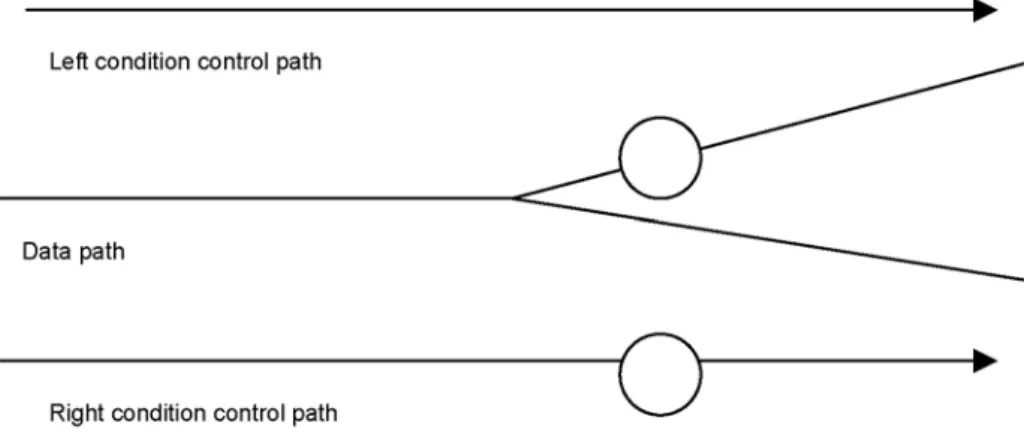
There are several designs made for reversible gate structures. One of the structures proposed by Merckle in 1993 is known as helical logic. In this design, the movement of single elec-tron is controlled by control logic. The opera-tion of the helical transistor can be explained as follows. An electron, which has two different paths to choose, is shown in Figure 4. The path of the electron is considered the data path. The
movement of the electron, selection of right or left path, is controlled by the electrostatic forces that act on the electron. The paths on both sides of the data path are called control paths. The electron on the data path is forced to take the right path if we send an electron on the left con-trol path simultaneously. The electrostatic force that acts on the data electron will force the elec-tron to take data path on the right. Likewise, if we want the data electron to take the left path, we should send a synchronized electron on the right control path15].
The name helical logic comes from the fact that the data and the control paths are actually rotat-ing electric fields which are easy to produce and adequate to drive wide range of logic devices
15]. Being thermodynamically reversible, this
type of circuit can be packed densely, can oper-ate at gigahertz range frequency and consumes very little power. Expected density of the de-vices is in the order of 1 nm16].
An advantage of this technology over the oth-ers is that, this technology is based on varia-tion of silicon technology we are quite familiar with. There is still much needs to be done be-fore making this technology mainstream, but it seems one of the promising technologies on the drawing board.
3.4. Optical Computing
Another promising technology of computation is optical computing. Optical computing has been around us for quite some time and used for experimental and research setups. So far it has not been accepted as mainstream technology because of problems with input power require-ments of optical logic circuits and the lack of
miniaturization. Most optical setups required high power laser beam and it is not possible to reduce the size to make it practical.
However, recent developments in optical com-puting have made optical comcom-puting a serious contender in alternative computing technology arena. The new approach utilizes optical com-puting not to replace but to enhance the current silicon processing technology.
Current computer architecture makes use of in-ternal buses to connect different gates imple-mented on the silicon hardware. Implemen-tation of the buses on VLSI hardware occu-pies considerable real estate space on the IC chip. Since the data can be transferred only in one direction at any given instant, the op-eration of the buses also stifles the speed of operation. Utilizing optical conduits as internal buses for transferring information in the form of light pulses present many advantages over the conventional bus for transferring information. By using different color pulses, it is possible to carry many sets of data simultaneously. The technique called wavelength division multiplex-ing can be used very effectively to increase the overall performance of the exiting processors.
Together with the new optical switching materi-als that operate at 60 Gigahertz and wavelength division multiplexing implemented inside CPU, we can expect computers with performance of 1017 operations per second17].
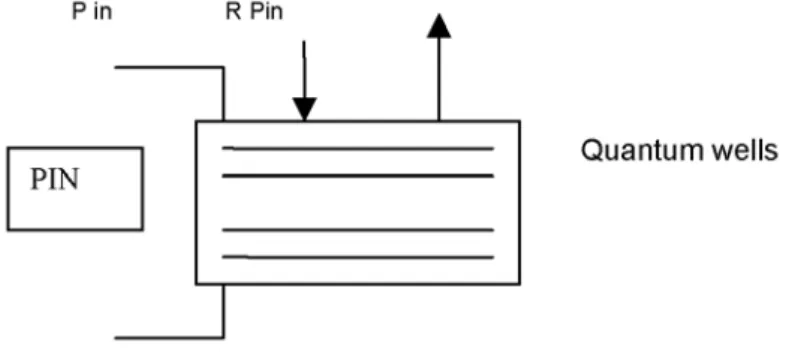
A new type low energy optical switch utiliz-ing this hybrid technology is called symmetric self-optical effect device. S-SEED works as an electronically controlled reflective switch. By controlling a gate voltage, reflective properties of the device can be changed. A schematic of an S-SEED device is shown in Figure 518].
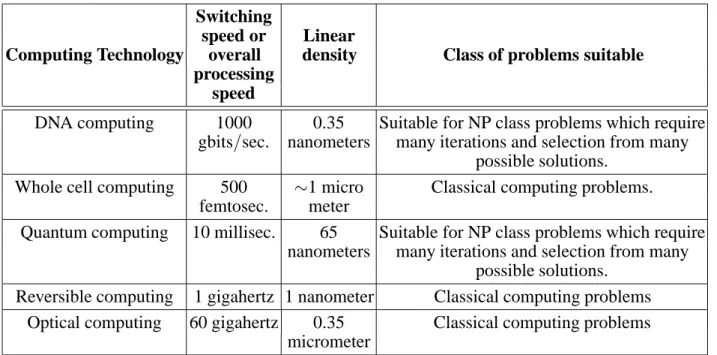
Switching
speed or Linear
Computing Technology overall density Class of problems suitable
processing speed
DNA computing 1000 0.35 Suitable for NP class problems which require gbits/sec. nanometers many iterations and selection from many
possible solutions.
Whole cell computing 500 1 micro Classical computing problems.
femtosec. meter
Quantum computing 10 millisec. 65 Suitable for NP class problems which require nanometers many iterations and selection from many
possible solutions. Reversible computing 1 gigahertz 1 nanometer Classical computing problems
Optical computing 60 gigahertz 0.35 Classical computing problems micrometer
Table 1. Comparison of existing alternative computing technologies.
S-SEED device can be manufactured in a hybrid chip form integrated with traditional switching gates. SEED device offers the possibility of us-ing optical signals as input and output signals to traditional VLSI chips. SEED integrated hybrid chip technology is called smart pixel and can be manufactured with traditional manufactur-ing technology. Through this method it seems that the pin out limitation of the VLSI chips can be tackled and power consumption can be reduced.
4. Comparison of Alternative Computing Technologies
The Table 1 above lists the potentially promis-ing technologies we expect to see in the near future.
5. Conclusions
In this paper we have discussed several tech-nologies which seem promising as alternative technologies for high performance information processing applications. All technologies are at their infancy and much remains to be done in or-der to make them mainstream technology. The
technologies are suitable for different classes of problems. DNA computing and Quantum com-puting may provide quick and easy solutions to problems which may be very difficult for classical sequential computers. Some technolo-gies are suitable for implementation as hybrid technology to enhance the performance of the existing silicon computers. Which technology becomes dominant is not necessarily dependant on the technical ability of the technology, but also on the political aspects of promoting the technology. It is also possible that none of the technologies becomes dominant and each tech-nology is limited to solving only very specific problems.
Although the figures for processing speed and density of each technology are given, these fig-ures alone do not represent the power of pro-cessing. Density figures indicate the current state of the art, but they are likely to be revised as the technology matures.
References
1] C. GWYN, Extreme ultraviolet technology
for next generation IC’s, Intel Corporation, http://www.intel.com/research/silicon /euv mpf 101100.pdf
2] F. L. CARTER, R. E. SIATKOWSKI,ANDH. WOHLT
-JEN, Molecular Electronic Devices, North–Holland, Amsterdam, 1988.
3] K. E. DREXLER, Nanosystems: Molecular
Ma-chinery, Manufacturing, and Computation, Wiley Interscience, 1992.
4] R. C. MERKLE, Reversible Electronic Logic Using
Switches, Nanotechnology, 4(1993), 21–40.
5] C. R. LOWE, Nanobiotechnology: The
fabrica-tion and Applicafabrica-tions of Chemical and Biological Nanostructures, Current Opinion in Structural Bio-logy 10(2000), pp. 428–434.
6] D. GHOSH, High throughput and global approaches
to gene expression, Comb. Chem. High Throughput Screen 3(2000), pp. 411–420.
7] G. S. WILSON, AND Y. B. HU, Enzyme–based
biosensors for in vivo measurements, Chem. Rev. 100(2000), pp. 2693–2704.
8] L. KARI, DNA computing in vitro and in vivo,
Fu-ture Generation Computer Systems 17(2001), pp.
823–834.
9] L. BOUSSE, Whole cell biosensors, Sensor Actuat.
34(1996)B, pp. 270–275.
10] M.L. SIMPSON, Bioluminescent bioreporter
inte-grated circuits (BBICs), in Smart Structures and
Materials Smart Electronics and MEMS(1998), pp.
202–212.
11] M. HIRATSUKA, T. AOKI ANDT. HIGUCHI, Enzyme
transistor circuits for reaction–diffusion computing, IEEE Transactions on Circuits and Systems I, Vol. 46, No. 2,(1999), pp. 294–303.
12] M. L. SIMPSON, Whole–cell Biocomputing, Trends
in Biotechnology 19(2001), pp. 317–323.
13] P. W. SHOR, Algorithms for quantum
computa-tion: Discrete logarithms and factoring, Proc. 35nd Annual Symposium on Foundations of Computer Science(Shafi Goldwasser, ed.), IEEE Computer
Society Press(1994), pp. 124–134.
14] V. PRIVMAN, D. MOZYRSKY, I. VAGNER, Design of
Gates for Quantum Computation: the Three–Spin XOR in Terms of Two–Spin Interactions, Int. J. Modern Phys. B(1998)12, pp. 591–600.
15] K.E DREXLER, Helical Logic, Nanotechnology,
1996, pp. 325–339
16] J. LEWIS ED. Nanocon proceedings,(1989)pp. 2.
17] H. ABDELDAYEM, Recent advances in photonic
de-vices for optical computing, NASA publication. http://science.nasa.gov/headlines /images/nanosecond/thepaper.pdf
18] B.S. WHERETT, Materials for Optical Computing,
Synthetic Metals 17(1996), pp. 3–9.
Received: July, 2002 Revised: May, 2003 Accepted: June, 2003
Contact address:
Tarik Ozkul American University of Sharjah Computer Engineering Division Sharjah UAE e-mail: [email protected]