Management System
Ng Set Foong1*, Foo Fong Yeng2, Chong Peng Hwa3
1,2
Faculty of Computer and Mathematical Sciences, Universiti Teknologi MARA Cawangan Johor, Kampus Pasir Gudang, Jalan Purnama, Bandar Seri Alam, 81750 Masai, Johor, Malaysia
3
Academy of Language Studies, Universiti Teknologi MARA Cawangan Johor, Kampus Pasir Gudang, Jalan Purnama, Bandar Seri Alam, 81750 Masai, Johor, Malaysia
Authors’ Email Address: *[email protected], [email protected], 3[email protected]
Received Date: 22 December 2019 Accepted Date: 20 January 2020
ABSTRACT
Assessment results are something private and confidential to most students. One may feel uncomfortable if his or her result is shown publicly. In most academic institutions, students’ results are displayed on a printed paper that contains the assessment of the whole class and the paper is usually posted on the notice board outside of the lecturer’s office. Students need to present personally at the lecturer’s office to check their results. Most of the time, students' names would be hidden on the paper but, students are still able to see each other’s results. Indirectly, the students’ results are not private though the lecturer does not intend to share them. In order to improve the privacy level of result management, a mobile application was programmed. This mobile application is an innovative tool that embedding the use of technology to assist students and educators in this era of Industrial Revolution 4.0. In this paper, the proposed mobile application/ app named as Result Tracking-on-Cloud (RTC) was presented. The users concluded that it is energy and time saving as they can check their results without present physically to the lecturer's office. At the same time, the privacy of students' result is secured.
Keywords: assessment, confidential, result, mobile app, result management system
INTRODUCTION
Towards the end of the semester, the assessment results are the concern of almost every student. It tells the students about their performances throughout the semester and how much effort should they spend in order to pass the final examination. It is the teacher or lecturer responsibility to inform students about their ongoing assessment result before the final examination begins such that the students will plan their revision strategically.
However, should the marks be revealed publicly has been a point of controversy? Some assume that announce the results publicly will promote a competitive atmosphere in class. Indirectly, the sense of competition creates a positive effect and students will be motivated to learn and participate more keenly in learning.
the students. In most academic institutions, lecturers will post the students' assessment result list without listing the students' names. The result list will only have the student identification card numbers and assessment marks. This action desires to give students some privacy in result viewing. The act of posting the result list without students' names is good but it still has some room to improve.
Furthermore, the assessment result list is usually posted on the bulletin board or notice board in front of the lecturer's office. Students need to present themselves physically to the bulletin board to check their ongoing assessment results. However, it may slightly time and energy consuming if the students need to present personally to the notice board. This also means that the students may not be able to know the result immediately if they are not on the campus.
To raise the confidential and privacy level of displaying students' results, a mobile application/app named Result Tracking-on Cloud (RTC) was designed. Through this mobile app, students can view their results anytime and anywhere without present physically on the campus. As this mobile app required the student to key in their student identification number for verification, students could only check their results and the possibility for them to access other results is reduced.
This paper is organised as follows: The second section gives a brief introduction on assessment types, traditional ways of displaying results and its disadvantages, and students’ perceptions towards private and confidential level of displaying the result. Then, the methodology is presented in the third section. The fourth section depicts the proposed mobile app, Result Tracking-On-Cloud (RTC). The reason to implement the mobile app and the student evaluation of using the app is described in the fifth section. The last section draws a conclusion.
BACKGROUND OF THE STUDY
Assessment Types
For every taught course in university, assessment is carried out for evaluation purposes. Jabbarifar (2009) stated that four basic components in the assessment are: 1) measuring improvement over time, 2) motivating students to study, 3) evaluating teaching methods, 4) ranking students’ capabilities to the whole group evaluation. For most courses in university, there are two types of assessment, namely formative assessment, and summative assessment. Both summative and formative assessments are integral parts of assessing students' performance in a balanced assessment system (Brookhart, 2001; Newton, 2007; Dixson & Worrell, 2016).
Formative assessment is usually carried out during the semester and it consists of different components such as tests, quizzes, assignments or projects. Each component contributes to different weight to the whole course evaluation. For different courses, the test can be carried out in different forms such as written tests, listening tests or speaking tests. The quizzes or assignments can also be conducted either online or written form.
Traditional Way of Result Display Method and Its Disadvantages
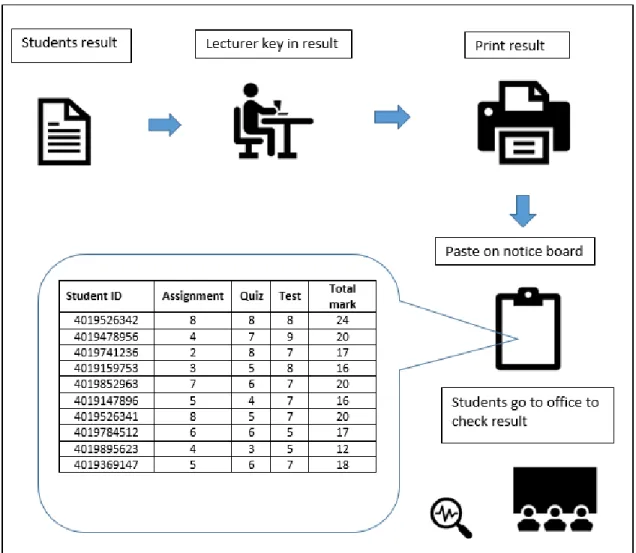
In university, many lecturers adopt the traditional way of displaying the students' results. It is a printed paper containing the assessment results of all students. The printed paper is usually displayed on the notice board outside of the lecturer's office. Students need to present personally at the lecturer’s office to check the result. The flow of this traditional way of handling and displaying the students' results is shown in Figure 1. Most of the time, although lecturers would hide the students' names on the paper when the results are posted, students are still able to see the result of each other.
Figure 1: The Flow of Traditional Way of Handling and Displaying Students Result
Students Perception towards Privacy of the Result
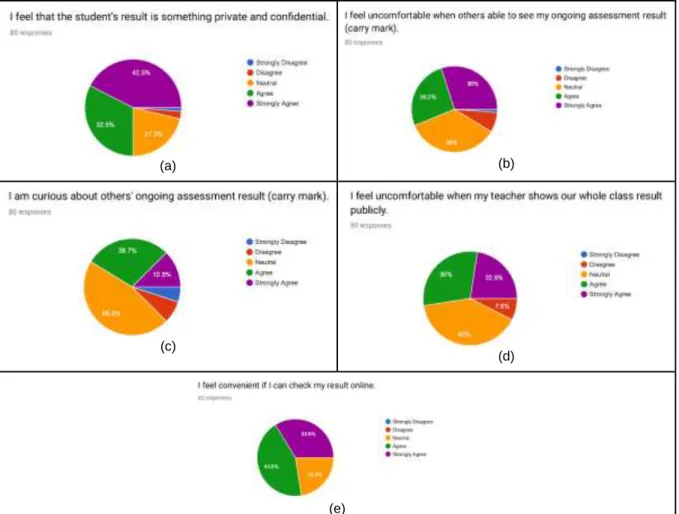
Figure 2 reveals the students' perception of the privacy of their performance. Fig 2(a) shows that the students’ consciousness regards the privacy of the result is high. About 75% of students strongly agreed or agreed that student’s result is something private and confidential. There are 21.3% of students who are holding a neutral opinion towards the privacy of results. Fig 2 (b) displays that slightly more than half of the students feel uneasy and uncomfortable when their results are known by others. The awareness of personal data protection has become a global issue (Chen & Ismail, 2013). The personal data includes not only personal financial data but also all sort of data linking to an individual. In general, students opined that their result is private and confidential.
In Fig 2 (c), there are approximately 40% of students who are either strongly agreed or agreed that they are curious about others’ results, more than 40 percent of students have a neutral opinion towards their curiosity. Fig 2 (d) indicates that half of the students feel uncomfortable when their results were displayed publicly and 40 percent of students feel neutral regards this issue. Fig 2 (e) shows that about three-quarters of students incline to access their results online which means they do not have to present physically to the noticeboard.
(a) (b)
(c)
(d)
(e)
Figure 2: Students Perception towards the Privacy of Assessment Result and Conveniency of Checking Results Online. (a) Students consciousness regards the privacy of results. (b) Students uneasiness feeling when their results are known by others. (c) Students curiosity towards others result. (d) Students sensation
METHODOLOGY
In order to improve the privacy level of result management, a mobile application named Result Tracking-on Cloud (RTC) was created in this study. The mobile app is created using Open as App. The Open as App is a website that enables the creation of a mobile app by using Microsoft Excel file as the data source. The student’s assessment result is first stored in a Microsoft Excel spreadsheet. Then, the spreadsheet is assigned as the data source in Open as App. The necessary entries such as student identification number, name, and ongoing assessment component (such as test, quiz, project, and assignment) are selected as the elements in the mobile app. Then, the background of the screen in the mobile app is designed. After the mobile app is created, it was pilot tested and implemented in several classes in a university. A survey on the feedback of the implementation is done. The results of the survey are analysed.
THE PROPOSED MOBILE APPLICATION, RESULT TRACKING-ON-CLOUD (RTC)
In this section, the details of the proposed mobile application/app, Result Tracking-on Cloud (RTC), are presented. By using this app, the flow of result management is slightly different from the conventional flow of result management. But still, there are two parties involved in this new system of result management. Lecturer: The lecturer is the course instructor who carries out the teaching duties and the evaluation of the ongoing assessment of the students. After the evaluation process, the student assessment result is obtained. Student: The student is an individual who attends the classes under the lecturer. The student will be evaluated by the ongoing assessment conducted by the lecturer.
The proposed RTC mobile app has the following elements:
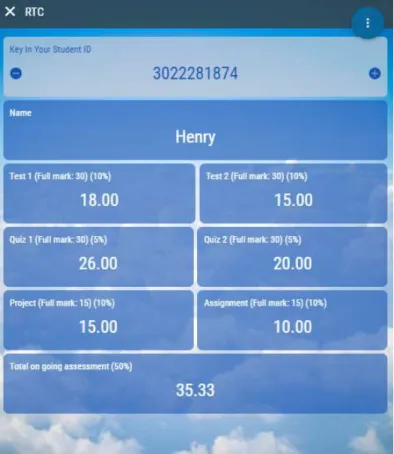
Authenticity: In the first entry of the proposed RTC mobile app, each student must key in his/her student identification number (ID number) provided by the university. Every student has a unique student ID number at the university. When the app receives the valid student ID, the student's name will appear in the second entry of the app. In this way, the student may verify if the app has received the correct information from the first entry. The result will only be displayed if the student ID is valid.
Privacy: When the student ID is received by the app, it will link to the result that has been stored in the cloud. Then, only the ongoing assessment of this particular student will be sent to the app and displayed on his/her mobile phone. This means that the results of the whole class are not displayed. In this way, the privacy of the student is protected.
Figure 3: The Screenshot of the Proposed RTC Mobile App to Display Assessment Result
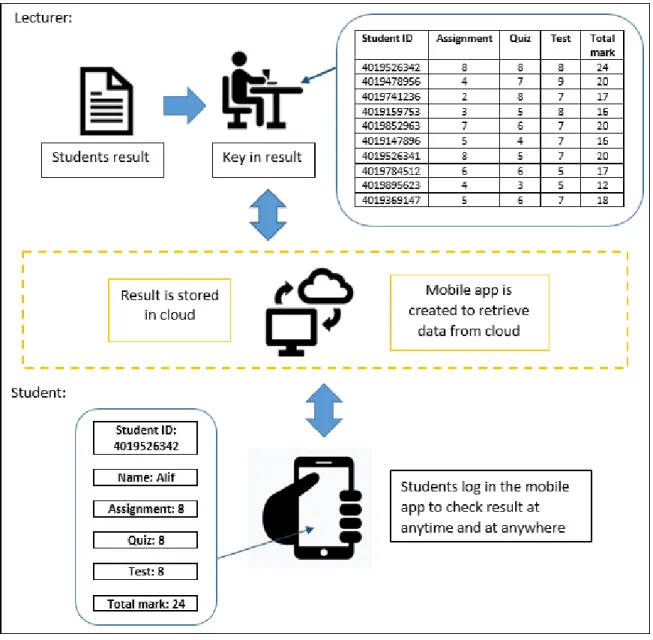
The RTC mobile app is application software that designed can be run on mobile devices such as smartphones, tablets or phablets. The flow of the result management by using the mobile app is shown in Figure 4. The lecturer will evaluate the student's performances through assessment and the result will be stored in the cloud.
Figure 4: The Flow of the Result Management by Proposed RTC Mobile App
IMPLEMENTATION OF THE RTC MOBILE APP
The Reason of Proposed New Result Management App
smartphone for educational purposes. The types of app frequently used by university students are text messaging, search engines, calculators, English dictionary, YouTube, camera, and voice recorder (Taleb & Sohrabi, 2012; Reese Bomhold, 2013; White & Mills, 2014).
Evaluation of the RTC Mobile App
A survey was conducted to investigate the evaluation of the usage of the mobile app. The sample size for conducting the survey was 80 respondents.
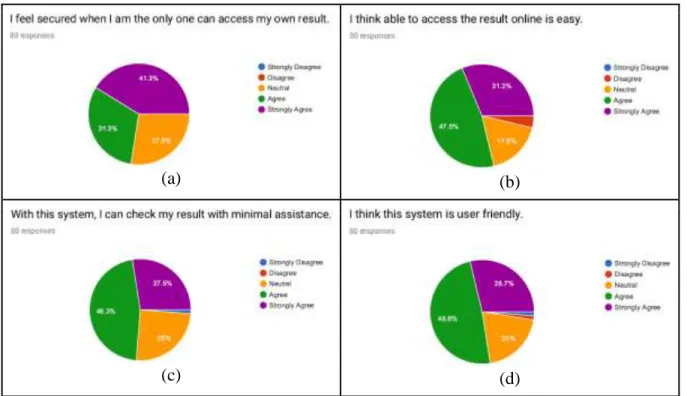
Figure 5 presents the students' evaluation of the implementation of the RTC mobile app. Fig 5 (a) shows that approximately three-quarters of students feel secure when they know the mobile app provides an access restriction to result and 27.5% of students feel neutral if they are the only one could access their own results. In Fig 5 (b), there are 31.3% and 47.5% of students strongly agreed or agreed that able to access the results online is easy.
Fig 5 (c) indicates that more than 70% of students strongly agreed or agreed that they could use the mobile app with minimal assistance from the lecturer and one-fourth of students hold a neutral view regards the difficulty of using this system. Fig 5 (d) is the students’ responses as end-users using this app. More than three-fourths of the students strongly agreed or agreed that the mobile app interface is user-friendly and one-fifth of students hold a neutral opinion regards this app
(a)
(b)
(c)
(d)
Figure 5: Students Appraisal of the RTC Mobile App as a Result Management System. (a) Students sense of secure when their results could not access by others. (b) Students viewpoint regards checking results online. (c) The difficulty level of using the RTC mobile app. (d) Students response of using the RTC mobile
CONCLUSION
Posting the list of student achievements on noticeboard is nothing new in an academic institution. Would publicly displaying student results benefit the learning process is something debatable. In order to reduce the possibility of public humiliation, most of the lecturers would hide the name of the student when the result list is posted on the noticeboard. Then, students will need to present physically to the noticeboard to check their results. Their assessment marks could be identified through student ID.
A survey of 80 respondents was conducted to investigate the student perception towards the privacy level and convenience of a traditional way of the result checking process. The survey shows that the majority of the students are aware that the result checking process is something private and confidential. Half of the respondents felt uncomfortable when their results were known by others. About 40% of the students were curious about the assessment mark of their counterparts. Three-quarters of respondents preferred the result checking online.
The RTC mobile app, a new result management system, was designed to make the result checking process easier and more confidential. With the implementation of this mobile app, majority of the respondents felt secure when they knew that there is restricted access to the result. Most of the students agreed that able to check their results online is convenient and easy. The majority of them agreed that this app is user-friendly and could be used with minimal assistance from the lecturers.
All the students participated in this pilot study are university undergraduates. Being able to check the individual result using smartphones anytime at anywhere aligns with the concept of education for the future, which is Education 4.0. Flexible and adaptive learning paths and incessant use of technology are deeply embedded in Education 4.0 (Puncreobutr, 2016). Therefore, the proposed RTC mobile apps is an innovative tool that caters the need of the society in this innovative era of Industrial Revolution 4.0 where technology is embedded into education.
REFERENCES
Benedict, L., & Pence, H. E. (2012). Teaching chemistry using student-created videos and photo blogs accessed with smartphones and two-dimensional barcodes. Journal of Chemical Education, 89(4), 492-496.
Brookhart, S. M. (2001). Successful students' formative and summative uses of assessment information. Assessment in Education: Principles, Policy & Practice, 8(2), 153-169.
Chen, L. F., & Ismail, R. (2013). Information Technology program students' awareness and perceptions towards personal data protection and privacy. In 2013 International Conference on Research and Innovation in Information Systems (ICRIIS) (pp. 434-438). IEEE.
Dixson, D. D., & Worrell, F. C. (2016). Formative and summative assessment in the classroom. Theory into practice, 55(2), 153-159.
Hong, Y. H., Teh, B. H., & Soh, C. H. (2014). Acceptance of smart phone by younger consumers in Malaysia. Asian Social Science, 10(6), 34.
Jabbarifar, T. (2009). The importance of classroom assessment and evaluation in educational system. In Proceedings of the 2nd International Conference of Teaching and Learning (pp. 1-9).
Kafyulilo, A. (2014). Access, use and perceptions of teachers and students towards mobile phones as a tool for teaching and learning in Tanzania. Education and Information Technologies, 19(1), 115-127. Mothar, N. M. M., Hassan, M. B. A., Hassan, M. S. B. H., & Osman, M. N. (2013). The importance of
Mtega, W. P., Bernard, R., Msungu, A. C., & Sanare, R. (2012). Using mobile phones for teaching and learning purposes in higher learning institutions: The case of Sokoine University of Agriculture in Tanzania.
Newton, P. E. (2007). Clarifying the purposes of educational assessment. Assessment in education, 14(2), 149-170.
Osman, M. A., Talib, A. Z., Sanusi, Z. A., Shiang-Yen, T., & Alwi, A. S. (2012). A Study of the Trend of Smartphone and its Usage Behavior in Malaysia. International Journal of New Computer Architectures and their Applications (IJNCAA), 2(1), 274-285.
Puncreobutr, V. (2016). Education 4.0: New challenge of learning. St. Theresa Journal of Humanities and Social Sciences, 2(2).
Reese Bomhold, C. (2013). Educational use of smart phone technology: A survey of mobile phone application use by undergraduate university students. Program, 47(4), 424-436.
Taleb, Z., & Sohrabi, A. (2012). Learning on the move: the use of mobile technology to support learning for university students. Procedia-Social and Behavioral Sciences, 69, 1102-1109.