A Constraint Guided Progressive
Sequential Mining Waterfall
Model for CRM
Bhawna Mallick
1, Deepak Garg
1and P. S. Grover
21Department of Computer Science & Engineering, Thapar University, Patiala, India 2Department of Computer Science & Engineering, GTBIT, Delhi, India
CRM has been realized as a core for the growth of any enterprise. This requires both the customer satisfaction and fulfillment of customer requirement, which can only be achieved by analyzing consumer behaviors. The data mining has become an effective tool since often the organizations have large databases of information on customers. However, the traditional data mining techniques have no relevant mechanism to provide guid-ance for business understanding, model selection and dynamic changes made in the databases. This article helps in understanding and maintaining the requirement of continuous data mining process for CRM in dynamic
environment. A novel integrative model, Constraint
GuidedProgressiveSequentialMiningWaterfall(
CGP-SMW) for knowledge discovery process is proposed.
The key performance factors that include management of marketing, sales, knowledge, technology among others those are required for the successful implementation of CRM. We have studied how the sequential pattern min-ing performed on progressive databases instead of static databases in conjunction with these CRM performance indicators can result in highly efficient and effective useful patterns. This would further help in classification of customers which any enterprise should focus on to achieve its growth and benefit. An organization has limited number of resources that it can only use for valu-able customers to reap the fruits of CRM. The different steps of the proposed CGP-SMW model give a detailed elaboration how to keep focus on these customers in dynamic scenarios.
Keywords: customer relationship management, key per-formance indicators, data mining techniques, constraints, sequential patterns, progressive databases, incremental mining
1. Introduction
In the competitive market today, it has become essential to maintain regular customers along with the effort made to acquire new ones. This
contributions to a business. These aspects need to be incorporated as constraints while mining to achieve business specific information regard-ing the CRM.
This study attempts to integrate the constraints identified from the customer value analysis, along with the sequential pattern mining on pro-gressive database. So, it establishes a method of mining customer behavior rules in the dynamic environment. In this study, we have proposed the Constraint Guided Progressive Sequential Mining Waterfall(CGP-SMW)model that can assist managers in developing better market-ing strategies and plannmarket-ing for successful im-plementation of CRM. The contribution of this research article can be summarized as below: 1. To understand the need of customer value
analysis for CRM.
2. To study the importance of sequential pattern mining over other data mining technique for analyzing consumer behavior.
3. To signify the role of incorporating straints in mining process referred to as con-straint-based sequential pattern mining( CB-SPM).
4. To focus on applying CBSPM on progressive databases instead of static databases. This would aid in getting useful knowledge un-der dynamic environment.
5. To identify the key performance parameters for CRM. These factors could be used to de-cide the frequency for application of mining technique on progressive databases.
6. To establish a Constraint Guided Progressive Sequential Mining Waterfall (CGP-SMW)
model for CRM that can be used by business managers for decision-making.
The rest of this article is organized as follows: In Section 2, we briefly cover the association of customer relationship management (CRM)
and the data mining. In Section 3, the re-lated work based on different data mining tech-niques used for CRM is cited. The constraint based sequential pattern mining on progressive databases is induced in Section 4. Integration of CRM key performance indicators along with the mining process is discussed in Section 5 to have dynamic useful results. Based on these concepts, we have proposed CGP-SMW model
for successful implementation of CRM, using constraint based sequential pattern mining in Section 5. We have concluded our study in Sec-tion 6.
2. Customer Relationship Management and Data Mining
Customer Relationship Management(CRM)is being used by any organization to identify the problems of customers and to improve the con-sistency with them. CRM is the utilization of customer related information or knowledge to deliver relevant products or services to cus-tomers (Parvatiyar et al., 2001; Collins, K. 2001). The main objective of CRM is to re-tain high value customers and to acquire new customers by providing high satisfaction. This further requires meeting customer needs, im-proving customer service and performing cus-tomer analysis. It also helps in maximizing the corporate profit to a measurable extent. Cus-tomer satisfaction provides results in the form of increased purchased volumes, repetitive pur-chases by regular and new customers, genera-tion of new business in the form of references and word of mouth. However, due to the indus-trial automation, most enterprises have gener-ated a mass of business data. Often the useful and valuable information is hidden in the enter-prise database which is required for customer analysis.
analysis and cluster analysis are some of them. In recent times, methods like decision tree, arti-ficial neural networks and rules induction have become quite popular.
Rule induction is an area of machine learning in which formal rules are extracted from a set of observations. The rules extracted may rep-resent a full scientific model of the data, or merely local patterns in the data. These rules could be formulated based on association min-ing or sequential pattern minmin-ing. Sequential pattern mining algorithms address the problem of discovering the existent frequent sequences in a given database. Sequential pattern min-ing is different from association rule minmin-ing, where the events are linked by time. Sequential patterns are generated using the correlation be-tween transactions while association rule min-ing gives patterns based on intra transaction re-lationships. Sequential pattern is a sequence of item sets that frequently occur in a specific order; all items in the same item set are sup-posed to have the same transaction time value or a value within a time gap. A sequential pat-tern is a sequence having support greater than or equal to a minimum threshold, called the mini-mum support. The support of a sequence is the percentage of data sequences containing the se-quence. The support calculation for association rules mining is transaction-based. However, se-quential pattern mining makes use of sequence-based support calculation. It is obvious from this discussion that the sequential pattern min-ing is more useful than any other data minmin-ing technique for CRM. It can play a vital role in studying the customer purchasing behavior due to its sequential tendencies to formulate strate-gies and marketing plans.
3. Related Work
Many previous CRM-related researches used different data mining techniques to analyze and understand customer behavior and characteris-tics. For example, Kim, Jung, Suh, and Hwang
(2006) adopted decision tree to classify the customers and further develop CRM strategies. This study is based on customer segmentation in accordance with their lifetime value so as to facilitate CRM. Hwang, Jung, and Suh(2004)
used logistic regression to segment customers. They used customer loyalty as the basis of seg-mentation. Kim and Street (2004) proposed a system which makes use of neural networks and genetic algorithm for customer targeting. Kim(2006)used logistic regression and neural networks for feature selection to predict churn. However, Baesens(2004)identified the slope of the customer lifecycle based on Bayesian net-work classifier. Sinha and Zhao(2008)adopted decision tree and logistic regression for churn prediction by incorporating domain knowledge into data mining. Tsai and Lu(2009)used hy-brid neural network for churn prediction. How-ever, customer value analysis is required when the focus is on retaining valuable customers and acquiring new customers for CRM. This further mandates studying and analyzing customer pur-chasing behavior. Association rule mining and sequential pattern mining can only be useful in such cases of CRM.
For different purposes in CRM, there have been researches on the utilization of association rules and sequential patterns. Sequential patterns can be used to predict future complaint(Lariviere & Van den Poel, 2005) and network banking churn(Chiang,Wang, Lee, & Lin, 2003). Ag-garwal, Procopiuc, and Yu (2002) conducted market basket analysis to identify association rules. Changchien, Lee, and Hsu(2004) used neural networks and association rules obtained from market basket analysis to develop on-line personalized sales promotion. Tsai and Chen
(2010)used association rules to select variables for churn prediction. There are limited stud-ies based on customer value analysis using se-quential pattern mining in the literature. Those available have shortcoming as discussed in next section.
4. Problem Formulation
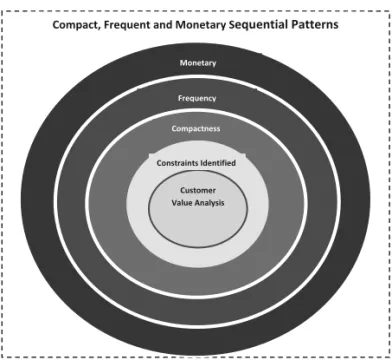
a possible and effective solution to this prob-lem. There is much importance of the mech-anism of constraint-based mining as it allows the user to have focused results in form of ap-plication semantics and business specific pat-terns. Besides allowing user exploration and control, the paradigm allows many of these con-straints to be pushed deep inside mining. This prunes the search space of patterns to those of interest to the user and achieves superior per-formance. The mining process which incorpo-rates user-specified constraints to reduce search space and derive only the user-interested terns is called constraint-based sequential pat-tern mining (CBSPM). There has been some research work in the area of CBSPM. Hosseini, Maleki, and Gholamian(2010)used RFM val-ues with K-means algorithm to classify the cus-tomer loyalty. Cheng and Chen (2009) used RFM values with K-means and rough set the-ory to segment customers. Chen, Kuo, Wu, and Tang (2009) identified purchasing patterns in the form of sequential patterns. Huang, Chang, and Wu (2009) adopted K-mean and cluster-ing to analyze the characteristics of customers based on RFM values. Chiang (2010) mined association rules of customer values. Mallick et al(2012)used CFM with the mining algorithms to give constraint based sequential patterns. However, a big question arises how to decide for the constraints that should be incorporated within the mining process? These studies have identified the constraints based on particular
ap-Customer
ValueAnalysis
ConstraintsIdentified
Compactness Frequency
Monetary
Compact,FrequentandMonetarySequentialPatterns
Figure 1.Identification of constraints based on
Customer Value Analysis(core)of CRM.
database. But, the problem to have the current state of the database persists with the incremen-tal constraint based sequential pattern mining. This is due to the presence of previous sequen-tial patterns that would become irrelevant and new sequential patterns might appear. When sequential patterns are generated, the newly ar-riving patterns may not be identified as frequent sequential patterns. This is because of the exis-tence of old data and sequences. Further to the problem, the results may depict the obsolete se-quential patterns that are not frequent recently. The incremental constraint based mining does not consider deletion of the obsolete data from the sequence database. This may cause lack of interest among the CRM users. It is noted that CRM users are usually more interested in the recent data than in the old ones.
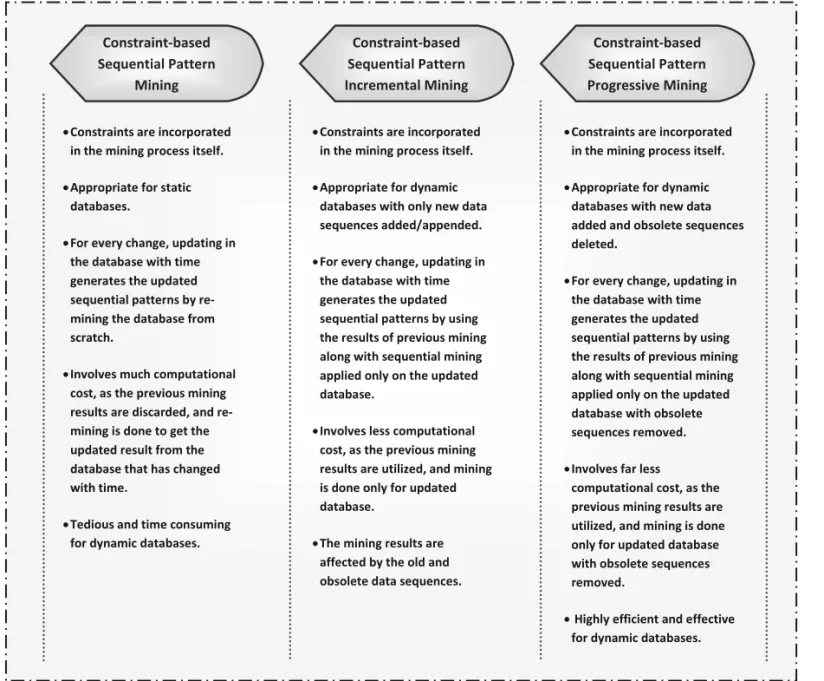
The solution comes in form of progressive se-quential pattern mining which deals with a pro-gressive database. This type of mining not only adds new data to the original database, but also removes obsolete data from the database. The sequential pattern mining with a static database finds sequential patterns in the database that do not change over time. The sequential pat-tern mining with an incremental database cor-responds to the mining process where there are new data arriving with time. As for the sequen-tial pattern mining with a progressive database, new data are added into the database and ob-solete data are removed simultaneously[detail study is done in Figure 2]. Therefore, one can find the most up-to-date sequential patterns that are not influenced by obsolete data. This has been well justified in our study made on pro-gressive databases, Mallick et al. (2013).
xConstraintsareincorporated
intheminingprocessitself.
xAppropriateforstatic
databases.
xForeverychange,updatingin
thedatabasewithtime
generatestheupdated
sequentialpatternsbyreͲ
miningthedatabasefrom
scratch.
xInvolvesmuchcomputational
cost,asthepreviousmining
resultsarediscarded,andreͲ
miningisdonetogetthe
updatedresultfromthe
databasethathaschanged
withtime.
xTediousandtimeconsuming
fordynamicdatabases.
xConstraintsareincorporated
intheminingprocessitself.
xAppropriatefordynamic
databaseswithonlynewdata
sequencesadded/appended.
xForeverychange,updatingin
thedatabasewithtime
generatestheupdated
sequentialpatternsbyusing
theresultsofpreviousmining
alongwithsequentialmining
appliedonlyontheupdated
database.
xInvolveslesscomputational
cost,asthepreviousmining
resultsareutilized,andmining
isdoneonlyforupdated
database.
xTheminingresultsare
affectedbytheoldand
obsoletedatasequences.
xConstraintsareincorporated
intheminingprocessitself.
xAppropriatefordynamic
databaseswithnewdata
addedandobsoletesequences
deleted.
xForeverychange,updatingin
thedatabasewithtime
generatestheupdated
sequentialpatternsbyusing
theresultsofpreviousmining
alongwithsequentialmining
appliedonlyontheupdated
databasewithobsolete
sequencesremoved.
xInvolvesfarless
computationalcost,asthe
previousminingresultsare
utilized,andminingisdone
onlyforupdateddatabase
withobsoletesequences
removed.
xHighlyefficientandeffective
fordynamicdatabases. ConstraintͲbased
SequentialPattern Mining
ConstraintͲbased SequentialPattern IncrementalMining
ConstraintͲbased SequentialPattern ProgressiveMining
5. Proposed Work
With this discussion, the significance of CB-SPM on progressive databases for CRM has been realized. There are other important as-pects, as mentioned below, that requires to be studied in detail:
1. Who are the CRM users to make use of customers’ purchasing progressive sequence databases?
2. What are the different ways in which CRM users access the customers’ purchasing pro-gressive sequence databases?
3. How is it decided on the frequency of access to the customers’ purchasing progressive se-quence databases?
The answers to all these queries could be made by identifying the factors that contribute to the successful implementation of CRM. The type/number of CRM users will depend on the nature of CRM factors. These CRM features will also cause difference in the access methods and the frequency of usage of the customers’ purchasing progressive sequence databases. In the next section, we have identified the key per-formance contributors for CRM.
5.1. CRM Key Performance Indicators
Different factors contribute to the implementa-tion of best CRM. These include management of different aspects, that is, technology, sales, marketing, customer service, supply chain, in-ventory control, knowledge and retail. Technol-ogy can help to reach market and publicize the products to the customers. It could be used to make convenient, easier and better services to them like making use of online payment, main-taining customer call centers for feedbacks and complaints etc. The sales management is often the backbone of CRM as it is responsible for enhancing the sales of the products. To achieve it, it could make use of efficient planning and strategy formulation. The other important fac-tor is marketing management which ensures the appropriate suggestions for new products. It takes care of the strategy based on customers, company and competitor analysis. Every ef-fort goes in vain if we are not able to main-tain the customer once acquired. This requires
good customer support and service. It includes answering the customer’s query, satisfying the customers for their complaints and assessing their valuable suggestions for future improve-ments and advanceimprove-ments.
The very first level of customer satisfaction is achieved by delivering the required product on time. This could only be maintained by ap-propriate inventory control and supply chain management. Appropriate inventory control ensures timely delivery of new and fresh prod-ucts without the need of much storage require-ment. However, the supply chain management requires proper coordination of all departments of organization. The storage of raw materi-als, production and delivery to customers that is from point-of-origin to point-of-consumption needs to be well managed. Knowledge man-agement is another crucial factor of CRM, as it helps to make forecast of products based on previous data. It also enables to attract the cus-tomers for the products and ideas of the enter-prise. The employees of the organization can improve their future by making benefit for the same. Lastly, retail management contributes for the CRM by delivering the manufactured prod-ucts to the customers through short and con-venient channels. Due to the importance and relevance of these factors to the success of the CRM, we have termed them as the Key Perfor-mance Indicators (KPIs) for the CRM in this article.
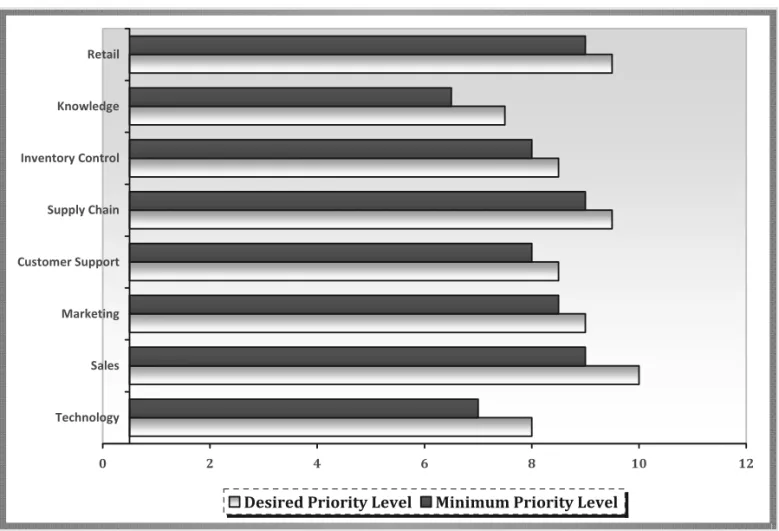
Figure 3 depicts the identified eight key perfor-mance indicators along with their desired and minimum priorities for CRM implementation of any enterprise on a scale from 1 to 10. The desired priority level specifies a specific KPI to achieve in normal scenarios for the successful execution of CRM. However, under any circum-stances, the KPI should at least maintain the minimum priority level for the CRM.
0 2 4 6 8 10 12
Technology Sales Marketing
CustomerSupport
SupplyChain
InventoryControl
Knowledge Retail
DesiredPriorityLevel MinimumPriorityLevel
Figure 3.CRM key performance indicators along with the desired and minimum priority level for any enterprise.
5.2. Constrained Guided Progressive Sequential Mining Waterfall (CGP-SMW) Model
It has already been mentioned in Section 3 and Section 4 that incorporation of constraints in the mining process itself could give useful and more relevant business- centric patterns. There has to be a basis for the selection of constraints and for the CRM application the customer value analy-sis is recommended. The identified constraints should be further used to generate sequential patterns by using them within the mining pro-cess. This will improve the value of the results obtained. The discovered patterns could be fur-ther used to classify the customers based on the scores or priority assigned to each resultant se-quential pattern. These customers are the ones on which any enterprise should focus and con-centrate their limited resources to achieve the goals of the CRM. However, looking at the dy-namic and versatile nature of the CRM due to customer purchasing behavior, the discovered patterns lose their significance with time. So it
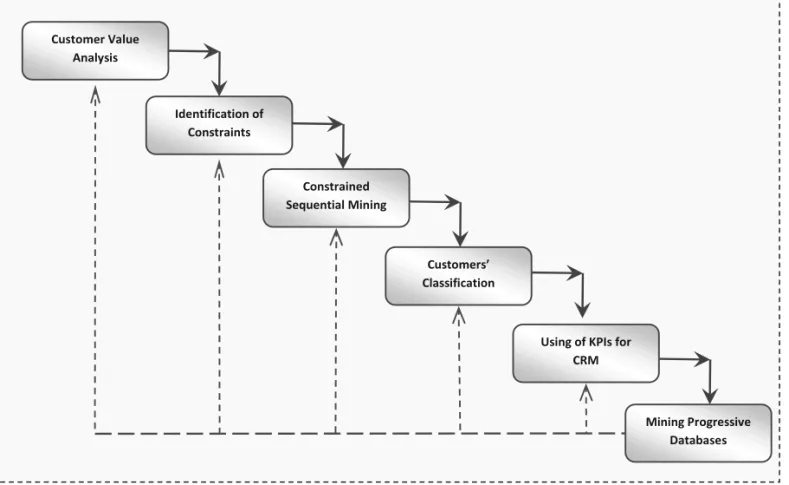
becomes necessary to maintain the progressive databases, instead of static or incremental. This will generate the most relevant and useful pat-terns giving valuable customers for CRM. This leads to an obvious query how to maintain the progressive database, that is, are we required to change and modify the database with every addition, modification or deletion? If we are to follow this, then the progressive database man-agement would become tedious, expensive and time consuming process itself. To take this into account, the frequency of maintaining the pro-gressive database could be decided based on the CRM’s key performance indicators. The factors which are significant for the successful implementation of the CRM have been identi-fied. Based on the requirements of these KPIs the progressive database could be maintained. To get valuable customers for any enterprise for the objectives of CRM relevant in both scalable and dynamic environments, the steps as given below, can be followed:
2. Identify the constraints relevant for the busi-ness based on step 1.
3. Conduct the sequential mining by incorpo-rating the constraints in step 2.
4. Classify the customers based on the patterns generated in step 3.
5. Identify KPIs for CRM and use them to de-cide the frequency of maintaining progres-sive database.
6. Perform sequential mining on progressive databases to get the valuable customers with the changing environment.
As prominent, these steps need to be performed in a specific sequence, that is, each step needs to be executed after the successful completion of the previous one. At the same time, the results of earlier step are being used by the next step for its implementation. It is the typical behav-ior of the waterfall model. We can, therefore, consider our model as a Constraint Guided Pro-gressive – Sequential Mining Waterfall ( CGP-SMW)model, as given in Figure 4.
This model is iterative in nature to take care of the changes with time. The parameters of
cus-tomer value analysis could differ in dynamic environment. For example, we have suggested acquiring new customers, maintaining regular customers and preserving valuable customers as important parameters for customer value anal-ysis. These could be modified, added or ap-pended with other parameters by any enterprise in competitive market. It would require further analysis and this would lead to identification of different constraints altogether. For example, for our suggested parameters compactness, fre-quency and monetary constraints are identified. However, if the enterprise intends to change the parameter of customer value analysis based on the number of purchases made by the customer in single transaction, then the length constraint has to be incorporated in the mining process. As the sequential pattern mining is based on con-straints, it is to be performed again with every alteration in step 1, leading to change in step 2 and all the following steps, as the model inherits waterfall nature. In fact, it is not necessary that we need to always transform from step 1 to take care of scalability in modern business scenario. For example, if required to change the CRM’s KPI to modify the frequency of maintenance
CustomerValue
Analysis
Customers’
Classification
Identificationof
Constraints
Constrained
SequentialMining
UsingofKPIsfor
CRM
MiningProgressive
Databases
of progressive databases, then the iteration is limited to steps 5 and 6.
We can conclude that the CGP-SMW model is hence iterative waterfall model as shown in Fig-ure 4. The detailed and elaborative version of this model is given in Figure 5.
6. Conclusions
Customer relationship management is essential effectively to compete today’s market. The profitability of an enterprise depends on the
1
C
u
st
o
m
er Val
u
e
Anal
y
sis
2
Ident
ifica
ti
o
n
o
f
Const
rai
n
ts
3
Sequ
ent
ial
Pattern M
ini
n
g
4
Cl
a
ssi
fi
c
a
ti
o
n
s o
f
Cus
tomers
5
Us
es
of
KP
Is
f
o
r
CRM
6
Mini
ng Pro
gres-sive D
a
ta
ba
se
s
Acquire
new
customer
Preserve
valuable
customer Customer
retention
CompactͲ
ness
Monetary Frequency
Discover
Constraint
Patterns
Classify
customers
Apply
Constraint s
Mining
Sequential
Databases
Constraint
Sequential
Pattern
Divide
patterns
2
3
4
5
6
F
Identify
KPIfor
CRM
Generate
Progressive
databases
Usethem
tomaintain
databases
Constraint
Sequential
Patterns
Perform
Incremental
Mining Maintain
Progressive
databases
use of information about customers and meet-ing their needs effectively. CRM based on CB-SPM can help enterprises obtain and maintain competitive advantage. CRM based on CBSPM can understand customer’s needs, improve cus-tomer’s satisfaction, gain more share in the mar-ket for the enterprise and ultimately promote its profitability. The constraints could be identified based on customer value analysis and applied on progressive databases to take care of the scal-able market. Studies reveal that almost 70% of the efforts put in the CRM initiative goes down the drain and the CRM fails due to inability of the performing companies to resolve certain key issues(D. K. Rigby and D. Ledingham, 2004). So the performance factors for CRM like sales, marketing, technology etc. should be utilized to decide on the access mechanism and frequency of using the progressive database. The pro-posed model, CGP-SMW, if used appropriately, will help in getting the information about the customers any enterprise should focus on for achieving the objectives of CRM.
Acknowledgements
The authors would like to thank the Editor and anonymous referees for providing valuable comments and constructive suggestions. We ex-press our gratitude to the Galgotias College of Engineering and Technology, Greater Noida for the support provided to complete this research work.
References
[1] C. C. AGGARWAL, C. PROCOPIUC, P. S. YU, Finding
localized associations in market basket data.IEEE
Transactions on Knowledge and Data Engineering,
14(2002), 51–62.
[2] B. BAESENS, G. VERSTRAETEN, D. VANDENPOEL, M. EGMONT-PETERSEN, P. VANKENHOVE, J. VAN -THIENEN, Bayesian network classifiers for identify-ing the slope of the customer lifecycle of long-life
customers. European Journal of Operational
Re-search,156(2004), 508–523.
[3] S. CHANGCHIEN, C. F. LEE, Y. J. HSU, On-line per-sonalized sales promotion in electronic commerce. Expert Systems with Applications,27 (2004), 35– 52.
[4] Y. L. CHEN, M. H. KUO, S. Y. WU, K. TANG,
Discov-ering recency, frequency, and monetary(RFM)
se-quential patterns from customers’ purchasing data. Electronic Commerce Research and Applications,8
(2009), 241–251.
[5] C. H. CHENG, Y. S. CHEN, Classifying the
seg-mentation of customer value via RFM model and
RS theory. Expert Systems with Applications, 36
(2009), 4176–4184.
[6] D. A. CHIANG, Y. F. WANG, S. L. LEE, C. J. LIN,
Goal-oriented sequential pattern for network
bank-ing churn analysis. Expert Systems with
Applica-tions,25(2003), 293–302.
[7] W. Y. CHIANG, To mine association rules of
cus-tomer values via a data mining procedure with
improved model: An empirical case study.Expert
Systems with Applications,(2010).
[8] K. COLLINS, Analytical CRM: Driving Profitable Customer Relationships, Strategic Planning,
SPA-12-7120,(2001).
[9] D. K. RIGBY, D. LEDINGHAM, CRM Done Right.
Harvard Business Review, (November 2004), pp. 118–129.
[10] S. M. S. HOSSEINI, A. MALEKI, M. R. GHOLAMIAN,
Cluster analysis using data mining approach to de-velop CRM methodology to assess the customer
loy-alty.Expert Systems with Applications,37(2010),
5259–5264.
[11] S. C. HUANG, E. C. CHANG, H. H. WU, A case study
of applying data mining techniques in an
outfit-ter’s customer value analysis.Expert Systems with
Applications,36(2009), 5909–5915.
[12] H. HWANG, T. JUNG, E. SUH, An LTV model and
customer segmentation based on customer value: A case study on the wireless telecommunication indus-try.Expert Systems with Applications, 26(2004), 181–188.
[13] S. Y. KIM, T. S. JUNG, E. H. SUH, H. S. HWANG,
Cus-tomer segmentation and strategy development based
on customer lifetime value: A case study. Expert
Systems with Applications,31(2006), 101–107.
[14] Y. S. KIM, Toward a successful CRM: Variable
se-lection, sampling, and ensemble.Decision Support
Systems,41(2006), 542–553.
[15] Y. S. KIM, W. N. STREET, An intelligent system
for customer targeting: A data mining approach. Decision Support Systems,37(2004), 215–228. [16] B. LARIVIERE, D. VAN DENPOEL, Investigating the
post-complaint period by means of survival analy-sis. Expert Systems with Applications, 29(2005), 667–677.
[17] B. MALLICK, D. GARG, P. S. GROVER, CFM- Pre-fixSpan: A pattern growth algorithm incorporating
compactness and monetary. International Journal
of Innovative Computing, Information and Control,
8(7(A)) (2012), 4509–4520.
[18] B. MALLICK, D. GARG, P. S. GROVER, CRM Cus-tomer Value based on Constrained Sequential
Pat-tern Mining. International Journal of Computer
[19] B. MALLICK, D. GARG, P. S. GROVER, Progres-sive Miner: An algorithm to mine CFM-Sequential patterns from a progressive database. International Journal of Computational Intelligent Systems,6(2) (2013), 209–222.
[20] A. PARVATIYAR, J. N. SHETH, Customer relationship management: Emerging practice, process, and
dis-cipline.Journal of Economic and Social Research,
3(2001), 1–34.
[21] A. P. SINHA, H. ZHAO, Incorporating domain
know-ledge into data mining classifiers: An application
in indirect lending.Decision Support Systems, 46
(2008), 287–299.
[22] C. F. TSAI, M. Y. CHEN, Variable selection by
as-sociation rules for customer churn prediction of
multimedia on demand.Expert Systems with
Appli-cations,37(2010), 2006–2015.
[23] C. F. TSAI, Y. H. LU, Customer churn prediction
by hybrid neural networks. Expert Systems with
Applications,36(2009), 12547–12553.
Received:January, 2013 Revised:January, 2014 Accepted:May, 2014
Contact addresses: Bhawna Mallick Department of Computer Science & Engg Thapar University Patiala India e-mail:[email protected]
Deepak Garg Department of Computer Science & Engg Thapar University Patiala India
P. S. Grover Department of Computer Science & Engg GTBIT Delhi India
BHAWNAMALLICKreceived her B.Tech in Computer Technology from Nagpur University, India and M.Tech in Information Technology from Punjabi University, Patiala, India. She received her PhD degree in the area of developing efficient algorithms for incremental mining from Thapar University. She is presently working as Professor & Head of Department of Computer Science & Engineering at Galgotias College of Engineering & Technology, Greater Noida affiliated to UP Technical University, India. She has more than 15 years of industry and academic experience with organizations like Infosys Technologies Ltd, Chandi-garh, India and NIIT Technologies Ltd, New Delhi, India. Her research interest is data mining, focusing on sequential mining from progressive databases and she has several publications in international journals.
DEEPAKGARGreceived his Ph.D. in the area of efficient algorithm design from Thapar University. He is certified on latest technologies from Sun for Java Products, IBM for Web services and Brain bench for programming concepts. He is Senior Member of IEEE(Institute of Electrical and Electronics Engineers), USA, Executive Member of IEEE Delhi Section and Secretary of IEEE Computer Society, Delhi Section. He is Life Member of ISTE, CSI , IETE(Institute of Electron-ics and Telecommunication Engineers), ISC(Indian Science Congress), British Computer Society and ACM, UK. He started his career as a soft-ware engineer in IBM Corporation Southbury, CT, USA and then with IBM Global Services India Pvt Ltd, Bangalore, India. He is presently working as Professor at Thapar University, Patiala.Deepak has 37 publi-cations in international journals and conferences. He is on the editorial boards of seven international journals. His active research area is data structure, algorithms and data mining.