ARTICLE
This open-access article is distributed under Creative Commons licence CC-BY-NC 4.0.The protective and developmental benefits of breastfeeding infants have been widely reported, and recommendations for the practice abound.[1-4] Breastfeeding exclusively for 6 months or more protects the child against diarrhoea, gastrointestinal tract infection, allergic diseases, diabetes, obesity, childhood leukaemia, inflammatory bowel disease and sudden infant death syndrome.[5,6] It is also reported that exclusive breastfeeding reduces the risk of HIV infection among infants.[7,8] There is also evidence that the benefits of breastfeeding extend far beyond the early years of life, and a consistent positive association has been established between infant breastfeeding and cognitive ability among adolescents.[9] Mothers also derive substantial health benefits from breastfeeding; the risk of breast cancer among breastfeeding women is lower than those who use infant formula.[10]
Moreover, breastfeeding has enormous economic benefits for countries, and it has been suggested that for every USD investment to enable a mother to breastfeed, about USD35 in economic returns is generated.[11] In countries with low breastfeeding rates, such as the USA, the estimated treatment savings for three childhood illnesses (i.e. otitis media, gastroenteritis and necrotising enterocolitis) would amount to USD3.6 million should breastfeeding rates reach the Surgeon General’s targets (75% at birth and 50% at 6 months).[12] While the advantages of breastfeeding are available to all women and children, breastfeeding duration tends to be short in many countries owing to barriers operating at the individual level (e.g. insufficient breast milk supply) and the societal level (e.g. unsupportive government policy and inhibitive sociocultural
norms). Maternal employment outside the home has been identified as one of the societal level barriers to breastfeeding, owing to its adverse effects on the duration of breastfeeding. Many studies have concluded that early return to work is associated with shorter breastfeeding duration among full-time working mothers.[13-15]
To date, however, few studies have explored breastfeeding practices among working mothers in the context of less developed countries, where an increasing number of women are entering the labour force as full-time workers. In employment sectors in Ghana such as healthcare, education and the civil service, women have become a notable segment of the labour force. Recent data suggest that the estimated number of female employees (n=68 725) outnumber male workers (n=56 092) in the civil service.[16] While this trend may be encouraging in a male-dominated society such as Ghana, it also has considerable implications for working mothers’ breastfeeding practices, given the acute stress that often pervades child-rearing and formal work obligations.[17] Although several studies have explored breastfeeding practices among women in Ghana,[18,19] not much is known about their experiences and changing needs at the workplace. Moreover, few studies have been undertaken that compare the availability of support systems for breastfeeding mothers in different work settings. This article aims to fill these gaps in knowledge by assessing the nature of existing breastfeeding support systems and the breastfeeding needs of working mothers at two workplaces (healthcare and educational) in Tamale, one of Ghana’s rapidly growing urban cities. It examines the availability of six breastfeeding support types, namely: private breastfeeding room; breastfeeding Background. Maternal employment outside the home is associated with shorter breastfeeding duration among full-time working mothers. However, few studies have explored breastfeeding practices among working mothers in the context of less-developed countries, where an increasing number of women are entering the labour force as full-time workers.
Objectives. To assess the nature of existing support systems and the needs of breastfeeding working mothers in Ghana.
Methods. A descriptive cross-sectional study design was used. Convenience sampling was used to recruit participants (N=128) from 15 healthcare and 12 educational institutions (n=27) to complete a self-administered questionnaire. The data analysis employed descriptive statistics to analyse both the demographic and the main study variables.
Results. The mean breastfeeding support score for both workplaces was nearly identical: 1.44 for healthcare institutions and 1.30 for educational institutions. With the exceptions of peer support and breastfeeding breaks, which were found to be common forms of support for breastfeeding employees, there was an evident lack of support systems to promote workplace breastfeeding. An increase in maternity leave from 3 months to 6 months, a private designated space for breastfeeding and a workplace crèche were found to be the greatest needs expressed by working mothers in Ghana.
Conclusion. There is a lack of targeted interventions to promote optimal breastfeeding practices among working mothers. Policy interventions should address the identified support needs of working mothers through the provision of private breastfeeding rooms, workplace crèches and an increase in maternity leave from 3 to 6 months.
S Afr J Child Health 2019;13(4):187-191. https://doi.org/10.7196/SAJCH.2019.v13i4.1649
Workplace support for breastfeeding employees in
educational and healthcare settings in Ghana
S Iddrisu,
1MSc; A Abdul-Lateef,
1MPhil; M Hushie,
2PhD; A Bashiru,
3MPhil
1Centre for Development and Policy Advocacy, Tamale, Northern Region, Ghana
2Department of Behavioural Sciences, School of Allied Health Sciences, University forDevelopment Studies, Tamale, Northern Region, Ghana 3Evangelical Presbyterian College of Education, Bimbila, Northern Region, Ghana
ARTICLE
breaks; peer support; basin, soap and water; flexible work schedule for breastfeeding mothers; and fridge for storing baby foods. The specific research questions that were explored were: (i) what are the existing support systems for mothers at workplaces in Ghana?; and (ii) what do mothers perceive as their breastfeeding support needs at the workplace?
Methods
Study setting and design
This was a descriptive cross-sectional study conducted in Tamale, the administrative capital of Ghana’s Northern Region. The city has an estimated population of 371 351, with males and females comprising ~50% each.[20] The major economic activities of the inhabitants are agriculture (31.2%), wholesale/retail businesses (24.3%), services (14.4%) and manufacturing (14.4%). In 2008, the city had 31 healthcare institutions made up of 5 public hospitals, 3 public health centres, 17 clinics (6 public, 8 private and 3 faith-based) and 6 Community Health-Planning Services compounds. There were also 305 pre-schools, made up 205 public and 100 private kindergartens; 303 primary schools comprising 245 public and 58 private; 104 junior high schools comprising 88 public and 16 private; 18 senior high schools comprising 10 public and 8 private; and 2 technical/vocational institutions and a polytechnic.[21]
Sampling
A two-stage sampling design was employed. The first stage involved a purposive selection of 15 and 12 state-operated healthcare and educational settings, respectively. Convenience sampling was used in the second stage to recruit 128 participants: 84 healthcare and 44 educational sector working mothers. They were eligible for inclusion if they were working with the identified institutions and currently breastfeeding, or had breastfed during the last 4 years.
Data collection
A self-administered questionnaire, which covered participants’ work history, breastfeeding duration, breastfeeding needs, workplace superiors’ attitudes, policies on breastfeeding and existing support systems for breastfeeding, was used to collect data from mothers over a 5-month period in 2017 (from August to December). A complementary instrument – non-participant observation – was also used to physically assess the existing structural support systems at the workplaces.
Data analysis
The data were edited, coded and analysed using SPSS version 20 (IBM Corp., USA). The analysis employed descriptive statistics for both the demographic and the main study variables. To assess the kinds of workplace support systems, all six breastfeeding support types were made binary variables (‘Yes’ or No’), and participants were asked to indicate those systems that were available to them. A ‘Yes’ answer meant the existence of a specific type of support, whereas a ‘No’ answer meant a lack of such support. Using an interval scale with scores ranging from 0 to 6, participants’ responses were scored 1 for every ‘Yes’ answer chosen, and 0 for a ‘No’ answer. The
mean breastfeeding support scores for the two work settings were then computed using SPSS.
Ethical considerations
Approval for this study was obtained from the Ethics Review Committee of the Tamale Teaching Hospital (ref. no. TTHERC/16/06/17/05). Permission to collect data was also granted by the Northern Regional Health Directorate of the Ghana Health Service, and the Tamale Metropolitan Directorate of the Ghana Education Service. All participants provided informed consent prior to participation.
Results
Demographic characteristics of participants
This study surveyed 128 participants from 27 institutions, comprising 15 educational and 12 healthcare facilities. The study had a response rate of 64%, representing 128 out of 200 participants contacted, made up of 84 (65.5%) healthcare and 44 (34.4%) educational employees, respectively. Moreover, about two-thirds (66%) of working mothers were aged between 26 and 35 years, followed by those aged 36 to 40 years (16%) (Table 1). Compared with the general Ghanaian population, in which mothers have an average of 4 children,[22] the participants in this study had fewer children. Only 1.6% of the mothers had more than 4 children. The majority of mothers (36.7%) had 2 children, while 32% and 19% had 1 child and 3 children, respectively. The percentage of mothers who were breastfeeding at the time of the study was smaller (46%) than that of those who had stopped (53.9%).
Workplace support for breastfeeding
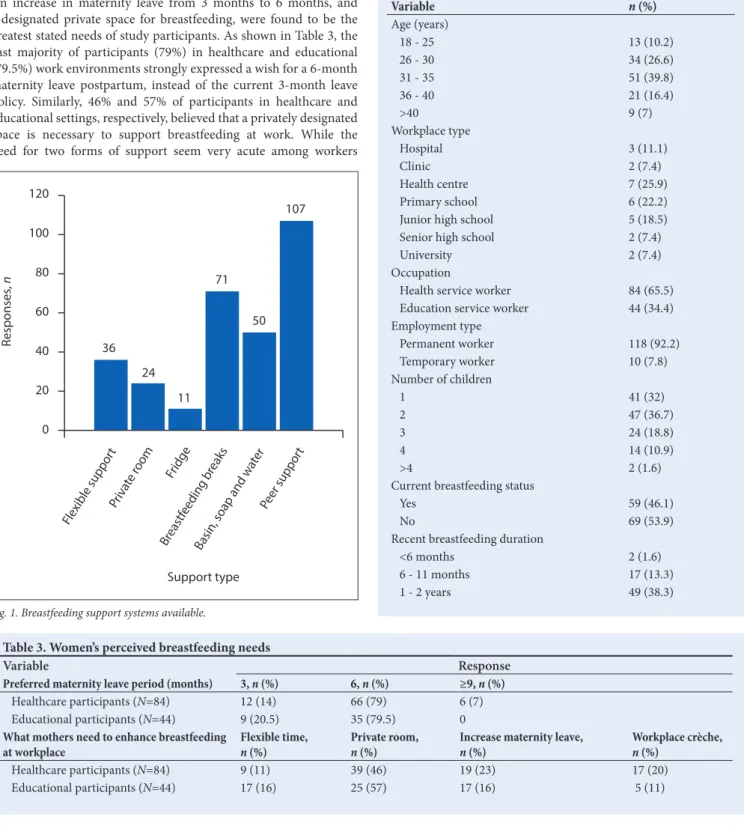
This study assessed the availability of six basic breastfeeding support types, namely: private breastfeeding room; breastfeeding breaks; peer support; basin, soap and water; flexible work schedule for breastfeeding mothers; and the availability of a fridge for storing baby foods. The results revealed that the mean breastfeeding support score for the two work settings was virtually identical: M=1.44 for healthcare institutions and M=1.30 for educational institutions. Moreover, the analysis indicated that peer support and breastfeeding breaks were the two most common forms of support for breastfeeding mothers. The majority of participants (84%) considered peer support as the greatest encouragement to workplace breastfeeding, while (55%) reported having access to breastfeeding breaks during the first year postpartum. This latter view was more commonly expressed by workers in educational settings, where mothers could take children along to the workplace. A modest percentage of participants (39%) also had access to hand washing facilities (e.g. wash basin, soap and water) at their workplaces. However, access to these facilities was more prevalent in healthcare institutions than educational establishments.
The results further showed that availability of a fridge for storing breast milk or other baby foods and designated private rooms for breastfeeding were the least commonly found forms of workplace support available to participants. This is shown in Fig. 1 where only 11 (8%) and 24 (19%) of participants in both work settings reported having access to a fridge and a private room as requisite support systems, respectively.
Table 2. Superiors’ attitude to workplace breastfeeding
Variable Response n (%)
Superior’s attitude to workplace breastfeeding Friendly Not interested Unfriendly Other Total
Healthcare participants (N=84) 55 (66) 17 (20) 10 (12) 2 (2) 84 (100)
ARTICLE
In addition, Table 2 shows that about two-thirds of participants in both healthcare (66%) and educational (68%) work environments, identified their superiors’ attitude to breastfeeding at the workplace as friendly. This was followed by a moderately high percentage of participants – 20% in healthcare and 18% in educational institutions, respectively, who described their superiors’ attitude to breastfeeding at the workplace as indifferent. Nonetheless, 12% and 14% of participants from healthcare and educational institutions, respectively, perceived the attitudes of their superiors to breastfeeding at the workplace as unfriendly.
The breastfeeding needs of working mothers
An increase in maternity leave from 3 months to 6 months, and a designated private space for breastfeeding, were found to be the greatest stated needs of study participants. As shown in Table 3, the vast majority of participants (79%) in healthcare and educational (79.5%) work environments strongly expressed a wish for a 6-month maternity leave postpartum, instead of the current 3-month leave policy. Similarly, 46% and 57% of participants in healthcare and educational settings, respectively, believed that a privately designated space is necessary to support breastfeeding at work. While the need for two forms of support seem very acute among workers
in both work settings, flexible work schedules for breastfeeding women and the availability of workplace crèche were also important forms of support desired by participants. Of the 27 institutions surveyed, none had a workplace crèche or nursery school nearby, yet 20 and 11% of workers in healthcare and educational settings, respectively, wished that such facilities existed nearby. This need was stronger among healthcare workers, who unlike their counterparts in educational settings are not professionally allowed to return to work with their babies because of the potentially high risk of infection to infants in such settings.
Peer suppor t
Support type 120
100
80
60
40
20
0
Flexible suppor
t
Priva
te room Fridge
Breastf
eeding br eaks
Basin, soap and w
ater
Responses
,
n
36 24
11 71
107
50
Fig. 1. Breastfeeding support systems available.
Table 3. Women’s perceived breastfeeding needs
Variable Response
Preferred maternity leave period (months) 3, n (%) 6, n (%) ≥9, n (%)
Healthcare participants (N=84) 12 (14) 66 (79) 6 (7) Educational participants (N=44) 9 (20.5) 35 (79.5) 0 What mothers need to enhance breastfeeding
at workplace Flexible time, n (%) Private room, n (%) Increase maternity leave, n (%) Workplace crèche, n (%)
Healthcare participants (N=84) 9 (11) 39 (46) 19 (23) 17 (20)
Educational participants (N=44) 17 (16) 25 (57) 17 (16) 5 (11)
Table 1. Demographic characteristics of participants (N=128)
Variable n (%)
Age (years)
18 - 25 13 (10.2)
26 - 30 34 (26.6)
31 - 35 51 (39.8)
36 - 40 21 (16.4)
>40 9 (7)
Workplace type
Hospital 3 (11.1)
Clinic 2 (7.4)
Health centre 7 (25.9)
Primary school 6 (22.2)
Junior high school 5 (18.5)
Senior high school 2 (7.4)
University 2 (7.4)
Occupation
Health service worker 84 (65.5) Education service worker 44 (34.4) Employment type
Permanent worker 118 (92.2)
Temporary worker 10 (7.8)
Number of children
1 41 (32)
2 47 (36.7)
3 24 (18.8)
4 14 (10.9)
>4 2 (1.6)
Current breastfeeding status
Yes 59 (46.1)
No 69 (53.9)
Recent breastfeeding duration
<6 months 2 (1.6)
6 - 11 months 17 (13.3)
ARTICLE
Discussion
This study assessed the existing forms of support for breastfeeding employees and their needs at healthcare and educational workplaces in Ghana. Similar to a recent study in Ghana, which found limited workplace support, lack of breastfeeding facilities and short breastfeeding breaks among professional working mothers,[18] our findings revealed a lack of targeted interventions to promote exclusive and continued breastfeeding among working mothers. Only 19% of participants had access to workplace private rooms, with most not designed to support or promote breastfeeding. In healthcare institutions where this facility was likely to be available, changing/ dressing rooms were commonly used as pseudo private spaces for breastfeeding. Unsurprisingly, these rooms lacked standardised features of what might be described as ‘designated’ breastfeeding rooms, such as comfortable chairs, wash basins or sinks, breast milk pumps and fridges, which acted as a major hindrance to effective workplace breastfeeding. This result is also consistent with the findings by Martin et al.[23] who reported an absence of designated private spaces for breastfeeding among active military women in the USA as a major obstacle to breastfeeding at the workplace. An earlier work by Dodgson et al., [24] among 19 hospitals in Hong Kong, however, showed the existence of private designated rooms equipped for breastfeeding in 14 hospitals, which contrasts with this study’s findings.
The finding that working mothers expressed a strong need for privately designated breastfeeding rooms, workplace crèches and an extension of the current maternity leave period from 3 to 6 months deserves an urgent policy consideration. While the current 12-week maternity leave policy allows for breastfeeding breaks of 1 hour per day for a year on returning to work,[25] this rather short period combined with the lack of equipped breastfeeding rooms and workplace crèches, essentially makes the practice of exclusive breastfeeding difficult for working mothers. This view is coherent with a recent study in the Upper West Region of Ghana, which found that full-time employed mothers with shorter maternity leave were less likely to breastfeed exclusively. [18] In another study, Dagher et al.[15] also showed that the hazard of breastfeeding cessation was higher for women who returned to work in the first 6 months postpartum. Elsewhere, in Canada, an extension of job-protected maternity leave for women from 6 months to 1 year in most provinces led to significant increases in the duration of exclusive breastfeeding and positive effects on continued breastfeeding for babies.[26]
Study limitations and future research
This study was limited by its focus on state-owned educational and healthcare institutions. This means that exploring the breastfeeding experiences and needs of working mothers in the private sector and other state-owned institutions not included in this study may have produced results different from the ones reported here. Replicating this study among working mothers in non-state and other state-owned institutions may be necessary in order to strengthen its theoretical generalisability. Moreover, the descriptive nature of this study also meant that we could not investigate the long-term impacts and implications of limited support systems on exclusive breastfeeding in particular, and continued breastfeeding in general among working mothers. Consequently, further quantitative studies will help to unravel some of these relationships and broaden our understanding of how best workplace support systems can be improved.
Conclusion
Despite increases in female participation in the labour force, state support for breastfeeding workers remains limited. This makes breastfeeding practices among working mothers, significantly, a private dilemma. This study has demonstrated how the lack of targeted interventions serves as a significant barrier to promoting exclusive and continued breastfeeding among working mothers. The key enabling factors for breastfeeding were found to be existing peer support, breastfeeding breaks and friendly attitude from superiors. Policy interventions to promote breastfeeding among working mothers should address the identified support needs of working mothers through the provision of private breastfeeding rooms, workplace crèches and an increase in maternity leave from 3 to 6 months.
Declaration. None.
Acknowledgements. We acknowledge the support provided by officials at the Northern Regional Health Directorate of the Ghana Health Service, Tamale Metropolitan Directorate of the Ghana Education Service and all study participants from the hospitals, clinics and schools.
Author contributions. IS and AAL designed the study and wrote the initial draft. MH and AB contributed to data analysis and subsequently reviewed the first draft. All authors read and approved the final manuscript. Funding. None.
Conflicts of interest. None.
1. Victora CG, Bahl R, Barros AJD, et al. Breastfeeding in the 21st century: Epidemiology, mechanisms, and lifelong effect. Lancet 2016;387:475-490. https://doi.org/10.1016/s0140-6736(15)01024-7
2. Coovadia HM, Rollins NC, Bland RM, et al. Mother-to-child transmission of HIV-1 infection during exclusive breastfeeding in the first 6 months of life: An intervention cohort study. Lancet 2007;369:1107-1116. http://doi.org/10.1016/ s0140-6736(07)60283-9
3. Chen A, Rogan WJ. Breastfeeding and the risk of post neonatal death in the United States. Pediatrics 2004;30;113(5):e435–e439. https://doi.org/10.1542/ peds.113.5.e435
4. WHO. Innocent Declaration on the Protection, Promotion and Support of Breastfeeding. Geneva: WHO, 1990.
5. American Academy of Pediatrics. Breastfeeding and the use of human milk. Pediatrics 2012;129(3):e827-e841. https://doi.org/10.1542/peds.2011-3552 6. Vennemann MM, Bajanowski T, Brinkmann B, et al. Does breastfeeding reduce
the risk of sudden infant syndrome? Pediatrics 2009;123(3):e406-e410. https:// doi.org/10.1542/peds.2008-2145.
7. Illif PJ, Piwoz EG, Tavengwa NV, et al. Early exclusive breastfeeding reduces the risk of postnatal HIV-1 transmissions and increases HIV-free survival. AIDS 2005;19:699-708. http://doi.org/10.1097/01.aids.0000166093.16446.c9 8. Coutsoudis A, Pillay K, Spooner E. Influence of infant feeding patterns on
early mother-to-child transmission of HIV-1 in Durban, South Africa: A prospective cohort study. Lancet. 1999;354:471-476. https://doi.org/10.1016/ s0140-6736(99)01101-0
9. Evenhouse E, Reilly S. Improved estimates of the benefits of breastfeeding using sibling comparisons to reduce selection bias. Health Serv Res 2005;40(6pt1):1781-1802. https://doi.org/10.1111/j.1475-6773.2005.00453.x 10. Zheng T, Holford TR, Mayne ST, et al. Lactation and breast cancer risk: A
case-control study in Connecticut. Br J Cancer. 2001;84(11):1472-1476. http:// dx.doi.org/10.1054/bjoc.2001.1793
11. United Nations Children’s Fund, World Health Organization. Nurturing the Health and Wealth of Nations: The Investment Case for Breastfeeding. New York and Geneva: UNICEF and WHO, 2017.
12. Weimer J. The Economic Benefits of Breastfeeding: A review and analysis. Food Assistance and Nutrition Research Report No. 13. Washington: US Department of Agriculture, 2001.
13. Mandal B, Roe BE, Fein SB. The differential effects of full-time and part-time work status on breastfeeding. Health Policy 2010;97:79-86 http://doi. org/10.1016/j.healthpol.2010.03.006
ARTICLE
15. Dearden KA, Quan LN, Do M, et al. Work outside the home is the primary barrier to exclusive breastfeeding in rural Viet Nam: Insights from mothers who exclusively breastfed and worked. Food Nutrition Bull 2002;23(4 Suppl 1):S99-S106. https://doi.org/10.1177/15648265020234s114
16. Ghana Statistical Service. 2015 labour force report. GSS: Accra. 2016 17. Waldfogel J. International policies toward parental leave and child care. The
Future of Children. JSTOR 2001;11(1):98. https://doi.org/10.2307/1602812 18. Dun-Dery EJ, Laar AK. Exclusive breastfeeding among city-dwelling
professional working mothers in Ghana. Int Breastfeeding J 2016;11:23. https:// doi.org/10.1186/s13006-016-0083-8
19. Aidam BA, Perez- Escamilla R, Lartey A, et al. Factors associated with exclusive breastfeeding in Accra. Eur J Clin Nutrition 2005;59:789-796 https://doi. org/10.1038/sj.ejcn.1602144
20. Ghana Statistical Service. 2010 Population and Housing Census: Summary Report of Final Results. GSS: Accra, 2012.
21. United Nations Development Programme. Tamale District Human Development Report 2010: Resource Endowment. New York: UNDP, 2010.
22. Ghana Statistical Service and ICF Macro. 2014 Ghana Demographic and Health Survey report. Calverton, Maryland: GSS & ICF Macro, 2015. 23. Martin MSE, Drake E, Yoder L, et al. Active duty women’s perceptions of
breast-feeding support in the military setting. Military Med 2015;180(11):1154-1160 https://doi.org/10.7205/milmed-d-14-00498
24. Dodgson JE, Chee YO, Yap TS. Workplace breastfeeding support for hospital employees. J Adv Nursing. 2004;47(1): 91-100
25. Republic of Ghana. Labour Act No. 651 of 2003.
26. Barker M, Milligah K. Maternal employment, breastfeeding and health: Evidence from maternity leave mandates. J Health Econ 2008;27(4):871-887. https://doi.org/10.1016/j.jhealeco.2008.02.006