
An Ef
fi
cient Unit-selection Method
for Concatenative Text-to-speech
Synthesis Systems
Jerneja Zganec Gros and Mario Zganec
Research and Development Group, Alpineon, d.o.o., Ljubljana, Slovenia
This paper presents a method for selecting speech units for polyphone concatenative speech synthesis, in which the simplification of procedures for search paths in a graph has accelerated the speed of the unit-selection procedure with minimum effects on the speech quality. The speech units selected are still optimal; only the costs of merging the units on which the selection is based are less accurately determined. Due to its low processing power and memory footprint requirements, the method is suitable for use in embedded speech synthesizers.
Keywords: human language technologies, speech syn-thesis, corpus-based speech synthesis
1. Introduction
Polyphone or corpus-based concatenative speech synthesis systems usually use exten-sive speech corpora containing tens of hours of recorded, sampled, segmented, and labeled speech, and use memory of several gigabytes. In such a corpus, each basic speech unit or each speech segment constituting a specific series of basic speech units or polyphones occurs re-peatedly in various contexts and with different prosodic characteristics[1].
Limitations in computational processing power and memory footprint used in embedded sys-tems affect the planning of the unit-selection process. Therefore, often HMM-based solu-tions are applied[2]. Selection of speech units is the part of concatenative or corpus-based speech synthesis that can exert the greatest influence on the speed of the entire speech synthesis process.
It is necessary to find a favorable compromise between the size of the speech corpus and the computational complexity of the unit-selection procedure[1]. If the unit-selection procedure is very simplified and thus also very fast, selection of units in a larger speech corpus can be per-formed in the same amount of time. Oversim-plification of the procedure can, however, result in the selection of inappropriate speech units and therefore reduce the speech quality despite using a larger corpus. In contrast, choosing a complex unit-selection procedure can ensure an optimal unit selection, but because of time re-strictions this can only be performed on a small speech corpus.
The paper is structured in the following way. In Section 2, unit-selection in polyphone con-catenative speech synthesis is introduced as a graph-search problem. An overview of unit-selection methods is presented.
The unit-selection procedure with which we succeeded in accelerating the speed of the pro-cedure without significantly affecting the speech quality is presented in Section 3. This is achieved by simplifying the calculation of the concatena-tion cost and thus creating the condiconcatena-tions en-abling a specific structure of the algorithm to find the optimal path in the graph.
2. Unit-selection in Polyphone Concatenative Speech Synthesis
The task of unit-selection procedures is to find the most appropriate speech units in the cor-pus such that they produce a maximum-quality signal when merged.
Input data that the unit-selection procedure re-ceives from language processing modules in the speech synthesizer are sequences of phonemes to be pronounced, whereby prosodic parame-ters for the pronunciation of each phoneme are provided. These parameters contain data on the fundamental frequency and duration of the phoneme pronunciation.
Output data that the unit-selection procedure must convey to the module for concatenating speech segments into a speech signal are se-quences of specific fragments from the speech corpus called polyphones, or the speech units that the concatenation module will have to merge. These sequences can also be equipped with prosodic parameters for each fragment, which enables the concatenating module to convert the original prosodic parameters from the corpus such that they resemble the desired prosodic parameters to the greatest extent possible.
2.1. Search Graph for Finding the Optimal Sequence of Speech Units
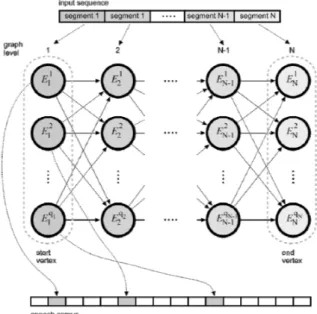
The problem of finding the optimal sequence of recorded units for quality speech signal synthe-sis can be presented as finding an optimal path in a graph. This kind of presentation clearly demonstrates the problem of selecting speech units and, at the same time, enables the use of recognized procedures for solving this prob-lem. Each vertex of the graph represents a basic speech unit from the speech corpus. The basic speech segments may be allophones, diphones, triphones, or any other basic speech unit. The graph is divided into individual levels. The first level contains the initial vertices; that is, all basic speech units in the speech corpus that cor-respond to the first basic speech unit in the input character sequence that needs to be synthesized. The edge between the vertices determines the possibility of merging the basic speech units
represented by the connected vertices. In merg-ing speech units, the unit of a higher-level vertex chronologically follows the unit of the lower-level vertex. This is why the edges between the vertices are directed. The vertices are intercon-nected such that each n-level vertex is conintercon-nected to all n+1-level vertices.
In this kind of graph, finding the optimal speech unit sequence can be defined as finding the opti-mal path between any initial vertex in the graph (first level of the graph)and any final vertex in the graph(last level of the graph), whereby the edges between the graph’s vertices determine the possible paths.
To start searching for the best path in the graph, criteria expressing the final goal of the speech unit selection must be defined as numeric rela-tions between the data represented in the graph. The final goal of the speech unit selection is the maximum possible intelligibility and nat-uralness of the synthetic speech. In general, the following criteria have been implemented to make the speech as intelligible and natural as possible:
• The smallest possible number of speech unit concatenations,
• The smallest possible discontinuity of con-catenated units at the point of concatena-tion,
Figure 1. Structure of the graph for finding the optimal speech unit sequence; Ei
1 are the graph initial-level vertices, Ei
N are the graph final-level
• The best fit between the concatenated units’ prosodic features and the desired speech prosody.
The first two criteria are evaluated by defining the concatenation cost for every edge between the vertices in the graph, whereas the last cri-terion is evaluated by defining the cost of fit of prosodic features for every vertex. The cost of an individual path in the graph equals the sum of the costs of vertices through which the path runs plus the sum of costs of all the edges the path contains. The optimal path in the graph is the path with the lowest cost.
2.2. The Cost of Fit of Prosodic Features
The cost of fit of prosodic features expresses the similarity or difference between the prosodic features of a specific speech unit from the speech corpus and the desired prosodic features of the part of the speech signal that the speech unit is to form. The required prosodic features can be determined as in [3] and [4]. The cost of fit of prosodic features usually consists of the weighted result of comparing the speech unit duration and its desired duration, and of the weighted result of comparing the profile of the speech unit basic frequency and the desired fun-damental frequency profile. In most cases, the ratio in which the unit’s duration and the fun-damental frequency profile influence the cost is determined experimentally.
In order to find the optimal speech unit sequence in the graph, the cost of fit of prosodic features is determined for each vertex. It is necessary to calculate this cost for each vertex. Although speech corpora can be very extensive, the calcu-lation of the cost does not constitute a numeric obstacle in finding the optimal path in the graph.
2.3. Concatenation Cost
A speech signal is formed by merging or con-catenating speech units from the pre-recorded speech corpus. During the process of merging, audible speech signal discontinuities can occur. We try to evaluate the influence of signal dis-continuity on the speech quality through the cost of concatenation.
There are several possible approaches to eval-uating the influence of concatenation on the speech quality. The simplest method is to define the cost as “0” for concatenating speech units that directly follow one another in the speech corpus, and to define the cost as “1” for all other speech unit combinations. The use of the cost “0” in units that directly follow one an-other in the speech corpus is logical because they are already linked together and therefore merging is not necessary. With the use of the cost “1” in units that do not follow one another in the speech corpus, all the concatenations were equally evaluated, regardless of the characteris-tics of the units being merged. With this kind of concatenation cost, the procedure for finding the optimal speech unit sequence would select the sequence with the smallest number of merg-ers, regardless of the type of speech units. A better evaluation of the influence of concate-nation on speech quality is achieved if the cost of speech unit merging depends on the allophones that are concatenated. Similar to the previous approach, the cost “0” is defined for the merging of speech units that directly follow one another in the speech corpus.
The most accurate evaluation of the influence of concatenation on speech quality is achieved by taking into account the phonetic features of both units merged when calculating the concate-nation cost. In this, the differences in the fun-damental frequency, formant frequencies, the amplitude, noise factor, noise spectral features, and so on can be taken into account. However, it should be noted that the use of a large number of parameters requires determination of a large number of weights evaluating the influence of the difference in every parameter on the cost of merging. Determining these weights can be very time-consuming and often includes long-term experiments, empirical solutions, and sup-positions. A great deficiency of this method of determining the cost of merging is its numeric complexity. With regard to the fact that con-catenation costs are determined individually for every pair of basic speech units from the speech corpus, they are impossible to calculate in ad-vance.
pho-netic features of concatenated speech units, is determining the concatenation cost in advance for the individual groups of basic speech units from the speech corpus. In this approach, all the basic speech units in a speech corpus are clas-sified into groups on the grounds of their pho-netic features such that the speech units within an individual group phonetically resemble one another to the best extent possible. This is achieved by using clustering techniques. The concatenation costs are calculated and saved in advance for all group combinations.
2.4. Related Work
The optimal path in the graph can be reliably determined by graph traversal whereby all the possible paths in the graph are examined and the best one among them can be selected. The number of possible paths between any initial and final vertex of the graph depends on the number of graph levels and the number of oc-currences of the basic speech units in the speech corpus.
Considering that a recording of a speech unit in the speech corpus can occur several thousand times and that input sequences can consist of dozens of basic speech units, it becomes clear that the number of possible paths in the graph is very large. Therefore, not all of the possible paths in the graph are investigated, but various procedures are used to simplify and accelerate the search. Some procedures preserve the op-timality of the solution, whereas other sacrifice optimality for the sake of faster operation. The optimal sequence of speech units is deter-mined by minimizing the cost that reflects a de-crease in the quality of the synthesized speech due to spectral differences, differences in the phonetic environment, and mutual merging of speech units. The system that was among the first to use the selection of speech units of vari-able length was the ATR ν-Talk [5]. In addi-tion to all the parameters used up until then, Hirokawa also suggested the use of prosodic differences in selecting the optimal sequence of speech units [6]. In this approach, synthesized speech is created by concatenating the selected speech units and changing their prosodic fea-tures if necessary. The use of information on prosody in the speech unit selection was pro-posed by Campbell[7],[8].
The procedure for minimizing the sums of both costs employs a search based on dynamic pro-gramming or one of its derivatives such as A*. Basic speech units or phonemes are usually used as the basic search units. The existing systems that synthesize speech by concatenating speech segments from an extensive speech corpus use this procedure most frequently. The CHATR speech synthesis system was developed on the basis of these methods[9].
By increasing the number of parameters used in finding or selecting speech segments, the size of the speech corpus has to be large enough. With a sufficiently extensive speech corpus, speech segments that resemble the required in-put prosodic parameters of the segments can be selected from it. In this case, it is not necessary to change the prosodic features before merging the selected speech segments[10].
Many recent studies that deal with improving the procedures for searching and defining the parameters were taken into account when cal-culating the cost of segments[11],[12]. Model-ing functions for calculatModel-ing costs is a complex issue.
In the selection of speech segments, search pro-cedures can use additional labeling of segments of various lengths that mark the critical parts where concatenation could result in the poten-tial distortion of the final speech signal[13]. Another approach to speech unit selection is the use of static modeling: FSM [14], DCD [15], GRM[16],[17], and Bulyko[18].
3. The Speech Unit Selection Method with a Simplified Cost of Merging
This section proposes a new and simplified speech unit selection method that is very fast and thus appropriate for implementing the con-catenative speech synthesizer in embedded sys-tems.
If merging is carried out at the phoneme bound-aries, the cost of merging must be defined for all the sequences of two phonemes that can oc-cur in speech. These costs of merging can be defined in advance and are not calculated dur-ing the synthesis. In addition to these costs of merging, it is presumed that the cost of merging equals “0” if the segments that are being merged directly follow one another in the speech cor-pus, regardless of the phonemes joined at the concatenation point.
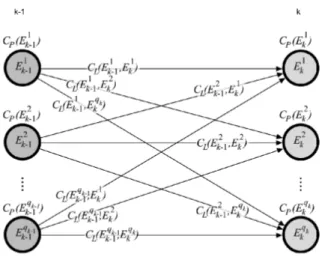
Figure 2.The costs of merging speech segments are defined for the connections between the graph’s vertices; k represents the level of the graph. The costs of fit of the prosodic features are defined for all of the graph’s vertices.
The graph used in speech unit selection is cre-ated as described in the previous paragraph. It comprises N levels, whereby each level corre-sponds to exactly one basic speech segment in the input sequence that is to be synthesized. At level k of the graph, which corresponds to the speech segment Sk, qk vertices are located; at level k +1, which corresponds to the speech segmentSk+1,qk+1vertices are located; and so
forth.
Every vertex Ei
k (1 ≤ i ≤ qk) at level k of the graph represents a specific recording of the speech segment Sk in the speech corpus. For every vertex Eki, the cost of fit of the prosodic features of the corpus speech segment repre-sented by the vertex is also calculated, as well as the required prosodies for the speech segment Sk in the input sequence. This cost is labeled CP(Eki). The vertices are connected by linking every vertex Eik (1 ≤ i ≤ qk) at level k with all the vertices Ekj−1 (1 ≤ j ≤ qk−1) at level
k−1. The cost of the connection between ver-tices Ei
k and Ekj−1 equals the cost of merging
the speech corpus segments represented by the vertices. This is labeledCL (Ekj −1,Eik). In finding the optimal path in the graph, it must be established which path between any initial vertex Ei1(1 ≤ i ≤ q1) and any final vertex
EiN(1 ≤ i ≤ qN) of the graph has the lowest cost.
The cost of the entire path is calculated by adding the costs of merging or the costs of edges between the vertices traversed (CL), and the costs of fit of the prosodic features or the costs of the vertices visited(CP). Thus, at every level k(1≤k≤N)of the graph, only one of the ver-ticesEik(1 ≤i≤qk)must be selected, or only one of the speech segments in the speech cor-pus that will be used in speech synthesis. This vertex is labeledExk(k). The cost of the optimal path in the graph can be expressed as:
C= min x(1),x(2)...x(N)
CP(Ex1(1)) + N
k=2
CP(Exk(k))
+ CL(Exk(k),Exk(−k−11 ))
.
The cost of the optimal path as the function of selecting a vertexx(k)at the individual level of the graph is a decomposable function. If the cost of the optimal path between the graph’s initial vertices and the vertex Eik at level k of the graph is labeled CO(Eik), and if the cost of the optimal path between the graph’s initial ver-tices and any k-level vertex is labeled Ck, the following applies:
Ck =min x(k)
CO(Exk(k))
and
CO(Eki) =CP(Eik) +xmin
(k−1)
CL(Eik,Ekx(−k1−1))
+ CO(Ekx(−1k−1))
.
It can be seen that the function of the cost can be defined recursively or that the cost of the path to vertexEi
kat levelkof the graph depends only on the cost of the prosodic fit for vertexEi
In optimizing such a function, dynamic pro-gramming can be used to find the optimal path in the graph. This method simplifies the search for the optimal path by dividing it into searches for partial optimal paths for every level of the graph.
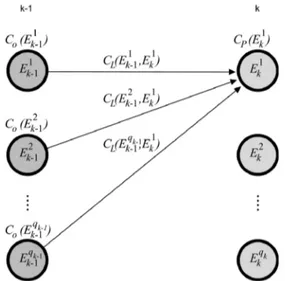
In practice, the procedure is designed such that four parameters are defined for every vertex of the graph. The first, parameterI(Eki), is an in-dex of the basic speech unit in the speech corpus represented by the vertex. This parameter is al-ready defined for the vertex at the start of the procedure, when the graph is created. The sec-ond parameter equals the cost of fit of prosodic featuresCP(Eik), which is also calculated when creating the graph. The third parameter equals the lowest cumulative cost or the lowest cost of the path between any initial vertex and the current CO(Eki) vertex. This cost is calculated during the optimal path calculation procedure. The fourth parameter is an index of the vertex P(Ei
k) from the previous level of the graph lo-cated on the optimal path between the initial vertices and the current vertex. This parame-ter is also calculated during the graph search procedure.
The procedure begins by defining the cost of fit of the prosodic features of the same vertices for the lowest cumulative cost of initial vertices:
CO(Ei1) =CP(Ei1), (1≤i≤q1).
In the initial vertices, the indicator of the vertex from the previous level of the graph is set to “0” because initial vertices have no precursor. Then the lowest cost of the path to individual vertices at the second level of the graph is defined:
CO(Ei2)=CP(Ei2)+
q1
min j=1
CL(E2i,E1j)+CO(E1j)
,
(1≤i≤qk).
In addition, the (j) index of the vertex at the previous level of the graph located on this path with the lowest cost is recorded. This procedure is repeated sequentially for all remaining levels
of the graph:
CO(Eki) =CP(Eki) +minqk−1 j=1
CL(Eik,Ejk−1)
+CO(Ejk−1)
,
(1≤i≤q; 2≤k≤N) (1)
The cost of the optimal path is the lowest among the costs of optimal paths to individual final ver-tices of the graph:
C =minqN j=1
Co(EjN)
.
The optimal final vertex is the final vertex with the lowest cumulative cost.
Figure 3. The costs of the optimal path to vertexEi k
depends on the costs of optimal paths to the vertices at the graph’s previous level CO(Eik−1), the costs of mergingCL(Ejk−1,Ei
k), and the cost of fit of the
prosodic featuresCP(Eik); krepresents the level of
the graph.
After the procedure is concluded, the sequence of vertices located on the optimal path is com-piled by tracing in reverse the indices of vertices at the previous levels of the graph P(Ei
k) that were saved during the procedure.
of the edges between the vertices of the graphs Ekj−1 andEi
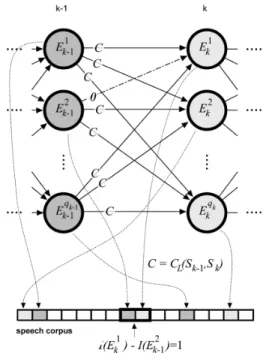
k are the same for anyjand i. This does not apply only if the speech segments rep-resented by verticesEkj−1andEik, directly follow one another in the speech corpus. In this case, the cost of merging equals 0:
CL(Eki−1,Ejk) = ⎧ ⎪ ⎪ ⎪ ⎪ ⎨ ⎪ ⎪ ⎪ ⎪ ⎩
CL(Sk−1,Sk); I(Ejk)−I(Ei
k−1)=1
0;
I(Ejk)−I(Ei
k−1) =1.
I(Ekj)is the index or the consecutive site of the speech segment represented by vertexEjkin the speech corpus.
This means that the calculation of the lowest cost of the path can be further simplified. The recursive equation for calculating the lowest cost of the path to vertexEikis shown in equation (1).
Taking into account the simplifications above, equation(1)can also be expressed as:
CO(Eik) =CP(Eki)
+minqk−1 j=1
⎧ ⎪ ⎪ ⎪ ⎪ ⎪ ⎨ ⎪ ⎪ ⎪ ⎪ ⎪ ⎩
CL(Sk−1,Sk) +CO(Ejk−1); I(Ejk)−I(Eki−1)=1
CO(Ekj−1);
I(Ejk)−I(Eki−1) =1.
CL(Sk−1,Sk)is always a positive number. There-fore, equation(1)can also be expressed as:
CO(Eik) = CP(Eik)
+ ⎧ ⎪ ⎪ ⎪ ⎪ ⎪ ⎪ ⎪ ⎪ ⎪ ⎨ ⎪ ⎪ ⎪ ⎪ ⎪ ⎪ ⎪ ⎪ ⎪ ⎩
minCO(EJk−1), qk−1
min
j=1 CL(Sk−1,Sk) +CO(E
j k−1)
,
if ∃J; I(Ei
k)−I(EJk−1) =1
qk−1
min j=1
CL(Sk−1,Sk) +CO(Ejk−1)
,
otherwise
(2)
Because the calculation of the minimum in the equation above does not depend oni, this
calcu-Figure 4.The costs of merging two speech segments directly following one another in the speech corpus equals 0; krepresents the level of the graph. The concatenation costs of all other segments depend only on the type(group)of speech segments that are being merged, and are therefore the same for all the connections between two levels of the graph.
lation can be performed only once for all the ver-tices incident to the same levelSk of the graph:
CO(Sk) = qk−1
min j=1
CL(Sk−1,Sk) +CO(Ejk−1)
=CL(Sk−1,Sk) + qk−1 min j=1
CO(Ejk−1)
Equation(2)can now be expressed as:
CO(Eik) =CP(Eik)
+ ⎧ ⎪ ⎪ ⎪ ⎨ ⎪ ⎪ ⎪ ⎩
minCO(EJk−1),CO(Sk) if ∃J; I(Ei
k)−I(EJk−1) =1
CO(Sk) otherwise
4. Evaluation
4.1. Computational Cost
Two versions of embedded concatenative speech synthesis for Slovenian using two different meth-ods for selecting speech units were compared according to synthesized speech quality ( sub-jective evaluation)and computational speed( ob-jective evaluation). The underlying speech cor-pus, which was used in both experiments, is described in[19]. It consists of 299 sentences, which were selected by a greedy algorithm out of a corpus comprising 2 million sentences. They cover the most frequent collocations, words, quadphones and triphones of the Slove-nian language.
The first version used a unit-selection method with a simplified cost of merging described to select speech units described in Section 3, while the second used the widely-used simpli-fied search method for speech unit selection[6], which does not search through all the possible paths in the graph, but limits itself only to the most promising ones. Using the second method, the quality of synthesized speech was slightly lower than the quality of the synthesized speech in the first procedure.
The search time in both speech unit selection methods increases linearly with the length of the utterance that is to be synthesized, and also lin-early with the size of the speech corpus, which is an improvement compared to traditional pro-cedures for finding paths in the graph used in speech unit selection of concatenative or corpus speech synthesis. As anticipated, both meth-ods operated increasingly more slowly when in-creasing the sentence size for which they were seeking the segments required for synthesis.
The simplified search method for speech unit selection is faster than the speech unit selec-tion method with a simplified cost of merging described in Section 3 because it is less com-plex. As shown in Figure 5, it can find segments for synthesizing shorter utterances twice as fast, and segments for longer sentences four times as fast.
Figure 5. Comparison of computational speed for two unit-selection search methods. As anticipated, the simplified search method for speech unit se-lection [6] is faster than the speech unit selection method with a simplified cost of merging described in Section 3 because it does not search through all the possible paths in the graph, but limits itself only to the most promising ones. The search speed in-creases with the length of the sentence for which the procedure must find a suitable speech unit sequence in the speech corpus.
4.2. Subjective Evaluation
Over recent years, various guidelines have been proposed for evaluating the quality of text-to-speech systems. Yet there are still no existing standards for their evaluation, although a num-ber of different methods have been tried and it has been pointed out that the test results they yielded were often inconsistent[20].
The adequacy of the resulting synthesized speech was evaluated in terms of acceptabil-ity and intelligibilacceptabil-ity. The experiment was per-formed in laboratory conditions with 51 test subjects. It was designed according to ITU-T Recommendations P.81 and P.85, describing methods for subjective performance assessment of the quality of voice output devices. The eval-uators were selected from a wide range of pro-fessional backgrounds, and they were in general not familiar with synthetic voice quality. The test was divided into two sessions, neither last-ing more than 20 minutes, in order to reduce the fatigue of the evaluators. Each test speech segment was presented only once.
The first part served to evaluate whether the intelligibility and the quality of the synthetic speech were sufficiently high for a real appli-cation of the system in a potential embedded-system application, simulating spoken informa-tion on honey yields at apicultural observainforma-tion points provided by an embedded application in a mobile communicator. The subjects were asked to fill in different application-specific templates based on the information they heard. Each mes-sage consisted of a fixed part, which was spe-cific to the task, and a variable part, which was different in all the produced messages. The in-telligibility, when spelling errors are ignored, was nearly 100%. Over 95% of the listeners es-timated that the embedded TTS system imple-mentation was mature enough for deployment in the given application domain.
In the second part of the test, the performance of the TTS system was evaluated by the same lis-teners with grades on a five-point MOS (Mean Opinion Score)scale. The listeners were asked to evaluate the overall quality, intelligibility, naturalness, and voice pleasantness.
The overall quality of the speech synthesizer was evaluated as 3.2, or “fair,” which corre-sponds to the overall quality of evaluations of state-of-the-art embedded speech synthesizers for other languages that usually receive grades of approx. 3.5 on the MOS scale.
The majority of the test subjects evaluated the synthetic speech as pleasant and quite natural-sounding, appropriately dynamic and fast and not over-articulated.
5. Conclusions
Limitations in computational processing power and memory footprint used in embedded sys-tems affect the planning of the unit-selection process. This article presents a new method for selecting speech units in polyphone concatena-tive speech synthesis, in which simplifications of procedures for finding the path in the graph increase the speed of the speech unit-selection procedure with minimum effects on the speech quality. The units selected are still optimal; only the costs of merging the units on which the se-lection is based are less accurately determined. Further evaluations, in terms of measuring com-putational speed and assessment of the result-ing speech quality by comparresult-ing the proposed method to other speech unit selection methods, are planned in future.
Due to its low computational speed and memory footprint requirements, the method is suitable for use in embedded speech synthesizers.
6. Acknowledgment
The work presented in this paper was performed as part of the VoiceTRAN project supported by the Slovenian Ministry of Defense and the Slovenian Research Agency under contract No. M2-0132.
References
[1] M. BEUTNAGEL, A. CONKIE, J. SCHROETER, Y.
STYLIANOU, The AT&T Next-Gen TTS System. Proceedings of the 137th Meeting of the Acoustic Society of America,(2002).
[2] S. MARTINCIC-IPSIC, I. IPSIC, Croatian HMM-based Speech Synthesis.Journal of Computing and Infor-mation Technology,14(4) (2006), 307–313.
[3] B. VESNICER, F. MIHELICˇ,Evaluation of the Slove-nian HMM-based Speech Synthesis System. Lect. Notes in Computer Science, Springer Verlag, 2006, 513–520.
[4] F. MIHELICˇ, B. VESNICER, J. ZˇIBERT, E. NOETH,
Prosody Evaluation for Embedded Slovene Speech Synthesis Systems.Inf. MIDEM,37(3) (2007).
[5] Y. SAGISAKA, N. KAIKI, N. IWAHASHI, K. MIMURA,
[6] T. HIROKAWA, K. HAKODA, Segment selection and
pitch modification for high quality speech synthe-sis using waveform segments. Proceedings of the ICSLP’90,(1990), 337–340, Kobe, Japan.
[7] W. N. CAMPBELL, C. W. WIGHTMAN, Prosodic en-coding of syntactic structure for speech synthesis.
Proceedings of the ICSLP,(1992), 369–372, Banff, Canada.
[8] W. N. CAMPBELL, Prosody and the selection of units
for concatenation synthesis.Proceedings of the 2nd ESCA/IEEE Workshop on Speech Synthesis,(1994), 61–64, New York, USA.
[9] A. W. BLACK, P. TAYLOR, CHATR: a generic speech
synthesis system. Proceedings of the COLING,
(1994), 983–986, Kyoto, Japan.
[10] W. N. CAMPBELL, Processing a speech corpus for
CHATR synthesis.Proceedings of the ICSP,(1997), 183-186, Seul, Korea.
[11] T. TODA, H. KAWA, M. TSUZAK, Optimizing
Sub-cost Functions for Segment Selection Based on Perceptual Evaluations in Concatenative Speech Synthesis.Proceedings of the ICASSP’04,(2004), 657–660.
[12] J. VEPA, S. KING, Subjective Evaluation of Joint
Cost Functions Used in Unit Selection Speech Synthesis. Proceedings of the INTERSPEECH’04,
(2004), 1181–1784.
[13] S. BREUER, J. ABRESCH, X Phoxsy: Multi-phone Segments for Unit Selection Speech Synthesis. Pro-ceedings of the Interspeech’04, (2004), Institute for Communication Research and Phonetics(IKP)
University of Bonn.
[14] M. MOHRI, F. C. N. PEREIRA, M. RILEY, The Design Principles of a Weighted Finite-state Transducer Library. Theoretical Computer Science, 231(1),
(2000), 17–32.
[15] C. ALLAUZEN, M. MOHRI, M. RILEY, DCD Library
– Decoder Library, software collection for decoding and related functions. In AT&T Labs – Research,
(2003).
[16] C. ALLAUZEN, M. MOHRI, B. ROARK, A General Weighted Grammar Library. Proceedings of the Ninth International Conference on Automata (CIAA 2004),(2005)Kingston, Canada.
[17] J. R. W. YI, Corpus-based Unit Selection for
Natural-sounding Speech Synthesis. PhD. Thesis, Massachusetts Institute of Technology,(2003).
[18] I. BULYKO, M. OSTENDORF, Unit Selection for Speech Synthesis Using Splicing Costs with Weighted Finite State Transducers. Proceedings of the EUROSPEECH ’01, 2 (2001), 987–990, Aalborg, Danmark.
[19] A. MIHELICˇ, J. ZˇGANEC GROS, N. PAVESIˇC´, M.
ˇ
ZGANEC, Efficient Subset Selection from
Phoneti-cally Transcribed Text Corpora for Concatenation-based Embedded Text-to-speech Synthesis. Inf. MIDEM,36(1) (2006), 19–24.
[20] Y. ALVAREZ, M. HUCKVALE, The Reliability of the
ITU-T P.85 Standard for the Evaluation of Text-to-speech Systems.In Proceedings of the ICSLP’02,
(2002), 329–332, Denver, CO.
Received:May, 2007
Revised:November, 2007
Accepted:November,2007
Contact addresses:
Jerneja Zganec Gros Alpineon R&D Language Technologies Group Ulica Iga Grudna 15 Ljubljana, Slovenia e-mail:[email protected]
Mario Zganec Alpineon R&D Language Technologies Group Ulica Iga Grudna 15 Ljubljana, Slovenia
JERNEJAZGANECGROS is heading the Research and Development Group at Alpineon, Slovenia. Her areas of interest include human lan-guage technologies, with the emphasis on speech-to-speech translation, speech recognition and speech synthesis. She is coordinating the largest Slovenian HLT project, VoiceTRAN:http://www.voicetran.org.
![Figure 5. Comparison of computational speed for two unit-selection search methods. As anticipated, the simplified search method for speech unit se-lection [6] is faster than the speech unit selection method with a simplified cost of merging described in S](https://thumb-us.123doks.com/thumbv2/123dok_us/8043389.2129833/8.892.471.790.128.607/comparison-computational-selection-anticipated-simplified-selection-simplified-described.webp)
