Journal of Applied Food Technology
H o m e p a g e : h t t p s : / / e j o u r n a l 2 . u n d i p . a c . i d / i n d e x . p h p / j a f t
Antioxidant Activity of Extract from Ultrasonic-Assisted Extraction of
Durian Peels
Bambang Kunarto, Ely Yuniarti Sani
Agricultural Product Technology Department, Faculty of Agricultural Technology, Semarang University, Semarang
*Corresponding author ([email protected])
Abstract Received: 28 September 2018 Article information:
Accepted:4 December 2018 Available online: 5 December 2018
Keywords:
durian peel ultrasonic assisted extraction antioxidants
© 2018 Indonesian Food Technologists All rights reserved
This is an open access article under the CC BY-NC-ND license
doi: 10.17728/jaft.3309
The increase in durian production results in the accumulation of durian peel waste. The bioactive component of durian peel has the potential to be used as an antioxidant. Thus, there is a need to carry out an extraction process to obtain bioactive compounds from durian peel. However, conventional extraction methods cause damage to phenolic compounds due to oxidation, hydrolysis and ionization reactions during the extraction process. Therefore, durian peel extraction was carried out using ultrasonic assisted extraction method (UAE) in this study. The purpose of this study was to investigate the effect of varying ratios of durian peel to ethanol solvents and extraction time on the yield, total phenolics content, total flavonoids content and anti-oxidant activity. The results of the research data were analyzed using a two-factor completely randomized design, which included variations of the ratio of durian peel to ethanol solvents and extraction time The Duncan’s New Multiple Range Test (DNMRT) was carried out as a follow up test to determine the differences in each treatment at a significance level of 0.05. The results showed that the best treatment for peel extraction using ultrasonic assisted extraction was a 1: 9 ratio of durian peel to ethanol at an extraction time of 20 minutes. The extraction of durian peel under this condition gave the highest yield of 12.77 ± 0.16%, antioxidant activity (IC50) of 38.33 ± 0.12 ppm, total phenolic content of 63.30 ± 0.08 mgGAE / g and total flavonoids content of 47.53 ± 0.48 mgQE / g. In addition, total phenolics content and total flavonoid content showed a strong correlation to the antioxidant activity of durian peel extract.
Introduction
Durian (Durio zibethinus Murr.) is one of the fruit varieties that has been examined, confirmed and released by the Decree of the Minister of Agriculture No. 476 / KPTS / UM / 8/1977 as a superior variety in Indonesia (Nurwasmaheni, 1999). The data obtained from the Central Bureau of Statistics (2015) shows that the production of durian in Indonesia increased during the periods of 2013 to 2017. The production of durian in the country increased from 759,055 tons in the year 2013 to 859,118 tons in the year 2014 and 1,020,055 tons in the year 2015. The production of the seeds and peel of durian also increased during these periods. This was due to the technology used in the post-harvest of durian fruits, which generated approximately 60% to 70% waste in the form of peel. Thus, there is a need to explore the
Durian peel has the potential to be used as an antioxidant. A study conducted by Muhtadi et al. (2014) tested the antioxidant activity of the peel using thiocyanate ferry method. The result of the study showed that durian peel extract had a greater percent inhibition of fat peroxidation compared to vitamin E. The authors also documented that durian peel had a total phenolic content of 64.27 mg/g gallic acid equivalent and flavonoid levels of 22.0%. Setyawati and Damayanti (2014) stated that the extraction method affects the antioxidant compounds of durian peel petruk variety. A strong antioxidant activity of durian fruit (IC50 = 94.125 ppm) was obtained by the maceration extraction method coupled with stirring per hour.
method of extraction causes damage to phenolic compounds as a result of oxidation, hydrolysis and ionization reactions during the extraction process. Feng et al. (2014) stated that the long duration of conventional extraction methods resulted in damage to phenolic compounds. The authors further stated that the contact between the material and heat during extraction may also result in the damage of the extracted bioactive compounds.
A suitable alternative to replace conventional extraction is the use of the Ultrasonic Assisted Extraction (UAE) method. Huang et al. (2009), stated that UAE is a simple and efficient extraction method. Ultrasonic waves damage the cell wall, thereby resulting in the release of the content of (including bioactive compounds) the cell and local heating of the liquid. These sequence of events results in an increase in the diffusion of extracts. Kinetic energy is passed to all parts of the liquid followed by the appearance of cavitation bubbles on the wall or surface. This results in an increase in mass transfers between solid-liquid surfaces. The mechanical effect caused by this phenomenon is the penetration of the cell membrane and cell wall. The mechanical effect supports the release of cell components and increases in mass transfer (Huang et al., 2009). Ultrasonic cavitation produces a fracture that breaks down the cell wall mechanically and increases the transfer of materials (Liu, 2010).
The main objective of this research was to investigate the effect of varying ratios of durian peel to ethanol solvents and extraction time on the yield, total phenolics content, total flavonoids content and antioxidant activity using the UAE method.
Materials and methods
Durian peels were collected from Klaten, Central Java, Indonesia. The chemicals used in the analysis of the raw material include aquadest, ethanol (Merck), methanol (Merck), gallic acid (Merck), quecertin (Merck), potassium acetate, AlCl3, DPPH (2,2-diphenyl-1 picrylyhdrazil) (Sigma-Aldrich, 90%) and folin ciocalteu's. Some of the equipment used in this study include cabinet drier, sonicator batche (Branson 3800), rotary vacuum evaporator (basic RV 10 IKA), UV-vis spectrophotometer (Shimadzu), oven and some glassware.
Durian Peel Extraction
Durian-sukun extraction was carried out using 70% ethanol. The durian fruits were sliced, dried, milled and sifted through a 40 mesh sieve. The fine particles obtained were subjected to extraction using 70% ethanol (as a solvent) in the ratios of 1: 3, 1: 6 and 1: 9. The extraction process was carried out using ultrasonic assisted extraction method with variations of extraction time (10, 20 and 30 minutes). The extract was separated from the solvent using a rotary vacuum evaporator at the boiling temperature of ethanol. The extracts of thickened sukun durian bark were analyzed
Total phenolic content
A 1 ml sample solution was mixed with 4 ml sodium carbonate solution (75 g/l) in a 10 ml measuring flask. The flask containing the mixture was shaken vigorously. A 2 ml solution of folin ciocalteu reagent was then added into the measuring flask and the mixture was shaken. Distilled water was continuously added until homogeneity was obtained. This mixture was left in a dark room at room temperature for one hour. The absorbance of the mixture was then measured at a wavelength of 760 nm using a UV-spectrophotometer; gallic acid solution was used as a standard. The total phenolic content was expressed as gallic acid equivalent in mg per gram of dry extract (Sahreen et al., 2010).
Determination of total flavonoids
A solution containing 10 μl extract, 60 μl methanol, 10 μl aluminum chloride (10% w / v), 10 μl potassium acetate (1 M) and 120 μl distilled water was mixed evenly and incubated at room temperature for 30 minutes. The absorbance of the mixture at 415 nm was then determined using a UV-spectrophotometer. Total flavonoids content was expressed as quercetin equivalent (QE) in mg per gram of dry extract (Mayur et al., 2010).
Antioxidant Activity with RSA method
A 0.1 gram sample of durian peel was dissolved in 10 ml of methanol. This sample solution was used to make 25ppm, 50ppm, 100ppm, 200ppm, 400ppm concentrations. A volume of 0.3 ml of each concentration was dissolved in 1.9 DPPH solution. The mixture was then incubated at room temperature in a dark condition for 30 minutes. The absorbance of the mixture at 517nm
wavelength was measured using a
UV-spectrophotometer. A blank solution (without the sample) was used as a control. The percentage of DPPH free radical scavenging was calculated using the formula:
% 100 ) 1
( scavenging radical
free
% x
blank Abs
sample Abs -=
The parameter used to determine the antioxidant activity using free radical scavenging was IC50. IC50 is the sample concentration required to reduce the color intensity of DPPH free radical by 50% (Zou et al., 2004). Hanani et al. (2005), defined IC50 as a number that indicates that the extract concentration inhibits 50% oxidation. The IC50 value was obtained by regenerating the concentration of extract with a percentage of DPPH free radical capture.
Result and Discussion
The yield obtained from the durian peel extract ranged from 8.04% to 12.77%. The total phenolic content ranged from 33.54 mg to 65.30 mg GAE/g, total flavonoids content ranged from 35.47 mg to 47.53 mg QE/g and antioxidant activity (IC50) ranged from 59.89 to 38.33. These results are different from the result of the studies on durian peel extraction documented in existing literature. This may be due to differences in the origin of raw materials, varieties, place of growth, climate, environmental conditions, methods of cultivation, parts of durian peel and the extraction methods used.
The yield of durian peel extract
The treatment of durian peel with varying ethanol ratios and extraction time had a significant effect (p <0.05) on the yield of the extraction process. In addition, statistical analysis showed that there were interactions between these two variables (Figure 1).
Figure 1 shows that the highest yield of durian peel extraction (12.77 ± 0.16%) was obtained using the ratio 1: 9 at an extraction time of 20 minutes. The increase in the volume of ethanol resulted in an increase in the yield of extract. The increase in the solvent may have resulted in an increase in pressure, thereby increasing the rate of the process of plasmolysis. As a result, there will also be an increase in the release of cell fluid of the durian peel. The longer the duration of the extraction time, the greater the chance for the durian peel to come in contact with the solvent, thereby, resulting in a higher yield until the solution becomes saturated. After passing through the saturation point of the solution, there will be no further increase in the yield
Figure 1. Effect of the varying ratios of durian peel to ethanol and extraction time on the yield of durian peel extract
Total phenolic content
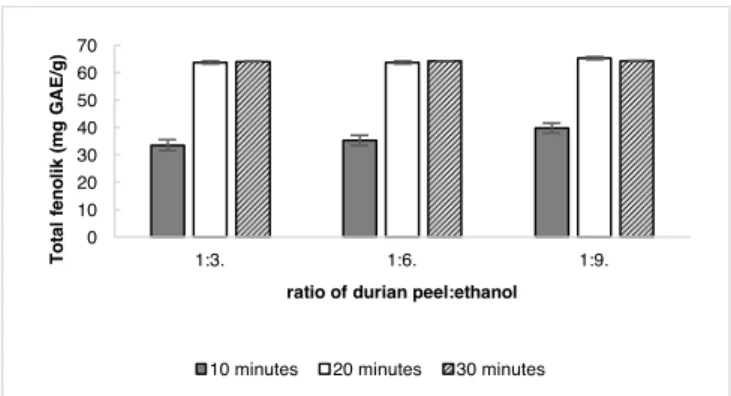
Figure 2 shows the effect of durian peel ratio treatment: ethanol and extraction time on total phenolic extract from durian peel. The statistical calculations showed that there were significant differences (p <0.05) between treatments.
Figure 2. Effect of the varying ratios of durian peel to ethanol and extraction time on total phenolic content
The increase in the volume of ethanol solvent and extraction time (from 10 minutes to 20 minutes) resulted in an increase in total phenolic content. However, there was a total decrease in phenolic content when the duration of the extraction time was increased to 30 minutes. An extraction time of 20 minutes with the ratio of durian peel to ethanol of 1: 9 resulted in the highest total phenolic content of 63.30 ± 0.08 mg GAE / g. This result may be due to the increase in extraction time, which increased the cavitation bubble contact time required to lyse the cells (Wang et al., 2012). The application of ultrasonic waves in solid-liquid extraction forms cavitation bubbles that destroy durian peel cells. This makes it easier for the solvent to penetrate the cell. Penetration causes swelling and hydration, which results in the enlargement of pores in the cell wall. This increase in the porosity of the cell wall increases the diffusion process and increases mass transfer from solid to liquid surfaces (Bilgin and Ahin, 2013). However, prolonged extraction time after equilibrium has been reached exposes phenolic compounds to light and oxygen for a long period of time. This exposure allows phenolic compounds to be oxidized, which in turn decreases the total phenolic content (TPC) obtained from the extraction. Furthermore, extending the duration of the extraction time may cause the accumulation of compounds that can increase the oxidation process (Bazykina et al., 2002). Chew et al. (2011) suggested that extending the extraction time did not significantly affect the total phenolic content obtained from the extraction of Orthosiphon stamineus, when the diffusion process had reached equilibrium.
Total flavonoids content
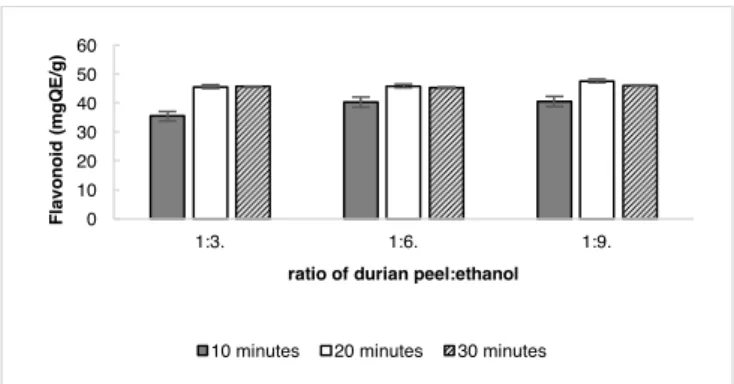
Total flavonoids content of durian peel extract were significantly affected (p <0.05) by a combination of peel ratio to ethanol and extraction time. The increase in the volume of ethanol and the duration of the extraction resulted in an increase in total flavonoids content. However, after extraction of 20 minutes, total flavonoid levels decreased (Figure 3).
0 2 4 6 8 10 12 14
1:3. 1:6. 1:9.
Yi
el
d
(%
)
ratio of durian peel:ethanol
10 minutes 20 minutes 30 minutes
0 10 20 30 40 50 60 70
1:3. 1:6. 1:9.
Tot
a
l
fe
nol
ik
(
m
g
G
A
E
/g)
ratio of durian peel:ethanol
Figure 3. Effect of the varying ratios of durian peel to ethanol and extraction time on total flavonoids content
Figure 3 shows that the highest total flavonoid levels (47.53 ± 0.48 mg QE/g ) were obtained using an extraction time of 20 minutes with a ratio of durian peel to ethanol of 1: 9. The increase in the duration of extraction time may result in an increase in temperature. This causes an increase in the amount of bubbles in the liquid. However, the presence of vapor pressure causes a reduction in the intensity, thereby decreasing bubble cavitation (Brennan, 2006).
Antioxidant activity
The combination of treatment of durian peel ratio to ethanol and extraction duration had a significant effect (p <0.05) on antioxidant activity (IC50). The highest antioxidant activity of the durian peel extract (IC50 = 38.33 ± 0.12 ppm) was recorded using an extraction time of 20 minutes and a ratio of durian peel to ethanol of 1: 9 (Figure 4). This result is in accordance with the extraction conditions for total phenolic content (Figure 2) and total flavonoids content (Figure 3.) According to Patel et al. (2015), the presence of phenol compounds (such as phenolic acids) has antioxidant effects. Some of the compounds with bioactive effects are phenol compounds. These compounds have a substituted hydroxy group at the ortho and para positions (from–OH to –OR groups). The study conducted by Alfianti (2012) documented that high phenolic and flavonoid content had a high DPPH radical scavenging antioxidant activity. This research was carried out on kale plants (Alfianti, 2012). Yi et al. (2010) also stated that the phenolic content contained in the plant Manihot esculenta has an antioxidant activity.
Correlation of total phenolic and flavonoids
Table 1 shows that there is a greater correlation between the total phenolic content and antioxidant activity (96%) compared to the correlation between total flavonoids content and antioxidant activity (89%). However, both total phenolic content and total flavonoid content have a strong correlation to antioxidant activity. According to Kahkonen et al. (1999), phenolic compounds have been reported to have antioxidant activities due to their redox properties. Phenolic compounds act as reducing agents, hydrogen feeders, singlet oxygen absorbers, and potential metal chelating agents.
Table 1. Correlation of the total phenolic and total flavonoids content to the antioxidant activity (IC50) of durian peel extract
Parameter
Total phenolic
content
Total flavonoids
content
Antioxidant activity
Total phenolic 1
Total flavonoids 0.94 1
Antioxidant activity -0.96 -0.92 1
Conclusion
The best treatment for durian peel extraction using ultrasonic assisted extraction (UAE) was a 1:9 ratio of durian peel to ethanol solvent at an extraction time of 20 minutes. The extract of durian peel under this condition provided the highest yield of 12.77 ± 0.16%, antioxidant activity (IC50) of 38.33 ± 0.12 ppm, total phenolic content of 63.30 ± 0.08 mgGAE/g and total flavonoids content of 47.53±0.48 mg QE/g. Total phenolics content and total flavonoid content showed a strong correlation to the antioxidant activity of durian peel extract.
Acknowledgement
The author would like to express deep gratitude to Kemenristekdikti for funding this research through the 2018 Institutional National Strategic Research.
References
Alfianti, U. 2012. Determination antioxidant activity on water spinach (Ipomea reptans Poir) grown ias organic treatement. Report. Chemistry Department, Science and Math Faculty, Riau University (In Bahasa Indonesia).
Bazykina, N.I., Nikolaevskii, A.N., Fillipenko, T.A. 2002. Optimization of conditions for the extraction of natural antioxidants from raw plant materials, Pharmaceutical Chemistry Journal 36(2): 46-49. Bilgin, M., Ahin, S. 2013. Effects of geographical origin and extraction methods on total phenolic yield of olive tree (Olea europaea) leaves, Journal of the Taiwan Institute of Chemical Engineers 44(1):8-12.
Brennan, J. G. 2006. Food Processing Handbook. Wiley-VCH Verlag GmbH &c Co. KgaA Weinheim, Germany.
0 10 20 30 40 50 60
1:3. 1:6. 1:9.
Fl
a
v
onoi
d
(m
gQ
E
/g)
ratio of durian peel:ethanol
10 minutes 20 minutes 30 minutes
0 10 20 30 40 50 60 70
1:3. 1:6. 1:9.
IC
5
0
capacity of Orthosiphon stamineus extracts, International Food Research Journal 18(4): 1427- 1435.
Feng, S., Luo, Z., Tao, B. Chen, C. 2014. Ultrasonic-assisted extraction and purification of phenolic compounds from sugar cane (Saccaharum
oficinarum L.) rinds. LWT-Food Science and
Technology 60(2):970-976.
Hanani, E., Mun’im, A., Sekarini, R. 2005. Identifikasi Senyawa Antioksidan dari Spons Callyspongin sp. Kep. Seribu. Majalah Ilmu Kefarmasian II(3). Huang, W., Xue, A., Niu, H., Jia, Z., Wang, J. W. 2009.
Optimised ultrasonic assisted extraction of flavonoids from Folium eucommiae and evaluation of antioxidant activity in multi-test systems in vitro. Food Chemistry 114(3):1147-1154.
Kahkonen, M.P., Hopia, A.I., Vuorela, H.J., Rauha, J.P., Pihlaja, K., Kujala, T.S., Heinonen, M. 1999. Antioxidant activity of extracts containing phenolic compounds. Journal of Agriculture and Food Chemistry 47: 3954-3962
Liu, Y.F., Liu, J.X., Chen, X.F., Liu, Y.W., Di, D.L. 2010. Preparative separation and purification of lycopene from tomato skins extracts by macroporous adsorption resins. Food Chemistry, 123(4): 1027-1034.
Mayur B, Sandesh S, Shruti S and Sung Y, S. 2010. Antioxidant and α-glucosidase Inhibitory Properties of Carpesium Abrotanoides L. Journal of Medicinal Plants Research 4: 1547-1553.
Muhtadi, A. L., Hidayati, A., Suhendi, T.A. Sudjono, Haryoto. 2014. Pengujian Daya Antioksidan Dari Beberapa Ekstrak Kulit Buah Asli Indonesia Dengan Metode FTC. Simposium Nasional RAPI XIII - 2014 FT Universitas Muhamadiyah Surakarta.
Nurwasmaheni. 1999 Durian, Budi daya dan Pemanfaatannya. Kanisius, Yogyakarta.
Patel, R., Yogesh, P., Prasant, K., and AnjukUnjadia. 2015. DPPH Free radical scavenging activity of phenolics and flavonoid in some medical plants of India. International Journal of Current Microbiology and Applied Science 1(1):773-780.
Sahreen S, Khan MR and Khan RA. 2010. Evaluation of Antioxidant Activities of Various Solvent Extracts of Carissa Opacus Fruits. Food Chemistry. 122: 1205-1211.
Setyowati, W. A. E dan Damayant, D. R. 2014. Pengaruh Metoda Ekstraksi terhadap Aktivitas Antioksidan Kulit Buah Durian (Durio zibethinus Murr) Varietas Petruk. Prosiding Pendikan Sains Seminar Nasional Pendidikan Sains IV.
Wang, X., Wu, Q., Wu, Y., Chen, G., Yue, W., Liang, Q., 2012. Response Surface Optimized Ultrasonic-Assisted Extraction of Flavonoids from Sparganii Rhizoma and Evaluation of Their in Vitro Antioxidant Activities. Molecules, 17(6), pp. 6769-6783.
Yi Bo, Hu, L. Mei, W. Zhou, K., Wang, H.Luo, Y., Wei, X., and Dai, H. 2010. Antioxidant Phenolic Compounds of Cassava (Manihot esculenta) from Hainan. Molecules 16:10157-10167 Zou Y., Lu, Y., Wei, D. 2004. Antioxidant Activity of