1Lecturer at University of Tokyo. 61 PLANNING MALAYSIA:
Journal of the Malaysian Institute of Planners SPECIAL ISSUE IV (2016), Page 61 - 74
PRESERVATION OF URBAN CULTURAL LANDSCAPE: CASE STUDY OF ROJI IN KAGURAZAKA, TOKYO
Benika Morokuma 1
1
Department of Urban Engineering UNIVERSITY OF TOKYO
Abstract
The Landscape Law, introduced in Japan in 2004, has granted the municipal governments the regulatory power to protect cultural landscape they wish to preserve. Due to its wider coverage, the law can technically protect the landscape developed through the secondary and tertiary industries, which theoretically includes the urban cultural landscape. However, until today, no significant cultural landscape is officially designated in its capital city Tokyo, although, such urban neighborhoods with historic sense of place still exist and are highly appreciated. By examining the fifteen-year community’s effort to preserve roji (alleys) and its landscape in Kagurazaka in central Tokyo as a case study, this paper aims to examine the achievement and limitation of the community’s advocacy efforts. In conclusion, this urban community has rather viewed its landscape as a favorable living environment than cultural resources, while the academic research recognized it as historic resource and urban cultural landscape. To better preserve the urban landscape as living environment with authenticity of the place, two approaches need to be combined in the future.
Keyword: urban cultural landscape; historic preservation; urban conservation; town planning; Tokyo; Kagurazaka
INTRODUCTION
manufacturing and tertiary industry can be eligible for it. Hence, this expanded concept of Japanese cultural landscape technically enables the designation of urban cultural landscape, which is not lined up with vernacular architecture with distinctive styles. This theoretically allows the urban areas of Japan such as Tokyo, where historic buildings do not survive as a group to constitute unique townscape due to the war disaster or sudden urbanization after the WWII, to recognize the landscape that people have attachment to and want to protect.
In reality, however, after ten years have passed since the introduction of cultural landscape, no significant cultural landscape is designated in its capital city Tokyo, although there are some old urban neighborhoods that still retain the trace of older development pattern and therefore historic sense of place, which was created through an urban life style or industry and are highly appreciated by the local people and city tourists. By examining the roji (alleys) and its cultural landscape in Kagurazaka, which was developed by Geisha industry (also called Karyukai)1 in the central part of Tokyo as a case study, this paper aims to examine how the fifteen-year community’s effort to preserve its unique landscape benefited its town planning but not led to the designation and stronger protection of cultural landscape. As a result, I would like to obtain implications for Kagurazaka and similar urban neighborhood to be protected as an urban cultural neighborhood.
TRANSITION OF KAGURAZAKA AFTER THE BEGINNING OF THE 21ST CENTURY
Roji as a Historic Layer to the Older Urban Structure of Kagurazaka
Located in the central part of Tokyo (Figure 1), Kagurazaka has been the commercial and residential neighborhood since late nineteenth century (Figure 2) and known for its main street and the organic network of roji in the Geisha quarters. Kagurazaka is one of the few remaining Geisha areas in Tokyo. Its population is approximately 2,600 and the size of the area is sixteen ha.
Roji itself is a general term to describe a narrow street, which is normally two to three meter wide, and developed as a private street. Roji was quite ubiquitous in any Japanese cities during twentieth century, but gradually disappeared, as the very narrowness of roji does not meet the post-war city planning system, which requires any road to be more than four meter for the sake of fire trucks.
1 The geishas are the bearer of the traditional Japanese performing arts such as dancing, singing and playing traditional
Figure 1: Location of Kagurazaka in Central Tokyo
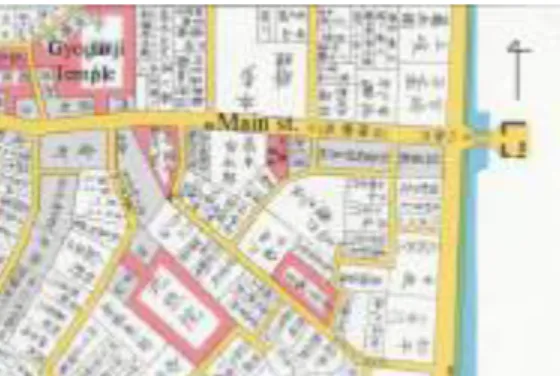
Figure 2: Map of Kagurazaka Neighborhood
Source: Kagurazaka Team of the Urban Design Laboratory at the University of Tokyo, 2012, partially revised by author
Castle. Most of the major streets that define the structure of today’s Kagurazaka dates back to this era (Figure 3). Later in the Meiji Period, when the Emperor took over the government from Tokugawa Shogunate in 1867, these worriers were evicted and the entire neighborhood was converted into commercial and entertainment district. Geisha industry, which has made Kagurazaka famous, originally started to appear in the late Edo Period (mid-nineteenth century) and started to flourish during the Meiji Period. Rojis were developed through the subdivision of the lots within the city blocks, which are bounded by the arterial streets that were developed during the Edo period. Therefore, roji in Kagurazaka itself is one of the historic layers added to the neighborhood.
Figure 3: Map of 1871. Streets in yellow in the map are still recognized in current structure of the neighbourhood.
Source: Shinjuku Educational Board ed. Map collection of Shinjuku Ward. 1979. (English caption was added by the author.)
Threat to the Roji: Surge of Urban Living Trend onto Kagurazaka Neighborhood
establishments and that of Geishas reduced to nine and thirty respectively. The decline of Geisha industry meant the loss of bearer of the landscape of roji quarters in Kagurazaka. Finding out that this development would be visually obtrusive and negatively affect the traditionally low-scale landscape of the neighborhood, the local community of residents and business owners formed the group, partnering with legal, city planning and urban design experts to protest the development and continued negotiated the possibility to scale down to the harmonious development with the developer. Although the developer decided to lower the building height to 26th story, it never met the way that the local people expected to see. The tower was completed in 2003 (Figure 4).
Figure 4: 26th Residential Tower: (Left) View from the arterial road (Right) View from roji
Rejuvenation of Kagurazaka after the Defeat of the Battle with the Developer
to investigate not only the tangible assets such as roji and old establishments in the neighborhood by holding the walking tour and roji symposium, but also the life and culture of the neighborhood life by resuming Yose events (performances including comedy, music, and magic shows) and by providing lecture on the old music performance that used to be held in Kagurazaka. All these efforts started to capture the eyes of the public and Kagurazaka started to be featured in several books and magazines as well as TV programs as a destination which has historic sense of place. After fifteen years of community’s effort to investigate their assets and to advocate its special characters to the larger audience beyond the neighborhood, Kagurazaka has changed from the rather quiet and mundane commercial area for the local people to the vibrant urban destination that even attracts the tourists from the other part of the country. The reputation of Kagurazaka as the town of old Japanese ambience attracted new business owners who are sympathetic to the brand that Kagurazaka now carries and some even adoptively reuse the former Ryotei (restaurant that provides dinner to the clients and where Geishas show their performance) buildings into new bars and restaurants. In the end, Kagurazaka community has turned the crisis of its landscape into the opportunity to successfully rebrand their neighborhood by figuring out the values of their unique urban landscape and the activities that have been accumulated over time and affected the characteristic landscape.
INCREASE IN INTEREST IN ROJI NATIONWIDE
Value of Roji within Today’s Context
Roji has had negative connotation for a long time in Japan, as it does not meet the current planning system whose main purpose is to build fireproof cities and efficient use of land by building taller structures. The neighborhoods with roji have been considered to be vulnerable for fire as it cannot accommodate the fire trucks and these densely built, old wooden buildings along rojis were targets of renewal. However, around the beginning of the twenty-first century, roji and its built environment has started to gain positive appreciation. Several books and articles, which discussed the benefit of roji started to be published. As Nishimura (Nishimura 2006) indicates, this revaluation of roji throughout Japan should be regarded as the people’s adverse claim to the post war city planning system, which is uniform and efficiency oriented as the city planning system in the twenty-century was mostly designed to serve the automobiles, not human beings. Within this discussion on roji, roji is recognized as the locus of the neighborhood life. Particularly within the residential neighborhood, roji has served as a common open space for the housewives who live there to chat during the day. For children, roji, which is free of automobiles, is a safe playground. Hence, roji has been always recognized as a place of daily activities. In the commercial quarters, roji functions as an urban mechanism to create the vibrant atmosphere, by concentrating human traffic into the limited space, whose narrowness is highlighted by the wall of the shops on the edges of roji.
It should be also pointed out that due to the involvement of the professionals of urban planning, architecture and urban design, roji has started to been recognized as the object of scholarly works, beyond the nostalgia.
Nationwide Movement to Revaluate Roji in Urban Settings
Respect and preservation effort for roji was also seen in the several urban neighborhoods in the country such as Kyoto and Osaka. Several organizations to advocate for the roji were launched in the other cities as well. These several movements were culminated into the launch of the nationwide organization called National Liaison Council of the Neighborhood with Roji in 2004, to advocate the necessity to preserve roji while rejuvenating and upgrading its built environment. The organization holds Roji Summit every year and it has helped concerned parties to exchange ideas to preserve roji with current planning tools and to advocate the value of roji to the public. Kagurazaka was one of the earlier members of the council and helped lead the initiative.
SEVERAL VALUES FOUND IN ROJI BY THE DIFFERENT STAKEHOLDERS
Although the interest in roji has significantly increased, it does not necessarily mean that every stakeholder have found the same value to the roji and its landscape. For the long time residents, who spent their childhood there and used roji as a play ground for hide and seek values roji as a safe and human scale living environment and likes the cleanliness of the roji which are maintained by the continuous use by the shops and residents1. For the tenants who run the restaurants and shops in the roji quarters, its quiet hidden location enhances the image of their business2. On the other hand, some property owners clearly showed their willingness to maximum financial benefit allowed as of right. Even after the roji has got public interest and attracted city tourists, out of scale development has occurred in and around roji quarters. In 2006, the owner of the property, which did not directly face to the roji but quite close to the roji, built the fourteen story residential buildings, which was considered to be out of scale to the roji quarters despite the strong opposition by the group of pro-roji people. In 2008, four contiguous lots in the roji quarters were merged into one, and five story commercial buildings were built, whose massing and height stands out in the low-scale neighborhood, but tried to show the visual connection to the roji quarters by installing black walls and stone pavement, which are often seen.
ROJI AS HISTORIC RESOURCE AND URBAN CULTURAL LANDSCAPE
Roji as a Historic Resource
There are some academic approach trying to evaluate roji as cultural and historic asset by the preservation and planning expertise to explore the authenticity of this new historic
1 Comments made by Osamu Yamashita in the newspaper article dated on June 19th, 2001. (The name of the
newspaper is not identified.)
2 In the website of the restaurant Kamikura, which adaptively reuses one of the former Ryotei building in the
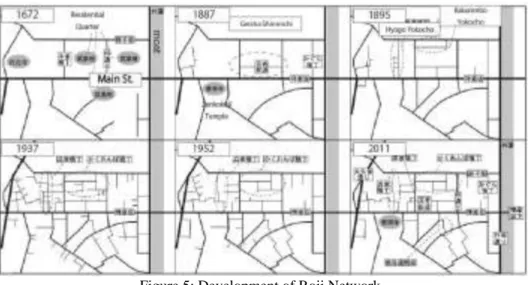
resource and landscape. According to Matsui and Kubota, who traced the major remaining rojis from the late Edo period to 2011 by using historic maps, roji was developed gradually within the Geisha industry quarters as the new buildings were constructed and the overall configuration of the major rojis can be recognized in the map of 1937 (Figure 5).
The fact that Kagurazaka was burnt down during the war and no pre-war buildings survived in the entire neighborhood makes these street patterns of roji as significant historic resources. Although no precedent of designation of historic street pattern or roji itself as a cultural property in Japan, there are some cities in the world that have acknowledged the significance of historic street pattern as a cultural resource. In New York City, where the development pressure is also high like Tokyo, they have protected the organic street pattern of Colonial New York by designating it as New York City landmark just like the buildings and historic district, since this street pattern is practically the only evidence on the ground in Manhattan that survived from the seventeenth century (New York City Landmarks Preservation Commission 1983). Its significance was particularly recognized as only a few buildings from seventeenth and eighteenth centuries have survived in entire city due to the continuous development (Shockley 2007). The designation of the historic street pattern as cultural resource prevents the removal of the street by merging the adjacent lots together and relocating it to build massive structures (Morokuma 2007). In the case of Kagurazaka, this justification could be also applied not only to protect the street pattern itself but also to prevent the possibility to allow developers merge several small plots along roji to develop the out of scale high-rise tower in the future.
Figure 5: Development of Roji Network
Source: Matsui and Kubota, 2012 (English captions area added by the author)
Landscape of Roji
not considered to be worthy of preservation but one1. It was probably due to the fact that the Geisha business owners had to reconstruct their buildings with the limited resources during the time when the building materials were scarce to resume the business as soon as possible. Also as the interview with Mr. Shibuya who was the owner of the Ryotei Chigetsu in 2007 indicates the interior space was more important and thus more resources were allocated to create the elaborate interior space for their clients to enjoy the dinner and entertainment by Geisha (Shibuya 2007). Just like the buildings, other materials that contributed to the characteristic roji streetscape does not have authenticity in the materials, but when collectively seen, there is a characteristic landscape within the roji quarters.
Study of widely recognized rojis such as Kakurenbo Yokocho and Hyogo Yokocho and other shorter rojis in the area indicates some physical characters and components that persist in the roji and its landscape. The major components of roji and landscapes are stone paving, tall walls, greenery and two-story buildings. The roji, together with these contributing components create the container like space filled with greenery (Figure 6).
Figure 6: Site plan and section of the part of Kakurenbo Yokocho
First of all, the very narrowness of roji is highlighted by the tall fences or walls of the buildings along roji. Either a fence which is as tall as approximately two meters or the exterior wall of the buildings stand at both sides of the edge of the roji. Although built by each owner of the properties, these fences and walls located on the edge of the roji create the continuous streetwall and provide the cohesive look for the clients of Geisha and passers-by as a neighborhood and remind them of the narrowness of the roji (Figure 7).
Second, the roji is usually paved with stone materials (Figure 8). The most common paving material is Pinkoro stone, which is 9 x 9 cm each, and laid out in a shape of fan. Some roji in Karyukai is paved with slabs of stones which provides the different appearance from Pinkoro stone. According to one of the old residents in Kagurazka, who spent his childhood right after the war, the roji was paved with slab of stone and did not
look as fancy as it is now. The old photo which is said to be taken in the late 1940 shows one of the rojis in Kagurazaka without paving.
Figure 7: Streetwall by the continuous tall fences
Figure 8: Types of Stone Pavements seen in Kagurazaka (Left is the Pinkoro pavement)
Greenery is also an element that is often seen in the streetscape of roji. Some buildings along roji have a vestibule garden between the edge of the roji and entrance of the buildings. In the garden, the shrubs or flowers are recognized. In other cases, the trees are planted behind the tall walls and seen from the street level. On some parts of the rojis, potted plants are placed by the occupants of the buildings, which are also not the special practice to Kagurazaka but is often seen in the densely built residential areas.
In 2010, the Agency for Cultural Affair, government of Japan, in its attempt to list the potential cultural landscape of the second and tertiary industries in Japan, Kagurazaka is selected as the area to be investigated further. Although the agency evaluates the entire Kagurazaka, it mentions the relationship between the landscape of roji quarters and Geisha industry briefly (Agency for Cultural Affairs, Government of Japan, 2010).
As discussed before, when evaluating roji and its landscape in Kagurazaka from the historic preservation point of view, street pattern which dates back to 1930s and landscape of roji can be seen as the cultural landscape that was created through the Geisha industry. There was a restriction on the Geisha business regarding where to be operated before the war The maps of 1937 and 1952 (Figure 9) which show the high density of Karyukai related buildings in the back side of the main street, where they were allowed to operate, and the fact that the Karyukai industry was booming with the growth of Japanese economy, the roji was used as a way to utilize the unused back lot so that Karyukai continued to thrive. Hence, roji and its cultural landscape was created through the needs of Karyukai in Kagurazaka and its landscape was inherited through the Karyukai use or similar use like restaurants and bars until today.
Figure 9: Concentration of Karukai Related Buildings in the Roji Quarters in 1937 and 1952
Source: Kagurazaka Team of the Urban Design Laboratory at the University of Tokyo, 2012 (revision of colors was made by the author.)
HOW TO PRESERVE ROJI AND ITS LANDSCAPE
Potential Tools to Preserve Roji and Its Cultural Landscapes
do not have long durability as they were built right after the war, where the construction materials were scarce, and aesthetic or architectural values of existing Karyukai buildings are not recognized fully, renewal of the buildings is inevitable.
Preservation of the width of roji can be achieved by the planning tools (Paragraph 3 Street system and the Design System for Continuous Buildings), preservation of the street pattern of 1930s by the preservation tools (designation of historic street pattern as cultural property or as the contributing elements of the Preservation District for the Groups of Traditional Buildings). New development along roji can be controlled by the District Plan and Landscape Guideline by the municipal government.
Gaps between the Residents and Preservation and Planning Professionals on the Future of Roji
Although the residents have acknowledged some historic and cultural values of roji and its landscape, there is a gap between the primary values of roji for the residents or business owners and those for the planning and preservation expertise. The views of roji from historic preservation point of view were not necessarily the central argument of the community of Kagurazaka to preserve roji. Rather, from the beginning, they pay more attention to preserve the human scale living environment created around roji and appropriate balance between the existing low scale quarters of roji and new infill development1. Particularly for the long time residents, roji and its landscape has gradually changed to meet the needs of the occupants at the time. As pointed out in the Chapter four, the paving of roji was changed to Pinkoro stone at some point after the war, and its paving itself is not unique to Kagurazaka. Some of the walls in the roji quarters were made of concrete blocks, which are common building materials. For the residents in the neighborhood, the cultural landscape of roji was rather part of their daily landscape.
What Can be Protected?
Current Status of the Land Use Control over Roji and its Cultural Landscape
Currently in Kagurazaka, the District Plan, which regulates the height of the new development in the roji quarters and the minimum lot size, and the Landscape Guideline, which projects the preferable image created through the new development, have been introduced.
District Plan
District Plan is a planning tool that has been widely used to regulate the new development in a designated area. The district plan allows a municipal government to create its own development rules. Additionally, the district plan system requires the municipality to include input from local residents, and the local community itself can start the process2. In Kagurazaka, despite the necessity to introduce district plan to prevent the out of scale development since 2000, it took seven more years to do so to reach the agreement. Although in the plan, it recognize roji and its landscape is a symbol of the neighborhood and its streetscape to be preserved, the restrictions on roji areas do not necessarily lead
1 The result of the questionnaires to the residents on the proposed 31st high-rise residential development, dated July 2000,
the harmonious development of the existing landscape of the area, since it only regulates the height limit of twenty-one meter and minimum size of the plot (65m2). In the roji areas where most of the old structures along roji are two-story, 21 meter is equivalent to seven stories and still too high. The new development, which was done prior to the district plan, is a five-story building, but it still breaks the visual sequence of the low-scale neighborhood. The qualities of roji space discussed as the elements of cultural landscape of roji space cannot be recreated in reconstruction of the buildings along roji by this limited district plan.
Landscape Guideline
Since the introduction of the Landscape Law in 2004, municipal governments are able to create its own landscape plan to indicate the basic standard of the landscape, which will be achieved through the new development and preservation of the existing built environment with good landscape. Shinjuku Ward has also introduced its own landscape law since 2009, and designated Kagurazaka as one of six special districts, which needs the special standard for landscape. By its landscape law and corresponding development guideline, Shinjuku tries to replicate the quality of the space in the roji quarters of Kagurazaka, which are often recognized in the roji and its landscape. In this guideline, the use of the stone paving, tall walls in dark colors, use of the Japanese style design and muted colors, which are often found in roji quarters, are indicated as the encouraged standard of the new development particularly along roji. The standard will help applicants of new building construction to understand the characters of the neighborhood to some extent and encourage them to observe the context. However, this standard does not have legal binding force and the building permit can be technically issued to the applicants, who do not follow the standard.
CONCLUSION
commercial uses in the roji areas might contribute to the preservation of such urban cultural landscape even after most of the original occupants of the buildings left the quarters. To find out this mechanism, further research is necessary to figure out how the roji quarters were used and maintained by the non-Karyukai occupants after most of the original use of the quarters was lost.
ACKNOWLEDGEMENT
This paper is based on the research that I conducted for the master’s thesis for the Graduate School of Architecture, Planning and Preservation, Columbia University in 2007. I would like to thank Mr. Kaoru Yamashita, who was the secretary of general of the Ikimachi Club in Kagurazaka, who has helped me obtain the relevant information, introduced the concerned people in the community and above anything else, led me understand the special characters of Kagurazaka.
I would also like to thank Prof. Aya Kubota of Tokyo University, who has given me kind advice and resources to write this paper.
REFERENCES
Agency for Cultural Affairs, Government of Japan (2010), Toshi no Bunka to Keikan (Culture and Landscape of Cities), Tokyo: Douseisya.
Kagurazaka Team of the Urban Design Laboratory, Department of Urban Engineering, the University of Tokyo (2012), Kagurazaka no Danpen. (Fragments of Kagurazaka) (in Japanese). Unpublished Report. Tokyo, Japan: University of Tokyo.
Nishimura, Yukio. (2006) Roji karanno machizukuri (Town Planning based on Roji). Kyoto; Gakugei Publishing.
New York City Landmarks Preservation Commission (1983). Street Plan of New
Amsterdam and Colonial New York. [Designation Report]. (online) http://s-media.nyc.gov/agencies/lpc/lp/1235.pdf (1 March, 2015)
Matsui, Daisuke and Kubota, Aya. (2012) “A Study on the Transformation and Planning Tasks of Historic Townscape in Kagurazaka-Kagai”, Journal of Architecture and Planning. Vol. 77 No.680, 2407-2414, Oct., 2012.
Morokuma, Benika (2007). Chapter 4: Case Studies of Street Pattern Protection in The Preservation of the Urban Cultural Landscape: A Case Study of the Rojis in Kagurazaka, Tokyo. Unpublished Master’s Thesis, New York City, United States, Graduate School of Architecture, Planning and Preservation, Columbia University.
Interviews
Shockley, Jay. Member of the Research Department at New York City Landmarks Preservation Commission, (1 February, 2007)
Shibuya, Shinichiro. Owner of the Ryotei Chigetsu and the director of Karyukai Guild in Kagurazaka. (8th January, 2015)