International Journal of Information Science and Technology
DESIGNING A MODEL FOR EVALUATING THE EFFECTIVENESS OF E-HRM (CASE STUDY: IRANIAN ORGANIZATIONS)[1]
A. Sanayei, Ph.D. A. Mirzaei, M. B. A.
Department of Administrative Sciences & Economics Department of Management University of Isfahan, I. R. of Iran University of Isfahan, I. R. of Iran Corresponding Author: [email protected] email: [email protected]
Abstract - This study aims at providing an explanation of Electronic Human Resource Management (E-HRM) and introducing its activities and tools. Furthermore, we investigate the effect of various independent variables such as job satisfaction, professional commitment, organizational commitment… on the effectiveness of HRM as a dependent variable. For this purpose, by cluster sampling from Iranian HR managers, 110 of them were chosen to participate in this study. Then, research hypotheses were examined by deploying multiple linear regressions to the data gathered from specially designed questionnaire. Findings indicate that E-HRM tools are rarely used, however, according to the experts’ judgment if they are used, they would have a positive effect on the HRM output in Iranian organization. Finally, a model for assessing the effectiveness of HRM was proposed.
Keywords: E-HRM, HRM Effectiveness, E-HRM functions, Electronic Tools, Virtual HR.
INTRODUCTION
E-HRM, the use of web-based technologies for human resource management practices and policies, is maturing within organizational lifecycle. Many of the reporting-type activities, previously performed by HR professionals, can now be performed online by managers and employees [8,12]. On their own desktops, line managers nowadays perform appraisals, evaluate employee costs, generate HR reports (turnover, absenteeism), process training requests and oversee competence management. Employees have access to everything they need to change and manage their personal files, plan their development, process financial documents and apply for new jobs. The topic of E-HRM is certainly not becoming obsolete, and its full potential is still anticipated, and therefore, academic involvement in the topic needs to grow. This paper aims at demystifying the phenomenon E-HRM and its tools. Also we explain the electronic application of HRM. Then, we identify a model to look if electronic HRM is leverage for HRM effectiveness.
electronic media, and telecommunication networks to carry out the functions of the human resources management department. E- HRM managers always strive to provide a seamless integration of all HRM services with a common goal of employee satisfaction. This technology-assisted model of HRM is often begun as an efficiency program, but it soon evolves into a major source of competitive advantage. In addition, while some human resources management departments utilize a few virtual HRM applications, others strive to reengineer, automate and integrate nearly all of their HRM functions. E- HRM costs lower and improves efficiency by:
• Reducing paperwork and streamlining work flow, • Automating redundant HRM tasks,
• Empowering employees to embrace a self- service HRM delivery system,
• Keeping the company workflow fully informed about all important HR
compliance issues and corporate events,
• Speeding up the response time of HRM systems, • Ensuring that more informed decisions are made, • Improving time management, and
• Offering a flexible model of HRM that meets the changing needs of an
increasingly diverse and global workforce [6].
GENERAL REVIEW
At first we demystify the phenomenon E-HRM by raising the following items: 1. The state of HRM in an organization,
2. The E-HRM goal, 3. Types of E-HRM, and 4. HRM outcomes.
- THE STATE OF HRM IN AN ORGANIZATION
E-HRM is a way of implementing HR strategies, policies, and practices in organizations through a conscious and directed support of and/or with the full use of web-based channels. E-HRM is a concept -a way of ‘doing’ HRM [11]. This is not to ignore the fact that E-HRM can transform the nature of HRM strategies, policies and practices.
The literature on E-HRM is growing, including a book edited by Gueutal and Stone [5] in which, mainly American scholars present a good overview of E-HRM research to date, and try to bridge the gap with E-HRM practice.
areas where web technology was first adopted.
E-HRM GOALS
What goals drive stakeholders when deciding about E-HRM? Based upon a scan of professionally-oriented and academic journals, we can draw three types of goals [7]:
1. Improving the strategic orientation of HRM, 2. Cost reduction/efficiency gains, and
3. Client service improvement/facilitating management and employees.
Some of the empirical findings add globalization to these goals, seeing it as an E-HRM driving force in large international organizations. However, findings also show that these goals are not clearly defined in practice and that E-HRM is mostly directed towards cost reductions and efficiency increases in HR services, rather than aiming to improve the strategic orientation of HRM [4,12]. Recent studies have found that in nearly half of the companies with a fully integrated HRIS, HR was not viewed as a strategic partner.
- E-HRM TYPES
The current literature distinguishes three types of E-HRM [15]: a) Operational E-HRM,
b) Relational E-HRM, and c) Transformational E-HRM.
Within all the types of HRM, choices have to be made in terms of which HRM activities will be offered face-to-face, and which will be offered through web-based HR [7].
For the operational type of HRM, this issue amounts to a choice between asking employees to keep their own personal data up-to-date through an HR website or to have an administrative force in place to do this for them. In terms of relational HRM, there is a choice between supporting recruitment and selection through a web-based application or using a paper-based approach. Finally, in terms of transformational HRM, it is possible to create a change-ready workforce through an integrated set of web-based tools that enables the workforce to develop in line with the company’s strategic choices, or to use paper-based materials.
emphasized that positioning companies by their E-HRM types does not imply judging them –it is not about better or worse E-HRM types. Further, it was shown that there is a “gap” between E-HRM in a technical sense (the available functionality) and its use and adoption by employees and line managers.
What has shown up clearly is that a company with HRM policies and practices which are of the bureaucratic type can not just jump to a transformational type of E-HRM. We think it is impossible to ‘jump’ immediately to a transformational type of E-HRM without first going through operational and relational E-HRM stages.
E-HRM OUTCOMES
Beer et al. [2] distinguish four possibilities: a) High commitment,
b) High competence, c) Cost effectiveness, and d) Higher congruence.
These outcomes, in turn, may change the state of HRM in an organization, or through individuals and/or groups within an organization actually result in a new HRM state. This closes the circle. With the addition of the E-HRM outcomes, the building blocks which are needed to finalize our E-HRM model have been identified (Figure 1).
Figure1: Demystifying E-HRM dimensions.
- VIRTUAL HRM DEPARTMENT
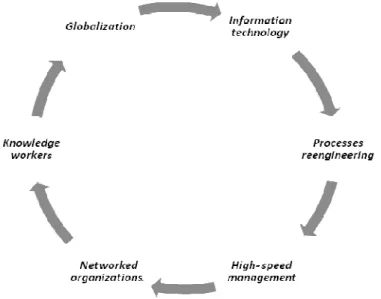
Virtual HRM is relevant to telecommuters who work out of their virtual home office. The evaluation of the virtual HRM department is based on six driving forces. These forces need to be harnessed and responded to as companies approach the 21st century. The following six forces must be addressed by HRM departments that want to continuously increase their value while reducing costs.
1. Information technology; HRM professionals are facing a digital future. The rapid growth in the field of computer hardware, software, networking, and telephony services is absolutely essential to the virtual HRM movement. It is not accident that virtual HRM departments will become the norm in the near future. This is especially true with the increase sophistication and lower costs of information age technology and automated processes.
2. Processes reengineering; strategic HRM managers are constantly looking for ways to streamline and improve core business processes to make them efficient. All business processes especially those in the HRM department can be reengineered and improved through the skillful application of information technology.
and faster. Virtual HRM is definitely a smarter and quicker form of service delivery than traditional HRM.
4. Networked organizations; virtual HRM departments are more likely to emerge in networked organizations than in traditional and bureaucratic companies. The proliferation of information technology such as local area networks, e-mail, and corporate intranets are the trademarks of a flatter networked company. These new-wave organizations offer state-of-the-art technology and information sharing to empower all levels of personals.
5. Knowledge workers; the 21st century organization will compete on strategic information and knowledge. These “learning organizations” will be staffed with self-directed and computer savvy, knowledge workers. These workers will excel at using information to quickly identify and capture lucrative business opportunities while also diligently identifying and resolving costly problems.
6. Globalization; to complete successfully in the 21st century, nearly all companies must develop a global business strategy. This means that HRM departments must be capable of providing services to their employees anywhere on earth. Obviously, a technology-assisted HRM department that is skilled at traversing the information superhighway, is in the best position to support a globalized workforce.
In summery, all of the aforementioned forces are designed to get rid of outmode organizational processes, procedures, layers and boundaries that add cost and form barriers between the HRM department and the company employees. Moreover, all of these forces reflect the enormous impact that information technology has, and will continue to have, on every process and procedure in the HRM department. Successful information of a virtual HRM department will clearly increase a company’s competitive advantage [6].
- ELECTRONIC HRM FUNCTIONS
-- E-PERFORMANCE MANAGEMENT
E-Performance, a web-based tool, has been designed to make your performance reviews easier than ever. E-Performance management places effective performance management where it belongs in the hands of line managers. Performance contracting and appraisal have never been easier. Goals are linked to the balanced scorecard elements giving the organization an overall view of performance with drill down capability to departments, subdepartments and individuals.
Benefits for Line Managers: Focused and aligned performance goals have a direct influence on company performance. On the other hand, employee performance and focus areas are accessible in an instant. Also, Performance management is a key part of an organization’s integrated human resources strategy. By this method, line managers receive instant feedback on performance with drill down to individual employee performance. No need to rewrite performance contracts each year. Simply you could upload and edit from a previous period and then, development needs emanating from performance discussions would be automatically fed into the individual development plan.
-- E-SALARY REVIEW
This module provides the functionality to model salary increases taking into account the employee’s performance, the budgeted salary increase and the industry benchmark salary for each job. In addition, the system operates on the principle of managing salaries within a particular band by limiting the recommended increases of over paid employees even if they perform well and recommending increases to underpaid employees even if they perform poorly.
Benefits for Line Managers: E-salary applies performance-based increases, manage salaries within industry range, address overpaid and underpaid employees and ensure salary budget is met. On the other hand, E-salary prevent organizational blockage by overpaid employees. Also ensure retention by addressing underpaid high potential employees and huge potential savings by effectively managing salaries e.g. a company with 500 employees with an average salary of $100000 is a save 0.1% by effective management salary budget of $50 million equals R50 000 (for year 2, 3 and 4 as well).
-- E- 360 º APPRAISALS
E-360 º appraisals have never been easier. Statements are preloaded into the system and the client is then able to custom build any number of profiles that can be linked to employees. There are a number of 360º appraisal reports available including individual reports that include and exclude self ratings, organizational reports that allow individual comparison to group and individual graphs. The reports also allow for drill down to statement averages to analyze the category averages. The system provides reports for HR or senior managers to monitor the progress of completed performance appraisals in the organization.
Benefits for Line Managers: That is easy to use online capture facility. Employee performance and focus areas are accessible in an instant. 360º appraisal provides unbiased and anonymous ratings. On the other hand, performance management is a key part of an organization’s integrated human resources management strategy. Line managers receive instant feedback on performance with drill down to individual employee performance.
-- E-RECRUITMENT AND SELECTION
Job advert generated
On line application
Pre-interview applicant matching
Interview Post interview applicant matching Create
recruitment profile
Standard interview questions by
Standard appointment clauses by job
Regret before interview
Post interview
regret
Regret & archive
Candidate appointment
Letter of appointment
generation applications, applicant matching, interview question database and letter of appointment generation. The recruitment monitor shows at a glance the status of organizational recruitment and provides reports that compare candidate suitability to the job profile.
Benefits: It is one stop shop for organizational recruitment. E-recruitment improves the quality of candidate by ensuring proper recruitment profiles and adverts are drafted and effective interviews are conducted. It also improves quality of interview questions. Potential candidate details are kept electronically. The use of electronic tools for recruitment provides real time reports for managers to monitor recruitment progress through the cycle. It also shows the candidates being most closely matched to the job specification and the standardized conditions of employment clauses.
Figure 4: E-recruitment process.[3]
-- E-SUCCESSION PLANNING AND CAREER MANAGEMENT
Who are the high flyers in your organization and when will they be ready for promotion? Does your organization have a strategy and process to identify and retain talent? Do you have adequate cover for the key jobs in your organization?
Succession planning provides tools to effectively manage the organization’s strategic people resources. Through the process of line driven career discussions, the potential of your employees is captured. Once captured, the organization is able to run reports that show potential by a variety of parameters. Future date driven reports indicate employee succession plans and allow the organization to ensure that there is adequate strategic cover of critical jobs.
Finally, this method highlights organizational jobs that are difficult to find replacements for.
-- E-SKILL MANAGEMENT
E-skills module allows for the management of the competency acquisition process & on-the-job-training in compliance with the Skills Development Act recommendations.
The functionality of this method allows for the assembly of unit standards according to job titles, roles or qualifications and the capability is provided to link employees to these unit standards. It monitors competency acquisition via sophisticated reports by individual, department, grade, and unit standard or job title. It is that simple if you harness the power of the software that provides E-skills development module. For each profile, the system has the functionality to add an assessment checklist for each unit standard comprising a set of learning objectives. Employees acquire a fixed number of learning objectives (normally between 50 and 150) when unit standards are linked to their respective jobs or qualifications. To show progress in skills acquisition, each employee is then assessed against the criteria and learning objectives are signed off on the software.
Benefits: E-learner ship and skill development enable line managers to obtain a real time indication of competency acquisition levels in every area of their business, from a departmental level right down to an individual level. By monitoring and measuring competence acquisition, organizations are able to effectively identify skill deficiencies that have a direct impact on productivity. Also, the transparent measure of competency acquisition and the quantification of progress provide an incentive to manage and focus on people development. By this method, the creation of profiles for each employee stimulates self directed learning and encourages greater employee participation and interaction around how work is done. On the other hand, as competency acquisition levels are raised in an organization, so too does the organizational culture change towards greater accountability for HRM by Line and a movement towards a self management culture.
-- E-TRAINING MANAGEMENT
Course reminders can be generated by email and details of training costs are recorded and can be reported on by race, gender and category.
Benefits: If organizations use electronic training management, training cost can be effectively managed and cost breakdowns by department, race, gender, category and employee will be available. Also by this method, employee training records are instantly accessible and training calendar is available by month. It also holds details of training vendors and venues. Finally, unique report writer gives user the means to generate customized reports.
-- E-DISCIPLINE AND GRIEVANCE MANAGEMENT
Line managers can now record details of their disciplinary hearings and grievance cases online. History of previous disciplinary cases can be accessed immediately. Manager can record details of counseling sessions as well as grievances lodged by employees. Drill down-departmental reports are available to analyze where disciplinary cases are most prevalent. The system provides the facility to record disciplinary cases by race, gender and occupational grouping and is used for employment equity returns.
Benefits: In this method, access to check disciplinary records and online capture of counseling, discipline and grievance records is easy. Quick view reporting on disciplinary cases and option to look up labor law and case history are other benefits of this method[4].
- E-HRM TOOLS AND SOFTWARE
-- SOFTWARE TARGETING HRM STAFF AS END USERS
HRM functional applications: “HRM applications” is the first E-HRM tools category that introduced software-enabled automation of discrete tasks and responsibilities assigned to the HRM function. Over time, vendors have developed a broad array of computer programs automating the whole gamut of actions carried out by HRM staff in the content domains of talent management, performance management, and stakeholder management. This technology category has matured to the point where one source publishes an annual census containing product summaries and contact information for over 1,300 HRM applications in the US alone [1]. Even though these technologies were among the first used to make the HRM department’s tasks easier, faster and more structured, absence of unifying standards made cross-application interfaces problematic.
to share data easily across applications. There also may be interfaces with non-HRM function (e.g. production scheduling, financial management), as would exist when the HRM suite is part of an Enterprise Resource Planning (ERP) system. While the first two E-HRM tools present opportunities to streamline the transactional elements of HRM service delivery, integrated HRM suites seek more ambitious improvements given the scope of their functionality. Consequently, the market for this innovation is less fragmented and more intensely competitive than it tends to be for vendors of discrete HRM functions.
-- SOFTWARE TARGETING INTERNAL CUSTOMERS AS END USERS
Interactive Voice Response (IVR) systems: Interactive Voice Response (IVR) systems, our third category, channel phone calls automatically to targeted recipients or recordings by pressing touchtone buttons. HRM functions subsequently leveraged this technology to facilitate telephone-driven consumption of such services as benefits enrollment, training registration, employee announcements, work-related surveys, etc. American firms like Procter and Gamble, Office Depot and Deloitte and Touche further deployed IVR systems to increase the efficiency of prescreening external applicants; a practice that has surfaced in Europe as well [9,13]. External organizations such as banks or bonding agencies also are able to verify employees’ status or income levels by calling the appropriate numbers.
HRM intranet applications: As intranet usage proliferates worldwide, opportunities emerge to utilize e-mail and electronic-form software to reduce the costs of data entry for payroll, benefits administration, training administration, etc. Employees increasingly become responsible for electronically updating their databases and downloading forms needed to execute task requirements. Even greater effort has been expended to migrate human-resource applications to internal websites, forming an HRM intranet within the larger corporate intranet. Online publishing of employee handbooks, work-related documents and descriptions of department’s operations permit employees to review company policies, access job postings and learn about the range of services available from HRM staff.
Employee self-service Manager self-service
B A
service applications have been hailed as a solution to one of the oldest criticisms of the HRM function-lagged response-time due to bureaucratic delay. For example, PeopleSoft’s collaborative applications offer more than 140 self-service transactions grouped into ten HR content areas: e-Benefits, e-Development, e-Pay, e-Equity, e-Recruit, e-Compensation, e-Profile, e-Recruit Manager Desktop, e-Compensation Desktop, and e-Profile Manager Desktop (PeopleSoft website). Available evidence reveals a sharp increase in the use of ESS and MSS applications, and widespread plans among non-adopters to introduce them over the next few years [3].
Figure 5: Self-service tools.[5]
HRM extranet applications: HRM extranets essentially act as conduits for electronic commerce between client firms and HR vendors (i.e. a business-to-business (B2B) market for HR services). Two different business models can govern these relationships. In the first one, the HRM department shares workforce data with vendors who use the information to effectively manage HRM services under their stewardship. The second model saddles vendors with broad responsibility for database management and service administration.
E-Commerce vendors for online purchasing. Portals are highly configurable through code modules, called “pagelets” or “applets”, that can be added to, or taken from, the entry page users encounter after logging into the system. Multiple sources document both real and planned growth for this HRIT category [10,14].
RESEARCH MODEL
Use of electronic HRM tools is not tangible for employees in most of developing countries. They believe that traditional tools are the best solution for HRM problem solving; therefore, they resist toward changing traditional HRM to modern HRM. Hence at first, we want to know how much of Iranian organizations are using electronic tools for HRM functions (selection, appraisal, and …).
On the other hand, based on literature review we selected six key factors as applications (outputs) of HRM. They were job satisfaction, job security, professional commitment, organizational commitment, workforce stress and organizational cohesiveness. We wanted to measure the impact of HRM’s electronic tools on these factors. Also we believed that using E-HRM tools such as intranet, extranet, portals and so on has positive effect on these factors. So the first hypothesis of this study is:
H1: Using E-HRM tools in Iranian organizations has positive effect on job
satisfaction, job security, professional commitment, organizational commitment, workforce stress and organizational cohesiveness.
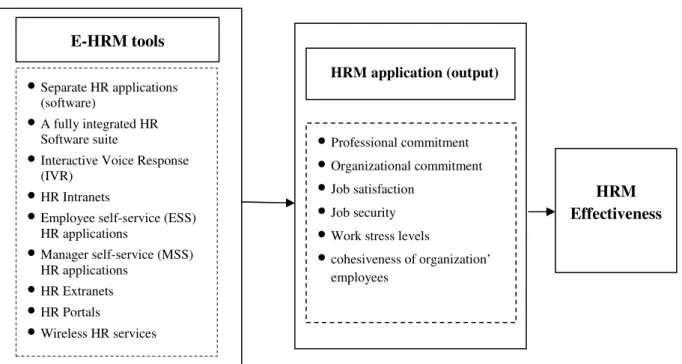
Finally as an end step in our model, using multiple linear regression we investigated that whether HRM applications (output) leads to the HRM effectiveness; in other words, whether use of electronic tools of HRM have an impact on HRM effectiveness.
H2: E-HRM applications have a significant positive effect on effectiveness of HRM
Following is a schema of the model used in this research:
3.1. Methodology
Figure 6: HRM effectiveness portrayed model.
The research design was quantitative and a questionnaire with three main parts was used to collect data:
Part one included demographic information about respondents. Respondents were 110 HR managers of Iranian organizations with more than 100 personnel.
Part two included phrases for assessing the degree of using E-HRM tools in Iranian organizations. These tools are intranet, extranet, portals, separated HRM software, and integrated HRM software, IVR, ESS, MSS and wireless services. We used a five point Likert scale questionnaire (1=is not used and 5= completely used).
Part three included phrases about whether the E-HRM tools impact on E-HRM applications (outputs). We also used a five point Likert scale for measuring the degree of effect of E-HRM tools on six key applications that noted earlier.
We used descriptive statistical techniques such as frequency measurement for evaluating the first question (the degree of using electronic tools for HRM). We also deployed one sample t-test to analyze the first hypothesis. And finally, multiple linear regressions were used to test the second hypothesis.
The data were analyzed using SPSS software and the Cronbach Alpha showed that the reliability of the questionnaire is α=.86 which is an acceptable amount.
STATISTICAL ANALYSIS AND DISCUSSION
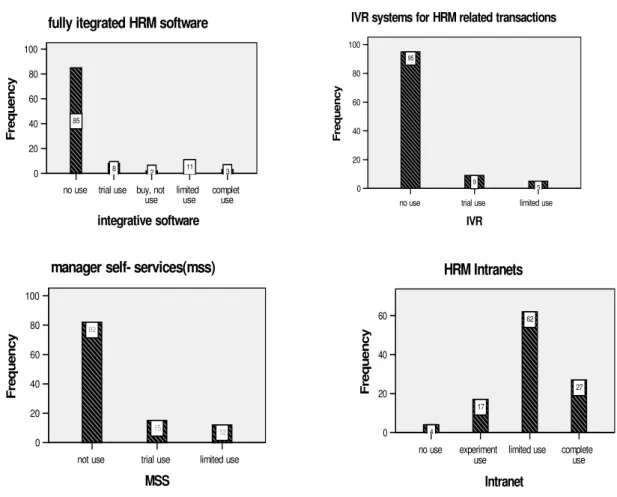
The charts presented blow show the amount of use of electronic tools for HRM applications in Iranian organizations. The most frequently used tool in Iranian
•Professional commitment •Organizational commitment •Job satisfaction
•Job security •Work stress levels
•cohesiveness of organization’ employees
HRM application (output)
HRM Effectiveness •Separate HR applications
(software)
•A fully integrated HR Software suite
•Interactive Voice Response (IVR)
•HR Intranets
•Employee self-service (ESS) HR applications
•Manager self-service (MSS) HR applications
•HR Extranets •HR Portals
organizations is intranet. complet use limited use buy, not use trial use no use integrative software 100 80 60 40 20 0 F r e q u e n c y 3 11 2 8 85
fully itegrated HRM software
limited use trial use no use IVR 100 80 60 40 20 0 F r e q u e n c y 5 9 95
IVR systems for HRM related transactions
limited use trial use not use MSS 100 80 60 40 20 0 F r e q u e n c y 12 15 82
manager self- services(mss)
complete use limited use experiment use no use Intranet 60 40 20 0 F r e q u e n c y 27 62 17 4 HRM Intranets
H1: Using E-HRM tools in Iranian organizations has positive effect on job
satisfaction, job security, professional commitment, organizational commitment, workforce stress and organizational cohesiveness.
Table 1: One-Sample t-test.
Test Value = 3
95% Confidence Interval of the Difference
t df
Sig. (2-tailed)
Mean
Difference Lower Upper
professional
commitment 15.902 108 .000 1.303 1.14 1.47 organizational
commitment 8.218 108 .000 .541 .41 .67
job satisfaction 23.059 101 .000 1.461 1.34 1.59 job security 9.303 108 .000 1.046 .82 1.27 work stress level 26.466 108 .000 1.615 1.49 1.74 organizational
In Table 1, low significance values (typically blow than .05) indicates that there is a significant different between the test value and the observed means. So the null hypothesis is rejected and H1 is accepted. Based on these results we can say that the use of HRM’s electronic tools improve the applications of HRM and have a positive impact on these outputs.
H2: E-HRM applications have a significant positive effect on effectiveness of HRM
activities.
Table 2: Variables entered/removed.
Model
Details 1 2 3 4 5
Variables Entered organizational commitment job satisfaction organizational cohesiveness professional commitment work stress level Variables
Removed . . . . .
Method Stepwise (Criteria: Probability-of-F-to-enter <= .050, Probability-of-F-to-remove >= .100). Stepwise (Criteria: Probability-of-F-to-enter <= .050, Probability- of-F-to-remove >= .100). Stepwise (Criteria: Probability-of-F-to-enter <= .050, Probability-of-F-to-remove >= .100). Stepwise (Criteria: Probability-of-F-to-enter <= .050, Probability- of-F-to-remove >= .100). Stepwise (Criteria: Probability-of-F-to-enter <= .050, Probability- of-F-to-remove >= .100).
Table 2 displays the variables entered or removed at each step. The variables entered into the model at each step are listed in the ‘variables entered row’. We used stepwise method to enter or remove the variables.
Table 3: Model summary.
Model R R Square Adjusted R
Square
Std. Error of the Estimate
1 .560 .313 .306 0.414
2 .749 .560 .551 0.333
3 .772 .597 .584 0.321
4 .822 .675 .661 0.289
5 .832 .692 .675 0.284
which has largest value of R and so indicates strongest relationship between dependent and independent variables of the model.
Since model number five contains all the independent variables except job security which has an approximately high R square (R2= .692), it can be said this model fits the data well.
Table 4: Coefficients.
Unstandardized Coefficients
Standardized Coefficients Model
B Std. Error Beta
t Sig.
(Constant) 3.158 .218 14.509 .000
1 organizational
commitment .396 .060 .560 6.619 .000
(Constant) 1.419 .296 4.800 .000
organizational
commitment .403 .048 .569 8.369 .000
2
job satisfaction .383 .052 .497 7.304 .000
(Constant) 1.275 .289 4.414 .000
organizational
commitment .333 .052 .471 6.391 .000
job satisfaction .371 .051 .482 7.335 .000 3
organizational
cohesiveness .106 .037 .215 2.914 .004
(Constant) .835 .277 3.018 .003
organizational
commitment .237 .051 .335 4.636 .000
job satisfaction .304 .048 .395 6.363 .000 organizational
cohesiveness .170 .036 .344 4.782 .000
4
professional
commitment .188 .040 .321 4.744 .000
(Constant) .511 .308 1.660 .100
organizational
commitment .234 .050 .330 4.660 .000
job satisfaction .200 .066 .260 3.034 .003 organizational
cohesiveness .207 .039 .418 5.365 .000
professional
commitment .171 .040 .292 4.309 .000
5
Table 4 shows the coefficients of the estimated regression model.
Based on this table the estimated model which is HRM effectiveness = .511+ .234(organizational commitment) + .2(job satisfaction) + .207(organizational cohesiveness) + .171(professional commitment) + .157(work stress level).
On the other hand, the statistics can help us determine the relative importance of each variable in the model. We are looking for values well blow -2 or above +2.
CONCLUSIONS
By examining gathered data, it became evident that E-HRM tools are rarely used in Iranian organizations and most of these organizations are not familiar with the tools such as ESS, MSS, HR extranet and more importantly wireless HR services. Moreover, they generally use ERP modules for solving their HRM problems.
In the second phase by using one sample t-test, the first hypothesis was examined. It was revealed that electronic tools have a significant effect on each of the HRM applications.
Then, for fitting data to the model, the HRM applications were investigated as independent variables for evaluating the HRM effectiveness as a dependent variable. From among independent variables, job security was omitted because according to the multiple regression evaluation, it was not a good predictor or determinant of dependent variable.
On the other hand, E-HRM applications have a significant positive effect on the effectiveness of HRM activities. This means that deploying E-HRM tools impacts on the effectiveness of HRM activities indirectly.
For implementing E-HRM tool, first we must identify the goals and strategies of E-HRM and then provide the infrastructure in organization such as information technology and telecommunication systems. It is essential to consider the limitations of implementing E-HRM such as hardware, software, employees’ skill and financial capabilities.
ENDNOTES
1. This article has been presented at the 4th International ICTM Conference, February 2008.
2. Available: at <http://wipro.com/webpages/itservices/b2e/idesk/eperformancemgmt .htm
3. Available: at <http://www.aspiration.co.za/literature/E_recruitment.pdf>. 4. Available: at <www.aspiration.co.za/>.
REFERENCES
[1] Alpar, P., “Automation of Banking Functions and its Managerial Implications.” IEEE Transactions on Engineering Management, Vol. 39, pp. 378-384, 1992. [2] Beer, M., et al., Managing Human Assets. New York: The Free Press, 1984.
[3] Cedar, “Human Resources Self Service/Portal Survey.” Cedar Enterprise Solutions, Available: at <www.cedar.com>, 2002.
[4] Gardner, S. D., et al., “Virtual HR: the Impact of Information Technology on the Human Resource Professional.” Journal of Vocational Behaviour, Vol. 63, pp. 159-179, 2003.
[5] Gueuntal, H. and Stone, D., The Brave New World of E-HR. San Francisco, CA.: Jossey-Bass, 2005.
[6] Jones, J., “Virtual HR: Human Resource Management in the Information Technology.” Available: at <http://www.books.google.com>, 1998.
[7] Lepak, D. P. and Snell, S. A. “Virtual HR: Strategic Human Resource Management in the 21st Century.” Human Resource Management Review, Vol. 8, No. 3, pp. 215-234, 1998.
[8] Martin, G., Technology and People Management: Challenges and Opportunities. Wimbledon: Chartered Institute of Personnel and Development, 2005.
[9] Overell, S., “Recruitment Technology: The Right Personalities in Store.” Financial Times, Vol. 10, 2002.
[10] Plumtree., “The Corporate Portal Market in 2002: A Synthesis of New, Comprehensive Survey Results and Recent Analyst Research on How Organizations Are Deploying Portals.” Plumtree Software Website, Available: at <www.plumtree. com>, 2002.
[11] Ruël, H. J. M., et al., E-HRM: Innovation or Irritation? An Exploration of Web-Based Human Resource Management in Large Companies. Utrecht: Purdue University Press/Lemma Publishers, 2004.
[12] Ruta, C. D., “The Application of Change Management Theory to the HR Portal Implementation in Subsidiaries of Multinational Corporations.” Human Resource Management, Vol. 35, p. 53, 2005.
[13] Thaler-Carter, R. E., “Reach Out and Hire Someone.” HR Magazine, Vol. 44, No. 5, pp. S8-S12, 1999.
[14] Towers P., “HR on the Web: New Realities in Service Delivery.” Towers Perrin Website, Available: at <www.tp.com>, 2002.
![Figure 3: E-Performance management cycle. [2]](https://thumb-us.123doks.com/thumbv2/123dok_us/8037244.2128208/7.892.129.724.625.1072/figure-e-performance-management-cycle.webp)
![Figure 4: E-recruitment process. [3]](https://thumb-us.123doks.com/thumbv2/123dok_us/8037244.2128208/9.892.100.800.400.695/figure-e-recruitment-process.webp)
![Figure 5: Self-service tools. [5]](https://thumb-us.123doks.com/thumbv2/123dok_us/8037244.2128208/13.892.118.760.341.724/figure-self-service-tools.webp)