ISSN (o): 2249-3905 ISSN (P): 2349-6525| Impact Factor: 7.19 |
ENGINEERING CHARACTERIZATION OF RIVER NIGER ONITSHA BEACH SAND FOR FOUNDRY APPLICATION
Agbo A. O, Ameh E M and Nwogbu C C
Department of Metallurgical and Materials Engineering, Enugu State University of Science and Technology, Enugu, Enugu State
Abstract
The Engineering Characterization of River Niger Onitsha Beach Sand has been undertaken with a view to finding its usefulness in the foundry industry. Chemical analysis was carried out using x-ray flurescence technique. Particle size analysis was conducted using electric sieve shaker. The mechanical properties of the moulding sand were tested using standard techniques (AFS). The mechanical properties tested were green compressive strength, green shear strength, dry compressive strength, refractoriness, moisture content and permeability. Results of the test obtained included: green compressive strength (31.65kN/m2, 23.25kN/m2), dry compressive strength (224kN/m2, 220kN/m2) permeability (141.15No, 143No), moisture content (3.80%, 3.55%), for bentonite and Ukpor clay respectively, with AFS grain fineness number (81.81), refractoriness (13880C) and fusion point (13900C) of River Niger Onitsha beach sand. From the result, it was found that 5% of bentonite and 5% of Ukpor clay respectively and then 5% water were most suitable for moulding river Niger Onitsha beach sand for application in non-ferrous foundry industry. These results demonstrated the possible utility of both binders for making sand casting moulds, and are therefore recommended for foundry application.
Keywords: River Niger sand, Ukpor clay, bentonite, refractoriness, dry strength, casting.
1.0 Introduction
Foundry sand mixtures for moulding purposes is expected to posses adequate green
compression strength, permeability as well as dry strength (Onyeji, 2010). The required
levels of these properties vary depending on the type of moulding, the types of metal cast, as
well as the size and shape of casting (Mathew and Aku, 1983).
There have been various attempts by Nigerian researchers to develop local alternatives to
imported foundry materials by determining their suitability for the production of sound
castings. Most research in this area centred mostly on determining the refractory properties of
various deposits of clays which are abundant in the country and are used as binder in
moulding sand (Ndaliman, 2002). Akinbode (1996) investigated the properties of termite hills
as refractory material for furnace lining, and observed that the refractory properties of
termite hill material like permeability, dimensional change and density were very similar to
known refractory materials for furnace lining. Aliyu et al (2013), studied the chemical and
State, Nigeria and found that the deposits could be processed for use in the paper and foundry
industries.
The properties of moulding sand are influenced by the amount of additives such as coal dust,
corn flours and clays and the ingredients such as binders and water (Ayoda et al, 2010).
Foundry industries in Nigeria use imported binders and synthetic sand for production.
According to Akintunde and Omole (2008), sand suitable for moulding consists largely of
grains of silica (SiO2) together with 5-6% clay to act as a binder. Binderbility of moulding
sands, determined by the amount of binder present in it, is one of the requirements for
effective performance of the sand for moulding. For both naturally occurring and synthetic
sand moulds, the quality of casting is influenced significantly by sand properties such as
green compression strength, dry compression strength, permeability, compactibility, moisture
content and others. All these properties are in turn dependent on the sand parameters of the
binder used, water and sand grain size (Ditert, 1966). Satisfactory mould property ranges for
sand casings of various metal grades is shown in Table 2. Development of Igbokoda clay in
the south western part of Nigeria as a binder for synthetic moulding sand was carried out by
Loto and Motoso (1990). Their results confirmed that Igbokoda clay had good value as a
binder for synthetic moulding sand. Aramide et al (2011) also investigated the effects of
binders (bentonite and dextrin) and water on the properties of recycled foundry sand made
from silica sand obtained from Ilaro sand deposit of Ogun State Nigeria. They discovered
that with minimum additives of binders recycled Ilaro sand can be reused. Katsina el al
(2013) studied the characterization of Beach/River sand for foundry application and
discovered that samples from Ughelli River, Warri River and Ethiope River could be used
effectively in the foundry. However, the sand from Lagos bar beach required to be sieved
properly to remove the coarse fractions.
This work, seeks to address the suitability of River Niger Onitsha beach sand for possible
foundry application using bentonite and Ukpor clay as binders.
2.0 Materials and Method
All the materials required for this research were sourced locally. The silica sand was sourced
from River Niger beach Onitsha, while the binding clay was sourced from Ukpor in Nnewi
South Local Government Area both in Anambra State. Each of the test specimens from the
various mixtures were subjected to the relevant sand mould test such as chemical analysis of
River Niger Onitsha beach sand, sieve analysis, green compression strength, green shear
permeability tests.
2.1 Sieve Analysis
The stocks of sieve were arranged according to the sieve aperture with the largest aperture on
top of the stock and the smallest aperture at the bottom. 1000g of sand dried in the air was put
into the top sieve stock. The stocks were placed on a sieve shaker which was then switched
on, and allowed to vibrate for a period of thirty (30) minutes. The sieves were removed one
after the other beginning with the one on top. The quantity of sand remaining in each sieve
was weighed. The weight was recorded for each sieve in the column corresponding to the
sieve mesh serial number (1.00mm, 0.71mm, 0.50mm, 0.18mm, 0.125mm, 0.09mm and
0.063mm). Each sieve weight was multiplied by the corresponding sieve mesh number. The
sum total of the product was divided by the total sample aligned and this produced the
fineness number of the sand.
2.2 Chemical analysis
The chemical composition of the samples (River Niger sand and Ukpor clay) was determined
sing X-ray florescence (XRF) spectroscopy technique. The samples were dried in an oven at
600C for 30mins and milled into powder sample of particle size 100mesh (0.15micron),
recommended for XRF analysis. The equipment was allowed to run for 5 hours with the
recommended voltage and current of 45volts and 40A respectively, to enable the standards
and other mechanical parts responsible for analysis to stabilize and initialized for XRF test.
2.3 Determination of green compression strength
The green compression strength was carried out using universal sand strength testing machine
(model: 6903). A prepared standard sample was positioned in the compression head already
fixed into the machine. The sample was loaded gradually, while the magnetic rider moved
along the measuring scale. As soon as the sample reached its maximum strength, the sample
experienced failure and the magnetic rider remained in position of the ultimate strength (a
value was noted), while the load was gradually released.
2.4 Determination of dry compression strength
A prepared standard sample of 5cm diameter x 5cm height was dried in the oven at a
temperature of 110oC for a period of 20minutes and then removed and allowed to cool in the
air to ambient temperature. After cooling, the sample was fixed onto the universal
sand-testing machine (model: 6903) with the compression head in place. The compressive load was
applied and the samples failed at the ultimate compressive strength of the sample. The point at
2.5 Determination of dry shear strength (DSS)
The prepared standard sample of 5cm diameter x 5cm height was dried in the oven at a
temperature of 110oC for 20 minutes and then removed from the oven to cool an air to
ambient temperature. The same universal testing machine was used for dry compression
strength. In this case, the shear head was replaced for the compression head. The shear
strength was recorded at the point of failure of the standard test sample.
2.6 Determination of green shear strength (GSS)
The machine used for the GCS was also used for the determination of (GSS), except that the
compression head was replaced with shear head in the machine. The green shear strength was
recorded at the point of failure of the sample loaded
2.7 Determination of permeability
The permeability test was done on the standard sample specimen of 5cm diameter x 5cm
height. The specimen, while still in the tube, was mounted on a permeability meter. The
permeability meter is an electrical perimeter and it employed the orifice method for rapid
determination of sand permeability. Air at a constant pressure was applied to the standard
sample specimen, immediately after producing the sample and the drop in pressure was
measured using a pressure gauge, calibrated directly in permeability numbers.
3.0 RESULTS AND DISCUSSION
Table 3 gives the chemical analysis result of the River Niger Onitsha beach sand, from the
Table 3, it is evident that silica is the predominant component in the River Niger Onitsha
beach sand. This is of good advantage since high percentages of silica in sand (Richard et al
1983), usually enhance its refractory and thermal stability, while it is noted that the presence
of iron oxide, potassium oxide and sodium oxide can course objectionable lowering of the
fussion point in sands. From the Table 3, the silica content of 94.49% compares well with the
acceptable values of between 80% and 97% recommended for moulding (Jain, 2008), but
cannot be used for ferrous castings because according of Mclaws (1971) ideal sand for ferrous
castings should contain silica in the region of 98% - 99%. It can also be seen from the Table
1 that the percentage of SiO2 content for Chelford, Warri and Ughellium River sand samples
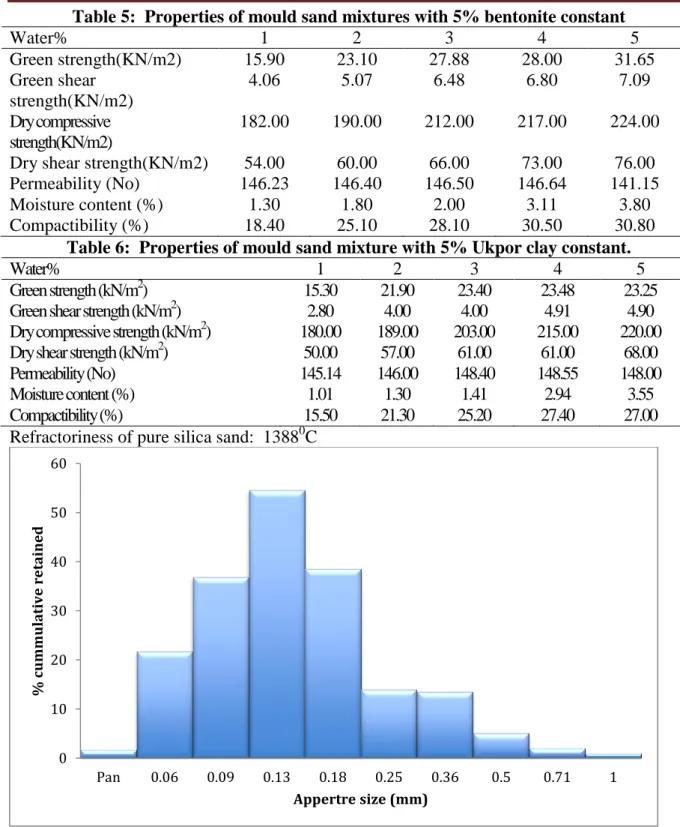
are very close to that of River Niger Onitsha beach sand sample. Table 4 and figure 1 showed
the parameters of River Niger Onitsha beach sand and AFS grain fineness number, from the
Table 4, it was shown that the grain fineness number falls within the acceptable range.
According to the American foundrymen’s society (AFS) Standard (1963) that 40 to 330
average fineness number of 81.81 as shown in Table 4. From the figure 1, it was seen that the
grain is distributed in all the screens and about 70.85 percent concentrations of the sand grains
retained by the three adjacent sieves of 0.18mm, 0.125mm and 0.09mm.
Moulding experiments using Ukpor clay and bentonite as binder at varying composition were
carried out to determine the basic mechanical properties such as the refractoriness,
permeability, compactibility, dry compressive strength, dry shear strength, and moisture
content of the moulded River Niger Onitsha beach sand. The variation of water content with
the values of green compression strength increases with increase in percentage water addition
as is shown figure 2. Green strength increases steadily from 15.90kN/m2 at 1% water
reaching a maximum value of 31.65kN/m2 at 5% water content for bentonite sample. The
maximum value of green compression strength of 23.25kN/m2 was obtained at percentage
water content of 5%. Dry compressive strength increased from 182.00kN/m2 at 1% water
content to 224.00kN/m2 at 5% water content addition for bentonite sample, while Ukpr clay
sample, increased from 180kN/m2 at 1% water to 220.00kN/m2 at 5% water content. This
increase in the dry compressive strength with increase in water content shows that the sand
can absorb more water.
These dry compressive values were in agreement with the American Foundrymen’s Standard
(AFS) shown in Table 2.
The green shear strength permeability and dry shear strength test were determined as shown
in Tables 5 and 6. The moisture content values increased with increase in water concentration
for both binders with bentonite sample having greater values as shown in figure 7 when
mixed with 1% water, the moisture contents are 1.30% and 1.01% respectively for bentonite
and Ukpor clay sample. These values increased to 3.80% and 3.55% at 5% water addition
respectively for bentonite and Ukpor clay sample. These values increased to 3.80% and
3.55% at 5% water addition respectively for bentonite and Ukpor clay sample.
The variation of water content with the values of compactibility, increases with increase in
percentage addition as shown in figure 8. From the figure, bentonite sample records higher
values of 30.80% at 5% water addition compared to 27.40% recorded for Ukpor clay sample
at 4% water addition. The bentonite sample shows a high value of compactibility number
than the Ukpor clay sample by about 3.4%. The refractoriness of the pure silica sample is
13880C. The refractoriness gives important information about the thermal resistance of the
sand. It showed that the sand is mainly suitable for non-ferrous metals with melting point
Table 1: Chemical Composition of some Foundry Sands
Constituent Chelford Warri River sand (%) Ethiope River sand (%) Ughelli River sand (%) Lagos Bar Beach sand (%)
SiO2 97.91 96.18 98.12 97.01 53.16
Al2O3 1.13 2.76 0.91 1.96 19.40
Fe2O3 0.50 0.06 0.16 0.13 4.70
CaO - - - - 2.66
MgO - - - - 2.08
K2O 0.25 - - - -
Loss on ignition 0.21 1.00 0.72 0.90 18.00 Total 100.00 100.00 100.00 100.00 100.00 Source: (Dietert .1954)
Table 2: Satisfactory Mould Property Ranges for Sand Castings
Metal Green
compressive strength (kN/m2)
Dry strength (kN/m2)
Permeability (No)
Heavy steel 70 – 85 1000 – 2000 130 – 300 Light steel 70 – 85 400 – 1000 125 – 200 Heavy grey iron 70 - 105 50 – 800 70 – 120
Aluminium 50 – 70 200 – 550 10 – 30 Brass and Bronze 55 – 85 200 – 860 15 – 40 Light grey iron 50 – 85 200 – 550 20 – 50 Malleable iron 45 – 55 210 – 550 20 – 60 Medium grey iron 70 – 105 350 – 800 40 – 80 Source: (Dietert 1966)
Table 3: Chemical analysis of River Niger Onitsha beach sand
Compound SiO2 K2O CaO TiO2 V2O5 MnO Fe2O3 NiO CuO
Conc. unit 94.49 % 1.30 % 0.475 % 0.341 % 0.012 % 0.027 % 1.675 % 0.0058 % 0.001 % Compound Ag2O BaO Nd2O3 OSO4 Au HgO
Conc. unit 0.904 % 0.052 % 0.049 % 0.14 % 0.23 % 0.30 %
Table 4: Parameters of River Niger Onitsha Beach sand and AFS fineness number
Sieve Serial No
Apperture size in (mm) Sand Retained on each sieve(g) Percentage of sand retained
Multiplier Product
1 1.00 9.8 0.98 9 8.82
2 0.71 10.5 1.05 15 15.75
3 0.50 40.2 4.02 25 100.50
4 0.355 95.2 9.52 35 333.20
5 0.25 44.7 4.47 45 201.15
6 0.18 340.5 34.05 60 2043
7 0.125 205 20.50 81 1660.5
8 0.09 163 16.30 118 1923.4
9 0.063 55.0 5.50 164 902
10 Pan (-63) 36.1 3.61 275 992.75
11 1000 100 8181.07
Table 5: Properties of mould sand mixtures with 5% bentonite constant
Water% 1 2 3 4 5
Green strength(KN/m2) 15.90 23.10 27.88 28.00 31.65 Green shear
strength(KN/m2)
4.06 5.07 6.48 6.80 7.09
Dry compressive strength(KN/m2)
182.00 190.00 212.00 217.00 224.00
Dry shear strength(KN/m2) 54.00 60.00 66.00 73.00 76.00 Permeability (No) 146.23 146.40 146.50 146.64 141.15 Moisture content (%) 1.30 1.80 2.00 3.11 3.80 Compactibility (%) 18.40 25.10 28.10 30.50 30.80
Table 6: Properties of mould sand mixture with 5% Ukpor clay constant.
Water% 1 2 3 4 5
Green strength (kN/m2) 15.30 21.90 23.40 23.48 23.25 Green shear strength (kN/m2) 2.80 4.00 4.00 4.91 4.90 Dry compressive strength (kN/m2) 180.00 189.00 203.00 215.00 220.00 Dry shear strength (kN/m2) 50.00 57.00 61.00 61.00 68.00 Permeability (No) 145.14 146.00 148.40 148.55 148.00 Moisture content (%) 1.01 1.30 1.41 2.94 3.55 Compactibility (%) 15.50 21.30 25.20 27.40 27.00 Refractoriness of pure silica sand: 13880C
Fig. 1 shows the cumulative percentages retained on each aperture size
0 10 20 30 40 50 60
Pan 0.06 0.09 0.13 0.18 0.25 0.36 0.5 0.71 1
%
cu
mm
u
la
tive
ret
aine
d
Fig 2: Effect of additives on the green compression strength and 5% water constant
Fig 3: Effect of additives on the green shear strength and 5% water constant
Fig 4: Effect of additives on the dry strength and 5% water constant
0 5 10 15 20 25 30 35
1 2 3 4 5
G
reen
st
reng
th
(K
N
/m
2)
Additives (%)
Bentonite Ukpor clay
0 1 2 3 4 5 6 7 8
1 2 3 4 5
G
reen
sh
ea
r
st
reng
th
(K
N
/m
2)
Additives (%)
Bentonite Ukpor clay
0 50 100 150 200 250
1 2 3 4 5
D
ry
st
reng
th
(K
N
/m
2)
Additives (%)
Fig 5: Effect of additives on the dry shear strength and 5% water constant
Fig 6: Effect of additives on the permeability and 5% water constant
Fig 7: Effect of additives on moisture content and 5% water constant
0 10 20 30 40 50 60 70 80
1 2 3 4 5
D
ry
sh
ea
r
st
reng
th
(K
N
/m
2)
Additives (%)
Bentonite Ukpor clay
136 138 140 142 144 146 148 150
1 2 3 4 5
Per
mea
bil
it
y
(No
)
Additives (%)
Bentonite Ukpor clay
0 0.5 1 1.5 2 2.5 3 3.5 4
1 2 3 4 5
Mo
ist
u
re
con
tent
(%)
Additives (%)
Fig 8: Effect of additives on compatability and 5% water constant Conclusion
This study has shown that
Ukpor clay is recommended for use in the foundry industry as replacement for imported
bentonite
The chemical analysis showed that the River Niger Onitsha beach sand is composed
predominantly of silica (94.49%) but not in the range that could be used for steel and
other heavy metals foundry
The sand mix with 5% bentonite and 5% water content was the best followed by 5%
Ukpor clay and 5% water content. These properties compared favourable with the
proportion of the moulding sand currently used in foundries for casting of non-ferrous
alloys.
Further research aimed at determining the binding properties of other cheap locally
available moulding materials is suggested.
0 5 10 15 20 25 30 35
1 2 3 4 5
Comp
acti
bil
it
y
(%)
Additives (%)
References
1. Akinbode F. O., (1996) An Investigation on the properties of Termite Hill as Refractory material for furnace lining Indian Foundry Journal 42(9) pp 10-13.
2. Akintunde M. A. and Omole S. O. (2008): Physico-chemical Assessment of Ijapo clay Deposit as Binder for moulding in foundry, The pacific Journal of Science and Technology volume 9 pp 578-582.
3. Aliyu S., Garba B. Danshehu B.G. and Isah A. D. (2013) Studies on the Chemical and Physical characteristics of selected clay samples, Internal Journal of Engineering Research and Technology 2(7) pp 171-183.
4. Ayoola W. A., Adeosun S. O., Oyetunji, A and Oladoye A.M. (2010) Suitability of Oshogbo sand deposit as moulding sand pp 33-41.
5. Dietert H. W. (1966). Foundry core practice 3rd edition American Foundrymen’s society, Des plaines Inc.
6. Higgin R. A. Engineering Metallurgy Edward Amold, 1974 pg 37.
7. Jain R. k. (2008). Production of foundry Technology 2nd Edition McGraw Hill Publishing Limited, New Delhi India pp 46-137.
8. Loto C. A. and Omoto E. O.(1990): Analysis and Development of Igbokoda clay as a Binder for synthetic moulding sand. Applied clay science. Vol 5, No 1, pp 85-97.
9. Mathew P., Aku S.Y. (1983): Improvement of some Nigerian foundry sands with locally available additives. Nigerian Journal of Engineering and Technology (6) 1:1-6.
10. McLaws I. J. (1971): Uses and specialization of Silica sand, Edmond, Alberta. Pp 35-68.
11. Ndaliman M. B. (2002). Effect of some Additives on the Refractory properties of Onibode clay, Nigerian Journal of Technological Research 1(1), pp 9-12.
12. Omeji A. (2010): Analysis and characterization on Nyikangbe clay, Chanchaga L.G.A. of Niger State. Journal of Metallurgy and Material Engineering (5) 2: 55-62