Meredith L. Pulley. Analysis of open-ended question responses reporting user satisfaction with library services using an interactive visualization tool. A Master’s Paper for the M.S. in I.L.S degree. April, 2007. 45 pages. Advisor: Bradley Hemminger
This paper discusses the major results and conclusions derived from the open-ended questions analysis, which was part of a 28 questions survey (25 close-ended questions, 3 open-ended questions) on academic scientist’s information seeking behavior (ISB) and information use (IU) conducted at the University of North Carolina-Chapel Hill (UNC-CH) during the Spring of 2005. The university’s academic scientists were asked to provide written responses expressing their perceptions about UNC-CH library and information services. The three open-ended questions were: (1) what are the positive aspects of service, (2) what are the shortcomings, and (3) what is one wish for future services (Hemminger, 2007). Nine-hundred sixty-nine (969) participants completed the survey. The participant comments were used to create a coding/classification schema of library services. Interactive Comment in Schema (ICIS), an interactive, web-based
visualization tool, was created for displaying, analyzing, and sharing participant feedback among the university’s librarians.
Headings:
Academic libraries – Science libraries Surveys – User satisfaction
by
Meredith L. Pulley
A Master’s paper submitted to the faculty of the School of Information and Library Science of the University of North Carolina at Chapel Hill
in partial fulfillment of the requirements for the degree of Master of Science in
Information Science.
Chapel Hill, North Carolina April 2007
Approved by
1. Introduction
“Academic libraries are facing two major threats: a global digital environment and increasing competition. They must improve the quality of their services in order to survive . . . Retaining and growing their customer base and focusing more energy on meeting their customers’ expectations is the only way for academic libraries to survive in this volatile competitive environment.”
-Rowena Cullen, “Perspectives on User Satisfaction Surveys,” Library Trends, 2001
1.1 Questions for academic libraries in the digital age
The library is a service organization, dedicated to facilitating its users’
information retrieval and use goals. As Buckland explains, “the mission of a library is to support the mission of the institution or the interests of the population served” (1992). In academic libraries, the service population consists of a wide range of academic
Libraries know that the research process revolves around information gathering, sensemaking, analysis, and knowledge sharing. However, what is not clear is how academic researchers would like their libraries to support their information use throughout these processes, especially in an age of constantly emerging electronic information technologies. Uncovering this knowledge is Cullen’s recommendation for library survival (2001).
While information technology is changing dramatically, the library’s mission of delivering effective library service remains the same. Consequently, the question arises, are academic scientists satisfied with the information services their university libraries provide in the 21st century? Asking this deceptively simple question may illuminate answers to greater, more complex questions. For instance, how has digital technology influenced academic researchers’ information access, retrieval, and use? What are the role and expectations of academic libraries to support electronic information behaviors? Are libraries keeping pace with users expectations? The answers lie in user-centered evaluation.
2. Background
2.1 Evaluation as a tool for implementing change
understanding users’ perceptions of the library, its role in the academic research community, and therefore, what the library needs to do to ensure a promising future. (Powe & Plung, 2001). Hernon and MacClure capture what is at the core of user evaluation in the following statement:
Evaluation reflects value judgments about what the library should be doing, adequate levels of performance, and criteria that describe success or
organizational effectiveness. Evaluation is tantamount to saying that change is both possible and desirable in the organization.
Consequently, the purpose of user evaluation is to illuminate areas of library service that users deem successful, as well as those areas requiring improvement. Thus, evaluation is a management tool for strategic decision making and organizational success. As Powe and Plung explain, libraries participate in two types of decision making:
There are two categories of decisions made within a library: interpersonal decisions made to meet customer needs (reference and directional services) and strategic decisions made to support library operations and growth (resource allocations, long range planning, facility optimization, etc.). While these
categories influence and support each other, their drivers are not always the same. The consequence of these decisions influences the world in which the decisions are made. In other words, our customers' successes (as a result of library
involvement) sustain and promote the organization, while positively influencing the customers' outlook on the library and their commitment to its future.
Therefore, there is an intricate relationship between libraries and their customers, or users, in that library planning and decision making about resource allocation and services, determine the library’s future. Satisfaction increases customer loyalty, which in turn promotes the future of the library. These same ideas are expressed by Cullen (2001). Powe and Plung further explain the relationship between library decision making, customer satisfaction, and library sustainability in the digital age:
the number of choices has grown exponentially. By the very nature of our jobs, most choices lead to more decisions. Choices made to satisfy our customers today, give us the opportunity to fill their needs tomorrow. Wise decisions keep us in business.
How do libraries make “wise decisions”? Having the right tools for decision making is critical.
2.2 Library Factors measured in User-centered surveys: from Servqual to Libqual+ Cook and Thompson, quoting Nitecki, note, “A measure of library quality based solely on collections has become obsolete” (2000). The products of the digital age--rapidly emerging information technologies and advances in information retrieval
methods, add new dimensions for evaluation beyond that of collection size in influencing users’ perceptions of effective library service. Still, the user centered survey has been by far the most popular tool for measuring library service satisfaction. Nitecki and Hernon note the value and importance of surveys:
The survey instrument, thus, becomes an important communications channel between customers and staff. . A culture of service quality assessment provides opportunities to demonstrate to customers how what the staff learns about customers’ expectations and perceptions helps to shape the service that libraries provide and the commitments that libraries make to their customers. Such opportunities should not be ignored (pg 269).
customer-based criteria. Quoting Nitecki, Cook et al. explain, “only customers judge quality; all other judgments are essentially irrelevant” (2001). Figure 1 shows the five dimensions or gaps, Servqual’s protocol theoretically evaluates.
However, the validity and reliability of Servqual were questioned in Cook and Thompson’s 2000 study. Servqual was administered across different user groups and measurements were taken at different times. As a result, Servqual’s five dimensions of service quality were not recovered. Cook further characterizes Servqual‘s 44 close-ended questions as cumbersome and inadaptable for local planning and decision making. Cook and Thompson conclude that new measures are needed to assess user perceptions of service quality (2000).
Gap 1. The discrepancy between customers' expectations and management's perceptions of these expectations.
Gap 2. The discrepancy between
management's perceptions of customers' expectations and service quality
specifications.
Gap 3. The discrepancy between service quality specifications and actual service delivery.
Gap 4. The discrepancy between actual service delivery and what is communicated to customers about it.
Gap 5. The discrepancy between customer's expected service and perceived service delivered.
Figure 1: The five Servqual dimensions identified by Parauraman et al (1988).
al, 2001). Two dimensions of Servqual service quality, Affect of Service and Reliability, were perserved; however three new factors, Library as a place, Provision of Physical Collection, and Access to Information were added to form the original LibQUALl+™ survey (Cook et al, 2001). The survey’s dimensions are refined on a yearly basis, and are based on the analysis of the previous year’s results. As a result of the 2002 survey results, the titles of the four dimensions were changed slightly to more clearly indicate the
questions and data from the 2003 survey (Libqual.org). The dimensions of library quality measured by the 2003 LibQual+™ are shown in Figure 2.
Affect of Service Information Control Library as Place
Employees who instill confidence in users
Dependability in handling users' service problems
Library space that inspires study and learning
Giving users individual attention
Making electronic resources accessible from my home or office
Quiet space for individual activities
Employees who are consistently courteous
A library Web site enabling me to locate information on my own
A comfortable and inviting location
Readiness to respond to users' questions
Printed library materials I need for my work
A getaway for study, learning, or research
Employees who have the knowledge to answer user questions
The electronic information resources I need
Community space for group learning and group study
Employees who deal with users in a caring fashion
Modern equipment that lets me easily access needed information
Employees who understand the needs of their users
Easy-to-use access tools that allow me to find things on my own
Willingness to help users Making information easily accessible for independent use
Print and/or electronic journal collections I require for my work
2.3 Differentiating between service quality and user satisfaction
In Hernon and Altman’s study on the complex relationship between user
satisfaction and user perception of library service quality, they propose the following two perspective model of user satisfaction:
The first is service encounter satisfaction—customer satisfaction or dissatisfaction with a specific service encounter—and the second is overall service satisfaction— customer satisfaction or dissatisfaction with an organization based on multiple encounters or experiences.”(p. 182)
Vaughn et al., quoting Hernon and Nitecki, distinguish user satisfaction surveys from service quality surveys both in their format and length and in their purpose:
Service quality as a means of evaluation probes precise statements on which the library seeks customer input… Judgments about satisfaction, on the other hand, tend to be global in the types of questions asked… Satisfaction focuses less on specific statements and relies more on open-ended questions. The intention of satisfaction studies is to identify if some general areas require scrutiny, whereas service quality studies offer data to examine specific problem areas for
improvement.
This study employs Hernon and Nitecki’s definition of user satisfaction, in that three open-ended questions were used to elicit users’ general satisfaction and
dissatisfaction with their library, rather than service quality, as measured by LibQUAL+ (Vaughn et al., 2007). For this reason, it was beneficial to the university’s libraries to participate in Hemminger’s ISB survey, to provide a more in-depth and focused user evaluation of existing library services.
generated from this project, as well as a comparison of the two project’s concept classification schemas (see Figure 2 and Figure 3 for comparison).
As noted by Vaughn et al., reference and instruction services are generally seen as a strength of library services, while depth of electronic collections are seen as a
shortcoming. Simmonds and Andaleeb identify the library’s physical space as an indicator of satisfaction with and use of the library’s services, but did not find “responsiveness, competence, and demeanor of the staff” to be a significant factor (Vaughn et al., 2007).
3. Methods
3.1 Survey Instrument and survey population
The original ISB survey was developed by Hemminger et al (2007) in conjunction with UNC-CH librarians and is currently being conducted at other academic research universities as part of a nationwide study (http://ils.unc.edu/bmh/isb/National-ISB-Survey.php.htm ).
The survey was administered to all university faculty, research scientists, post docs, and graduate (primarily doctoral students) who were in science departments. A total of 969 participants completed the survey. Of these 969, 901 were from 32 different campus science departments, representing four different campus libraries, and 68
respondents were from 3 outlying science departments (such as the School of Information and Library Science) and represented 3 other campus libraries (see Table 1 ).
gain a better understanding of how these users feel about their library in terms of the services provided. This was accomplished by including three open-ended questions which asked respondents to provide their opinions on the libraries’ successes and
shortcomings, as well as one wish for future library services (see Table 2) (Hemminger et al, 2007). As Vaughn et al. note, these questions elicit statements about general
satisfaction and dissatisfaction with the respondent’s library, as opposed to measuring service quality, like the formal LibQUAL+ survey. The results will be shared with the university’s librarians to better fulfill and support the university’s academic scientists’ library and information needs (Hemminger et al, 2007). The analysis of respondents’ comments provided from these three open-ended questions is the focus of this paper. 3.2 Role of open-ended questions
By asking users to provide written responses describing their likes and dislikes about existing library services, the researchers were able to explore a number of research questions that investigated respondents’ opinions about library services and how they support or do not support academic scientists’ information seeking and use habits. These included, but were not limited to:
What are users’ preferences for existing library services/resources? That is, what are the university libraries doing well and what do the libraries need to change/improve/add?
Which attributes of services do users like or find helpful? (e.g. campus document delivery, remote electronic access)
Which services do users expect to have available to them? (e.g. 24-hour library access, ability to annotate retrieved documents, free printing and photocopying)
What library services do academic scientists use/do not use? How much do users know about existing library services/resources
and what services would like to learn to use?
What services need more publicizing on library’s part?
In their article entitled, “Problems in the Use of Survey Questions to Measure Public Opinion,” Schuman and Scott, indicate that open-ended questions are a more effective method of eliciting study participants’ true feelings on a topic, as compared to
Department Participants Library
Biochemistry and Biophysics 30 HSL
Biology 77 Biology
Biomedical Engineering 8 HSL
Biostatistics 18 HSL
Cell and Developmental Biology 36 HSL
Cell and Molecular Physiology 34 HSL
Chemistry 82 Chemistry
Computer Science 52 Math/Phys
Curriculum in Toxicology 10 HSL
Environmental Sciences and Engineering 17 Biology
Epidemiology 77 HSL
Genetics 23 HSL
Lineberger Cancer Center 3 HSL
Marine Sciences 9 Biology
Mathematics 22 Math/Phys
Medicine 13 HSL
Microbiology and Immunology 43 HSL
Neurobiology 2 HSL
Neurology 12 HSL
Nutrition 26 HSL
Orthopedics Surgery 2 HSL
Pathology and Lab Medicine 38 HSL
Pediatrics and Genetics 2 HSL
Pharmacology 41 HSL
Physics and Astronomy 35 Math/Phys
Psychiatry 25 HSL
Radiation Oncology 1 HSL
Radiology 2 HSL
School of Nursing 39 HSL
School of Pharmacy 109 HSL
Statistics & Operations Research 13 Math/Phys
Surgery 4 HSL
\Public Health 3 HSL
Library 2 Other Table 1: Information Seeking Behavior of Academic Scientists Survey: 969
participants grouped by department. The department’s library is indicated in the last column (Hemminger et al, 2007).
Q26: In your opinion, what are the successes of your library?
Q27: In your opinion, what are the shortcomings of the library, and what new or different services would you like to see provided?
Q28: Imagine that you could have information made available to you in any form you desired. What one thing would you change to improve your access to, or use of, scholarly information?
Table 2: Open-ended questions from the Information Seeking Behavior of Academic Scientists Survey (Hemminger et al, 2007).
closed-ended questions, which limit participants’ responses to a predefined set of possible responses (1987).
Reja et al, citing Foddy, explain that open-ended questions may reduce the bias incorporated in the researchers’ suggested responses included in close-ended questions (2003). The use of open-ended questions was to the study’s advantage, in that the questions produced a large number of comments for analysis. The free response nature of the questions enabled researchers to gain a rich understanding of respondents’ attitudes toward current library services as well as how the library services and resources support their information seeking and use behavior. However, open-ended questions also have disadvantages, such as the extensive, often time-consuming, coding required before analysis (Foddy, 1993). Furthermore, the coding of open-ended responses is a difficult task, requiring the subjective judgment of the coder. Coders may have multiple
3.3 Sharing respondents’ comments to the open-ended question with UNC-CH librarians As previously explained, one of the objectives of this study was to not only analyze respondents’ comments, but to share the comments with campus librarians so that the user feedback could be used for library decision making and planning. However, the sheer number of participant comments and the length of the comments initially presented a barrier to accomplishing this goal. Printing out pages of typed responses would not be effective for the sharing nor the analysis procedures, as the comments were over 73 pages of text. It would be difficult to employ this method because the comments were organized only by survey question (Q26, 27, 28 in Table 2); therefore, large reams of paper would need to be flipped in an attempt to locate specific comments. When viewing the coded comments for analysis, the researchers and librarians would need to flip back and forth from the coded comments to the codebook to view the meaning of the codes, which could be a time consuming and clumsy process. Therefore, the researchers developed a novel approach to the display and exploration of the data that would
facilitate both the analysis and the sharing of coded comments. Interactive Comments in Schema, ICIS, is a web-based interactive visualization tool that enables the seamless viewing of the coded comments and their placement into the library services coding schema developed by the researchers (http://bioivlab.ils.unc.edu/icisNew5/). Thus, the ICIS tool was vehicle for communicating respondents’ comments to campus librarians.
3.4 A note on the comment coding
categories have been short descriptions and the concepts were not as detailed. In addition, the design and implementation of automatic coding methods are expensive and time consuming while results are still unreliable (Giorgetti & Sebastiani, 2003). The domain of this study’s schema categories required longer, more expressive coding to capture the meaning of the respondents’ comments. To ensure coding accuracy, the coding was reviewed by an expert librarian.
3.5 Coding schema development
The researchers’ first task was to develop an organizational schema for coding or classifying participant comments. Two approaches to creating an initial coding schema of library services were employed; these were a user-based model and a library-based model. The first method, a grounded theory approach, produced a coding schema developed solely from the themes presented in the respondents’ comments (Dick, 2005). In taking this approach, the researchers ensured that the schema was not predefined or artificially imposed on the comments, but rather a true reflection of respondents’ views and perceptions of library services.
produced a hierarchical coding schema consisting of four categories of library services: people, information space, physical space, and content.
Category definitions were developed to explain category inclusion and exclusion criteria. One theme that emerged in doing the reading and content analysis of the comments is that the comments were often more than one sentence long and expressed more than one theme, thereby requiring coding at different places within the schema. Consequently, such comments were broken into multiple parts and each part was coded in the appropriate schema category. The researchers referred to a respondent’s whole comment to a particular question as the preprocessed comment, and broken-up comments were referred to as post-processed comments.
The library-based model to coding schema development was based on how the library perceived its organization. The model was developed from the organizational framework of the library’s webpage (http://www.lib.unc.edu), which reflected the
library’s perception of the organization of its services. As in the user-model, the resulting coding schema was hierarchical.
The researchers, with the assistance of an expert librarian, evaluated the two schema designs and found them to contain essentially the same major concepts, thus it was possible to produce a single, unified schema. Processed comments that had been mapped to the user model were then mapped to the unified schema. The hierarchical unified schema is shown in Figure 3.
3.6 An overview of ICIS’s functionality
manually coded comments within the schema category that best represents the comments meaning. ICIS also allow for data exploration by providing a number of interactive features for comment filtering and display.
1. Library Services a. Circulation
b. Electronic Search Capabilities Provided by Library c. Education and Training
d. Reference/Patron Assistance e. Collection Development 2. Library Collections
a. Electronic Collection b. Print Collection 3. Library Infrastructure
a. Virtual Space/Website
b. Supporting Equipment/Services c. Building/Physical Space
4. Personal Library Tools
5. General Comments about the Library
Figure 3: ICIS Top Level Hierarchy
3.7 ICIS’s navigational features
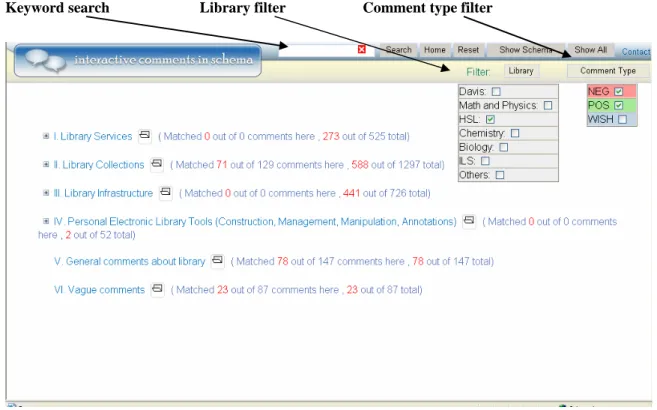
ICIS navigation and data exploration is possible via the following methods, as shown in Figure 5: (1) browsing or scrolling and clicking through the schema attempting to locate relevant category (this is the least structured search method), (2) keyword search, (3) filter by comment type, and (4) filter by library. Figure 6 describes the 5 navigational tabs located at the top right hand corner of the screen.
The presence of a plus sign to the left of a category or subcategory heading indicates that there are more levels (subcategories or child categories) beneath that parent level. By clicking on the plus sign or the name of the parent level, that particular level is expanded, displaying all child levels beneath it in the schema. Clicking on the folder icon to the right of a schema heading displays comments coded under that schema heading level.
Clicking on the "Comment Type" tab located at the page’s top right-hand corner, allows the user to filter the comments by comment type, thus allowing viewing of positive and/or negative and/or wish comments. The comment types are color
coordinated to match the color of the “Comment #” label on the displayed comments. In addition, each comment coded under a particular schema heading is given a number to allow unique identification of all the coded comments in the schema.
Another benefit of the tool is the ability to quantitatively describe the data. The parentheses located next to each category and subcategory indicates the number of comments that matched the selected filter settings (number of matched comments is the first number in the parenthesis). The second number in the parenthesis indicates the total number of comments coded at that particular schema level. At the four main parent categories (I-IV), the parentheses contain both the number of comments at that initial level, followed by the total number of coded comments under that entire schema category (see Figure 5).
Keyword search Library filter Comment type filter
Figure 5: ICIS’s search features: keyword search, filter by library, and filter by comment type.
Note: Clicking on tabs in the order of Home, Show Schema, Show All, takes the user
progressively deeper into the coding schema, and eventually to viewing the participant comments within the coding schema framework.
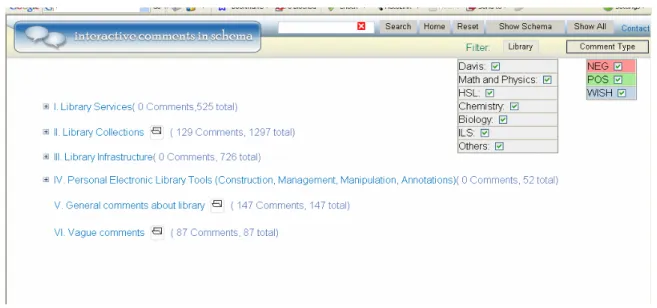
Home: The tools starting position. Shows hierarchical coding schema at only the upper most parent levels, or core category headings (6 core categories, labeled I-VI) The positive sign icon next to the category name indicates the ability to expand the category by clicking on icon, and allows viewing of the levels beneath it in the hierarchy. Hence, the user can manually “drill down” and explore the comments by clicking on the comment folder icon.
Show Schema: Shows all levels of schema (categories and subcategories, some categories are up to 4 levels deep). (The same result is obtained if the user clicked on each individual positive icon in “Home” (starting) position.). Again, comments can be manually displayed.
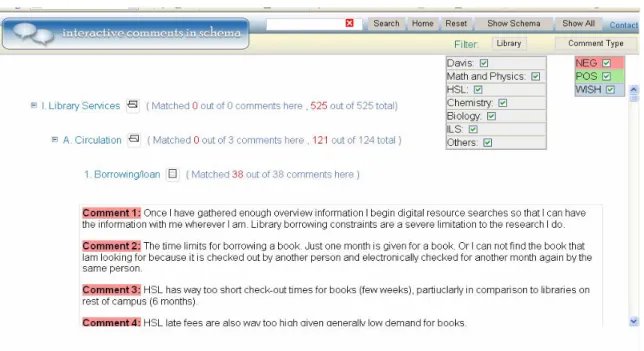
Show All: Shows all comments at all levels in the schema.
Reset: Returns to “Home” or starting position screen.
Search: Performs the search on the selected comment and/or library filter settings.
Figure 8: ICIS in "Home" or starting position. Note how all library comments and comment types are selected as the default.
Figure 10: ICIS in "Show All" view. Note how comment text is displayed and the color coordination of the highlighted comment number in the text and comment type tab.
4. Results
While reading the results and discussion sections, the reader is encouraged to explore the participant comments using the ICIS tool available at
(http://bioivlab.ils.unc.edu/icisNew5/ ).
4.1 Overall observations
4.1.1 Comment type content, syntax, and format
In providing success, shortcoming, or wish comments for library service,
respondents often used the open-ended format as a conversational tool to ask questions, make suggestions, brainstorm, provide compliments, or express dissatisfaction.
Interestingly, the content, syntax, and format of a comment were often influenced by the question type (i.e., library successes or shortcomings) the respondent was answering.
typical. This contrasts to the content and format of the shortcoming comments, which often described a respondent’s dissatisfaction in detail. Shortcoming comments also tended to use more expressive language and used text formatting for emphasis:
The hospital is open 24 hours a day and physicians and scientists therefore do too so WHY ISN'T THE LIBRARY OPEN 24 HOURS A DAY TOO? Many other great institutions have this service!
*Note on General Comments category: Schema category V, General Comments, received 150 comments. Typical comments in this category were brief like, “great library.” Note that because of the general and uninformative nature of these comments, only the four main schema categories (I-IV) will be discussed in the remainder of this paper.
4.1.2 Overall comment type distribution
# respondents # comments Avg. #comments/ respondent
Q26: Successes 648 1365 2.10
Q27: Shortcomings 574 817 1.42
Q28: Wish 544 652 1.20
Table 3: Numbers of respondents and comments for Q26, Q27, and Q28 of Survey Note: The “number of comments” column represents the post-processed comment totals, which were obtained from the breaking up of whole comments in order to categorize each issue the respondent discussed into the appropriate schema category.
4.1.3 Distribution of comments among the main schema categories
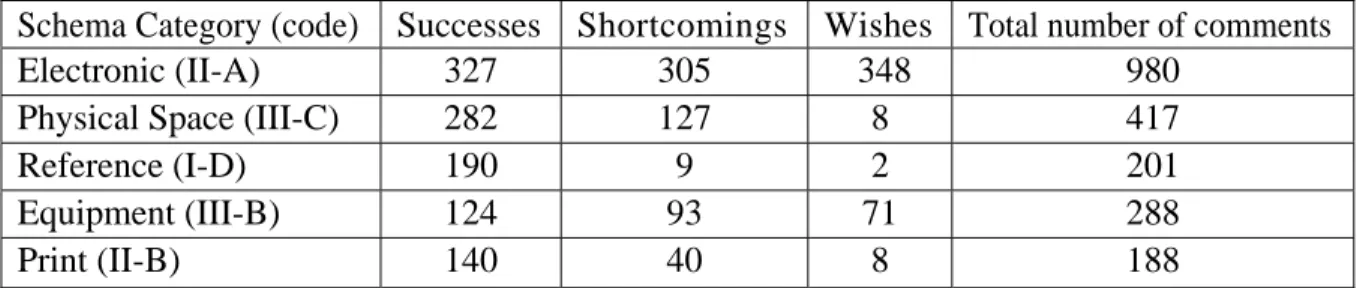
Table 4 shows the ranking of the four main or core schema categories according to the total number of comments received. Library Collections (II) received the greatest number of comments (1297). Of those 1297 comments, 980 were about the Electronic Collection (II-A). Library Infrastructure (III) received the second greatest number of comments (726), of which the Physical Library Space (III-B) was the facet most often commented on (417 comments). Library Services (I) was ranked third overall, with 525 comments. In this category, Reference Services (I-D) received the greatest number of comments (201). The fewest number of comments (52) were made pertaining to Personal Electronic Library Tools (IV).
A more detailed distribution of comments categorized by the specific areas of the library is presented in Table 5 and will be discussed in the sections following.
Successes Shortcomings Total
Library Collections 553 387 1297
Infrastructure 418 227 726
Library Services 323 131 525
Personal Electronic Library Tools 0 4 52
The remainder of the results section will present the comments in the order of the four main schema categories. In each of these results subsections, the subcategories will be discussed in the order of decreasing comment distribution.
4.4 Detailed observations on respondent comments 4.4.1 Library services (I)
According to the total number of comments received, Library Services was third among the four main categories (see Table 4). Respondents provided significantly more success comments about library service than shortcomings; in fact, success comments totaled more than twice the number of shortcoming comments (see Table 6).
Schema Category (code) Successes Shortcomings Wishes Total number of comments
Electronic (II-A) 327 305 348 980
Physical Space (III-C) 282 127 8 417
Reference (I-D) 190 9 2 201
Equipment (III-B) 124 93 71 288
Print (II-B) 140 40 8 188
Table 5: The five subcategories of library service with the greatest total number of respondent comments, ordered by comment total.
Successes Shortcomings Wishes
Services (525 total) 323 131 71
Reference 190 9 2
Catalog/Library Search 60 49 54
Circulation 54 60 10
Education & Training 19 13 5
Table 6: Success, Shortcomings, and Wishes of Library Services
In particular, comments focused most on the successes of reference services (190
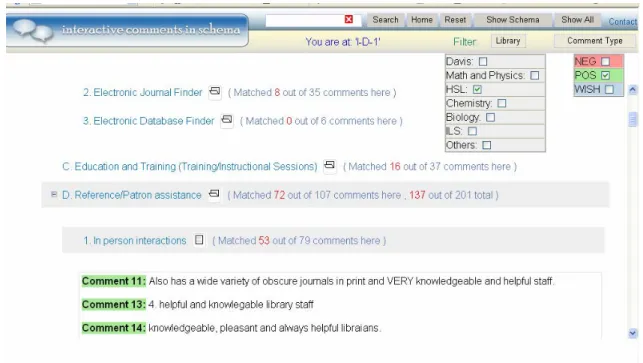
comments). The majority of Reference Services success comments noted the friendliness and/or helpfulness of library employees, as exemplified by the following typical
comment in this subcategory: I. Library Services
D. Reference
Comment 29: Helpful and knowledgeable staff
Only nine shortcoming comments about reference services were provided, and these requested personal assistance with locating materials.
“Electronic Search Capabilities Provided by the Library” (I-B) received the second greatest number of comments (163) under Library Services. It’s interesting to note that respondents made approximately the same number of success, shortcoming, and wish comments in this area, indicating this facet of library service is equally mixed with satisfaction and dissatisfaction. The “Electronic Search Capabilities Provided by the Library” subcategory consists of the Electronic Catalog (I-B-1) and the Electronic Journal Finder (I-B-2), both of which are accessible from the library’s webpage. The catalog and the electronic journal finder were evenly split in the success and shortcoming comments received. As for success comments, they were generally a listing the search entity the respondent deemed successful:
I. Library Services
B. Electronic Search Capabilities Provided by the Library 1. Catalog
Comment 32: Online catalog. Comment 33: Book catalog
Comment 34: good database, easy to search
In contrast, the shortcoming comments usually described respondents’ dissatisfaction in detail. Poor design and navigation of the library’s electronic search catalog were most discussed. For example, respondents’ often described the difficulty experienced while searching the catalog or electronic journal finder, or the dissatisfaction with the search engine features to access a particular journal:
I. Library Services
1. Catalog
Comment 17: The catalog needs work. Please allow searches that are limited to materials in a single library. It would also be nice not to have to go through so many screens to see if something is available or not.
Comment 22: The library web interface and, in general, its electronic system is just terrible. Here are some of the problems: - the access is very often slow, discouragingly slow - the returned results often
require several further clicks to reach the information needed about a title, especially the current availability of the item.
Another theme expressed in the shortcoming comments was the desire for cross platform searching among search engines:
Comment 7: I'm aware that the technology is still in its Infancy to enable cross-platform searching, and that the resources that exist are (and will be) less than ideal. However - again, because of the
multidisciplinarity of my research - it is crucial for me to be aware of literature in other fields, and at present, I am using ISI and Google Scholar to try to cast a wide net. These tools are less than satisfactory. I urge the libraries to continue their work toward enabling cross-platform searching capabilities, if there is truly an intent to support multidisciplinary research.
There were only six wish comments provided in Catalog/Library Search, all of which were about the Electronic Journal Finder. A main theme presented in the wish comments was the request for a better, more user friendly search engine, and comments often referred to popular, open source search engines as examples.
I. Library Services
Comment 31: Implement Google-like search of all electonic journals the library has or subsribes to. This search would link directly to the PDF
Comment 35: a centralized, easy to use, online search engine (such as PubMed) that automatically directs to journals that the university subscribes to
In the next subcategory, Circulation (I-A), comments pertained to
Borrowing/Loan (I-A-1) and Personalized Request Services (I-A-2) (I-A-2 includes interlibrary loan (ILL) and information retrieval services for specific user requests). Thirty-eight comments were coded under Borrowing/Loan. Twenty-five were
shortcomings discussing the inconvenience of short checkout periods and/or the inability to return books to any campus library.
I. Library Services
A. Circulation
1. Borrowing/Loan
Comment 3: HSL has way too short check-out times for books (few weeks), partiuclarly in comparison to libraries on rest of campus (6 months).
Comment 5: i would like to return books to a different library than i check them out. e.g. i often check books out from Math/Physics, which is out of my normal route, while i walk by Davis grad library daily.
Borrowing/loan received only 13 success comments and no wish comments were received.
Personalized Request Services (I-A-2) received 83 comments. Forty-one were success comments and tended to state that the speed of the ILL service as a library
I. Library Services
A. Circulation
2. Personalized Request Services
Comment 42: prompt interlibrary loan
Thirty-two shortcomings comments were made and more than half of them stated their dissatisfaction with ILL fees, and did so in a more descriptive nature:
Comment 16: $10 charge for interlibrary loan ... it should be free
Another theme found in shortcoming comments was the lack of a document delivery/courier service and how this service would potentially benefit workflow.
Comment 5: In my previous degree program,
materials could be sent via courier from one campus library to another - this was an incredible help, since my research is multidisciplinary. Because of my
schedule (and ironically, because if anything I'm using the various libraries much more than I did even then), the lack of this service now constitutes a serious barrier to access.
Comment 7: I work in Fordham Hall which is close to both the Biology Library as well as the Health Affairs Library, so physically visiting the libraries isn't too much work; however, it would be nice to have book/document delivery, perhaps 1x/day, from the libraries to the different labs which request materials. However, typically my need to access print material is limited since >95% of the journal articles I read are available as PDFs.
The same theme was found in the wish comments received pertaining to this subcategory; however, WISH comments tended to envision the entire information retrieval process to be offered as library service:
I. Library Services A. Circulation
Comment 81: HAVE SOMEONE ELSE RETREIVE AND SEARCH FOR ME AND LOCATE RELEVANT SOURCES AND INFORMATION
Lastly, Education and Training Services (I-C), received the fewest number of comments, (42). There were approximately an equal number of success (19) and shortcoming (17) comments. Successes tended to note the effectiveness of training classes on specific databases, like EndNote and PubMed, while shortcomings generally focused on the lack of training classes on basic information retrieval skills.
4.4.2 Library Collections (II)
Out of the four main schema categories, Library Collections was the most popular category among respondents, giving it the greatest number of total comments (1297). Again, more successes (553) than shortcomings (387) were provided (see Table 7) in this category. More respondents commented on the Electronic Collections (II-A) (980) than on any other category or subcategory in the schema (see Table 4). More precisely, Electronic Journal Collection (II-A-2) was the specific facet most commented on in comparison to any other area of library service (see Table 5).
Successes Shortcomings Wishes
Collections (1297 total) 553 387 357
Electronic 327 305 348
Print 140 40 8
Table 7: Successes, Shortcomings, and Wishes of Library Collections
provision of a web accessible electronic journal collection was one of the library’s greatest assets.
II. Library Collections
A. Electronic Collection
2. Electronic Journal Collectoin
Comment 394: Availability of so many journals via web access. Awesome tool.
In contrast, respondents’ shortcomings and wish comments expressed the need for a greater breadth and depth of electronic journals and journal volumes, in order to facilitate research. For instance:
Comment 32: Some interesting and widely used e- journals are not available.
Comment 131: Limited online access to journal articles. Better online journal access (i.e., access to more journals than is currently provided) would be the #1 way in which my university's library could better support my research, publishing, and academic training
It is also interesting to note that a few participants did not see a lack of electronic journals as a shortcoming the library was responsible for, but actually commented that high
publishing costs or budget crunches were the causes for not having widespread access: Comment 34: Some journals are becoming less available electronically, or back issues are not available electronically (not a failing of the libary so much as the increasing costs charged by publishers)
II. Library Collections
A. Electronic Collection
2. Electronic Journal Collection
Comment 479: ALL journals would be available electronically.
Comment 480: Electronic access to scientific journals in my field
Comment 481: I would like to see digitization of journal articles stretch farther back in time and span across more journal titles.
Print Collections (II-B) received significantly more positive than negative feedback from respondents (140 success comments vs. 40 shortcoming comments). The majority of success comments in this category were more descriptive than success comments in other schema categories. Comments discussed the success of the wide breadth and scope of the print journal collection (comment #’s 22, 23). Others noted that the library’s print journal and book collection were particularly helpful when an
electronic counterpart was not available (comment #’s 23, 46, 87): II. Library Collections
B. Print Collection
1. Print Journal Collection
Comment 22: Broad and deep journal and monograph collections.
Comment 23: Large archive of older editions and journal runs
Comment 46: In past years I have been impressed by the large number of e-subscriptions to journals supplemented by print copies of some older journals
Comment 87: Extensive collection of older articles that are not available on-line.
4.4.5 Library Infrastructure (III)
Respondents provided the second highest number of total comments (417) about library infrastructure. Following only Electronic Journal Collection (II-A-2), this
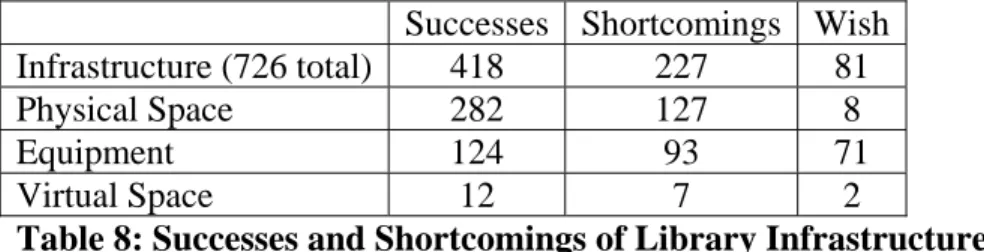
category received the highest number of success comments (282) (see Table 5). Specifically, Physical Space (III-C) was the subcategory respondents discussed most frequently in terms of both successes and shortcomings (418 success comments vs. 227 shortcoming comments) (see Table 8). Just prior to the survey’s distribution, major construction on the HSL was completed. The majority of study participants (561/969) have the HSL as their departmental library; therefore, 210 of the comments on physical space came from these participants concerning the HSL’s renovations.
Successes Shortcomings Wish
Infrastructure (726 total) 418 227 81
Physical Space 282 127 8
Equipment 124 93 71
Virtual Space 12 7 2
Table 8: Successes and Shortcomings of Library Infrastructure
demonstrate the positive perspective participants have pertaining to electronic content and a remotely accessible network.
I. Library Infrastructure B. Equipment
1. Proxy server/Remote Access
Comment 42: Number one by far is the accessibility to articles from home or work...most of what I need is always at my fingertips. This greatly improves the efficiency of my work.
Comment 43: Availability off campus (I can work from home)
Comment 45: I think the library has been very
intentional about making information available online, both on campus and at home. I do not have an office on campus, so availability of the proxy server has been crucial to my work.
In terms of 93 shortcoming comments received about equipment, 32 comments were about the inability to connect to the proxy server or the inconsistent access to this service. Twenty-nine negative comments discussed respondents dissatisfaction with photocopying services and fees. Comments discussing fees were the most expressive:
Comment 10: Not pleased about the increases in copy charges (YIKES they are high!)
As observed in the shortcoming comments coded under the electronic journal subcategory (II-B-2), often respondents did not blame the library for this perceived shortcoming.
The Virtual Space category (III-A), discussed comments about the organization of the library’s webpage. In total, only twenty-one comments about this area were received, and most were short and brief. Representative success comments stated “Good web page.” Shortcoming comments, unlike shortcoming comments provided in other areas, were also brief.
4.4.6 Personal Electronic Library Management Tools (IV)
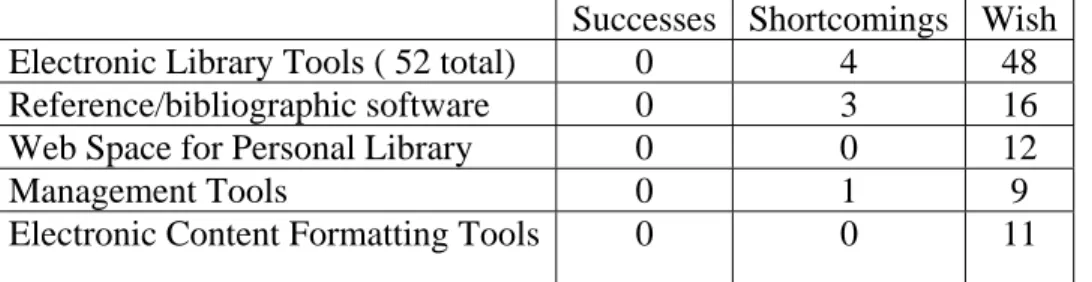
Personal Electronic Library Management Tools (IV), was divided into four subcategories based on participant comments about the organization, storage, and management of their individual electronic collection materials. This schema category received the fewest number of comments, totaling only 52. As seen in Table 9, 48 of the comments were wishes describing tools that would potentially streamline information management workflow.
Successes Shortcomings Wish
Electronic Library Tools ( 52 total) 0 4 48
Reference/bibliographic software 0 3 16
Web Space for Personal Library 0 0 12
Management Tools 0 1 9
Electronic Content Formatting Tools 0 0 11
Table 9: Successes and Shortcomings of Personal Electronic Library Management Tools
This is especially true for the reference/bibliographic management subcategory, as it received the highest number of comments, 19. Sixteen of the comments were wishes, which either described hopes for a faster method of downloading/importing citations (comment numbers 11, 18), or an automated search and download function into a
IV. Personal Library Management Tools A. Reference/Bibliographic Software
Comment 7: Customized weekly abstract searches of
electronic data bases with automated download into endnote format and access to full text.
Comment 9: EASIER search interface --> that searches with more options for fields (for instance able to search by
institution of authors) --> reassures me that I am finding what I am looking for (because I understand how the search
engine works) --> that downloads all ref information and the relevant PDF to EndNote in one step instead of several . . .
Comment 11: The most valuable change in terms of improving my access to information would be to streamline the process of searching through articles, importing
reference information into EndNote, AND importing .pdf articles into my personal library (or at least acces
Comment 18: Maybe this is currently available, but
databases directly linked to programs such as endnote that would facilitate the construction of reference sections would be helpful. Importing is a fairly slow process and used to be prone to errors when I did it often.
5. Discussion
5.1 Overall conclusions on comment data
Schema Category (code) Successes Shortcomings Wishes Total number of comments Electronic Journal
Collection (II-A-2)
224 230 185 639
Qualities of interior physical space (III-B-3)
155 39 0 194
Reference (I-D, I-D-1) 176 9 2 186
Remote Access (III-B-1)
64 32 52 148
Print Journals (II-B-1) 77 20 5 102
Table 10: The 5 specific facets of library service that received the most respondent comments.
What do these user evaluation outcomes mean for UNC-CH libraries? Librarians and library employees should be pleased that the university’s academic scientists are generally satisfied with existing library services. In other words, the university library system is keeping pace with its scientists’ service expectations. Of particular interest to the university, should be the success of the reference services and the physical library infrastructure. It should be satisfying for the university and the library management to have evidence that the work of their employees is highly regarded among patrons, as are the results of the extensive renovations.
Also interesting, was the fact that there were few truly visionary Wish comments provided. The majority of Wish comments were for more electronic journals, personal electronic library tools, and better electronic library search capabilities. In fact, all of the personal electronic library tools comments were Wishes. One of the more visionary wish comments in this category envisioned a web accessible, sharable personal library:
I'd love to be able to (hmm, this is fun!) have my personal archive of documents and weblinks reside in a web location, and to be able to annotate and rate these materials... If, furthermore, I could share them by pointing to their location AND could browse other researchers' web archives (sort of like those illegal music downloading sites) I could link to that... this conceptual citation index would be infinitely relational (like a mind map!), full-text accessible, and mineable for usage statistics .
In addition, it is interesting how the low number of comments received pertaining to personal electronic library tools supports the quantitative findings obtained from the survey’s close-ended question 17, which asked “Do you maintain a personal article collection?”(Hemminger, 2007) Although 85.4% of respondents indicated that they did, when asked in survey question 17.1 to “Indicate the approximate size of both your print and electronic article collections,” the results showed that keeping an electronic journal article collection appeared to be a newer practice that had not yet been adopted by a large number of researchers (Hemminger, 2007). However, adoption of a personal electronic article collection will most likely increase in the digital age.
5.2 Top ten suggested improvements
1. Expand digital collections:
Now more than ever before, libraries need to keep pace with users’ demands for access to digital content. More than half of the user Wish comments requested access to more electronic content, specifically in the form of online journals. Thus, users expect to have access to a wide-ranging, quality electronic collection. It is expected that this demand will only increase with time.
2. Convenient, consistent, and fast remote access to digital content:
Libraries need to provide consistent electronic access, both on and off campus, especially with the expected continuous growth in virtual offices and universities. As such, proxy servers should deliver the same content and provide the same path to that content as when accessing the network on campus. Remote users should not have to be frustrated with continuous logins/authentications or the inability to access information that is accessible when on campus.
3. The physical library should provide separate areas conducive for quiet work and
collaborative group work:
a. Libraries need to provide a well-organized and pleasant environment for their users. User satisfaction is influenced by the quality of the physical library’s interior space. In particular, users appreciate a comfortable, quiet environment for research and reflective thought. These study spaces should be separate from areas of computer stations and areas for collaborative work.
knowledge sharing and group discussions. Rooms should be provided for these purposes, so as not to disturb others.
5. Helpful, courteous reference service:
Even in the digital age, interactions with library employees still greatly influence user satisfaction/dissatisfaction. Users value friendly and polite library employees who go out of their way to provide assistance.
6. Simple to use meta-search engines: Confusing library search engines were a large
source of frustration for respondents. Many respondents’ comments indicated a
preference for a single, simple, intuitive search interface such as those provided by search engines like Google. In addition, respondents wanted a search engine to immediately provide comprehensive results (all the content in all the resource collections being searched).
7. Reduce or eliminate services fees:
Library management should work on developing ways of streamlining fees associated with interlibrary loan, document delivery, printing, and photocopying, as this area was associated with a large source of frustration by respondents.
8. Provide document delivery service:
9. Maintain the library’s print collection, especially journals not available in
electronic format:
In addition to the electronic journal collection, respondents still value comprehensive, quality print collections. Special efforts should be made to provide easily accessibly copies of relevant print journals that are not available online.
10. Support bibliographic management tools and offer tool training classes:
As a consequence of the popularity of electronic information retrieval, the library needs to support the use of bibliographic management tools like Refworks and EndNote for the creation, storage, and management of personal bibliographic databases of electronic references. The survey reported that 59% of respondents maintained a personal bibliographic database (close-ended question 18) (Hemminger, 2007). In addition, the comments provided in response to the open-ended questions indicated that although respondents found the tools useful, they also wanted the library to offer bibliographic management tool training classes.
6. Further research
6.1 ICIS Usability Testing
Currently, usability tests are being designed to observe how well users interact with ICIS and to determine how useful they judge the tool to be for comment analysis. Because librarians will be the main users of the tool, task questions are being developed from a list of questions librarians wish to capture from the survey.
comments to, determine which method is easier, more efficient, and provides a better understanding of the coded data.
6.2 How using ICIS can benefit library decision making
After completing this test, the authors will make the tool accessible on the Internet for campus librarians to use as both a data sharing/analysis tool and as a decision making tool. The main objective of the ISB and IU survey was to illuminate areas of university’s library services that academic scientists have deemed successful as well as those which are considered unsuccessful. As such, ICIS can function as a communication tool between academic scientists and their libraries.
Using ICIS, librarians can investigate user preferences for campus library services and focus in on participant feedback from one particular department’s library. This allows for a comparative analysis among different science libraries on campus to determine which services are successful and which are shortcomings. One idea being discussed by librarians at UNC as a result of analyzing the comments with ICIS, is the movement towards a set of unified, standard borrowing policies and procedures. The tool also allows librarians to gain an in-depth look at their particular users’ ISB and to
Altman, E., & Hernon, p. (1998). Service quality and customer satisfaction do matter. American Libraries: 29 (7), 53-55.
Buckland, M. (1992). Redesigning library services: a manifesto.
American Library Association. Retrieved January 22, 2007 from http://sunsite.berkeley.edu/Literature/Library/Redesigning/user.html
Cook, C. & Thompson, B. (2000). Reliability and validity of SERVQUAL scores used to evaluate perceptions of library service quality. Journal of Academic
Librarianship: 26 (4), 248-258.
Cook, C., Heath, F., & Thompson, B. (2001) “LibQUAL+: one instrument in the new measures toolbox. Journal of library administration: 35 (4). Retrieved January, 24, 2007 from http://www.haworthpress.com/store /EText/ViewLibrary
EText.asp?s=J111&m=
Cullen, R. (2001). Perspectives on user satisfaction surveys. Library Trends: 49 (4) 662-686.
Dick, B. (2005). Grounded theory: a thumbnail sketch. Retrieved January 2007 from http://www.scu.edu.au/schools/gcm/ar/arp/grounded.html
Foddy, W. (1993). Constructing questions for interviews and questionnaires: theory and practice in social research. Cambridge, England: Cambridge University Press.
Giorgetti, D. & Sebastiani, F.Automating survey coding by multiclass text categorization
Hemminger, B. et al. (expected 2007). Information Seeking Behavior of Academic Scientists. Journal of the American Society for Information Science and Technology In press
Hemminger, B.M. Information Seeking Behavior of Science Researchers (ISBoSR) protocol Retrieved February 2007 from http://www.ils.unc.edu/
bmh/isb/ISB.site.protocol.htm.
Hemminger, B.M. Information seeking behavior of scientists web survey. Retrieved October 2006 from http://www.ils.unc.edu/bmh/isb/UNC-ISB-survey.php.htm. Hernon, P. & MacClure, C. (1990). Evaluation and library decision making. Retrieved
January 24, 2007 from http://books.google.com/books?id= uK109xqwCoC&dq =strategic+decision +making+in+libraries&psp=1
Hernon, P. & Nitecki, D. (2001): Service quality: a concept not fully explored. Library Trends: 49( 4) 687-708.
Interactive Comments in Schema. (2007). Retrieved April 2, 2007 from http://bioivlab.ils.unc.edu/icisNew5/
LibQUAL+(TM). Retrieved March 15, 2007 from http://www.libqual.org/
Nitecki, D. & Hernon, P. (2001). Measuring service quality at Yale University’s libraries. Journal of Academic Librarianship: 26 (4), 259-273.
Parasuraman, A., Zeithaml, V.A., & Berry, I.L. (1988). SERVQUAL: a multiple-item scale for measuring consumer perceptions of service quality. Journal of Retailing: 64, 12-37.
overload. Information Outlook: 5 (11). Retrieved January 24, 2007 from http://www.sla.org/content/Shop/Information/infoonline/2001/nov01/powe.cfm Reja, U. et al. (2003). Open-ended vs. close-ended questions in web
questionnaires. Developments in Applied Statistics: 19. Retrieved January 27, 2007 from http://mrvar.fdv.uni-lj.si/pub/mz/mz19/reja.pdf
Schuman, H. & Scott, J. (1987). Problems in the use of survey questions to measure public opinion. Science: 236(4804), 957 – 959. Retrieved March 1, 2007 from http://www.sciencemag.org/cgi/content/abstract/236/4804/957
Simmonds, P & Andaleeb.S (2001). Usage of academic libraries: the role of service quality, resources, and user characteristics. Library Trend: , 49 ( 4 ): 626-634. Vaughn, K., Hemminger, B., & Pulley, M. (2007). Scientists comment on their
libraries: successes, shortcomings, and dreams for the future. Submitted to College & Research Libraries.
University of North Carolina Academic Affairs Library. Retrieved October 2006 from http://www.lib.unc.edu
University of North Carolina Health Sciences Library. Retrieved October 2006 from http://www.hsl.unc.edu
Libraries that are interested in surveying their researchers using the Hemminger