The main job of a reference librarian is to know where to go for information resources needed by their clients and many of these resources are housed in databases. Fortunately there are programs offering developing countries free or reduced cost access to their journals and books. However librarians in developing countries struggle with finding these organizations. The overarching problem is that they have to deal with a huge or total lack of Internet connection, and this is one of the biggest enablers to the digital divide that is currently and rapidly growing between first and developing countries. This project aims to connect journal providers who provide their content at free or reduced cost to underserved countries to librarians in these countries by means of a hybrid database called Journal Access for Underserved Areas JAFUA.
Headings:
Database design – Database development
Scholarly periodicals – Scholarly publishing
Acquisition of electronic journals – Electronic journals
Access to information – Information needs
JOURNAL ACCESS FOR UNDERSERVED AREAS (JAFUA): DESIGNING A DATABASE FOR UNDERSERVED COUNTRIES FOR THE WIDERNET PROJECT
By Laura Ashcraft
A Master's paper submitted to the faculty of the School of Information and Library Science of the University of North Carolina at Chapel Hill in partial fulfillment of the
requirements for the degree of Master of Science in Information Science.
Chapel Hill, North Carolina July, 2015
Approved by:
___________________________
Table of Contents
List of Figures ... 2
Introduction/background ... 3
High level problem ... 3
Statement of need ... 4
Resolve the problem ... 5
State objectives ... 8
Literature review ... 9
Project Scope ... 21
User Analysis ... 23
Core group ... 23
Secondary group ... 25
Potential future groups ... 27
System Analysis ... 28
Description of original data: turning data into information ... 28
Design database ... 31
Conceptual modelling ... 31
Logical modelling ... 32
Physical modelling ... 33
Using Workbench to create tables ... 37
Exploring the JAFUA ... 38
Management & Security ... 41
Problems Encountered ... 42
Future Plans ... 46
References ... 49
Appendices ... 53
Appendix 1 Project team and roles ... 53
Appendix 2 Project Resources ... 54
Appendix 3 Developing Countries Initiatives & Open Access Collections ... 56
List of Figures
Figure 1: Sub-Sahara's Internet usage (per 100 inhabitants) in 1999... 15
Figure 2: Sub-Sahara's Internet usage (per 100 inhabitants) in 2010... 15
Figure 3: Challenges of teaching and learning ICT courses in HLIs ... 18
Figure 4: Initial conceptual model for project ... 33
Figure 5: Initial logical model for project ... 34
Figure 6: Sample of m:m relationship tables ... 35
Introduction/background
This project aims to connect journal providers who provide their content at free or
reduced cost to underserved countries with librarians in these countries by means of a
hybrid database called Journal Access for Underserved Areas JAFUA.
High level problem
Programs have been created for the specific purpose of providing high quality
reference resources to underserved populations. The problem is that librarians in these
location have to navigate through myriad barriers to get to these programs. The main
barriers this project focuses on are described below:
Connecting libraries in underserved areas with programs: The main job of a reference librarian is to know where to go for information resources needed by their
clients, and many of these resources are housed in on-line databases. While there are
many programs that can provide relevant information many librarians remain unaware of
them. Also the content providing programs may not have the adequate means of
advertising their services to these locations (due to lack of ICT and telecommunication
infrastructure).
Unreliable Internet access: Most of these underserved communities have to deal with a huge or total lack of Internet connection. And this is one of the biggest enablers to
the information and digital divide that is currently and rapidly growing between first and
Funding: On-line DBs and journals are expensive. For example, in 2014 the University of Manchester, UK, paid a total of £1,543,204 for a year's subscription of
Elsevier [25]. Fortunately there are programs offering developing countries free or
reduced cost access to their journals and books. However librarians in these countries
struggle with accessing these programs, again due to a lack of awareness of these
programs.
ICT capacity: Fostering awareness and understanding the complex options and requirements for these programs requires high-level librarian, technology, legal, and
management skills.
Statement of need
What is the problem? A librarian gets many information requests for research,
and the most necessary component in research is accessing journals. While some patrons
may know the specific journal they need, the majority do not and seek out a librarian to
aid in finding the best resources. For most countries this would not be a problem, the
librarian would simply fire up the internet, search through databases, and then acquire the
relevant materials. However, for African librarians in developing countries, this is not so
simple a process. According the Internet World Stats, Africa makes up 9.8% of the
world's Internet users [41]. This is due to the high costs in connecting to the net (via
satellite, Wi-Fi, or broadband). For these librarians, this is a huge problem.
Individual programs or journals that provide subsidized access have a matrix of
qualifications to meet and requisite infrastructure. Librarians are required to assess and
apply for each. A user-centric finding tool, that presents only options available to them
In order to meet the information needs of their patrons, a database housing free
and subsidized journal information would be helpful. It is the goal of this project to create
such a database.
Resolve the problem
High level solution: The WiderNet Project decided to take on this challenge and
develop a database that would house the manifold collections that are either free or are
discounted through programs between journal publishers and certain institutions that
meet criteria favorable to developing countries. This database, it was imagined, would
give the African librarian the information they need to access these repositories, be it the
link to an Open Access collection or to organizations that are actively involved in
providing these countries with access to high quality content via registration through their
institutions.
The WiderNet Project: The WiderNet Project seeks to address critical
information issues within developing countries. An example is their flagship project: the
eGranary Digital Library which is a database with over thirty million documents and acts
as an intranet, thus getting surmounting
Internet connectivity issues.
My involvement: I worked as a digital librarian volunteer for this project during my
The WiderNet Project librarians had created a spreadsheet of data that needed
converted into a database. This data consisted of information about programs aimed at
giving certain countries journal collections free or at a greatly reduced cost. These
programs partner with top publishers (i.e. JSTOR, Wiley, Elsevier) to produce journal
packages for countries that match the criteria of being a developing country. Each
program had its own criteria or restrictions. Besides these larger, more formal programs,
the WiderNet librarians had also combed other journal collections that met such criteria
as: legitimacy (the content provider provided actual and trustworthy material. Websites
were checked against the open access predatory list: Scholarly Open Access:
http://scholarlyoa.com/publishers/), subjects were relevant (information was relevant to
the user's needs), and availability (the content could be accessed for free or at a reduced
subscription).
The next step in this mission was to take this data and turn it into a database that
can be accessed both on and offline.
Products created: Two products will be created for this project: a database and
an interface via a web site.
The database will track journal organizations and open access repositories
identified and assessed by the WiderNet Project digital librarians along with users and
experts worldwide. The database will store information to make it possible for users
(librarians in underserved areas) to search for journals either individually or through
collections based on that librarian's location and capacity.
The interface will allow librarians to access this information through a web site
website will have step by step instructions on how to navigate and interact with the
database.
My master's project will consist of identifying the requirements and developing a
database prototype, while the rest of the team (team members and roles are explained in
State objectives
The objectives for developing the Journal Access for Underserved Areas
(JAFUA) will be handled in five stages:
1. Clean the data
2. Design the database based on the data
3. Develop the physical database
4. Create views (read in Future Plans)
Literature review
In order to create a database that will deliver up to date information about journal
programs specifically tailored for developing countries, I had to answer three questions:
1. Is there an information and digital divide in Africa, specifically sub-Sahara Africa?
And if there is, then why?
2. Is there an Internet access problem in Sub-Sahara Africa? If so then why?
3. What other databases have been built to address this problem?
These questions helped develop the criteria I used for my literature review. The
criteria in brief:
• Papers describing the information and digital divide between underdeveloped
countries and developed countries.
• Papers describing Internet access and reliability issues in these countries.
• Papers describing database projects addressing these countries.
1. Is there an information and digital divide in Africa, specifically sub-Sahara Africa?
And if there is, then why?
It has been well documented that there is an information gap between rich
countries and poor countries. First a review of the problem of developed countries with
regard to the acquisition of publications. This will help highlight the gap in developing
countries.
Information divide: The problem with journal acquisitions and libraries. The
what is known as the "serial crisis". These costs have become so high that top universities
in America have started considering submitting their research to open access publishing.
An example of this can be seen in a communiqué written from Harvard's Faculty
Advisory Council to "Faculty Members in all Schools, Faculties, and Units". This letter
stated in no uncertain terms that acquiring materials from top publishers "have made the
scholarly communication environment fiscally unsustainable and academically
restrictive"[35]. They even made a statement/plea to "move prestige to open access" [35].
A white paper written by the University of North Carolina Chapel Hill provided research
given by the Association of Research Librarians that looked at subscription costs given
from their member libraries. Between 1986 and 2003, “the price per subscription of
serials rose by 215%” [37]. Another study was done in the UK that looked at the rise of
subscription costs, these researchers asked over 100 universities to provide their annual
subscription payments to top publishers within the last 5 years (2010-2014). Publishers
represented were: Elsevier, Wiley, Springer, Taylor & Francis, Sage, Oxford University
Press, Cambridge University Press, Nature Publishing Group, Royal Society of
Chemistry, and the Institute of Physics Publishing. The results showed that the prices per
publisher and between schools were uneven. For example: University of Manchester paid
a total of £7,395,406 for Elsevier within these 5 years, whereas the University for the
Creative Arts spent £8,273 [25]. Even though the data doesn't explicitly explain which
collections these universities bought, a Google search on each university tells us what
they teach and a possible explanation for the contrasting prices could lie in the fact that
the University of Manchester is a STM (Science, Technology, and Math) as well as
university. The UNC white paper explained that “STM journals show some of the
steepest prices and price increases" [25].
So if the top countries in the world are struggling with subscription costs, it is no
wonder that developing countries in Africa are at such an information disadvantage. But
these issues are nothing new for developing countries in Africa, for there is a long history
of and well documented literature on the information poor and information rich. Some of
the barriers towards accessing and producing information lie is educational and training
inefficiencies [33], institutional financial lack [6], governments political interests in
suppressing information (Burkett, 2000), lack of physical infrastructure (roads,
telecommunication lines) [18], and not least international politics (IMF pressuring
governments to privatize infrastructure, visa requirements that restrict African scholars
from participating at international conferences, as well as trade agreements such as WIPO
and TRIPS that want to restrict fair use within electronic information) [22]. All of these
factors (and many more) are present and worst, exacerbated when it comes to discussing
the digital divide. Here is an example of how unequal ICT access and use is in developed
countries. Muir and Oppenheim researched factors that inhibit "universal" access within
developed countries:
• telecommunication infrastructures need to be completed;
• people with disabilities need technological assistance to overcome barriers of a standard computer interface;
• users’ set-up and access costs; • lack of physical access;
• illiteracy (both the inability to read, and the inability to use IT properly).
[26]
Again, if these are factors in developed countries, then underdeveloped countries
have yet another barrier to overcome. To understand the digital divide in developing
countries in Africa, a better understanding of the Internet and ICT use and access within
underdeveloped Africa is needed.
2. Is there an Internet access problem in Sub-Sahara Africa? If so then why?
Some might think that lack of ICT and Internet capability could be resolved in
having the hardware, such as a computer. Yet this is an erroneous assumption for
"computer technology represents only the pinnacle of a whole array of prerequisites" [7].
Requisite technology comes in the form telecommunication infrastructure, funding,
political and economic support, and ICT literacy (education and training). The following
section will discuss the various barriers to ICT access and implementation within
developing countries in Africa.
Sub-Sahara access to Internet data: Analyzing the data provided by the World
Bank, we can see that in 1999, top Countries in North America and those in Europe and
Central Asia had a significant advantage in internet use over those countries in
Figure 1. Sub-Sahara's Internet usage (per 100 inhabitants) in 1999. Compare this number to those of the developed nations in North America and Europe and Central Asia. From World Bank data, mapped with Google's Public Data Explorer, retrieved from http://tinyurl.com/nfvzsth. Last updated Jun 9, 2015.
And it isn't until 2010 that Sub-Saharan Africa's internet usage gets above 10%:
data, mapped with Google's Public Data Explorer, retrieved from http://tinyurl.com/nfvzsth. Last updated Jun 9, 2015.
The Unreliable Internet
Internet cost: SSA countries, due to the lack of internet subscription by
population (not enough people to drive the cost down as well as not enough Internet
company competition), must pay far more for internet service. In a study that explored
medical professionals’ use of ICT with SSA it was remarked that "Internet service can
cost around $50 per month, while the annual salary is often less than $1,000" [11].
IEEE Spectrum looked at the University of Kinshasa, Democratic Republic of
Congo, and saw costs fifty times that of developed countries: "While a university in
Germany might pay about US $4,000 per month for 1 gigabit per second of bandwidth, a
school in Kenya can expect to pay $200,000 for the same service.” [9].
Electricity: Many Sub-Saharan countries struggle to provide consistent electricity
to a fraction of their population. Even the larger, more prosperous countries, like Nigeria
and South Africa, experience frequent and significant outages. Reuters Africa reported
South Africa's main electrical supplier, Eskom, had to initiate rolling blackouts due to
their poorly maintained electrical infrastructure. Very recently this company had to
implement a last effort "load shed" (where power is deliberately cut off from users in
order to stave off total collapse within the power grid) and this is said to be costing the
SA economy " $1.7 billion (R20 billion) and $6.8 billion (R80.1 billion) a month" [30].
Fiber-optics: An example of vulnerable data infrastructure lies in the submarine
cables enabling much of coastal Africa broadband connectivity. Whether by earthquakes
or accident [8], ships [17], or by malicious people [27], these cables, if damaged, can take
vulnerability describing the fallout of a cut cable: "A cut cable off the coast of Alexandria
in 2008 left Egypt, India, Pakistan and Kuwait in the dark. A 2006 earthquake in Taiwan
damaged several cables and cut off communication to Hong Kong, South East Asia and
China" [8].
Slow Speeds: Researchers studied traffic patterns within two South African rural
areas (Macha, Zambia and Dwesa, South Africa) and found the following factors that
contributed to poor network and internet connectivity:
• VSAT internet connectivity only produced "a committed download speed
of 128 kbps bursting to 1 Mbps and a committed upload speed of 64 kbps
bursting to 256 kbps "[23].
o Compare this number, 128kbps, to the average American download
speed of 18,000kbps (home) and 5,530 kbps (cell phone) [34].
• Very regular power failures per month "lasting an hour to a few days".
• Large traffic load goes to web applications such as Facebook, Skype and
web browsing [23].
• Malware attacks due to out of data virus signatures, lack of technicians to
maintain the computers as well as a faulty perception of just whose
responsibility it is to secure personal computers [23].
SSA poor ICT infrastructure: Authors Rumanyika and Mashenene analyzed 13
papers describing the challenges in utilizing ICT within Tanzania HLIs (higher learning
institutions) and noted the critical challenges had in common. They used Unified Theory
of Acceptance and Use of Technology (UTAUT) to test whether ICT was being
utilization. Their initial review formed a hypothesis that these challenges would make
UTAUT aspects (performance expectancy, effort expectancy, social influence, and
facilitating conditions) negative and therefore overall ICT implementation (use, learning
and teaching) would be negatively affected. Their findings show the critical factors that
negatively impact ICT utilization with Tanzanian HLIs [33]:
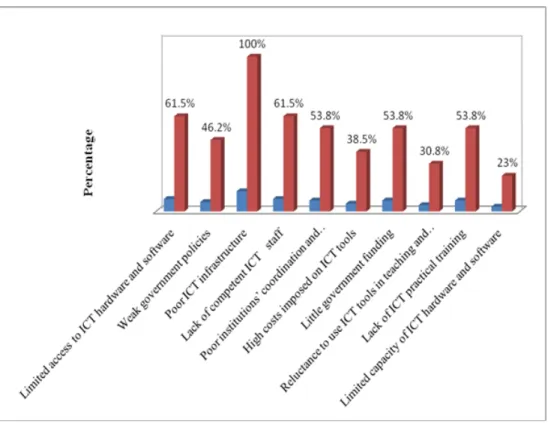
Figure 3. Challenges of teaching and learning ICT courses in HLIs. This figure illustrates the critical factors inhibiting ICT implementation. Adapted from "Challenges for Teaching and Learning Information and Communication Technology Courses in Higher Learning Institutions in Tanzania: A Review" by J. D. Rumanyika and R. M. Galan, 2015, Information and Knowledge Management, 5, p. 8, Copyright 2015 by IISTE.
Here the most critical factor inhibiting ICT implementation is poor infrastructure.
This entails poor bandwidth capability and an overall lack of appropriate
telecommunication structures as the biggest barrier [33]. A quick look at the World Bank
data shows that the percentage of Tanzania that had access to electricity, as of 2012, was
consumption (kWh per capita) shows that in 2011 the score was 92kWh. Compare this
number in the same year to the US: 13,240 kWh [39].
Within figure 3, two other factors stand out: ICT access and ICT competency.
Factors contributing to the lack of ICT hardware are funds, lack of adequate technical
experts, lack of bandwidth, and poor supporting telecommunication infrastructure [33].
As for the ICT competencies, Ruminyaki and Galan conclude that there must be a "poor
instructors-students ratio in HLIs in Tanzania" [33].
Conclusion about digital divide: Recapping the ICT and Internet problem in
developing countries of Africa: Internet access is either too expensive, ICT may not be
supported by necessary telecommunication infrastructure, and training and maintaining
technical experts can be problematic. Besides being slow, the Internet that relies on
electricity and fiber optic cables is vulnerable to electrical blackouts and torn underwater
cables. And finally not least is the issue of political support in governments not interested
in an informed populace via ICT [3] [4] [10].
3. What other databases have been built to address this problem?
Getting information to rural areas in the world has been a challenge to which
many researchers and organizations have devoted themselves. In 1990 SatelLife
delivered the first peer-reviewed article discussing the use of Vitamin A for measles via
the satellite HealthNet in select African countries [32]. Other organizations have begun
developing countries' initiatives with the goal of getting up to date journal information to
these countries. Below is a small sample of such initiatives. A much more thorough list
will be discussed in Exploring the JAFUA section as this database project will be
Online digital libraries and databases:
• Edinburgh University Press (EUP)
o Publishes books and journals. Through the Developing Countries Initiatives
certain countries can either gain free access to their products or get a reduced
subscription. EUP also partners with the Programme for the Enrichment of
Research Information (PERii), which offers certain African developing
countries a discounted subscription price to their journals [13].
• Research4Life
o This is an overarching program that hosts 4 programs (HINARI, AGORA,
OARE, and ARDI) aimed at providing free or discounted subscriptions to
eligible developing countries. HINARI (Access to Research in Health
Programme) provides health journals, AGORA (Access to Global Online
Research in Agriculture) provides agricultural journals, OARE (Online
Access to Research in the Environment) provides environmental journals, and
ARDI (Access to Research for Development and Innovation) provides
research and development journals. [2].
• JSTOR
o Through their Developing Nations Access Initiative JSTOR provides eligible
developing countries free or reduced cost to their journals [14].
• OXFORD
o Their developing countries initiative provides journals to certain developing
(International Network for the Availability of Scientific Publications),
Research4Life, and EIFL (Electronic Information for Libraries) [12].
Hybrid and offline digital libraries and databases: While access to the Internet
is accessible yet unreliable (for now), alternatives have been made such as digital
libraries via hybrid technology (online and offline), and CD-ROM and offline databases.
As there are many initiatives in Africa focusing on this problem, this paper will use one
country's program initiatives as an example.
Below is a list of digital library projects in Ghana:
• George Padmore Research Library on African Affairs
o Place and Purpose: Accra. In 2007 digital preservation and digitization efforts
focused on the historical files about Kwame Nkruma's presidency [36].
• University of Cape Coast Digital Library (UCC)
o Place and purpose: University of Cape Coast. In 2005 the university library
began digitizing the university's educational materials to aid in distance
learning [36].
• Gramophone Records Museum and Research Centre (GRMRC)
o Place and Purpose: Centre for National Culture in Cape Coast. In 2002 the
museum received funds to digitize Ghanaian music from 1920' on [36].
• ITC Digital Library
o Place and purpose: Kwame Nkrumah University of Science and Technology
in Kumasi, Ghana. Holds geo-information (GIS) and remote sensing
Science and Technology (KNUST) and International Institute for
Geo-Information Science and Earth Observation in the Netherlands [24].
• eGranary Digital Library
o Place and purpose: Ashaiman, Ghana (year unknown). Augments primary and
secondary education [28].
• Librii
o Place and purpose: Accra. A new KickStart project aimed at providing a
public library via an "e-hub made from a modified shipping container that
contains high-speed computers along with other digital tools and … a public
plaza equipped with Wi-Fi" [40]. This project is still awaiting some final
funding.
In conclusion, while there are online and offline products that provide developing
countries access to journal information, there is not one that is focused on indexing all
journal databases aimed at these countries that can be received free or at a reduced cost
either through non-profit or for profit organizations. It is the goal of this project to begin
such a database. Further discussion of how this project will accomplish will be discussed
in the Exploring the JAFUA section.
Research conclusion: Due to lack of funding, poor or vulnerable ICT
infrastructure and capacity underserved areas need an alternative means of connecting to
high quality journals. Hybrid databases can provide such a means in that they contain
Project Scope
This is a holistic description of the data evaluation, database critical components,
creation process, and lack/future components. More detailed descriptions will be
discussed in the system analysis section.
Data (Evaluate the given data, getting the data ready for a DB): The data in the spreadsheet must be cleaned: atomizing the data which consists of standardizing the data.
After that is normalizing the data and then from there the entities and their attributes can
be developed.
Design (Design (ideation) and conceptualization, database table creation): This stage consists of modeling the entities to understand their relationships. Conceptual
models are the rough sketches, the logical models are a more detailed sketch including
the entity's attributes, and the physical model contains the most detail housing the data
types.
Project components (What this project entails: DB prototype and logical design):
Three products will be created for this project: a relational database and two interfaces
via a web site. My master's project will be the production of a prototype relational
database.
Future components: What this project lacks: Interfaces (will be created later by the WiderNet Project). The interfaces will allow librarians to access this information and
websites will have step-by-step instructions on how to navigate and interact with the
User Analysis
Core group
Brief description of the African librarians: The African librarian has the same
education and tasks that their counterparts all over the world does. They are graduates
from an accredited university and are tasked with helping their patrons (reference),
organizing and curating the collections (subject specialists), administration (acquisitions,
managerial, etc.), cataloging, and other tasks. The poorer and more rural the library, the
more multitasking the librarian must be. This project aims to aid the librarian that needs
journal information for her or his country, and by her or his institution (mainly a
university).
Snapshot of an African librarian (Persona):
• Knowledge and experience
o College education, domain of knowledge wide • Computer/IT experience or knowledge
o Medium computer knowledge and competencies. Main experience is data
processing (using documentation tools such as the Office suite). Very high
experience with mobile use and technology. Has low-medium knowledge of
ICT hardware installation and maintenance. If there is a breakdown in the ICT
hardware and/or software, she may try to troubleshoot for simple solutions or
problems she is familiar with. But she is comfortable with calling in IT.
o High level of experience in utilizing databases for information gathering
purposes. However, due to Internet connectivity issues and low browser
rendering capability, she may be used to simpler databases rather than the
complex ones.
• Psychological characteristics
o Highly empathetic, great listening skills, observant, high communication
skills.
Task Analysis: What they will need to do to use the system
The librarian will need to be able to have a medium competency with ICT,
specifically utilizing a computer that is connected to the JAFUA. They will need to be
familiar at least on an experiential level the 3-tier architecture: the browser connects to a
databases via a server. Even though this database can be accessed offline, there will be an
online site as well that will be more up to date.
User scenario:
A new librarian in a university in Rwanda is given the task of cataloging free
health journal content that her college can apply for. The college specifically wants
access to three journals: Oxford, NEJM (New England Journal of Medicine) and HINARI
(Access to Research in Health Programme), but she is to also find other journals with the
same high caliber of these collections. So she uses the JAFUA. Once she gives her
location (Rwanda) she can give the type of access she requires (free or paid), in this case
she clicks free. She is given a list of collections with these criteria. She scans for the three
journals she wants and sees that they are included. Clicking on those shows her that
free. The database includes links to the application pages for all three. She peruses the
other collections in the list and notes the ones of interest that meet her criteria. Some of
the collections have certain restrictions such as rolling-walls (new content can be
accessed after a certain time period), some are in certain languages, and some may be
viewed in certain formats that she may have to upload in order to view.
Secondary group
A brief description: Besides the librarian in a university, this system may be
produced for primary schools up to technical colleges. Also African LIS students may
employ the JAFUA either in training or in their internships.
Another group that will definitely be interacting with this JAFUA will be the
back-end volunteers or employees charged with maintaining the DB and interfaces. These
people may be part of the WiderNet Project both in Africa and America. Within this
organization will be digital librarians whose role is to curate the entire collection, update
changes to countries status via a change within a program, and add new collections and
programs.
Snapshot of a back-end developer:
This example will outline a general back-end developer whose task is to maintain
the JAFUA.
• Knowledge and experience
o College student, domain of knowledge specific. Work experience part-time
work as an IT team member. School projects hone his database understanding,
MySQL and SQL coding as well as school training in coding in PHP and
• Computer/IT experience or knowledge
o Intermediate to high computer knowledge and competencies. Main experience
with troubleshooting issues such as handled by IT departments he may have
worked for. May have had undergraduate training in computer science and
foundational knowledge of JAVA, C++, or some other programming
language.
• Level of experience with the task
o Low to medium experience in utilizing databases for information gathering
purposes. Most of his education has been application based and projects
oriented. Research was done with material either already had (books in his
class) or informal Internet searches relying on Google information retrieval
knowledge to get his resources. College may be the first time he has learned
about designing databases and their applications.
• Psychological characteristics
o Low to medium soft skills, including empathy. Highly skilled in linear, logical
thinking: rendering communication into systematic thinking.
Task Analysis: What they will need to do to use the system.
The technical volunteer will need to be able to have a medium to high
competency with ICT, specifically utilizing a computer that is connected to the JAFUA.
They will need to be on expert level with the 3-tier architecture. As his job will be
troubleshooting any issues within the database as well as interface issues, he will also
need to have medium to high knowledge and skills with back-end development such as
User scenario:
An email was sent from a Rwanda librarian alerting the JAFUA team of
non-working hyperlinks. The IT volunteer pulls up the appropriate mark-up page and
compares the hyperlinks to those in the JAFUA tests both sets. Sure enough the links turn
up a "404 Page not found" error. He goes to the original site and navigates to the desired
links and finds that the links have been changed to redirect to different pages. He fixes
the links in both the website markup page and the database. After he successfully tests
both sets again he logs the error and emails the librarian that the links are working.
Potential future groups
For now this project is focusing on developing countries within Africa, but the
Director of the WiderNet Project expects that this product could be employed in other
developing countries such as India, the Americas (including North American poverty
stricken schools), and even prisons. Other important groups will be the collaboration with
System Analysis
Description of original data: turning data into information
The original spreadsheet had developed four entities: Aggregators, Journals,
Books, and Countries. Aggregators are collections of journals, either different journals in
a collection or just one title in a collection. Journals contains single individual titles and
will be considered the same as Aggregators (the two sheets were eventually merged).
Books are published or produced by organizations involved in disseminating critical
information (i.e. health care, technical, science, etc.). And Countries holds the data which
organizations have created programs for underdeveloped countries. This project only
focuses on the Aggregators sheet as this was the more challenging data set, also the
procedures learned and successfully implemented at this stage would be the outline for
the other entities.
The original Aggregators spreadsheet data:
• Website - Name of the collection
• Link - URL link to the collection
• About - A brief description of what the collection is about
• Host Index - If the collection resided in the eGranary, then this field would provide
the index number to it
• eGranay - A binary field of whether the collection was hosted in the eGranary or not
Available offline? - Describes the formats the content could be saved and then later
• Open online? - A binary field of whether the collection could be read online or not
• Paid online? Discount? - This field describes which journals in the collection were
free or at what cost
• Other - Some notes of interest on a collection
From this point I followed a set of procedures was developed to clean scrub the
data set and which would then help me create the database. Here are the procedures:
- Correctly define the fields
− Standardize the data
− Atomize and normalize fields
− Add or remove fields
Correctly define the fields: Remote collaboration and personal meetings were had
with the team’s librarian in order to understand and refine data. Collaboration was done
through remote software tools such as Google Hangouts, HipChat (both video and texting
mediums) as well as Google Drive for document review.
Standardize the data: The spreadsheet had taken the WiderNet librarian months to
compile. As such, when listing data for a field that were having some duplicated information, she would eventually start to standardize the data. The problem was that she had other tasks to attend to and so this spreadsheet would sit for days or weeks, and when she would get back to compiling data for the fields, she would sometimes set a new standard for the data. Also, as she got to know the data better, she would change the standards accordingly. Standardization came in
understanding which data was truly unique and which data was a representation.
An example of standardizing: Using the field name "Available Offline?” This
accessed offline and 2) what format can be stored. But the original field had this
non-standardized data:
• "Available journals have individual article links to PDF download."
• "Availability and format depends on individual journal title, but in general
looks to be PDF and HTML."
• "Titles have individual article PDF links for download."
What is the difference between a title and a journal? Most of the fields had to
be grammatically cleaned (spelling errors, punctuation removed when unnecessary),
parsed (simplifying the data and removing erroneous data: atomize), standardized (figure
out which data could possibly mean the same thing, in other words figure out naming
conventions), and normalized (remove data from a column if it should be its own field).
This exercise was a great lesson in learning the difference between creating a
database from an information standpoint and creating a database from a data standpoint
(more about this in Final Comments section).
Atomize and normalize the fields: This stage occurred in tandem with the
previous procedure. Standardizing the data led to a better understanding between what
was erroneous data and that could be taken out of the data set. After the data was cleaned
it was possible to discern which fields would be converted into entities and attributes.
Add or remove fields: Much of this occurred during normalization, however in
modelling the entities and then testing them in the DBMS with queries resulted in better
understanding of the entity relationships to their attributes: sets of entities were modelled
in UML mockups, tested in the Workbench DBMS, and then find out which entities
Design database
Conceptual modelling: After the spreadsheet data was cleaned, fields were
converted into entities. After several versions (modifying the spreadsheet) the entities
were tested for child-parent relationships as well as which would become lookup tables.
Also this stage helped in figuring out the types of relationships between entities. A good
resource I had for spelling out relationships can be had for free in iTunesU, by Professor
Jay Jarmin of the University of Tennessee [20].
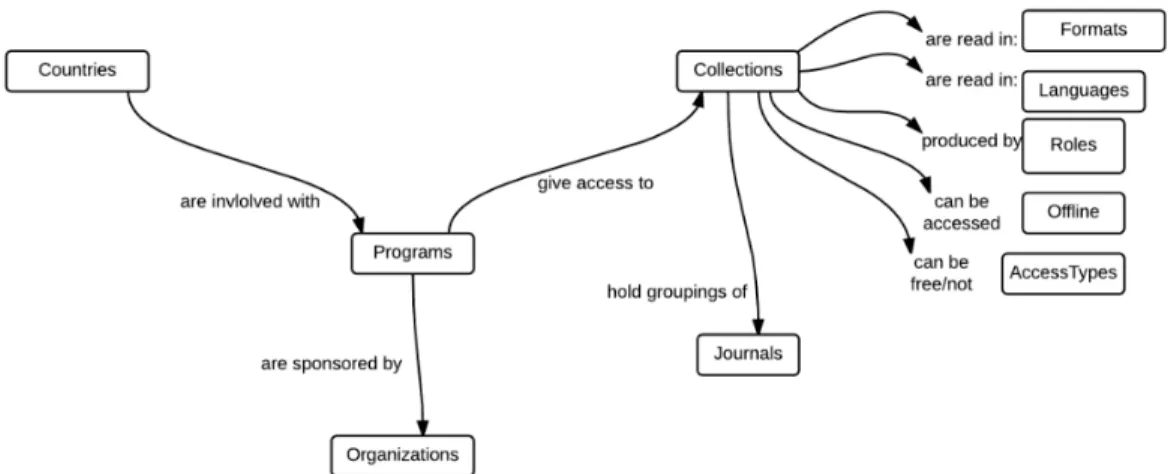
Here is an initial concept design. The finished model is different from this but this
design provided the core understanding:
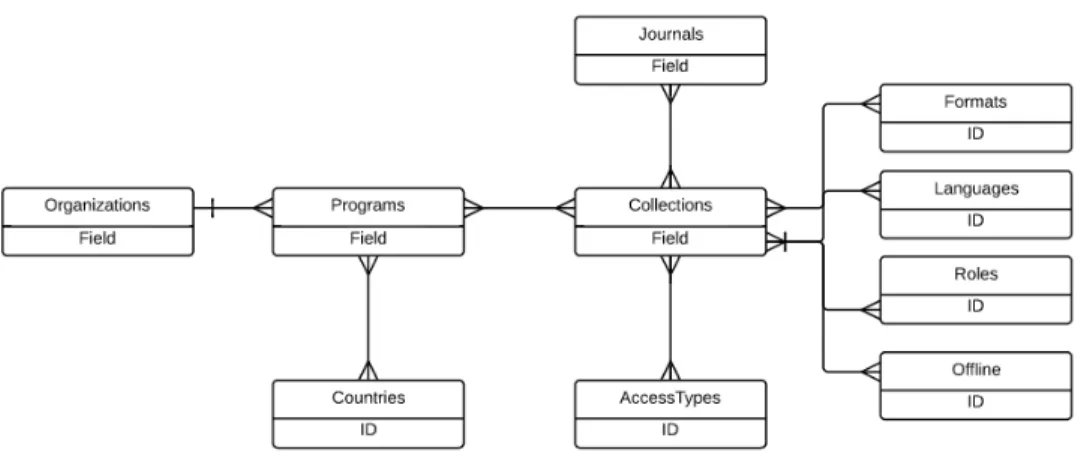
Figure 5. Initial logical model for project.
Logical modelling:Create relationships: Logical modeling helps in taking the
abstract ideas of entities and formally organizing them in relationships. This model
depicts primitive relationships in that there are many many-to-many (M:M) tables.
However this gives me the starting point in understanding which entities will need bridge
tables.
Sample (Explanation of full relationships is in the Appendix 4.): This sample
describes the relationship between Collections and Journals.
In English: One collection can have many journals, and one journal can be
accessed in more than one collection.
Sample relationship:
Entity Relationship Entity
Collection12 Contains Journal 29 Journal 29 Is accessed through Collection7
Final analysis of relationship: this is a m:m relationship. The final tables will need
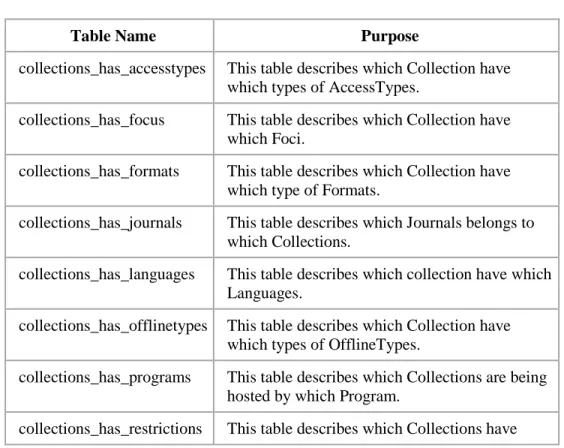
Figure 6. Sample of m:m relationship tables.
Physical modelling: Create parent and child tables: This is where the schema and
tables as well as data types inside the DBMS were created. Listed below are the entities
in this section but for a full explanation, the entities and their relationships can be viewed
in the Appendix 4.
Parent tables:
Table Name Purpose
Collections Collections are the groups of journals. Collections can be a group by a single publisher or an aggregate of publishers.
Journals Journals are the single titles of a collection. This table will be the largest of the main parent tables.
Organizations Lookup table for Programs. Only some programs are run by an official organizations.
Programs Programs table describe the program that negotiates with countries for certain collections of journals. This table has a 1:M relationship with Organizations table (1 Org. can participate in several Programs.) and has a M:M relationship with Countries table.
Table explanation: We want the African Librarian to be able to access journal
information from all levels, be it accessing a single title to accessing the overall
collection information, and even getting collections from Organization and Programs. So
if a librarian wants to access all journals under the Organization AGORA (a collections
AGORA. Or if the librarian wanted to look for just the title "BioChem", they could also
query for that title in the database.
Child tables:
Table Name Purpose
Accesstypes Lookup table: This table describes how an institution can gain access to the collection.
Coverage Lookup table: This table describes the text that is available: abstracts, full-text, or both.
Countries Lookup table: These are the countries that our database holds program information for.
Focus Lookup table: These are the subjects that a journal or collection covers.
Formats Lookup table: This table describes how the journal can be viewed (HTML or PDF or both).
Languages Lookup table: This table describes the languages that the journal can be viewed in.
Offlinetypes Lookup table: This table describes how the journal can be viewed offline.
Publishers This table describes the Collections' Publishers. (This may be a lookup table if there are duplicate Publishers for multiple Collections).
Restrictions Lookup table: This table describes how a collection may be restricted from an institution. This table differs from the Accesstypes in that it tells how a collection is closed from the user whereas the Accesstypes tells how a collection can be accessed. For instance, a collection may be accessed for free with registration but only to certain Vocations.
Roles Lookup table: Roles describe the publishing type category that the collection is being displayed under. Publisher both owns the collection and grants permission to its contents. A Broker is a third party that has bought from another publisher collection(s) and has the right to grant users permission access. A Guide neither owns nor has the right to grant access, they simply hold a list of collections as a reference guide and can point to the collection's location for users to access. For Guides, material ranges from free access to subscription.
Table explanation: Tables AccessTypes, Focus, Formats, Languages,
OfflineTypes, Restrictions and Roles are children tables to the Collections table. These
describe how to access a collection and how that collection can be read either online or
offline and in what language. Roles tells the user whether or not the collection is being
represented by a publisher within the database or is the source for the collection acting as
an approved gateway (approved being that it has purchased the content of the collection
to provide to users) or if the collection is simple a list of links that point to the journals
for the user to further research. Focus is the subject of the Collection. (In the future some
of these table relationships will be changed. More on this in the Problems Encountered
section.)
Tables Coverage and Publishers belong to the Journals table. And Countries
belongs to the Programs table.
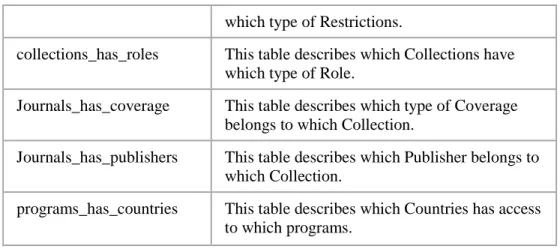
Bridge tables (M:M converting to 1:M relationships):
Table Name Purpose
collections_has_accesstypes This table describes which Collection have which types of AccessTypes.
collections_has_focus This table describes which Collection have which Foci.
collections_has_formats This table describes which Collection have which type of Formats.
collections_has_journals This table describes which Journals belongs to which Collections.
collections_has_languages This table describes which collection have which Languages.
collections_has_offlinetypes This table describes which Collection have which types of OfflineTypes.
collections_has_programs This table describes which Collections are being hosted by which Program.
which type of Restrictions.
collections_has_roles This table describes which Collections have which type of Role.
Journals_has_coverage This table describes which type of Coverage belongs to which Collection.
Journals_has_publishers This table describes which Publisher belongs to which Collection.
programs_has_countries This table describes which Countries has access to which programs.
Table explanation: These tables represent the relationships between the parent and
child tables.
Create relationships: This is the current model. There are additional tables as well
as the insertion of bridge tables.
Figure 7. Physical modeling done with Workbench.
Create Lookup tables: Lookup tables acts as a data dictionary that holds a strict
The lookup tables are located on the far right in the previous image. Relationships are
drawn for a high level understanding but are not necessary. A full description of tables
can be viewed in the Appendix 4.
Using Workbench to create tables
Schemas and tables were created using the Workbench GUI rather than MySQL
code due to future considerations. The majority of employees/volunteers that will
maintain this DBMS will be digital librarians rather than IT personnel. Therefore it was
felt that the user-friendly aspects of the Workbench program would be a better
Exploring the JAFUA
As was stated in the Introduction, the goal of this database is to provide
developing countries in Africa a means of tracking journal accessibility via programs
directed towards giving the free or reduced cost access to their collections, or tracking
collections that are freely available. This database will also track restrictions of these
collections as pertains to that librarian’s country. Below is a fuller description of these
programs and collections.
Resources available:
• Criteria for journal database entry into the JAFUA:
o All resources have at least some free journal content available.
o Journals are either peer-reviewed or vetted by the WiderNet Project’s digital
librarians.
o Resources can cover a wide range of topics, not exclusive to Africa.
• Content providers:
o There are three types of providers, which are called Roles in the JAFUA:
Publishers: organizations that publish and produce the content.
Brokers: does not publish the content but has the right to produce it, right is given by
the publishers. Some aggregators are collections that are publishing their own content
and has the right to provide other publishers' works.Guides: neither publishes or has
the right to provide the content. These are usually websites that act as a reference
• Information about access:
o Online content can be access via an Internet connection.
o Offline content can be access either through the eGranary (if the eGranary
contains it) or can be downloaded in various formats from the Internet to
access offline. Also some content can be emailed or sent to the librarian via
mail orders. Information on how to access the content will be included in the
content description within the DB.
o Information about providers such as URLs, organizations involved in the
content's production, formats and languages the content can be read in, and
any type of restrictions placed on the collection (i.e. rolling-walls, restricted
by country, registration access, or no restrictions in the case of Open Access
publishers) will be provided for each collection in the DB.
o The countries listed in the JAFUA are African developing countries as listed
by the organizations that have developing country initiatives. The DB will
keep track of changes in countries' status.
Below are an example list of major programs providing developing countries free
or reduced cost content that is included in the JAFUA. To see the details of each program
a fuller list is given in Appendix 3.
• Developing countries programs:
o Edinburgh University Press (EUP)
o Research4Life
o JSTOR Developing nations access initiative
o IMF (International Monetary Fund) Free Subscription Policy
o NEJM (New England Journal of Medicine) Free Access from Outside the U.S.
o PTOLEMY
o RSC (Royal Society of Chemistry) Archive for Developing Countries
• Open Access publishing:
o Directory of Open Access Journals (DOAJ)
o APS
Management & Security
Maintenance will be done by the WiderNet Project administrator in charge of this
site. A team of digital librarians both locally and remotely will coordinate for data
curation while an IT employee or volunteer will look after the security of the database
and site. The team will need to ensure that the online site will have proper security such
as separate server-side scripting locations, appropriate permissions per roles, updating
security software, using secure FTP for file upload and download, and adequate backups.
The website developers will make sure that any sensitive data (such as database login and
password information) in the PHP files will be properly hidden. Also when designing the
forms input data will need to be carefully constrained so as to not let erroneous data
Problems Encountered
Initial data: As was stated, the initial data set received was a non-standardized,
non-atomized spreadsheet of data. As I began this project after my first class of
databases, this came as a shock. Before this experience I had only created databases from
higher level information standpoint (more on this in Final Comments). Here I had to
reverse engineer a database from the data out. I had to really understand each field and
the cells beneath them in order to know which data could be standardized and which data
was truly unique.
Collaborative issues: The main tools used with the content specialist (the
project's digital librarian) was an internet application called HipChat. This application
allowed for instant chatting as well as video conferences. This was a great tool but was
not the best when it came to collaborating on the spreadsheet. For this task Google Drive
was used. Google Drive also allowed document storage via Google's cloud under a
person's account. But this had a couple of problems. The first being, at the time, there
was a 400,000 cell limit. This may seem like it should be enough but in collaborating for
edits, this was not enough. However Google has recently updated the Drive's cell
capacity to 2 million cells. Understanding the strengths and weaknesses of collaborative
tools will be useful for future collaborations with project team members and users.
DB needs a new perspective (from Access to Country): When building the
database, I was looking at a lot of access type information (how free was a collection),
focused on how to access different collections and how free or with what type of
restriction would hinder that access. Later I had a meeting with the director, Professor
Missen (also my master's project advisor), and he told me that the perspective needs to be
from the Countries perspective. He also noted how three parent tables would have access
and restriction information that could also differ. So instead of having the AccessTypes,
Restrictions, and Countries be child tables to Collection only, I have to reconfigure the
relationships so that Collections, Programs, and Journals have this relationship. This
perspective will also need a scoring mechanism attached to the AccessTypes table.
The finished database should be able to get the appropriate programs and
collections from a given country and then automatically apply a scoring output so that the
user will see a list of collections with the "free-est" score at the top of the list to the most
restricted collection showing at the bottom. These calculations will need to be created by
the PHP/interface team. This new perspective will mean that I go back to the database
physical models and re-arrange the countries table to reflect this new perspective.
These new relationships will need to be attached to the bridge tables:
programs_has_countries
• CountryID
• ProgramID
• AccessID
• RestrictionID
collections_has_programs
• CollectionID
• ProgramID
• AccessID
• RestrictionID
collections_has_journals
• CollectionID
• JournalID
• AccessID
• RestrictionID
• CountryID
Need automated programs for capturing Collection data:
Focus: This is just too much work for a (future) content analyst to have to deal
with. We need to find a way to have a program automatically read from a website and
capture key words that it knows to be a focus subject. This focus list will need to be
created, a good resource for this will be the Library of Congress. This table will be
deleted and shelved for future purposes.
General about-ness data: The same program can be applied here when ingesting
collections information from a website.
Reconfigure relationships:
• Formats, OfflineTypes, and Languages will need to be related to the Journals table
rather than the Collections table. The reason for this is that a journal has the more
specific of these fields and can easily be indirectly queried from the Collections table.
• Restrictions and AccessTypes
o Restrictions and AccessTypes: These two tables reflected similar information and need to be better differentiated. A new understanding of the tables read:
AccessTypes describe how to get access: Free, Open Access, Free w/
Restrictions are barriers to access: describe what these restrictions (if any)
are: None (for Free or Open Access), Institution, Vocation, etc.
Need a letter to Publishers for requesting metadata of their journals: Only a
small portion of publishers had their collections organized in a csv file. A letter asking
publishers for their metadata will be extremely useful as this will cut down a huge time in
data processing upon the future digital librarians that will be curating and adding to this
Future Plans
Entities and their relationships have been created. Sample SQL statements have
been successfully tested. The future tasks for the JAFUA are the following:
Find out which collections/journals are in the eGranary: Some collections may
reside in the eGranary, the WiderNet Project's digital librarians and volunteers will find
which are indexed and relay that information to the JAFUA. This will be useful both end
users who have an eGranay, that way they can simply access the material.
Upload the rest of the journals (+100,000): A small sample of the data was
uploaded for modeling and database testing purposes. The journal table is the most
complex one with regards to relationships, so after further modifications are done to the
existing model, testing for this table can begin. Below are what still needs to be
incorporated into the JAFUA:
− Upload the Books data
− Upload the Countries data
− Upload the Journals data (this is a separate set of journal data, individual titles only)
Implement the 3-tier architecture (Client-Server-Browser): My part of the project
is to develop the database, the Web team will take care of the interface (web-site, PHP
server connection and protection).
Product implementation: Once the database and interface are ready it will be
ready for user testing. The users will consist of volunteers from the WiderNet Project as
Establishing a connection to underserved country initiative programs: Plans for
the future entail our team establishing a communication with these programs as well as
others. For the myriad of reasons this paper has already discussed, users that most need
these types of programs may not be able to navigate to these sites when they are able to
browse the Internet. This DB can act as an advertisement for content providers to get the
word out to their intended users. Also content providers will be given forms and
understand what information the JAFUA team needs to better display their collection
information (these needs consist of metadata that organizations have created to maintain
their own journal collection databases).
Updating the JAFUA database: Once the databases has been successfully
deployed updates will be done via asynchronous methods (Web interfaces will be used to
Project Conclusion
Data vs Information: In my database classes, I was usually given a high level idea
from which to create a database. I call this creating a database from an information
standpoint because data has not yet been gathered, and all tables (entities and attributes)
must be conceptually created with all possible data perspectives in mind. For example, if
my teacher gave me the task of creating a database for a future shoe store, then I would
have model/guess what might my entities be. And then I would input dummy data to test
the logical models and reconfigure as needed. The important thing to remember in this
scenario is that I don't have any real-world data to grow my database around. All
ideation, conceptual and physical modelling must be done from a high-level, outside-in
standpoint (information).
On the other hand, this project gave me very solid data. Instead of having a clean
slate for modelling first and then inputting data to test the models, I had to create my
database from the inside-out so to speak. I had to first understand the data, which was not
easy to do at first for there was a lot of standardization that needed to happen.
Normalization had to occur after the data was cleaned and standardized. And after that
then could I start physical modelling with data types. Relationship testing happened once
I could input some test data into the Workbench, and this usually concluded more
normalization within the spreadsheet. This was a more iterative process than my
experience with creating a database from an information stand-point, and thus a very
References
[1] About NEJM access from outside the U.S. (n.d.). Retrieved from http://www.nejm.org/page/about-nejm/access-for-low-income-countries.
[2] About Research4Life. (n.d.). Retrieved from http://www.research4life.org/about/. [3] Africa's worst new internet censorship law could be coming to South Africa [press release]. (2015, May 26). AllAfrica.Com Retrieved from
http://search.proquest.com/docview/1683560803?accountid=14244.
[4] Al jazeera.net: Africa under cascade of internet censorship. (2011, May 15). BBC Monitoring Media Retrieved from
http://search.proquest.com/docview/866488160?accountid=14244. [5] APS Physics Journals. (n.d.). Retrieved from
http://www.aps.org/publications/journals/index.cfm.
[6] Britz, J. J., & Ponelis, S. (2012, September). Social justice and the international flow of knowledge with specific reference to African scholars. In A. Olden (Ed.), Aslib Proceedings (Vol. 64, No. 5, pp. 462-477). Emerald Group Publishing Limited.
[7] Burkett, I. (2000). Beyond the ‘information rich and poor’: futures understandings of inequality in globalising informational economies. Futures, 32(7), 679-694.
[8] Chang, A. (2013, April 2). Why undersea internet cables are more vulnerable than you think. Retrieved from http://www.wired.com/2013/04/how-vulnerable-are-undersea-internet-cables/.
[9] Cottrell, R. (2013, January 29). How bad is Africa’s internet? Retrieved from http://spectrum.ieee.org/telecom/internet/how-bad-is-africas-internet.
[10] CPJ: Ethiopia is introducing high-tech censorship in Africa. (2012, Jul 03). McClatchy - Tribune Business News Retrieved from
http://search.proquest.com/docview/1023003457?accountid=14244.
[11] Crow, J., Broussard, R., Dong, L., Finn, J., Wiley, B., & Geisler, G. (2012). A synthesis of research on ICT adoption and use by medical professionals in Sub-Saharan Africa. Proceedings of the 2nd ACM SIGHIT Symposium on International Health Informatics - IHI '12, 161-170. doi:10.1145/2110363.2110384.
[12] Developing Countries Initiative. (n.d.). Retrieved from
[13] Developing Countries Initiatives. (n.d.). Retrieved from
http://www.euppublishing.com/page/infoZone/librarians/developingcountries. [14] Developing nations access initiative. (n.d.). Retrieved from
http://about.jstor.org/libraries/developing-nations-access-initiative.
[15] Directory of Open Access Journals. (n.d.). Retrieved from https://doaj.org/about. [16] EJournals Delivery Service (eJDS). (n.d.). Retrieved from
http://ejds.ictp.it/ejds/faces/index.xhtml;jsessionid=2ed9509419faaa6547418335808b. [17] Fripp, C. (2013, March 25). Seacom outage could last till April | IT News Africa- Africa's Technology News Leader. Retrieved from
http://www.itnewsafrica.com/2013/03/seacom-outage-could-last-till-april/.
[18] Holmner, M., & Britz, J. J. (2011). The road less travelled: a critical reflection on infrastructure development in Africa from a perspective of the new economics of information. Mousaion, 29(1), 1-16.
[19] IMF eLibrary. (n.d.). Retrieved from http://www.elibrary.imf.org/. [20] Internet Users in Africa. (2014). Retrieved from
http://www.internetworldstats.com/stats1.htm.
[21] J. Jarmin. (2013). CSCI 2020 - Database fundamentals. [iTuneU videos #6-9]. Retrieved from
https://itunes.apple.com/us/itunes-u/csci-2020-database-fundamentals/id564238056?mt=10.
[22] Johan Lor, P., & Britz, J. (2005). Knowledge production from an African
perspective: International information flows and intellectual property⋆. The International Information & Library Review, 37(2), 61-76.
[23] Johnson, D. L., Pejovic, V., Belding, E. M., & Van Stam, G. (2011, March). Traffic characterization and internet usage in rural Africa. In Proceedings of the 20th
international conference companion on World Wide Web (pp. 493-502). ACM. [24] Koelen, M., & Quaye-Ballard, J. A. (2009). The importance of digital libraries in joint educational programmes. D-Lib Magazine, 15(11/12), 1082-9873.
[25] Lawson, S., & Meghreblian, B. (2014, October 15). Freedom of Information requests uncover the lack of transparency in journal subscription costs. Retrieved from http://blogs.lse.ac.uk/impactofsocialsciences/2014/10/15/foi-requests-uncover-lack-of-transparency/.
[28] Patten, N. (2012, October 3). The eGranary Digital Library (EDUCAUSE Review). Retrieved from http://www.educause.edu/ero/article/egranary-digital-library.
[29] Ptolemy Library. (n.d.). Retrieved from http://ptolemy.library.utoronto.ca/library. [30] Roelf, W. (2015, March 25). South Africa's Eskom chairman could be ousted by board. Retrieved from
http://af.reuters.com/article/investingNews/idAFKBN0ML0L420150325?pageNumber=1 &virtualBrandChannel=0.
[31] Royal Society of Chemistry. (n.d.). Retrieved from http://www.rsc.org/.
[32] Royall, J. (1998). SatelLife linking information and people: the last ten centimetres. Development in Practice, 8(1). Retrieved from http://www.jstor.org/stable/40288. [33] Rumanyika, J., & Galan, R. (2015). Challenges for teaching and learning information and communication technology courses in higher learning institutions in Tanzania: A review. Information and Knowledge Management, 5(2), 1-12. Retrieved from http://iiste.org/Journals/index.php/IKM/article/view/19878/20178.
[34] Sullivan, M. (n.d.). 3G and 4G Wireless Speed Showdown: Which Networks Are Fastest? Retrieved from
http://www.pcworld.com/article/253808/3g_and_4g_wireless_speed_showdown_which_ networks_are_fastest_.html
[35] The Faculty Advisory Council. (2012, April 17). Faculty advisory council memorandum on journal pricing: Major periodical subscriptions cannot be sustained. Retrieved from
http://isites.harvard.edu/icb/icb.do?keyword=k77982&tabgroupid=icb.tabgroup143448. [36] Tritt, S. (2010). Digital Libraries in Ghana. Retrieved from
http://www.indiana.edu/~libsalc/african/ALN125/125DigLibsGhana.html.
[37] UNC Chapel Hill. (2005). The Serial Crisis: A White Paper for the UNC-Chapel Hill Scholarly Communications Convocation [White paper]. Retrieved from
http://www.unc.edu/scholcomdig/whitepapers/panitch-michalak.html#_ftn1. [38] World Bank. (2015). Access to electricity (% of population). [Custom cross-tabulation of data]. Retrieved from
http://data.worldbank.org/indicator/EG.ELC.ACCS.ZS/countries.
[39] World Bank. (2015). Electric power consumption (kWh per capita). [Custom cross-tabulation of data]. Retrieved from
http://data.worldbank.org/indicator/EG.USE.ELEC.KH.PC.
Appendices
Appendix 1 Project team and roles
Cliff Missen – Project Director for the WiderNet Project at the University of Chapel Hill, NC
Laura Ashcraft – Database developer (prototype) Billy Gagon – (Future) IT troubleshooter
Joan Ferguson – Digital librarian