Michelle A. Stover. Categorizing the Unique: Analyzing artists’ books for a framework of description. Master’s Paper for the M.S. in L.S degree. April, 2005. 56 pages. Advisor: David Carr
Artists’ books are works of art that utilize the form of the book. Since they are usually in a format reminiscent of the codex, they inevitably end up in a library. As works of art, librarians encounter various challenges when trying to obtain the works, house them, and create access to them for users. Utilizing grounded theory fourteen books are analyzed so that a framework for description emerges to enhance access for users. Ideally, this work will be built upon to increase collaboration between libraries with artists’ books
collections.
Headings:
Artists’ Books
by
Michelle A. Stover
A Master’s paper submitted to the faculty of the School of Information and Library Science of the University of North Carolina at Chapel Hill
in partial fulfillment of the requirements for the degree of Master of Science
in Library Science. Chapel Hill, North Carolina
April 2005
Approved by
Table of Contents
Introduction... 3
The Emergence of Artists’ Books ... 6
Literature Review ... 9
Problem Statement and Methodology... 18
Examples from the Sloane Art Library’s Collection ... 21
Attempting a solution ... 42
Further Research ... 48
Works Consulted... 49
Acknowledgements
The author would like to thank Patricia Thompson, Beth Grabowski, and the staff of the Sloane Art Library at the University of North Carolina at Chapel Hill for their
Introduction
Artists’ books are virtually unheard of outside the art world, and not clearly conceived within. They continue to be overlooked and misunderstood, never quite aligning with a specific art movement, yet making an appearance in each. It is easier to define what artists’ books are by what they are not, than it is to create a precise set of boundaries. Operating within a loosely outlined conceptual area, by the simplest definition, artists’ books are books created by artists as contained works of art. Such a simple definition surfaces more questions; in addition, the term artists’ books itself is highly contested. Not every book created by an artist is an artist’s book, nor is every artist’s book created by an established artist. They are not art books, or books about art and artists, or books illustrated by artists, though some illustrated books may be artists’ books. Most importantly, artists’ books must manipulate and interact with the loosely defined form of the book. In the end, the fine conceptual line between what is an artist book and what is not, is left up to the viewer to decipher and the critics to debate.
familiarized touch. Traditional exhibitions, in which a curator must choose an exemplarypage for visitors to view under glass, leave viewers disconnected from the artist’s original intent. Though this method is often justified as damage prevention, it is often more physically stressful for a book to remain constantly open for display, which can harm its binding more than the wear and tear of a reader turning the pages. Therefore, artists’ books are often left stored in a library, confirming their status as art world
outsiders.
The libraries that house artists’ books have a divergent, yet parallel set of problems to address from those of a museum. Many works included with artists’ books may not be in the codex form at all, but can incorporate unique book objects, or artworks that embody the concept of the book. In addition, they can be made of ephemeral
materials or delicate bindings that do not endure under the physical stress of traditional shelving. Therefore, many require special enclosures to prevent wear and tear, since library bindings can conceal their unique features. As heavy use can damage the books, they are often housed separately from the rest of the collection as works of art, for their security and well-being. Yet, to be accessible, they must be made visible, as they are not well known. In addition, they do not adapt well to the traditional method for cataloging books by title, author, and subject matter. Some have no discernible subject matter, and the artists may be little known. Regardless, users may seek them out by design principle rather than by title or author. Therefore, the challenge emerges for the librarian to make the items visible without compromising their well-being and to make them accessible via unconventional access points.
means of access to their collections, but when demand requires it they must develop their own way to do so as there are no standards. Ideally these works would have infiltrated our culture and thus be well known, but this dream has never been actualized. So the librarian is required to create awareness of these works within the traditional library organizational scheme designed for the written word. Unfortunately, since artists’ books are not well known as an art form and cannot easily be displayed, their exposure
decreases by being housed on a library shelf. Therefore, creating new modes of access are not only necessary, they are essential to the productive life of the work. With this, a need to break free from traditional access occurs and new methods must be explored. This paper will examine why and how artists’ books defy or create challenges for
categorization and subsequent access. A framework for description will emerge through the case study of one library’s attempt to harness all the disparate characteristics that artists’ books embody.
On the local level, this information will benefit the library, faculty, researchers, and students that make up the art department and the greater university community. In addition, the findings could aid art and library professionals by creating a framework on which future access projects can be built upon for artists’ books and possibly other visual or ephemera collections. Art historians will benefit by the methodical look at the
The Emergence of Artists’ Books
Artists’ books did not appear as a form of artistic expression overnight. They evolved from experimentation that synthesized literature and art over several centuries. Such experimentation manipulated the book as a form of expression where the message was dependent on its bounded space; the word became viewed for its inherent structure, as well as its meaning. Authors such as William Blake, who experimented with printing techniques to illustrate his own written works, envisioned art and text intertwined, transcending traditional illustration and printing.
Though this synthesis of art and text can be traced throughout the history of the illustrated word, most histories of artists’ books start slightly more than a century ago in the fine presses of France. Livres d’artistes, or livres de peintres, were elaborately produced, artist illustrated literary texts. Perrée attributes the first “livre de peintre” to Ambroise Vollard for his production of Parallélement, a collection of Verlaine’s poems illustrated with lithographs by Pierre Bonnard, published in 1900 (22). Most of Vollard’s elaborate productions were of classical works illustrated by modern artists, but
in hopes that another publisher would produce a larger run (20). Though deluxe editions such as livres d’artiste are excluded from the classification of artists’ books, since they are not dependent on the book form and are often high-priced and unattainable, this genre opened the door for artists to fully experiment with the book form.
The Russian avant-garde, or Russian Futurists, produced works in direct contrast to the expensive editions produced by Kahnweiler and Vollard. Their works were small, inexpensive booklets or pamphlets that utilized lithography, handwritten text, and rubberstamps interspersed with poetry. Their innovative works flourished between 1912 and 1917 (Drucker, Century 49), but few examples remain because they were
purposefully ephemeral, made with volatile materials that disintegrated over time (Drucker, Century 47). It is here that the concepts that would drive the artists’ books movement emerge. Drucker acknowledges, “In this moment the book becomes first and foremost a means of direct communication, a multiple which can be readily circulated, given away, or sold for very little money” (Century 50).
(“Twentysix” 4); yet he proclaims that, “Twentysix Gasoline Stations is the work that established the paradigm for a new concept of the cheap multiple booklet as art” (6).
The concept of the book form as an affordable art medium came to be after the 1960s. However, the types of works included in this category continue to grow and change, so that the term continues to defy precise definition. With the range of works that compose the history and the category of artists’ books today, it is no surprise that artists’ books are the source of much confusion in the art and library worlds. Yet their
Literature Review
“Every book is a metaphor, an object of associations and history, cultural meanings and production values, spiritual possibilities and poetic spaces, and all of these are a part of the field from which the artist’s book derives its identity…” (Drucker, Century 42)
An uncertain identity
Art criticism gravitates towards a discourse debating the designation artist’s book, its meaning, and its consequence. A myriad of terms are incorrectly used
interchangeably, each having their own nuanced meaning. Just a few of the most frequently debated include: artist(s)’(s) book(s), book art, book artwork, bookwork, livre(s) d’arte(s), livre(s) d’artiste(s), edition(s) de luxe, livre(s) d’peintre(s), artist(s)’(s) bookwork(s), and illustrated book(s). The discussion is so prolific that Stephan Klima’s survey of the literature on artists’ books has a twenty-page chapter solely on the debate; he asserts that despite a decade long debate about the definition and terminology, little has been accomplished, which “serves as a metaphor for the still insecure position of artists [sic] books in the world” (21).
the exclusionary hierarchy of the art world. Kostelantz, a book artist himself, defines it with distaste as:
[…] anything bookish made by individuals established in the visual-arts world or who had gone to art school. Like most terms based on biography, rather than the intrinsic properties of the art, it was a marketing device, designed to sell works to an audience respectful of “artists.” (34)
Kostelantz prefers the term “book-art” as he feels that it is an esthetic definition that removes the bias towards established artists (34). Yet he too resigns himself to name dropping, as he ends his definition with a list of well-established book artists.
On the cover of Art Documentation in December 1982, the definitions of several of the terms mentioned previously appear, beginning with the basic definition of a book and continuing with more complex concepts as the list progresses. The definitions are so simple they almost mock the debate which lay within:
book collection of blank and/or image-bearing sheets usually fastened together along one edge and trimmed at the other edges to form a single series of uniform leaves.
art book book of which art or an artist is the subject. artist’s book book of which an artist is the author. book art art which employs the book form.
bookwork artwork dependent upon the structure of a book. book object art object which alludes to the form of a book.
In the introduction to this issue, Phillpot states that these definitions are to help the librarian “chart a course through the various terms.” He further clarifies that though artists’ books are popularly defined so simply, they clearly exclude conventional works by artists such as autobiographies, letters and other familiar literary forms (169).
Book Collection (Ekdahl 242). In his article “Twentysix Gasoline Stations That Shook The World”, he debates the very use of the term artists’ books for the confusion that it causes. He states that the first time the term was “used to include modest, cheap,
unlimited, booklets conceived by artists, was probably on the occasion of the exhibition
Artists Books, at Moore College of Art in Philadelphia in 1973,” yet this very exhibit included other types of books in which artists were involved, so the term at conception conveyed an unclear meaning (4).
A sense of place: libraries, a home for artists’ books
Librarians are wary of attempting to define artists’ books. They feel the term will always be indefinable, as it would kill the essence of the term to pin it down. In fear that they may exclude a critical work, they would rather be all inclusive, yet budget
constraints prevent comprehensive inclusion. Even Phillpot, who is an active figure in the discourse, states that he would not presume to outline criteria for identifying artists’ books as “it would be an inevitably subjective answer” (“Introduction” 169).
several of the interviewees were uncomfortable with defining the concept at all (24). One interviewee stated, “you can’t define book art until you define art” (24).
Not only is the terminology and definition surrounding the artist’s book still volatile and debated, the dream of becoming a democratic form of art which reached the people has yet to be actualized and so the works remain unknown. Art critic Lucy Lippard had faith in the capability of artists’ books to reach a broader public than
contemporary high art. She mused that “One day I’d like to see artists’ books ensconced in supermarkets, drugstores, and airports and, not incidentally, to see artists able to profit economically from broad communication rather than from lack of it” (“The Artist’s Book” 48). Yet, less than seven years later, Lippard lamented the failure of the artist’s book as it was “still necessary to define an artist’s book for any but a specialized audience” (“Conspicuous” 49), which still holds true today. Artists’ books cannot be purchased at your local supermarket or even from traditional booksellers, so the first challenge to librarians lies in identifying and acquiring artists’ books. Libraries that are dependent on legal copyright deposit, like the Library of Congress, have an added challenge as artist’s books “escape the normal copyright channels” (Ford 16).
are few bookshops dedicated solely to artists’ books, visiting one enables the librarian to see the works before purchasing (Ford 18).
Chermero, Seigel and Wilson found in their survey of twenty-seven libraries that “the average collection size was 1,096 items” (22). To acquire artists’ books, there are a few options for libraries: directly from the press, through a specialized bookseller or bookshop, or directly from an artist. It is essential for librarians to keep in contact with presses as they are often unstable and can go out of business or change their purpose or direction. For example, Nexus Press has suspended all future production until an unknown date according to their website. Books can still be purchased from their website; orders are being filled by volunteers. It was also found that most titles (93%) were acquired from specialized book distributors and the second largest percentage (74%) from individual artists (Chemero, Seigel, Wilson 22). Ford advises that prices are often negotiable and it is common to request items on approval as it is unrealistic for distributors to require purchases on description alone (18). Some book distributors will also bring a selection of works to the library for collection developers or bibliographers to review and purchase, such as Vamp and Tramp Booksellers. Ford also points out that an institution with book art programs can acquire their students’ works, which are
sometimes as significant as those of an established artist (16).
Once the books are obtained, the next challenge for librarians’ lies in developing public awareness of the books and the collection. As artists’ books have yet to
but 78% of libraries surveyed by Chemero, Seigel, and Wilson utilize this method of promotion; Ekdahl (247) and Ford (21) also mention exhibits as an effective means of promotion. In addition, Ford suggests research guides, but he warns that they are time consuming, expensive, and the benefits can be impossible to quantify (21). Chemero, Seigel, and Wilson found in their survey of art libraries that several libraries were creating finding aids to assist users, but they varied widely in content and format (23).
The next most popular method of exposure is lectures at 48% (23). Byrne and Hansen state that
For the instructor the artists’ book collection provides a means of expanding visual awareness as well as exposure to varied examples of collaborative group projects. For the student it provides a visual database for hands-on appreciation of professional craftsmanship. (74)
Taraba’s article, “Now What Should We Do With Them?: Artists’ Books in the
Curriculum, highlights various ways of introducing artists’ books to multiple academic disciplines besides art through bibliographic instruction. She highlights specific artists’ books that can be used to represent history (111), canonical literature (112), American studies (113), music (113), engineering and science (115), as well as, studio art and art history (118-9). With a little original thought, artists’ books can be incorporated into all disciplines as their subject matter is so wide ranging and inclusive. There are no
boundaries here.
When access is discussed, the most common method among libraries is traditional cataloging with AACR2, MARC 21, and Library of Congress Subject Headings.
identifiable bibliographical details” and “they are less likely to appear on shared cataloguing databases, and therefore entail more ‘original’ cataloguing”(Ford 19). It becomes evident in many articles that enhanced records and the extensive use of prose notes to annotate the traditional catalog record become necessary with most works (Chemero, Siegel, Wilson 23; Ford 19; Shipe 24; Ekdahl 247). In addition, as artists’ books often challenge the reader’s perceptions through deception, the cataloger will inevitably encounter obstacles to deciphering the intent and subject matter of the work (Ford 19; Shipe 24). It is also notable that when a cataloger ventures to interpret the artist’s intention, they become an art critic, thus molding the very way the work is initially approached by the user (Shipe 24).
Shipe implies in his discussion of cataloging artists’ books that through description, the cataloger affects the way the book is perceived and approached (24). Therefore, it may be beneficial to the work to only provide bibliographical access. However, Ford lists three approaches to the cataloging of artists’ books:
The first option is to treat them in the same way as other library material (which is conducive to information sharing), whilst the second option is to develop a system that is tailored to the specific qualities of the specific collection. The third
possibility is to have both. (19)
(33). Physical descriptors were thought to be essential to increased ease of access (34). Fellowes therefore recommends that alternatives to the MARC 21 format should be explored since it cannot accurately embody the physicality of the artists’ books (35).
Many feel that in order to provide access to the physical nature of artists’ books, an image database is necessary or preferable (Chemero, Siegel, and Wilson 23; Ford 19; Hillbruner 27-28). “As digitization becomes more efficient and less costly, however, the merger of cataloging records with images will become a more realistic possibility for libraries” (Chemero, Sigel, and Wilson 24). It appears that many libraries provide online exhibits or example images since an image database is not always feasible. However, Hillbruner was experimenting with image capture for catalog records in the early nineties using newly emerging technologies (28). With the constant changes in image capture and hardware capacities, image databases are now more possible, but time and money still remain inhibiting factors. In addition, copyright issues with images of artists’ books are especially unclear as they straddle various creative forms covered by copyright law, such as literary texts, artistic works, and original images (Shincovich 8). As the laws are unclear, many libraries appear to be claiming fair use as the images do not represent a “substantial part” of the work and they are used to aid academic endeavors (Shincovich 12).
librarian mentioned that she felt that guidelines should begin at the local level since needs and funding varies between locales (32). However, she felt that if guidelines were created by reputable experts she would refer to them (33).
Artists’ books seem to cause many problems for libraries, yet Phillpot thinks these problems are inherent to all library collections (“Introduction” 169). Since they are fairly new to libraries and few libraries have substantial collections, the literature is not
extremely prolific, yet has begun to grow with the turn of the 21st century. So far, the most acknowledged problem with artists’ books is increasing the methods of access. As there are currently no standards in place for libraries to follow, methods of access vary from collection to collection, which creates challenges for librarians and patrons.
Consequently, an individual library’s needs dictate the path for creating additional access. The question that emerges is what points of access embody the characteristics in
Problem Statement and Methodology
Sloane Art Library’s Collection
Sloane Art Library has a small collection of artists’ books, just over 300 titles. They are regularly utilized by the studio book arts classes, as well as, some other related art classes, such as photography. There is little collection use outside these classes. The collection until now has mainly focused on North American and European artists’ books. Recently, the library has begun to acquire Latin American books and has decided to continue to focus collection building on the Americas in the future. Though the collection is somewhat small, it includes many of the pinnacle works of the 1960s and offers a wide range of objects that illustrate various book-making techniques. Pat Thompson, the art librarian, is intentionally trying to acquire any unrepresented book forms to better support the curriculum. Though several of the older books are bound in library buckram, all new items are processed as little as possible and are often housed in archival quality
enclosures to prevent damage.
for the library to identify. Many of her category suggestions were based directly on her class assignments and knowledge of artists’ books. For example, she requested that altered books, or books made from other books, be indicated, as one of her assignments required students to create such a work.
With the suggestions from the professor, we assembled a list of potential categories and examined the literature to be sure that we were covering all important aspects of the books. The most heavily consulted work was Johanna Drucker’s The Century of Artists’ Books. In order to effectively portray artists’ books, we had to be familiar with the descriptive terminology that art critics use to describe the binding, paper-making, printing process, and conceptual realm of each book. Each object is distinctive and unique in its combinations of techniques. Professor Grabowski also suggested spending time with the books to better understand the collection and the nature of artists’ books. As the items were handled, categories became clearer while others became more complex. The wide ranging differences in form, method, and subject made it almost impossible to unify categories of description.
To illustrate this process for the reader, a group of artists’ books have been
assembled from the local collection embodying the diverse characteristics to be addressed descriptively and the challenges that they pose. Fourteen books are examined and
described in the following pages. The challenges they create for libraries are also
Each book was analyzed as a unique piece of data subject to grounded theory, or the “discovery of theory from data” (Glaser 1). The method used was the “constant comparative method of qualitative analysis.” There are four stages in this method, each built upon the last:
(1) comparing incidents applicable to each category (2) integrating categories and their properties (3) delimiting the theory
(4) writing the theory (Glaser 105)
Examples from the Sloane Art Library’s Collection
Determining bibliographic information
Inside a Box by Berwyn Hung (see Example 1) is a textual work centered around a first person narrative voice. The images of bugs, people, and gas masks are embedded in the background of the pages so that they appear faintly as if they were hallucinations. The words scrawled across the page in a frantic hand create a sense of urgency or delirium. A feeling of containment is created through the monologue. The narrator feels as if he is covered in bugs that he must eat, while birds try to attack him and throw themselves upon the door. His words seem frantic and hysterical. The narrator ends reassuring himself that he can remove himself at anytime, yet simultaneously screaming through the text:
can’t see all blind no walls NO walls NO WALLS! can I
join you? can you join me? we’ll see we’ll see
Example 1: Inside a Box by Berwyn Hung
Unlike most books, artists’ books rarely have a title page and/or title page verso that clearly identify pertinent bibliographic information. Many artists’ books do have a colophon, similar to older works and some art books, but few provide even half that much information to the cataloger. Inside a box is a perfect example of such a work with limited bibliographic information which is in turn challenging to locate. It may take several minutes for a cataloger to find the information, because it is not located on the cover, in a title page, or even a colophon, but on the back flap of the book. Yet, if a cataloger is looking for a colophon, they might happen across such strategically placed information; but to further complicate locating it, the information is in barely
distinguishable print. The information appears in a slightly different shade of the back cover’s color. It is also very light almost as if it is grayed out. The information itself is limited, as the press is identified, but not the place of publication. A date is provided, but it does not appear to be a copyright date. In addition, the work was printed by the author at another locale. Many artists’ books not only have a publisher, but often have a
different press, binder, and distributor. Making all this information available to the user through a bibliographic record can be somewhat challenging.
Deciphering Content
The following artists’ books utilize the traditional codex form, but it is their content that causes confusion. Most of the problems outlined here come first with deciphering if the work is an artist’s book, if so what is its purpose or intent, and lastly, how to connect this information to the user.
composed of twenty-six black and white photographs of gasoline stations that dotted U.S. route 40 between Oklahoma City, where Ruscha grew up, and Los Angeles, where he was living at the time. The title states exactly what the book entails. The layout of the photographs does not appear to be of significant consequence; in addition, they do not appear in sequential order and seem to have no pre-designed layout.
This book is often called the definitive artist’s book because of its democratic multiple status, it was produced in multiple editions that sold cheaply. The problem lies not in its unique format, it is a normal trade paper-back codex of an average size, but in its content or lack there of. Drucker states that the humor conveyed at that time has been stunted by the art that has followed it:
But in 1962 this work read against the photographic landscape of highly aestheticized image-making, work which carried photography’s claims to art status forward on the double engines of fine art imagery and/or humanistic critical visions (the Edward Weston, Ansel Adams tradition on the other hand and the Dorothea Lange, Walker Evans tradition on the other hand). (Century 76) She aptly points out that other titles that followed make the humor more apparent in the titles such as Various Small Fires and Milk and Nine Swimming Pools and Broken Glass.
As part of the American Pop Art movement, Ruscha’s book is inherently ironic, leading the reader to evaluate what part of popular culture Ruscha is representing or critiquing. As the multiple was embraced by the pop art movement in other forms, it is not
been Ruscha’s intention. As it is now an iconographical work this is unlikely to happen since there is already an established Library of Congress catalog record available for the item. However, the problem with many early artists’ books is that they are already in traditional library collections often hidden by their original location. Therefore they will not be found unless they are specifically searched for by title or author. Once the work is identified as an artist’s book, there is little that can be done by a cataloger to explain the content. In addition, it is not the catalogers place to ascribe meaning or intent.
Pseudo-scientific works
There are two types of works that fall into this category, ones that blend science and art and those that fictionalize a scientific work. Both can be misleading because at first glance they appear to be scientific texts, but as they are examined it usually becomes evident that they are not. However, most catalogers do not have the time to read the work that they are cataloging, so on an initial glance these works are mistakenly classified as science books. Two such examples are The Book of Dust and Dr. Ameisenhaufen’s Fauna.
The Book of Dust: the Beginning and the End of Time and Thereafter by Agnes Denes (see Example 3) is an amalgamation of scientific information and artistic
Example 3: Book of Dust by Agnes Denes
from NASA, such a mistake is understandable. Yet the scientific information is intermingled with social statements and artistic impression. For example, the work “Human Dust,” which she states “was probably most symbolic and relevant to this book” (6), is an artistic expression of the dust we all become. She describes the piece as follows, “In this work, an artist becomes his own essence, reduced to numbers and statistics that are exhibited together with his own calcareous remains” (6). Her introduction provides substantial information about her intent, which is unusual in an artist’s book. Another clue for the cataloger is that the work was published by a publisher of artists’ books. Locally, the book has been reclassified as an artist’s book, but does not have any subject headings pertaining to art.
Political or social statements
Created in a set of five “magic wallets”, as described by the author, Mutually Exclusive by Emily Martin (see Example 5) emerged from the political climate that followed after the September 11, 2001 attacks. She states inside the cover that these works “address the cacophony of news reports, emotions and opinions (expert and otherwise) that follows in the wake of any major news event.” Her book addresses how politics and emotion can be portrayed within the form of the artist’s book to reach an intimate audience, at once creating a discourse within the work and beyond it. The background of each component embodies the polarizing language that dominated American culture during this time. In smaller text running across each wallet’s cover appears: I/you us/them we/they. In juxtaposing larger text appear opposites such as: straight/crooked, light/dark, odd/even. When each wallet is opened, they contain a single statement in bold lettering that appears over an internal dialogue. Each side is an
opposing statement of the other. For example, “Mutually Exclusive #3” has “I am a patriot” on one side and “You are a traitor” on the other. Each side contains the same dialogue pertaining to these statements, but each wallet contains its own disscussion:
Can we learn a lesson from this. [sic] Globalism is not just economic. Terrorism is not just religious. The experts all seem to have hidden agendas. The government claims it is working for the public good. Just which public is that. Do we have a national ideology. We are intentionally diverse, it is the strength of this country and I don’t think it is also our weakness.
Example 5: Mutually Exclusive by Emily Martin
for the subject matter: “September 11 Terrorist Attacks, 2001, in art.” The work is also identified as an artist’s book in the subject headings. However, the physicality of the book can only be identified in the field notes, which provides only limited access to the user.
Waste Not/What Not Catalog is a catalog spoof created by Gaza Bowen (see Example 6) while she was an artist-in-residence at San Francisco’s transfer station to the landfill. This work stems from her dismay at the sheer amount of usable items that were discarded on a daily basis. She shares this frustration within stating, “…I witnessed the discarding of hundreds of thousands of usable items and materials—enough items to fill a catalog like this one every day.” The catalog is a representation of usable items that she found discarded on route to the landfill. Her catalog displays/sells these items to the reader making them aware of our wasteful, consumer culture while simultaneously mocking this very culture through its own medium. Her message is best laid across in a democratic multiple, as it reaches more people, by infiltrating the culture it mocks. Similar to Mutually Exclusive, the artist makes her intentions with the work evident through her statements within the text. The overt social message is easily
identified. The only way for the reader to identify from the record that the book may have a social message is through its subject heading “Recycling and Refuse”.
Narrative
library can decide where they would like the book to reside. These artists’ books often combine a text by an author in conjunction with an artist who illustrates the work, not far from the artists’ book predecessor the livre d’artiste.
Well-Heeled by Julie O’Callahan with lithographs by Susan Johanknecht (see Example 7) is a collaborative artist’s book about a woman with an extreme shoe fetish. Through her first-person narrative, a picture of a shallow, unfulfilling life emerges, one in which emotions are apparent through anecdotes about her high-end shoes and not her interaction with people. The lithographs meld with the text and create a frenzied atmosphere on the page that give voice to the narrator’s delirium:
Nobody gives a damn about shoes anymore. Will Sammy the Hong Kong mailman
want to seduce me in my red rabbit fur bedroom slippers who’s to appreciate-Glen my spouse?
What a joke!
He trots off in his Gucci loafers to work and you might as well be wearing hiking books under your negligee for all he cares.
Example 7: Well-Heeled by Julie O'Callahan with lithographs by Susan Johanknecht
retrieve the item. However, the user would have to know the book was identified as such beforehand as the user is not prompted to choose a structure by the online catalog.
Non-narrative
On the other end of the spectrum are works that do not create a story but explore the medium of the book. Last Day in Kas by Helen Douglas(see Example 8) uses a non-narrative visual sequence of images to entrance the user within the covers. The images exude warmth and comfort capturing the beauty of the mundane objects of every day life. The shadow play and color within each image draws the viewer’s eye, creating an
intimate space that makes this work engaging without text or narrative.
In the descriptive catalog note, it is indicated that the work is “all col. ill.” non-catalogers are unlikely to interpret this phrase to mean that the book is made up of all color illustrations. In addition, there is no way for a user to search the catalog for all artifacts that are solely images. This is problematic for someone who is interested in the sequencing and manipulation of photographs and images within artists’ books.
Self-reflexive work
Example 9: Partitions by Jacki Apple
following page to appear just beyond reach. The first line centered on the first page is “A plate glass window exists between us.” Through this page you can see the paragraphs of the next page equidistantly spaced on each side of this line. The physical line acts as this metaphorical plate glass window in its spacing, while its composition allows the
monologue to unfold. There are no images in this work, but the placement of the words creates imagery that propels the narrative.
Partitions is fully dependent on the form of the book to emphasize its point. In traditional cataloging, there is no way to indicate to the user that the book is
hyperconscious or self-reflexive. As this concept is often explored by book artists it is worth noting for the user. Without this indication, the work becomes just another codex filled with text.
Verbal Exploration
Johanna Drucker’s book The Word Made Flesh (see Example 10) is another artifact that is self-reflexive, as each page builds upon the last. It is also an exploration of the form of words and language, their representation on the page, their meaning, and the reading process. She purposely plays with the size, color, font, and placement of the words to slow down the reader’s eye, to require them to think about the act of reading a page. In her own words:
The letters of the title phrase are spelled out one to a page in sequence so that the books unifying element is provided by huge, darkly inked, wood letters. In these works the manipulations of typographic size play a role in the gradual revelation of the text, not only at the level of the page but also throughout the book. (Century
Therefore, the title moves beyond representation of what lies within, but is also an omnipresent unifier from page to page. Similar to most books, the title reveals itself to the reader as they move through the text.
Verbal exploration is a method often utilized by book artists who are enthralled with the codex’s form and the structure of words. There is little or no way to represent such a text in a catalog except in the prose notes. As catalogers are not instructed to observe such visual play, it is rarely identified.
Deconstructing Structure
An altered book, or book made from another book, manipulates the structure of the book that is already in place. Humument by Tom Phillips (see Example 11), probably the first to utilize this method, began with a Victorian novel, A Human Document by William H. Mallock. Phillips’ first inked out all the words he did not want to use and then painted over these words creating a new text with the words remaining. Each page
Example 11: Humument by Tom Phillips
Coleccion Golosina (see Example 12) is a group of three books held together in a “Multi-Pack!” to resemble packs of gum. Each book is unique, by a different author, and assigned its own ISBN; but the works are permanently bound in the multi-pack unless opened thus destroying the presentation. On the back of these “packs of gum,” a website, www.pinia.com.ar, is indicated. When a user visits the site, they can actually view limited contents of the books and read a synopsis on each item’s premise. For example,
Infancia is a book that represents the view of the world through the eyes of an infant. The website describes the work as follows:
Un recorrido a través de las sensaciones, colores y sabores de la infancia, vista desde los ojos de una niña. Una mirada ingenua, naif y dulce de la vida. Paisajes y estructuras dinámicas conviven en un universo donde lo real se mezcla con lo onírico.
[A travel through the sensations, colors and flavors of infancy, viewed through the eyes of a child. A candid, naïve and sweet look at life. Landscapes and dynamic structures live together in a universe where the real mixes with dreams.]
Therefore, the work can be partially paged through with the surrogate website; the additional summary provides insight into the works. As this work is fairly cheap currently, it may be feasible for the library to purchase two copies so that one can be opened. Unfortunately, there is only one housed at Sloane Art Library, so users are dependent on the website’s longevity and cannot view the complete work.
Example 13: Love Re-turned by Lois Morrison
on how a worm loves if it has ten hearts. The bibliographic information is also found on the back side of the work within the folds of the paper. There is no press, printer, or distributor indicated, so it must be assumed that the work is self-published. Most of the unique features of this artist’s book can only be accounted for in the notes fields of a catalog record. It is almost impossible for a user to retrieve all works with accordion fold structures or other book structures via a traditional catalog unless they are strategically included in the notes field. Even then such features could only be retrieved via a keyword search which is not ideal. This book is a perfect example of an artist’s book that would escape normal copyright channels as it is not associated with a publisher.
Binding Analysis: double bind by Heather Weston (see Example 14) is a work whose structure overtly demonstrates the content that lay within. The book is wrapped in its own straight jacket, which implies that the text deals with psychosis. The title
simultaneously refers to the binding of a straight jacket and the method of binding used within the book, double bind. The text is formatted like a series of doctor’s notes that document the decline and withdrawal of the individual from normal society. The final note is distinct from the others as it is identified as a clinical note. Through the
description of the patient’s mental state, the book refers to its own structure. It states: Note the patient’s profound confusion between the literal and the metaphorical. A readiness to revert to the metaphorical here allows the patient to leave clues to his predicament at the same time as allowing the listener the chance ‘not to know’ or to avoid the true meaning.
title, author, place, and year, so it must be assumed that it was not published by a publisher.
Attempting a solution
“Needless to say, such flux does not, and cannot, deter classifiers in their search for order.” (Phillpot “Introduction” 169)
There are universal problems with cataloging artists’ book and other visual materials. Cataloging was designed for print materials, over time it has been adapted for inclusion of non-traditional materials, but it only allows minimal enhanced description for special collections. Even when extra description is added to a catalog record, no new access points to the material are created. Therefore, additional information remains locked in the record until it is stumbled upon by a user. Without increased modes of access, the record is no more likely to be found than a catalog record that has not been enhanced.
At Sloane Art Library, it was determined that a separate database would be more effective for complex searching and more feasible than enhanced cataloging. Enhanced cataloging did not seem possible because the cataloger for the artists’ books is housed at the main library across campus. Though the art librarian provides feedback to the cataloger for improved practices, there are still barriers in place that do not allow much room for radical change and new procedures. The systematic way the cataloging is done defies alteration and makes it hard to introduce new cataloging techniques and
manipulation of local fields. Even if negotiations occurred that would allow such
to insure the local fields were used most effectively. Traditional cataloging with MARC 21 allows for limited additional fields of local information, but this information does not necessarily provide additional access points and is not shared between libraries.
Other modes of access were discussed and attempted, but over time the
development of a database became ideal. Initially, a list of examples illustrating specific types of artists’ books was discussed as a possibility, but such a method would not represent the full collection. Though a guide will be added to the library’s website to enhance understanding, the database will allow researchers to work beyond the provided examples a reference guide illustrates. Yet, the examples given can assist in the
understanding of artists’ books and the treasures the collection holds, which will in turn help researchers formulate advanced queries.
As mentioned before, extensive research on the discourse and terminology surrounding the artists’ books was done to determine what terms would be most appropriate for access points. The success of the database is dependent on the access points chosen for each artist’s book. For example, if structure is not identified for each book, there would be no way short of touching each book for a researcher to examine the different uses of a specific structure. However, if accordion fold was designated for each book with such a structure, a list could be generated quite easily cutting the time for research remarkably. If the user does not understand the term structure to signify the way the paper was folded, this mode of access loses all potential value. Thus it becomes essential that the access points are clearly defined to assist users in their search strategies.
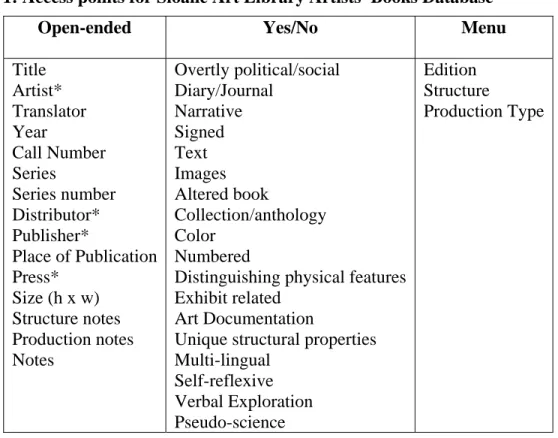
The following access points (see Table 1) emerged from grounded theory
open-ended, yes/no and menu, which allows for searching and browsing of the records. There are still limitations inherent within these access points, but it is impossible to provide access to each aspect of a body of unique works. There will always be new techniques that may not be represented, therefore multiple notes fields have been allowed for enhanced description similar to that of traditional cataloging. The benefit of these notes fields are that they are not restricted by AACR2, and they pertain to different areas of the books.
Table 1: Access points for Sloane Art Library Artists' Books Database
Open-ended Yes/No Menu
Title Artist* Translator Year Call Number Series Series number Distributor* Publisher*
Place of Publication Press*
Size (h x w) Structure notes Production notes Notes Overtly political/social Diary/Journal Narrative Signed Text Images Altered book Collection/anthology Color Numbered
Distinguishing physical features Exhibit related
Art Documentation
Unique structural properties Multi-lingual Self-reflexive Verbal Exploration Pseudo-science Edition Structure Production Type
From the books discussed, it becomes evident that even defining what is an artist’s book is never simple. For libraries, it is important when defining artists’ books for internal purposes that they err on the side of simplicity, encompassing a wide array of books that support the curriculum and/or mission of the institution served. As
bibliographic information for works is not always immediately available, catalogers must utilize extrinsic resources such as press websites, exhibit catalogs, and critical works to obtain full information to assure accurate description. As the literature indicates,
enhanced description needs to include the physicality and structure of the book to provide an alternative route of access to the works. However, the cataloger or documenter should avoid excessive interpretation as it can influence the perception of the work. To ensure this, in a database or catalog, fields should allow unknown or empty records. However, when a work is overtly representing a topic or message, it should be indicated if possible.
With such diverse materials and conceptual work, artists’ books cannot always be fully identified by a descriptor or access point. Institutions must recognize that a perfect record will always be unattainable, but whatever is done to further connect the user to the work is worthwhile. If possible, records should include images as they clarify the
physical embodiment of the work. Most importantly if faculty is involved in increasing access, their suggestions must always be weighed heavily. If concepts are not understood by staff, it is important to collaborate and confirm on the terms given or the techniques highlighted. As this is likely to be a method that the faculty and students will want to access the collection by, it is better to enter the information initially than to try to add a field retrospectively.
collaborative situation, agreement may be hard to come by as everyone will have their own ideas and perceptions. The standard bibliographic fields, such as title and author, can even cause contention when discussing artists’ books. For example, at the Sloane Art Library, we had trouble deciding if Artist Name would be all encompassing of each collaborator or if it would refer only to the main artist. This led us to an unanswerable question echoing Fellowes’ informant: What defines an artist? What can be done, when such disagreements occur, is to cross-list terms through a glossary or user guide so that all ideas are covered.
To aid in the understanding of artists’ books among unfamiliar patrons and to clarify the terminology used in the database, the Sloane Art Library will provide a web guide with the following information pages:
• “What are artists’ books?”
• “Types of Artists’ Books”
• “Artists’ Books and Books About Artists’ Books in the Sloane Art Library” • “Links to Artists’ Books Presses and Other Library Collections”
If the database is made web accessible in the future, it will be preferable for an additional page to be included with a glossary of terms used for searching.
Further Research
Access standardization for artists’ books will only occur when there is open discourse and collaboration between institutions. The increasing number of libraries that include artists’ books in their collections will only intensify this need in the future. New problems will emerge with changing technologies. As more artists manipulate electronic mediums in the tradition of artists’ books, there will be a need to include these works in collections. Consequently, another complication will be added to describing these unique artifacts combined with the need to archive the format so new works will not be lost with technological changes. We are already seeing such problems at Sloane Art Library with various artists’ books that incorporate a CD-Rom.
Works Consulted
Bloch, Susi R. “The Book Stripped Bare.” Artists’ Books: A Critical Anthology and
Sourcebook. Ed. Joan Lyons. Rochester, NY: Visual Studies Worshop Press,
1985.
Byrne, Nadene and Roland Hansen. “Chopsticks, Toilet Paper and Other Odd Things: Artists’ Book Collections in an Instructional Setting.” Art Documentation 11
(1992): 74.
Castelman, Riva. A Century of Artists Books. New York: MOMA, 1994.
Chappell, Duncan. “Typologising the artist’s book.” Art Libraries Journal 28 (2003): 20.
Chemero, Andrea, Caroline Seigel, and Terrie Wilson. “How Libraries Collect and Handle Artists’ Books.” Art Documentation 19.1 (2000): 22-25.
Chilvers, Ian and Harold Osborne, eds. The Oxford Dictionary of Art. New ed. Oxford: Oxford Univ. Press, 1997.
Courtney, Cathy. Speaking of Book Art: Interviews with British and American Book
Artists. Los Altos Hills, CA: Anderson-Lovelace Publishers, 1999.
Dalberto, Janet. “Acquisition of Artists’ Books.” Art Documentation 1 (1982): 169-70. Drucker, Johanna. “Artists’ Books and the Cultural Status of the Book.” Journal of
Communication 44 (1994): 12-42.
---. “The Myth of the Artist’s Book as a Democratic Multiple.” Art Papers 21.6 (1997): 10-17.
Ekdahl, Janis. “Artists’ Books and Beyond: The Library of the Museum of Modern Art As A Curatorial and Research Resource.” Inspel 33 (1994): 241-8.
Fellowes, Cristianne. “Artists’ Books in Libraries: Current Practices & the Issue of Standards and Guidelines.” Master’s Paper. UNC-Chapel Hill, 2003.
Ford, Simon. “Artists’ Books in UK & Eire Libraries.” Art Libraries Journal 18 (1993): 14-25.
Glaser, Barney C. and Anselm L. Strauss. The Discovery of Grounded Theory: Strategies for Qualitative Research. Chicago: Aldine Pub. Co., 1967.
Gordeev, Sergey. “The Book In the Museum.” Art Libraries Journal 25.1 (2000): 31-2. Higgins, Dick. “A Preface.” Artists’ Books. NYC: Granary Books, 1995.
Hillbruner, Fred A. “The Automated Catalog of the Joan Flasch Artists’ Book Collection at the School of the Art Institute of Chicago.” Art Libraries Journal 18(1993): 28.
Jörgensen, Corinne. Image Retrieval: Theory and Research. Lanham, MD: Scarecrow
Press, 2003.
Klima, Stefan. Artists’ Books: A Critical Survey of the Literature. New York: Granary
Books, 1998.
Lippard, Lucy R. “The Artist’s Book Goes Public.” Artists’ Books: A Critical Anthology
and Sourcebook. Ed. Joan Lyons. Rochester, NY: Visual Studies Workshop Press,
1985. 45-48.
---. “Conspicuous Consumption: New Artists’ Books.” Artists’ Books: A Critical Anthology and Sourcebook. Ed. Joan Lyons. Rochester, NY: Visual Studies Workshop Press, 1985. 49-47.
Moore, Barbara and Jon Hendricks. “The Page as Alternative Space 1950 to 1969.”
Artists’ Books: A Critical Anthology and Sourcebook. Ed. Joan Lyons. Rochester: Visual Studies Workshop, 1985. 87-95.
Nexus Press Home Page. The Contemporary: Atlanta Contemporary Art Center. 3 April 2005. <http://www.thecontemporary.org/pages/nexuspress/nexuspress.html>. Osborne, Harold, ed. The Oxford Companion to Twentieth-Century Art. Oxford: Oxford Univ. Press, 1981.
Perrée, Rob. Cover to Cover: The Artist’s Book in Perspective. Rotterdam: NAi Publishers, 2002.
Phaidon Dictionary of Twentieth-Century Art. London: Phaidon Press, 1973. Phillpot, Clive. “Books by Artists and Books as Art.” Artist/Author: Contemporary Artists’ Books. Eds. Cornelia Lauf and Clive Phillpot. New York: Art Publishers
Inc., 1998. 30-55.
---. “Introduction.” Art Documentation 1 (1982): 169.
---. “Twentysix Gasoline Stations That Shook The World: The Rise and Fall of Cheap Booklets as Art.” Art Libraries Journal 18 (1993): 4-13.
Shincovich, Ann C. “Copyright Issues and the Creation of a Digital Resource: Artists’ Books Collection at the Frick Fine Arts Library, University of Pittsburgh.” Art
Documentation 23.2 (2004): 8-13.
Shipe, Timothy. “The Monographic Cataloger and the Artist’s Book: The Ideal Reader.”
Art Documentation 10 (1991): 23-25.
Stein, Donna. “When a Book Is More Than A Book.” Artists’ Books in the Modern Era 1870-2000: The Reva and David Logan Collection of Illustrated Books. by Robert Flynn Johnson. London: Thames & Hudson, 2001. 17-45.
Strachan, W.J. “Livre d’artiste.” The Dictionary of Art. 33 vols. Ed. by Jane Turner. London: Macmillan Publishers, 1996. 512-514.
Svenonius, Elaine. “Access to Nonbook Materials: The Limits of Subject Indexing for Visual and Aural Languages.” Journal of the American Society for Information
Science 45 (1994): 600-606.
Taraba, Suzy. “Now What Should We Do With Them?: Artists’ Books in the Curriculum.” RBM: A Journal of Rare Books, Manuscripts, and Cultural
Heritage.” 4 (2003): 109-120.
Turner, Jane, ed. The Dictionary of Art. 33 vol. London: Macmillan Publishers, 1996. Wilson, Terrie L. “Collection Development Policies for Artists’ Books.” Art
Documentation 21.1 (2002) 27-29.
Artists’ Books Reviewed
Apple, Jacki. Partitions. New York: J. Apple, 1976.
Aviador, Jack, Ariel Cortese and Magali Mansilla. Coleccion Golosina. Buenos Aires: Piña Estudio, 2004.
Bowen, Gaza. Waste Not/What Not Catalog. Santa Cruz, Calif.: Cackling Crones Press, 2002.
Denes, Agnes. Book of Dust: The Beginning and The End of Time and Thereafter.
Rochester: Visual Studies Workshop, 1989.
Douglas, Helen. Last Day in Kas. [Atlanta]: Nexus Press, 2001.
Drucker, Johanna. The Word Made Flesh. New York: Granary Books, 1996. Hung, Berwyn. Inside a Box. [Atlanta]: Nexus Press, 1996.
Fontcuberta, Joan and Pere Formiguera. Dr. Ameisenhaufen’s Fauna. Göttingen, W. Germany: Hubert & Co., 1988.
Martin, Emily. Mutually Exclusive. n.p.: Naughty Dog Press. 2002. Morrison, Lois. Love Re-Turned. n.p.: n.p., 1996.
O’Callahan, Julie. Well-Heeled. London: Gefn Janus Unlimited Publishers, 1998. Phillips, Tom. A Humument: A Treated Victorian Novel. London: Thames and Hudson, 1980.
Ruscha, Edward. Twentysix Gasoline Stations. Alhambra, Calif.: Cunningham Press, 1962.
Ruscha, Edward. Various Small Fires and Milk. Los Angeles: printed by Anderson, Ritchie, and Simon, 1964.