Uncharted Territory:
A Case Study of Rental Assistance Demonstration
Program Implementation in Durham, North Carolina
Carly Hoffmann
Department of City & Regional Planning
Master’s Project
Draft 2
Table of Contents
I: Introduction
3
II: The history of U.S. public housing
4
III: The birth of the Rental Assistance Demonstration
8
IV: The Durham Housing Authority’s implementation of RAD
16
I: Introduction
In 2012, the U.S. Department of Housing & Urban Development (HUD) launched the Rental Assistance Demonstration (RAD), which was designed to address the estimated $25.6 billion in capital improvement needs of the nation’s public housing stock (U.S. Department of Housing & Urban Development [HUD] n.d.; Abt Associates 2010). Through the RAD program, public housing authorities (PHAs) can apply to convert public housing units to project-based Section 8 housing, which allows them to leverage private and public funding to be used for repairs or redevelopment (Hanlon 2017, 612). HUD reports that more than $4 billion in funding from outside sources has been invested in public housing through RAD, as of May 2017—and RAD represents the sole housing program that President Trump pledged to devote further funding to in his May 2017 budget proposal (Ockerman 2017). Given its high-profile political support, as well as its role in addressing the critical issue of public housing deterioration, RAD will be an important federal housing program in the years to come. However, some housing authorities, including the Durham Housing Authority (DHA), have struggled to secure financing and complete the RAD conversion process, causing costly delays.
consequences of the novel aspect of the program: the freedom it allows PHAs to implement mixed-finance strategies.
II: The history of U.S. public housing
Looking back at nearly a century of American low-income housing policy reveals inconsistent progress towards the goal of housing all families. The first major public housing program in the United States was created in response to the Great Depression, through a clause in the National Industrial Recovery Act in 1933 that permitted the Public Works Administration to build low-cost housing. The 22,000 units of public housing that were built between 1933 to 1938 were federally owned, constructed, and managed. Critics of the first public housing program pushed for more local control, which the Wagner-Steagall Housing Act of 1937 addressed through the creation of public housing authorities, entities that apply for federal subsidies, select sites, oversee construction, and manage public housing (McDonald 2011, 4). The Housing Act of 1937 also dictated that, while capital costs would be covered by the federal government through “annual contribution contracts,” operating and maintenance costs would need to be paid for solely through tenant rent collections—a financial arrangement that would stay in place until the late 1960s (Orlebeke 2000, 492).
The Housing Act of 1937, alongside a series of other housing laws that organized a mortgage market to benefit the middle class, effectively created a two-tiered housing policy – one to help the private industry and the middle class, and one to build government housing for low-income people. Housing activists of the 1930s, including Catherine Bauer, the director of the American Federation of Labor’s Housing Conference, pointed out that “as long as public housing was known as a poor people’s program, it would never be popular or have strong political
support” (von Hoffman 2000, 302-303). And thanks to strong objections from the private real estate industry, early public housing construction was constrained; from the passage of the act in 1937 through 1943, approximately 160,000 public housing units were constructed, and only 10,000 additional permanent units were constructed between 1944 and 1948 (Orlebeke 2000, 492; McDonald 2011, 4).
Act were lofty: to eliminate slums and blighted areas and, as stated directly in the Act, to “provide a decent, safe, and sanitary living environment… for every American” (McDonald 2011, 4). The Act authorized the construction of 810,000 units over the next six years, but opponents of public housing hampered the appropriations process; throughout the 1950s,
Congress typically only awarded enough money to build an average of 25,000 units per year. On a local level, protests against efforts to build units resulted in public housing being built in the least desirable, already low-income areas. By 1959, only a quarter of the 810,000 units
authorized had been built (Orlebeke 2000, 493).
The Housing Act of 1949 also represented a shift in the types of populations served by public housing. Housing built in the 1930s was designed for working-class families, but due to policy decisions and demographic changes, public housing became home to a disproportionately low-income and African-American population beginning in the 1950s. By 1962, nearly half of public housing residents were dependent on public assistance (Smetak 2014, 6-7). The declining incomes of tenants posed a significant challenge for public housing authorities, who were expected to use tenant rents to fund operations and maintenance costs. Large-scale high-rise public housing projects like Pruitt-Igoe in St. Louis became visibly neglected and rundown. The problems of public housing in the 1960s were blamed on residents, creating an association between poor African-American communities and vandalized, poorly maintained public housing (Bristol 1991, 166). Some public housing authorities responded by raising rents, which provided the impetus for the passage of the Brooke Amendment to the Housing and Urban Development Act of 1969, which capped tenant rents at twenty-five percent of household incomes (later raised to 30 percent). The Brooke Amendment also required that the federal government provide operating subsidies to cover the gap between tenant rents and operating costs—thereby solidifying the dependency of public housing on federal funding (Smetak 2014, 7-8).
program, which was renamed the Housing Choice Voucher (HCV) program under President Obama’s administration, is the largest HUD program with over 2.2 million households receiving vouchers (Hanlon 2017, 614).
Insufficient federal subsidies for public housing
While the housing voucher programs have expanded since their creation, public housing has suffered from continued funding cuts and minimal reinvestment. Public housing authorities rely on three sources of funding: tenant rents, federal operating subsidies, and federal capital funds. Tenant rents, which are dependent on the tenant’s income level and restricted to 30 percent of household income, cover roughly 40 percent of operating costs (Smetak 2014, 9). Federal operating subsidies are awarded to housing authorities through the Public Housing Operating Fund based on a formula that was developed in the mid-1970s (Rice & Sard 2009, 15; Smetak 2014, 9; Council of Large Public Housing Authorities (CLPHA) 2013b, 1). But Congress often fails to award full funding as dictated by the formula, forcing housing authorities to rely on reserves to cover necessary operating costs (Smetak 2014, 10-11). The Council of Large Public Housing Authorities found in 2013 that Congress fully funded the Operating Fund only four out of thirteen years between 2001 and 2013. Insufficient operating funds result in deferred
maintenance, staff reductions, service cuts, and ultimately, the loss of units due to lack of maintenance (CLPHA 2013b, 2).
Federal funding for capital needs, including necessary repairs, replacements, and
modernization work, is distributed through the Public Housing Capital Fund. Funding for capital improvements was authorized under the 1937 Housing Act, but no funds were dedicated for capital needs until HUD created a discretionary grant program in the late 1960s. It wasn’t until the 1990s that a more predictable and significant funding stream was established for capital needs, through the Comprehensive Grant Program. In 1999, the Comprehensive Grant Program and other funding programs were merged into the Public Housing Capital Fund (U.S.
Department of Housing and Urban Development (HUD) 2016a, 3-4).
The fact that there was no stable funding mechanism for capital needs until the 1990s caused public housing developments, the majority of which were built in the 1970s and 1980s, to accrue significant unmet capital needs. And since 2001, Public Housing Capital Fund
as of the last estimation in 2010, is $26 billion, or $23,000 per unit—with the backlog projected to grow by $3 billion per year (Abt Associates 2010). Neglected repairs and maintenance impact the housing stock; HUD estimates that 10,000 units are lost each year due to deterioration (CLPHA 2013b, 3).
HOPE VI: The first policy response to public housing deterioration
The HOPE VI program was developed in the early 1990s as the central policy response to public housing deterioration—and its successes and failures would provide a blueprint for the Rental Assistance Demonstration Program two decades later. The visible signs of public housing distress in the 1980s spurred Congress to create the National Commission on Severely Distressed Public Housing in 1989 (Oakley and Burchfield 2009, 592). The Commission reported that more than 80 percent of public housing residents lived below the poverty threshold, and that 6 percent of public housing (approximately 86,000 units) were uninhabitable (Brazley et al. 2007, 434). The commission’s recommendations focused on preservation and rehabilitation of units, rather than demolition and redevelopment (Hanlon 2017, 615).
Congress passed the Housing and Community Development Act in 1992 to fund the Urban Revitalization Demonstration program, which later became known as HOPE VI, based on the recommendations of the commission. In its first years, the goals of the HOPE VI program were to rehabilitate existing public housing and to fund community revitalization and resident empowerment programs (Chaskin and Joseph 2015, 58). As HOPE VI was enacted in 1992, President Bill Clinton was elected and he in turn appointed Henry Cisneros as the Secretary of HUD (Popkin et al. 2004, 14). This change in administration, alongside pressure from
developers, caused the HOPE VI program to shift gears towards demolishing public housing and building mixed-income developments to solve the problem of concentrated poverty (Chaskin and Joseph 2015, 58). The focus on developing mixed-income communities following the demolition of existing public housing posed a challenge in terms of adhering to HUD’s one-for-one
The HOPE VI program was also notable for its mixed-finance model of public housing redevelopment. HUD’s 1996 Notice of Funding Availability (NOFA) encouraged public housing authorities to explore mixed-financing strategies for new developments, such as combining public housing with units funded through the Low-Income Housing Tax Credit (LIHTC), as well as market-rate units (Chaskin and Joseph 2015, 9). Since HOPE VI grants were limited, HUD also enabled housing authorities to utilize mixed financing through the Public Housing Mortgage Program, created in 1998, and the Capital Fund Financing Program, created in 2000—through both programs have seen limited usage since they require that housing authorities draw from their already-limited Capital Fund Appropriations or borrow against them (Hanlon 2017, 616). Further, borrowing against future Capital Fund payments requires a debt service coverage ratio of about 3.0, which is not financially feasible given the low net operating income produced by tenant rents (Schwartz 2017, 804).
In 2009, President Obama replaced the HOPE VI program with the Choice
Neighborhoods program. Under HOPE VI, over 240 revitalization grants totaling $6 billion had been awarded, resulting in 73,167 relocated households, 96,017 public housing units demolished, and 83,951 units rehabilitated or constructed as of September, 2010 (US HUD 2012). In
evaluating the seventeen years of HOPE VI, researchers note that the program saw successes in physically transforming public housing sites and some surrounding neighborhoods (Chaskin and Joseph, 2015, 59). However, the program has been criticized widely for the repeal of the one-for-one replacement policy (which was reinstated under the Choice Neighborhoods program) and strict readmissions policies (Hanlon 2017, 615-616). In terms of public housing production, HUD reports that 83,951 units were rehabilitated or constructed under HOPE VI as of September 2010 (HUD 2012). But the problem of deferred maintenance and deteriorating public housing persists; between 1995 and 2008, 165,000 public housing units were lost due to deterioration, without replacements (Rice & Sard 2009, 16).
III: The birth of the Rental Assistance Demonstration
financing of HOPE VI was preserved, while HOPE VI’s inadequate tenant protections were rectified. A further notable difference is that RAD is revenue-neutral and no new federal funds were appropriated for the program.
The RAD program was first introduced by the Obama administration in 2010 under a different name—the Preservation, Enhancement, and Transformation of Rental Assistance Act (PETRA). PETRA was built off of two important precedents set in the decades before RAD was proposed: the ability of PHAs to dispose of public housing (or sell to non-PHA entities), and to convert public housing to other forms of subsidized housing (Hanlon 2017, 616-622).
PETRA was ambitious; it proposed converting 300,000 public housing units to project-based contracts at a cost of $350 million (Reid 2017, 4). PETRA was also the first housing policy to not specify that PHAs would own converted public housing projects, implying that public housing could be owned by private entities, including non-profit agencies (Hanlon 2017, 622). After protests from Congresspersons on both sides of the aisle (liberals raised concerns about the potential impacts on tenants and conservatives protested the cost of the program), the RAD program emerged as a compromise in November 2011. RAD was written as a pilot program, with only 60,000 units authorized to be converted, and Congress required that it be revenue-neutral. To address concerns about negative impacts on tenants, RAD also includes long-term affordability protections, the right-to-return for current residents, and a one-for-one replacement policy related to the demolition and creation of new units (Reid 2017, 4; Hanlon 2017, 623).
Since RAD was authorized in late 2011 and implemented in early 2012, Congress has now lifted the cap on units twice to its current level of 225,000, following strong demand from PHAs. As of August 2017, more than 60,000 units have been converted to project-based contracts, 125,000 are in the process of securing financing, and 48,000 units are on the waitlist (Reid 2017, 4). And as of May 2017, more than $4 billion in funding from outside sources has been invested in public housing through RAD, representing $19 in capital leveraged for every one dollar of public housing funds. HUD estimates that it would have taken the PHAs
The RAD application and implementation process
The key feature of RAD is the transition of public housing units from their existing contracts with HUD to what is known as a Housing Assistance Payment (HAP) contract. In exchange, HUD subsidizes tenant rent through the project-based rental assistance (PBRA) or project-based vouchers (PBV) program—two already existing HUD programs with long track records of stable funding (Reid 2017, 5). Conversion to PBRA or PBV contracts allows PHAs to access alternate forms of capital, such as conventional debt, which they are not able to do under current public housing contracts (Hanlon 2017, 625). Importantly, funding through the project-based contracts replaces the federal operating subsidies, which are dependent on annual appropriations and have decreased over time (Smetak 2017, 13).
To participate in RAD, PHAs must assess their capital needs and funding sources and the basic financial feasibility of RAD conversion, which they report to HUD in their applications. In the pre-application period, PHAs must also decide whether to pursue the PBRA or the PBV contract (Econometrica, Inc. 2016, xvi). Differences between the two programs boil down to minimum contract length (fifteen years for PBV and twenty years for PBRA) and how the contract is administered. PHAs administer the PBV program, which is a part of the Housing Choice Voucher program, so that option allows the PHA to stay more involved in the project. PHAs also receive additional voucher administration fees to support operations. The PBRA program is administered by HUD’s Office of Multifamily Housing; a PHA may choose PBRA so as to more easily turn over management of the project to a third-party entity such as a non-profit (Smetak 2014, 13; Reid 2017, 7).
In their applications for RAD, PHAs must include financial pro formas and financing plans, including proposed funding sources (the section below includes a more detailed
long as they propose an alternate financing strategy (such as 4 percent tax credits) (HUD 2017b, 95-96). Between receiving a CHAP and closing, PHAs must also complete a Physical Condition Assessment of the current and future capital needs for the proposed projects. The project is considered closed when the new HAP contract is fully executed. The housing authority will then begin receiving PBV or PBRA payments, instead of payments through the Public Housing Capital and Operating Funds, and will begin the process of rehabilitating the project. PHAs are responsible for completing construction, making debt payments, and adhering to RAD’s tenant protections (Econometrica, Inc. 2016, xvi-xvii).
The RAD program’s mixed-finance approach
The first in-depth report on the results of the RAD program, completed by the firm Econometrica, Inc., reviewed the 966 RAD projects that had active CHAPs and the 189 projects that had completed conversions as of October 2015 (2016, xvii-xviii). The researchers found that the active projects proposed $8 billion in capital funding, with mortgage debt and LIHTC equity representing the largest shares at 28 percent and 38 percent respectively. Other sources,
including public and private sources and public housing funding sources like operating reserves and replacement housing funds, represented the last 34 percent (xvii-xviii). Of the 189 projects that has closed, Econometrica, Inc. found that the projects had raised $2.5 billion in funding for an adjusted leverage ratio of $8.91 private dollars raised for every one dollar of public housing funding spent (xviii).
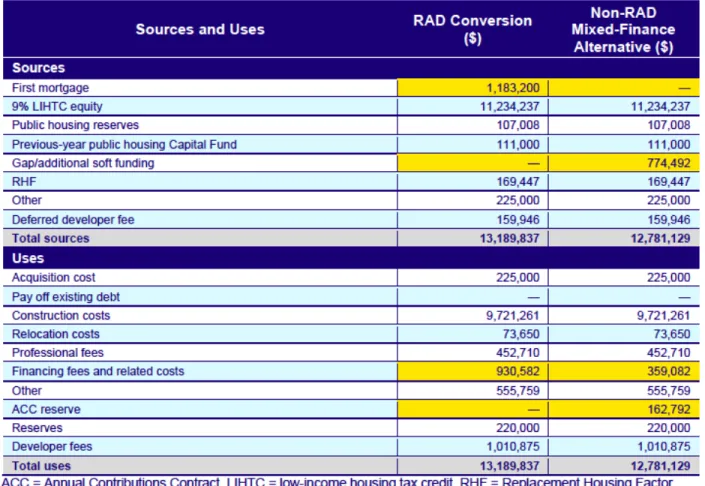
To illustrate how a RAD conversion is financed with LIHTC and mortgage debt, Econometrica, Inc. prepared an example financial analysis of a theoretical 50-unit demolition and new construction project serving families (2016, 160-164). Table 1 represents the
development budgets for this project if the PHA participated in RAD (the left column), and if the PHA financed the project without RAD (the right column). This case has high development costs, and the PHA has a modest amount of internal funding available (roughly $387,000 in combined public housing reserves, replacement housing funds, and money from the Public Housing Capital Fund). The overall development costs are higher for the RAD project because of the financing fees related to the mortgage. The non-RAD budget requires close to $800,000 in additional soft sources because public housing rent and federal subsidies are not secure enough to support conventional debt. Both projects are able to take advantage of 9 percent LIHTC equity.
Table 1: Development Budget for New Construction Project (RAD Conversion with LIHTC and Debt and Non-RAD Alternative)
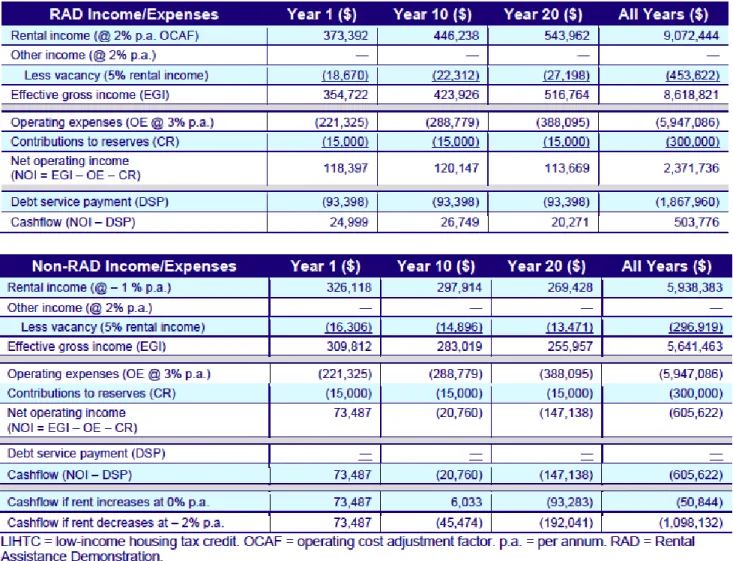
Table 2: 20-Year Pro Forma for New Construction Project (RAD Conversion with LIHTC and Debt and Non-RAD Alternative)
Source: Econometrica, Inc. 2016, 162.
many public housing residents are on public assistance or work low wage jobs that have seen little wage growth in the last decade. The non-RAD project loses $600,000 over 20 years, making it not possible to maintain reserves or potentially cover operating expenses—and therefore exacerbating the problem of public housing distress.
The conclusion of this case study, as well as two different examples fleshed out by Econometrica, Inc. of rehabilitation projects financed with just mortgage debt and with 4 percent tax credits, is that RAD can be used in many different rehab scenarios. Further, the flexible funding options give PHAs a range of possibilities, depending on their financial resources, such as debt financing and tax credit equity—options that make the program more effective from a financial perspective than previous attempts at addressing public housing deterioration.
Evaluating RAD
Evaluations of RAD have focused on the implementation process for PHAs and the experiences of tenants living in public housing that is being converted. Many researchers have found that a wide array of PHAs have been able to take advantage of the program, though they have faced challenges in the implementation process. Hanlon (2017) compared PHA
participation in RAD to participation in the HOPE VI and Choice Neighborhoods programs, finding that the barrier for entry for RAD was “exceptionally low.” The result is that far more small PHAs (defined as under 250 units) have participated in RAD than were able to participate in HOPE VI, which had a strong bias toward large PHAs in major cities (626-627). Reid (2017) of the Terner Center for Housing Innovation found that, though there are low barriers for entry, PHAs face implementation challenges related to regulatory burdens, dealing with various siloed departments within HUD, and meeting tight deadlines related to financing, conversion,
relocation, and rehabilitation (26-27). Evaluating RAD in 2016, Econometrica, Inc. found that PHAs who began the RAD process but then dropped out did so because of unworkable timelines and inadequate preparation (xxix).
the long-term voucher contracts (174). However, the researchers note that more complex financing arrangements, including combining 4 percent LIHTC and mortgage debt, at times led to delays in closing and occasional dropouts from the program (174-175).
In terms of the tenant experience with RAD, researchers note that the design of the program is meant to ensure that displacement of residents and loss of units—downsides of the HOPE VI program—do not occur. Hanlon (2017) points to tenant protections that include the prohibition of permanent involuntary tenant displacement, the right-of-return for tenants that are temporarily relocated during unit rehabilitation, and the prohibition of tenant rescreening for relocated tenants (628). Further, one of the chief concerns raised in Congressional debates before the authorization of RAD was the loss of public housing through foreclosure—particularly for properties that take on mortgage debt. But the RAD program includes safeguards to ensure long-term affordability, including that PHAs must retain an ownership interest in properties that are transferred to private ownership through the LIHTC program. And PHAs must enter into RAD Use Agreements, which stipulate that the current and all future owners must comply with affordability requirements, even if the property is foreclosed upon (Reid 2017, 11-12).
Ultimately, Reid (2017) points out that RAD is a “powerful tool” for addressing the serious need for repairs to public housing across the United States. She quotes one developer who stated that, “Without RAD, it was just a matter of time before a large portion of these buildings had to be vacated… and people would have been displaced” (9-10).
Though the cited studies of RAD provide a valuable understanding of the overall successes and challenges seen by PHAs in the first five years of the program, researchers note that more scholarship is needed, particularly in the form of case studies and comparative research. The following case study of the Durham Housing Authority’s conversion and renovation of its portfolio through the RAD program, as well as a comparative analysis of the RAD conversion implemented in Greensboro, North Carolina by the Greensboro Housing Authority (GHA), aims to address that gap in research and reveal challenges related to external financing restrictions and internal missteps in implementation and management.
IV: The Durham Housing Authority’s implementation of RAD
The Durham Housing Authority (DHA), which was founded in 1949, oversees an affordable housing portfolio of close to 1,900 units in 19 public housing developments and four mixed-income developments (Scott 2017, 4; Housing Authority of the City of the Durham (DHA) 2017a, 6). Many of DHA’s public housing developments were built before the 1970s, such as McDougald Terrace, which has 360 units and was built in 1959, and Cornwallis Road, which has 200 units and was built in 1967. Given the age of the Durham Housing Authority’s portfolio and its existing capital needs, DHA staff became interested in RAD soon after the program launched in 2012. The initial strategy for participating in RAD, which involved submitting applications for individual developments on a case-by-case basis, was led by the DHA development team, led at the time by Shannon McLean. In December 2012, Development Ventures Incorporated (DVI), DHA’s non-profit development arm that is staffed solely by DHA employees, submitted one application to convert the 224-unit Morreene Road development, which was built in the 1960s. HUD issued a CHAP to DHA for the Morreene Road development in January 2013. In early 2013, DVI submitted an application for the nearby Damar Court
development, and HUD awarded a CHAP for Damar Court in July 2013 (HUD 2018). Both developments required substantial rehabilitation, and DHA planned to finance both through a mix of tax credits, conventional debt, and internal sources.
condition and secure financing before the project closes. Between receiving the CHAP award and closing, DHA ran into a number of roadblocks for the Morreene Road and Damar Court developments. For the Morreene Road development specifically, DHA planned to fund
renovations with 9 percent tax credits, but the North Carolina Finance Agency (NCHFA) did not award the project tax credits. After their application for 9 percent tax credits was denied, DHA applied for 4 percent tax credits in December 2013. The next roadblock, according to Meredith Daye, who joined the DHA Development team in May of 2013 and is the current DHA Director of Development, appeared after the NCHFA visited Morreene Road to complete an on-site inspection. NCHFA’s inspection revealed a more extensive list of repairs than DHA had budgeted for, so DHA was required to expand the scope and budget of the project. A larger budget created a gap in funding sources, which DHA was able to fill with an FHA-insured loan —which brought in two additional parties, the lender and the FHA. Both parties required that the scope of renovations be expanded further. By the time the budget was finalized, the scope of the project had expanded from $10 million to $20 million.
Over four years after DHA applied to HUD to convert and renovate Morreene Road and Damar Court, DHA closed on the two developments in December 2017 as well as five others that received CHAPs in March 2015. The years of delays were costly for DHA; in 2016, DHA approached the Durham City Council to request a $1.2 million grant to cover DHA’s depleted reserve funds, which DHA had used to cover administrative costs after not receiving expected developer fees from closing on Morreene Road and Damar Count developments (Horsch 2016; Bridges 2016b). While DHA was still working to close on Moreene Road and Damar Court, the agency decided to change course from its original plan of applying for RAD conversions for individual developments one at a time. In 2014, DHA applied to HUD for an entire portfolio conversion award, which it received from HUD in March 2015 (DHA 2017a, 20).
In another change of course, DHA plans to release Requests for Proposals (RFPs) for developers to apply to jointly manage the process of converting and renovating DHA
applications in 2016 and 2017 to the NCHFA for 9 percent tax credit awards were unsuccessful and DHA currently has no plan for how to finance the conversion and rehabilitation. The Oldham Towers development may also have its CHAP rescinded by HUD, as DHA will not be following its stated plan of submitting a LIHTC application for the development in 2018 (DHA 2018, 29).
For the seven developments that DHA has closed on through RAD, the average length of time between receiving CHAPs and closing is 38.9 months, according to HUD data (HUD 2018). For contrast, the average length of time from CHAP to closing for the 18 developments the Greensboro Housing Authority has converted through RAD is 27.6 months. For the 833 developments that have closed nationwide through February 2018, the average closing time is 21.3 months (HUD 2018).
Analyzing the factors that contributed to DHA’s delayed conversion process and rescinded CHAPs, as well as past and present challenges faced by the agency in implementing RAD, can shed light on the characteristics of the RAD program that housing agencies struggle with, as well as the state and local political factors that may constrain affordable housing preservation. For DHA, the challenges faced in implementing RAD conversions can be organized into three categories: issues in securing financing that are related to the specific requirements of the tax credit program in North Carolina; decisions that were made in 2012 to pursue an individual conversion strategy that ultimately handicapped the implementation process; and finally, the fact that RAD conversions require housing authorities to adopt an asset management approach to manage their portfolios, which, alongside staff turnover, has been a challenge for DHA. These three sets of challenges will be explored in detail below.
Financing challenges
As has been detailed by researchers evaluating the RAD program, tax credits represent a significant source of funding for housing authorities that are pursuing RAD renovations.
bonds are eligible for tax credit allocations equal to roughly 4 percent of the project’s eligible basis. Tax credits are awarded to projects by each state’s housing finance agency, which receives tax credit allocations from the U.S. Treasury Department, and each housing finance agency releases an annual Qualified Allocation Plan (QAP) to guide applicants and set the state’s allocation priorities. Applicants for tax credits are scored based on the rules set in each state’s QAP, and tax credits are awarded to the highest-scoring developments (Novogradac n.d.).
For developments that require substantial rehab and therefore have larger budgets, as both Morreene Road and Damar Court do, housing authorities must be able to access tax credits, and preferably 9 percent tax credits, to make these projects work. In North Carolina, however, housing authorities (and affordable housing developers in general) have faced multiple
challenges related to the policies of the North Carolina Housing Finance Agency and its QAP. According to HUD data from 2018, only two of the 98 developments in North Carolina undergoing RAD conversions that have received CHAPs have been awarded 9 percent tax credits (HUD 2018)—a rate that is far below the 17 percent of RAD developments nationwide that have received 9 percent credits (Schwartz 2017, 798). The Durham Housing Authority has specifically struggled to receive 9 percent tax credit awards for RAD conversions, having applied once for Morreene Road and two years in a row for the Club Boulevard development, to no avail. To be sure, the competition for 9 percent tax credits (in North Carolina and across the country) is fierce, as they result in the largest funding awards available. In North Carolina, however, the NCHFA awards 9 percent tax credits at a rate of one award per metropolitan area per year, according to conversations with multiple people who work in the affordable housing field in North Carolina. In North Carolina’s larger cities like Raleigh, Charlotte, Durham, and Greensboro, housing authorities are competing for credits with a large community of developers, to the disadvantage of all compared to affordable housing providers in small cities and counties in North Carolina.
Further complications arise from the fact that the North Carolina’s QAP is written with private developers in mind and has not been updated to reflect the constraints of RAD
housing authorities to compete against private developers, and as stated in the letter, help them implement RAD and “maximize the use of LIHTC financing” (Bell et al. 2017).
Six of the 11 requests relate to the scoring of applications for 9 percent tax credits. The first addresses the points awarded for income targeting, as laid out in Section IV(B.2.) of the QAP. Currently, the NCHFA awards a maximum of two points for projects that have at least 25 percent of their units designated as affordable for households with incomes at or below 30 percent of the area median income (AMI) (North Carolina Housing Finance Agency [NCHFA] 2017, 16). The four housing authorities are requesting an additional bonus point for projects with the same income targeting; the authors of the letter note that housing authorities “have a high priority to serve Extremely Low Income (ELI) families, with incomes below… 30 percent of AMI,” which distinguishes them from private developers who are solely bound to provide LIHTC housing that is affordable to households with incomes at or below 60 percent of AMI. The authors are also requesting bonus points for projects receiving federal rental assistance (Bell et al. 2017).
Three of the 11 requests related to 9 percent tax credits reflect the fact that the North Carolina QAP has not been updated to accommodate the growing importance of RAD for public housing authorities. The authors point to Section IV (C.1.a.) of the QAP, which details the maximum per unit project development costs allowed. The QAP allows for a higher per unit cost of $89,000 if the project meets any of a list of characteristics, including serving people with severe mobility impairments, being located within a central business district, or being a public housing redevelopment project (NCHFA 2017, 17-18). The four housing authorities request that the list of types of projects eligible for higher costs be expanded to include RAD projects, as RAD conversions (Bell et al. 2017, 2-3)—an addition that is most likely necessary because developments are technically no longer “public housing” once they have been converted to project-based vouchers through RAD. The authors include an additional another request to increase the number of awards for redevelopment projects, which are defined as adaptive re-use projects that may utilize historic rehabilitation credits and that are part of local revitalization plans that have committed financial support from local governments, from one to four (NCHFA 2017, 6; Bell et al. 2017, 2).
tiebreakers for projects with equal scores: a tax credit award will be given to “the project in the census tract with the lowest percentage of families below the poverty rate” (NCHFA 2017, 22). Giving preference to projects in lower poverty areas is in-line with the national focus on
Affirmatively Furthering Fair Housing and decreasing segregation. But rewarding projects in lower poverty areas will automatically disadvantage housing authorities. The four housing authorities request that that tiebreaker be modified to give redevelopment projects involving the revitalization of former public housing equal value with projects in the lowest poverty census tract. The authors justify this request with the statement, “Our properties are where they are, and they are frequently in high poverty census tracts. This change will give redevelopment and revitalization efforts on behalf of our extremely low-income residents equal footing with greenfield developments at this important tiebreaker stage” (Bell et al. 2017, 2). This specific issue reveals an irony inherent in the design of the RAD program: RAD allows public housing authorities to more easily access alternate funding sources such as LIHTC, but the aims of the tax credit program are at times deliberately contrary to those of traditional public housing, as is illustrated in the design of this tiebreaker.
representative of how the existing QAP disadvantages affordable housing providers in North Carolina’s urban areas.
When the final 2018 QAP was released in December 2017, none of the housing
authorities’ requested modifications had been incorporated. According to Mark Shelburne, who served as the NCHFA’s Counsel and Policy Coordinator for thirteen years up until 2014, the four housing authorities mistimed the release of their letter. NCHFA released the first draft of the 2018 QAP in the spring of 2017 and invited public comment. Based on feedback and internal decision-making, a number of changes were made to the first draft. The second draft, which was released on October 10, 2017, was near-final. By submitting their letter after the second draft of the QAP was released, the housing authorities all-but-guaranteed that their requests would not be incorporated in this year’s document, according to Shelburne.
To request the same changes for the 2019 QAP, the housing authorities will have to resubmit their letter in 2018 in a timely manner after the first draft of the 2019 QAP is released. Shelburne, however, questioned the efficaciousness of solely submitting public comments to NCHFA. He notes that the organization receives a large volume of public comments each year (77 letters in total just in 2017 [NCHFA n.d.]) and has just three dedicated staff members who write and review the QAP each year. And NCHFA staff are faced with the challenge of juggling a large number of competing and contradicting needs, which they must attempt to settle fairly while also respecting the desires of the state legislature. With that in mind, Shelburne noted that it would potentially be more helpful if the housing authorities met with NCHFA staff in person to present their requests, which would allow them to learn more about why certain changes may or may not be feasible and to identify feasible changes to the QAP that would meet the housing authorities’ needs. The in-person lobbying strategy seems to already be in play at DHA; in March 2018, DHA CEO Anthony Scott told me that his team had had productive conversations with NCHFA, and he seemed confident that the needs of housing authorities implementing RAD would be considered in future drafts of the QAP.
Implementation challenges
and support while imposing burdensome requirements” and the second being “the inability of the PHA to manage the project” (134). DHA seems to have struggled with both factors.
DHA CEO Anthony Scott directly addressed the first challenge of meeting HUD’s milestones and requirements, describing HUD regulations as “unnecessary and onerous.” In particular, Scott took umbrage with the fact that HUD’s milestones for finalizing financing plans do not take into consideration potential issues that may arise and the fact that staff may be inexperienced in mixed-finance transactions. Similarly, Econometrica, Inc. reported in 2016 that PHAs across the country struggled to meet HUD’s financial plan milestone and found the timeline to be too aggressive. DHA has faced direct consequences related to HUD’s tight timeline, with the CHAPs for four developments rescinded, and two likely to be rescinded this year.
Though DHA has struggled in following HUD’s process for implementing RAD, Catherine Liu, who is a lawyer with DHA’s general counsel, the Banks Law Firm, noted that RAD conversions may pay off in the long-term. In our interview, Liu described a series of requirements of the public housing program that are not required of the PBV and PBRA platforms, including regulations on whether the project can be encumbered and required compliance with HUD’s procurement process. Liu described the benefit of converting
developments through RAD as “requiring upfront effort, but then in the long-term, [Section 8 compliance] requires less effort.” Liu also noted that conversion to RAD may result in cost savings for housing authorities, as they may be able to consolidate their staff.
There is also an argument to be made that DHA’s RAD implementation has been hampered by the fact that it began without a coherent strategy, even as the housing authority switched from submitting individual applications to a full portfolio conversion in 2014. In our conversation, DHA CEO Anthony Scott, who took over for former CEO Dallas Parks in June 2016, distanced himself from the decision-making that led to DHA’s RAD implementation to-date. When I asked him why Morreene Road and Damar Court were selected first, he responded, “I’m really not sure why they started with those two.” Scott also noted that the number of
CHAPs that have been rescinded represents a failure on DHA’s part to adequately prepare financing plans for the developments after the full portfolio application was submitted.
First, housing authorities may choose to take on RAD conversions so as to earn developer fees, which represent a substantial source of income. The trade-off of earning developer fees is that the housing authority then takes on the risk and the challenge of handling the financing and closing processes, which ended up being burdensome for DHA. Second, Liu noted that DHA had prior experience acting as a developer, with the financing and construction of Preiss-Steele Place, a project-based voucher development built in 2013. DHA was awarded 9 percent LIHTC for the project (which was not developed through RAD). Liu described the financing scheme for Preiss-Steele as “comparatively simple” compared to the RAD conversions, which have required tax credits in addition to other sources of financing. Liu argued that, because the Preiss-Steele development was simple, DHA leadership felt that that experience laid the groundwork for them to successfully handle other developments. As noted above, the conversions of Morreene Road and Damar Court ended up being anything but simple. When DHA took on the two RAD conversions, they were also limited by being regulated by HUD. Private developers have the benefit of being nimble; housing authorities acting as developers do not. As Liu described, “If I’m a private developer, I can hire someone without getting Board approval and going through a procurement process. If I have to advance some money, I don’t have to identify money other than HUD money, or jump through some hoops if I do use HUD money.”
In addition to the question of outsourcing complicated conversions to developer partners, DHA could have been better prepared by more thoughtfully considering the sequence of
conversions. HUD (2016b) offers a number of lessons learned and best practices for housing authorities electing to convert their entire portfolios, which provide a useful framework for understanding how DHA could have better prepared for portfolio conversion. HUD recommends developing a strategy for the sequencing of conversion—whether that means starting the process by converting properties with fewer needs and less complicated financing first, or starting with the most distressed asset. HUD is agnostic about which type of property should be converted first: “There is no single ‘right’ way; the important thing is for PHAs to thoughtfully plan out a strategy” (2016, 2).
their need is great. However, projects with large total construction costs require mixed-finance strategies and likely require tax credits. With the benefit of hindsight and given the challenges faced by housing authorities attempting to access tax credits in North Carolina—particularly the more valuable 9 percent tax credits—it may have been a stronger strategy for DHA to pursue a simpler conversion first.
The Greensboro Housing Authority’s (GHA) experience implementing the RAD program provides a useful comparison case study to illustrate the importance of developing a thoughtful strategy for full portfolio conversion. GHA is the second-largest public housing authority in North Carolina, owning 19 developments in the City of Greensboro and housing over 10,000 people. In 2013, GHA received an approval from HUD to convert its entire portfolio of 20 developments through RAD, and as of 2018, GHA had closed on 18 of those developments. The 287-unit Hampton Homes development was in the first batch of CHAPs that GHA received in December 2013, and was the first development GHA closed on in June 2015, according to 2018 HUD data. The total construction cost of Hampton Homes’ rehab was $2.9 million, or roughly $9,000 per unit. To finance the rehab of Hampton Homes, GHA was able to secure a Section 223(f) FHA loan totaling $8.8 million, which allowed them to generate $4.6 million in excess loan proceeds that GHA is using to finance other RAD transactions (HUD 2016, 2). Regarding the question of why the Hampton Homes development was the first GHA development to be converted through RAD, GHA CEO Tina Akers Brown is quoted in a 2016 HUD newsletter as saying, “We chose Hampton Homes for our first conversion because most of the improvements needed there are not structural” (2). As noted in HUD’s best practices for full portfolio
conversions, selecting a lower-needs property for the first conversion is one successful track housing authorities have chosen to begin their RAD conversions, since simpler conversions require less financing and will take less time.
GHA has also taken a separate track with its portfolio conversion by selecting Greystone Affordable Development as a developer partner to handle the RAD implementation process for nine of its 19 developments. In late November 2017, GHA and Greystone announced that it had closed on those nine developments, financing the roughly $44,000 deferred maintenance needs per unit through a combination of LIHTC, tax-exempt bonds, and conventional loans (Greystone 2018). All nine developments were financed with 4 percent tax credits, and Greystone
It is important to note, however, that the Greensboro Housing Authority is advantaged by owning a housing stock that is in less need of repair than that of the Durham Housing Authority. For the 18 RAD conversions GHA has closed on as of February 2018, the average total
construction cost is roughly $2.4 million. Securing financing for a $2 million project is
inherently less of a challenge that securing financing for projects that are over $10 million, such as DHA’s Damar Court and Morreene Road. However, important lessons can be taken from GHA’s experience in planning for and implementing the RAD program.
Now, DHA CEO Anthony Scott wants to incorporate DHA’s RAD conversions into a larger comprehensive plan to break up pockets of concentrated poverty and redevelop land owned by the housing authority. For developments that are being converted through RAD, Scott wants to think more ambitiously about how DHA’s aging properties can be redeveloped into vibrant mixed-income communities. Importantly, he wants to focus on the DHA properties in downtown Durham—notably the JJ Henderson and Oldham Towers developments, which house 213 units between them on roughly 13 acres. Scott wants to increase the density on these sites through market-rate development and scatter the LMI units through downtown Durham. Focusing on DHA’s downtown properties is an attempt to secure affordable housing in a city with skyrocketing housing costs and also ensure that DHA has a role in the revitalization of downtown Durham. To that end, DHA will also aim to integrate the redevelopment of its
downtown sites into other plans for the city, such as those produced by Downtown Durham, Inc. and GoTriangle.
Scott also reported that DHA has taken strides to plan for smoother RAD conversions moving forward. DHA is currently working with Rhae Parkes of EJP Consulting, who has extensive experience advising on mixed-finance developments and working with housing authorities. EJP Consulting will be leading the community planning and engagement process as DHA embarks on its downtown revitalization plans. EJP Consulting will also assist DHA in selecting developer partners for its future RAD conversions, as DHA’s development arm DVI has reached its capacity with the Morreene Road and Damar Court developments. DHA/DVI and their to-be-selected developer partners will not be re-submitting CHAPs for the stalled
developments until they have firmer financing plans in place, according to Scott.
is yet to be seen whether DHA’s strategic planning process for large-scale redevelopment will better prepare DHA for the uncertainties of RAD conversions. But it is clear that Scott’s bold leadership and desire to innovate are a breath of fresh air for DHA. DHA counsel Catherine Liu said about Scott, “This is his dream job, and it’s evidenced in what he does. He thinks a lot about how to address all the challenges that housing authorities face by looking into new venues and new opportunities.” To be sure, Scott and DHA leadership will be facing serious challenges related to implementing new processes and bringing about change, but DHA is making strides to ensure that their residents are well-served and able to participate in Durham’s bright future.
V: Conclusion and recommendations
The future of the RAD program, and indeed of public housing, depends on political support on the federal level for housing low-income households. Thankfully, the fiscal year 2018 omnibus spending package, released by Congress in March 2018, provides significant support for affordable housing programs. Not only does the spending bill raise the RAD cap to 455,000 units, the bill also includes a 12.5 percent increase in LIHTC allocations and increased funding for CDBG, HOME, PBRA, and both the Public Housing Operating and Capital Funds (Barrow 2018). The increased resources devoted to affordable housing programs will benefit low-income families across the country and will facilitate the implementation of the RAD program.
Though the omnibus increased LIHTC allocations, the need for gap financing programs will likely continue to grow as tax credit prices fluctuate. President Trump’s December 2017 tax reform bill, which cut the marginal corporate tax rate to 21 percent, is projected to result in a drop in LIHTC prices—which means that developers and housing authorities will need to find sources for gap financing for deals that use tax credits. And LIHTC deals that were made when investors expected the tax rate to be cut to 25 percent may also need to be reworked, potentially resulting in delayed or cancelled projects (Kimura 2018).
For RAD to truly be successful, Congress needs to continue to devote further resources to the program, as well as to the spectrum of tax credit and grant programs that are critical to the preservation and development of affordable housing. Removing the Congressional mandate that RAD be revenue-neutral is one immediate recommended course of action, alongside removing the cap on units. Additional appropriations for the RAD program are needed to supplement contract rents, which are too low to support debt in hot markets and, importantly, in
neighborhoods of opportunity that are experiencing rising rents (Reid 2017, 22-24).
On the state level, the NCHFA can provide support for housing authorities implementing RAD by making critical modifications to future QAPs. Notably, NCHFA can put North
Carolina’s cities on a more even playing field in applying for tax credits by awarding more redevelopment projects and aligning the parking requirement with local regulations. The
NCHFA can also protect the needs of the lowest-income households by adding a bonus point for projects that serve households at 30 percent of AMI or less. And importantly, the NCHFA can modify the QAP to put public housing redevelopment projects on the same level as projects in areas of lower poverty, which would support both the aims of RAD and Affirmatively Furthering Fair Housing. Lastly, the North Carolina legislature should devote more state resources to affordable housing, such as bringing back the state tax credit to provide gap financing, which would provide valuable support to housing authorities as they face the challenge of securing financing for RAD conversions.
NCHFA, which could result in necessary changes to the QAP. DHA and the three other housing authorities who co-authored the letter to NCHFA might also benefit from continuing their collaboration by meeting in-person as a group with NCHFA.
Works Cited
Abt Associates. 2010. “Capital Needs in the Public Housing Program.” U.S. Department of Housing and Urban Development. C-DEN-02277-TO001.
Akers Brown, Tina. 2016. “Re: 2017 North Carolina Low-Income Housing Tax Credit Qualified Allocation Plan Comments.” Retrieved from
https://www.nchfa.com/sites/default/files/page_attachments/17-GreensboroHousingAuthority.pdf
Barrow, Olivia. 2018. “Congress Releases Omnibus Bill with Significant Increases for
Affordable Housing.” Enterprise Community Partners, March 22. Retrieved from https:// www.enterprisecommunity.org/blog/2018/03/congress-releases-omnibus-bill-with-significant-increases-for-affordable-housing
Bell, Gene, Anthony Scott, Fulton Meachem, and Tine Akers Brown. 2017. “2018 QAP
Comments.” Retrieved from https://www.nchfa.com/sites/default/files/page_attachments/ 18-VariousHousingAuthorities.pdf
Brazley, Michael and John I. Gilderbloom. 2007. “Hope VI Housing Program: Was it Effective?” American Journal of Economics and Sociology 66 (2): 433-442.
Bridges, Virginia. 2016a. “DHA will use grant to steamline process.” The News & Observer, September 13.
http://www.newsobserver.com/news/local/community/durham-news/article101215207.ht ml
Bridges, Virginia. 2016b. “Durham City Council bails out housing authority with $1.2 million grant.” The News & Observer, October 31.
http://www.newsobserver.com/news/local/community/durham-news/article111686327.ht ml
Bristol, Katherine G. 1991. “The Pruitt-Igoe Myth.” Journal of Architectural Education, 44(3), 163-171. Retrieved from
http://www.pruitt-igoe.com/temp/1991-bristol-pruitt-igoemyth.pdf
Chaskin, Robert J. and Mark L. Joseph. 2015. Integrating the Inner City: The Promise and Perils of Mixed-Income Public Housing Transformation. Chicago: University of Chicago Press.
Council of Large Public Housing Authorities. 2013a. “Public Housing Capital Fund.” Retrieved from
http://www.clpha.org/uploads/Issue_Briefs/2013IssueBrief-PublicHousingCapitalFund.pdf
Council of Large Public Housing Authorities. 2013b. “Public Housing and Housing Choice Voucher Funding History.” Retrieved from
Econometrica, Inc.. 2016. “Interim Report: Evaluation of HUD’s Rental Assistance
Demonstration.” U.S. Department of Housing and Urban Development, Office of Policy Development and Research, September. http://nhlp.org/files/RAD-InterimRpt.pdf
Greystone. 2018. “Greystone Affordable Development Closes $79.2 Million RAD Deal in Greensboro, NC.” January 25. Retrieved from https://www.greyco.com/greystone-affordable-development-closes-79-2-million-rad-deal-greensboro-nc/
Hanlon, James. 2017. “The Origins of the Rental Assistance Demonstration Program and the End of Public Housing.” Housing Policy Debate, 27(5), 611-639.
Horsch, Lauren. 2016. “With a $1.2 Million Grant, Durham City Council Helps Save Deficit-Burdened Housing Authority.” Indy Week, November 1.
https://www.indyweek.com/news/archives/2016/11/01/with-a-12-million-grant-the-city-council-helps-save-deficit-burdened-housing-authority
Housing Authority of the City of Durham. 2017a. “Annual PHA Plan – FY 2018 (Draft).” http:// www.durhamhousingauthority.org/public/uploads/2018-DHA-Annual-Plan-Draft-7.6.17-page-numbers-(2).pdf
Housing Authority of the City of Durham. 2017b. “Agenda, Minutes, Financials, Resolutions, Reports for Regular Meeting of the Board of Commissioners.” June 28. Retrieved from https://www.durhamhousingauthority.org/public/uploads/2017.6..June-Board-Packet-DHA.pdf
Housing Authority of the City of Durham. 2018. “Agenda and Resolution for Regular Meeting of the Board of Commissioners.” January 24. Retrieved from
http://www.durhamhousingauthority.org/public/uploads/2018.1.January-Board-Packet-DHA.pdf
Kimura, Donna. 2018. “LIHTC Prices Expected to Drop as Market Adjusts to Tax Rate.”
Affordable Housing Finance, March 1. Retrieved from
http://www.housingfinance.com/finance/lihtc-prices-expected-to-drop-as-market-adjusts-to-tax-rate_o
McDonald, John F. 2011. “Public Housing Construction and the Cities: 1937—1967.” Urban Studies Research, 2011, 1-12.
North Carolina Housing Finance Agency. 2017. “The 2018 Low-Income Housing Tax Credit Qualified Allocation Plan for the State of North Carolina.” Retrieved from
https://www.nchfa.com/sites/default/files/forms_resources/18-QAPFinal.pdf
Novogradac. n.d. “About the LIHTC.” Retrieved from https://www.novoco.com/resource-centers/affordable-housing-tax-credits/lihtc-basics/about-lihtc
Oakley, Dierdre and Keri Burchfield. 2004. “Out of the Projects, Still in the Hood: The Spatial Constraints on Public-Housing Residents’ Relocation in Chicago.” Journal of Urban Affairs 31 (5): 589-614.
Ockerman, Emma. 2017. “Bill de Blasio, city mayors say Trump administration’s budget cuts could shut down public housing units.” The Washington Post, June 30.
https://www.washingtonpost.com/news/post-nation/wp/2017/06/30/bill-de-blasio-city-mayors-say-trump-administrations-budget-cuts-could-shut-down-public-housing-units/? utm_term=.b77bd690c76a
Orlebeke, Charles J. 2000. “The Evolution of Low-Income Housing Policy, 1949 to 1999.”
Housing Policy Debate, 11(2): 489-520.
Popkin, Susan J., Bruce Katz, Mary K. Cunningham, Karen D. Brown, Jeremy Gustafson, and Margery A. Turner. 2004. A Decade of HOPE VI: Research Findings and Policy Challenges. Washington, DC: Urban Institute.
Reid, Carolina. 2017. “Lessons for the Future of Public Housing: Assessing the Early
Implementation of the Rental Assistance Demonstration Program.” The Terner Center for Housing Innovation, UC Berkeley. Retrieved from
https://ternercenter.berkeley.edu/news/introducing-rental-assistance-demonstration-program-assessment
Rice, Douglas and Barbara Sard. 2009. “Decade of Neglect Has Weakened Federal Low-Income Housing Programs: New Resources Required to Meet Growing Needs.” The Center on Budget and Policy Priorities, February 24. Retrieved from
https://www.cbpp.org/sites/default/files/atoms/files/2-24-09hous.pdf
Schwartz, Alex. 2017. “Future Prospects for Public Housing in the United States: Lessons from the Rental Assistance Demonstration Program.” Housing Policy Debate, 27(5): 789-806.
Scott, Anthony. 2017. “Housing Authority of the City of Durham.” Presentation to Durham Congregations in Action, September 19. Retrieved from http://www.dcia.org/wp-content/ uploads/DCIA-091917-Final.pdf
Smetak, Anne Marie. 2014. “Private Funding, Public Housing: The Devil in the Details.” The Virginia Journal of Social Policy & the Law, 21(1): 1-62.
U.S. Department of Housing and Urban Development. n.d. “About RAD Public Housing.”
U.S. Department of Housing and Urban Development. 2012. “Revitalization of Distressed Public Housing (HOPE VI), 2012 Summary Statement and Initiatives.” Retrieved from
https://portal.hud.gov/hudportal/documents/huddoc?id=rev-of-sev-distress.pdf
U.S. Department of Housing and Urban Development. 2015. “Rental Assistance Demonstration Newsletter.” Issue 10, July. Retrieved from
https://www.hud.gov/sites/documents/RAD_NEWSLTR_JUL2015.PDF
U.S. Department of Housing and Urban Development. 2016a. “Capital Fund Guidebook.” Retrieved from
https://www.hud.gov/sites/documents/CAPITALFUNDGUIDEBOOKFINAL.PDF
U.S. Department of Housing and Urban Development. 2016b. “Rental Assistance Demonstration Newsletter.” Issue 16, March. Retrieved from
https://www.hud.gov/sites/documents/RAD_NEWSLTR_MAR2016.PDF
U.S. Department of Housing and Urban Development. 2017a. “Rental Assistance Demonstration Generates $4 Billion in Public-Private Investment in Distressed Public Housing.” Press Release, HUD No. 17-033. Retrieved from
https://www.hud.gov/press/press_releases_media_advisories/2017/HUDNo_17-033
U.S. Department of Housing and Urban Development. 2017b. “Rental Assistance Demonstration —Final Implementation, Revision 2.” Notice PIH-2012-32 (HA), REV-2. Washington, DC: U.S. Department of Housing and Urban Development, Office of Public and Indian Housing, Office of Housing.
U.S. Department of Housing and Urban Development. 2018. “RAD First Component Data – North Carolina and Nationwide.” Rental Assistance Demonstration Resource Desk. Retrieved from http://www.radresource.net/firstcomponent.cfm