Katie G. Womble. Collaboration between Library Publishing Services and University Presses. A Master’s Paper for the M.S. in I.S. degree. April, 2015. 58 pages. Advisor: Amelia Gibson
The rapid pace of change in scholarly communication in the digital age has led many academic research libraries to adopt new roles as scholarly publishers, while university presses have also been in a state of changing roles. Qualitative research explores both the development of these library publishing services at responding libraries and how these services collaborate and relate to the university presses at their host institutions. Results demonstrate a variety of degrees of collaboration between library publishing services and university presses.
Headings:
Libraries and electronic publishing.
Scholarly publishing.
Open access publishing.
Communication in learning and scholarship.
COLLABORATION BETWEEN LIBRARY PUBLISHING SERVICES AND UNIVERSITY PRESSES
by
Katie G. Womble
A Master’s paper submitted to the faculty of the School of Information and Library Science of the University of North Carolina at Chapel Hill
in partial fulfillment of the requirements for the degree of Master of Science in
Information Science.
Chapel Hill, North Carolina
April 2015
Approved by
TABLE OF CONTENTS
Introduction……….2
Research Questions……….6
Literature Review………7
Lay of the Land………7
Scholarly Presses……….9
Academic Libraries………11
The Concept of Collaboration………12
Presses and Libraries in Dialogue………..13
New Directions………..16
Library Publishing Services………...17
Methods………..19
Survey Instrument………..20
Coding Strategy……….21
Results………..………..25
Demographics of Library Publishing Services………..27
Relationships between LPS and Corresponding University Presses……….29
Permissions and Licensing Agreements………29
Open Access Collaborations between LPS and University Presses……..30
LPS Perception of Relationship with University Press and Potential for Collaboration………..31
Discussion………..35
Demographics of Library Publishing Services………..35
Relationships between LPS and Corresponding University Presses……….38
Permissions and Licensing Agreements………38
Open Access Collaborations between LPS and University Presses……..39
LPS Perception of Relationship with University Press and Potential for Collaboration……….39 Conclusion……….43 Bibliography………..47 Appendix………49 Survey Instrument………..49 Memos………53
Codes and Code Definitions………..54
INTRODUCTION
Libraries have historically been warehouses of knowledge, made accessible to
few or to many, and of every size, shape, and stripe. Publishers have always been the
initial producers of the content that libraries collect, differing distinctly in purpose and
scope. A book written in the 1970s might go through numerous drafts and be exchanged
multiple times with the primary editor, not to mention the copyediting, marketing, and
production knowledge required to make it a physical reality connoting curated, quality
scholarship. Then the book would go to live at the library, where it would be made
available via the card catalog for users to check out, and there it would probably live out
the rest of its lifespan, being a physical object subject to deterioration.
In 2010, that book is probably gone from its spot in the library. There are
probably comfy chairs, work tables and classrooms, and many computers. Publishers and
libraries have both had to react to the increasingly untethered-to-physical-space nature of
scholarship, offering new services and eliminating others. What happens now that it has
become so easy to publish material online? What happens to publishers’ traditional role
in the content production process, and what happens to libraries that want to curate and
provide access to this same content? Can the two coexist?
Library publishing services have emerged as a response to these questions.
Library publishing services have, according to the Library Publishing Coalition’s
libraries have come to librarians for assistance with technical support and help with
“early experiments in digital scholarship.” The Library Publishing Coalition’s 2014
directory roughly sketches the a general outline of library publishing services as follows:
“From hosting ejournals and electronic theses and dissertations… to collaborating with teams of researchers to construct multimedia experiences…[these libraries have been involved in the] mission of creating and disseminating scholarship.” (Library Publishing Directory 2014, 2013, p. viii)
Many of the academic research libraries from the ARL have active publishing services,
publishing everything from white papers to conference proceedings, or journals that are
no longer published by their original publisher, to name a few. Libraries, academic
libraries specifically, are publishing electronic theses and dissertations (ETDs), digital
humanities projects, and even on rare occasion, monographs, often stored in online digital
repositories.
In most situations librarians are seeking to publish materials that traditional
academic publishers would not undertake because of the relatively niche audiences of
these works. Librarians often focus on dissemination rather than the laborious and
complex editorial, production, and marketing devoted to a traditional scholarly
monograph. Still, library publishing services are carving out a sizeable niche. The Library
Publishing Coalition stated in 2014 that 2007 marked a key point in the growth of library
publishing services as indicated by the growing numbers of studies being conducted on
library publishing services, which “reinforced the importance of these emerging
library-based publishing endeavors,” concluding that, “publishing services now are thriving
across the whole range of academic libraries today” (Library Publishing Directory 2014,
2013, p. viii). Publishers are beginning to take notice, as evidenced by the extensive
which, like this study, focuses on collaboration between library publishing services and
university presses (Press and Library Collaboration Survey). The accessibility of DOIs
and URIs makes it fairly easy for scholars to draw these library-produced resources into
their body of reading with few barriers. Library publishing services are only gaining in
credibility, but their role in the publishing ecosystem is still undetermined, fitting into the
“Wild West” analogy often referenced by publishers and information science
professionals regarding the effects of the internet on scholarship. Sarah Thomas, the vice
president for the Harvard Library, comments in an article on changing scholarly
communication that, “we are still in the Wild West of sorting out how we will
communicate our academic developments effectively” (Lambert, 2015).
This picture is complicated in cases where library publishing services exist at
institutions of higher learning that also have university presses. The Library Publishing
Coalition traces the development of library publishing services back to a little more than
two decades (Library Publishing Directory, 2014, 2013, p. viii), and the Library
Publishing Coalition has only been around long enough to issue two directories, one in
2014 and one in 2015 (Library Publishing Coalition Homepage, 2015). On the other
hand, the Association of American University Presses (hereafter referred to as the
AAUP) was established in 1937 as the result of the growing bonds between the roughly
two dozen university presses in America during the 1920s (AAUP History Webpage).
The AAUP’s longer lineage confers upon university presses the prerogative to judge
these new inhabitants of their publishing landscape: Phill Jones writes on the scholarly
I had been half expecting the librarian publisher movement to fizzle out, or perhaps reduce in scope to just creating archives of grey literature and PhD dissertations for use as a campus resource.
Importantly, his next point was that he had been shown otherwise, and that “a number of
conversations with librarians have caused me to take another look at the role of librarians
as publishers” (Jones, 2014). Library publishing services are new but they are
demonstrating their viability, as Jones’s comments indicate.
It is critical for information professionals to have a better understanding of the
relationship between library publishing services and university presses that exist within
the same institutions. This will give us a better understanding of obstacles, and potential
for collaborative or adversarial relationships between university publishing services and
university presses. Examples of successful collaborations between library publishing
services and university press within the same institutions will better help information
professionals increase the impact of their library publishing services. By examining this
relationship as experienced by the managers of library publishing services at institutions
that also have university presses, we can identify best practices for collaboration.
Through observation of productive collaborations, and trends emerging from the
participating libraries, we can provide context for further exploration of the topic on a
broader level. This is the route forward to making library publishing services effective
and well-received members and perhaps eventual competitors in the world of publishing.
The qualitative survey administered in this research study seeks to derive a better
understanding of how library publishing services relate to the university presses hosted
by the same institutions. The results not generalizable by any means but they do provide a
clear picture of the types of activities and relationships between library publishing
publishing services. There were three main research questions that informed the mainly
qualitative survey.
RESEARCH QUESTIONS
1. What are the demographics of library publishing services? How have library
publishing services evolved over time and what is their scope at different
institutions?
2. What relationship do library publishing services have with their corresponding
host institution university press?
a. Specifically, what, if any, are their agreements over university press book
permissions and licensing?
b. Do library publishing services collaborate with the university press on
open access initiatives?
c. How do library publishing services describe their relationship to their host
institution university press? How do the two organizations relate to each
other in the larger organizational scheme of the university? Do they see
potential for collaboration? What kind of relationship do they have to their
LITERATURE REVIEW
Studies pertinent to collaboration between academic libraries and their
university’s university presses are not exclusively found in either the library literature or
the publishing scholarship available. To remedy this, the literature survey will pull
material from both library and publishing arenas as well as from an organizational
management article dealing with the challenges of creating collaborative cultures. The
literature can be arranged along several different themes. First, what led to the current
situation in scholarly communication as it pertains to both libraries and university
presses. Second, an exploration of the challenges and initiatives amongst publishers,
succeeded by the very same question applied to academic libraries. Then, following a
brief overview of the scholarship on collaboration, we will explore ideas and studies
regarding the collaborations between university presses and academic libraries to date,
followed by an overview of what both academic libraries and university presses envision
in their future and directions they need to take to achieve their goals.
LAY OF THE LAND
University presses and academic libraries share a common feature: both are
mission-driven organizations dependent on the university system and fundraising for their
budgets. Historically, university presses have served to disseminate cutting-edge
to make publishing decisions “solely by their quality, with as little regard as possible for
their potential market,” but instead presses have been increasingly pressured to generate
their own funds via profits (Bartlett, 2009, p. 3). This encourages idea that “the ‘best’
books are those that sell the most copies” (Bartlett, 2009, p. 6). Bartlett states on the same
page that authors do not publish with scholarly presses with profit as their main motive,
and professes that “a book’s quality is the author’s currency.” The result of economic
pressures over the past couple decades has manifested in the so-called “serials crisis” of
the 1990s, which Jones and Courant term as being practically a parable amongst
publishers (Jones and Courant, 2014, p. 43). ‘Serials crisis’ refers to the fast-rising rates
for serial subscription in the late 1990s that forced academic librarians to order serials at
a higher price, to the disadvantage of scholarly presses publishing monographs, as
monograph budgets were (in theory) reduced to compensate for the rise in serials prices
(Jones and Courant, 2014, p. 43). Yet as Jones and Courant assert in their empirical study
of whether the serials crisis actually caused the dire financial straits of university
publishers, “the relationship between library budgets and the relative health of university
presses is a topic on which one can find many claims, but little verifiable data” (Jones
and Courant, 2014, p. 45). Still, the common lore amongst scholarly press publishers is
that “plummeting retail and library sales…present us with an environment in which this
type of publishing has never been more endangered” (Bartlett, 2009, p. 5). Jones and
Courant find that the idea that the serials crisis caused the plight of monograph purchases
(and therefore of scholarly presses) is misdirected for three reasons, first, the decrease in
monograph purchases only began very recently (not in the 1990s), the data used by
publishers are drawing their conclusions from, and lastly, that those same statistics used
by publishers regarding monograph purchases by libraries are quite different from
statistics pertaining to scholarly press monographs (Jones and Courant, 2014, p. 45). The
very recent nature of this article means that the publishing literature still attributes many
business problems to shrinking monograph funds at libraries, and Jones and Courant do
not deny that this may be true, it merely says the existing information used to
demonstrate the causality of scholarly press financial difficulties from the serials crisis of
the 1990s is inadequate; the argument is not complete. In 2012, the Modern Language
Association created the “Committee on the Future of Scholarly Publishing,” which did
come to the conclusion that “the ‘library budget problem’ of sharply reducing monograph
budgets and shrinking university press revenue corresponded with a concomitant rise in
manuscripts submitted to university presses” (Walters, 2014, p. 430). Jones and Courant
also mentioned the rise in manuscripts being published per annum by scholarly presses in the 1990s as a reason that each individual monograph was being purchased less on a
percentage basis (Jones and Courant, 2014); that at least is something both articles agree
upon.
SCHOLARLY PRESSES
The discourse amongst publishers is often marked by anxieties over the future of
scholarly presses. In his article on the future of university press publishing, Richard
Brown mentions the struggle of many scholarly presses to keep their doors open and, in
response to a list of problems with the existing model of scholarly publishing, admits that
university presses “need to reassess how [they] operate in a digital environment” (Brown,
university press in the Brown article, notably including academic and research librarians
and the Association of Research Libraries (ARL) (Brown, 2013, p. 108). As previously
mentioned, studies using ARL data have often been so limited by the limits of ARL data
that the number of academic libraries included is less than one thirtieth of the total
number (Jones and Courant, 2014). Despite conviction by publishers that the serials crisis
accounts for a huge part of their financial difficulties, Jones and Courant conclude that
the answer to that question was a “fairly decisive no”(Jones and Courant, 2014, p. 56). Jones and Courant opine that “perhaps unsurprisingly, press directors and editors seem
especially quick to assert [that the serials crisis caused the current problems in scholarly
publishing]…library purchasing, after all, tends to be well out of the scope of factors
under the press’s control” (Jones and Courant, 2014, p. 45).
If Jones and Courant’s work is any indication, publishers are sticking their heads
in the sand. That has not been evidenced in my survey of the literature: publishers are
actively debating what steps forward they ought to be taking in aggregate. For instance,
Brown writes that “it is our responsibility, as UPs [university presses], to get more
content online and to do so immediately. We must provide better, more discoverable
content that can help teachers teach, learners learn, and librarians serve their institutions.
We need to collaborate, aggregate, chunk, and enhance….University presses….should (a)
strategically seek the widest possible access for value-added content through (b) creative
delivery channels in order to help scholarly communities of practice advance their
teaching, learning, and research” (Brown, 2013, pp. 111-112).
Ultimately, regardless of whether these publishers think the serials crisis caused
heavy-hitting contributors, the steps presses need to take to stay viable are not dramatically
different. One example of an initiative from a prominent press is the Stalin Archive at
Yale University Press. As of 2009, in direct conversation with a book published by YUP,
more than 400,000 pages (or 28,000 documents) are being digitized and made fully
searchable online into a “living, constantly updated and expanded resource for
researchers, students, and all those interested in twentieth-century history” (Bartlett,
2009, p. 10). John Donatich, YUP’s director, comments that the Stalin Archive lets the
YUP act more like a “research centre…with its careful value-added publishing of
scholarly primary sources” (Bartlett, 2009, p. 11). These sorts of initiatives are laudable
and tangibly useful to the new generation of scholars who will be using them, not to
mention the many questions they generate regarding data storage and maintenance that
figure into the discussion of the role of academic libraries in the changing scholarly
communication atmosphere.
ACADEMIC LIBRARIES
Academic libraries have been strongly affected by changing patterns of
scholarship as well as university presses. We’ve been going digital for decades now, and
the conversion from print to electronic resources is happening in one way or another on
increasing scales at high-powered academic libraries. Yet even ‘high-powered’ academic
libraries are under a lot of pressure these days to acquire all the research and to also serve
scholars within our institutions by hosting their digital projects (in connection with
presses at that university or elsewhere or not at all), providing access to e-content,
making collaborative spaces for students and faculty, and promoting the idea of the
every way imaginable rather than check out and check in books. Many academic libraries
are getting into the realm of publishing, though often with differing impetuses than
scholarly publishers (Walters, 2014, p. 441) Walters states that libraries getting involved
in digital publishing often are already dealing with financial strictures, and that “funding
for library publishing may be low, necessitating ingenious approaches to leveraging
resources across institutions, such as through publishing cooperatives and
library-publisher collaborations” (Walters, 2014, p. 429) Many academic libraries experimenting
with library publishing services (LPS) are only hoping to be “supplementary commercial
and large-scale society publishing” (Walters, 2014, pp. 441-442). Society publishing and
commercial publishing are very different from scholarly publishing.
Another facet of libraries becoming interested in providing access to original
content (or as it was known before Web 2.0, publishing) is that the types of content
extend far beyond books, digital or analog. Many libraries are interested in providing
access to old forgotten repositories, “digital humanities-like projects” where “typically
text-based book content becomes visual/text/numeric content expressed as an interactive
website,” or other “new media and informal” tactics that differ from the traditional
notions associated with publishing (Walters, 2014, p. 441). Finally, according to Walters,
the real challenge for academic libraries becoming quasi-publishers is going to be to
“develop a rich set of digital publishing support services and operations” (Walters, 2014,
p. 429).
THE CONCEPT OF COLLABORATION
If collaboration were easy it would be the norm. It seems more realistic from an
academic libraries) will each in their own way try to maintain their discreteness and
impede collaboration. Yet both organizations have been impacted by shrinking budgets
and both are charting new courses from the ones that previously served them in the
pre-digital age. Maccoby posits, “Ideally, you’d like to simply round up the experts from the
different disciplines to achieve a common purpose. But it’s not that easy” (Maccoby,
2006, p. 60). Instead he describes how it is difficult to map collaborations onto
organizational charts and how issues such as accountability, conflict-resolution, authority
and ability to relate to each other as peers not as subordinates or superiors predetermines
the potential success of many collaboration attempts before they begin (Maccoby, 2006,
pp. 60-61). He states that problems especially occur when authority figures do not want
to invest more decision-making power in their subordinates or when by-the-book
subordinates do not want to step out of their normal bounds (Maccoby, 2006, p. 61). This
has definitely been a problem in libraries, where stalwart but remarkably hard-nosed
employees have been known to show resistance to the ever-expanding functions of the
library. It may also have been behind a lot of the reactivity (rather than proactivity) of
scholarly presses to changing market demands.
PRESSES AND LIBRARIES IN DIALOGUE
The path forward for both academic libraries and university presses might involve
more collaboration than before. According to a 2004 account of the collaboration
between Penn State’s academic library and university press, “there will be numerous
models of successful library/press partnership and that…we need them all if we are to
rebuild the scholarly publishing system, which we all agree is broken.” (Eaton,
slowly built a collaborative atmosphere based on the initial crossing of organizational
boundaries in the 1970s of a librarian on the press’s editorial board. Accordingly, “the
director of the press and the dean of the libraries were instrumental in bringing together
their counterparts at other ‘Big Ten’ institutions for in-person meetings, beginning in the
early 1990s, under the auspices of the Committee on Institutional Cooperation (CIC)”
(Eaton, MacEwan, and Potter, 2004, p. 216). The resulting projects at Penn have been
fruitful—including a digital project hosted by the library and based on scholarship
published by the press dealing with Three Mile Island. The Three Mile Island project
went well and the library and press were “emboldened...to explore a more ambitious
e-publishing partnership….we hope to make a large proportion of these titles available
electronically via the libraries’ web site” (Eaton, MacEwan, and Potter, 2004, p. 218).
Other instances of similar collaborations in 2004 were happening at these universities:
Purdue, Columbia, Michigan, Utah, and California (Walters, 2014, p. 429).
This collaborative effort at Penn State is valuable for a couple reasons. The
description provided by the authors emphasizes that the collaboration was slowly
developed over time. Throwing an entirely new initiative at both organizations would
probably have created much more conflict than the incremental steps both organizations
took to work together over the course of several decades, though the digital collaborative
efforts took place much more recently (Eaton, MacEwan, and Potter, 2004, p. 216). The
authors state, “our idea was that if we could successfully collaborate on a few relatively
limited endeavors, we would then have set the stage for more ambitious and systematic
collaboration….In the process we began to better understand each other’s strengths (and
(Eaton, MacEwan, and Potter, 2004, pp. 216-217). Besides the steady development
behind the project, another interesting aspect of the collaboration is that the project was
not done in isolation, but as a proactive gesture; the authors recount, “we understand that
Penn State must be proactive if it wants to shape, and not simply be shaped by, the
dramatic changes that are transforming the scholarly community’s information
landscape” (Eaton, MacEwan, and Potter, 2004, p. 216).
Neither organization claims that one organization has all the skills necessary to
survive in the new era of scholarly communication, but Walters compiles lists of the
skillsets specific to scholarly presses and academic libraries (see Table 1). Items in the
publisher category are ones librarians listed as needing to acquire themselves, but the
libraries list was generated by the panel of librarians in the study, so there is some bias
but it is a rich starting point nonetheless.
Academic Libraries Scholarly Publishers
digitization, digital curation, metadata, organizational vision, outreach, repository infrastructure, research data management, scholarly communication awareness and training, search and discovery technology, understanding the faculty in their
disciplinary setting
assessment of publishing services, business modeling, business negotiation, client needs assessment, commissioning authors and writers, copyright, rights management, licensing and legal experience, editorial services, graphic design, marketing, new media and social software expertise, product design, product management, project
management, publishing technology and software programming, revenue
generation, user experience, user needs assessment
NEW DIRECTIONS
Ultimately most of the articles surveyed indicate a need to adapt to the changing
market and forms of scholarly communication. Some publishers see collaboration with
libraries as a path forward, some libraries see library publishing services as an option, and
some are focused on their own organization and not on the other. Yet, to quote Yale
University Press’s entry in the 2009 University Press Forum, “by the end of the
day...what was needed was...a plan for their [books and new media formats] coexistence,
if not mutual aggrandizement” (Bartlett, 2009, p. 10). The need to be “more nimble,
creative, and entrepreneurial” is widely recognized amongst scholarly publishers,
including, “press-library collaborations at Purdue, Pittsburgh, and Penn State….These
[non-library initiatives were listed as well] are the new models of scholarly publishing,
and they are just the beginning” (Brown, 2013, p. 112).
Libraries are innovating as well, with programs known as library publishing
services, which are often not designed to make the library competitive publishers, and
according to Walters, the “key aspect [to succeed with LPS] is the incorporation of a
variety of general business acumen, some specific publishing industry expertise, and
certain library skills into any library organization with the goal of becoming a publishing
services provider” (Walters, 2014, p. 444). Many of the librarians did not see a future for
this non-traditional role in academic libraries, so this is all but determined (Walters, 2014,
p. 438). Yet the one constant amongst academic libraries and publishers alike is
LIBRARY PUBLISHING SERVICES
My research focuses on the relationships that library publishing services have
with the university presses of their host institution. While some research has been
conducted by the AAUP (Press and Library Collaboration Survey, 2013), it has focused
on both library publishing services (hereafter referred to as LPS) and presses and has
taken more of a quantitative approach. This is a great step forward as LPS are speedily
evolving, but there is certainly room and a need to provide greater qualitative
understanding of some of the relationships that LPS have with the university presses of
their host institutions.
I have written in the past about how publishers are often frustrated with LPS
misconceptions about what constitutes solid publishing (Womble, 2014, p. 6).
Specifically, a blog post written by Phill Jones for Scholarly Kitchen in December of
2014 expressed frustration that librarians still think, “‘if you put an article up on
wordpress [sic], that’s publishing’” (Jones, 2014). While Jones first imagined that the
LPS movement would “fizzle out” or “reduce in scope to just creating archives of grey
literature and PhD dissertations for use as a campus resource,” he admits that these
presentiments were incorrect (Jones, 2014), and I write that some of the reasoning for
why LPS has burgeoned is because, “librarians seek to provide their constituencies with
adequate resources for both dissemination of their scholarship and copyright protection of
their digital content, as well as numerous other impetuses like providing a storage center
for data sharing and digital humanities projects” (Womble, 2014, p. 7). I then write that
instead of libraries being marginalized in the campus community, libraries are actually
“constantly attuning themselves to the particular needs of their institution’s faculty and
students, not the needs of academics as a whole like university presses do (Womble,
METHODS
The decision to conduct a survey of LPS attitudes towards collaboration between
LPS and University Presses from the same parent institution evolved out of the
researcher’s original plan of examining the topic from both the angle of press employees
as well as LPS employees. The thoroughness of the 2013 AAUP Press and Library
Collaboration Survey informed the decision to avoid a replication of it and rather to focus
on the library side, which has, from a library science perspective been less explored, as
well as to focus more specifically from a qualitative standpoint to gather a different level
of detail from participants.
Thirty-two potential participants were identified from the Library Publishing
Directory 2015 based upon their listed status as the primary contacts for LPS programs
(along with their emails) as well as the existence of a university press at the institution in
question (Library Publishing Directory 2015, 2014). There could have easily been a
greater number of participants, around forty-three, but attempts were made by the
researcher to make sure the relationship between the LPS and the university press were at
least the same from a hierarchical view. For example, the University of Florida LPS was
excluded despite the existence of the University Press of Florida, which is the affiliated
publisher with the University of Florida, the parent institution of the LPS in question,
because the University Press of Florida (not the University of Florida Press, significantly)
is the system-wide press for the whole of the University Florida system. Several similar
have similar relationship potential based on organizational hierarchy under the same
umbrella of the parent university. The researcher has since learned that even with these
methods in mind there is still the possibility that the press serves more campuses than the
one to one ratio she hoped to ensure, but the above-described criteria for inclusion have at
least eliminated some potential participants that fell into this nebulous category of library
publishing services that have corresponding university presses that serve more campus
communities than the library does. Additionally, the LPS at University of North Carolina
at Chapel Hill was not included because of the concern that the researcher’s own bias
from working at the University of North Carolina Press as an intern in former years could
influence her coding of the data. One LPS contact was also excluded because the contact
email did not pertain to a single person but rather to a whole department and the
researcher wanted to minimize the chance of multiple persons from the same department
responding to the survey.
Upon identification, the thirty-two potential participants were sent an initial email
briefly requesting their participation in the survey, estimated to take ten minutes of their
time. In reality this was an overestimate, the survey only took seven minutes on average
to complete. A brief description of the aims of the project was mentioned and the link to
the survey was included.
SURVEY INSTRUMENT
The survey itself consisted of eighteen questions, with three to make sure the
participant met the inclusion criteria (which were a) agreement to conditions of the study,
b) whether the participant was an employee of the library, and c) whether their job
type of LPS, and ten questions dealing with the remaining research questions, namely
focusing on the relationship of the LPS to the university press at their institution as
exemplified through promotions and licensing relationships between the two, open access
initiatives facilitated by both organizations, the participant’s perception of the formality
of the relationship of the LPS to the University press, and the participant’s understanding
of whether the roles of the two organizations overlap in any way and their thoughts on the
best way forward regarding future collaborations with the university press. See the
appendix for a detailed representation of the survey instrument.
CODING STRATEGY
Responses to each question were coded along the lines of inductive analysis
through a combination of initial coding to gather information about themes present,
creating a list of codes from the corpus of the responses, and then going back and
examining each response and applying (sometime multiple) applicable codes to it. The
process of initial coding was informed by Barbara Wildemuth and Yan Zhang’s chapter
on qualitative analysis (Wildemuth and Zhang, 2009). The basic unit of analysis for each
response was the full extent of the participant’s response to a given survey question as
informed by Wildemuth and Zhang’s delineation of units of coding analysis (Wildemuth
and Zhang, 2009, p. 310). The researcher then analyzed seven participants’ responses
(looking at the sum total of one participant’s responses to the entire survey and then
moving to the second participant’s responses to the entire survey, and so on) and initially
coded them according to the concepts that arose. This conforms to Corbin and Strauss’s
is evidenced through the first of two memos included in the appendix. These initial codes
were provisional attempts to identify relevant categories, but it was only in the second
phase of coding, the actual coding, that the actual codes were created and adhered to in
the construction of categories.
By going through a three-part coding process of initial coding of the first seven
participants’ responses to identify provisional codes, creating the actual codes by going
through each participant’s responses to every question, and then, after organizing the list
of possible codes for each survey question, going back and coding each participant’s
responses, the researcher ultimately (though she discovered this ex post facto) adhered to
Corbin and Strauss’s recommendations that researchers first adopt provisional codes and
only after doing that go ahead and develop codes that express an abstracted form of the
individual concepts presented in the data (in this case, the responses) (Corbin and Strauss,
1990, p. 7).
After developing these provisional codes, the researcher kept these codes in mind
while approaching the responses from a different angle to come up with the resolved
(actual, not provisional) codes. For provisional coding the researcher went through all the
responses for each participant, participant by participant. For the creation of the resolved
codes it was easier to view apparent themes by looking at the aggregation of all the
responses from all participants to each question, which was easy, since Qualtrics readily
allows users to view results in this way. Each response was coded with one code that
expressed the concept described in the response. Semantically identical codes were
semantically identical codes. Then the researcher made an inventory of all the resolved
codes, organized by question.
To prevent the researcher from merely recalling the code she applied to a certain
survey response and applying it again without regard to whether another code might
better apply, the researcher again varied the way she viewed the data by looking at it, as
she did the first time with provisional coding, participant by participant, looking at all of
participant n’s responses to all of the survey questions before moving on to another participant’s responses. Using the resolved codes, she coded all of each participant’s
responses, sometimes applying more than one code to a response in order to make sure no
possible meanings were being ignored and thus patterns began to emerge even in the
small sample size of thirteen participants.
Potential downsides of the coding strategy lie in its selective borrowing from
grounded theory techniques. Grounded theory demands consistency throughout the
coding process (Corbin and Strauss, 1990, p. 9). Because memos were only written
during the first two stages of coding and not after the final stage there is some loss of
richness for future researchers seeking to replicate the study and consistency in
documentation throughout the coding process was therefore weakened (Corbin and
Strauss, 1990, p. 10). Grounded theory also demands proper techniques of theoretical
sampling in order to be able to extend findings from the surveyed group of participants to
the larger demographics they represent, something this study did not set out to do (Corbin
and Strauss, 1990, p.9). Findings from this study only apply to the population surveyed,
and while they might provide informal suggestions for areas where larger trends may
library publishing services employees surveyed. The researcher was not trying to use a
grounded theory approach but rather an inductive analysis approach and therefore the
selective borrowing of coding strategies was warranted as a way of, if imperfectly, at
least attempting to in all ways possible ensure the scientific validity of the research.
There is an inventory of each resolved code per survey question in the appendix
with operational definitions of each code. The structure of the survey (as opposed to, say,
an open-ended interview) meant that answers to certain questions already dealt with
certain themes. For example, a response to a question about the development of LPS
services over time would not be coded as dealing with LPS services over time because
that was already understood. Instead, the researcher has attempted to isolate what actual
patterns emerged within the context of these questions, treating codes that repeated
RESULTS
The fifteen-question survey was administered on January 21, 2015 and closed two
weeks later on February 4, 2015. During that time, fifteen of the thirty-two contacted
persons completed the survey, but two participants left without completing it at all, so
although participants were referenced ranging from participant 1 to participant 15,
respondents no. 9 and no. 13 were essentially empty placeholders and were not included
in statistics. According to Qualtrics, excluding these two participants, 100% of
participants completed the survey, but all participants did not complete the survey fully.
The survey was open response-heavy towards the end and there were fewer responses to
these questions than the earlier, more easily answered yes/no and multiple choice/
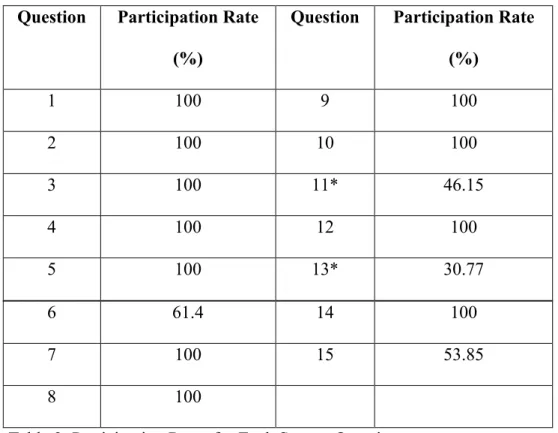
checklist questions. The participation rate for each question is detailed in Table 2 on the
following page.
Question Participation Rate
(%)
Question Participation Rate
(%)
1 100 9 100
2 100 10 100
3 100 11* 46.15
4 100 12 100
5 100 13* 30.77
6 61.4 14 100
7 100 15 53.85
8 100
Table 2: Participation Rates for Each Survey Question
*Questions 11 & 13 were both questions that only applied to those who answered “Yes”
to the previous question, hence low participation rates were not indicative of participants
willfully ignoring the question. Additionally, many questions had options to provide
additional qualitative information and some respondents did not do this but because they
did answer the non-qualitative portion of the question it was recorded as a completed
response by Qualtrics.
The first three questions (not listed in Table 2) ensured that survey participants
met the inclusion criteria for this study: they had to a) consent to the terms of the study
including being over 18, b) be a library employee at their institution, and c) their job had
to involve library publishing services at their institution. All thirteen respondents met
continue. The three inclusion criteria filtering questions are not included in the total
question count. The response rate for each question is as follows, with the fourth question
counting as question 1 because of the first three being to filter out non-eligible persons.
The appendix also contains a list of the operational definitions of each code.
DEMOGRAPHICS OF LIBRARY PUBLISHING SERVICES
The first six questions focused upon demographics of the participating library
publishing services. The purpose of these questions was to get a picture of the scope and
development over time of library publishing services surveyed. When asked how many
years their library has offered library publishing services, all thirteen respondents
responded. Only 8% indicated that they had been providing LPS for less than one year,
15% had been providing LPS between two and three years, 8% had provided more than
four but less than five years, and the remaining 69% of participants indicated that their
library has been providing LPS for more than five years.
When asked what type of publications their library publishing services publish
(respondents often checked more than one option), 54% of the 13 total respondents to
that question had published monographs, 85% had published journals, 62% had published
undergraduate publications, 85% had published electronic theses and dissertations, 69%
had published conference proceedings, 69% had published reports, 54% had published
digital humanities projects, and 15% had published other types of publications like
graduate journals or blog-like objects.
Of the thirteen respondents to the third question, which asked whether all of the
publications produced by the LPS were open-access (OA), 62% of respondents indicated
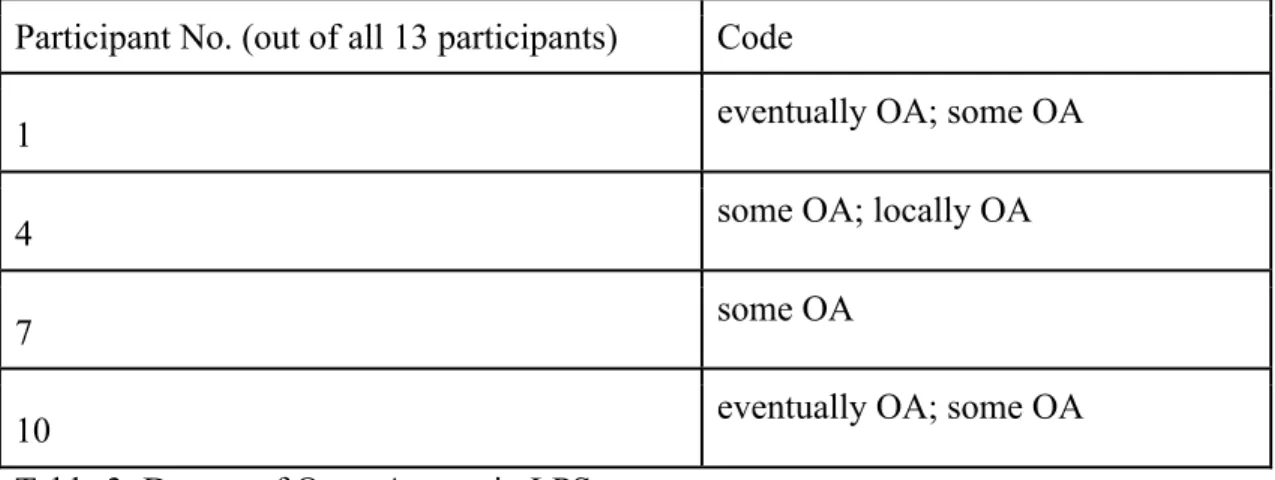
publications were OA, four participants provided additional descriptions of why not.
These four responses were coded as follows (see appendix for code definitions):
Participant No. (out of all 13 participants) Code
1 eventually OA; some OA
4 some OA; locally OA
7 some OA
10 eventually OA; some OA
Table 3: Degree of Open Access in LPSs
Regarding the medium of the LPS publications, none of the thirteen respondents
answered that all publications were print. Instead, 77% indicated that all of their LPS
publications were electronic and the remaining 33% that indicated a mix of print and
electronic publications did not choose to describe why although that option was present.
All thirteen respondents to question five indicated that yes, their library had an
institutional repository.
The sixth question asked about the development of library publishing services
Participant Codes
2 focus on IR; focus on online journals; repository-based; gradual growth
3 gradual growth; repository-based
7 gradual growth; many stakeholders
8 gradual growth; repository-based; cooperation with Press; focus on IR
10 gradual growth; repository-based; focus on ETDs
11 gradual growth; focus on IR; repository-based; focus on online journals; focus on digital humanities
14 gradual growth; repository-based; focus on IR
15 recent formalization; focus on digital humanities; focus on online journals
Table 4: Development of LPSs over Time
RELATIONSHIPS BETWEEN LPS AND CORRESPONDING UNIVERSITY PRESSES
PERMISSIONS AND LICENSING AGREEMENTS
Two questions dealt with permissions and licensing of press materials by LPSs.
The first asked whether the library in general had a special purchasing relationship with
the university press, for example library digitization of press backlist titles, which are
then hosted through the institutional repository (which is considered LPS). 38% of the
thirteen respondents to this part of the question indicated that they did have a special
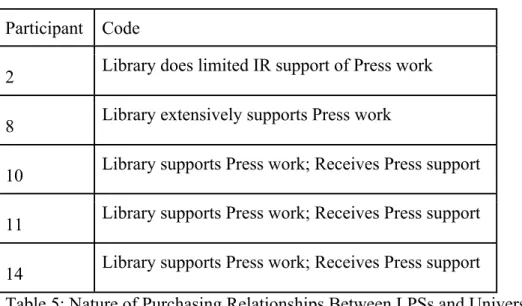
purchasing relationship with the university press at their institution, and all five of the
respondents comprising the 38% who said yes detailed the type of relationship and these
Participant Code
2 Library does limited IR support of Press work
8 Library extensively supports Press work
10 Library supports Press work; Receives Press support
11 Library supports Press work; Receives Press support
14 Library supports Press work; Receives Press support
Table 5: Nature of Purchasing Relationships Between LPSs and University Presses
Regarding special licensing relationships (for example, special discounts for the
library from the press on press books) between library publishing services and their
corresponding presses (question 8), only 15% of the thirteen respondents to this question
indicated that they did have special licensing relationships with their university presses,
46% indicated that they did not have special licensing relationships with their university
presses, and 38% said they were unsure.
OPEN ACCESS COLLABORATIONS BETWEEN LPS AND UNIVERSITY PRESSES
When asked if their LPS collaborated with their respective university press on any
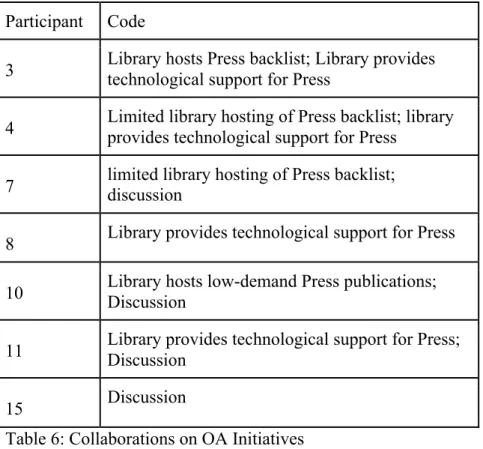
OA initiatives, 54% of the thirteen respondents said that they did and 46% said no. All
seven of the “yes” respondents gave additional detail about these initiatives coded as
Participant Code
3 Library hosts Press backlist; Library provides technological support for Press
4 Limited library hosting of Press backlist; library provides technological support for Press
7 limited library hosting of Press backlist; discussion
8 Library provides technological support for Press
10 Library hosts low-demand Press publications; Discussion
11 Library provides technological support for Press; Discussion
15 Discussion
Table 6: Collaborations on OA Initiatives
LPS PERCEPTION OF RELATIONSHIP WITH UNIVERSITY PRESS AND POTENTIAL FOR COLLABORATION
The first of the six questions concerned with the LPS perception of their
relationship with their university press asked whether the LPS had any ongoing formal or
informal relationship with their corresponding university press. 62% of the thirteen
respondents to this question indicated that they did have an ongoing relationship of some
kind with their corresponding university press; 38% indicated that they did not. The next
question was a follow-up question only applicable to the 62% of respondents to the
previous question who answered “yes”. Of the eight who responded yes to the previous
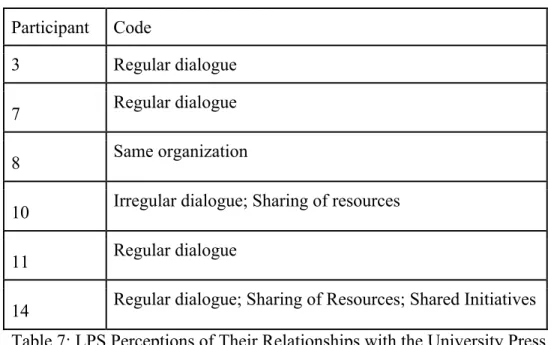
Participant Code
3 Regular dialogue
7 Regular dialogue
8 Same organization
10 Irregular dialogue; Sharing of resources
11 Regular dialogue
14 Regular dialogue; Sharing of Resources; Shared Initiatives
Table 7: LPS Perceptions of Their Relationships with the University Press
The next question asked, in order to cover all bases, whether the participating LPS
had any formal or informal relationships with publishers outside of their institution. 38%
of the thirteen respondents to this question responded that they did have these
relationships with publishers outside their institution, 62% said they did not. The next
question was a follow-up question to the previous one about publishers outside the LPS’s
institution designed only for those who answered “yes” to the previous question to
answer. Only four of the five who answered “yes” to the previous question provided
more detail in the follow-up question, coded as follows.
Participant Code
4 Library supports non-press titles
7 Library publishes archives of non-press titles
8 Library supports non-press titles
11 Library supports non-press titles
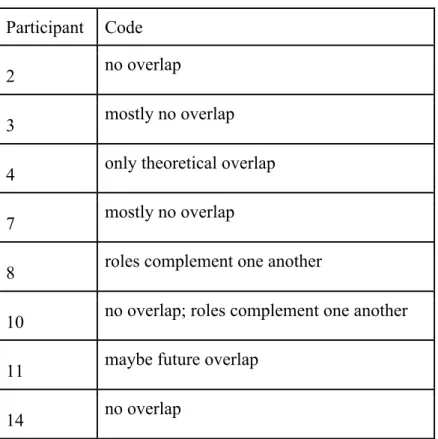
The following question asks for an opinion (yes, no, each followed with text
boxes for further description) from the participant on whether library publishing services
and university press publishing functionally overlap at their institution. 23% of the
thirteen respondents chose “yes” that LPS and publishing functionally overlap at their
institution, and 77% chose “no”, that they did not overlap. Eight respondents provided
more detail for their responses, with all three “Yes” participants providing responses
coded below alongside the five (of ten original) responses from those who said “no”, LPS
and publishing did not functionally overlap. They were merged into one coding block
because even the “yes” values did not actually express in their detailed responses any
sentiments that opposed the “no” respondents.
Participant Code
2 no overlap
3 mostly no overlap
4 only theoretical overlap
7 mostly no overlap
8 roles complement one another
10 no overlap; roles complement one another
11 maybe future overlap
14 no overlap
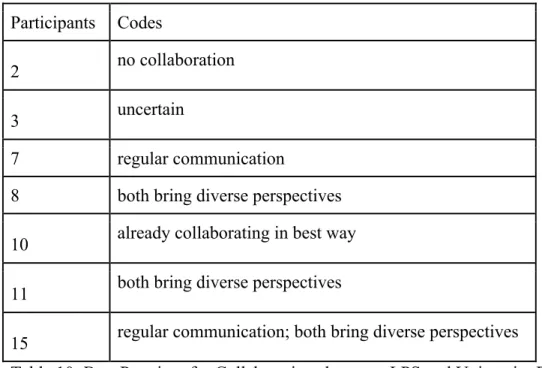
And finally, when asked for their opinions on how their library publishing service
might best collaborate with the university press at their institution, participants responses
(seven total) were coded as follows.
Participants Codes
2 no collaboration
3 uncertain
7 regular communication
8 both bring diverse perspectives
10 already collaborating in best way
11 both bring diverse perspectives
15 regular communication; both bring diverse perspectives
DISCUSSION
DEMOGRAPHICS OF LIBRARY PUBLISHING SERVICES
By and large the majority of LPS represented have been in existence for more
than five years, indicating that LPS is not a novel trend among participants. Although
69% of participants indicated their LPS had existed for more than five years, the
remaining 31% were not insignificant, and the participants in the less-than-five-years
category were spread across the possible responses evenly, with only 8% having had LPS
for less than one year, indicative of perhaps being late to the trend. Yet the fact that the
majority had been engaged in LPS of some kind for more than five years does not
necessarily mean the majority were engaged in similar LPS activities.
In order of greatest to least representation amongst respondents, the following
were publishing activities engaged in by the responding LPSs: in equal rank (85%
marked both of these), journals and electronic theses and dissertations (ETDs), followed
by conference proceedings and reports (tied at 69%), undergraduate publications (62%),
and then monographs and digital humanities projects tied at 54%, and then 15% indicated
other types of publications.
The order indicates that most of the participating LPS institutions place highest
value on publishing journals and ETDs, slightly less emphasis but still a good deal of
investment in conference proceedings and reports, undergraduate publications being less
that monographs and digital humanities projects were published by 54% of participants
indicates that monographs, often not expected publishing outputs of LPS programs, are in
fact significant forms of LPS publications, and the prevalence of digital humanities (DH)
projects at more than half of participating LPS programs indicates again that the niche for
LPS programs is in providing access to unique, often non-traditional publications that
traditional publishing does not fully support. It would be interesting to know whether
these DH projects are being published in another, more traditional form by either LPS or
university or trade presses. The main takeaway from the above-described ranking is that
the participating LPS are involved mainly in areas that university presses traditionally
focused on monographs are less involved in, but that LPS are not adverse to publishing in
areas (specifically monograph publishing) that presses traditionally published.
The question of degree of open-access (OA) in LPS was a surprising mix; the
general ethos of libraries being to provide as much access as possible to their patrons, it
was interesting that 38% of respondents did not indicate that all of their LPS publications
were OA. However, the additional details four participants provided about why the
publications weren’t all OA were enlightening: all four said some publications were OA,
two of the four said that eventually all their publications would OA, and one respondent
specifying that on campus, everything the LPS published was OA but off-campus there
were charges. It’s possible that even those who indicated all of their publications were
OA could fall into that category because they were automatically restricting their concept
of their audience to their on-campus users.
The majority of participants (77%) said all of their LPS publications were
more description why. It makes sense that most LPS would be electronic and the results
agree with the idea that as libraries began increasing their online holdings and creating
institutional repositories, they became de facto publishers and that might be one way they
became involved in LPS. That, coupled with the unanimous response from all 13
participants that their libraries have institutional repositories, again emphasizes the LPS
focus on digital means of publishing. The fact that only 33% of the participants indicated
they published print materials suggests that LPS see a niche for themselves in digital
publishing of serials, ETDs, and other low-cost to produce publications that traditional
publishers are not fully tapped into, although that would need to be explored from the
publisher perspective as well.
Fortunately we have information regarding not only the current state of LPS at the
participating institutions but also about the trajectory of the development of LPS at each
institution. One strong theme was the gradual development of LPS at their institutions
over time. Some reported that LPS activities were based in the development of their
institution’s repository. Four also indicated that their LPS activities were focused on their
institutional repository, a code that aligns with the previously mentioned repository-based
code. Three of eight respondents indicated their LPS activities had developed around
their online journals. Others mentioned that their LPS activities had evolved with many
stakeholders, that they had only recently formalized their LPS program, and two
respondents indicated that their LPS activities developed around digital humanities
related publications. From this we can see that respondents tended to have LPS
trajectories that were defined by a slow evolution over time that centered around the
(ETDS, DH projects, and journals), again showing how LPS has evolved to fill a niche
left open by publishing.
RELATIONSHIPS BETWEEN LPS AND CORRESPONDING UNIVERSITY
PRESSES
PERMISSIONS AND LICENSING AGREEMENTS
Agreements of any kind regarding permissions and licensing between LPS
programs and their corresponding university presses were not the norm (54% said no, 8%
unsure, 38% yes), but the five respondents who comprised the 38% who had special
relationships regarding purchasing with their university presses all exhibited two main
trends: first, all five expressed that they in some way support press publications through
their offerings. Secondly, three of the five received support of some kind from the press
in return. One of the two that did not receive press support in return described its work
for the press as provided limited support via the library’s institutional repository for Press
publications. The norm was not to have special purchasing agreements with the press, but
those agreements that did exist seemed often established a quid pro quo, where both LPS
and press mutually benefit from the exchange.
When it came to licensing relationships between the two organizations as
perceived by LPS respondents, 46% said they had no special licensing relationship with
the press, 15% said they did have a special licensing relationship with the press, and 38%
said they were unsure. This lack of confidence could have been due at least to two
different factors: one, that the employee completing the survey was not involved in
collection development for the library at large and therefore did not have the knowledge
Still, the discrepancy between those who indicated unsurety in the purchasing
relationship question and those who indicated it in the licensing relationship question
reinforces the idea that the wording of the licensing question was not the cause of
unsurety but rather that the unsurety was genuinely in regard to the actual answer to the
question. The lack of many respondents who had licensing relationships with their
university presses indicates that these licensing relationships are not priorities for either
or both parties.
OPEN ACCESS COLLABORATIONS BETWEEN LPS AND UNIVERSITY PRESSES
Regarding OA collaborations between participating LPSs and their university
presses, more than half of the participants said their LPS had collaborated with their
university press on OA projects, but only by a slight margin (54% yes vs. 46% no).
Examples of these kinds of projects included (in order of most frequent to least) the
library providing technological support for the university press, (tied in second) library
and press discuss OA initiatives, the library provides limited hosting of the university
press’s backlist, and then tied in last, library hosts press backlist (presumably the entire
backlist), and the library hosts low-demand press publications.
LPS PERCEPTION OF RELATIONSHIP WITH UNIVERSITY PRESS AND POTENTIAL FOR COLLABORATION
A clear but not overwhelming majority of participating LPSs had some kind of
ongoing formal or informal relationship with their university press (62%), and the most
common description of this relationship was that the two organizations engaged in
indicated that the LPS and press shared resources in some way. One respondent indicated
that their LPS communicated irregularly with the Press, and one respondent indicated that
they had a shared initiative together. One respondent said the LPS and press were, in fact,
the same organization. The results indicate that participating LPSs more often than not
have relationships with their corresponding university presses, and that these
relationships are usually characterized by regular dialogue, that the two organizations
sometimes share resources, and that other varied forms of engaging with each other occur
as well. The one respondent that indicated both are part of the same organization points to
a rare and exciting convergence of the two organizations; these would be great case
studies on how the two organizations work as one and support each other as well as what
tensions arise as well as how the decision to collapse the two organizations into one
might be a response to market pressures and whether such a two-headed organization is
sustainable. For now we can say that open streams of communication appear to define the
relationships of the LPS participants to their university presses.
Only 38% of the respondents had relationships with publishers outside of their
institution, and these relationships were usually reduced to the expression that the library
supports non-press titles (3 of 4), as well as one instance (the remaining 1 of 4) wherein
the library publishes archives of non-press titles (as distinguished from the current issues
of those titles). This indicates that the majority of the participating LPS respondents don’t
work much with publishers outside of their institutions, but this question needs to be
broken down in future iterations of this study in order to make sure participants
understand what is meant by a relationship, and what qualifies as an actual ongoing
that participating LPSs provide support for other presses the minority of the time and that
this can mean support for either current publications or providing digital access to back
issues.
The vast majority of participants (77%) did not think that their LPS and the
university presses functionally overlapped. The qualitative responses (including from
those who thought the two organizations did functionally overlap) were spread across a
number of different areas ranging along the spectrum of whether they overlapped but all
indicated that the two roles, if they overlapped did not do so significantly. 3 of 8
respondents said there was no overlap, two said mostly no overlap, one said it was only
theoretically overlap (they had said yes, overlap existed), two people said the roles of
each organization complemented one another, and one person said maybe in the future
the two roles would overlap. From this we can gather that the main sentiment from all
respondents was along the lines of saying the two organizations do not functionally
overlap in their publishing activities. The one response about the two potentially
overlapping in the future indicates perhaps that the scope of either of the two
organizations publishing activities is definitely in flux at their institution.
The seven qualitative responses about how their library publishing service might
best collaborate with their university press were varied and merit individual discussion.
One participant said the best way for the two to relate to each other was to not collaborate
at all, which indicates that there possibly is tension between the missions of the two
organizations at their institution, and one respondent was uncertain on the best way to
collaborate. Three participants said that both organizations bring diverse perspectives,
said regular communication was the way forward. Finally, one participant said their LPS
CONCLUSION
There are several insights to be gained about the demographics of library
publishing services that participated in this study. The first of these is that library
publishing services have evolved slowly over time, and often their publishing activities
center around their digital repositories. The majority of participants worked at library
publishing services that had been around for more than five years, indicating that this is
not a flash-in-the-pan trend arriving recently. Rather, these programs tended to develop
out of their repositories, and there was a wide spectrum of activities engaged in by each
LPS. Digital humanities projects were part, though not overwhelmingly, of these
publishing activities, and as digital humanities gains cache in the academic community, it
would be useful to follow this study up with another measuring the growth in DH
projects within library publishing services from a longitudinal perspective. Mainly, the
variety in types of publications produced by the participating library publishing services
indicates the flexibility of library publishing services and the ability or at least the intent
of these services in satisfying small niche markets, for example through providing access
to undergraduate publications, which would not be of interest to a university press.
Lastly, LPSs engage mainly in digital publishing, which was expected, but a
not-insignificant portion of surveyed LPSs (33%) are still publishing some form of print
Library publishing services relationship to their corresponding university presses
were characterized by several key features. To start with, the permissions agreements
between the two organizations were hard to ascertain. The question may have been
unclear because of the high number of “unsure” responses, but it may have been that the
respondents did not know the answer but understood the question, in which case it was
targeted at the wrong audience. Still, from the information gleaned about permissioning
between university presses and library publishing services, the participating LPSs by and
large do not have special agreements with their university presses. The 38% who did all
were involved in relationships whereby they were providing support to the press, and
there was less reciprocal press support in this regard for LPS materials, though it was not
unheard of. Licensing relationships to the university presses in question were subject to
the same issues with question phrasing that could be due either to the targeting issue or to
a comprehension issue. The results nonetheless indicate a plurality of those who do not
have special licensing relationships with their university presses.
Open-access (OA) collaborations with the corresponding university presses were
prevalent but not rampant amongst surveyed library publishing services. These
collaborations were often in the form of libraries providing support for the university
press’s provision of OA publications. Through these collaborations the LPSs sometimes
gained access to the press backlist, and often involved some level of support by the LPS
toward providing access to the press publications being made OA. This makes sense
because of the earlier-discussed strong presence of repositories amongst surveyed LPSs,