Paper for the M.S. in L.S. degree. April, 2009. 95 pages. Advisor: Barbara B. Moran.
This study examined the amount of management experience, development, preparation, and training possessed by middle managers in academic libraries. Previous studies and reports have pointed out that librarians often take on middle management roles without extensive preparation and training to perform management duties and without much previous experience performing management duties. This study found there has been some improvement in the preparation and training of academic librarians to handle management duties over the past couple of decades. Presently, most middle managers in academic libraries have had at least some prior experience performing management duties before becoming middle managers. Additionally, most academic library middle managers participate in management training prior to and during their jobs as middle managers. However, the study also found room for improvement in some areas of management preparation and training within the academic librarian profession.
Headings:
Administration -- Teaching
College and university librarians -- Education
Library management
ACADEMIC LIBRARIES
by
Michael P. Rooney
A Master’s paper submitted to the faculty of the School of Information and Library Science of the University of North Carolina at Chapel Hill
in partial fulfillment of the requirements for the degree of Master of Science in
Library Science.
Chapel Hill, North Carolina April 2009
Approved by
Table of Contents
Introduction ... 3
Literature Review... 4
Research Question ... 9
Methodology ... 11
Results ... 17
Respondent Profile ... 17
Sub-question results ... 20
Discussion ... 45
Conclusion ... 61
Works Cited ... 65
Appendix A: Full Report on Administrator Attitudes ... 67
Appendix B: Department Head Invite Email ... 70
Appendix C: Library Administrator Invite Email ... 72
Appendix D: Survey for Department Heads ... 74
Table of Figures
Figure 1: Management Duties Performed by Responding Department Heads ... 18
Figure 2: Types of On-the-Job Management Training Obtained Prior to First Department Head Job ... 23
Figure 3: Types of On-the-Job Management Training Obtained while Serving as a Department Head ... 28
Figure 4: Formal Management Training Requirements ... 30
Figure 5: Library Support for Formal Management Training ... 30
Figure 6: On-the-Job Management Training Requirements ... 31
Figure 7: On-the-Job Training Provided by Libraries to Department Heads ... 32
Figure 8: Methods Used to Identify Lower Level Librarians with Management Potential ... 33
Figure 9: Is Previous Experience as a Department Head a Listed Job Qualification? .... 34
Figure 10: Is Experience in a Lesser Management Role a Listed Job Qualification? ... 35
Figure 11: Is Previous Supervisory Experience a Listed Job Qualification? ... 36
Figure 12: Importance of Management versus Departmental Experience ... 37
Figure 13: Is General Academic Librarianship Experience a Listed Job Qualification? ... 37
Figure 14: Was Previous Management Experience a Qualification for your First Job as a Department Head? ... 39
Figure 15: Was Previous Management Experience a Qualification for your Current Job as a Department Head? ... 39
Figure 16: Was Previous Management Training a Qualification for your First Job as a Department Head? ... 40
Figure 17: Was Previous Management Training a Qualification for your Current Job as a Department Head? ... 40
Figure 18: Effective Management Training Methods Identified by Department Heads ... 42
Figure 19: Have You Implemented Ideas Learned from Formal Training? ... 43
Figure 20: Effective Management Training Methods Identified by Administrators ... 44
Table of Tables
Table 1: Management Duty Comparison - ARL vs. non-ARL Libraries ... 19Table 2: Management Duty Comparison - Larger vs. Smaller Libraries ... 19
Table 3: Mean Number of Employees Supervised by Department Heads ... 20
Table 4: Formal Management Training Prior to First Department Head Job ... 22
Table 5: Other Management Experience Prior to First Department Head Job ... 25
Introduction
Academic libraries exist within the unique environment of higher education. Operating structures among professionals within the academy differ from those of most other organizations because they are usually marked by more collegiality and a greater degree of democratic compromise in decision making. Control is diffuse throughout the university or college as a whole and within individual academic departments. This organizational structure has interesting implications for management and governance within the academy, mainly concerning who, if anybody, is really in charge.
Management issues within the academic library can be further complicated by the ambiguous position that the library holds within the larger academic institution. Debates continue over whether the library is an academic unit or a separate, distinct part of the organization. This ambiguity often extends to the librarians themselves. Librarians are certainly professionals, but should they be seen as faculty members in the same sense that economics professors are faculty members? Such questions have had an effect on the role of management within the academic library. Academic libraries do in fact have a
in recent decades. This study examined a central dimension of that newfound interest: the preparation and development of academic librarians to take on the role of manager.
Literature Review
With his 1980 article titled “Library Managers: Can They Manage? Will They Lead?” Charles McClure put out a clarion call for more attention to be paid to the discipline of management in academic libraries and for more formal training in the techniques of management to be provided to librarians. Specifically, McClure declared:
The dominant concept for library and information professionals as we enter the next hundred years is that of management…. Unfortunately, library managers are ill equipped to respond to societal information problems via improved managerial techniques…. In part, poor performance as a manager and the secondary
importance of management can be attributed to a lack of formal managerial preparation. (McClure, 1980, p. 2388-2389)
McClure was writing about all sorts of academic library managers, up to and including library directors. However, a lack of management preparation is likely to be most acute at the middle level of management, among those librarians who are newer to management and are mediating between the upper administrators and front line professionals and paraprofessionals. In fact, shortly after McClure’s article, Deanna Marcum (1983) noted that a lack of management training for middle managers was one of the greatest
contemporaneous problems facing research libraries (p. 4).
management topics such as budget preparation, personnel management, planning, and evaluation. Furthermore, those in managerial positions hardly thought of themselves as managers, seeing themselves as librarians first and as managers only secondarily (p. 2389). A concurrent study backed up McClure’s contentions. In Supervisory and
Middle Managers in Libraries, Martha Bailey (1981) noted that “Libraries often do not
have employees with training in management” (p. 1). She also found that middle managers “may lack the experience of working under trained managers. They also may consider themelves to be specialists first and managers second” (Bailey, 1981, p. 2).
Those subsequently writing on the same subject have generally expressed the same conclusions. After surveying the heads of cataloging and reference departments at libraries belonging to the Association of Research Libraries (ARL), Stephanie
Wittenbach, Sever Bordeianu, and Kristine Wycisk (1992) found that between 93% and 96% of those department heads had no formal classroom management training beyond library school before becoming a department head. Additionally, over half of their respondents had not participated in management workshops prior to starting a job as a department head. Finally, that study also found that many department heads possessed only a few years of management experience in lower level managerial roles prior to becoming a department head (p. 322-323).
These outcomes likely represent the reality that many department heads may not have anticipated becoming managers as soon as they did or at all. In Transitioning from
Librarian to Middle Manager, Pixie Anne Mosley (2004) wrote that “Librarianship is a
experts in their specialist roles, such as those of a language specialist cataloger or subject specialist reference librarian. Others focus on the scholarship role of academic
librarianship. For those who do transition into management roles, the move can be sudden (Mosley, 2004, p. xi-xii). In The Accidental Library Manager, Rachel Singer Gordon (2005) reiterated the notion that many librarian managers enter management roles by accident. They may have temporarily filled a management role when their supervisor stepped down, and then been asked to assume the job permanently, or they may have had management responsibilities placed upon them by their administrators. Having surveyed 244 librarian managers, Gordon found that many emphasized the accidental nature of having taken on a management role and that most had little to no previous formal management training (p. xiii-xvii). Even before becoming a librarian, many library school students have already developed an attitude against ever becoming a manager. Rich Gazan (2007) surveyed library students and asked them to agree or disagree with statements about their work preferences. Based on the statements the students most strongly disagreed with, the results indicated many of them would not want to manage projects, manage people, or direct a library (p. 243).
Indeed, the nature of library school management courses and the attitudes of students hamper the preparation of many librarians to become managers. Bailey noted that more than half of the academic library middle managers she interviewed stated their management courses in library school were of no use to them in their positions as middle managers. The library administrators she interviewed also felt library school management courses were of little value (1981, p. 109). The trouble arises because most middle
that time they have forgotten most of what they learned in their management courses in school (Bailey, 1981, p. 112). Gordon makes many of the same points in her book. She states that management classes in LIS schools may have been theoretical, or aimed at administration, without much emphasis on middle level management issues. Furthermore, students may have downplayed the class, not expecting to become managers. Finally, managers may have gone to a school that did not have a management requirement (2005, p. xiv). On top of these problems, Gazan added that library school classes are unable to instill much concrete understanding of management issues and skills when they are not coupled with other learning opportunities. He proposed adding a practicum component to library school management education to solve this problem (2007, p. 245). Generally speaking, library school by itself does not prepare librarians to effectively serve as a manager in a library.
The aging of the profession has combined with a lack of management experience in the “middle-aged group” of academic librarians. Middle-aged librarians did not receive enough opportunity to develop as managers on account of budget cuts over the past few decades. As middle managers retired, those positions were frozen or abolished (p. 135). Additionally, as administrators and managers became more pressed for time, mentoring and training of the next generation of managers lost out (Curran, 2003, p. 138). Thus, Curran expects a huge shortage of qualified librarians at the level of middle manager, in addition to the shortages at the entry level expected by other writers (2003, p. 135). James Neal (2006) discussed the increasing number of professionals without MLS degrees who are entering the academic library profession and the increase of staff participation in areas once handled solely by professionals. These trends mean there is a need for “more effective training for managers in working with more ambiguous definitions of
professional and more blended staff participation” (p. 44).
cannot simply look outside the profession to recruit those with management expertise. Felix Unaeze (2003) points out that such a course of action would harm trust within departments, demean the profession, and cause a rift among professionals (p. 114-115).
Maureen Sullivan (1992) called for the profession to get out ahead of this curve nearly fifteen years ago when she stated “While individual managers must do all they can to develop necessary skills and abilities, senior administrators in today’s research
libraries have an important responsibility to prepare current and future middle managers” (p. 279). She asked administrators to provide support for librarians to attend
management training programs, to serve as mentors, and to provide coaching sessions and on-the-job management training experiences (Sullivan, 1992, p. 279-80). More recently, Philip Howze repeated this call to action by writing, “Libraries can and must respond to the shortage of qualified leaders by establishing training programs and encouraging continuing education in management studies” (2003, p. 31). Mosley made the same point by stating, “The creation of good library managers is not a ‘wave the magic wand’ or ‘abracadabra’ type of process. It involves recognizing potential in entry-level and mid-career librarians and giving them the opportunity to grow and develop skills that are appropriate to managerial responsibilities” (2004, p. xii).
Research Question
Scholars and professional librarians have shown that library school management classes are not enough to create good mangers, management training has not received enough focus from libraries themselves in the past, and management skills are now more important than ever. The last time research was applied to examine management
Wittenbach et al. gave a mixed picture of management and training at the time. That study showed that academic library department heads had some prior on-the-job management experience, but they were lacking in prior formal management training outside of library school. The study did find that once they became department heads, librarians were participating in on-going management training. Still, although many academic libraries supported this ongoing training through time off and financial assistance, the majority neither required nor encouraged continuing management education.
Since management skills are gaining newfound importance within academic libraries and the last study on management preparation and training was completed 17 years ago, it was time to revisit the topic of management preparation, training, and development among middle managers in academic libraries. Accordingly, this study sought to answer the question: What is the current state of management preparation, training, and development among middle managers in American academic libraries and
how does this state compare to that of previous decades?
This research question was answered by examining the following sub-questions:
Sub-question 1: What management preparation, training, and development did current
middle managers in academic libraries receive before becoming middle managers?
Sub-question 2: What ongoing management preparation, training, and development have
current middle managers participated in since becoming middle managers?
Sub-question 3: How are the upper administrations of academic libraries supporting the
Sub-question 4: What attitudes do library administrators and middle managers have
towards management preparation, training, and development, and what methods do they
believe to be most effective at developing employees into managers?
Methodology
This study sought to examine the sub-questions and answer the research question by following the methodology of the Wittenbach et al. study, while also expanding upon that study’s methods. The resulting methodology involved the use of two online surveys. The surveys were created using the Qualtrics survey software available through the Odum Institute for Research in Social Science at the University of North Carolina at Chapel Hill. The surveys were pre-tested by a small group of academic librarians in North Carolina and then edited to incorporate the feedback offered by those librarians. Potential subjects were invited to participate through email. The email invitation contained a link that took participating subjects to the survey website, where they completed and submitted the survey electronically.
The sample of subjects was developed by first creating a sample of academic libraries. The Wittenbach et al. study focused solely on libraries that are members of ARL. The current study also included ARL libraries in its sample. ARL libraries
membership. This expansion allowed for a fuller accounting of management preparation and training throughout the academic library population. After creating the first part of the sample of institutions from the group of ARL libraries, a random sample of 243 academic libraries at other universities and colleges was taken to represent the population of non-ARL academic libraries. This number is 10% of the 2,425 four-year American universities and colleges that grant at least bachelor’s degrees (National Center for Education Statistics). As the libraries for this second sample were being chosen, the organizational structure of each library was examined. If a very small academic library was identified as not having a middle level of management, it was excluded from being in the sample, and a more appropriate library was randomly selected in its place. Once the sample of 342 American academic libraries was established, a sample of individual librarians was then created by selecting employees from these 342 libraries based on the positions the librarians held. There were two groups of librarians selected and an
individual survey was constructed for each group.
paraprofessionals, and (2) the use of these departments will allow for easy historical comparison to the results of the Wittenbach et al. study, which focused on cataloging and reference department heads. Since organizational structures vary from library to library, the functional areas of the departments included in this study expanded beyond just “reference” and “cataloging.” Altogether, the important point was whether the manager's department included the reference or cataloging function, despite the actual title of their department. Thus, differing organizational structures meant that the targeted departments included those with the following titles: reference, cataloging, public services, research and instructional services, technical services, metadata services, and other title variations.
and their job, the department head’s management training and experience prior to becoming a department head, their ongoing training and education since becoming a department head, the support they receive from their library for training and continuing education in management, whether training in management has been required or encouraged at their library, and their views on the efficacy of different management training and preparation methods.
The second survey focused on the views of library administrators. The university librarian, dean of libraries, or library director for each library in the sample was invited to participate in this second survey. The methods used to gather administrator contact information and send the survey invitations to administrators were the same as described above. The total administrator sample included 342 individual librarians. The questions in this second survey gathered data on the attitudes of library administrators towards the importance of formal management education and training for librarians, both before and after those librarians assume roles as middle managers, the efforts library administrations make to identify and develop potential managers, and the views of administrators on the efficacy of different management training and preparation methods.
Both surveys were conducted at the same time. The surveys were open on the
Qualtrics website for three weeks. The original email invitations were sent out on
completed surveys were not used in the data analysis.
Once the final data set for each survey was constructed, descriptive statistics such as measures of central tendency and the proportion of respondents falling into various categories were generated and used to determine the answers to the four sub-questions posed in the Research Questions section above. These statistics were first calculated for the department head and administrator groups as a whole. Then, statistics for various pairs of sub-groups were calculated to see if there were any significant differences between these sub-groups. The first pair of sub-groups was created by dividing the respondents according to whether they worked at an ARL or a non-ARL library. ARL libraries tend to be larger then non-ARL libraries, but there are many larger academic libraries that are not members of ARL. Thus, the second pair of sub-groups was created by dividing the respondents according to the size of the university or college at which they work. The median size of the sampled universities and colleges was calculated and the institutions were divided into a group that was larger than the median size and a group that included the median size and all smaller institutions. The final pair of sub-groups was used only when examining the department head results for the first two sub-questions. This pair divided the department heads into those who began their first department head job before 2003 and those who started since 2003.
confidence level. The results of the t-tests and z-tests will only be discussed in this report when they revealed statistically significant differences between the two sub-groups in a pair. Once the answers to each sub-question were examined, a synthesis of all the generated data was used to draw conclusions and answer the main research question.
This methodology was chosen based on its appropriateness to the research question and its ability to provide accurate results. Surveys are appropriate for research looking at self-reported beliefs and behaviors. It is true that surveys can only measure what the respondents say, rather than directly measuring reality. However, there is no other alternative in this study’s case because the data sought are not generally recorded anywhere except in the minds of the respondents. The results of the pre-test helped ensure that the final surveys were constructed in a manner that promoted increased reliability and internal validity. Reliability and internal validity were also enhanced by the fact that the surveys were informed by a previous survey instrument that was used in a study ultimately published in a reputable scholarly journal. The samples for the survey have been purposefully chosen to provide for external validity. The results should be generalizable to the wider population of academic librarian middle managers.
was assured because each email invitation had a coded link that only allowed the invitation recipient to respond to the survey, and those recipients were only allowed to respond to the survey once. Overall, the study’s methodology provided for meaningful data and accurate answers to the research questions.
Results
Respondent Profile
Before presenting the results of the survey questions aimed at answering the sub-questions, it helps to have an understanding of some of the basic characteristics of the respondents. Overall, 255 department heads and 159 library administrators completed their respective surveys. These numbers constituted a 40% response rate for the
department head survey and a 46% response rate for the administrator survey. Since two department heads and the chief administrator of the main library at each university were invited to participate, each sampled university or college could have provided up to three different respondents to the surveys. In fact, many institutions did provide more than one respondent. Ultimately, 264 different universities and colleges were represented among the individual respondents. Of those universities and colleges, 72 have libraries that are members of ARL, making for 27% of the total. The institutions ranged in size from a low enrollment of around 1,400 students to a high enrollment of over 50,000 students. Thus, a very diverse set of institutions were represented among the respondents.
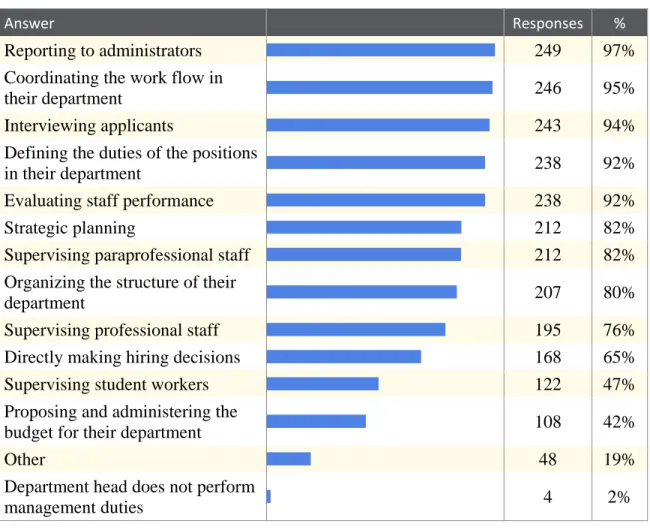
experience as department heads. Figure 1 provides a snapshot of the management duties that these department heads perform.
Figure 1: Management Duties Performed by Responding Department Heads
Answer Responses %
Reporting to administrators 249 97%
Coordinating the work flow in
their department 246 95%
Interviewing applicants 243 94%
Defining the duties of the positions
in their department 238 92%
Evaluating staff performance 238 92%
Strategic planning 212 82%
Supervising paraprofessional staff 212 82%
Organizing the structure of their
department 207 80%
Supervising professional staff 195 76%
Directly making hiring decisions 168 65%
Supervising student workers 122 47%
Proposing and administering the
budget for their department 108 42%
Other 48 19%
Department head does not perform
management duties 4 2%
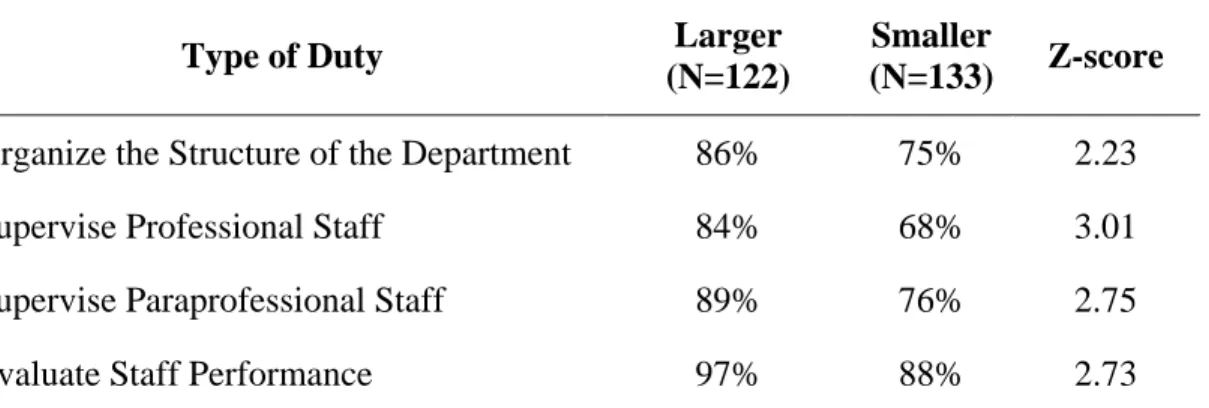
Also, a significantly higher proportion of department heads at larger libraries supervise paraprofessional staff than those at smaller libraries. These differences are presented in Table 1 and Table 2.
Table 1: Management Duty Comparison - ARL vs. non-ARL Libraries
Type of Duty ARL
(N=68)
Non-ARL
(N=187) Z-score Organize the Structure of the Department 91% 76% 2.67
Supervise Professional Staff 96% 68% 4.63
Evaluate Staff Performance 100% 89% 2.87
Table 2: Management Duty Comparison - Larger vs. Smaller Libraries
Type of Duty Larger
(N=122)
Smaller
(N=133) Z-score Organize the Structure of the Department 86% 75% 2.23
Supervise Professional Staff 84% 68% 3.01
Supervise Paraprofessional Staff 89% 76% 2.75
Evaluate Staff Performance 97% 88% 2.73
Table 3: Mean Number of Employees Supervised by Department Heads
Type of Library Professional Staff Supervised
Paraprofessional Staff Supervised
Student Staff Supervised
All Libraries 5.5 4.6 4.8
ARL Libraries 8.1 7.0 4.6
Non-ARL Libraries 4.1 3.6 4.8
(T-test p-value) (.000) (.003) -
Larger Libraries 6.7 5.4 5.5
Smaller Libraries 4.1 3.7 4.1
(T-test p-value) (.000) (.014) -
Sub-question results
Sub-question 1: What management preparation, training, and development did current
middle managers in academic libraries receive before becoming middle managers?
The department heads were asked several survey questions related to the first research sub-question. The first of these questions sought to measure the extent to which the department heads participated in several types of formal and on-the-job management training prior to beginning their first job as a department head in an academic library. In terms of formal training, department heads were asked how many classes, workshops, etc. they had completed in the following categories:
• Management classes while in library school
• Management classes at a library school since graduating • Classes in business schools or public administration programs • Management workshops or seminars
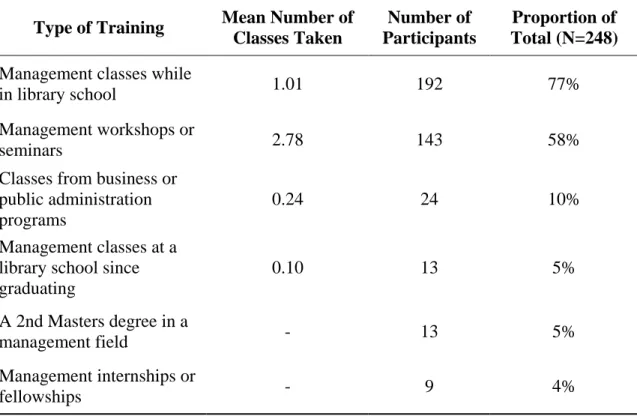
Table 4: Formal Management Training Prior to First Department Head Job
Type of Training Mean Number of Classes Taken
Number of Participants
Proportion of Total (N=248) Management classes while
in library school 1.01 192 77%
Management workshops or
seminars 2.78 143 58%
Classes from business or public administration programs
0.24 24 10% Management classes at a
library school since graduating
0.10 13 5% A 2nd Masters degree in a
management field - 13 5%
Management internships or
fellowships - 9 4%
Table 4 shows that management classes taken while in library school and management workshops or seminars were the most widely used types of formal
There were no significant differences in the attainment of formal management training prior to the first department head job between ARL versus non-ARL librarians, librarians at larger libraries versus smaller libraries, and librarians who obtained their first
department head job prior to 2003 versus those who obtained their first department head job since 2003.
Still, formal management training was not the only type of training studied in the survey. The department heads were also asked about what types of on-the-job
management training they had received prior to obtaining their first jobs as department heads. Figure 2 shows the proportion of respondents who participated in various categories of on-the-job management training prior to becoming department heads.
Figure 2: Types of On-the-Job Management Training Obtained Prior to First Department Head Job
Answer Responses %
Did not participate in on-the-job
management training 143 58%
Mentorship from department heads 96 39%
Shadowing department heads 22 9%
Formally structured in-house training
program in management skills 16 6%
Other methods 3 1%
structured in-house training program in management skills or had shadowed a department head, which would involve actually observing the department head perform their
management tasks. This general pattern held for each of the sub-groups for the most part. The one statistically significant difference was in the percentage of ARL department heads versus non-ARL department heads who had participated in a formal in-house training program in management skills. Only 4% of non-ARL department heads had participated in a formal in-house management training program prior to becoming a department head, while 13% of their ARL counterparts had done so (z-score = 2.58).
Department head responses were examined on an individual basis to determine their overall participation in both types of management training prior to becoming department heads. When formal and on-the-job management training were considered together, the analysis showed that 95% of the respondents had participated in at least one type of formal or on-the-job management training before starting their first job as a department head. Also, 81% of respondents had participated in at least one type of formal or on-the-job management training beyond a management class in library school before starting their first department head job.
In addition to investigating the management training department heads had received prior to moving into middle management positions, the survey also asked the department heads how many years of experience they had in other management roles besides department head positions. Table 5 presents the mean number of years of
Table 5: Other Management Experience Prior to First Department Head Job
Type of Experience Mean Years of Experience
Number with Experience
Proportion of Total (N=237) Acting department head
position(s) 0.36 64 27%
Assistant department head
position(s) 0.42 31 13%
Unit head/team leader
position(s) 2.05 96 41%
Other management
position(s) 0.70 28 13%
Table 5 shows that department heads did have a fair amount of previous management experience in other roles. An examination of each individual's previous experience showed that 69% of respondents had previous management experience in at least one of the types of experience investigated in the survey. Also, after the number of years of experience across categories were added together for each individual department head, the mean number of combined years of previous experience totaled almost three and half years for the group of department heads as a whole. However, there were statistically significant differences between the sub-groups in this area. ARL librarians had a significantly higher mean in the number of years spent as unit heads or team leaders compared to non-ARL librarians, 3.18 years versus 1.61 years (t-test p-value = .008). Additionally, a significantly higher proportion of ARL librarians had previous
department heads (37% vs. 23%, z-score = 2.17) and as unit heads or team leaders (60% vs. 33%, z-score = 3.78). The same exact differences existed between larger and smaller libraries in general. Plus, a significantly higher proportion of department heads in larger libraries (18%) had previous assistant department head experience compared to their counterparts in smaller libraries (8%) (z-score = 2.30).
Sub-question 2: What ongoing management preparation, training, and development have
current middle managers participated in since becoming middle managers?
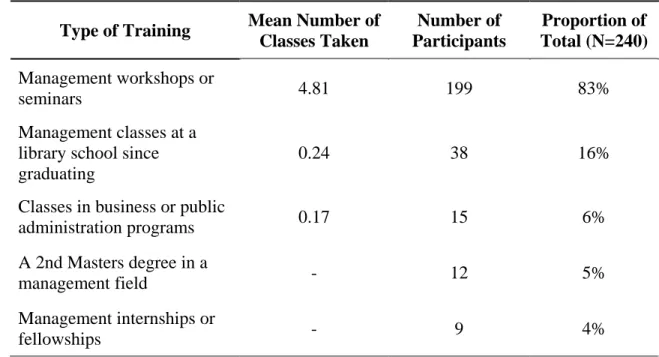
Table 6: Formal Management Training While a Department Head
Type of Training Mean Number of Classes Taken
Number of Participants
Proportion of Total (N=240) Management workshops or
seminars 4.81 199 83%
Management classes at a library school since graduating
0.24 38 16%
Classes in business or public
administration programs 0.17 15 6%
A 2nd Masters degree in a
management field - 12 5%
Management internships or
fellowships - 9 4%
There were not any significant differences between ARL department heads and non-ARL department heads when it came to participating in ongoing formal management training. However, when it comes to library size in general, significantly higher
proportions of department heads at larger libraries have taken classes in a business or public administration program (10% vs. 3%, z-score = 2.23) and participated in
Department heads were also asked about the on-the-job management training they have received while serving as a middle manager. Figure 3 presents their responses. More department heads have participated in on-the-job management training since starting their jobs than did so before becoming middle managers, but nearly half still say they have not participated in any on-the-job management training since joining the ranks of middle managers. Those who have participated in ongoing on-the-job management training mostly received mentorship from senior administrators, but 17% have participated in a formally structured on-the-job management training program provided by their library. There were no significant differences between sub-groups in this area.
Figure 3: Types of On-the-Job Management Training Obtained while Serving as a Department Head
Answer Responses %
Did not participate in on-the-job
management training 115 47%
Mentorship from administrators 108 44%
Formally structured in-house training
program in management skills 42 17%
Shadowing administrators 16 6%
Other methods 11 4%
Sub-question 3: How are the upper administrations of academic libraries supporting the
preparation, training, and development of their employees in the area of management?
financial assistance or release time from their jobs. The department head and administrator responses were combined to determine which libraries required,
encouraged, and supported management training for their department heads. If there was an internal disagreement between the answers given by multiple respondents at the same library, the responses for that library were removed from the analysis. For example, if the administrator from a particular library stated department heads at their library were encouraged to participate in formal management training, but a department head from the same library stated formal management training was neither required nor encouraged, the answers from that library were not included in the analysis.
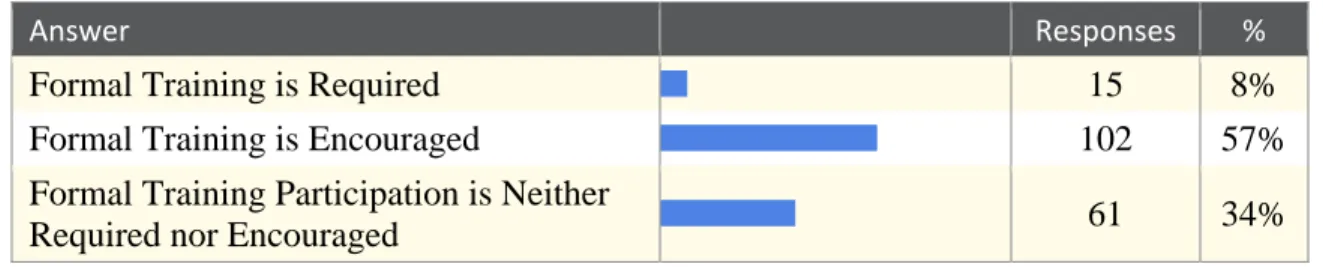
Figure 4: Formal Management Training Requirements
Answer Responses %
Formal Training is Required 15 8%
Formal Training is Encouraged 102 57%
Formal Training Participation is Neither
Required nor Encouraged 61 34%
Figure 5 indicates the proportion of libraries that support ongoing formal training in one way or another. Due to internal disagreements, 212 of the 264 represented libraries had answers recorded for this question. Figure 5 shows that the vast majority of
respondent libraries offer support to department heads who pursue ongoing formal management training, with a full three quarters of libraries offering both financial assistance and release time. However, a significantly higher percentage of ARL libraries and larger libraries offer both financial assistance and release time for ongoing formal management training than non-ARL libraries (87% vs. 71%, z-score = 2.48) and smaller libraries (82% vs. 70%, z-score = 2.05), which makes sense given that more ARL and larger libraries require such training.
Figure 5: Library Support for Formal Management Training
Answer Responses %
Financial Assistance Only 12 6%
Release Time Only 26 12%
Both Financial Assistance and
Release Time 161 76%
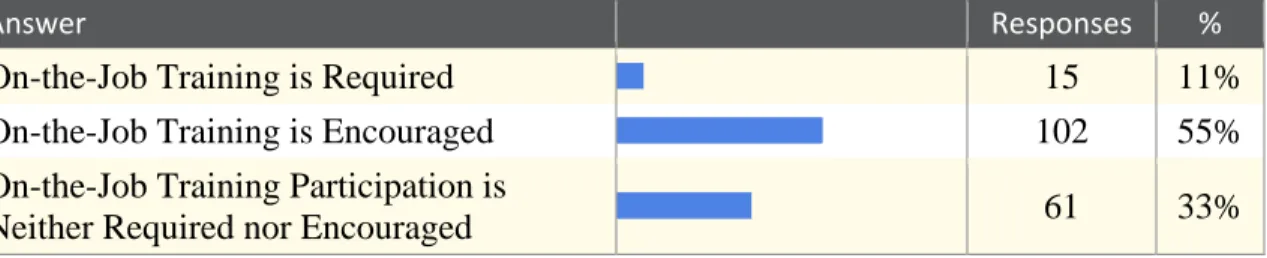
Figure 6 presents the proportion of libraries requiring and encouraging on-the-job training for current department heads. Due to internal disagreements, only 157 of the 264 represented libraries had answers recorded for this question. Of those libraries, the majority requires or encourages job training. However, only 11% require on-the-job management training and a third do not require or encourage on-the-on-the-job training at all. Furthermore, a significantly higher percentage of ARL libraries require on-the-job training than non-ARL libraries (23% vs. 7%, z-score = 2.82).
Figure 6: On-the-Job Management Training Requirements
Answer Responses %
On-the-Job Training is Required 15 11%
On-the-Job Training is Encouraged 102 55%
On-the-Job Training Participation is
Neither Required nor Encouraged 61 33%
Library administrators were also asked about the types of on-the-job management training their library provides for department heads. Apparently a third of libraries are not requiring or encouraging on-the-job management training because they do not provide any job management training, as shown in Figure 7. Those that do provide on-the-job management training offer a mixture of mostly mentorship programs, formally
structured in-house training programs in management skills, and other types of on-the-job training. It should also be noted that the only significant difference between ARL
compared to 16% (z-score = 3.71). Thus, nearly half of all ARL libraries provide formally structured on-the-job training programs.
Figure 7: On-the-Job Training Provided by Libraries to Department Heads
Answer Responses %
My library does not conduct on-the-job management training for current department heads
51 34%
Mentorship arrangements where senior
administrators mentor department heads 55 37%
Shadowing programs where department heads shadow a senior administrator as they perform similar management tasks
9 6%
A formal in-house training program in
management skills 38 25%
Other on-the-job training arrangements 43 29%
management training through financial assistance or release time in roughly the same proportions as the support they offer to current department heads, meaning that most identified lower level librarians receive both financial assistance and paid time-off to participate in formal management training.
Figure 8: Methods Used to Identify Lower Level Librarians with Management Potential
Answer Responses %
Daily contact with lower level
librarians 74 83%
Department or unit heads identify
librarians with potential 71 80%
Through committee activities 64 72%
Using information from annual
evaluation forms 54 61%
Personnel librarians identify
librarians with potential 23 26%
Other methods 7 8%
Sub-question 4: What attitudes do library administrators and middle managers have
towards management preparation, training, and development, and what methods do they
believe to be most effective in developing employees into managers?
demonstrate administrators' overall agreement with the discussed statements. (Please see Appendix A for a complete breakdown of administrator responses to each statement). First, administrators were presented with several statements about the importance of various management qualifications for newly hired department heads. They were also asked whether their library listed these qualifications as required or preferred
qualifications when advertising open department head positions.
Administrators were first asked whether they agreed with the following statement: “It is important for a new department head at my library to have previously served as a department head at another library or in another department at my library.” Only 16% of administrators stated that they strongly agreed or agreed with this statement. However, Figure 9 shows that over half of the respondent administrators still list previous
experience as a department head as a preferred qualification when advertising department head jobs, and a few even list such experience as a required qualification. Interestingly, significantly more non-ARL libraries list previous experience as a department head as a required or preferred qualification than ARL libraries (63% vs. 43%, z-score = 2.29).
Figure 9: Is Previous Experience as a Department Head a Listed Job Qualification?
Answer Responses %
Yes, it is a required qualification 6 4%
Yes, it is a preferred qualification 87 54%
No, it is not listed as a qualification 68 42%
acting department head position, an assistant department head position, or a unit head or team leader position. Overall 68% of administrators either strongly agreed or agreed that such experience was important for new department heads to possess, although a
significantly higher percentage of non-ARL librarians disagreed in comparison to ARL librarians (14% vs. 0%, z-score = 2.62). Figure 10 shows that an even higher percentage of libraries (82%) list such experience as a preferred or required qualification in
department head job postings, with a significantly higher percentage of larger libraries listing such experience as a preferred qualification than smaller libraries (92% vs. 74%, z-score = 3.00).
Figure 10: Is Experience in a Lesser Management Role a Listed Job Qualification?
Answer Responses %
Yes, it is a required qualification 31 19%
Yes, it is a preferred qualification 101 63%
No, it is not listed as a qualification 28 18%
Figure 11: Is Previous Supervisory Experience a Listed Job Qualification?
Answer Responses %
Yes, it is a required qualification 69 43%
Yes, it is a preferred qualification 83 52%
No, it is not listed as a qualification 7 5%
Next, to see how the importance of management experience compares to the importance of general academic librarianship experience, administrators were asked whether they agreed or disagreed with the following statement: “It is important for new
department heads at my library to have general academic librarianship experience, though not necessarily in a management or supervisory position, prior to becoming a new
department head.” In total, 81% of administrators said they strongly agreed or agreed with this statement. It is important to note that a slightly larger percentage of
administrators (87%) agreed that previous supervisory experience is important than agreed that general academic librarianship experience is important, while 13% fewer administrators agreed that previous management experience in a lesser role is important than agreed that general academic librarianship experience is important. Administrators were asked more directly whether previous management experience or previous
experience in a similar department was more important when hiring a new department head. Figure 12 shows that the majority considers both types of experience to be equally important, while 14% consider management experience more important than
Figure 12: Importance of Management versus Departmental Experience
Answer Responses %
Both types of experience are
equally important 99 62%
Previous experience in a similar
department is more important 39 24%
Previous management
experience is more important 22 14%
Figure 13 shows the proportion of libraries that require or prefer general academic library experience in department head candidates. Almost all libraries list this experience as a required or preferred qualification. On average, the libraries ask for 3.5 years of general academic librarianship experience. Thus, departmental and management experience are equally important, but general academic librarianship is listed as a
preferred or required qualification for a department head job by a much higher proportion of libraries. Still, previous supervisory experience and general academic librarianship experience are listed as qualifications in equal proportions.
Figure 13: Is General Academic Librarianship Experience a Listed Job Qualification?
Answer Responses %
Yes, it is a required qualification 76 48%
Yes, it is a preferred qualification 75 47%
No, it is not listed as a qualification 7 4%
Next, administrators were asked about the importance of new department heads having previous management training. First, they were asked whether they agreed that: “It is important for a new department head at my library to have participated in formal
becoming a new department head.” Administrators did not feel that previous formal management training was as important as various types of experience. In fact, only 19% of administrators strongly agreed or agreed that previous participation in formal
management training was important. Additionally, only 14% of libraries list previous participation in formal management training as a required or preferred qualification, with only 1% saying it was a required qualification.
Secondly, administrators were presented a statement about previous on-the-job management training that read as follows: “It is important for a new department head at my library to have participated in on-the-job management training prior to becoming a new department head.” More strongly agreed or agreed with this statement than with the formal management statement. Still, only 37% agreed, far less than half. Only 24% list previous participation in on-the-job management training as a required or preferred qualification, with only 3% requiring such a qualification. Clearly, administrators find management and supervisory experience much more important than previous
management training when examining applicants for department head jobs.
Qualifications for department head jobs were also examined in the department head survey, though in a more general manner than in the administrator survey.
Department heads were asked whether previous management experience in general and whether previous management training in general were required or preferred
higher a new department head. Two-thirds of department heads faced a required or preferred qualification for previous management experience when obtaining their current job. The importance of previous management experience has also been growing recently. The proportion of department heads who faced a requirement of previous management experience when competing for their current job is significantly higher than the
proportion who faced such a requirement when competing for their first job as a department head (37% vs. 14%, z-score = 5.10).
Figure 14: Was Previous Management Experience a Qualification for your First Job as a Department Head?
Answer Responses %
Yes, it was required 16 14%
No, but it was a preferred
qualification 37 32%
No, it was neither a required nor a
preferred qualification 49 43%
I don’t remember 13 11%
Figure 15: Was Previous Management Experience a Qualification for your Current Job as a Department Head?
Answer Responses %
Yes, it was required 94 37%
No, but it was a preferred
qualification 71 28%
No, it was neither a required nor a
preferred qualification 64 25%
Figure 16 and Figure 17 present the respective answers about previous
management training participation. These two figures show that previous management training has never been listed by many libraries as a required or preferred qualification in department head job announcements. Additionally, the proportion of department heads who faced such qualifications has not significantly changed from when librarians obtained their first department head jobs to when they started their current jobs.
Figure 16: Was Previous Management Training a Qualification for your First Job as a Department Head?
Answer Responses %
Yes, it was required 7 6%
No, but it was a preferred
qualification 22 19%
No, it was neither a required nor a
preferred qualification 69 61%
I don’t remember 16 14%
Figure 17: Was Previous Management Training a Qualification for your Current Job as a Department Head?
Answer Responses %
Yes, it was required 22 9%
No, but it was a preferred
qualification 59 23%
No, it was neither a required nor a
preferred qualification 142 56%
I don't remember 30 12%
management training.” A total of 71% of the administrator respondents strongly agreed or agreed that it is important for current department heads to participate in ongoing formal management training. The second statement read: “It is important for current
department heads to participate in ongoing on-the-job management training.” A total of 76% of the administrators strongly agreed or agreed that on-the-job management training participation is important for current department heads. In the eyes of administrators, participation in management training is clearly more important for current department heads than for department head applicants.
Finally, both department heads and administrators were asked what management training methods and experiences they thought were particularly effective in helping librarians develop their management skills and capacity. Figure 18 presents the opinions of department heads on this matter by showing what proportion of the responding department heads chose certain methods as being particularly effective. Figure 18 shows that almost all department heads have found at least some management training methods to have been effective at helping them develop their management skills. Only 6% did not find any methods to be particularly effective. Management workshops and seminars were identified as effective vehicles for management development by the most department heads, followed closely by experiences while serving on committee assignments. Task force assignments, special projects, and mentorship from senior administrators were also identified as effective management development methods by around half of the
Figure 18: Effective Management Training Methods as Identified by Department Heads
Answer Responses %
Management workshops or
seminars 170 69%
Committee assignments 151 61%
Special Projects 133 54%
Mentorship from senior
administrators 120 49%
Task force assignments 119 48%
A formal in-house training
program in management skills 36 15%
Job rotation 23 9%
Shadowing senior administrators 19 8%
Obtaining a 2nd Masters degree in a management field, such as a MBA or MPA degree
16 6%
Classes in business or public administration programs (without obtaining a 2nd Masters degree)
15 6%
Management internships or
fellowships 11 4%
Additional management classes at a library school beyond a basic management class
4 2%
Other methods 46 19%
No methods have proven to be
particularly effective 14 6%
formal management training they have participated in has provided at least some useful knowledge they could utilize to be better managers.
Figure 19: Have You Implemented Ideas Learned from Formal Training?
Answer Responses %
Generally Yes 92 40%
Somewhat 107 47%
Generally No 29 13%
Figure 20: Effective Management Training Methods as Identified by Administrators
Answer Responses %
Committee assignments 131 85%
Special Projects 128 83%
Management workshops or
seminars 122 79%
Task Force Assignments 119 77%
Mentorship arrangements 81 52%
A formal in-house training
program in management skills 32 21%
Classes in business schools or
public administration programs 29 19%
Job rotation 28 18%
Management internships or
fellowships 26 17%
Shadowing programs 15 9%
Additional management classes at a library school beyond a basic management class
10 6%
Other methods 14 9%
No methods have proven to be
particularly effective 13 8%
Figure 20 shows that almost all administrators, like their department head
force assignments, and mentorship arrangements. These five methods were also the top five methods identified by department heads, although in a slightly different order. At the same time though, a significantly higher proportion of administrators than department heads found nine out of the eleven training methods listed in Figure 20 to be effective. The only methods that administrators and department heads agreed upon were
mentorship arrangements and shadowing programs. Otherwise, administrators have more faith that the training methods discussed are effective. The difference between the
responses of administrators and department heads could possibly be caused by a greater familiarity with all the different training methods amongst the administrator group. Finally, answers in the “Other” category for Figure 20 included attending leadership institutes, participating in management discussion groups, and participating in
management training sessions provided by the university-wide human resources office.
Discussion
This study was partly modeled on a study published in 1992 that was conducted by Wittenbach, Bordeianu, and Wycisk to examine the management preparation and development of department heads in ARL libraries. The methodology of this study
department heads surveyed for that study did not possess much formal management training before they first became department heads, and libraries were not requiring or encouraging management training to a large extent. But, most department heads had at least some management experience in a lower level role, such as a unit head position, and they were acquiring formal management training once they had assumed their roles as middle managers.
This study’s literature review determined that it has been thought for some time that middle managers in academic libraries should be well trained and prepared in the discipline of management. The literature also established that the need for academic librarians well versed in the art and science of management has only grown more urgent over the last decade. It is important to know whether the state of management
preparation, training, and development for academic library middle managers has
improved, remained static, or even declined over the past twenty years. Thus, this section will examine the results of the current study generally and discuss how these results compare to those of the Wittenbach et al. study, in order to determine what changes have occurred.
Sub-question 1: What management preparation, training, and development did current
middle managers in academic libraries receive before becoming middle managers?
Management training and development prior to the first department head job has improved slightly since the 1992 Wittenbach et al. study, but the total picture on
formal management classes, workshops, etc., prior to starting their first job as a
department head. Respondents in the Wittenbach et al. study averaged 3.2 formal classes, workshops, etc., prior to their first middle management job, a full class less than
respondents in the current study. Furthermore, 64% of department heads participating in the current study had taken part in at least one type of formal management training beyond library school management courses prior to their first department head job. In the Wittenbach et al. study, only 5.5% of respondents had classroom training beyond library school and only 48% had management workshop training prior to becoming a department head for the first time. Thus, a significantly higher proportion of department heads in the current study had participated in formal management training before becoming a middle manager, demonstrating improvement in this area since 1992 (z-score = 2.52).
of department heads had at least some sort of management training beyond library school before starting as a middle manager. But, that does still leave a fifth of current
department heads without any management training beyond library school before their promotion to the level of middle management.
When it comes to previous management experience in some other role prior to becoming a department head, the Wittenbach et al. cohort and the cohort for this study were somewhat similar. Participants in the Wittenbach et al. study had a mean of 3.24 years of management experience in other roles and 78.5% of the respondents had some sort of previous management experience. The numbers for the current study were a mean of 3.48 years of experience and a proportion of 69% of respondents possessing
management experience in another role. The current proportion is significantly lower than the 1992 proportion overall (z-score = 2.13). But, the 1992 sample only contained ARL librarians. The proportion of ARL librarians in the current study with previous management experience was 75%, which is essentially equal to the 1992 proportion. Thus, the more concerning figure is the 60% of non-ARL department heads who do not obtain any management experience at a lower level before becoming a middle manager.
Overall, 87% of current department heads have had some form of management training or experience after graduating library school but prior to becoming a department head. Additionally, more current department heads have participated in formal
department heads, fewer department heads have previous management experience in other roles than in 1992, at least a third of current department heads still had no formal training since library school before becoming a department head, and many department heads only had training or experience but not both.
The proportion of department heads without formal training prior to becoming middle managers is troubling because, as Wittenbach et al. stated, “Despite the lack of clarity in the use of the term experience, much of the research points to its value in addition to management education and training. Seldom is experience viewed as sufficient in itself” (1992, p. 321). McClure also placed the cause of poor managerial performance in libraries at the feet of a deficit in formal management training (1980, p. 2389). Training in library school is not enough, because what is learned in one management class is not sufficient knowledge to manage a department and is often forgotten before one is in a position to manage a department.
receive both training and hands-on management experience before moving up to middle management. Nevertheless, these issues can be mitigated if department heads consistently participate in management training once they have become a middle manager.
Sub-question 2: What ongoing management preparation, training, and development have
current middle managers participated in since becoming middle managers?
Thankfully, the results for Sub-question 2 showed that more department heads participate in formal and on-the-job training once they have reached the level of middle manager than do so before becoming a department head. Department heads in academic libraries show a concerted drive to obtain formal training once they reach the top of a department. In the current study, 87% of current department heads had participated in at least one type of formal management training since becoming a department head, while only 64% had done so after leaving library school but before becoming a department head. The respondents in the current study have taken a mean of 5.31 formal management classes or workshops while serving as department heads, making for an average of about a class or workshop every other year. Unfortunately, these numbers mark a slight
regression since the time of the Wittenbach et al. study, when an equally large proportion of 87% of department heads were averaging a management class or workshop nearly every single year, for a total mean of 5.98 formal courses for those respondents while they were serving as department heads.
those who started as heads before 2003. The newly minted department heads have been taking more than a class a year, meaning that department heads with less middle
management experience are serious about countering that lack of experience with formal training in management techniques and skills. However, the digital revolution means that academic libraries are facing great changes in the ways they operate and the services they offer. Additionally, new technologies aimed at helping managers to be more efficient and effective are being introduced every year. The reality is that even highly experienced managers need to continue to pursue formal management training in order to keep up with the changes that are occurring, to be able to manage the new technologies that are being introduced, and to help keep their library services relevant.
The current study also found that a significantly higher proportion of department heads participated in on-the-job management training once at the middle management level than had participated in on-the-job training prior to becoming the head of a
department (53% vs. 42%, z-score = 2.45). However, the data still show that barely half of all department heads are receiving on-the-job management training. But, most of those who have not received on-the-job management training have at least received some formal management training. Only 4.5% of respondents had not participated in any formal or on-the-job management training since becoming a department head.
augment what they were learning in more formal settings. A look at the requirements libraries have for ongoing training and the support they provide for such training can further illuminate the patterns of department head participation in ongoing training.
Sub-question 3: How are the administrations of academic libraries supporting the
preparation, training, and development of their employees in the area of management?
When examining the results related to Sub-question 3, it is important to remember that responses from department heads and administrators were combined to see which libraries require and support which types of ongoing training. In 1992, Wittenbach et al. had asked just department heads whether their libraries supported their participation in formal management training and learned that 77% of department heads received financial assistance and 85% were given release time from their job duties to participate in ongoing formal management training. So, academic libraries have always been supportive of ongoing management training. The results from the current study show that library administrations are slightly more supportive of ongoing training now, with 82% of department heads receiving financial assistance, 88% receiving release time, and 76% receiving both financial assistance and release time. All in all, library administrations are doing a good job of supporting continued formal training.
up from the 14.5% of ARL libraries recorded by Wittenbach et al. So, slightly more ARL libraries require ongoing formal training than in 1992, but barely any non-ARL libraries make such requirements of their middle managers. Additionally, the current study found that 65% of all libraries and 75% of ARL libraries either require or encourage ongoing formal training, whereas only 54% of ARL libraries required or encouraged this training in 1992 according to Wittenbach et al. So improvements have been made since 1992 in terms of libraries promoting ongoing management training among their department heads.
On the other hand, with so many libraries offering support to department heads who pursue formal management training, more libraries should be requiring this training. Wittenbach et al. found that requirements of ongoing management training lead to
statistically significant higher rates of participation. Even when support is offered, participation is lower without a requirement to participate. If the support is there, a requirement to undertake formal management training is not overly burdensome on department heads. Nevertheless, encouraging department heads to take formal
management training classes does not hurt either, and it is not known why more libraries are not encouraging such training. There is no reason why 100% of academic libraries cannot at least encourage participation in formal management training.
training is not surprising. On the other hand, given the reasonableness of Howze’s statement that, “Libraries can and must respond to the shortage of qualified leaders by establishing training programs and encouraging continuing education in management studies” (2003, p. 31), and given that several other practitioners and authors have made similar declarations, it would be encouraging to see more libraries offering at least
mentorship opportunities, if not more formally structured management training programs. Additionally, given that it will be harder to recruit middle managers from other libraries (Curran, 2003, p. 135) and it may be unwise to recruit middle managers from other professions (Unaeze, 2003, p. 114-15), it will be necessary in the future for more
academic libraries to develop their own middle managers from within (Sullivan 1992, p. 279; Mosley 2004, p. xii). Currently, 56% of all libraries, 79% of ARL libraries, and 67% of larger libraries have policies of identifying lower level librarians who have the
potential to become effective managers in the future and helping those librarians to develop their management abilities. So, many libraries do recognize the impending necessity of developing their own management talent pool, but these proportions could stand to be even higher.
Before concluding this section, the discrepancies between the responses of department heads and administrators in terms of the requirement, encouragement, and/or support of ongoing management training must be mentioned once more. In dozens of cases where several respondents from the same library answered the questions related to Sub-question 3, the answers from one respondent to the next were contradictory. Often, these internal disagreements saw administrators claim that ongoing training was