Standards for Extending
Extra-Territorial Jurisdiction:
Written in Black and White?
Ann Moss Joyner, CGISC
The following article examines the public outcry surrounding one town’s attempt to establish an extra-territorial jurisdiction (ETJ). Most towns easily establish ETJs with little or no resistance. In contrast, when the predominantly minority Town of Green Level attempted to use this common planning tool, it faced inordinately strong and negative public resistance. The author addresses each of the arguments made by members of the public against Green Level’s proposed ETJ, and nds that each argument is unfounded. In the end, she nds, the only difference between the Town of Green Level and its neighbors, who were allowed to extend ETJs, is that of racial composition.
T
he predominantly-minority Town of Green Level in Alamance County is trying to reserve room for growth and diversity, as many towns in the county aregrowing so fast that many now abut each other. The
Town has initiated an extra-territorial jurisdiction (ETJ),
establishing the right to zone neighboring rural parcels and eventually incorporate them into itself. Some of
the neighbors, however, have objected to the Town’s
plans and have prevailed upon the County to stop Green
Level.
Seven municipalities in Alamance County already have
an ETJ.1 However, the Alamance County
commission-ers, who happen to be all white, are making history by attempting to create a new rural overlay district that
would block the predominantly-minority town of Green
Level from establishing its own ETJ.2 Although the
population of Green Level makes up only 1.6% of Ala-mance County’s total population, the tiny Town is
ght-ing the County for its right to plan for its own future.
A look at the populations of the town and the
sur-rounding area shows that the town and the rest of the
County are almost identical in most respects
(educa-tion, income, commute to work, percentage on public assistance, home ownership patterns, size of homes,
etc.). However, three distinct differences remain:
den-sity, mobile homes, and race. Green Level is
predomi-nantly African-American (74%), though the County is predominantly white (75%) (See Map 1). While
op-ponents of Green Level’s ETJ frame this issue as a
con-The author is a former land developer in the Research
Tri-angle region of North Carolina. She is currently president
of Cedar Grove Institute for Sustainable Communities, Inc.,
a NC non-pro t specializing in civil rights and land use.
She and her team use their backgrounds in investigative
reporting, GIS, demography and land use in cases involving
civil rights, predatory lending and institutionalized
dis-crimination for legal cases and research in North Carolina,
ict between “the city” and “the country,” an analysis
of community characteristics, the County’s actions, and the opponents’ complaints suggest that the real story is
fundamentally about race. This racial dynamic makes
this a potential civil rights issue that sets an important
precedent for Alamance County and for the state of North Carolina.
What is an ETJ?
Extraterritorial Jurisdiction (ETJ) is a zoning “overlay”
that allows a town to zone areas outside of its limits
in order to plan for future growth. In North Carolina,
the state gives municipalities broad powers to control planning and growth for up to three miles beyond their
borders (up to one mile for smaller towns like Green
Level). NC General Statute §160A-360(b) provides
that the area must be based on “existing or projected urban development and areas of critical concern to the
city, as evidenced by of cially-adopted plans for its
de-velopment.” While smaller towns are less likely to have
ETJs, most towns in North Carolina have taken
advan-tage of the statutory authority to exercise extraterritorial zoning.3 A 1995 North Carolina League of
Munici-palities survey indicated that 89% of larger towns and
68% of municipalities the size of Green Level (1,000
to 2,500 people) have ETJs. In designing ETJs, towns may exclude areas if they are separated from the city
by barriers to growth; as
an example, Green Level
elected to exclude the Water Quality Critical
Area surrounding
Gra-ham-Mebane Lake
(for-merly Quaker Lake) from its ETJ.
Why Might Green Level Need an ETJ?
According to the US
Cen-sus, the population of
Al-amance County grew by
more than 20% from 1990 to 2000, and is projected
to increase by 8.6%, to
142,008, between 2000
and 2005. This growth, and the proximity of
the towns in Alamance
County, together with the concomitant expansion of
the towns—especially Haw River—and their ETJs dic-tate that any town that wants to grow in the future must
stake out the right to grow now, before another town
expands into that territory. In fact, this has already
oc-curred. The town of Haw River noti ed Green Level on April 16, 2004 that it intends to expand its ETJ,
“es-pecially since some properties have recently been
an-nexed into the city limits, thereby expanding our ETJ
capabilities.”4 In the same letter, Haw River went on to request that Green Level “reschedule the community
meeting and public hearing regarding ETJ until we can
According to Quentin McPhatter, the Green Level Town
Administrator, the town wanted to build economic and racial diversity into its future, an accepted strategy for
attracting growth. According to James Johnson Jr.,
Kenan Professor of Management at the Kenan-Flagler
Business School at the University of North Carolina at Chapel Hill, “the ability of cities to thrive and
com-pete…depends on the willingness of communities to
re-spond positively to growing diversity in demographics
and lifestyles.”5 The North Carolina Human Relations Commission, part of the NC Department of
Adminis-tration, has a slide show about diversity, which states
“when a community develops positive inter-group
re-lations, it has an advantage in attracting investment.” The challenge for Green Level is that the Town is 86%
miniority and has almost no non-residential tax base, in
a county that is 72.5% white.
In an effort to improve Green Level’s quality of life,
the town has applied for a US Post Of ce and a
poll-ing place for elections, accordpoll-ing to Town Manager
McPhatter. In both cases, the requests were turned down because the proximity to other locations made an
additional location in Green Level “not economically
feasible.”6 According to Alamance Board of Elections
representative Kathy Holland, “expenses [for a polling place] would include the cost of advertising and the
cost of notifying the voter. The positions at the
poll-ing places on Election Day are paid positions; however,
the amount paid is minimal….”7 In addition, accord-ing to Senator Elizabeth Dole’s of ce, the Burlaccord-ington
Post Of ce (eight miles away) and the Haw River Post
Of ce (two miles away) provide “convenient access.”8
Essentially, the Town’s efforts to provide more services for its populace have been stymied by its size and low
tax rate.
Growth and diversi cation would help solve both these problems, but Green Level is bounded to the east by the
Water Quality Critical Area and to the south by Haw
River and the Town of Haw River’s ETJ. Making
mat-ters more dif cult, on April 5, 2004, the Town of Haw
River voted unanimously to extend its own ETJ out to the 1-mile limit to all surrounding areas that are not
al-ready zoned—further reducing the land available for
Green Level to annex.
Precedent
There are ten municipalities in Alamance County, and
all but three—including Green Level—have an ETJ,
according to County Planning Director Craig Harmon. When creating ETJs, “some towns asked [the County
for permission], some didn’t,” Harmon said, and the
County has never moved to stop or preclude a town from
establishing or extending an ETJ prior to this time.
In the case of Green Level, however, the County has
taken a completely different approach.
Unprecedented Opposition
When the town sent out letters to property owners to
prepare them for the ETJ extension, many of the
neigh-bors immediately objected. While vocal objection to proposed annexation is common, it is rare to
encoun-ter signi cant objection to proposed extension of ETJ
because most people do not know the implications or
consequences of an ETJ. In this case, however, neigh-bors to the northeast mounted a vigorous campaign in
opposition to the proposed ETJ, placing anti-ETJ signs
in their yards and initiating a petition drive to let their
Commissioners know of their complaint. They de-scribed the ght as countryside versus town, a common
approach in ETJ extensions.
In response to these complaints, the County Commis-sion held a public hearing at its regularly scheduled
Commission meeting on April 19, 2004, during which
the Commission discussed a Watershed Protection
Or-dinance Amendment. In this hearing, both the “coun-tryside versus city” theme and thick racial tension were
clearly on display, as described by The Alamance News
Despite this decision, the Town of Green Level decided
to ght on with its plans for extending its ETJ, which triggered additional public opposition. In early June, the
Concerned Citizens Against ETJ Expansion Committee
called an “emergency meeting” for June 15, 2004 to
“discuss our options and generate some funds to help in our legal battle with the Town of Green Level on this
is-sue.” Jerry Rudd and another resident of Green Level’s
proposed ETJ then led for an injunction to stop Green
Level from extending its ETJ. Almost simultaneously,
the Town led suit against the County for a declaratory judgment in order to determine who currently has
juris-diction—the town or the county.
In the midst of this urry of legal activity, racial ten-sions continued to are. On July 3, a citizen sent the
following email to Green Level’s Town Manager:
There is no one in the Alamance phone book by the
name in which the email was signed and there was no
response to an email inquiry to the sender, so these com-ments cannot be explained.
“People on both sides of the con ict have seen the cultural and racial divisions that, they say, exist in this County emerging in this debate, pitting the ‘farm peo-ple’ in the Alamance countryside against a small town with an overwhelmingly black population…. About 85 residents were crammed into the Commissioner’s meet-ing chamber, while dozens more stood in the hall and spilled into the adjacent County Manager’s suite….
According to the minutes, County Planner Craig Har-mon “stated a group of citizens presented a petition to the Planning Board asking the County to help in their effort to keep Green Level from extending an Extrater-ritorial Jurisdiction (ETJ) into their area of the Coun-ty.” County resident Jerry Rudd, candidate for the NC House of Representatives, “presented petitions with 554 signatures of residents and church members in the affected area. He stated that 146 letters were mailed, and 90.2 % signed in favor of the RCD. He stated the citizens asked the County for zoning because they like the rural setting and do not think the Town of Green Level has anything to offer that would enhance their property or their lives. Several members of the audi-ence spoke in favor of the Ordinance Amendment, not-ing that the Watershed Protection Ordinance was set up to protect the water and to prevent towns from en-croaching on the lakes. Some of the comments were that people want to live in a rural setting, not a town; that Green Level cannot control what it has; and that Green Level has nothing to offer except taxes.
....[R]acial undertones were also easy to detect in the events at [the April 19] meeting. The case against Green Level’s plans was made mostly by white residents who were clustered along the chamber’s back wall or sat on the left side of the room. Whenever one of Green Level’s detractors made a punchy rejoinder, this whole side of the chamber broke into applause. Meanwhile, a few rows, lled with black faces, watched the whole hearing in silence from the right side of the room….. In the end, the County’s all-white board of commissioners voted against Green Level’s request.”
“To: [email protected]. Sent: Saturday, July 03, 2004 7:42 AM
Town has never been much except for an infrquent stop for side road chicken and Mcbroom trash [early garbage pickup business, based in Green Level com-munity]. No re dept. has ever been spotted there. Keep pushing for that ETJ and maybe you can get the Pleasant Grove Fire dept. under your jurisdic-tion. Major obstacle to that will be the locals who know all too well what the Green Level intentions really are.
Unprecedented County Response
In order to fully understand the racial dimensions of the Commission’s decision, it is important to more closely
study the reasoning the Commission gave in support of
its decision and to examine the ways in which that
deci-sion completely broke with past precedent.
First, it appears that the Commission acted beyond its
authority in prohibiting Green Level from expanding,
and did so because of concerns over public opposition to the ETJ. The April 22, 2004 issue of The Alamance
News quoted two Commissioners regarding the lack
of precedent for the objections. Commissioner Larry
Sharpe (up for re-election) said, “This is the rst time we’ve had many people oppose an ETJ….”
Com-missioner W.B. Teague said, “I have never received a
phone call, in my 17 years sitting in this seat, over any
ETJ issue.” Commissioner Sharp also commented, “I understand that the only way to expand [the ETJ] is if
the community asks for it.” According to state statute,
however, this is not true—residents should have no say
in whether or not they become part of an ETJ.10 More-over, a town must ask permission of the County only
in those cases where the County has already zoned the
area in question.
Additionally, Green Level and the County have a basic
disagreement concerning the County Watershed
tion Ordinance, which, prior to the Watershed
Protec-tion Ordinance Amendment, only applied “within the areas designated as a Public Water Supply Watershed
by the NC Environmental Management Commission
(EMC) and … de ned and established on the maps
en-titled, “Watershed Protection Map of Alamance County, North Carolina.” In order to support its claim that this
document is a zoning ordinance, the County amended
the Ordinance to replace the language that restricted it
to the management of the water supply.11 The use of a watershed ordinance for zoning purposes is
unprec-edented, according to Green Level Town Manager
McPhatter and the town’s attorneys. The distinction is
important, because without current zoning in the area,
Green Level does not need to obtain permission from the County to extend an ETJ.
In effect, the County Commission was attempting to
claim that its current Watershed Protection ordinance was actually a zoning ordinance. This position is
some-what ironic given the Commission’s historical and
ongoing opposition to zoning, opposition voiced as
recently as June 19, 2004. During this particular meet-ing of Southern Alamance residents to consider zonmeet-ing,
Commissioner Teague “said he was worried about a
‘bureaucrat’ from Graham [the county seat] telling the
County’s farmers what to do,” according to the Burling-ton Times-News. “‘I don’t think you’re going to nd
many full- edged farmers…. [t]hat are going to be for
zoning,’ Teague said. ‘As the Board of
Commission-ers stands now, there are probably not enough votes on the ve-person board to pass zoning. Commissioners
John Patterson, W.B. ‘Junior’ Teague and Bill Lashley
have all come out against it in the past.’” But yet, when
it came to Green Level, the Commission eagerly em-braced the expansion of zoning tools.
Checking the Facts
Green Level’s neighbors and the County Commission-ers have couched the dispute in terms of “city vCommission-ersus
country” and a lack of value to the “countryside.” As
part of this central argument, opponents of Green
el’s new ETJ made several points, and this article will
consider the validity of these points.
Countryside versus City
The demographic characteristics of the residents of
Green Level and the residents of Alamance County are similar in all but three areas: race, percentage of mobile
homes, and lot size (density). This difference in
den-sity is the very core of the difference between town and
country, and the reason that the state instituted extra-territorial jurisdiction zoning. Thus, for the County to
attempt to deny the Green Level an ETJ without a
long-term plan or a study of the area to be zoned—while
abstaining from such action when other towns in the County extended similar zoning—appears to be an
ac-tion based on race.
ETJs exist for the logical extension of growth and plan-ning for towns into the countryside. While Green Level
has not yet extended its boundaries, it is a new town,
incorporated only in 1990, and its strategic plan calls for growth. That growth is greatly limited to the south
by the town of Haw River, whose city limits and ETJ
bound Green Level, and to the east and northeast by the
Mebane-Graham Lake’s Water Quality Critical Area (WQCA) and Balance of the Watershed (BAL). As
stated above, Green Level initially intended to extend
its ETJ to the north and east as well as to the west—the
land to the south is already taken by the town of Gra-ham and GraGra-ham’s ETJ—but decided to exclude the
Watershed land. (See Map 2.)
Map 3 shows how the County’s amended Watershed Ordinance and the Rural Communities District it
cre-ated t within the current watershed.
Opponents’ Petition
An “Agenda Item Pro le,” prepared by the County
Planning Department and presented to the
Commis-sioners at the April 19 hearing, stated, “This action fol-lows a petition signed by a vast majority of the owners
in this area.” The petition stated, “We the citizens of
Alamance County, listed below, do hereby petition the
Alamance County Commissioners to zone our property in the manner in which it is being used—agricultural,
residential and heavy industry. This request is a
vol-untary zoning request.” This petition asking for
zon-ing is unusual, as rural residents often oppose zonzon-ing
since it restricts use of their land. In addition, though the petition requests that the County “zone their
prop-erty,” about half of the petitioners lived on land already
“zoned” by the current Watershed Ordinance prior to its
amendment.
Moreover, geocoding the addresses of the petition’s
signers reveals that most of the signers do not live in
the area that Green Level designated for its ETJ, and
about 20% live in other jurisdictions, including Burl-ington, Haw River, other ETJs, and some out of state
jurisdictions. Map 4 shows the location of the signers’
residences.
While opposition leader Jerry Rudd claimed “554
sig-natures of residents and church members in the affected
area,” the petition actually consisted of 206 signatures,
of which two individuals signed for two churches:
Deep Creek Baptist Church, claiming 150 members, and Long’s UCC Chapel, claiming 145 members. Deep
Creek Church, at 1923 Deep Creek Church Road, is not
in the proposed ETJ and has an unlisted phone number.
A conversation with a Long’s Chapel church member, who asked not to be identi ed, said that he thought that
most people sign a petition as a favor for those who
surounding the situation.
Of the 206 actual signatures on the petition, 20 are off of
this map, and 11 of those are out of the County entirely.
Though the Commissioner’s statement that the petition
was “signed by the vast majority of owners in this area” may be accurate if applied to the greater County area,
many of the signers do not actually live in the affected
area, and most do not live in the area that Green Level
has selected for its ETJ.
Services
When an area becomes part of a town’s ETJ—prior to
annexation—the town may begin to offer services to property owners. Usually, however, extension of
ser-vices follows annexation, and the serser-vices offered vary
signi cantly across the state. Green Level’s opponents
argue that the town provides inferior services to its ex-isting residents, and that those in the proposed ETJ area
do not want to have to pay for those inferior services.
Jerry Rudd, presenting a petition from opponents, com-plained to the Commissioners that “Green Level has
nothing to offer except taxes.” County resident Ray
Cobb, candidate for County Commissioner, spoke
dis-missively of the Town’s services at the Commission meeting, saying, “What in my lifetime can they
pos-sibly do to bene t me in the county? Maybe they’ll put
speed bumps on [NC Hwy.] 49. Maybe, if I’m lucky,
some day, I can get sewage out of my faucet.” The Ala-mance News, reported Cobb as saying that the biggest
difference between Green Level and other area towns
is the level of service that other communities provide
residents of their ETJs, and that Green Level relies on a “rent-a-cop” for its policing.
Are these complaints valid? While larger towns and
cities usually provide their own safety of cers, many municipalities contract out services like solid waste
collection and treatment and recycling. Municipalities,
both large and small, “outsource” and “privatize” these
public services, and others negotiate with other
govern-ments to realize economies of scale. It is common for smaller towns to have the county perform building
in-spections for them, and even zoning enforcement and
planning, according to David Owens of the UNC-CH
Institute of Government. Some small towns have the regional COG do permit administration. Solid waste
and recycling trucks owned by Waste Management,
Inc., are a common sight in Piedmont North Carolina.
Like many small towns, Green Level has purchase agreements for many of its basic services.
A brief survey of Alamance County reveals this to be
standard practice. In Alamance County, Mebane and Graham jointly own a reservoir and water treatment
facility. Mebane has a contract with the E and Fire
Department to cover part of its area in Orange County.
The City of Burlington GIS Division serves as the “GIS Department” for the City of Burlington, the City of
Gra-ham, and the Town of Elon by the terms of the recently
approved Regional GIS Agreement. Burlington and
Al-amance County share an animal shelter. Burlington and Graham outsource their MPO contract to Mobility
So-lutions. The Town of Alamance has a contract with the
City of Burlington to receive re and police protection.
In addition to selling its water to Green Level, Graham also sells water to Swepsonville. Swepsonville receives
re and police protection from Graham. The Town of
Ossippee has a contract with the County Sheriff’s
De-partment for police protection. The City of Burlington provides water for the Town of Gibsonville.
These are but a few of the inter-governmental
agree-ments and private purchasing contracts in this area. It would seem then that the question is not how the town
provides the services, but what services the town
pro-vides. According to Green Level Town Manager, the
Town currently offers the following Services:
• Water: Through a purchase agreement with the
City of Graham.
Town of Haw River; it is treated in Burlington.
• Solid Waste and Recycling Service: Through con-tracts. Note: Green Level is one of the few
mu-nicipalities that provides free weekly curbside
ser-vice or monthly bulk pick-up.
• Law Enforcement: Through a law enforcement agreement with Alamance County, signed in
De-cember, 2003. Of cers operate from donated
ce space in the Green Level Town Hall.
• Street Lighting: The Town pays for 118 street lights throughout the Town.
• Street Maintenance: The Town maintains streets
within the City Limits and constructs new streets
and improves current streets—paving and adding curb and gutter—each year. Currently, the Town
is paving Florence Road and Otter Creek Trail,
providing both curbs and gutters.
• Fire Protection: The Town of Haw River provides re protection for the Town.
• City Park: Matching funds from NC Parks and
Recreation Trust Fund, the Town has
appropri-ated $250,000 to create a 10-acre City Park next to Green Level’s Town Hall. The park will include
a baseball/softball eld, a rectangular multi-use
eld, a volleyball court, a paved walking track,
two horseshoe pits, three playground areas, and a covered picnic area.
Water Quality
According to The Alamance News, County Commis-sion Candidate Ray Cobb “alleged a history of
contami-nation with Green Level’s water system, which he said
is reason enough to impose county zoning on outlying
areas. ‘They got a letter from the North Carolina De-partment of Environment and Natural Resources
con-cerning their water,’ he explained. ‘It’s not safe to drink
the water down there.’” Cobb expressed the concerns
of many people regarding problems that Green Level has had with “dingy water.”
When asked about “sewage” coming from Green Level
taps, Lee Spencer of the North Carolina Department of
the Environment and Natural Resources Public Water Supply Section, said, “I don’t think that’s true.”
Spen-cer explained, “Last fall, there were several complaints
about the water. Last fall, there was at least one—maybe
two—water line breaks. That’s not uncommon for any system. Green Level had to turn off their whole system
because there were not enough valves to turn off a small
section. That’s being xed now.” The water was dingy
because “when a system’s water is turned off, the pres-sure increases all at once when it’s turned back on and it
scours the distribution water lines.” This can cause
re-sidual rust and mud to make the water murky.
Accord-ing to Green Level Town Manager McPhatter, the criti-cal improvements will be completed by the end of June,
2004, with additional valves being added over time.
As it turns out, Green Level’s water comes from the City of Graham, and Green Level is at the end of the
line. Spencer explained that this can cause higher
lev-els of “disinfection by-products.” While no bacteria
have been found in Green Level’s water, Graham has received an exclusion from the Environmental
Protec-tion Agency’s limit on disinfecProtec-tion by-products. When
the City of Graham expanded its water plant in 2003, it
put in a chloramination system, so “from now on, this should no longer be an issue. Green Level has good
chlorine residuals.” Regarding actual sewage from a
tap, Spencer said that, to his knowledge, this has never
happened in North Carolina. “You might get a smell of sewage out of a tap, that (the smell) is actually coming
trough the v-trap under the sink, from an
improperly-plumbed or missing v-trap, or the presence of a vacuum
in the trap.11
Without water from a public system, like Green
Lev-el’s, County residents must rely on well water for their
homes. According to the 2000 Healthy Alamance Sur-vey, “about half of the 120,000 residences in Alamance
County depend on groundwater for their drinking water.
County. Since 1990, newly constructed wells in
Ala-mance County have been sited and inspected by
envi-ronmental health specialists, but even though the wells
are being sited and inspected now, about 20% are found to have polluted water after the rst water samples are
tested.”12 In the 2001 calendar year, the State
Labo-ratory conducted microbiological analyses on 888
wa-ter samples from wells in Alamance County. Of these, 240, or 27%, showed the presence of bacteria. In 2002,
analyses were performed on 1,013 samples from private
wells, with 283 or 28% testing positive for “total
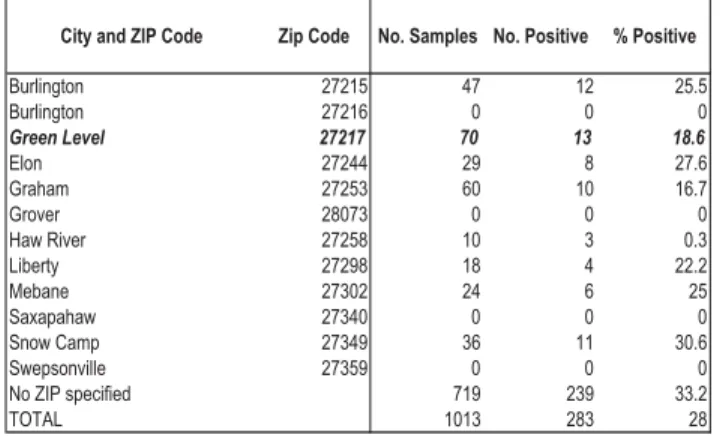
coli-forms” or E. coli. The geographic distribution of the samples positive for total coliforms or E. coli is shown
in Table 1.13
According to this data, the Alamance County areas,
des-ignated by ZIP code, with 25% or more of tested wells
with positive analyses were Elon, Mebane, and Snow
Camp. The highest percentage of positives pertains to a large number of samples for which no speci c ZIP code
was given in the analysis report. Graham and Green
Level had the lowest percent of contaminated wells
in 2002. Green Level had a contamination average of 18.6%, versus the County average of 28%—in spite of
the fact that Burlington and Green Level had the highest
level of testing in the County, for all areas with a
ed zip code.
Additional data from the NC Division of Water
Qual-ity Incident Management Data shows 47 incidences of ground water contamination “incidents” in Alamance
County in the three years from 2000-2002. None of
these occurred in Green Level. The North Carolina
Division of Water Quality Incident Management ce keeps track of leaks and spills of chemicals that
present risks to health. The majority of the incidents
in Alamance County appear to be underground storage
tank (UST) leaks. It should be noted that even “old” incidents can be signi cant because many of the
ma-terials may persist in the environment for years, and,
through leaching, nd their way into ground water that
animals and people contact or consume.14 According to this data, it can be easily argued that Green Level’s
critics are mistaken in their criticisms of the Town’s
wa-ter quality.
Sewer
One of the accusations made against Green Level by
residents of the proposed/new ETJ was that the town
experienced signi cant sewer spills that damaged the watershed, with particular mention of a spill this past
spring into Otter Creek, which drains into Graham
Me-bane Lake, their drinking water reservoir. A March
8 email from Jenny Freeman, NC DENR Winston-Sa-lem Regional Of ce, Division of Water Quality, Water
Quality Section, to McPhatter stated: “….As we
dis-cussed…our of ce received two complaints from
con-cerned citizens regarding your last sewer over ow at the Otter Creek pump station. I assured them that it had
been reported and was only 7,500 gallons, not reaching
surface waters.” Sewage over ows can thus be ruled
out as a signi cant problem.
Taxes
In presenting his petition, Rudd commented, “Green
Level has nothing to offer except taxes.” Neither taxes nor services automatically accompany ETJ extension,
but if a Town involuntarily annexes an area, the Town
must provide services thus subjecting the area to the
City and ZIP Code Zip Code No. Samples No. Positive % Positive
Burlington 27215 47 12 25.5
Burlington 27216 0 0 0
Green Level 27217 70 13 18.6
Elon 27244 29 8 27.6
Graham 27253 60 10 16.7
Grover 28073 0 0 0
Haw River 27258 10 3 0.3
Liberty 27298 18 4 22.2
Mebane 27302 24 6 25
Saxapahaw 27340 0 0 0
Snow Camp 27349 36 11 30.6
Swepsonville 27359 0 0 0
No ZIP specified 719 239 33.2
TOTAL 1013 283 28
Town’s tax rate. In the case of Green Level, Table 2
shows the tax rates and populations of the municipal and county governments in Alamance County grouped
by tax rate.
Green Level has the lowest tax rate in the county for a
town its size, and its utility rates are also low. Most re-cently, in May, 2004, the Town’s application to the Clean
Water Management Trust Fund for a $513,000 grant to
improve its wastewater infrastructure was rejected
be-cause the agency felt that the town had not maximized the monies it could get from its own fees for service.
According to McPhatter, “This grant did not require a
match and it was hoped that this funding would help the
Town repair sewer lines that are between 30-40 years old. Repair of aging lines is imperative for the Town
since in ow and in ltration from rain and other sources
increase the sewer ow, thereby increasing the amount
of money the Town must pay Haw River for wastewa-ter.” The Town was “encouraged to reapply when the
water and sewer rates are complementary with HUC’s
[high unit costs].”15 The Town has spent $20,000
within the last three years to obtain grant funding for water/sewer projects and has committed $10,000 for the
coming scal year for grant applications, according to
McPhatter. Taxes and fees can be ruled out as a serious
problem for those living in the ETJ.
Characteristics of Town and County Residents
In 2000, Green Level residents comprised 1.6% of the
Alamance County’s population of 130,800.16
Interest-ingly, the characteristics shared by the citizens of Green Level and the citizens of the County as a whole are
more notable than their differences.
The economic status of the groups is not markedly dif-ferent. While there are more higher-income residents
in the County as a whole, the majority of both groups
are solidly middle class, making between $35,000 and
$99,999 (62% for the county, 61.4% of Green Level). The median household income for both groups is in the
$30,000s—approximately $39,000 for the County and
$32,000 for Green Level. Most households earn this
money through work, with 79% of County households receiving wages or salaries and 85% of Green Level
households. Only 2 to 3% of either group receives
pub-lic assistance.
The median year houses were built shows little
differ-ence in the age of the housing stock, although those in
Green Level are somewhat newer (1981 versus 1974).
In both cases, more than half the houses have been built since 1970 (56% for the county versus 69% for Green
Level). While the County has more two-bedroom
homes and Green Level has more three-bedroom homes
(56% versus 47%), the County had more four-bedroom homes (9% versus 7%). Less than 2% of both groups
had ve or more bedrooms. Almost all houses have
complete plumbing facilities (more than 99% of both
groups).
There is a difference in family composition, with more
married couples in the County (76%) than Green Level
(57%). That difference is primarily made up of “single female head of household” (18% of the county, 33% of
Green Level), while Green Level households are more
likely to be employed than similar County households
(74% versus 66%). Of the households headed by single men, there is no signi cant difference in employment
status: those in Green Level are just as likely to be
em-ployed (71%) as those in the county (73%).
Municipality Tax Rates per $100
Valuation Population
Ossipee $0.05 996
Swepsonville $0.09 922
Alamance $0.24 310
Green Level $0.25 2,042
Elon $0.37 6,783
Haw River $0.45 1,908
Mebane $0.47 7,284
Graham $0.48 12,833
Gibsonville $0.52 4,372
Burlington .50+.16 downtown 44,917
Alamance Co. $0.52 130,800
The median age of residents of both groups is similar:
36.3 years for the County versus 34.6 years for Green Level, while the median age for the state is between
the two: 35.3 years. The age distribution of Alamance
County differs slightly from Green Level’s age
distribu-tion. Alamance County has a larger proportion of adults of retirement age than the town, but a smaller proportion
of children. Both groups have a similar proportion of
adults of working age (62.1% versus 61.5%). 6.4 % of
County residents are under age 5, versus 6.7% of Green Level residents. 23.8 % of County residents are under
age 18, versus 27.9% of Green Level residents. 14.1
% of County residents are over age 64, versus 10.4% of
Green Level residents.
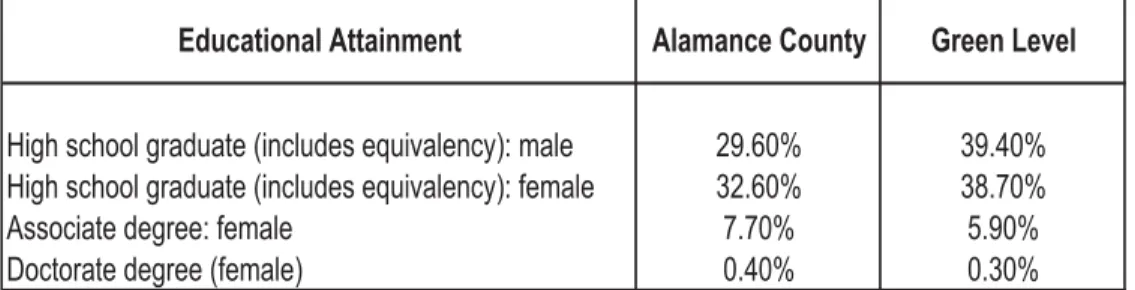
Educational attainment for both groups also shows
some similar characteristics. While more of the County
residents have a B.A., the percentage of those holding other degrees is very similar:
The commuting patterns for both groups are almost
identical:
Housing characteristics are also similar. Most
hous-es in both groups are owner-occupied: 70% for the county and 78% for Green Level. Vacancy rates for
both groups are similar, with Green Level’s somewhat
higher (89% versus 93%), and similar levels of these
vacant houses abandoned (15% of the county’s and 11% of Green Level’s vacant houses).
The great majority of both groups’ households are
comprised of 1 to 4 people (92.4% of the county’s and 86% of Green Level’s households). While the
County has more smaller houses (1-4 rooms), the
ma-jority of both groups’ houses have ve or more rooms
(70% of the County vs. 74% of Green Level). The median number of rooms for both groups is almost
identical (5.2% versus 5.1%).
The type of housing shows some major differences, with 15% of County households living in duplexes
or apartments, versus
2.2% of Green Level
households. The great-est difference in
hous-ing composition is the
percentage of mobile
homes, which com-prises 15% (8,493) of
the County’s housing
stock and 46% (382) of Green Level’s. This is not
especially something the town has encouraged or al-lowed, as the census tracts that Green Level lies in
contained 727 mobile homes in 1989—before Green
Level’s incorporation, when the County held complete
jurisdiction. Note that the census areas are larger than the town of Green Level, and contained 646 mobile
homes in 2000, again pointing out the similarity of
Green Level to its neighbors.17
Lot size is a major difference; Green Level lots are
smaller than the average County lot, although not
smaller than the average lots of other towns in the
Commute Time To/From Work
Alamance
County Green Level
Less than 30 minutes: 74% 75%
30 to 44 minutes: 16% 17%
45 to 59 minutes: 6% 5%
60 or more minutes: 4% 3%
Educational Attainment Alamance County Green Level
High school graduate (includes equivalency): male 29.60% 39.40% High school graduate (includes equivalency): female 32.60% 38.70%
Associate degree: female 7.70% 5.90%
Doctorate degree (female) 0.40% 0.30%
Table 3. Education attainment. Comparison of Ala-mance County and Green Level
County. As Commissioner W. B. Teague said at the
County’s public hearing on amending the Watershed, “I have never received a phone call in my 17 years sitting
in this seat, over any ETJ issue.” With all these
simi-larities between the Town and County and the relative
lack of controversy over previous ETJ extensions, what is different about this case?
According to the November 2003 Alamance County
Community Health Assessment Final Report, “Among all of the locations in Alamance County for which
cen-sus data is collected, Green Level is the only place that
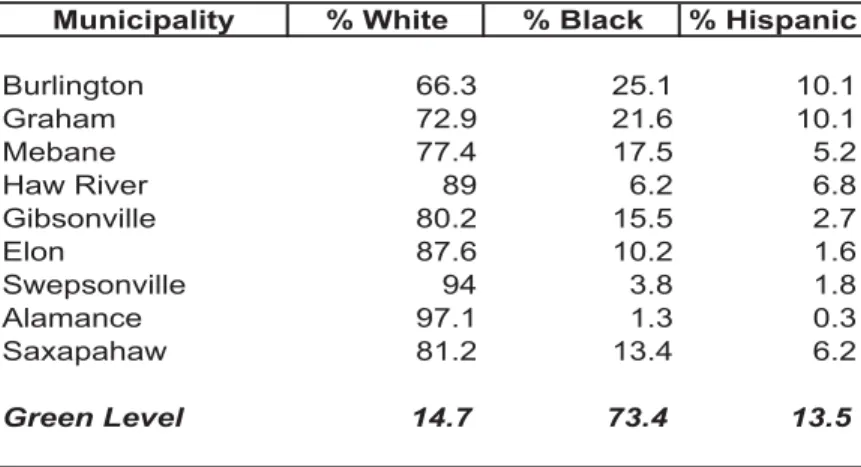
has a majority black or African-American population.”
The Census data presented in Table 5 bears out the unique racial pro le of Green Level.
Jurisdiction, Timing and Authority
Beyond these differences, the County also handled the
case very differently than past ETJ extensions. Green
Level rst took up the subject of ETJ extension in 1991, soon after its incorporation. At that time, the Council
voted to direct the planning board to “proceed
im-mediately with a study of ETJ….”18 Unfortunately,
this study was interrupted by a death on the Planning Board.
Green Level voted to extend an ETJ on August 14, 2003.
According to McPhatter, the Town sent out courtesy
let-ters to the property owners November 26. On Decem-ber 13, 2003, the Town received a letter from County
Attorney advising that the statute “implies directly that
any municipality wishing to extend its ETJ must rst
get the approval of the county.” On January 6, 2004, Green Level’s Town Administrator and Town Attorney
met with the County’s attorney and “pointed out that
they read the statutes differently and noted that the town
is not required to ask for permission for ETJ where the watershed does not exist.” The next day, according to
McPhatter, the Town contacted Elon, Mebane, and
Vil-lage of Alamance, and “learned that they did not ask
for the County Commissioners for permission prior to obtaining ETJ.”19
In response to the complaints they were
hearing, the Commissioners took action that broke precedent. At their regular meeting
on April 5, 2004, the County
Commission-ers set these public hearings for April 19: A
Scattered Site CDBG; Economic develop-ment for a local rm; Amending the
Water-shed Protection Ordinance; and Amending
the Road Naming Ordinance. The
Com-mission also considered 21 other issues. None dealt explicitly with Green Level or
a Rural Communities Zoning District
des-ignation. According to McPhatter, “there was no public
mention of it at the meeting. I was in attendance at this meeting and the public hearing date was approved
under the consent agenda at the 4/5/2004 meeting.” At
a Special Board meeting held later the same morning,
the Board heard a report from Planning Director Craig Harmon, which outlined concerns for the coming year
and the need for a Comprehensive Land Use Plan, and
this report did not mention Green Level or the need for
a “Rural” designation. Harmon reported that this meet-ing concerned only scal year 2004/2005, and that the
Green Level matter was current business.
Municipality % White % Black % Hispanic
Burlington 66.3 25.1 10.1
Graham 72.9 21.6 10.1
Mebane 77.4 17.5 5.2
Haw River 89 6.2 6.8
Gibsonville 80.2 15.5 2.7
Elon 87.6 10.2 1.6
Swepsonville 94 3.8 1.8
Alamance 97.1 1.3 0.3
Saxapahaw 81.2 13.4 6.2
Green Level 14.7 73.4 13.5
On April 19, 2004, the Commissioners voted
unani-mously to amend the Watershed Protection Ordinance as a method of zoning the land around Green Level. If
the courts determined that this was the equivalent of a
zoning, then it meant that Green Level must get
permis-sion from the County to extend its ETJ and the Town of Green Level would have to decide whether to challenge
the legality of the County’s action by ling a lawsuit.
Or, since Green Level went ahead and approved its ETJ,
the County may elect to le suit against Green Level to declare the town’s action invalid. The question of each
jurisdiction’s authority in this case is unclear.
Accord-ing to North Carolina Institute of Government attorney
David Owens: “This question does not have an abso-lutely clear answer as far as I know.”
The timing of the County’s action “appears to be
moti-vated by the fact that [the applicable state statute] says that towns don’t have to seek permission from the
Coun-ty to extend an ETJ if there’s no zoning ordinance,”
ac-cording to Eric Braun, an attorney hired by Green
Lev-el. Braun faults the County’s action for being “written without having a study of whether or not this should be
done,” according to The Alamance News.
Neither the minutes of the Alamance County Commis-sioner’s January, February, and March meetings, nor the
minutes of the County’s Special Meeting held on April
5, 2004—characterized by County Planning Director
Harmon as concerning only the coming 2004/2005 bud-get year—mention the Watershed Amendment, zoning
the area around Green Level, or Green Level’s ETJ. Yet
the County Planning Board considered the Amendment
to the Watershed Protection Ordinance earlier in April and recommended approval. In spite of the County’s
action, “The Green Level Town Council held a public
hearing to consider establishing the ETJ and the
appli-cation of Green Level zoning classi appli-cations to the af-fected properties on Thursday, April 22, 2004,”
accord-ing to Green Level Online.20 “… [T]he Town Council
voted 4-1 to adopt the ETJ Boundary Ordinance and
application of Green Level zoning classi cations to the
affected properties.”21 On June 18, 2004, Green Level led suit against the County for a declaratory judgment
to decide the issue. The speed with which the County
acted to halt Green Level’s actions may have precluded
a thorough look at the situation, but the facts may re-ceive a thorough airing in the court.
Conclusion
Our study nds that Green Level’s attempt to extend an ETJ does not differ substantially from similar efforts
by other towns in the County to expand their ETJs. In
fact, the only major discrepancies appear to be
relat-ed to differences in living conditions in Green Level. Speci cally, there are three major differences between
the citizens of the town and those who oppose a Green
Level ETJ:
1. As with most towns when compared with rural areas,
Green Level’s housing pattern has higher density than
exists in the surrounding area;
2. The town contains a higher percentage of mobile
homes than does the surrounding area, though these
were present before the town’s incorporation, when the
County controlled land-use; and
3. Green Level is predominantly African-American
(74%) and Latino (13.5%), while the County is
pre-dominantly white (75%). The Town of Alamance has a higher percentage of land under its jurisdiction in its
ETJ than Green Level proposes, but it encountered no
County opposition, and, notably, the Town of Alamance
is almost entirely white.
Since ETJs were instituted by the state to accomplish
exactly what Green Level is trying to accomplish, we
must conclude that the extreme opposition by County citizens who do not live in the proposed ETJ—and the
reaction of the County Commissioners to pre-empt that
Endnotes
1 Harmon, Craig, Alamance County Planning Director,
interview by Ann Moss Joyner, May 13, 2004.
2 Accessed online at http://www.alamance-nc.com/
commissioners/index.html.
3 Owens, David. (1998). Extraterritorial Zoning
Au-thority. Chapel Hill: Institute of Government, The
University of North Carolina at Chapel Hill.
4 Letter from David Beal, Haw River Town Manager to
Quentin McPhatter, Green Level Town Manager. 5 Accessed online at http://www.usc.edu/schools/sppd/
lusk/press/item.
6 McPhatter, Quentin. (2004, May 10). Email from
Kathy Holland, email from Kathy Holland of Alamance
County Board of Elections.
7 Joyce, Bob. (2004, June 15). Email from Bob Joyce,
Professor of Public Law and Government, UNC
Insti-tute of Government.
8 McPhatter, Quentin. (2004, May 27). Letter from
David Fields Sr., Sen. Dole’s of ce. 9 McPhatter, Quentin, July 3, 2004.
10 NC General Statute §160A-360.
11 Alamance County Board of Commissioners. (2004).
Agenda Item Pro le for Public Hearing, April 19. 12 Alamance County Health Department. (2003,
No-vember). Final Report, Alamance County Health
As-sessment. accessed online at
http://www.alamance-nc.com/healthed/assess.htm.
13 North Carolina State Laboratory for
Pub-lic Health. (2004, July 25). Accessed online at
http://204.211.171.13/EnvironmentalSciences/Micro-biology/TestResult.asp.
14 Alamance County Community Health Assessment
Final Report. (2003, November). Data from the NC
Division of Water Quality Incident Management Data,
Wilmington Regional Of ce. Accessed online at http:// gw.enhr.state.nc.us/database/gwdata2.htm.
15 McPhatter, Quentin. (2003). Letter from Bill
Hole-man, Exec. Dir., Clean Water Management Trust Fund,
May 11, 2003.
16 All demographic statistics in this report are taken
from US Census 2000, Summary File 1.
17 Block Groups 1 and 2, Census Tract 212.01,
Ala-mance County, North Carolina: comprising the area from NC 49 to Sandy Cross Road to the Haw River to
Haw River/Hopedale Road to Keck Road to Isley Road,
and from Mebane Rogers Road to Bason Road to Back
Creek to NC 49.
18 Town of Green Level, “Minutes of Town Meeting”,
January 31, 1991 and February 14, 1991.
19 McPhatter, Quentin, interview by Ann Moss Joyner,
April 3, 2005.
20 Accessed online at http://www.greenlevelnc.com/
jobs.html. 21Ibid.
Who can help with these issues?
The UNC Center for Civil Rights, based out of the UNC-Chapel Hill Law School, is an organiza-tion broadly committed to improving social jus-tice and advancing the civil rights of minorities and other groups whose rights have been margin-alized. Through research and outreach, the Cen-ter connects communities with current legal and academic resources for addressing social justice-related planning issues. Focusing its efforts on communities in the American South, the Center has helped a number of municipalities grapple with dif cult topics, such as ETJ issues, voting rights, income tax credit programs, and poverty concerns. Its expertise in these areas can provide planners with valuable insights, options, and ac-tion steps for addressing the speci c problems facing their communities.