Clot Warriors: Using Medical Students for Improved HA-VTE Prophylaxis
By
Max Nagle
A Master’s Paper submitted to the faculty of the University of North Carolina Gillings
School of Global Public Health in partial fulfillment of the requirements for the degree of Master of Public Health in the Public Health Leadership Program.
ABSTRACT
Introduction: Health care-associated venous thromboembolism (HA-VTE) leads to significant costs, morbidity, and mortality. Health care systems can prevent these patient safety events using prophylactic methods and systems of care. Medical students could help identify patients requiring HA-VTE prophylaxis on the wards. This paper expounds a research study design for a patient safety educational intervention involving medical students in this role.
Methods: We will give third-year medical students on inpatient medicine rotations a card to carry in their white coats to help remind them of VTE risk stratification, prophylaxis choice, and words to use with superiors when safety issues arise. This will be incorporated into a series of lectures given during the rotation, covering topics such as VTE prophylaxis, patient safety, systems thinking, and navigating hierarchies. Medical students will bring their knowledge and their cards onto the wards, enabling them to raise patient safety concerns regarding VTE prophylaxis to their teams. Students will then submit descriptions of the “near miss” events. We will also assess changes among medical students in attitude and self-reported knowledge through the Attitudes to Patient Safety Questionnaire.
ACKNOWLEDGEMENTS
I would like to thank Dr. Sue Tolleson-Rinehart and Dr. Amy Shaheen for their
assistance in editing this paper and designing this project, along with their constant encouragement and support. I could not have asked for two more caring and
knowledgeable advisors for this project.
I would also like to thank Dr. Jamison Chang and Dr. Carlton Moore. I have worked with
them on a quality improvement project for preventing hospital-acquired venous
thromboembolism over the past year. Their mentorship has been indispensable in my
Table of Contents
ABSTRACT ii
ACKNOWLEDGEMENTS iii
INTRODUCTION 1
METHODS 5
DISCUSSION 11
CONCLUSION 13
REFERENCES 14
APPENDIX 1: Limited Systematic Review 17
INTRODUCTION 17
METHODS 17
RESULTS 18
APPENDIX 1A: PICOTS table. 21
APPENDIX 1B: Search strategies for PubMed and Cochrane. 22
APPENDIX 1C: AMSTAR-2 checklist. 23
APPENDIX 2A: Pre-Program Survey 24
INTRODUCTION
Medical Error: HA-VTE
Health care-associated venous thromboembolism (HA-VTE) poses a significant public health problem. Comprising deep vein thrombosis and pulmonary embolism, HA-VTE is “the most common preventable cause of hospital death.” 1 Nearly 900,000
Americans experience VTE each year, causing 100,000 deaths and $10 billion in costs.2 Over half of incident VTE are associated with hospitalization or surgery, making
this a particular challenge for designing health care delivery systems.2
For at-risk hospitalized patients, HA-VTE can be prevented through the use of chemical and mechanical prevention. Chemical prophylaxis can reduce HA-VTE “by
30-65 percent.” 3 Unfortunately, health care systems do not consistently use these
preventive methods. The Centers for Disease Control and Prevention estimates 70% of
HA-VTE could have been prevented and fewer than half of at-risk hospitalized patients receive appropriate prophylactic measures.2
Gaps in the evidence regarding HA-VTE prophylaxis account for some of this preventable error. Clinical practice guidelines are inconsistent, numerous, and limited to particular clinical settings (e.g., surgical specialties). Additionally, numerous risk
stratification methods exist without consensus as to which is most appropriate to use. Complicating the issue, HA-VTE prophylaxis can cause such harms as “discomfort, bleeding, [and] expense.” 3 As a result, providers may experience difficulty
understanding how best to prevent VTE in their patients.
As the seminal “To Err is Human” report argues, medical errors such as HA-VTE
largely result from faulty systems.4 For reference, the Institute for Healthcare
Improvement defines a system as “a set of interdependent elements interacting to achieve a common aim,” taking “inputs and transform[ing] them into outputs through a process or a series of processes.” 5 Contributing factors to this source of preventable
error include fragmented health care delivery and minimal teaching on the prevention of medical errors.4 It is important to emphasize that threats to patient safety commonly
result from the complexity of health care systems, not simply from the vigilance of a single health care provider. Therefore, patient safety initiatives underscore fostering a
culture of team-based delivery of care, recognizing that clinical and non-clinical members of varying backgrounds can contribute to minimizing medical errors.6
An often-underused member of the patient safety health care team is the medical
student. Carrying a lighter patient load than that of resident or attending physicians, medical students can provide greater attention towards safety measures and individual
patients, along with redundant oversight that may lead to identifying or preventing errors.7 Interviews with clinic site leaders suggest the leaders are receptive towards
medical students in systems roles that add value to health care delivery, for activities
that benefit both patients and the operation of clinics.8
Opinions in the literature critique the current medical education curriculum in
patient safety. Noting the challenges of health care delivery, Lin, Schilinger, and Irby note that medical students are prepared to interact “with patients, but not with teams and systems.” 9 Gonzalo, Haidet, and Wolpaw call for future medical education
experiences.10 This shift in emphasis to incorporating systems-based thinking reflects
the changing landscape of delivering health care and practicing medicine.11 To provide
a working definition, systems thinking involves evaluating the “relationships between parts of a system and how they connect” with a goal of “understand[ing] patterns over time.” 12 As an additional challenge, medical students must learn to navigate hierarchies
in health care teams to voice concerns for patient safety. Medical students are reluctant to question senior staff regarding patient safety procedures such as hand washing,
thinking their superiors would be annoyed or irritated by such remarks. This is despite the students acknowledging the importance of hand washing in preventing patient
harm.13 Learning to navigate hierarchies is imperative for medical students’ ability to
work effectively within systems.
In this research protocol, I explicate a systems role for medical students in
preventing HA-VTE as they participate on medical inpatient teams. We will educate medical students about patient safety, systems thinking, navigating team hierarchies,
VTE risk assessment, and appropriate VTE prophylaxis. The intervention will include three lectures over eight weeks, online resources, and “Clot Warrior” cards for the
medical students to keep in their white coats. Using these various resources, medical students will have a structured way of intervening during their team’s daily rounds for
patients receiving inappropriate or inadequate VTE prophylaxis. I hypothesize that using medical students in this capacity will result in the identification of “near miss” events,
which occur when the medical team commits an error or omits care that results in no
receiving appropriate VTE prophylaxis, leading to lower VTE rates. This represents our attempt to demonstrate that medical students can improve patient safety outcomes.
Prior to discussing the methods involved in this protocol, I provide a brief
overview of the literature on patient safety education interventions in medical students,
with particular attention to whether these interventions evaluated patient outcomes. Prior Literature
Presently, medical student exposure to patient safety is typically performed via
knowledge-based (e.g., lecture series) as opposed to application-based interventions.15
A systematic review performed in 2015 analyzed outcomes of patient safety educational
interventions in medical students and resident physicians. Eleven of the twenty-six studies involved medical students. The outcomes of these studies focused largely on student attitudes and knowledge acquisition regarding patient safety. The authors note
that the studies generally produced significant improvement from pre- to
post-intervention in attitudes, knowledge, and self-reported behavior changes; as well, the
studies reported generally high ratings of satisfaction among medical students.16
However, none of the included studies attempted to link patient safety
educational interventions to patient outcomes.16 I conducted a limited systematic review
to evaluate the literature published since the 2015 systematic review. I investigated whether studies on patient safety interventions for medical students reported outcomes
related to patient outcomes. A PubMed and Cochrane search returned no published studies discussing a connection between these educational interventions and patient
address. The methods and findings of the limited systematic review are discussed further in Appendix 1.
Outside the patient safety realm, various studies analyze interventions for medical students in improving patient outcomes. A systematic review of studies
involving medical students in patient education in 2017 found eighteen publications. The review finds that patient education from medical students can improve quality of care, with three studies demonstrating improvement in disease management and one in
medication adherence. The studies from the review also suggest such experiences enhanced student education.17 Additionally, a 2002 study on quality improvement
initiatives led by medical students “at 24 community-based primary care practices”
demonstrates a statistically significant improvement in baseline hemoglobin A1c among patients with diabetes mellitus, from 7.71% to 7.22%.18
In sum, though other interventions involving medical students have improved patient outcomes, patient safety interventions for medical students have not linked
interventions to improvements in patient outcomes. To extend the literature, this study attempts to demonstrate that medical students can improve patient outcomes for HA-VTE prophylaxis in a structured patient safety educational intervention.
METHODS
This project is part of a larger ongoing quality improvement (QI) project at
For this project, we aim to educate medical students about patient safety, VTE prophylaxis, and navigating hierarchies in medical teams. Using this knowledge,
medical students will then have training to evaluate whether patients on their clinical teams have appropriate VTE prophylaxis ordered. Additionally, students will have the
skills and confidence to voice their concerns on VTE prophylaxis. We hypothesize that this intervention will (1) improve medical students’ attitudes to and knowledge of patient
safety and (2) increase the identification of near miss events for patients receiving
inappropriate VTE prophylaxis Population
Third year medical students completing their inpatient adult medicine rotations at UNC hospitals will undergo the educational intervention. This rotation is part of a four-month block divided between inpatient surgery and medicine rotations. Members of the
project team obtained permission from clerkship directors prior to designing this
curriculum. I am presently drafting an application to the UINC Institutional Review Board
for approval to conduct the study. The patients of interest include those for whom care would be provided by clinical teams that include third-year medical students.
Intervention
The educational intervention involves the distribution of two different resources to the medical student: (1) a series of lectures and (2) an informational card for the
medical students to carry with them on rounds.
The students have a total of three lectures during their eight-week inpatient
the Department of Family Medicine. The other two lectures teach patient safety and errors from a systems approach. The first is largely didactic, providing an introduction to
accident theory and safety principles in health care. The second serves as a structured reflection session for the students regarding any patient safety events they experienced.
This is taught by the Head of Healthcare Engineering Division, who has a doctorate in industrial and management engineering.
A fourth-year medical student will introduce the intervention to the third-year
medical students during the first week of the rotation. This student educator, also author of this master’s paper, obtained a Master in Public Health during medical school, has
training in patient safety and quality improvement, and served on the aforementioned VTE QI project. The team decided that his role as presenter would help the medical students relate to the project, especially since he could provide personalized experience
of navigating hierarchies. The three lectures take place at varying points during the rotation block based on instructor availability; therefore, the third-year medical students
will receive the intervention during the earliest available lecture, but a goal for the sequence of the lectures is to present the VTE learning in Week 1 of the rotation, the first safety lecture in Week 3, and the second safety lecture in Week 6 or Week 7. .
We designed the card for medical students to keep in the pockets of their white coats for easy reference during clinical team rounds. The front of the card includes the
risk factors used in the IMPROVE risk assessment model for VTE risk among medical (i.e., non-surgical) inpatients, guidance for stratifying patients as high or low risk, and
guidance for choice of prophylactic medication.19 The IMPROVE risk assessment model
one of the risk assessment models now required for admission documentation in calculating the VTE-6 quality measure.3,20 The front also includes a list of bleeding risk
contraindications to VTE prophylaxis, derived from an Agency for Healthcare Research and quality guidance document. The back of the card includes guidance for voicing
patient safety concerns derived from TeamStepps material.21 It also includes
instructions for how to submit near miss events for the study, further discussed below. We plan to distribute these to medical students along with a description of the project in the first week of the students’ rotation.
We will encourage medical students first to consider voicing their VTE
prophylaxis concerns on team rounds. However, we realize this may not be feasible. A second option for voicing their concerns includes doing so to residents during
unstructured time through the day. As a third option, we will encourage the medical
student to identify the clinical pharmacist covering their team and to either voice concerns in person or through an Epic message to the covering pharmacist.
Over the course of their inpatient medicine rotations, we will encourage medical students to submit near miss events to the writer of this paper and the organizer of this project. We will use Epic messages for submission of these events. We will ask
students to describe the situation (i.e., patient VTE risk and prophylaxis) along with how their team responded (e.g., team accepted medical student suggestion to start heparin).
We will emphasize to the medical students that this information should not include protected health information. The study coordinator will then submit these events into “Good Catch” software, which was developed by the Division of Healthcare Engineering
We plan to have students competing in “Clot Warriors Teams,” dividing up the
cohort such that no medical students on the same clinical team are in direct
competition. We are currently developing an incentive for the student team that completes the largest number of submissions over the course of a rotation block; this
may involve a lunch with health system leadership.
Additionally, we will give students access to the UNC VTE guidelines for reference. These were initially developed in 2014 by a hematologist and critical care
pharmacist at UNC, reflecting literature through 2012. These guidelines are currently being updated by the writer of this master’s paper, a pharmacist, and a pharmacy intern
with an expected completion date in Fall 2018. Outcomes
Our study has two primary outcomes: (1) the number of near miss submissions,
and (2) medical student attitudes toward and knowledge of patient safety. Student-related outcomes.
We will survey students’ attitudes to patient safety and self-reported knowledge
of patient safety twice: once at the beginning of their rotation and again at the end of their eight-week rotation block for adult inpatient medicine. We plan to use the Attitudes
to Patient Safety Questionnaire.22 The survey was developed to assess changes in
medical students’ attitudes and self-reported knowledge from patient safety education
interventions. Additionally, we will ask students in the second survey about their satisfaction with the project (on a scale of 0 to100), the number of submissions they
available in Appendix 2. We will emphasize that student surveys are de-identified and will not be linked to their performance evaluations. We will attempt to link student’s
surveys before and after the intervention using a series of three questions (e.g., “What is your father’s middle name?”) so we can analyze changes in individual students while
preserving their anonymity. However, we will also plan to present survey results in aggregate.
Patient-related outcomes.
For our patient-related outcomes, we will use the proxy of near miss events. We use this for its analytical simplicity, as a near miss represents a patient safety error
recognized before patient harm occurs.14 We plan to collect this variable in a dynamic
fashion. As we will conduct this study over a number of rotation blocks, this will allow us to visualize the number of submissions by students over time.
Proposed Secondary Analyses
In addition to the outcomes mentioned above, we propose a number of
secondary analyses. For student-related outcomes, we plan to analyze the in-depth, open-ended survey responses for themes of what the medical students observed about patient VTE risk along with how the teams responded to the intervention from the medical student’s perspective. For patient-centered outcomes, we plan to conduct a
chart review to evaluate the percentage of appropriate VTE prophylaxis administered to
a randomly selected sample patients cared for by clinical teams with medical students. We define “appropriate” prophylaxis as methods that adhere to the UNC VTE guidelines
DISCUSSION
This study is a patient safety educational intervention. It provides medical
students with a semi-structured role in voicing patient safety concerns regarding VTE prophylaxis risk. After noting a gap in the literature regarding patient safety educational
interventions leading to patient benefit, we believe this study represents a first step in linking such interventions to patient outcomes, even if this is accomplished by proxy through near miss events.
The design process went through a number of iterations prior to its present form. As third-year medical students at UNC, students rotate through inpatient medicine and
surgery rotations as part of a four-month block. Students switch between medicine and surgery after two months, which creates a natural crossover design. However, we decided to target the intervention to medicine inpatients, as the students on the surgery
rotation would not serve as apt comparators in a crossover study given their exposure to VTE prophylaxis principles.
We discussed the intervention with a number of medical students during the design process. The feedback was generally positive, that medical students would be generally willing to participate in the study. They voiced two primary concerns, which
were (1) that it would reflect poorly on their performance evaluation and (2) they would not have the information necessary to discuss VTE prophylaxis on the teams. We feel
that the informational card allays the latter concern. We will address the former concern in introducing the project, noting that students have numerous routes for voicing their
We also had a medical student try the intervention over the course of a week on her medicine team. She noted that it fit well in her daily workflow, and she felt prepared
to voice concerns regarding VTE prophylaxis to the team. However, she found no patients with inappropriate prophylaxis over the course of the short QI cycle.
Based on chart review with the QI team, we found that around zero to two patients daily on services staffed by hospitalists do not receive appropriate VTE prophylaxis. However, we anticipate that teaching services have fewer patients with
inappropriate VTE prophylaxis, due to the vigilance of resident physicians. We expect this would halve our estimations derived from the hospitalist services for the medical
student intervention. We aim for student teams to submit 2 near misses per week or 8 near misses per month.
Separately, we think the students using IMPROVE as the method for risk
stratifying patients represents a future direction of medicine. The Joint Commission recently announced that its VTE-6 quality measure would require documentation of one
of three risk assessment models in the admission order set.20 The IMPROVE model,
which appears on our intervention card, is one of those three models.19 This intervention
may help medical students acclimate to the future direction of medicine, with the
integration of risk prediction models into clinical practice. This is not currently in Epic at UNC; as part of the larger QI project, we are trialing the introduction of a VTE risk
prediction model into the admission order sets. Limitations
as preventing deep vein thrombosis or pulmonary emboli. We felt that our study would not achieve sufficient power to demonstrate a change in these levels based on the rate
of VTE on teaching services. Separately, we could have measured the intermediate outcome of whether this intervention increased the percentage of patients receiving appropriate prophylaxis. However, judging “appropriate” prophylaxis would require
extensive retrospective chart review, which we propose as a task we could complete in a later secondary analysis.
As well, in its present design, the study does not engage in a broader discussion of the potential harms of VTE prophylaxis. A recently published research letter
estimates that rates of excess or unnecessary prophylaxis in the Michigan Hospital Medicine Safety Consortium is 65.3%.23 Excess prophylaxis may make patients more
prone to the harms of anticoagulants, such as heparin-induced thrombocytopenia or
bleeding events. We may consider incorporating this concept further in a future iteration of the project.
CONCLUSION
The Clot Warriors study design is a patient safety educational intervention for medical students to identify patients with inappropriate VTE prophylaxis. We hope to demonstrate patient benefit through students capturing “near miss” events. The study
REFERENCES
1. Centers for Medicare & Medicaid Services. CMS Measure Fact Sheet - VTE. 2013;86(1):1-4.
2. Centers for Disease Control and Prevention. Healthcare-Associated Venous Thromboembolism. CDC.gov 2018. Available at:
https://www.cdc.gov/ncbddd/dvt/ha-vte.html#ref. Accessed February 27, 2018. 3. Maynard G. Preventing Hospital-Associated Venous Thromboembolism: A Guide
for Effective Quality Improvement. 2nd ed. Rockville, MD: Agency for Healthcare Research and Quality; 2016.
4. Institute of Medicine. To Err Is Human: Building a Safer Health System. Washington, D.C.: National Academy of Sciences; 1999.
5. Institute for Healthcare Improvement. Want a New Level of Performance? Get a New System. Institute for Healthcare Improvement: Improvement Stories 2018. Available at:
http://www.ihi.org/resources/Pages/ImprovementStories/WantaNewLevelofPerfor manceGetaNewSystem.aspx. Accessed April 11, 2018.
6. WHO Patient Safety. WHO Patient Safety Curriculum Guide for Medical Schools. World Health Organization; 2009.
7. Seiden SC, Galvan C, Lamm R. Role of medical students in preventing patient harm and enhancing patient safety. Qual. Saf. Health Care 2006;15(4):272-276. doi:10.1136/qshc.2006.018044.
8. Gonzalo JD, Graaf D, Johannes B, Blatt B, Wolpaw DR. Adding Value to the Health Care System: Identifying Value-Added Systems Roles for Medical Students. Am. J. Med. Qual. 2017;32(3):261-270.
doi:10.1177/1062860616645401.
9. Lin SY, Schillinger E, Irby DM. Value-added medical education: engaging future doctors to transform health care delivery today. J. Gen. Intern. Med.
2015;30(2):150-151. doi:10.1007/s11606-014-3018-3.
10. Gonzalo JD, Haidet P, Wolpaw DR. Authentic clinical experiences and depth in systems: toward a 21st century curriculum. Med. Educ. 2014;48(2):104-105. doi:10.1111/medu.12400.
11. Lucey CR. Medical education: part of the problem and part of the solution. JAMA Intern. Med. 2013;173(17):1639-1643. doi:10.1001/jamainternmed.2013.9074. 12. West of England Academic Health Science Network. What is systems thinking?
academy/improvement-resources-and-tools/the-improvement-journey/steps-in-the-improvement-journey/step-3-plan-the-changes/what-is-systems-thinking/. Accessed April 11, 2018.
13. Samuel R, Shuen A, Dendle C, Kotsanas D, Scott C, Stuart RL. Hierarchy and hand hygiene: would medical students speak up to prevent hospital-acquired infection? Infect. Control Hosp. Epidemiol. 2012;33(8):861-863.
doi:10.1086/666634.
14. AHRQ Patient Safety Network. Adverse Events, Near Misses, and Errors. Agency for Healthcare Research and Quality 2017. Available at:
https://psnet.ahrq.gov/primers/primer/34/adverse-events-near-misses-and-errors. Accessed June 6, 2018.
15. Farnan JM, Gaffney S, Poston JT, et al. Patient safety room of horrors: a novel method to assess medical students and entering residents’ ability to identify hazards of hospitalisation. BMJ Qual. Saf. 2016;25(3):153-158.
doi:10.1136/bmjqs-2015-004621.
16. Kirkman MA, Sevdalis N, Arora S, Baker P, Vincent C, Ahmed M. The outcomes of recent patient safety education interventions for trainee physicians and medical students: a systematic review. BMJ Open 2015;5(5):e007705.
doi:10.1136/bmjopen-2015-007705.
17. Vijn TW, Fluit CRMG, Kremer JAM, Beune T, Faber MJ, Wollersheim H. Involving medical students in providing patient education for real patients: A scoping
review. J. Gen. Intern. Med. 2017;32(9):1031-1043. doi:10.1007/s11606-017-4065-3.
18. Gould BE, Grey MR, Huntington CG, et al. Improving Patient Care Outcomes by Teaching Quality Improvement to Medical Students in. Academic Medicine
2002;77(10):1011-1018.
19. Center for Outcomes Research, University of Massachusetts Medical School. Welcome to IMPROVE. International Medical Prevention Registry on Venous Thromboembolism (IMPROVE) 2018. Available at: http://www.outcomes-umassmed.org/improve/. Accessed April 17, 2018.
20. The Joint Commission. Release Notes v5.4. The Joint Commission; 2017. Available at:
https://www.jointcommission.org/assets/1/6/HIQR_Release_Notes_5_4.pdf. Accessed June 7, 2018.
22. Carruthers S, Lawton R, Sandars J, Howe A, Perry M. Attitudes to patient safety amongst medical students and tutors: Developing a reliable and valid measure.
Med. Teach. 2009;31(8):e370-6. doi:10.1080/01421590802650142.
23. Grant PJ, Conlon A, Chopra V, Flanders SA. Use of venous thromboembolism prophylaxis in hospitalized patients. JAMA Intern. Med. 2018.
doi:10.1001/jamainternmed.2018.2022.
APPENDIX 1: Limited Systematic Review
Patient Safety Educational Interventions for Medical Students Affecting Patient Outcomes: A Limited Systematic Review
INTRODUCTION
I conducted this systematic review to accompany the research design for the Clot Warriors study. The study coordinators were interested in what the literature says about
patient safety education interventions for medical students that confer patient benefit. I hypothesize that few, if any, studies exist measuring how such interventions affect patient care. This systematic review aims to answer this question.
METHODS
I developed a protocol for the inclusion and exclusion criteria. The PICOTS table
is available in Appendix 1a. This study is not formally registered and was not funded, as it was completed as part of my Master’s paper for educational purposes.
The key question for the limited systematic review investigated patient safety
educational interventions compared to no intervention. The intended study population is medical students, excluding studies involving other medical trainees such as resident
physicians. A best available evidence approach was used, considering a prior
systematic review noted the heterogeneity of study designs available studying patient
safety education interventions.16 The outcome of interest includes any measure
reflecting that the intervention affected patient care. This could include mortality, morbidity, or prevention of patient safety events (e.g., “near misses”).
physicians. Their search strategy spanned through May 2014.16 This systematic review
searches for studies published from May 2014 to June 2018.
I conducted a search of PubMed and Cochrane databases (Appendix 1b), using Medical Subject Headings (MESH) terms available for medical students and patient safety. I combined the two MESH terms using the Boolean operator ‘and.’ I also
conducted a search of unpublished trials on Clinicaltrials.gov using these two terms as keywords. I screened results first through title and abstract review, followed by full text review. I planned to also conduct a “hand search” of references in included studies. I
was the sole investigator for this review.
Given the broad outcome definition for this review and the anticipation of few studies meeting inclusion criteria, I planned a descriptive summary of results from included studies. This would include describing intervention characteristics,
patient-related outcomes, and risk of bias of included studies using validated critical appraisal tools appropriate to the study design. Unfortunately, no studies from the search met
inclusion criteria. As such, I will provide a descriptive summary of the systematic review published in 2015, including its discussion of patient-related outcomes and an
evaluation of its risk of bias using the AMSTAR-2 criteria.24
RESULTS
PUBMED and Cochrane were searched on May 29, 2018 using MESH terms for
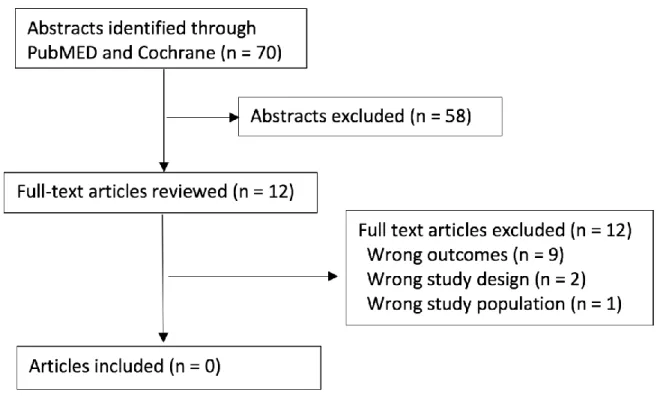
medical students and patient safety. 70 articles were found and included in title & abstract review, with no duplicates across databases. 12 articles were evaluated for full
Additionally, a search of Clinicaltrials.gov yielded 2 unpublished trials. Both of these were not applicable to this review because of incorrect outcomes.
Figure 1: Evidence search diagram.
As previously mentioned, Kirkman, Sevdalis, Arora, et al. published a systematic
review on this topic in 2015. In their systematic review of patient safety education interventions among both medical students and physician trainees, they find no studies demonstrating “patient benefit” – which I refer to in this review as a patient-related
outcome.16 Their review included 11 total studies involving medical students. Using the
AMSTAR-2 checklist for assessing the risk of bias of systematic reviews, I rate the 2015
review as having moderate risk of bias overall (Appendix 1c).24 The authors posit its
methodological difficulties stemmed from conducting reviews on education
individual studies; rather, they use these characteristics to describe the state of the literature in aggregate. Separately, I rate the 2015 review as having moderate risk of bias regarding the author’s search strategy to uncover studies revealing patient-related
outcomes. This primarily arises from no searches of registries or the grey literature;
APPENDIX 1A: PICOTS table.
Population Medical students
Exclude: Other medical trainees
Intervention Patient safety educational intervention
Comparator No intervention
Outcome Patient-related outcomes (i.e., mortality,
morbidity, near miss)
Exclude: knowledge, attitudes/perceptions
Timing Studies published since prior systematic
review (May 2014)
Study Design Best available evidence (reviews, trials,
APPENDIX 1B: Search strategies for PubMed and Cochrane.
PubMed:
APPENDIX 1C: AMSTAR-2 checklist. Question # & Brief
Descriptor
Fulfilled?
(Yes/Partial Yes/No)
Comments
#1 – Include PICO Yes
#2 – Prespecified Partial Yes Prespecified, but no independent verification stated
#3 – Study design selection Yes
#4 – Comprehensive search Partial Yes Performed hand search, but did not extend to grey literature or
registries
#5 – Duplicate selection Yes
#6 – Duplicate extraction No Not stated how data was extracted by reviewer(s)
#7 – Describe excluded Yes
#8 – Describe included Yes
#9 – Risk of Bias (RoB) technique
Partial Yes Per authors - difficulties with standards for evaluating RoB in educational interventions. Cited tool, but tool did not provide “checklist”
#10 – Studies funding No
#11 – MA combination N/A
#12 – MA RoB addressed N/A
#13 – RoB Individual No Described in aggregate to
characterize the field. RoB
discussion not applied to individual studies.
#14 - Heterogeneity Yes
#15 – Publication bias N/A
APPENDIX 2A: Pre-Program Survey
Clot Warriors PRE Survey
Start of Block: Default Question Block
We are glad you have chosen to participate in Clot Warriors! We believe we should engage in rigorous evaluation of this program, and that includes asking you to complete a survey before and after the program. We hope you will enjoy, and learn from the surveys as well as from the program.
Your answers will be anonymous, but you will find some silly questions at the end. Please answer them! Their purpose is to help us link before and after responses at the individual level without sacrificing your anonymity in any way.
The whole purpose of the survey is to gauge your attitudes & knowledge about patient safety using the Attitudes to Patient Safety Questionnaire, along with your perception of the program. We believe this survey will only take a few minutes. We thank you very much for participating in it!
We'll distribute this survey again at the conclusion of the curriculum.
Please click one of the choices below to begin!
o
I will complete the survey (1)o
I DECLINE to complete the survey (2)Skip To: End of Survey If We are glad you have chosen to participate in Clot Warriors! We believe we should engage in rigo... = I DECLINE to complete the survey
Attitudes to Patient Safety (Part 1/4) This questionnaire has 26 items to evaluate medical student's attitudes about patient safety issues & training.
1 (1) 2 (2) 3 (3) 4 (4) 5 (5) 6 (6) 7 (7)
My training is preparing me to understand the causes of
medical errors. (1)
o
o
o
o
o
o
o
I have a good understanding
of patient safety issues as a result of
my undergraduate
medical training. (2)
o
o
o
o
o
o
o
My training is preparing me to prevent
medical
errors. (3)
o
o
o
o
o
o
o
I would feel comfortable reporting any
errors I had made, no matter how
serious the outcome had
been for the patient. (4)
o
o
o
o
o
o
o
I would feel comfortable reporting any errors other people had made, no matter how serious the outcome had
been for the patient. (5)
I am confident I could talk openly to my
supervisor about an error I had made if it had resulted in potential or actual harm to my patient. (6)
o
o
o
o
o
o
o
Attitudes to Patient Safety (Part 2/4) Please select the number that best reflects your opinion.
1 (1) 2 (2) 3 (3) 4 (4) 5 (5) 6 (6) 7 (7)
Shorter shifts for doctors will reduce medical errors. (1)
o
o
o
o
o
o
o
By not taking regular breaks during shifts doctors are at an increased risk of making errors. (2)
o
o
o
o
o
o
o
The number of hours doctors work increases the likelihood of making medical errors. (3)
o
o
o
o
o
o
o
Even the most experienced and competent doctors make errors. (4)
o
o
o
o
o
o
o
A true professional does not make mistakes or errors. (5)
o
o
o
o
o
o
o
Human error is inevitable.
Attitudes to Patient Safety (Part 3/4) Please select the number that best reflects your opinion.
1 (1) 2 (2) 3 (3) 4 (4) 5 (5) 6 (6) 7 (7)
Most medical errors result from careless
nurses. (1)
o
o
o
o
o
o
o
If people paid more attention at work, medical errors would be avoided. (2)
o
o
o
o
o
o
o
Most medical errors result from careless
doctors. (3)
o
o
o
o
o
o
o
Medical errors are a
sign of incompetence.
(4)
o
o
o
o
o
o
o
It is not necessary to report errors which do not
result in adverse outcomes for
the patient. (5)
o
o
o
o
o
o
o
Doctors have a responsibility to disclose errors to patients only if they result in patient harm. (6)
o
o
o
o
o
o
o
All medical errors should
be reported.
1 (1) 2 (2) 3 (3) 4 (4) 5 (5) 6 (6) 7 (7) 8 (8) Better multi-disciplinary teamwork will reduce medical errors. (1)
o
o
o
o
o
o
o
o
Teaching teamwork skills will reduce medical errors. (2)
o
o
o
o
o
o
o
o
Patients have an important role in preventing medical errors. (3)
o
o
o
o
o
o
o
o
Encouraging patients to
be more involved in
their care can help to reduce the risk of medical errors occurring. (4)
o
o
o
o
o
o
o
o
Teaching students about patient safety should be an important priority in medical students training. (5)
Patient safety issues
cannot be taught and can only be learned by
clinical experience
when qualified.
(6)
o
o
o
o
o
o
o
o
Learning about patient safety issues
before I qualify will
enable me to become a
more effective doctor. (7)
o
o
o
o
o
o
o
o
Error and Patient Safety Knowledge
This is a short addition to the Attitudes to Patient Safety Questionnaire. It asks you about your self-rated knowledge of important domains in safety.
Please choose the number that best reflects your knowledge for each item, with 1 being a low level of knowledge and 7 being a high level of knowledge.
1 (1) 2 (2) 3 (3) 4 (4) 5 (5) 6 (6) 7 (7)
Different types of human error?
(1)
o
o
o
o
o
o
o
Factors contributing
to human
error? (2)
o
o
o
o
o
o
o
Factors influencing
patient
safety? (3)
o
o
o
o
o
o
o
Ways of speaking up about error?
(4)
o
o
o
o
o
o
o
What should happen if an
error is
made? (5)
o
o
o
o
o
o
o
How to report an
error? (6)
o
o
o
o
o
o
o
The role of healthcare organizations (e.g., hospitals, general practitioners) in error reporting? (7)
o
o
o
o
o
o
o
Please answer these 3 silly questions.
The purpose of these questions is to link your answers from both of the surveys without sacrificing your anonymity in any way.
What is your maternal grandmother's first name?
________________________________________________________________
What is the name of the elementary school where you spent the most time? ________________________________________________________________
What is your father's middle name?
________________________________________________________________
APPENDIX 2B: Post-Program Survey
Clot Warriors POST Survey
Start of Block: Default Question Block
We appreciate your participation in the Clot Warriors program! As you may remember, we asked you to complete a survey at the beginning of the program regarding your attitudes and knowledge about patient safety using the Attitudes to Patient Safety Questionnaire. We want to ask you to complete this survey at the completion of the program to see how your attitudes and knowledge have changed. We will also ask a few questions about your experience with the program.
Again - your answers will be anonymous, but you will find some silly questions at the
end. Please answer them! Their purpose is to help us link before and after responses at the individual level without sacrificing your anonymity in any way.
We believe this survey will only take a few minutes. We thank you very much for participating in it!
Please click one of the choices below to begin!
o
I will complete the survey (1)o
I DECLINE to complete the survey (2)Skip To: End of Survey If We appreciate your participation in the Clot Warriors program! As you may remember, we asked you... = I DECLINE to complete the survey
Attitudes to Patient Safety (Part 1/4) This questionnaire has 26 items to evaluate medical student's attitudes about patient safety issues & training.
1 (1) 2 (2) 3 (3) 4 (4) 5 (5) 6 (6) 7 (7)
My training is preparing me to understand the causes of
medical errors. (1)
o
o
o
o
o
o
o
I have a good understanding
of patient safety issues as a result of
my undergraduate
medical training. (2)
o
o
o
o
o
o
o
My training is preparing me to prevent
medical
errors. (3)
o
o
o
o
o
o
o
I would feel comfortable reporting any
errors I had made, no matter how
serious the outcome had
been for the patient. (4)
o
o
o
o
o
o
o
I would feel comfortable reporting any errors other people had made, no matter how serious the outcome had
been for the patient. (5)
I am confident I could talk openly to my
supervisor about an error I had made if it had resulted in potential or actual harm to my patient. (6)
o
o
o
o
o
o
o
Attitudes to Patient Safety (Part 2/4) Please select the number that best reflects your opinion.
1 (1) 2 (2) 3 (3) 4 (4) 5 (5) 6 (6) 7 (7)
Shorter shifts for doctors will reduce medical errors. (1)
o
o
o
o
o
o
o
By not taking regular breaks during shifts doctors are at an increased risk of making errors. (2)
o
o
o
o
o
o
o
The number of hours doctors work increases the likelihood of making medical errors. (3)
o
o
o
o
o
o
o
Even the most experienced and competent doctors make errors. (4)
o
o
o
o
o
o
o
A true professional does not make mistakes or errors. (5)
o
o
o
o
o
o
o
Human error is inevitable.
Attitudes to Patient Safety (Part 3/4) Please select the number that best reflects your opinion.
1 (1) 2 (2) 3 (3) 4 (4) 5 (5) 6 (6) 7 (7)
Most medical errors result from careless
nurses. (1)
o
o
o
o
o
o
o
If people paid more attention at work, medical errors would be avoided. (2)
o
o
o
o
o
o
o
Most medical errors result from careless
doctors. (3)
o
o
o
o
o
o
o
Medical errors are a
sign of incompetence.
(4)
o
o
o
o
o
o
o
It is not necessary to report errors which do not
result in adverse outcomes for
the patient. (5)
o
o
o
o
o
o
o
Doctors have a responsibility to disclose errors to patients only if they result in patient harm. (6)
o
o
o
o
o
o
o
All medical errors should
be reported.
1 (1) 2 (2) 3 (3) 4 (4) 5 (5) 6 (6) 7 (7) 8 (8) Better multi-disciplinary teamwork will reduce medical errors. (1)
o
o
o
o
o
o
o
o
Teaching teamwork skills will reduce medical errors. (2)
o
o
o
o
o
o
o
o
Patients have an important role in preventing medical errors. (3)
o
o
o
o
o
o
o
o
Encouraging patients to
be more involved in
their care can help to reduce the risk of medical errors occurring. (4)
o
o
o
o
o
o
o
o
Teaching students about patient safety should be an important priority in medical students training. (5)
Patient safety issues
cannot be taught and can only be learned by
clinical experience
when qualified.
(6)
o
o
o
o
o
o
o
o
Learning about patient safety issues
before I qualify will
enable me to become a
more effective doctor. (7)
o
o
o
o
o
o
o
o
Error and Patient Safety Knowledge
This is a short addition to the Attitudes to Patient Safety Questionnaire. It asks you about your self-rated knowledge of important domains in safety.
Please choose the number that best reflects your knowledge for each item, with 1 being a low level of knowledge and 7 being a high level of knowledge.
1 (1) 2 (2) 3 (3) 4 (4) 5 (5) 6 (6) 7 (7)
Different types of human error?
(1)
o
o
o
o
o
o
o
Factors contributing
to human
error? (2)
o
o
o
o
o
o
o
Factors influencing
patient
safety? (3)
o
o
o
o
o
o
o
Ways of speaking up about error?
(4)
o
o
o
o
o
o
o
What should happen if an
error is
made? (5)
o
o
o
o
o
o
o
How to report an
error? (6)
o
o
o
o
o
o
o
The role of healthcare organizations (e.g., hospitals, general practitioners) in error reporting? (7)
o
o
o
o
o
o
o
How satisfied were you with your participation in the Clot Warriors program? Extremely
dissatisfied Extremely satisfied 0 10 20 30 40 50 60 70 80 90 100
1 ()
How many EPIC submissions did you personally perform? Please choose a number from the drop down list.
▼ 0 (1) ... 10+ (11)
What worked well in this project?
________________________________________________________________ ________________________________________________________________ ________________________________________________________________ ________________________________________________________________ ________________________________________________________________
What did not work well in this project?
________________________________________________________________
What would you like to see changed?
________________________________________________________________
Please answer these 3 silly questions.
The purpose of these questions is to link your answers from both of the surveys without sacrificing your anonymity in any way.
Q11 What is your maternal grandmother's first name? ________________________________________________________________
Q13 What is the name of the elementary school where you spent the most time? ________________________________________________________________
Q14 What is your father's middle name?
________________________________________________________________