Neighborhood Watch Improves the Public’s Health as it Prevents Crime
By
Rashida Lawrence
A Master’s Paper submitted to the faculty of the University of North Carolina at Chapel Hill
In partial fulfillment of the requirements for the degree of Master of Public Health in
the Public Health Leadership Program.
Chapel Hill
2011
___________________________ Advisor signature/printed name
________________________________ Second Reader Signature/printed name
2 Abstract
Neighborhood Watch is a community crime prevention program in the United States which coordinates police departments with citizens and residents. Today‟s transient society produces communities that are less personal. Many families have two
working parents and children involved in many activities that keep them away from
home. An empty house in a neighborhood where none of the neighbors know the owner
is a prime target for burglary, and other acts of crime. In Durham, NC‟s District 2 alone,
there were 115 crimes reported in July 2008 relevant to break-ins, robberies, and
aggravated assaults (DPD, 2011).
Obvious impacts of crime on public health may include physical injury, disability,
death from violent assaults, abuse and accidents, including those caused by dangerous
driving, and the associated physical and psychological consequences (Goodwin, 2004).
Neighborhoods and communities that have established neighborhood watch programs are more likely to have higher amounts of social support and social capital compared to those neighborhoods who may suffer from crime, environmental decay, and urban blight. More neighborhood watch program interventions are needed to effectively prevent crime and increase social capital. Preventing crime, particularly in those areas most affected, would improve health (Goodwin, 2004).
Neighborhoods and Social Support
3
order for social support to be a functional aspect within neighborhoods and communities, the barrier to social change within the community needs to be addressed with
communitarian modifications so that all citizens will be benefit from positive
interventions such as a Neighborhood Watch program to reduce crime and impact public health.
Impact of Community Views. There are several commonly dysfunctional ways
that citizens view their communities. For example, Peter Block discusses the current way of retributive thinking where the community and its citizens are constantly perpetuating mental models of the past and having the same conversations of how the community is viewed, seeing it as a set of problems related to housing, health care, the environment, youth at risk, race, the disabled, poverty, unemployment, public education, transportation, and drugs (Block, pg. 32). Block states that „the context of retribution and the story that
grows out of it cause our attempts to build community to be what actually keeps it unchanged‟ (Block, pg. 45). This means that change within the community cannot occur unless we change the „story‟, which is what we currently believe about the community and its citizens, including the type of advertising „that exploits the fear we have of
violence, of the urban core, of terrorism, of African Americans and other ethnic groups, of immigrants, of those who are poor or undereducated, of other religions, and of other countries‟ (Block, pg. 38). This is further exacerbated by the media, which markets fear about our self and other groups which is a „subtle but clear argument against diversity and inclusion‟ (Block, pg. 38). As Etzioni concludes, „we should not treat violence, drug
4
isolated phenomena‟ (Etzioni, Character Education pg. 1). We need to be inclusive in promoting positive social values within the community instead.
Community Leadership. In terms of belonging in a community, Block says that
„to belong to a community is to act as a creator or co-creator of that community‟ (Block,
pg. xii). The nature of belonging to a community would mean that citizens would need to nurture and build upon the community‟s existence through accountability. What makes citizens accountable is the acknowledgement of their responsibility to initiate change. According to Block, the lack of citizen accountability allows the blame to be placed on public leaders when something happens, which sustains the idea that „leaders are cause and all others are effect‟ (Block, pg. 41). This contributes to the retributive culture of the
community. Given the importance of recognizing retributive mental models, it is also essential to recognize new views of the community and neighborhood.
To move toward an alternative future, restoration must take place among citizens within the community. This begins with creating conversations amongst members of the community that „produces new energy rather than holding us in place‟ (Block, pg. 47). Through Block‟s insight, a citizen can be an effective leader in the community through
the following (as mentioned on pg. 65):
Hold oneself accountable for the well-being of the larger collective of which we
are a part.
Choose to own and exercise power rather than defer or delegate it to others.
Enter into a collective possibility that gives hospitable and restorative community
its own sense of being.
5
Attend to the gifts and capacities of all others, and act to bring the gifts of those
on the margin into the center.
Accepting accountability rather than entitlement (Block, pg. 48) allows the current context to be changed from retribution to restoration, which means that citizens change their thinking about the community from „a problem to be solved to a possibility to be lived into‟ (Block, pg. 53).As indicated by Etzioni, no one is „entitled to the community‟s
approval, as this must be earned‟ (Etzioni, pg. 116). Citizens within a community who engage in positive activities within their neighborhood and go beyond what is required of them as law abiding citizens do so in seeking „the approbation of their fellow members of the community‟ (Etzioni, pg. 116). As citizens, we often have the expectation that law
enforcement, public leaders, and elected officials must fix the social problems of society. As Etzioni states, „too often we demand rights without assuming responsibilities, pursue entitlements while shying away from obligations‟ (Etzioni, pg. 1). This misconception contributes to the weakening of America‟s moral and social fabric, as postulated by
Etzioni. To strengthen the social fabric of the community, it is important for citizens to engage in positive activities for the common good of the neighborhood.
In Bowling Alone, Robert Putnam says that “social capital can thus be
simultaneously a “private good” and a “public good” (Putnam, pg. 20), as bystanders may
gain benefits of social capital, while some of the benefit may generate immediately to persons making the investment. For example, many neighborhoods participate in „National Night Out‟ on an annual basis, which is sponsored through the city‟s police
6
promote crime prevention, and at the same time, allows neighbors and police staff to interact socially. Putnam calls this “community policing”, where police departments across the country began to implement a kind of “applied social capitalism, seeking to
fight crime by building working partnerships between law enforcement officials and community residents (Putnam, pg. 317). Because the participation in „National Night Out‟ is done solely on a voluntary basis of the neighborhoods, it indicates the willingness
of the citizens to go beyond what is expected of them. Voluntary participation shows accountability and sets the stage for fighting neighborhood crime.
Impact of Crime
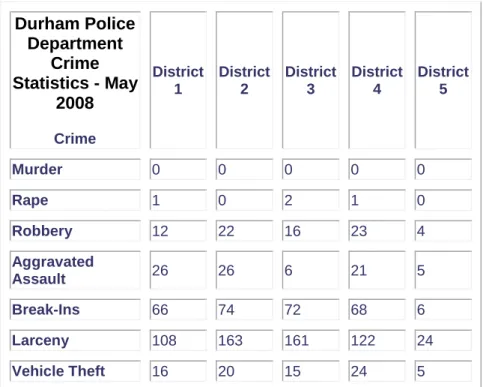
The interest of establishing a Neighborhood Watch program for my community began when I purchased my home in October 2008. The location of the home was not in the most desirable location of the city due to higher rates of crime (Fig 1). I noticed that many surrounding neighborhoods that had „Neighborhood Watch‟ indicator signs also had manicured lawns, paved streets, sidewalks, and lower crime rates. This was evidence of the positive impact that the Neighborhood Watch program had on those communities and was indicative of the social support within those neighborhoods. Surrounding these communities were recreational parks in close proximity, walking trails, and schools which seem to positively contribute to the overall quality of life in those areas. Given this observation, it is important to understand that the physical features of neighborhoods can be significant indicators of the well-being of the citizens and residents in the
7
daily stress imposed upon residents”(Cutrona et al, 2008). Such characteristics can
greatly influence the health and well-being of the community in general.
Impact of physical characteristics. Physical characteristics such as vandalism,
graffiti, and property crime rates have a distinct impact on the attractiveness of a
neighborhood. According to Sampson and Raudenbush, “minor forms of public disorder, if unchecked, lead to a downward spiral of urban decay and crime” (Sampson and
Raudenbush, pg. 7). Such characteristics within a neighborhood can lead to
neighborhood disorder, which “has been linked to declines in individual health and
well-being (Sampson and Raudenbush, pg. 7). Consequences of neighborhood disorder can further lead to physical ailments, depression, psychological stress, and perceived
powerlessness rises as postulated by Sampson and Raudenbush. Physical characteristics are external factors of neighborhoods; however they may influence internal factors of institutions in the community such as schools.
Limbos and Casteel found that “schools in disadvantaged, disorganized
communities have been found to have higher rates of violence” (Limbos and Casteel, pg. 540). This implies that advantaged communities contain schools that have lower rates of violence. In addition the cause of “high rates of violence in certain communities is proposed to be the lack of effective social organization” (Limbos and Casteel, pg. 540). School and neighborhood level factors were found to be associated with increasing crime rates in secondary schools. Prevention efforts within schools “should include school and
8
Crime statistics for Durham, NC. In 2008, crime statistics for the district 2
Durham area were:
Durham Police Department
Crime Statistics - May
2008
Crime
District 1
District 2
District 3
District 4
District 5
Murder 0 0 0 0 0
Rape 1 0 2 1 0
Robbery 12 22 16 23 4
Aggravated
Assault 26 26 6 21 5
Break-Ins 66 74 72 68 6
Larceny 108 163 161 122 24
Vehicle Theft 16 20 15 24 5
Figure 1: Durham Crime Statistics, 2008
Health Impact. From the statistics indicated, crime varied across the districts of
Durham, NC in 2008. As indicated by Godwin, “indirect effects of crime include the impact on victims‟ health of time off work, financial losses, and changes in home circumstances” (Godwin, pg. 27). From the statistics above, it can be inferred that
District 2 residents who were victims of crime, may have sustained significant health stressors due to the numbers of robberies, aggravated assaults, break-ins, larcenies, and vehicle thefts compared to the other districts within the city. In addition, higher rates of crime cause individuals to have “consequences of higher rates of mental health problems,
9
have lower rates of health stressors from crime factors than residents in districts 1-4 of the city, based on the crime statistics.
In addition, neighborhood improvement initiatives can also impact mental health of the community. As discussed by Cutrona, Wallace, and Wesner, “the most efficient
way to improve mental health in impoverished neighborhoods is to improve the quality of the neighborhoods” (Cutrona et al, pg. 5). Facilitation of change could positively affect
this aspect to reduce physical cues of blight such as trash, loitering, abandoned buildings, and other signs of urban decay.
Sampson and Raudenbush also found that “neighborhood social and ethnic
composition were powerfully linked to perceptions of disorder, in particular, concentrated poverty, the proportion of blacks, and the proportion of Latinos in a neighborhood were related positively and significantly to perceived disorder” (Sampson and Raudenbush Pg. 9). Although these findings determined a relationship between disorder and race, the perceptions of disorder were “heavily influenced by the racial and class composition of
the neighborhood. This implies that residents in the neighborhood may not have close relationships among each other due to the perceived disorder and influence of race.
Socialization. Neighborhood Within the social aspect of neighborhoods,
Greenbaum and Greenbaum write that “when unlike people live close together, they will become friends much more frequently than is likely to occur among unlike people who live apart” (Greenbaum and Greenbaum, pg. 53). This suggests that the social cohesion
of residents living in close proximity increases the social support of those living close together in the community. Family and economic characteristics of an urban
10
described by Bell and Boat (pg. 398). Social relations among neighbors could lead to change in other aspects of the social environment.
As Wilson mentions, “neighborhoods that become organized are empowered to address other needs such as safety, education, health, and employment” (Wilson, pg. 2).
Perhaps a neighborhood watch program for communities could be a building block to greater initiatives for neighborhoods. As Wilson says, “most people scarcely know their neighbors, but there is nothing like a common goal…to bring people together” (Wilson,
pg. 3). Authors concur that social capital consists of a set of components found in social associations and interactions among people that, when activated, empower individuals and facilitate cooperation toward a mutual benefit (Ferguson and Mindel, pg. 2). This further validates the importance of community partnerships and residents within neighborhoods.
Conclusion
11
What Can Be Done Differently
In terms of neighborhood socialization, Kim and Schweitzer say that “we could build social capital by promoting socializing among residents at the block level” (Kim
and Schweitzer, pg. 7). Activities within neighborhoods should be linked to the
promotion of socialization among residents, with face to face interaction at first. In the first initiation of recruiting neighborhood watch participants, letters were sent out to home owners who were residents within the neighborhood. This was in contradiction to face-to-face interaction, in the context that many of the residents did not know me, and perhaps they were not comfortable disclosing their contact information with someone they had not met in person. This was a social barrier at first, but was
Mittelmark discussed that compliance is a process wherein requesters use a series of requests (starting with modest request) to induce consenters to yield to a significant request, using the mechanisms of commitment and consistency (Mittelmark, pg. S25). This process resembles the initial approach taken in the establishment of the
neighborhood watch program for my community. The „modest request‟ was the request
of contact information for the residents such as name, address, email, and phone
12
information regarding crime statistics, or personal stories of being a victim of crime as a result of not having a neighborhood watch program was included. To draw more interest and consent to establish the program for the community, this approach may have been a better alternative to recruit more residential interest, although at this time we do have 19 active participants within our established Neighborhood Watch Program.
Putnam discussed that “social capital can help to mitigate the insidious effects of
socioeconomic disadvantage” (Putnam, pg. 319). In the process of recruiting the interest of neighbors for the neighborhood watch program, those of lower socioeconomic status may not have been included. This is somewhat counterproductive since “poor people (by
definition) have little economic capital and face formidable obstacles in acquiring human capital (that is, education), social capital is disproportionately important to their welfare” (Putnam, pg. 318). In actuality, all residents within the neighborhood of various
economic backgrounds should have been included in the program interest recruitment, however, interest letters were only sent to residential homeowners, thus not incorporating those individuals who rent homes within the community, who may be more likely to have a lower socioeconomic status. Using the following logic model as a guide, individuals of a variety of backgrounds will contribute to the goals and future outcomes of the
established neighborhood watch program for the neighborhood of District 2‟s W. Murray
Figure 2: Established Neighborhood Watch Logic Model
Inputs
Activities
Outputs
Short/Long term
Outcomes
Impact
• Support: community advisors, grant funding local
vendors/institutions • Potential
neighborhood interest • Donated goods (i.e.,
brochures,
neighborhood watch signs, security lights, etc.)
• Meeting location • Block captain
volunteers • Local authorities:
Police, Neighborhood Improvement Services
• Train Block Captains and Community Support Workers • Recruit neighborhood
participants, partners & facilities
• Develop & implement neighborhood
improvement plans • Participate in city wide
crime prevention demos
• Create neighborhood communication list serve
• Neighborhood watch program series for block captain
presentations • Data collection
tools
• Number of new participants, partners and facilities available for use
• Number of meetings
• Identification of barriers to neighborhood change
• Evaluation validation of program outputs
• Additional meeting locations
• Increased residential participation
Improvement in
perceptions of ability to improve neighborhood • Increase in
empowerment and self-efficacy in participants and community
advisors
• Increased availability and demand of local neighborhood watch programs
• Program sustained via community capacity
• Decrease in crime risk for residents
• Increased social support & motivation for program
participants • Daily use of new
knowledge & transfer of skill/knowledge to others
• Policy, systems & neighborhood
References
1. Bennett T, Holloway K, Farrington D. The Effectiveness of neighborhood watch. Campbell Systematic Reviews 2008:18 DOI:10.4073/csr.2008.18
2. Block, Peter (2008). Community: The Structure of Belonging. San Francisco, CA: Berrett-Koehler Publishers, Inc.
3. Cutrona, Carolyn E., Wallace, Gail and Wesner, Kristin A.; Curr Dir Psychol Sci. 2006 August; 15(4): 188-192
4. http://www.durhampolice.com/stats/stats0508.cfm 5. http://www.durhampolice.com/stats/stats0708.cfm
6. Elo, Irma T.; Mykyta, Laryssa; Margolis, Rachel; Culhane, Jennifer F.. Social Science Quarterly (Blackwell Publishing Limited), Dec2009, Vol. 90 Issue 5, p1298-1320, 23p, 6 Charts; DOI: 10.1111/j.1540-6237.2009.00657.x
7. Etzioni, Amitai; A Communitarian Position on Character Education 8. Etzioni, Amitai; Communitarianism
9. www.euphix.org
10. Ferguson, Kristin M., Mindel, Charles H. Crime and Deliquency, Vol. 49 No. X, Month 2006 1-DOI: 10.1177/0011128705285039
11. Greenbaum, Susan D.; Greenbaum, Paul E.; Social Networks, Vol 7(1), Mar, 1985. pp. 47-76.
12. Goodwin, Shirley; Health and Crime, Chapter 3 13. Kim, June Woo and Schweitzer, John.;
https://www.msu.edu/user/cocomm/S_CAPITL.html
14. Limbos, MAP, Casteel C. Schools and neighborhoods: organizational and environmental factors associated with crime in secondary schools. J Sch Health. 2088; 78: 539-544.
15. www.manhattan-institute.org/...atlantic...broken_windows.pdf
16. Mittelmark, Maurice B.; Preventive Medicine: An International Journal Devoted to Practice and Theory, Vol 29(6, Part 2 of 2), Dec, 1999. pp. S24-S2 Putnam, Robert (2001). Bowling Alone. New York, NY: Simon and Schuster
17. Sampson, R.J. and Raudenbush, Stephen.; Focus: Vol 24, No. 1, Fall 2005, ISSN: 0195-5705. Pgs. 7-11.
18. Wilson, David Sloan: http://bnp.binghamton.edu/wp-content/uploads/2011/02/DYOP-Jan-26-2011.pdf