Advisor: Dr. Deborah Barreau
This study investigates job satisfaction among reference librarians at six academic libraries in central North Carolina. Interviews were conducted to determine whether or not the current economic climate has an affect on the job satisfaction of reference librarians.
Previous research shows that job satisfaction has strong correlation with gender, race, and age. A random sample of reference librarians in the six colleges and universities were contacted to setup interviews to test this theory. Questions were devised to identify how reference librarians, or information professionals regularly performing reference duties, report their job satisfaction in a time of economic stress. A qualitative data analysis was performed to identify whether reference librarians were satisfied with their positions and what factors contribute and/or counteract job satisfaction. Age, gender, job advancement, and interaction with colleagues may play large roles in job satisfaction.
Headings:
Colleges and University – Reference Librarian College and University Libraries – North Carolina Reference services – North Carolina
by
Brendan R. Thompson
A Master's paper submitted to the faculty of the School of Information and Library Science of the University of North Carolina at Chapel Hill in partial fulfillment of the
requirements for the degree of Master of Science in Information/Library Science.
Chapel Hill, North Carolina April, 2010
Approved by:
Table of Contents
Introduction ...3
Purpose...4
Definitions ...5
Information Professional/ Librarian ... 6
Job Satisfaction ... 6
Job Promotion/Advancement ... 6
Literature Review ...7
Gender ... 8
Race ... 11
Job Promotion ... 14
Colleague Interaction ... 16
Summary ... 18
Method ...19
Results ...21
Satisfied ... 22
Mostly Satisfied ... 23
Not Sure ... 23
Dissatisfied ... 23
Open-Ended Questions ... 24
Analysis ...24
Gender ...24
Race ...25
Job Promotion ...26
Colleague Interaction...27
Discussion and Summary ...29
Bibliography ...33
Appendices ...38
Appendix A ...38
Appendix B part I ...39
Appendix B part II ...40
Table of Figures
Figure 1: Satisfaction Scale ...20
Figure 2: Likert Scale Answers ...22
Figure 3: Levels of Satisfaction ...24
Figure 4: Participants ...42
Figure 5: Job Advance Responses ...43
Figure 6: Economy Responses ...46
Figure 7: Comparing Departments ...48
Figure 8: Minority Responses ...51
Introduction
In times of economic stress it is not likely that salaries will increase. In lieu of salary increase it is important that managers identify and apply other factors to promote job satisfaction. Previous research studies have justified the notion that job satisfaction is an important factor, and in fact it has become common knowledge that job satisfaction is linked to productivity (Schachter 2009). Schacters article primarily focuses on “new” librarians, but the results can apply to all information professionals. For employees to maintain or increase job productivity it is important to identify factors that contribute to job satisfaction.
Job satisfaction comes in many different forms. As described by Brian Kenney in “Happy Days” one way to determine work life quality, his interpretation of job
satisfaction, is by determining what librarians enjoy doing the most. One of the factors contributing to job satisfaction is gratification from working with students and faculty, and another is job advancement or promotion. By determining factors such as these, an institution can focus on designing working environments that can possibly compensate for stagnant salaries.
Job satisfaction is defined by Howard M. Weiss as the emotional reaction to one’s job (Weiss 2002). This definition is the simplest
description of job satisfaction. Weiss’ article “Deconstructing Job Satisfaction Separating Evaluations, Beliefs and Affective Experiences” focuses in-depth on the term job
Weiss attempts to create a consensual definition that applies to both the academic and corporate fields. Kenney and Weiss’ definitions will help determine what it means for reference librarians to be satisfied with their jobs.
Are reference librarians satisfied with their jobs today? If so, what are the
contributing factors to high job satisfaction? Has the economy impacted job satisfaction? These research questions are motivations for the research described. In-person and phone interviews of reference librarians at six colleges and universities were conducted to identify trends in job satisfaction in the current economic climate. Those in an
administrative role can benefit from an understanding of job satisfaction in the current economic climate. It is more important that those in the administrative roles promote job satisfaction with factors such as job promotion and recognition, even when salary
increases are unlikely.
Purpose
During a period of economic stress it is important that employers can identify what incentives they have to offer in lieu of a salary increase since salary increase are not likely. This study is a continuation of previous studies that have helped to identify what contributes to job satisfaction, helping employees produce the most beneficial results for their institution. The study will try to identify the connection between economic
conditions and the job satisfaction of reference librarians. Although the study focuses on reference librarians in academic settings, the results may apply to all information
higher levels of job satisfaction in these areas make them an ideal subset of the profession to study (Chwe 1978). This study focuses on the understanding of interaction between employees and possibly more importantly the relationship between administrators and their employees.
Positive links have been made between an employee’s satisfaction with his or her job and the employee’s productivity within the workplace (Judge et al., 2001). The purpose of this study is to gain a better understanding of the correlation between job satisfaction and certain demographic and workplace characteristics of reference librarians in a time of economic stress. Employers stand to gain an understanding of what they can do to make their employees’ happy. Increasing employees’ job satisfaction or happiness with their job, will inherently increase their productivity and help to uphold the goals of the institution in which they are employed. Employees, by increasing their job
satisfaction, can increase what Kenney refers to as “work life quality”(Kenney 2009). Kenney states that an employee’s satisfaction with his job is linked to his emotions about the job (Kenney 2009). The goal of the employer should be to make efforts to increase the positive emotions of their employees. These connections should be made since links in previous studies have been made between job satisfaction and job productivity (Lim 2008). The happiness of employees positively reflects upon the growth of an institution.
Definitions
Information Professional/ Librarian
The terms used to describe what has traditionally been referred to as librarian has many variations. For this study the terms librarian and information professional will be used interchangeably. Terms such as information professional have become popular in the field to encompass all of the responsibilities and differing titles that have become a part of the profession.
Job Satisfaction
As previously discussed, Brian Kenney describes job satisfaction as the determination of what librarians find enjoyable and relate to the quality of their work (Kenney 2009). This definition combined with Howard Weiss’ simple definition of one’s emotional reaction to his job (Weiss 2002), creates the description of job satisfaction for librarians that will be used for this study, i.e., one’s emotional reaction to his job while maintaining or improving his life in a work environment.
Job Advancement/Job Promotion
For this study, the terms job advancement and job promotion are used
interchangeably. The terms come from articles that describe advances in one’s job (Tella 2007). Differing articles referred to the progress in one’s job differently. Some
Literature Review
It is assumed that job satisfaction is closely linked to monetary compensation, but there are many more factors that have a stronger impact. In the field of librarianship, librarians’ service to the community and not their salary is more important. Similar to K-12 teachers and other service-oriented fields, librarians more characteristically care about the service they provide more than the amount of money they take home (Perrachione 2008). Because of this commitment to service it is important to recognize and try to enact as many facets that help librarians reach their highest level of job satisfaction, which benefits the library and the library’s mission. This can be done through many different aspects such as building a strong relationship with administration. By having a strong connection with administration, librarians can help mold a better institution. A large part of the library science profession is providing specific services for their community. One of the highest ranked variables determining job satisfaction for librarians in their
relationship with library users (Leckie, et al. 1997). The following literature builds upon connections, both simple and complex between job satisfaction and factors such as job advancement/promotion, colleague interaction, race, age, and gender.
part in the increase of job satisfaction for employees such as variation in activity, social service, or the creativity allowed by individuals (Chwe 1978). The following literature review describes different factors that impact job satisfaction.
Gender
Joyce Thornton, an authority on job satisfaction and more strongly the relationship of gender and race in association to job satisfaction, discusses in her study, “African American Female Librarians: A Study of Job Satisfaction” that the work force has changed significantly in the past century and more changes are to come in the 21st Century. In a study conducted by the Association of Research Libraries (ARL), 98 percent of females that participated (73 percent of the respondents) state that, job
larger influence on the retention of women in the workplace. This means that a woman’s decision on which jobs to apply may determine whether she stayed at the job and not necessarily the climate at the workplace. The trend was that women were just as likely to commit to a job as men. This study, based in Switzerland, combats the idea that gender played a role in the satisfaction while at a job, but rather the research and selection of a job made a difference. A study such as the one’s performed by Sousa-Poza display that there is conflicting research. This research will attempt to eliminate the conflict and provide a consensual agreement determining if gender actually plays a role in job satisfaction.
influences in choosing jobs traditionally held by men. Scales for women measure job satisfaction of women in non-traditional jobs (Auster and Auster 1981). Auster and Auster researched women in the role of vocational counselor to identify their influences for choosing their jobs. Results show that the size of the women’s family, peer influences, and socioeconomic statues help in determining their choice to work in non-traditional roles. Both the Dodson et. al and Austers’ articles have scales that analyze gender roles in non-traditional setting and as stated earlier, men are traditionally the minority in the information science field
In the Dodson and Border’s study they combine the general scale with others like the Male Role Norms Scale determining the “masculinity ideology” (Dodson, et. Al 2006) levels in different work settings or the Occupational Choice Dilemma Inventory Scale, which displays what level of prestige a male feels about their job. These scales help as follows: (1) to determine whether or not a job is considered as normally masculine or feminine, and (2) to play a role in identifying the role of masculine/feminine construct and the relation to job satisfaction in the library field. These preexisting scales are helpful in planning interviews for this research as well as in helping to analyze the data from these interviews. The two main focuses for determining the role of gender and job satisfaction will be deciding what role gender plays in the library setting, then deciding whether or not that role has any bearing on the job satisfaction within a library institute.
et al. 2004). Positive interaction between genders and healthy mental state within the workplace leads to a higher morale in the workplace hence job satisfaction. Unique to this study of health and gender in conjunction with job satisfaction, men and women showed similar levels of stress when it came to workplace sexism, organizational responsiveness to gender, racial discrimination, psychological demands, and other stresses. Women were offered more social tools and programs to handle such stresses whereas the support for men lacked (Bond et. al 2004). Identifying more programs and social tools for men was suggested for future studies.
The roles of gender and job satisfaction will continue to be studied with the ever-changing roles of men and women in the workplace. The body of literature crosses subjects and disciplines including business, psychology, and library science. This study will help to answer the question of whether gender has an effect on job satisfaction in academic settings and perhaps close the gap of understanding the part of gender roles in job satisfaction by specifically targeting gender as a variable affecting morale in the workplace.
Race
As much as gender plays a role in job satisfaction so does one's race. Joyce Thornton deciphered statistics about race and the role it plays in job satisfaction in her 2000 study of the issues evident in the workplace. She found that issues that play a role in job satisfaction are not solely due to race, but other factors, such as the pressure to
there is a large amount of literature available on race in different settings there is little on the part race plays in library settings. This study identifies the correlation between job satisfaction and race in library settings.
Another way of viewing the minority relationships in libraries can be found in, “Job satisfaction among Greek academic librarians “ by Togia, Kousteliosm and Tsigilis”. This study provides a different point of view of minority and satisfaction within the
workplace. The need to overachieve or prove oneself remains the same, as well as, the loneliness one might feel when he is not understood due to his individuality, as described by Thornton in her research (Thornton 2000). By using the tool, the Employee
Satisfaction Inventory, Togia et al. were able to measure job satisfaction within Greek Librarians. One roadblock the researchers faced was the need to translate the tool. Many established measuring tools were developed in the United States. Because previous studies have proven that cross-cultural research does not always apply to different cultures it would be important for these researchers to develop a tool uniquely for their
environment and in Greek. Togia et al. strongly iterates the necessity to use translated tools, scales, measuring devices, and other methods to convey the differences in culture while collecting data about job satisfaction in their library setting.
In a separate study performed by Joyce Thornton entitled, “Job Satisfaction of librarians of African Descent Employed in ARL Academic Libraries” Thornton notes that a major “cause for concern” is the lack of representation of African Americans as
academic Faculty (Thornton 2000). Included in the definition of faculty are librarians. According to Thornton, “Job satisfaction refers to the feelings and emotional aspects of individuals’ experiences toward their jobs, as different from the intellectual or rational aspects” (Thornton 2000). After performing the study the results showed that minority librarians (mostly of African descent) were dissatisfied with their jobs if they felt self-induced pressure to overachieve, if their library lacked a diversity program, or if standards of performance were different than that applied to non-minority members of the staff. Thornton indicates that the self-induced pressure comes from the minority, pressuring themselves to be better than their peers in fear that if they are not they will be criticized for their lack of knowledge or skill, whereas they did not believe the same to be true for their non-minority peers. This is also related to the standards of performance. The standards were sometimes held higher or lower depending on the institution. This
becomes problematic because all individuals should be held to the same standard. Finally, the lack of a diversity program can show that an institute is or is not embracing their diversity, or that they lack diversity hence leading one to believe they do not need a diversity program. Gerhard and Boydston’s article, “A Library Committee on Diversity and Its Role in a Library Diversity Program”, discusses the importance of diversity
noticeable change improvement in job satisfaction (Dewey 2009). Diversity programs can help recruit, inform, and retain employees leading to job satisfaction.
Race plays many different roles in many different settings. Literature has proven that racial differences inadvertently affect job satisfaction. It is important that managers understand that people of different races may have entirely different experiences with respect to their jobs. In a period of change and acceptance it is more important to recognize diversity as a variable that needs to be considered when trying to increase overall job satisfaction. This is true for both minorities and non-minorities because diversity helps to increase collaboration and innovation in organizations (Dewey 2009).
Job Promotion
In almost all studies of job satisfaction, job promotion or advancement is always an indicator of satisfaction. Some studies show it as playing a small role in determining job satisfaction, but some show it as the main reason employees are satisfied or unhappy with their jobs. No matter the feelings, job advancement plays a major role in determining morale. Job advancement can affect an entire climate depending on who is promoted. Sook Lim’s Definition of promotion is based on merit and ability, which promotes “fairness” (Lim 2008). Lim also states that individuals who believe they have
satisfied with their level of recognition. Everyone wants recognition, especially when we believe we are working hard and are deserving of attention. If one goes too long without anyone recognizing his or her efforts then job satisfaction lowers. Once job satisfaction is lowered a domino effect occurs spreading to others leading to a widespread loss of job satisfaction amongst employees.
In Greece, Togia et al. found that salary and promotion played a lesser part in job satisfaction when compared to other variables such as the "job itself" or "the organization as a whole" (Togia et al 2004). On the subscale of the Employees Satisfaction Inventory, promotion held the least amount of weight when it came to importance and job
satisfaction. It was also noted that there was little room for job advancement in Greek libraries. A reason this occurred in Greek libraries was because the “promotion procedure is rather slow since the length of employment is the only criterion for advancement to senior positions” (Togia et al. 2004) whereas in the United States and other countries promotion can be decided by merit and/or willingness of the librarian to change or adopt more responsibility. It is also noted that Greek librarians’ satisfaction seems to diminish the more years a librarian worked at a particular institution. This is explained by the notion that public service workers, once employed, have been known to stay in the same job for many years, often until retirement, unlike other professions that change jobs as often as every 2 to 3 years.
their work and service to the community considered as valuable as faculty. It is not the process of promotion librarians’ value, but rather the recognition. In a separate
measurement it is noted that when the academic librarians in Canada are compared to nonacademic librarians that nonacademic librarians were even more dissatisfied with the opportunity for promotion and advancement.
It is important to note that promotion is measured separately from salary or salary increase; the need for promotion does not directly correlate with the desire for increased monetary compensation. These variables were separate in all studies reported. This reiterates the notion that salary is not the biggest factor determining job satisfaction, nor is it a major deciding factor in the uplifting of morale (Leckie and Brett 1997).
As noted earlier, job promotion can be defined in different terms such as accepting more responsibility or adopting new challenges, but it does not have to correlate with salary increase or the supervision of people. Many that are dedicated to the service industry are interested in serving their community and by holding more responsibility individuals have more of an opportunity to shape their institution in a manner that will supposedly better their patrons and their community.
Colleague Interaction
As previously expressed, one of the major reasons librarians pursue their career is their pull towards helping others. Research shows salaries are low priority for librarians. More important predictors with respect to job satisfaction are gender, job advancement, and coworker interaction. In articles like “Encouraging the New Librarians” by Debbie Schachter describes that one of the best ways to retain new librarians is to, “Make
few weeks of your new position will have a lasting impact on your overall success” (Schachter 2009). As the first bullet in this article dictates, new librarians can improve their jobs and furthermore their job satisfaction.
Davis-Kendrick’s article, “The African American Male Librarian: Motivational Factors in Choosing a Career in Library and Information Science addresses many factors in job satisfaction including race and gender, and it is one of the few articles identifying reasons such as colleague interaction as a leading reason for job satisfaction. Unique to this article is the idea that African-American males, both minorities in the profession, are more likely to stay in the profession if they have a colleague to mentor or guide them through their initial years of service.
Mentorship is important in many careers, but it is especially important to librarians’ job satisfaction. Although the article, “Work characteristics and determinants of job satisfaction” is targeted at “new librarians” the theories and supporting arguments can be applied to all librarians (Schacter 2009).
In four age groups: <35 years, 35–44 years, 45–54 years, ≥55 years; university employees’ point of view” focuses on the job satisfaction of university employees, generally, but included as university employees are librarians. Interaction with
satisfaction. This article will be supportive in tracking trends in job satisfaction with reference librarians as well as add ways of analyzing the date from my research.
Summary
Four important factors that suggest reported differences in job satisfaction among reference librarians are gender, race, colleague interaction, and job advancement. These aspects are just a few of the many determining factors job satisfaction. The sources used have varying degrees of what it means to be satisfied with your job. Some resources even distinguished between being satisfied with your job juxtaposed to being satisfied at your job. Because job satisfaction has such a varied listing of meanings it is imperative to focus on what job satisfaction means in respect to my search topic. Mallaiah (Mallaiah 2008) states that job satisfaction is one of the criteria of establishing a healthy
organizational structure. Beverly Lynch and Jo Ann Verdin who states that, “the close connection perceived as existing between job satisfaction and the quality of library service leads librarians to want to determine what factors may be related to the satisfaction of staff member “(Lynch &Verdin 1993). The combination of Lynch et. al. and Mallaiah’s
Method
As demonstrated by the literature review there have been many previous studies of job satisfaction, but none that investigate a combination of five major factors of jobs satisfaction: age, gender, race, job promotion, and interaction with colleagues. It is important to study these factors together to identify if a diverse group of librarians are truly satisfied with their job and whether these factors combined affect job satisfaction.
Reference librarians at six libraries of local colleges and universities were contacted to participate in the study. Three of those colleges are considered historically black colleges or universities: North Carolina Central University, St. Augustine College, and Shaw University. All of the colleges and universities selected have a strong statement embracing diversity, according to their mission statement.
Initial contact of participants was conducted by electronic mail. Library directories were reviewed to identify reference librarians or librarians performing reference duties. Librarians from six local colleges and universities were contacted by email (Appendix C) asking for their participation in the study. Subjects were informed of the reason for the study, time commitment, and any risks possible, and the University of North Carolina at Chapel Hill Institutional Review Board approved all materials. Shortly thereafter, participants responded agreeing to the interview. Participants were contacted, again by email, to arrange times, dates, and locations to meet. Participants were given the option to meet in-person or by phone.
in-person. Participants were then asked questions (Appendix B part II) ranging from general information such as name and age to more complex questions asking participants to elaborate on their job satisfaction, or lack there of. After the collection of data, the information was analyzed first by evaluating the Likert Scale questions. There are four Likert Scale questions. These questions were used to identify the level of satisfaction or dissatisfaction the participants had with their jobs. A table was formed to identify where reference librarians fall in terms of job satisfaction (See Figure 2). Percentages are calculated and reflected in the results section.
Following the Likert Scale questions were open-ended questions. These questions were analyzed to identify trends in causes of job satisfaction. Responses were given a classification of negative, positive, or neutral. The responses to these questions have been identified as negative, positive or neutral. Responses that include terms such as
possibilities, autonomy, benefit, or progression were classified as positive. If the terms improvement, predetermined, or mostly satisfied appear in the responses it is ranked as neutral. Lack thereof, discrimination, dissatisfied, negative are terms that are categorized as negative.
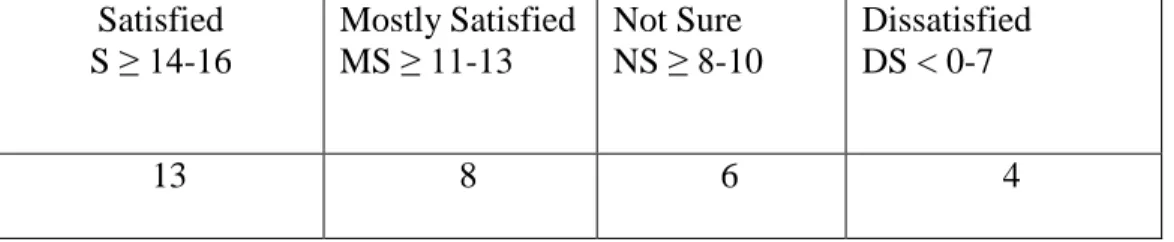
Results mostly correlate with the overall ratings from the Likert Scale Questions. Figure 1:
Satisfaction Scale Satisfied S ≥ 14-16
Mostly Satisfied MS ≥ 11-13
Not Sure NS ≥ 8-10
Dissatisfied DS < 0-7
Results
Interviews of reference librarians in academic settings show a trend that factors such as a clear promotion track, good interaction with colleagues, and the opportunity to work with students and faculty are leading factors to job satisfaction. When asked about increase in salaries, no librarians ranked it as their number one priority when placed in the context of job satisfaction.
Staff directories for six local colleges and universities were used to contact
references librarians, or librarians that regularly perform reference transactions. A total of one hundred two librarians were contacted.
Out of one hundred two contacted librarians thirty-one librarians responded
indicating they were willing to participate, a 30.3 percent response rate. An ideal response rate would have been closer to 50 percent to 75 percent, but the limited time for the study may have limited the number of responses.
After consenting to participate, the librarians were contacted with a follow-up email asking them to determine a time and date for interviewing. Participants were also given the option of a phone or in-person interview.
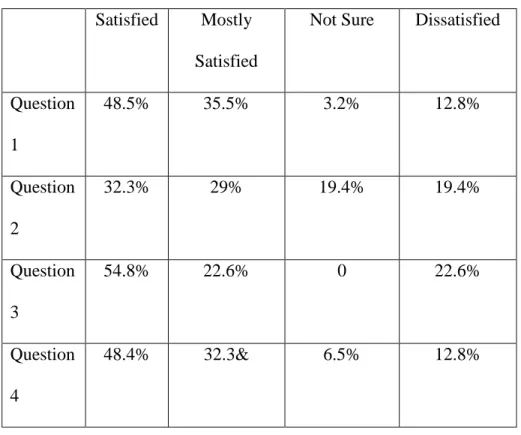
Appendix B part II shows the questions asked of participants. After more logistical questions, participants were asked four Likert Scale questions. A chart below shows the results.
Participants were asked:
1. How satisfied are you with your present job when you compare it with similar positions you have held in other departments or other libraries? Satisfied, Mostly Satisfied, Not Sure, or Dissatisfied
3. How satisfied are you with your present job when you consider the expectations you had when you took the position? Satisfied, Mostly Satisfied, Not Sure, or Dissatisfied
4. What opportunities for advancement exist in your library? And, Would job advancement increase your job satisfaction? Satisfied, Mostly Satisfied, Not Sure, or Dissatisfied
Each answer was given a number. Satisfied was assigned a four, mostly satisfied was assigned a three, not sure was assigned a two, and dissatisfied was assigned a one. The participants’ scores would reflect their overall satisfaction with their jobs in relation to the Likert Scale question.
Figure 2: Likert Scale Answers
Satisfied
The study shows that 41.9 percent of participants indicated that they are satisfied. This means that participants were satisfied with their current positions and opportunities for career advancement do not play a role in their level of satisfaction. Factors that
Satisfied Mostly Satisfied
Not Sure Dissatisfied
Question 1
48.5% 35.5% 3.2% 12.8%
Question 2
32.3% 29% 19.4% 19.4%
Question 3
54.8% 22.6% 0 22.6%
Question 4
contributed to job satisfaction include interaction with colleagues, interaction with faculty and students, and autonomy. These factors will be discussed in later sections.
Mostly Satisfied
25.9 percent of participants are identified as being mostly satisfied. Research suggests that those identified as mostly satisfied were happy with aspects of their job, but thought there were areas that could be improved. These improvements could range from how their responsibilities have evolved to how administration in their current position interacted with employees compared to previous positions.
Not Sure
19.4 percent of respondents are classified as being “not sure” about their level of satisfaction. These participants tended to have apprehension about stating their
satisfaction with their job, but they were not dissatisfied with their jobs. Participants that are in the “not sure” range of satisfaction had aspects of their jobs in which they were mostly satisfied, but are also interested in improving other aspects of their jobs. Some participants went as far as to describe some dissatisfaction with their jobs.
Dissatisfaction
12.9 percent of participants fall in the range of dissatisfaction. Participants that fall in the range of dissatisfaction answered dissatisfied to almost all Likert Scale questions and elaborated upon their dissatisfaction in the open-ended questions. Some attributes of dissatisfaction included the lack of clear promotion possibilities, change in responsibilities, or issues with diversity and the diversity policy.
plays in relation to job satisfaction. Results indicate that reference librarians are satisfied with their jobs, but there are several factors that could improve job satisfaction.
Open-Ended Questions
With indicators that 38.7 percent of participants are satisfied with their jobs, 25.8 percent mostly satisfied, 22.6 percent not sure, and 12.9 percent dissatisfied, some open-ended questions were asked to understand their reasons for their levels of satisfaction. A detailed explanation of those answers will follow in the discussion section.
Figure 3: Levels of Satisfaction
0 2 4 6 8 10 12 14 16 18
Job Satisfaction Comparison
Job Progress Expectation Satisfaction
Career Expectation
Satisfied Mostly Satisfied Not Sure Disstisfied
Analysis
Results support previous literature that suggests that reference librarians are
satisfied with their jobs. It is important to note these findings are consistent even in a time of economic stress. The findings below detail the relation of job satisfaction to factors such as age, gender, race, job advancement, and colleague interaction.
Gender
Previous articles, described in the literature review, insinuate that this field has similar implications of the male dominated corporate workforce. While there may be a tendency to believe that since men are minorities in the information profession, they will be treated the way minorities, including women, are treated in a white male dominated workforce. However, this study found that being a man, as a minority, has little impact on job
satisfaction. 45.1 percent of participants were men. Out of the participants very few agreed that being a male in the profession had an effect on their job satisfaction. Most respondents stated that if anything, they were embraced by their female colleagues.
The respondents that said their gender has an impact on their job satisfaction mostly discussed the differences in management style. Respondents did not give detail on the differences in management style. Although women are not the minority when it comes to gender, a few discussed the affects of gender in the same manner as men. Female respondents discussed what has become a larger discussion in the field, the increase in administrative roles dominated by men. One respondent, female, discussed how her outspokenness has led to her elimination from future search committees and outright rudeness from administration. Administration in this particular library was mostly male. This negative reaction from administration was just one example given of differences in management styles.
Race
32.2 percent of respondents identified themselves as a race other than white. Almost all respondents answered that race had little to no effect on their job satisfaction. As previously discussed, Thornton argues that race, specific to her article,
African-Americans, plays a large role of job satisfaction. Respondents stated that there were more important factors that impact their job satisfaction. This study includes varying races, African-American, Hispanic, and Chinese. Having a variety of races supports the research on the impact that being part of a racial minority may have on job satisfaction.
There were two respondents that stated that because they are African-American they were expected to either serve on a diversity committee or serve as the main collection developer for the African and African-American collections. The former described that other facts played a role in their selection to serve on the diversity committee for their library, but also believed that because of their race it was expected they would serve on the diversity committee.
The information professional that was recruited to serve as the collection
developer for the African and African-American collection was selected to do so because of having background in the field. This information professional had a background and education on these topics, so the commitment to the position was expected.
Job Promotion
Job promotion plays a larger role than race or gender, but still lower than
with salary as they were with the role or responsibilities that come along with a job promotion.
With the change in responsibilities most respondents were not interested in the new role or taking on administrative responsibilities. Respondents often feared that they would lose parts of the job that made them happy, most importantly the interaction with students, faculty and staff.
Respondents also discussed the lack of clear paths for promotion. One university ranked their librarians according to years of experience and their contribution to the library and university. Although the titles seemed definitive, a few respondents pointed out that the lines were often blurry when describing the difference between positions. Respondents were interested in a clear path for progression. Other schools had a tenure track for their librarians relating them to the traditional professor track in colleges and universities. Information professionals/librarians on the tenure track were more likely to be satisfied with their job because there is a clear track to promotion.
Respondents’ answers about advancement differed dependent on the size of the library. Research shows that the smaller the library the less opportunity there is for
advancement or promotion. Larger libraries had more opportunities for advancement, but advancement meant progression into administration or waiting for positions to become vacant, usually the retirement of a librarian.
Colleague Interaction
93.5 percent of respondents stated that the most important part of their job satisfaction was their positive interaction with colleagues. Respondents appreciated the scholarly nature of conversation. Also important in colleague interaction is the common goal information professionals/librarians have, which is serving their patrons and
providing them with the best and most useful information in a timely manner. The 6.5 percent of respondents that had negative responses associated with colleague interaction said that age was a factor. One respondent discussed how their advanced age led younger colleagues to believe that she was less knowledgeable about emerging technology. The respondent felt she was being “talked down to” or demeaned by the younger colleague. In fact the older colleague has actively learned new technology over the years and is one of the reasons she pursued a career in the information/library field.
As results show, age plays role in job satisfaction and age may have influenced how librarians interacted with their colleagues. Those more advanced in age sometimes had problems convincing their younger colleagues of their technological abilities. This caused tension between employees. It is important that younger librarians appreciate and respect the abilities that veteran employees contribute to the profession. Another
participant had the opinion that her advanced age contributed positively to their
satisfaction. The participant, 53, stated that at her age she is satisfied because at this age she knows what she wants and her years of experience have contributed to her job satisfaction. She also stated that at her age if she was not satisfied it was her own fault.
Discussion and Summary
As discussed in the results section, the factors that play the most important roles in job satisfaction for these reference librarians are colleague interaction, autonomy, and patron interaction. Age, gender, race, job promotion, and colleague interaction were touted as being the most relevant contributors to job satisfaction, but results proved that in the current economy race, gender, and age play a smaller role than originally expected.
The research shows that colleague interaction impacts job satisfaction the most. All participants in this study addressed colleague interaction. This is exceptional since there were no direct questions addressing colleague interaction. When asked, “What factors do you think have contributed most to your job satisfaction (or dissatisfaction)?” (Appendix B part II) all respondents, somewhere in their answers mentioned colleague interaction. 93.5 percent of respondents said that their interactions positively impacted their job satisfaction. One participant addressed their pleasure at length. The respondent appreciated how understanding their colleagues are in appreciating how important the balance of family and work life is and helping to accommodate this balance. The respondent also appreciates the day-to-day interaction and conversations she has with colleagues. The participant also discussed other work interactions such as having a great supervisor and interacting with students, staff, and faculty.
Contact with students, staff, and faculty was also ranked very high as a reason for job satisfaction. Participants appreciated the scholarly interaction they had with
student, staff, and faculty and job satisfaction. The interaction with faculty, students, and staff leads one to believe that reference librarians at academic institutions are happier because of the elevated level of scholarly interaction.
Another important factor for job satisfaction, not foreseen, was the importance of autonomy. Several participants mentioned the importance of autonomy. The idea of freedom in decision-making ranked high in importance on factors listed that positively contribute to job satisfaction. Autonomy came in different forms from the flexibility of work schedules to the freedoms of ones work responsibilities. Based on prior literature, age, gender, race, colleague interaction, and job promotion are significant factors related to job satisfaction. Findings from this study demonstrate that autonomy, unexpectedly, is influential as well.
This research was conducted to identify trends in job satisfaction. The research also focused on the importance of job satisfaction during a period of economic stress. The research supports, as did past literature, that salary, may not be as important as other factors in assessing job satisfaction, even in times of economic stress. Participants seem to recognize the current economic climate and often praised their libraries for actively working to prevent any layoffs. It seems that in this time of economic stress participants began to recognize how important it is that they recognize what made them satisfied, but it became evident that employees were recognizing what satisfied them with their current position. Because of the economy, participants seem less likely to change jobs because of satisfaction, but rather look for what they could change.
participants identifiable. To avoid compromising anonymity specific titles have been omitted.
Participants also had a wide range of experience before obtaining their degree related to their current jobs. Some backgrounds included corporate library work, newspaper experience, working at publishing houses. There is also a large amount of current librarians that started as paraprofessionals in technical services including cataloging, collection development, and acquisitions.
Maybe not evident to the participants, the economy made a stronger impact than they expected. Although respondents spoke of their satisfaction with their current jobs, many spoke of the lack of jobs available making them less likely to leave their jobs if they were dissatisfied. Participants discussed leaving previous jobs because of their
dissatisfaction, if asked if this was an option the respondents answered no. Also a result of the economy was the budget cuts leading to restricted resources, and limited resources are described as discouraging for these librarians as it may affect how they perform their jobs. Providing resources for patrons is integral and the limit of resources makes
performing their jobs difficult.
Salary plays a small role in job satisfaction, but no more than any other profession or field. Participants said that salary did not play a large role in their job satisfaction, but they do believe they are underpaid and spoke of the relation between their salary and the cost of living. Participants stated that they were demoralized by the likelihood that they would not receive raises because of the economy, but this does not have a major impact on their job satisfaction.
interaction, autonomy, and patron interaction play the biggest roles and it is important that these factors are recognized and supported by administration.
Bibliography
Auster, C. J., & Auster, D. (1981). Factors influencing women's choice of
nontraditional careers: The role of family, peers, and counselors. The Vocational Guidance Quarterly, 29, 253-263.
Babbie, Earl. (2007). The Practice of Social Research. Belmont, CA. Thomson Higher Education.
Bartlett, C. (98). The relationship between superiors' self-disclosure, offers of help, offers of cooperation, frequency of contact, trust, and subordinates' job satisfaction. North Carolina Libraries, 56(4), 155-157.
Bengston , D. S. & Shields , D. (1985). A test of Marchant's Predictive Formula's involving job satisfaction. The Journal of Academic Librarianship, 11(2), 88-92.
Bos, J. T., Donders, N. C., Bouwman-Brower, K. M., & Van Der Gulden, J. J. (2009). Work Characteristics and Determinants of Job Satisfaction in Four Age Groups: University Employees' point of view. International Archives of Occupational and Environmental Health, 82(10), 1249-1259.
Chwe, S. S. (1978). A comparative study of job satisfaction: catalogers and reference librarians in university libraries. The Journal of Academic Librarianship, 4(3), 139 -143.
Cogliser, C. C. & Schriesheim, C. A. (2000). Exploring work unit context and leader-member exchange: A multi-level perspective. Journal of Organizational Behavior, 21, 487-511.
Davis-Kendrick, K. D. (2009). The African American Male Librarian: Motivational Factors in Choosing a Career in Library and Information Science. Behavioral and Social Sciences Librarian, 28, 23-52.
Dewey, B. (2009). The Imperative for Diversity: ARL’s Progress and Role. Libraries and the Academy, 9(3), 355-361
Dodson, T. A. & Boders, L. D. (2006). Men in traditional and nontraditional careers: gender role attitudes, gender role conflict, and job satisfaction. The Career Development Quarterly, 54, 283-296.
Evans , L. (2001). Delving deeper in morale, job satisfaction and motivation among education professionals: re-examining leadership dimension. Educational Management Administration & Leadership, 29, 291-306.
Gerhard, K. H., & Boydston, J. M. (1993). A Library Committee on Diversity and Its Role in a Library Diversity Program. College and Research Libraries, 54(4), 335-343
Johnsrud, L. K., Heck, R. H., & Rosser, V. J. (2000). Morale matters: midlevel administrators and their intent to leave. The Journal of Higher Education, 71(1), 34-59.
Judge , T. A., Thoresen, C. J., Bono , J. E., & Patton, G. K. (2001). The job satisfaction-job performance relationship: a qualitative and quantitative review. Psychological Bulletin, 127(3), 367-407.
Kenney, B. (2009). Happy Days. School Library Journal, , 28-31.
Leckie, G. J. & Brett, J. (1997). Job satisfaction of Canadian University librarians: a national survey. College & Research Libraries, , 31-47.
Lynch , B. P. & Verdin, J. (1983). Job satisfaction in libraries: relationships of the work itself, age, sex, occupational group, tenure, supervisory level, career commitment, and library department. The Library Quarterly, 53(4), 443-447.
Mallaiah, T. Y. (2008). Performance management and job satisfaction of
University library professionals in Karnataka: a study. Journal of Library & Technology, 28(6), 39-44.
Mallaiah, T. Y. (2008). Job and job environment of library professionals in university libraries in Karnataka. Information Studies, 14(3), 135-150.
Rose, J. (2007). Suite 101. Retrieved Feb. 10, 2009, from http://trainingpd.suite101.com/article.cfm/communicationstyles
Schachter, D. (2009). Encouraging the New Librarian. Information Outlook, 13(6), 4142.
Sook , L. (2007). Library information technology workers: the sense of belonging, role, job autonomy, and job satisfaction. The Journal of Academic Librarianship, 33(4), 492-500.
Sook, L. (2008). Job satisfaction of information technology workers in academic libraries. Library & Information Science Research, 30, 115-121.
Sousa-Poza, A. & Sousa-Poza, A. A. (2007). The effect of job satisfaction on labor turnover by gender: An analysis for Switzerland. The Journal of Socio-Economics, 36, 895-913.
Thornton, J. K. (2000). Job satisfaction of librarians of African descent employed in ARL academic libraries. College & Research Libraries, , 217-232.
Tella, A. (2007). Work motivation, job satisfaction, and organizational
commitment of library personnel in academic and research libraries in Oyo State, Nigeria. Library Philosophy and Practice, , 1-16.
Togia , A., Koustelios, A., & Tsigilis, N. (2004). Job satisfaction among Greek academic librarians. Library & Information Science Research, 26, 373-383.
Appendix A
Greetings:
My name is Brendan Thompson. I am a graduate student at the University of North Carolina at Chapel Hill School of Information and Library Science. I am conducting interviews investigating job satisfaction. I am contacting you because you have been identified as an information professional that provides references services providing or as regularly performing traditional reference duties. I am asking for your participation in a graduate study identifying leading factors in job satisfaction in a climate of
economic stress. Reference librarians from six local colleges and universities were
randomly selected in hopes of receiving a diverse cross section of age, race, and gender. Participation in this interview is voluntary and the option to opt-out of the study is
available at any time.
If you agree to participate in this study there is a minimal time commitment of
approximately 15 minutes to complete the interview asking the librarians their views on job satisfaction. There is the possibility of follow-up questions with an additional time commitment of 30 minutes to an hour, or however long the participant needs or wants to explain their answers. Questions range from asking about race, age and gender, to views on job satisfaction.
The information collected will be kept confidential and will be discarded at the end of the study. There are no risks involved in the participation of this study since the information will not be shared and will be discarded at the end of the study.
For further questions or concerns feel free to contact me at (336) 671-0931 or by email at [email protected]. You can also contact my faculty advisor Deborah Barreau at (919) 966-5042 or by email at. [email protected].
Thank you for considering this request, Brendan Thompson
Appendix B part I
Phone Consent form
Hello my name is Brendan Thompson and I am a graduate student at the University of North Carolina at Chapel Hill School of information and Library Science. I am conducting a research study to identify trends with job satisfaction with reference librarians. Today I will be conducting an interview to see how satisfied you are with your job. Today’s interview will be approximately 20-30 minutes long. Time is not a factor in this study, so take as long as you need to answer the questions. You might be contacted at a later date for follow-up questions or clarification.
I am contacting you because you have been identified as an information professional that provides references services or as regularly performing traditional reference duties. I am asking for your participation in a graduate study to identify leading factors in job satisfaction during the current economic climate. Reference librarians from six local colleges and universities were randomly selected in hopes of receiving a diverse cross section of age, race, and gender. Participation in this interview is voluntary and the option to opt-out of the study is available at any time.
The information collected will be kept confidential and will be discarded at the end of the study. There are no risks involved in the participation of this study since participants will be kept confidential and all data will be discarded at the end of the study.
Appendix B part II
Interview Questions
Please State Your name, Age, Race, and Gender How long have you worked in your current position? How long have you worked in the profession?
Do you have an MLS, MLIS, or an advanced degree related to your current position? How satisfied are you with your present job when you compare it with similar positions you have held in other departments or other libraries? Satisfied, Mostly Satisfied, Not Sure, Dissatisfied
How satisfied are you with the progress you are making toward the goals that you have set for yourself in your present position? Satisfied, Mostly Satisfied, Not Sure, Dissatisfied How satisfied are you with your present job when you consider the expectations you had when you took the job? Satisfied, Mostly Satisfied, Not Sure, Dissatisfied
How satisfied are you with your present job in light of your career expectations?, Satisfied, Mostly Satisfied, Not Sure, Dissatisfied
What opportunities for advancement exist in your library? Would job advancement increase your job satisfaction? Why? Or Why not?
What impact, if any, has the economy had on your job satisfaction?
What factors do you think have contributed most to your job satisfaction (or dissatisfaction)?
What other library departments have you worked in as a Librarian?
Have you worked in other library departments before obtaining your MLS?
How does working in other departments compare to working in the Reference department? Does being a minority have an affect on your job satisfaction (gender, race, age)?
Appendix C
In-Person Consent Form
Hello my name is Brendan Thompson and I am a graduate student at the University of North Carolina at Chapel Hill School of information and Library Science. I am conducting a research study to identify trends with job satisfaction with reference librarians. Today I will be conducting an interview to see how satisfied you are with your job. Today’s interview will be approximately 20-30 minutes long. Time is not a factor in this study, so take as long as you need to answer the questions. You might be contacted at a later date for follow-up questions or clarification.
I am contacting you because you have been identified as an information professional that provides references services or as regularly performing traditional reference duties. I am asking for your participation in a graduate study to identify leading factors in job satisfaction during the current economic climate. Reference librarians from six local colleges and universities were randomly selected in hopes of receiving a diverse cross section of age, race, and gender. Participation in this interview is voluntary and the option to opt-out of the study is available at any time.
The information collected will be kept confidential and will be discarded at the end of the study. There are no risks involved in the participation of this study since participants will be kept confidential and all data will be discarded at the end of the study.
If you agree to this interview please sign below
___________________________ ______________ Signature date
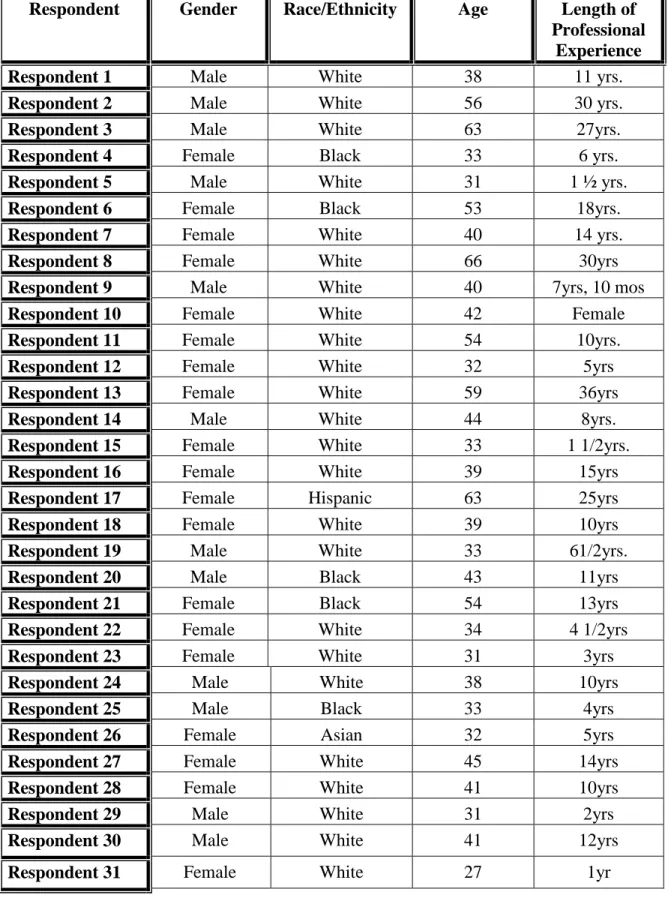
Figure 4: Participants
Respondent Gender Race/Ethnicity Age Length of
Professional Experience
Respondent 1 Male White 38 11 yrs.
Respondent 2 Male White 56 30 yrs.
Respondent 3 Male White 63 27yrs.
Respondent 4 Female Black 33 6 yrs.
Respondent 5 Male White 31 1 ½ yrs.
Respondent 6 Female Black 53 18yrs.
Respondent 7 Female White 40 14 yrs.
Respondent 8 Female White 66 30yrs
Respondent 9 Male White 40 7yrs, 10 mos
Respondent 10 Female White 42 Female
Respondent 11 Female White 54 10yrs.
Respondent 12 Female White 32 5yrs
Respondent 13 Female White 59 36yrs
Respondent 14 Male White 44 8yrs.
Respondent 15 Female White 33 1 1/2yrs.
Respondent 16 Female White 39 15yrs
Respondent 17 Female Hispanic 63 25yrs
Respondent 18 Female White 39 10yrs
Respondent 19 Male White 33 61/2yrs.
Respondent 20 Male Black 43 11yrs
Respondent 21 Female Black 54 13yrs
Respondent 22 Female White 34 4 1/2yrs
Respondent 23 Female White 31 3yrs
Respondent 24 Male White 38 10yrs
Respondent 25 Male Black 33 4yrs
Respondent 26 Female Asian 32 5yrs
Respondent 27 Female White 45 14yrs
Respondent 28 Female White 41 10yrs
Respondent 29 Male White 31 2yrs
Respondent 30 Male White 41 12yrs
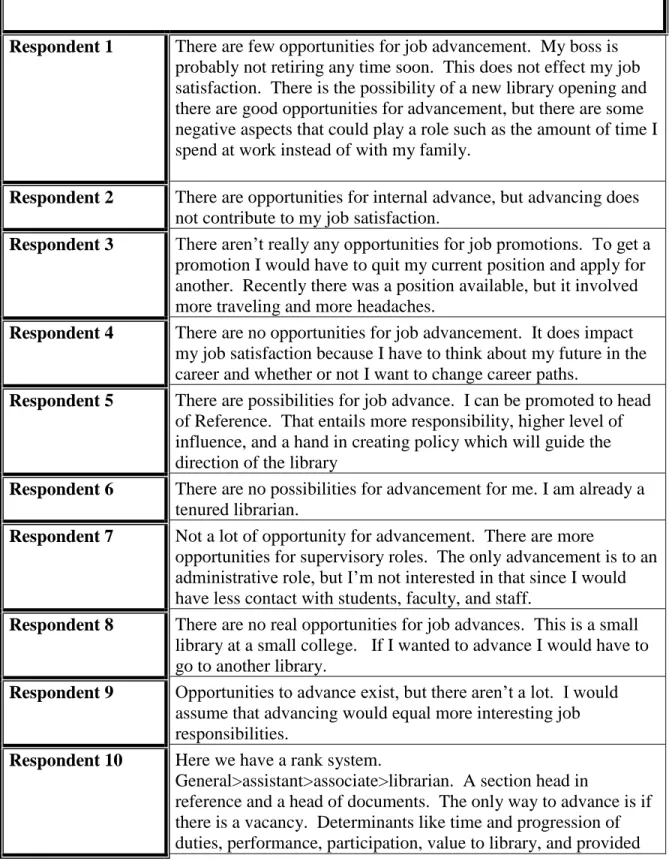
Figure 5: Job Advancement Responses
Question: What opportunities for advancement exist in your library? Would job advancement increase your job satisfaction? Why? Or Why not?
Respondent 1 There are few opportunities for job advancement. My boss is probably not retiring any time soon. This does not effect my job satisfaction. There is the possibility of a new library opening and there are good opportunities for advancement, but there are some negative aspects that could play a role such as the amount of time I spend at work instead of with my family.
Respondent 2 There are opportunities for internal advance, but advancing does not contribute to my job satisfaction.
Respondent 3 There aren’t really any opportunities for job promotions. To get a promotion I would have to quit my current position and apply for another. Recently there was a position available, but it involved more traveling and more headaches.
Respondent 4 There are no opportunities for job advancement. It does impact my job satisfaction because I have to think about my future in the career and whether or not I want to change career paths.
Respondent 5 There are possibilities for job advance. I can be promoted to head of Reference. That entails more responsibility, higher level of influence, and a hand in creating policy which will guide the direction of the library
Respondent 6 There are no possibilities for advancement for me. I am already a tenured librarian.
Respondent 7 Not a lot of opportunity for advancement. There are more
opportunities for supervisory roles. The only advancement is to an administrative role, but I’m not interested in that since I would have less contact with students, faculty, and staff.
Respondent 8 There are no real opportunities for job advances. This is a small library at a small college. If I wanted to advance I would have to go to another library.
Respondent 9 Opportunities to advance exist, but there aren’t a lot. I would assume that advancing would equal more interesting job responsibilities.
Respondent 10 Here we have a rank system.
General>assistant>associate>librarian. A section head in
value all determine your progression. The ranks don’t really have an effect on my job satisfaction.
Respondent 11 The reference departments rank and promotion process is dependent upon years served when you are up for review. Included in the review are goals and future plans so moving from one rank to another is really up to the individual.
Respondent 12 From my role I can become the Head of Reference or Dean of Libraries, but these people would have to retire before this happens. I’m not sure if I would be more satisfied. I am
extremely satisfied with my position now and I would have to take on a lot more responsibility and I already have a lot.
Respondent 13 I can go further, but it is difficult. It would be into an administrative role and this would probably decrease my satisfaction.
Respondent 14 I’m not sure if a job advance would increase my job satisfaction. Our department and library are going through a major
reorganization and we recently had a position available, but I wasn’t really interested.
Respondent 15 I work in a small branch library that is merging with a bigger library. I was the branch head but I will become a subject specialist. I don’t’ really feel like it is a demotion because there are a lot of opportunities with the larger department.
Respondent 16 I think job advancement would increase my job satisfaction. It would be nice to make more money to help with expenses, but I am glad to have a job.
Respondent 17 Little to no opportunities for job advance. I think it might make a difference.
Respondent 18 There are no real opportunities for job advancement. There are also no clear paths. The structure is artificial and there is no guaranteed pay raise with promotions. Since there is not a lot of contact with administration there is not a big chance that this structure will change.
Respondent 19 Currently I do reference instruction and I can advance within the department or go to other departments, so it’s more of an adjacent move. I don’t particularly want to advance because I am not interested in the responsibilities that would go with advancing. Respondent 20 There are opportunities to advance in my library, but I am at the
highest position.
Respondent 21 Yes, there are opportunities to advance in the library.
Respondent 22 There are no opportunities for advancement. This is a small library.
to quit or retire. There is also the opportunity to advance in a new library that will open on campus. It is not clear what these
opportunities will be.
Respondent 24 The only opportunities for advancing are if someone retires Respondent 25 There aren’t really any opportunities for advancement. It is a
small library so there aren’t a lot of positions. I expected it when I started.
Respondent 26 There are opportunities to advance. I am currently an instruction and subject specialist. I can advance to assistant head, or head of the department., but I don’t think either position will become available anytime soon..
Respondent 27 There aren’t opportunities to advance form my position, but I was promoted into this position so that’s proof that there are chances to advance.
Respondent 28 There is the possibility for advancing, but I am not interested in administrative work. Advancing would actually decrease my job satisfaction since I wouldn’t be able to interact with patrons. Respondent 29 There seems to be a lot of opportunities to advance from my
position. The only problem is that I would have to quit my current position to apply for another. This becomes risky in an economy like this. I don’t have as much leverage in negotiating at jobs like this.
Respondent 30 From my position there aren’t many opportunities for
advancement. Advancement would include becoming a part of administration. Advancing doesn’t have an effect on my job satisfaction. I am not interested in the responsibilities that go along with being a part of administration
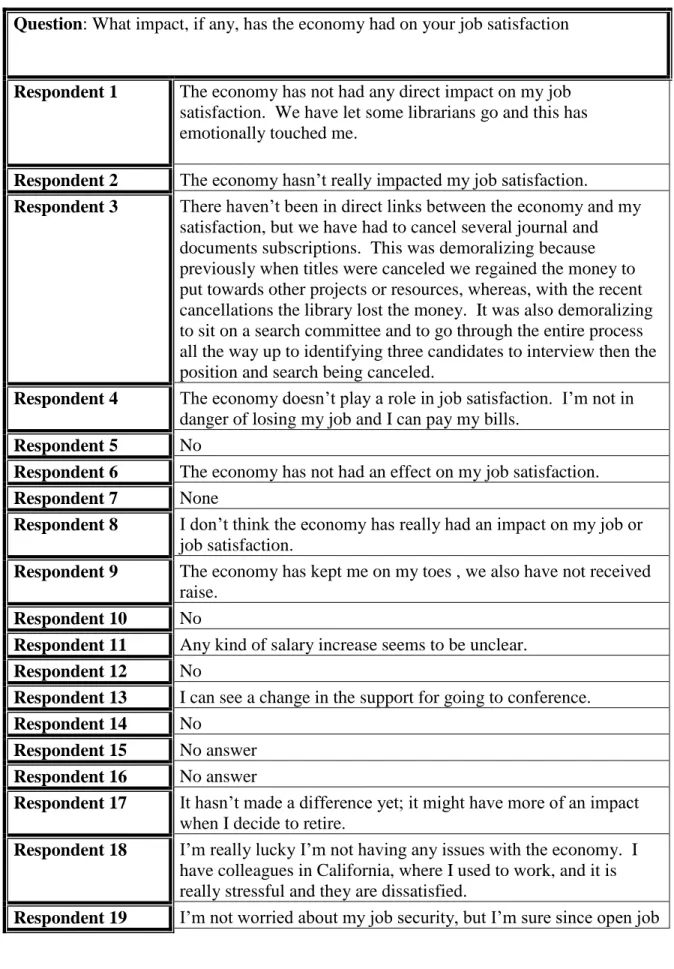
Figure 6: Economy responses
Question: What impact, if any, has the economy had on your job satisfaction
Respondent 1 The economy has not had any direct impact on my job satisfaction. We have let some librarians go and this has emotionally touched me.
Respondent 2 The economy hasn’t really impacted my job satisfaction. Respondent 3 There haven’t been in direct links between the economy and my
satisfaction, but we have had to cancel several journal and documents subscriptions. This was demoralizing because previously when titles were canceled we regained the money to put towards other projects or resources, whereas, with the recent cancellations the library lost the money. It was also demoralizing to sit on a search committee and to go through the entire process all the way up to identifying three candidates to interview then the position and search being canceled.
Respondent 4 The economy doesn’t play a role in job satisfaction. I’m not in danger of losing my job and I can pay my bills.
Respondent 5 No
Respondent 6 The economy has not had an effect on my job satisfaction. Respondent 7 None
Respondent 8 I don’t think the economy has really had an impact on my job or job satisfaction.
Respondent 9 The economy has kept me on my toes , we also have not received raise.
Respondent 10 No
Respondent 11 Any kind of salary increase seems to be unclear. Respondent 12 No
Respondent 13 I can see a change in the support for going to conference. Respondent 14 No
Respondent 15 No answer Respondent 16 No answer
Respondent 17 It hasn’t made a difference yet; it might have more of an impact when I decide to retire.
Respondent 18 I’m really lucky I’m not having any issues with the economy. I have colleagues in California, where I used to work, and it is really stressful and they are dissatisfied.
positions are not filled, that means I will take on more responsibility or performing things not planned.
Respondent 20 The economy has mostly affected our budget. We are not able to subscribe to as many journals as before and we have limited our operating hours.
Respondent 21 For our library I think the economy has increased our workload. There are positions open in our library and we aren’t able to fill them because of the economy. If these positions were filled our workload would lighten, so I guess the economy has played a small role in my job satisfaction.
Respondent 22 The economy hasn’t effected my position. I was hired a few years ago to work as a part-time librarian. My hours have not been reduced. It is probably helpful for the library that I am only working part-time.
Respondent 23 We have had to reduce some subscriptions; we also eliminated positions that were vacant. The library has worked really hard to avoid letting any current librarians go.
Respondent 24 The economy has had little impact on my job satisfaction. We were understaffed and lacked resources before the economic downturn.
Respondent 25 We haven’t seen salary increases in a while and I don’t think any will be coming anytime soon. Fortunately I think I have job security.
Respondent 26 I haven’t seen a big change since the economy went down. My colleagues’ jobs and mine are pretty safe. The administration has worked hard so that no positions were lost.
Respondent 27 The economy has not impacted my job satisfaction.
Respondent 28 The economy has kind of increased my job satisfaction. I am really lucky because my job is specialized. I was hired right before a hiring freeze. If I had not gotten the job when I did the position would have gone away permanently.
Respondent 29 The economy has not impacted my job or me directly, but the library system has had to cut back on some of the resources we subscribed to.
Respondent 30 None
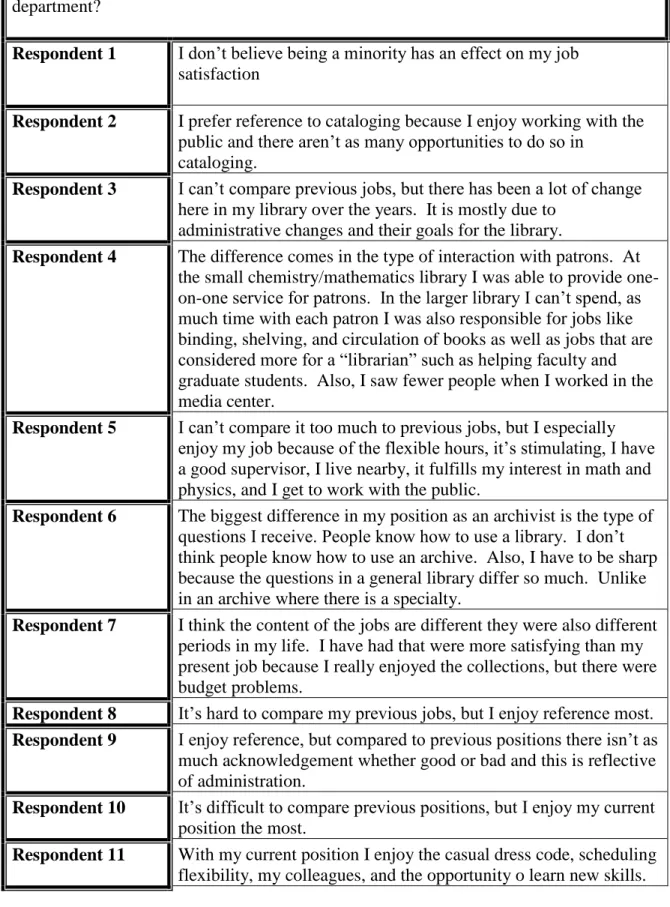
Figure 7: Comparing Departments
Question: How does working in other departments compare to working in the reference department?
Respondent 1 I don’t believe being a minority has an effect on my job satisfaction
Respondent 2 I prefer reference to cataloging because I enjoy working with the public and there aren’t as many opportunities to do so in
cataloging.
Respondent 3 I can’t compare previous jobs, but there has been a lot of change here in my library over the years. It is mostly due to
administrative changes and their goals for the library.
Respondent 4 The difference comes in the type of interaction with patrons. At the small chemistry/mathematics library I was able to provide one-on-one service for patrons. In the larger library I can’t spend, as much time with each patron I was also responsible for jobs like binding, shelving, and circulation of books as well as jobs that are considered more for a “librarian” such as helping faculty and graduate students. Also, I saw fewer people when I worked in the media center.
Respondent 5 I can’t compare it too much to previous jobs, but I especially enjoy my job because of the flexible hours, it’s stimulating, I have a good supervisor, I live nearby, it fulfills my interest in math and physics, and I get to work with the public.
Respondent 6 The biggest difference in my position as an archivist is the type of questions I receive. People know how to use a library. I don’t think people know how to use an archive. Also, I have to be sharp because the questions in a general library differ so much. Unlike in an archive where there is a specialty.
Respondent 7 I think the content of the jobs are different they were also different periods in my life. I have had that were more satisfying than my present job because I really enjoyed the collections, but there were budget problems.
Respondent 8 It’s hard to compare my previous jobs, but I enjoy reference most. Respondent 9 I enjoy reference, but compared to previous positions there isn’t as
much acknowledgement whether good or bad and this is reflective of administration.
Respondent 10 It’s difficult to compare previous positions, but I enjoy my current position the most.