Maria M. McCall. Music Libraries and E-Readers: Perspectives from the Profession. A Master’s Paper for the M.S. in L.S degree. April, 2011.30pages.Advisor: Jeffrey Pomerantz
Purpose: The purpose of this study is to explore the intersection of music libraries and e-readers by identifying key features, uses, and challenges of e-reader usage in the context of music libraries.
Design/Methodology: This study surveyed 66 music librarian participants and analyzed the most important features and challenges of the devices.
Findings: Findings showed that the variety of file formats supported is the most important feature and that content availability and cost pose the most significant challenges.
Originality/Value: This study explores a new and developing area of library and collections technology that has been minimally investigated at this point.
Headings:
by
Maria M. McCall
A Master’s paper submitted to the faculty of the School of Information and Library Science of the University of North Carolina at Chapel Hill
in partial fulfillment of the requirements for the degree of Master of Science in
Library Science.
Chapel Hill, North Carolina April 2011
Approved by
I. Introduction
The rumbling chatter in the concert hall gave way to applause as the conductor made his entrance. With the evening’s program about to begin, the maestro turned and
raised his baton not to the orchestra and choir assembled onstage, but to the audience. The Kennedy Center’s annual Messiah Sing-Along was about to get underway, the hall filled to bursting with over 2,400 voices. Armed with an abundance holiday spirit and scores of George Frideric Handel’s famed oratorio, the rustle of thousands of hands turning thousands of pages could be heard as the audience überchoir located the starting movement. A few individuals, however, stood out from the rustling masses. Shining out in the soft darkness of the concert hall, halos of light appeared silently around them in the expectant pause before the first measure. Had the heavenly host descended, luminescent divinity quietly come down to bless this haphazard assembly of voices? Angels? Saints? Fairy godmothers? Nope...iPads.
***
assessment e-readers specifically in the area of music libraries. Because the study of music is highly multifaceted and relies on a diverse array of resources, music libraries have a unique set of needs. This study identifies key features and uses of e-readers that are relevant to supporting the specific needs of music resources and libraries.
Music libraries are collections of textual, notational, and multimedia materials that support the study of the subject of music, which can include research, teaching, and performance. These collections are managed by music librarians, professionals with an educational background in both library science and music. E-readers are handheld
electronic devices which display digital content; for the purposes of this study, “e-reader”
includes both dedicated e-reading devices, such as the Amazon Kindle, and tablet devices that support e-reading, such as the Apple iPad. This study excludes smartphone devices, such as the Research In Motion BlackBerry and the Apple iPhone. These kinds of devices have very small screens, often less than the size of the palm of the hand, which are difficult to use for sustained, serious reading of literature. Small screens are
particularly prohibitive to the reading of music notation, especially for performance use. As music library usage demands these capabilities, smartphones do not fall within the purview of this study.
respectively, both companies have made statements attesting to vigorous and unflagging sales of the devices, with millions of units being sold in 2010 alone. E-readers do not exist in isolation; they are dependent on the progress of e-books and other digital materials to provide useful and attractive content to the consumer and library markets alike. The most recent figures from the Association of American publishers, tracking annual activity for 2010, report sales of $443.4 million for e-books, up 164.4% from the previous year (AAP, 2011).
As the proliferation of e-readers in the consumer market extends its influence into libraries, this study turns an eye specifically to music libraries and is guided by the following questions: What are the uses of e-readers in the context of music libraries? What are the most important features of e-readers in music libraries?
II. Literature Review
Music Library Literature
returned no materials. Discussion of e-readers is found, however, in the archives of the Music Library Association’s list serve, MLA-L. This informal commentary by members of the music library community includes the use of iPads and Kindles for the display of sheet music, electronic versus paper display, inquiries into how music libraries are using e-readers, converting files for use on e-readers, and digital music readers (Bristah, 2010; Colvin, 2009; Crum, 2009; Kijas, 2010; Maxfield, 2009; Thomas, 2009). This list serv activity demonstrates the interest of the music library community in e-readers, their capabilities, and their uses. Music librarians are seeking the professional opinions and experiences of their peers with regard to e-readers, but published research has not yet met this demand. This exploratory investigation of the features and uses of e-readers in music libraries will begin to fulfill the demonstrated need for literature on this topic.
Music libraries host a wide variety of content formats, notably music notation; examination of e-readers within the context of music libraries must include consideration of this critical content format and its applications. Digital music stands and readers, dedicated electronic devices for the display of digital music notation, often for use in performance, aim to address digital notation content. They have yet to experience
E-Reader Functions and Features
The study of e-readers in a music library setting necessitates a firm understanding of what these devices are and of what they are capable. To illustrate this, a sampling of technical specifications for 4 popular e-reader devices, the Amazon Kindle, Apple iPad, Barnes & Noble Nook, and Sony Reader are presented. Base models are used.
Basic Specs:
Amazon Kindle
Screen size: 6 in Weight: 8.5 oz
Battery life: 3 weeks - 1 month Zoom capability: Yes
Backlit display: No Memory: 4 GB
Apple iPad
Screen size: 9.7 in diagonal Weight: 1.33 lbs
Barnes & Noble Nook
Screen size: 6 in main screen, 3.5 in navigation screen Weight: 11.6 oz
Battery life: up to 10 days Zoom capability: Yes Backlit display: No Memory: 2 GB
Sony Reader Pocket Screen size: 5 in Weight: 5.47 oz Battery life: 2 weeks Zoom capability: Yes Backlit display: No Memory: 2 GB
File Formats and Compatibility
Content format is one of the most crucial elements in the functionality of e-readers. E-readers depend on digital content, electronic resources with no strict
image or as text within a file. Within the kinds of content that are suitable for use on e-readers, the makers of the devices incorporate restrictions that encourage or limit users (and libraries) to the purchase of titles through their own “libraries.” For perspective on e-readers and file formats, here are some popular readers and their basic file
compatibilities:
Amazon Kindle
Natively: .MOBI, .PRC, .TXT, .AZW (Kindle proprietary format), PDF, Audible Supported conversion: DOC, HTML, JPEG, GIF, PNG, BMP
Apple iPad
Natively: iBooks, EPUB, PDF, HTML, TXT, RTF, JPEG, TIFF, GIF, DOC, DOCX, PAGES
Supported conversion: Kindle app, Nook app, inestimable number of other reading-related apps
Barnes & Noble Nook
Natively: EPUB (including Non- or Adobe DRM), PDB, PDF, JPG, GIF, PNG, BMP Supported conversion: n/a
Sony Reader Pocket
There are a number of similarities across these popular platforms, but no two devices support exactly the same kinds of content. Hacking and jailbreaking of the devices can enable the use of other file formats and reading applications. For a listing of e-book file formats, the Wikipedia entry “Comparison of e-book formats” appears to be the most complete and authoritative resource currently available, although as with all Wikipedia and user-contributed resources, caution and fact-checking are strongly
recommended (Wikipedia, http://en.wikipedia.org/wiki/Comparison_of_e-book_formats).
III. Methodology
This study collected information on the features and uses of e-readers from active music librarians. It was designed as an anonymous, self-administered, web survey in two parts. The first part consisted of quantitative, Likert-type, closed-ended questions on e-reader features followed by two open-ended questions on features and perceptions. The second part consisted of a qualitative, open-ended questionnaire on experiences with the use of e-readers in music libraries. All subjects were asked to answer the questions in Part I; subjects who indicated direct experience with e-readers in a music library context were asked to complete Part II as well. Responses for questions in both sections were optional, not required. Participants could to skip questions and leave the survey at any time. Data collection was managed through the Qualtrics survey client. See Appendix I for the data collection instrument.
second portion, the subject must also have indicated experience with e-readers in a music library context. Subjects without direct experience were excluded from the second section; those questions all ask the subject to describe elements of their music library experience with e-readers.
The total number of professional music librarians is not documented. Music librarian positions, much like all library positions, vary in wording of job title, professional affiliations, and job duties. Given these variables, it would take nothing short of an international census to accurately determine the total population of those professionals whose jobs are or include the duties of a music librarian. The best available samples for web survey contact are the populations of the Music Library Association’s MLA-L list serv and the International Association of Music Libraries, Archives and Documentation Centres’ IAML-L list serv. MLA-L has 1,165 subscribers (as of 1/12/11) and IAML-L has 604 subscribers (as of 3/30/11). Subjects were recruited via an email invitation and reminder which contained a link to the survey. Once at the survey page, subjects had to confirm their consent to participate. Subjects were contacted three times over the course of the study: one invitation email, one reminder invitation email, and the survey itself. Due to anonymity, no follow-up contact was initiated. The survey was open for a two-week period.
data. The qualitative data from the open-ended Part II questionnaire underwent inductive, conventional, qualitative content analysis and was coded thematically.
IV. Data
The web survey instrument recorded 101 respondents and 66 usable responses. The disparity in these figures is due to respondents who answered a consent question but then chose not to answer any data-related survey questions. This difference could be the result of respondents who changed their minds about participating or clicked through the instrument without entering any responses. See Appendix II for complete response data.
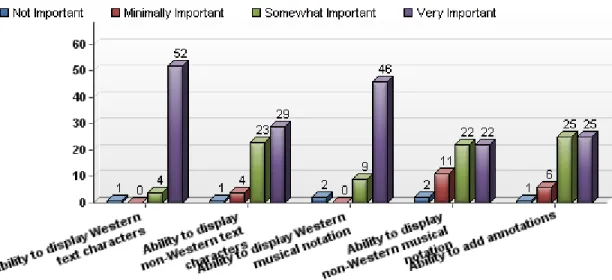
Fig. 1: Importance of E-Reader Characteristics (I)
Fig. 2: Importance of E-Reader Characteristics (II)
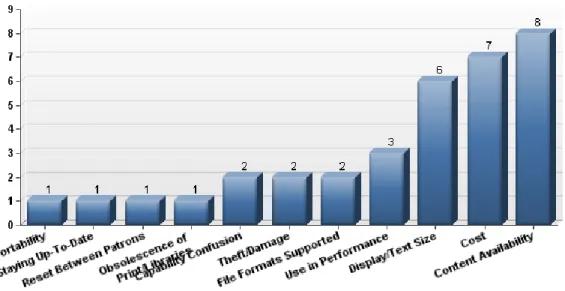
in an e-reader. The greatest area of challenge and concern is content availability, followed closely by cost and display/text size (Fig.4).
Fig. 3: Most Important E-Reader Characteristic Overall
Fig. 4: Biggest Challenge/Concern with E-Reader Usage in Music Libraries
E-reader use varies from checkout of the physical device and content, to just the content, to just the device. The content supported on the devices includes web-accessible content, multimedia files, text only files, and files from a particular retailer only. Staff responses run the gamut from very positive to very negative, with the influences of fear, newness, and inaccessibility contributing to lack of staff knowledge about the devices. Patron response is characterized as enthusiastic, mixed, lacking proactivity, unsure, and unaware.
V. Discussion
The data collected in this study is an important first look into the world of readers and music libraries. It reflects a desire for an incredibly versatile device. An e-reader should be portable and powerful, be capable of accessing digital library
collections, have multimedia functionality, and provide for the clear reading of notation, including in performance situations. Music librarians understand the diverse demands placed upon their collections; the data demonstrates that they want a device that is able to handle those demands at a very sophisticated level, or else it is not worthwhile to them.
developed that minimize the compatibility challenges between the competing sides, such as in PC versus Mac. Also, the open source movement continues to grow across the technological spectrum; users increasingly expect unfettered access and customization options in their digital realm, expectations that go against the idea of proprietary and limited file format support. Given these trends, there is great potential for resolution of the critical issue of file format that the data identifies. File format concern is a challenge that is likely to minimize or disappear in near future; following the pattern of previous “format wars,” a particular file format for e-readers will be accepted as a standard or greater file compatibility will become available, if demanded by users.
Content availability is a key part of a successful library/e-reader relationship and is named as the biggest challenge and concern by respondents. Whether through library-initiated projects or through vendors, there is not yet enough digital music literature and notation content, although availability is growing. It will be some time before digital resources can begin to approach the authoritative depth of current print holdings in music libraries.
E-readers, as a highly portable technology, are poised to provide versatile use of music literature and notation for a range of functions, from scholarly study to
performance. Study data indicates portability as an important feature to almost all
area where music truly does have highly unique needs from a digital reader. Devices with larger screens, such as an iPad or a Kindle DX may meet the needs of musicians such as choristers or pianists, who may prefer performance stances that require less distance between themselves and their parts. In the case of a timpanist, however, even the largest current e-reader screen will be illegible when peered at from across a 4-foot drum. The use of e-readers for performers will not be one-size-fits-all and will vary greatly in utility depending on instrument, stance, and eyesight.
Data in Part II indicates models of e-reader involvement from music libraries vary from checkout of only the device, only content, and both. While this study does not address it, this issue relates closely to assumptions regarding personal technology
ownership and where a line can reasonably be drawn by an institution. For example, it is common to assume that the average college student patron has a laptop; it is common to assume that the average adult has a cellphone. Only time will tell where the line for e-readers can be drawn. Right now, they are far from ubiquitous in the general population, but once up on a time, so were laptops and cellphones. For e-readers and other
technological advances, it is important to understand the state of personal technology ownership, and how it differs across a patron base, impacted by a number of factors including age, level of academic study, and socioeconomic background.
go away or cease its evolution. Helping staff members to feel comfortable with the technology they provide to their patrons is essential.
Overall, e-readers do not currently meet the needs expressed by music librarians. File formats are treacherous to navigate, content availability is limited, and costs are relatively high at a time when budgets are particularly strained. This situation, however, should not deter music librarians from continuing to investigate e-readers and their developments. Technological evolution is a given; these devices can increase in usability and content base and decrease in cost over time, as have many other areas of technology, from computers to video games to apps. Libraries of all varieties are already in the midst of radical changes, many driven or impacted by digital developments. Multimedia-heavy fields such as music have experienced perhaps the most drastic of these changes, and as such, need to be vigilant and proactive in their watch for what is coming next.
VI. Conclusion
The rise of e-readers only reinforces the following: technology is constantly growing and changing. These devices are still at a relatively young stage in their development and it remains to be seen where they will go next. In a very short span of time, e-readers have gone from providing basic functionalities to multimedia capabilities, with a huge consumer market following. Cultivating an understanding and indicating interest in them at this stage can be an impetus for more library-friendly developments in future e-reader releases. It is beneficial for music libraries to keep an eye on such rapidly advancing, library-relevant technologies, even if not adopting them at the current moment. The iPad singers at the Kennedy Center would certainly sound a hearty
Works Cited
"AAP Publishers Report Strong Growth in Year-to-Year, Year-End Book Sales." The Association of American Publishers, 16 Feb. 2011. Web.
<http://www.publishers.org/press/24/>.
Ajero, Mario. "Professional resources: Random access - Switching to digital music scores in the digital age." American Music Teacher 58.5 (2009). Web. <http://
search.proquest.com.libproxy.lib.unc.edu/docview/942035?accountid=14244>. Bristah, Pamela. "Reading music on the ipad ." 06 Jul 2010. Online Posting to MLA-L.
E-mail.
Carnoy, David. "B&N: Nook line 'biggest bestseller ever'." Crave: The Gadget Blog from CNET. CBS Interactive, 30 Dec. 2010. Web.
<http://news.cnet.com/8301-17938_105-20026837-1.html>.
Colvin, Jenny. "Kindle music impressions ." 22 Aug. 2009. Online Posting to MLA-L. E-mail.
"Comparison of e-book formats." Wikipedia. 30 Mar. 2011. Web. <http://en.wikipedia.org/wiki/Comparison_of_e-book_formats>.
Cross, Jane. "Digital media reviews: estand electronic music stand." Notes: Quarterly Journal of the Music Library Association 60.3 (2004): n. pag. Web.
Crum, Jennifer. "Re: taiga statements, the future, etc. etc. etc." 05 Aug. 2009. Online Posting to MLA-L. E-mail.
Jobs, Steven. "Apple iPad 2 Keynote." Web.
<http://www.youtube.com/watch?v=TGxEQhdi1AQ>.
Kijas, Anna. "are you using ipads in your library or classes?." 05 Oct. 2010. Online Posting to MLA-L. E-mail.
"Kindle Technical Details." Kindle Wireless Reading Device. Amazon.com, Inc. Web.
<http://www.amazon.com/dp/B002Y27P3M/?tag=googhydr-20&hvadid=6734403317&ref=pd_sl_96l1nf9bbr_e>.
Maxfield, Patrick. "Kindle and music pdf's??." 23 June 2009. Online Posting to MLA-L. E-mail.
"Nook Specs." Barnes & Noble, Inc. Web.
<http://www.barnesandnoble.com/nook/features/techspecs/index.asp>. "Specifications." Sony Reader Pocket Edition. Sony Electronics, Inc. Web.
<http://www.sonystyle.com/webapp/wcs/stores/servlet/ProductDisplay?catalogId=
10551&storeId=10151&langId=-1&productId=8198552921666257813#specifications>.
"Technical Specifications." iPad. Apple Inc. Web. <http://www.apple.com/ipad/specs/>. Thomas, Kirsti. "Digital music readers (was: taiga statements, the future, etc. etc. etc.)."
Appendix I: Survey Instrument
Welcome to the Music Libraries and E-Readers survey! The purpose of this brief survey is to identify key features and uses of e-readers in the context of music libraries. This survey will not collect any personal or sensitive information about you. There are no known risks to participation in this survey. Please participate only if you are currently a music library professional. Participant’s Agreement: I voluntarily agree to participate in this web survey. Clicking “I Agree” indicates your consent.
o I Agree
o I Do Not Agree
[Part I]
For the purposes of this survey "e-reader" includes both dedicated e-reading devices, such as the Amazon Kindle, and tablet devices that support e-reading, such as the Apple iPad. Please base your answers on the use of e-readers in the context of music libraries,
inclusive of the reading of both text and music notation. How important are the following e-reader characteristics?
Not Important Minimally Important
Somewhat Important
Very Important Ability to use
digital library collections Technologically progressive reputation
How important are the following e-reader characteristics? Not Important Minimally
Important Somewhat Important Very Important Portability (weight, size)
Battery life
Zoom capability
Variety of file formats supported
Backlit display
Memory capacity
Speed of page turns
Ease of page turns
How important are the following e-reader characteristics? Not Important Minimally
Important
Somewhat Important
Very Important Ability to display
Western text characters
Ability to display non-Western text
characters
Ability to display Western musical
notation
Ability to display non-Western musical notation
Ability to add annotations
How important are the following e-reader characteristics? Not Important Minimally
Important Somewhat Important Very Important Graphics capabilities Audio capabilities Video capabilities
Overall, what is the most important e-reader characteristic (whether already identified in this survey or not)? Why?
What is the biggest challenge or concern with regard to the use of e-readers in music libraries?
Does your institution support the use of e-readers, either through the lending of physical reader devices or through the lending of digital book materials specifically for e-reader devices?
o Yes
o No
o Don't know
If you have experience working with e-readers in your institution, would you be
interested in continuing to a brief questionnaire about your institution’s e-reader usage?
o Yes
[Part II]
Please describe how e-readers are used in your music library, by patrons and/or staff.
Please describe the kinds of content that are supported for e-readers in your music library.
Please describe staff response to the use of e-readers in your music library.
Appendix II: Survey Data
Welcome to the Music Libraries and E-Readers survey!
The purpose of this brief survey is to identify key features and uses of
e-readers in the context of music libraries. This survey will not collect any
personal or sensitive information about you. There are no known risks to
participation in this survey. Please participate only if you are currently a
music library professional.
Participant’s Agreement: I voluntarily agree to participate in this web
survey. Clicking “I Agree” indicates your consent.
# Answer Response %
1 I Agree 101 100%
2 I Do Not Agree 0 0%