Sharif University of Technology
Scientia IranicaTransactions F: Nanotechnology http://scientiairanica.sharif.edu
An analytical solution to the bending problem of
micro-plate using a new displacement potential function
F. Yakhkeshi and B. Navayi Neya
Faculty of Civil Engineering, Babol Noshirvani University of Technology, Babol, Iran. Received 13 July 2018; received in revised form 1 January 2019; accepted 23 February 2019
KEYWORDS Micromechanics; Couple stress theory; Length-scale
parameter; Rectangular plate; Displacement potential function.
Abstract. In this paper, to include small-scale eect, the augmented Love Displacement Potential Functions (DPF) are developed for isotropic micro or nano-scale mediums based on couple stress theory. By substituting the new DPF into the equilibrium equations, the governing equations were simplied to two linear partial dierential equations of sixth and fourth orders. Then, the governing dierential equations were solved for simply supported rectangular plate using the separation of variable method by satisfying exact boundary conditions without any simplication assumptions. Displacements, bending and torsional moments of rectangular plate were obtained for dierent length-scale parameters and aspect and Poisson's ratios. The obtained results were compared with other studies, which showed excellent agreement.
© 2019 Sharif University of Technology. All rights reserved.
1. Introduction
Nowadays, thin beams and plates are widely used in nanoelectromechanical systems (NEMS), microelectromechanical systems (MEMS) and mi-cro/nanotechnologies. Hence, investigating the me-chanical behavior of such components has always been an important issue among the researchers. The clas-sical continuum theory of elasticity is a theoretical, idealized, and simplied model with limited ability to predict behaviors of solid body in micro scale. For instance, based on the classical theory, stress concen-tration factor around a circular hole in an innite plate is independent of the radius of the hole [1]. Also, in this theory, it is assumed that all material bodies are continuous and therefore, the laws of motion and postulates of constitution are valid for any part of
*. Corresponding author.
E-mail addresses: [email protected] (F. Yakhkeshi); [email protected] (B. Navayi Neya) doi: 10.24200/sci.2019.51264.2087
the body regardless of their dimensions [2]. On the contrary, any material body consists of granular or porous materials. Experimental studies such as those of McFarland and Calton [3] have indicated that the classical continuum mechanics is incapable of justifying the size dependency in micro or nano scales due to the lack of material length-scale parameter. In addi-tion, micro structure eects become important when the thickness of the structure is extremely low and comparable to internal length scales of its materials [4]. As a result, a number of theories comprising material length-scale parameters have been proposed. These theories are known to bridge between macroscopic and microscopic physics [2]. Voigt, who was one of the pioneers in formulating the theory of elasticity, introduced couple stresses mij in addition to the force
stresses ij [5]. In 1909, Cosserat brothers developed
the rst mathematical model using couple stress theory. Based on their theory, during loading on a body made of elastic material, the body not only is displaced, but also rotates independently, meaning that three extra freedoms need to be considered for any element [5,6]. Despite its novelty, Cosserat brothers' theory remained
unknown during their lifetime. Afterwards, in 1968, Eringen introduced the micropolar theory based on the Cosserat theory. Another higher-order contin-uum theory is the couple stress theory developed by Toupin [7], Mindlin and Tiersten [8], Koiter [9], and Nowacki [10]. The couple stress theory is a special form of the micropolar theory in which rotation vectors for microstructure and macrostructure are considered to be equal [11]. Hence, rotation components are obtained based on displacements [8]. In couple stress theory, in addition to two Lame constants, there are two material length-scale parameters for an isotropic elastic material [12]. Yang et al. [13] utilized an additional equilibrium equation for moments of couples as well as two classical equilibrium equations in order to describe the behavior of the couples. Thus, the couple stress tensor was constrained to be symmetric and the two material length scales were reduced to only one. Yang's studies are known as the modied couple stress theory. The modied couple stress theory has been used in some researches for static and dynamic problems. Park and Gao [14], Ma et al. [15], Kong et al. [12] and Ke and Wang [16] stated that in static analysis, the displacement obtained by the modied couple stress theory was smaller than that by the classical theory. This implies that the size dependency reduces deection and increases bending rigidity. Also, when size eect is applied to the dynamic behavior of microstructures, natural frequencies of free vibration predicted by the modied couple stress theory are higher than those by the classical model [15,17-23].
Microplates can be considered as important parts of various microsystems. Therefore, the static and dy-namic behaviors of the microplate have been studied by many researchers [24-28]. Tsiatas [17] developed a new Kirchho plate method for static analysis of isotropic micro-plates based on the modied couple stress theory with only one material-length scale parameter. The proposed model was capable of analyzing plates with complex geometries and boundary conditions.
Even after the introduction of the modied couple stress theory, the couple stress theory was being studied in parallel. Asghari et al. [11] showed that from the two existing material length-scale parameters in the constitutive equations of the couple stress theory, only one of them would appear. Fathalilou et al. [29] showed that bending rigidity of couple stress theory was closer than that of modied couple stress theory to the experimental results.
Due to indeterminacy of the spherical part of the couple-stress tensor and appearance of body couple in the constitutive relations of force-stress tensor, formu-lation of the couple stress theory is more dicult than classical theory [8,30]. Hadjesfandiari and Dargush [31] developed the consistent couple stress theory for solids. They introduced the skew-symmetric couple stress
ten-sor by utilizing the principle of virtual work and some kinematical considerations. It is necessary to point out that Mindlin and Tiersten [8] derived the general solution to the displacement in isotropic elasticity within the context of the indeterminate couple stress theory. Their formulation included two couple stress parameters, which limited its application. Hadjesfan-diari and Dargush [31] showed that these coecients were not independent. They presented the governing equation with only one length scale parameter.
Utilizing potential functions is a suitable method to simplify and solve elasticity problems. Hence, several potential functions have been developed for elasticity problems within both displacement and stress formulations. Displacement formulation is more com-mon for 3D elasticity problems. There are some displacement potential functions such as Helmholtz de-composition, Galerkin vector, Papkovich-Neuber func-tions, Love's strain function, and Lame's strain po-tential function that can be used for isotropic me-dia [1]. It is to be noted that Love [32] originally derived his solutions expressively for the axisymmet-ric case. Love's displacement potential function was then extended to non-axisymmetric irrotational prob-lems [33]. In honor of Love, a non-axisymmetric DPF, named the non-axisymmetric Love solution, and its completeness were investigated by Tran-Cong [33] for a simply connected and z-convex smooth surface. In non-axisymmetric augmented Love DPF, irrota-tional limitation is omitted by adding the second function in displacement vectors. Completeness of augmented Love DPF was investigated for elastostatics and elastodynamics problems by Tran-Cong [33], Pak and Eskandari-Ghadi [34], and Eskandari-Ghadi and Pak [35]. One of the useful displacement poten-tial functions is Lekhnitskii-Hu-Nowacki, proposed for transversely isotropic materials. Lekhnitskii presented particular potential functions for the general solution to axisymmetric problems in transversely isotropic materials that were the generalization forms of Love solution [1]. Hu (1953) and Nowacki (1954) developed the Lekhnitskii solution to a general case of elastostatic problems for transversely isotropic media [36]. Wang and Wang [37] proved that Lekhnitskii-Hu-Nowacki's solution was complete for elastostatic problems in transversely isotropic media. Afterwards, Eskandari-Ghadi [36] generalized the Lekhnitskii-Hu-Nowacki so-lution to dynamic problems. They successfully ap-plied augmented Love, Lekhnitskii-Hu-Nowacki, and Eskandari-Ghadi displacement potential functions to bending, buckling, and vibration of isotropic and trans-versely isotropic simply supported thick rectangular plates problems [38,39].
In this paper, the augmented Love displacement potential functions are developed to take into account the small eect of micro and nano mediums. By
substituting the new DPF in equilibrium equations, the sixth- and fourth-order partial dierential equations are obtained as the governing equations. Then, the governing equations are solved for simply supported rectangular plate by separation of the variable method, satisfying exact boundary conditions. The presented method is exact and applicable to all isotropic plates of the problem with any thickness ratio, because there is no simplifying assumption in the procedure, displacement or stress components, thickness ratio, and linear elastic material properties.
2. The governing equations
In continuum mechanics, for an arbitrary part of the material continuum with volume, V , enclosed by boundary surface, S, the linear and angular equilibrium equations for the couple stress theory are written as [1]: ji;j+ Fi= 0; (1)
ji;j+ "ijkjk+ Ci= 0; (2)
where jiand jiare force stress and couple stress
ten-sors, respectively; Fiand Ciare body force and couple
per unit volume, respectively; and "ijk is permutation
symbol. Here, the subscript denotes dierentiation with respect to spatial variables.
Writing force-stress tensor in terms of displace-ments and substituting it into the linear equilibrium equation, Eq. (3) is obtained. In this paper, we use the liner equilibrium equation derived by Hadjesfandiari and Dargush [31], which is a dierent version of the Mindlin and Tiersten [8] equation:
++r2r (r:~u)+ r2r2~u + F =0; (3)
where ~u is the displacement vector of the continuum material, and are the Lame constants, ij is the
Kronecker delta, and is an extra material constant dened in couple stress theory.
In Eq. (3), ~u is of class C4on R3if u is continuous
on R3and its position derivative up to the 4th order is
at each point in R3, where R is the set of real numbers.
A solution, u, to Eq. (3) of class C4 on R3 will be
referred to as an elastic response in micro scale of an isotropic material.
Using the energy and the constitutive relations, the force stress tensor and couple stress tensor can be written as [30]:
ji=ekkij+ 2eij+ 2r2!ji= uk;kij
+ (ui;j+ uj;i) l2r2(ui;j uj;i); (4)
ji= 4(!i;j !j;i); (5)
where ui is displacement vector component of the
continuum material, and eij and !ij are strain and
rotation tensors and can be written as:
eij =12(ui;j+ uj;i); (6)
!ij = 12(ui;j uj;i): (7)
The operator r is dened as:
r = @x@~i + @@y~j + @@z~k: (8) Also, can be represented in terms of length scale parameter, l, as [31]:
= l2: (9)
3. Displacement potential functions
In non-axisymmetric Love DPF, only one function is used, i.e., F (see Eqs. (10)-(12)), and for rotation-free augmented Love DPF, function is added. The completeness of augmented Love potential functions, as mentioned before, has been investigated for many elas-todynamics and elastostatics mechanics problems [33-35], but due to the lack of length scale parameter, the augmented Love displacement potential functions are not suitable for solving of the micromechanics problems [40]. Hence, in this section, by developing the augmented Love potential functions for isotropic materials, we introduce new displacement potential functions that include length scale parameter.
u = (1+ l2r2)@ 2F
@x@z @
@y; (10)
v = (1+ l2r2)@ 2F
@y@z + @
@x; (11)
w = 2
@2F
@x2 +
@2F
@y2
+ (1 l2r2)@2F
@z2; (12)
where u, v, and w are displacement components in x, y, and z directions, respectively; F and are displacements potential functions, respectively; and 1
and 2are dened as:
1= + ; 2= + 2 : (13)
Substituting the displacement potential functions into the governing equation (3) with some algebraic manip-ulations, the governing equations can be written as:
(1 l2r2)@
@yr2 = 0; (14) (1 l2r2) @
@xr2 = 0; (15) (1 l2r2)r4F = 0: (16)
may dene a vector function, namely G, as G = ((1 l2r2)r2)ez, where ez is the unite vector in
z-direction. Then, the rst two equations are translated to curl G = 0. The solution to this equation is not unique [41] and, in this problem, it is enough to be zero, meaning that:
(1 l2r2)r2 = 0; (17)
where F (x; y; z) is a class C6 eld and (x; y; z) is a
class C4eld on R3.
It can be seen that by eliminating the length scale parameter (l), Eqs. (16) and (17) are simplied to the classical form [39]. The proposed displacement potential functions and governing equations are valid for any isotropic medium. In the following, these equations are solved for a simple rectangular plate.
4. Application to plates
The governing dierential equations (16) and (17) are solved here for a simply supported rectangular plate with thickness of t, length of a, and width of b (see Figure 1).
As shown in Figure 1, an x, y, z Cartesian coordinates system is used, where the z-axis is along the plate thickness and q is a static lateral load applied to upper surface of plate and written in the form of the Fourier series as:
q(x; y) =X
m
X
n
qmnsinma x
sinnb y; (18) where n and m are integers, and qmn is the Fourier
loading coecient written as [42]:
qmn=ab4 a
Z
0 b
Z
0
qz(x; y): sinma x
sinnb ydxdy; (19) where qz(x; y) is static lateral load.
4.1. Boundary conditions
For a simply supported rectangular plate, the boundary conditions on edges can be written as:
w = 0; Mx= 0 at x = 0; a; (20)
w = 0; My = 0 at y = 0; b; (21)
where bending moments Mx and My are dened as:
Mx=
Z t 2 t 2
xzdz; My =
Z t 2 t 2
yzdz: (22)
The boundary conditions on the upper ( t=2) and lower (+t=2) surfaces of the plate can be represented as: At z = t
2:
zz= q; (23a)
zx= 0; (23b)
zy = 0; (23c)
zx= 0; (23d)
zy= 0: (23e)
At z = +t 2 :
zz= 0; (24a)
zx= 0; (24b)
zy = 0; (24c)
zx= 0; (24d)
zy= 0: (24e)
5. Solution procedure
Using the method of separation of variables, Eq. (16) can be solved for the potential function, F , in terms of three scalar functions, f, g, and h, which are functions of x, y, and z, respectively.
F (x; y; z) = f(x) g(y) h(z): (25) Substituting Eq. (25) into Eq. (16), by satisfying the displacement boundary conditions, i.e., Eqs. (20)
and (21), f and g are determined as: f = C0
1sinma x; (26)
g = C0
2sinnb y; (27)
where C0
1 to C20 are constant coecients. Parameters
m, n, and mnare dened as:
m= ma ; n=nb ; (28)
mn=
p
(m)2+ (n)2: (29)
Substituting f and g into Eq. (16), the governing dierential equation is obtained in terms of h:
d6h
dz6( l2) +
d4h
dz4(1 + 32mnl2)
+ddz2h2( 22
mn 34mnl2)
+ h(4
mn+ 6mnl2) = 0: (30)
The solution to Eq. (30) can be written as: h =c0
3sinh mnz + c04cosh mnz + c05z sinh mnz
+ c0
6z cosh mnz + c07z sinh (p1 z)
+ c0
8z cosh (p1 z) ; (31)
where 1=l12 + 2mn.
Introducing new coecients C1to C6, the
poten-tial function F can be rewritten as: F =X
m
X
n
"
C1sinh mnz + C2cosh mnz
+ C3z sinh mnz + C4z cosh mnz
+ C5sinh (p1 z) + C6cosh (p1 z)
sinm a x sin
n b y
#
: (32)
Similar to F , the potential function can be derived as:
(x; y; z) = f1(x) g1(y) h1(z): (33)
Substituting Eq. (33) into Eq. (17) and using the separation of variables technique, by satisfying the moment boundary conditions, i.e., Eqs. (20) and (21), f1 and g1 are specied as
f1= A01cosma x; (34)
g1= A02cosnb y: (35)
Substituting f1, i.e., Eq. (34), and g1, i.e., Eq. (35), into
Eq. (17), the governing dierential equation is obtained in terms of h1as:
d4h 1
dz4 (l2)
d2h 1
dz2 (1+22mnl2)+h12mn(1+2mnl2)=0:
(36) Eq. (36) can be solved as:
h1=A03sinh mnz + A04cosh mnz
+ A0
5sinh (p1 z) + A06cosh (p1 z) : (37)
By introducing new coecients A1to A4, the potential
function is expressed as: =X
m
X
n
"
A1sinh mnz + A2cosh mnz
+ A3sinh (p1 z) + A4cosh(p1 z)
cosma x cosnb y #
: (38)
To nd the unknown coecients C1-C6 and A1-A4,
the remaining boundary conditions must be satised. Hence, the displacements components and boundary conditions, Eqs. (23) and (24), are written in terms of f, g, h and f1, g1, h1 as:
u = 1f0gh0 l2r2f0gh0 f1g01h1; (39)
v = 1fg0h0 l2r2fg0h0 f10g1h1; (40)
w = 2f00gh + 2fg00h + fgh00 l2r2fgh00; (41)
zx=
+k
2 k
f0gh00+k
2
1 l2+2mn
f0gh
+ k 2 mn 1 2 + 1 2 f0gh(4)
+
2k
2
f1g01h01+
k 222mn
f1g10h0001 ;
(42) zy= + k 2 k
fg0h00+k
2
1 l2+2mn
fg0h
+k2
mn 1 2 + 1 2 fg0h(4)
+
+2k
2
f0
1g1h01+
k 222mn
f0
1g1h0001;
(43)
zy=k
h0 1
2 mnh
000f0g
+k
2 1 2 mnh 00 1+ h1
zx=k
h0+ 1
2 mnh
000fg0
+k
2
1 2
mnh 00 1+ h1
f0
1g1; (45)
zz=
2
mn l24mn lk2
fgh0
+
2+ l22mn+k2
fgh000
+
k 22
mn
fgh(5); (46)
where k = 2l2 2mn2.
Satisfying boundary conditions (23b), (23c) and (24b), (24c) lead to the zero value of . It is noticeable that the length scale parameter remains although po-tential function is eliminated. Thus, the coecients C1 to C6 should be obtained based on boundary
conditions, i.e., Eqs. (23) and (24). Eqs. (23b), (23c) and (24b), (24c) can be rewritten as:
k + k 2
h00+k
2
1 l2+ 2mn
h
+k2
mn
1 2+
1 2
h(4)= 0 at z = t
2:(47)
Similarly, zx and zy can be written as:
At z = t 2:
zx= k
h0+ 1
2 mnh
000fg0 = 0; (48)
zy= k
h0 1
2 mnh
000
f0g = 0: (49)
It can be seen that Eqs. (48) and (49) are identical and can be rewritten as:
kh0+ k
2 mnh
000= 0 at z = t
2: (50) Thus, the previous boundary conditions are reduced to 6 boundary conditions, namely force stresses zz,
Eqs. (23a) and (24a); shear stresses, Eqs. (23c) and (24c); and couple stresses, Eqs. (23e) and (24e). Therefore, there is a system of 6 independent equations in which 6 constants C1 to C6 remain unknown.
Using MATLAB software, the 6 constant coef-cients and, consequently, the displacement potential function F can be determined. Having F , the displace-ments, strains, force stresses, couple stress tensors, and shear forces, bending and twisting moments can be determined.
6. Numerical examples
In this section, it is shown that how the new displace-ment potential functions can be employed in order to solve the real-case problems. The results obtained by utilizing the new displacement potential functions are compared to the classical data as well as the outcomes of the previous study.
6.1. Verications
Verication of the proposed displacement potential functions is shown in the following by eliminating length scale parameter (l) in the governing equations (Eqs. (16) and (17)). Therefore, the equations are simplied to the classical form [39], demonstrating the validity of the new displacement potential functions.
To compare the results, non-dimensional displace-ment of the mid-plane is introduced as w = wD=qa4,
in which D is rigidity of plate (D = (Et3=12(1 v2))),
and non-dimensional bending moments in x and y directions are introduced as Mx= Mx=qa2 and My =
My=qa2.
To verify the accuracy of the Presented Work (PW), the central non-dimensional deection ( wc) and
central non-dimensional bending moment in x and y directions ( Mxc and Myc) are compared with their
exact classical solutions, namely wc
c, Mxcc , and Mycc .
Considering t = 0:01 in contrast to l, which is in micro range, the l=t ratio becomes approximately zero. With the elimination of the l=t ratio, the solutions become similar to those to the classical method for thin plate. Thus, wc, Mxc, and Myc are adapted as wcc, Mxcc ,
and Mc
yc, demonstrating the accuracy of the model
developed in this study [43]. According to Table 1, the results of the central deection in rectangular plate for 4 dierent aspect ratios are in excellent agreement
Table 1. Comparison of wc
c and wc, Mxcc and Mxc, and Mycc and Mycin the rectangular plate for various aspect ratios.
b=a wc
c wc Mxcc Mxc Mycc Myc
1 0.00406 0.00406 0.047900 0.048236 0.047900 0.048236 2 0.01013 0.01014 0.101700 0.102293 0.046400 0.047449 3 0.01223 0.01227 0.118900 0.119985 0.0406000 0.042726 4 0.01282 0.01292 0.123500 0.125377 0.038400 0.041458
Table 2. Comparison of normalized central deections of square micro-plate in the PW and Tsiatas results versus (l=t)2
for 3 dierent Poisson's ratios. (l=t)2
wc=wcc
v = 0:25 v = 0:3 v = 0:35
PW Tsiatas PW Tsiatas PW Tsiatas
0 1 1 1 1 1 1
0.05 0.648 0. 817 0. 655 0.825 0.684 0.85
0.10 0.516 0.69 0.53 0.7 0.547 0.72
0.20 0.415 0.53 0.43 0.545 0.45 0.565
with those obtained by the analytical solutions of Timoshenko and Krieger [43]. Also, the comparison of Mxc and Myc with Mxcc and Mycc is summarized in
Table 1.
Also, the presented results in Table 1 show that the central non-dimensional bending moments in rect-angular plate for the 4 aspect ratios are consistent with the solutions for the classical method. The slight dierence is due to the length scale parameter.
Table 2 shows the normalized central deection, wc=wcc, for a square plate versus (l=t)2 for 3 dierent
Poisson's ratios (v = 0:25; 0:3; 0:35) of PW and Tsiatas result.
According to Table 2, the deection of the plate decreases by the increment of (l=t). This is similar to the results of Tsiatas, in which the normalized deection decreased with the increase in (l=t). Also, it is observed that the deection of the micro-plate slightly decreases with increase in the Poisson's ratio. 6.2. Results and discussion
The results for the analysis of micro plates under uniformly distributed load have been presented in Figures 2-6. Here, the following assumptions have been made: Young's modulus: E = 2:1 1011 N/m2 and
Poisson's ratio: v = 0:3.
Figure 2 shows non-dimensional displacements of
Figure 2. Non-dimensional displacement of the square nano-plate at y = (1=2)b for various values of l=t.
the simply supported square plate (b=a = 1) on the line y = (1=2)b for various length-to-thickness, l=t, ratios.
According to Figure 2, displacement of plate decreases with increase in l=t and it is always smaller than the classical deection. This can be justied with rigidity of microplate dened as D = (Et3=12(1 v2))+
tl2. Rigidity of micro plate is the sum of bending
rigidity of the plate and the contribution of rotation gradients to the bending rigidity [17]. By considering length scale parameter, the rigidity of couple stress theory increases. Hence, the displacement of plate decreases. It is noticeable that the displacements estimated here are less than those estimated by the classical theory and are adapted to Tsiatas results. In both Tsiatas model and PW, the displacement treatments are equal and for the same value of l=t , the displacement for PW is less than that for the Tsiatas model. It is noticeable that in the couple stress theory, size eect is applied using the l=t ratio.
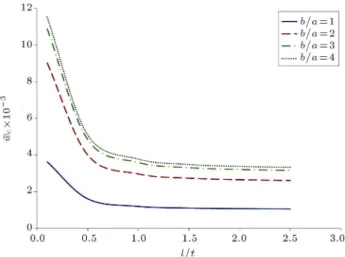
The eect of the aspect ratio, b=a, on the central displacement of the rectangular microplates for various l=t ratios is illustrated in Figure 3.
The results indicate that by the increasing the as-pect ratio (b=a), the central displacement will increase for dierent l=t ratios. Also, for the ratios of b=a = 3 and 4, the displacements are approximately equal.
Figure 3. Non-dimensional maximum displacement for various values of l=t and b=a.
Figure 4. Non-dimensional bending moment ( Mxc) for
dierence values of l=t and b=a.
Figure 5. Non-dimensional bending moment ( Myc) for
various values of l=t and b=a.
Such behavior can be justied for an innite length stripe. Figure 3 also shows that by increasing l=t, the central displacement of rectangular plate always decreases nonlinearly. This response is similar to that obtained by Tsiatas [17], and Papargyri-Beskou and Beskos [4].
Maximum bending moment of the rectangular plate in x direction (Mx) depends on the b=a ratio.
In this regard, Mxc for dierent l=t and b=a ratios
under uniform distributed load is determined. Figure 4 shows the variations of Mxc with respect to dierent
ratios of l=t and dierent plate dimensions of b=a. It is observed that, unlike for l=t > 0:5, for small l=t ratios, with increase in b=a, the maximum bending moments increase. In addition, it is observed that as l=t increases, thickness of the plate becomes smaller than length scale parameter and Mxc shows convergence
behavior for dierent b=a ratios.
The variation of non-dimensional maximum mo-ment in y direction ( Myc) is depicted in Figure 5. The
behavior of Myc is similar to that of Mxc with respect
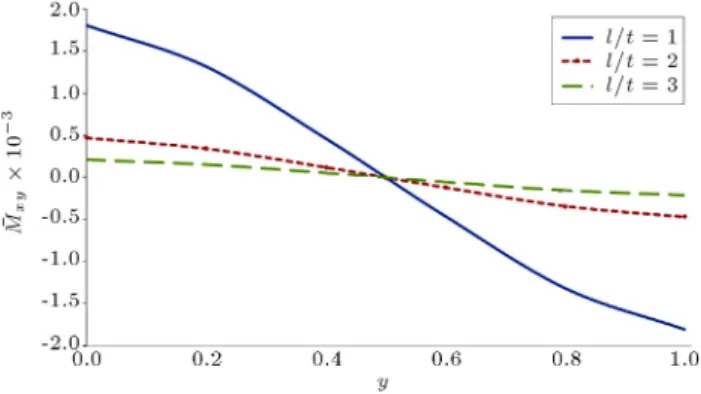
Figure 6. Distribution of non-dimensional torsional moment Mxyat x = a for various values of l=t.
to the variations of l=t. In contrast, when b=a increases,
Mycslightly decreases and the convergence between the
results improves for all the values of b=a. The twisting moment Mxy can be written as:
Mxy=
Z t 2 t 2
xyzdz: (51)
In order to investigate the inuence of twisting ment, distribution of non-dimensional twisting mo-ment, Mxy= Mxy=qa2, in x = a for the square plate is
shown in Figure 6. The gure shows that maximum
Mxy occurs at the edges of the plate and increases
by decreasing l=t. Also, the dierences between the twisting moments are reduced as the l=t ratio increases.
7. Conclusions
In this paper, the augmented Love displacement poten-tial functions were developed for mediums of isotropic micro and nano scales based on couple stress theory. Using the new DPF for an arbitrary isotropic and homogeneous medium in micro or nano scale led to the formation of dierential equations in the form of two independent partial dierential equations of sixth and fourth orders. These equations were solved for micro rectangular plates using the method of sepa-ration of variables. In contrast with the results of the previous researches, the proposed solution did not require simplifying assumptions, especially for shear stress or strain in thickness of plate. The numerical results of this study showed that with the reduction in plate thickness and by considering length parameter, the stiness of the plate increased and the plate dis-placement decreased, compared with the classic theory. Moreover, it was observed that in the couple stress theory for rectangular plates, with increase in b=a, the plate maximum displacement, wc, and the maximum
moment, Mxc, increased, while the maximum moment
Myc of the plate decreased. In addition, wc, Mxc, and
Myc decreased by increasing l=t. In the investigation
length parameter increased, Mxyon a simply supported
edge decreased and the convergence of the values of Mxyimproved.
Acknowledgment
This work was supported by Babol Noshirvani Univer-sity of Technology through Grant No. 91/13150490. This support is gratefully acknowledged.
References
1. Sadd, M. H., Elasticity Theory, Applications, and Numerics, Elsevier, 2nd edition (2009).
2. Asghari, M. \Geometrically nonlinear micro-plate for-mulation based", International Journal of Engineering Science, 51, pp. 292-309 (2012).
3. McFarland, A.W. and Colton, J.S. \Role of material microstructure in plate stiness with relevance to micro cantilever sensors", Journal of Micromechanics and Microengineering, 15, pp. 1060-1067 (2005).
4. Papargyri-Beskou, S. and Beskos, D.E. \Static, stabil-ity and dynamic analysis of gradient elastic exural Kirchho plates", Archive of Applied Mechanics, 78, pp. 625-635 (2008).
5. Nowacki, W. \The linear theory of micropolar elas-ticity", International Center for Mechanical Sciences, 151, pp. 1-43 (1974)
6. Wang, X. and Lee, J.D. \Micromorphic theory: a gateway to Nano world", International Journal of Smart and Nano Materials, 1, pp. 115-135 (2010)
7. Toupin, R.A. \Elastic materials with couple-stresses", Archive for Rational Mechanics and Analysis, 11(1), pp. 385-414 (1962)
8. Mindlin, R. and Tiersten, H.F. \Eects of couple-stresses in linear elasticity", Archive for Rational Mechanics and Analysis, 11, pp. 415-488 (1962).
9. Koiter, W.T. \Couple-stresses in the theory of elastic-ity", I and II Proc. Koninklijke Nederlandse Akademie Van Weteschappen - Proceedings Series B - Physical Sciences, 67, pp. 17-44 (1964)
10. Nowacki, W., Theory of Asymmetric Elasticity, Perg-amon Press, Oxford (1986).
11. Asghari, M., Kahrobaiyan, M.H., Rahaeifard, M., and Ahmadian, M.T. \Investigation of the size eects in Timoshenko beams based on the couple stress theory", Archive of Applied Mechanics, 81, pp. 863-874 (2011).
12. Kong, S., Zhou, S., Nie, Z., and Wang, K. \The size-dependent natural frequency of Bernoulli-Euler micro-beams", International Journal of Engineering Science, 46, pp. 427-437 (2008).
13. Yang, F., Chong, A., Lam, D., and Tong, P. \Couple stress based strain gradient theory for elasticity", International Journal of Solids and Structures, 39, pp. 2731-2743 (2002).
14. Park, S.K. and Gao, X.L. \Bernoullie Euler beam model based on a modied couple stress theory", Journal of Micromechanics and Microengineering, 16, pp. 2355-2359 (2006).
15. Ma, H., Gao, X.-L., and Reddy, J. \A microstructure-dependent Timoshenko beam model based on a mod-ied couple stress theory", Journal of the Mechanics and Physics of Solids, 56, pp. 3379-3391 (2008)
16. Ke, L. and Wang, Y. \Size eect on dynamic stability of functionally graded microbeams based on a modied couple stress theory", Composite Structures, 93, pp. 342-350 (2011)
17. Tsiatas, G. \A new Kirchho plate model based on a modied couple stress theory", International Journal of Solids and Structures, 46, pp. 2757-2764 (2009)
18. Setoodeh, A.R. and Rezaei, M. \An explicit solu-tion for the size-dependent large amplitude transverse vibration of thin functionally graded micro-plates", Scientia Iranica, 25(2), pp. 799-812 (2018).
19. Karimzadeh, A., Ahmadian, M.T., and Rahaeifard, M. \Eect of size dependency on in-plane vibration of circular micro-ring", Scientia Iranica, 24(4), pp. 1996-2008 (2017).
20. Rahaeifard, M. and Mojahedi, M. \Size-dependent dy-namic behavior of electrostatically actuated microac-celerometers under mechanical shock", International Journal of Structural Stability and Dynamics, 1750042 (2016)
21. Mojahedi, M. \Size dependent dynamic behavior of electrostatically actuated microbridges", International Journal of Engineering Science, 111, pp. 74-85 (2017).
22. Akbas, S.D. \Free vibration of edge cracked function-ally graded microscale beams based on the modied couple stress theory", International Journal of Struc-tural Stability and Dynamics, 1750033 (2016).
23. Mohammad-Abadi, M. and Daneshmehr, A. \Modied couple stress theory applied to dynamic analysis of composite laminated beams by considering dierent beam theories", International Journal of Engineering Science, 87, pp. 83-102 (2015).
24. Ansari, R., and Gholami, R. \Size-dependent buck-ling and postbuckbuck-ling analyses of rst-order shear deformable magneto-electro-thermo elastic nanoplates based on the nonlocal elasticity theory", International Journal of Structural Stability and Dynamics, 1750014 (2016).
25. Arani, A. and Jafari, G. \Nonlinear vibration anal-ysis of laminated composite Mindlin micro/nano-plates resting on orthotropic Pasternak medium using DQM", Applied Mathematics and Mechanics, 36(8), pp. 1033-1044 (2015).
26. Batra, R., Porri, M., and Spinello, D. \Reduced-order models for microelectromechanical rectangular and circular plates incorporating the Casimir force", International Journal of Solids and Structures, 45(11), pp. 3558-3583 (2008).
27. Li, Y. and Pan, E. \Static bending and free vibration of a functionally graded piezoelectric microplate based on the modied couple-stress theory", International Journal of Engineering Science, 97, pp. 40-59 (2015).
28. Changizi, A., Stiharu, I., Olbrechts, B., and Raskin, J.-P. \Extraction method for the residual stress in multi-layer microplates under large deection based on static deection analysis", Journal of Microelectromechanical Systems, 24(4), pp. 1150-1163 (2015).
29. Fathalilou, M., Sadeghi, M., and Rezazadeh, G. \Micro-inertia eects on the dynamic characteristics of micro-beams considering the couple stress theory", Mechanics Research Communications, 60, pp. 74-80 (2014).
30. Hadjesfandiari, A.R. and Dargush, G.F. \Fundamental solutions for isotropic size-dependent couple stress elasticity", International Journal of Solids and Struc-tures, 50, pp. 1253-1265 (2013).
31. Hadjesfandiari, A.R. and Dargush, G.F. \Couple stress theory for solids", International Journal of Solids and Structures, 48, pp. 2496-2510 (2011).
32. Love, A.E.H.. A Treatise on the Mathematical Theory of Elasticity, 4th Ed., Dover, New York, MR0010851 (6:79e) (1944).
33. Tran-Cong, T. \On the completeness and uniqueness of Papkovich-Neuber and the non-axisymmetric Boussi-nesq, Love and Burgatti solutions in general cylindrical coordinates", Journal of Elasticity, 36, pp. 227-255 (1995)
34. Pak, R.Y.S. and Eskandari-Ghadi, M. \On the com-pleteness of a method of potentials in elastodynamics", Quart. Appl. Math., 65(4), pp. 789-797 (2007).
35. Eskandari-Ghadi, M. and Pak, R.Y.S. \Elastodynam-ics and elastostat\Elastodynam-ics by a unied method of potentials for x3-convex domains", Journal of Elasticity, 92, pp. 187-194 (2008).
36. Eskandari-Ghadi, M. \A complete solution of the wave equations for transversely isotropic media", Journal of Elasticity, 81, pp. 1-19 (2005)
37. Wang, M.Z. and Wang, W. \Completeness and
nonuniqueness of general solutions of transversely isotropic elasticity", Int. J. Solids Structure, 32(3/4), pp. 501-513 (1995).
38. Moslemi, A., Navayi Neya, B., and Vaseghi Amiri, J. \3-D elasticity buckling solution for simply supported thick rectangular plates using displacement potential functions", Applied Mathematical Modelling, 40, pp. 5717-5730 (2016).
39. Nematzadeh, M., Eskandari-Ghadi, M., and Navayi Neya, B. \An analytical solution for transversely isotropic simply supported thick rectangular plates us-ing displacement potential functions", Strain Analysis, 46, pp. 121-142 (2010).
40. Yakhkeshi, F. and Navayi Neya, B. \Governing equa-tions of micro-scale plate in terms of displacement potential functions", 8th National Congress on Civil Engineering, Babol Noshirvani University of Technol-ogy, Babol, Iran (7-8 May, 2014).
41. Apostol, T.M., Mathematical Analysis, A Modern Approach to Advanced Calculus, Addison-Wesley Pub-lishing Co., London (1957).
42. Szilard, R., Theories and Applications of Plate Analy-sis, ISBN 0-471-42989-9 (2004).
43. Timoshenko, S.P. and Krieger, W., Theory of Plates and Shells, Second Ed., McGraw-Hill Book Company (1959).
Biographies
Fatemeh Yakhkeshi is a PhD candidate in the Department of Civil Engineering at Babol Noshirvani University of Technology (NIT). She received her BS and MSc degrees in Civil Engineering from Babol Noshirvani University of Technology in 2012 and 2014, respectively. Her MSc thesis was entitled \Analysis of plates in micro and nano scales based of couple stress theory." Her research interests include micromechan-ics, fracture mechanmicromechan-ics, and plates analysis.
Bahram Navayi Neya is an Associate Professor in the Department of Civil Engineering at Babol Noshir-vani University of Technology (NIT). His research interests include theory of plate and shell, theory of elasticity, dynamic analysis, and concrete dams.