Sharif University of Technology
Scientia IranicaTransactions D: Computer Science & Engineering and Electrical Engineering http://scientiairanica.sharif.edu
Iterative method for simultaneous sparse approximation
S. Sadrizadeh, Sh. Kianidehkordi, M. Boloursaz Mashhadi, and F. Marvasti
Advanced Communication Research Institute (ACRI), Electrical Engineering Department, Sharif University of Technology, Tehran, Iran.
Received 12 November 2017; received in revised form 22 July 2018; accepted 29 October 2018
KEYWORDS Simultaneous sparse approximation; Iterative method; Joint recovery.
Abstract.This paper studies the problem of Simultaneous Sparse Approximation (SSA). This problem arises in many applications that work with multiple signals maintaining some degree of dependency, e.g., radar and sensor networks. We introduce a new method towards joint recovery of several independent sparse signals with the same support. We provide an analytical discussion of the convergence of our method, called Simultaneous Iterative Method (SIM). In this study, we compared our method with other group-sparse reconstruction techniques, namely Simultaneous Orthogonal Matching Pursuit (SOMP) and Block Iterative Method with Adaptive Thresholding (BIMAT), through numerical experiments. The simulation results demonstrated that SIM outperformed these algorithms in terms of the metrics Signal to Noise Ratio (SNR) and Success Rate (SR). Moreover, SIM is considerably less complicated than BIMAT, which makes it feasible for practical applications such as implementation in MIMO radar systems.
© 2019 Sharif University of Technology. All rights reserved.
1. Introduction
Sparse signal processing has recently been exploited in various elds of communication, because sparse signals can be approximated by only a few nonzero coecients and, hence, sub-Nyquist sampling and Compressed Sensing (CS) [1-4]. The general CS problem is for-mulated as follows:
minimize kxk0
subject to ky Axk2 "; (1) where x is the main sparse signal, y is the measurement vector, A is the sensing matrix, and kvk2 " with
v representing the additive noise vector. Two main
*. Corresponding author.
E-mail addresses: [email protected] (S. Sadrizadeh); [email protected] (Sh. Kianidehkordi); [email protected] (M. Boloursaz Mashhadi); [email protected] (F. Marvasti)
doi: 10.24200/sci.2018.5564.1347
models are considered in CS for reconstruction of sparse signals. Models with one measurement vector are referred to as Single Measurement Vector (SMV) models, while the other models with at least two measurement vectors are called Multiple Measurement Vector (MMV) models.
The problem investigated in MMV models, known as SSA, aims to jointly recover sparse representation of the measurement vectors. The SSA applications may be encountered in various elds such as sensor networks [5,6], Electroencephalography and Magne-toencephalography (EEG and MEG) [7], source local-ization [8], and distributed MIMO radar systems [9].
Mohammadi et al. [10] investigates the theory of MMV models. Some algorithms have been developed by extending the general SMV model into the MMV model to solve the SSA problems. Orthogonal Match-ing Pursuit (OMP) [11] as a greedy algorithm is one of the very rst algorithms used for sparse recovery. At each iteration of this algorithm, the best local improve-ment to the current approximations is found in hope of obtaining a good overall solution. The extension of the
OMP algorithm to the MMV paradigm, simultaneous OMP (SOMP), has been presented in [12-14].
The Iterative Method with Adaptive Threshold-ing (IMAT) algorithm was originally proposed for sparse signal reconstruction from missing samples [15-21]. The Block Iterative Method with Adaptive Thresholding (BIMAT) [22] as an extension of IMAT is employed for block sparse recovery for distributed MIMO radar systems.
In this paper, we propose SIM for simultaneous reconstruction of jointly sparse signals from their miss-ing samples.
1.1. Paper overview
The rest of this paper is structured as follows. In Section 2, we rst provide the description of SSA model. Then the proposed method is introduced and its convergence is analyzed. Numerical experiments of our method in comparison with the SOMP algorithm are presented in Section 3. SIM is then demonstrated as a simple decoding algorithm for MIMO radar systems, and its performance is compared with BIMAT by means of simulation. Finally, the paper is concluded in Section 4.
1.2. Notations
Scalar variables, vectors, and matrices are denoted by italic lower-case, boldface lower-case, and boldface upper-case, respectively. The elements of a vector are denoted by subscripts, i.e., xi is the i-th element
of the vector x. jxj calculates the absolute value of each entry of the vector x. The pseudoinverse of matrix A is represented by Ay. Finally, the output
of the thresholding operator TH(x; thr) is dened as a diagonal matrix whose diagonal entries are determined as follows:
TH(x; thr)ii = (
1; jxij thr
0; jxij < thr (2)
2. The proposed method 2.1. Problem statement
In this section, we provide the formulation of SSA problems. Assume that x1; x2; :::; xL are L
equal-length signals that share the same sparsity support in a specic transform domain. It is assumed that the non-zero coecients of the original sparse signals have a Gaussian distribution [23]. These signals are randomly sampled in another domain by independent sampling masks s1; s2; :::; sL. These masks are binary and each
element of them is generated independently based on a Bernoulli distribution, i.e., si
n Bernoulli(p), 1
i L, and 0 p 1 is the sampling probability. The randomly sampled signals y1; y2; :::; yL are derived as
follows:
yi
n= sin xin: (3)
The problem is to simultaneously reconstruct the original sparse signals from their randomly sampled versions by employing the additional information that the signals share a common support in a specic transform domain.
2.2. Algorithm
One can nd the SIM algorithm in Algorithm 1. Let n; m and k denote the lengths of the original signal, the length of the observed vectors, and the sparsity number, respectively. Moreover, let xji represent the reconstruction of the j-th signal after i-th iteration.
It should be noted that the measurement matri-ces, i.e., [A1; A2; :::; AL] can be calculated by
mul-tiplying the transformation matrix, which maps the signals to their sparsity domain, and diagonal matrices whose diagonal entries are equal to the elements of s1; s2; :::; sL.
This algorithm gradually extracts the sparse com-ponents of the signals by thresholding the estimated signals iteratively. Each iteration involves two dierent steps of thresholding and projection. The thresholding step provides an approximation of the common support of the signals by hard-thresholding the summation of the absolute values of the approximated signals. The projection step projects each of the estimated signals onto the convex set dened by the support vector approximated in the previous step.
In this algorithm, is the relaxation parameter and controls the convergence speed. The threshold value is decreased exponentially by e (k 1), where
k is the iteration number. The performance of the algorithm is not much aected if the choice of the
Algorithm 1. The pseudo-code of the proposed method: Simultaneous Iterative Method (SIM).
parameters , , and is not optimum; however, these parameters are optimized empirically to achieve a faster convergence.
The algorithm is stopped when the maximum number of iterations is reached or the relative error between two consequent iterations is less than a thresh-old, i.e., kXk Xk 1k2 ", where Xk and Xk 1 are
the estimated signals in k-th and (k 1)-th iterations, respectively.
2.3. Analytical discussion
In [24], it is proved that under sucient condition, the Iterative Method with Adaptive Thresholding (IMAT) converges to the sparsest solution to the random sample SMV problem. Now, we show that the probability of nding the support of signals with the SIM is more than that with the IMAT. Before proving this statement, we note the following points.
We assume that the original signals are sparse in the time domain, and each non-zero coecient has a Gaussian distribution. Additionally, the signals are randomly sampled and polluted by additive white Gaussian noise in the frequency domain. Since the signals are estimated by line 16 of Algorithm 1 in each iteration, each coecient of the estimated signals has a Gaussian distribution.
The distribution of the absolute value of a random variable with Gaussian distribution N(0; 2) is
half-normal with the following probability density (PDF) and cumulative distribution (CDF):
PY(y; ) =
p 2 p 2 exp y2
2 2
y 0; (4) QY (y; ) = erf
y p
2 2
: (5)
In the thresholding step of each iteration of our algorithm, the absolute values of the coecients are calculated. Hence, these variables have half-normal distribution. We dene the variable z as the absolute value of the estimation of a non-zero coecient of a signal and assume that it has variance 2
1and mean 1.
Similarly, we dene the variable w associated with a zero coecient of a signal and assume that its variance and mean are 2
0 and 0, respectively. We also assume
1> 0since the variance of the additive noise is small.
Due to the fact that the means of L signals is calculated for the SIM, the variables zL and wL can be dened
as the mean of the variables mentioned above. The variance and the mean of zL and wLare
2 1
L, 1,
2 0
L and
0, as a result of the independency of signals.
We prove the superiority of SIM over IMAT through Lemmas 1 and 2. As a general idea of these lemmas, according to the law of large numbers, the coecients of the signal in the SIM get closer to their mean when L, the number of signals, goes toward
innity. In fact, the none-zero coecients tend to 1
and the zero coecients tend to 0. Therefore, it would
be easier to nd the non-zero coecients of the original signals.
Lemma 1. If the number of signals L satises the following inequality:
L 20
(" 0)
1 erf " p 2 02
> 0; (6) then P (w ") P (wL ") ; 8" 2 0, where
P is the probability sign. w and wL are the variables
representing the estimated zero coecients of a signal in each iteration of IMAT and SIM, respectively. Proof. As a result of " 20and positivity of wL,
one can easily show the following equality:
P (wL ") = P (jwL 0j " 0) : (7)
According to the Chebyshev's theorem, we have: P (jwL 0j " 0)
2 0
L
" 0: (8)
If we dene Qw(") as the CDF of P (w), we get:
P (w ") = 1 Qw(") = 1 erf p "
2 0 2
! : (9) Since 1 erf
" p 2 02
0 and (" 0) 0, the
lemma is proved for the number of signals specied by Relation (6).
Lemma 2. If the number of signals L satises the following inequality:
L 21
(1 ")
erf " p 2 12
> 0; (10) then P (z ") P (zL ") ; 8 1 " 2 0,
where P is the probability sign and the estimated non-zero coecients of a signal in each iteration of IMAT and SIM are denoted by z and zL, respectively.
Proof. It is not too dicult to derive the following inequality:
P (zL ") 1 P (jzL 1j 1 ") : (11)
According to the Chebyshev's theorem, we have: P (jzL 1j 1 ")
2 1
L
P (zL ") 1 2
1
L
1 ": (12)
If we dene Qz(") as the CDF of P (z), then we get:
P (z ") = 1 Qz(") = 1 erf p "
2 1 2
! : (13) Since erf
"
p
2 12
0 and (1 ") 0 for 1
" 2 0, one can easily prove the lemma for the L
indicated in Relation (10).
Theorem 1. If the number of signals L satises the following inequality:
8 1 " 2 0;
L max
2 1
(1 ")
erf
"
p
2 12
;
2 0
(" 0)
1 erf
"
p
2 02
; (14)
then 8 1 " 2 0, and the probability of nding
the support with SIM is higher than that with IMAT. Proof. According to Lemma 1, if L satises Relation (6), the probability of mistaking a zero coecient for a support in SIM is less than that in IMAT. According to Lemma 2, if L satises Relation (10), the probability of nding a none-zero coecient in SIM is higher than that in IMAT.
Therefore, if L satises Relation (14), it is more probable to nd the support with the SIM than with the IMAT.
One can nd the minimum value of L which satises Relation (14) as shown in Table 1. This table shows that the minimum number of signals L that guarantees superiority of SIM over IMAT is very low; hence, there is no need to have a large number of signals to benet from SIM.
Table 1. Minimum number of signals that satises Theorem 1.
Input SNR (dB) 10 20 50
0 0.25 0.079 0.0025
1 0.5 0.5 0.5
2
0 0.1 0.01 10 5
2
1 0.18 0.09 0.08
" 0.5 0.2 0.011
Minimum Value of L 4 2 5
3. Simulation Results
In each trial of our simulation, we generate L number of K-sparse signals. We choose K components out of N = 256 randomly, and set them to a random number in the interval [ 1; 1]. Then, the noisy signals are random-sampled by a sampling rate of M=N. By the law of algebra, the number of samples needed to specify the sparsity prole of the signals is at least twice the sparsity number, hence K M=(2 N). We optimize the parameters of the algorithm in each trial.
Table 2 compares the average reconstruction SNR (dB) of three algorithms, namely IMAT, SIM and SOMP, for dierent density numbers and input SNRs. As observed in Table 2, the simultaneous reconstruc-tion methods outperform IMAT, especially for higher sparsity numbers.
In the case of not knowing the density rate, SIM yields the best results both in low and high density rates as well as in noisier channels. In noiseless channels, the signal can be perfectly reconstructed by SIM when the sparsity number is small.
In the case of knowing the density rate, SOMP and SIM exhibit similar performances in all the cases. However, based on the results in Table 3, SIM outper-forms SOMP in terms of the complexity measured by the run-time.
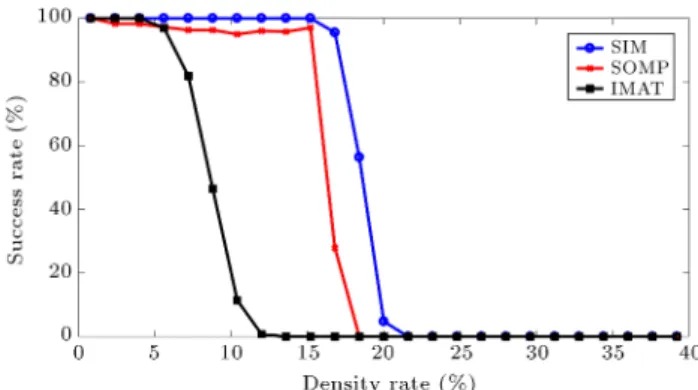
The success rates of IMAT, SIM, and SOMP algorithms for dierent density rates are depicted in Figure 1. A reconstruction is considered to be success-ful if the output SNR is more than 20dB. As seen in this gure, all curves experience a sudden knee-like fall as the density rate increases. This fall is considered as the boundary between successful and unsuccessful reconstruction. The simulation results reveal that for the SIM, success rate falls around 20% density rate, while the knee-like fall happens in 18% and 12% density rates for IMAT and SOMP, respectively. This indicates that SIM can successfully reconstruct the signals with high sparsity numbers in comparison with SOMP and IMAT algorithms.
Figure 1. Success rate versus density rate (input SNR = 20 dB, sampling rate = 25%, L = 8, and the sparsity number is unknown).
Table 2. Reconstruction SNRs (dB) of three dierent algorithms for dierent density rates (K (%)) in the presence of noise (SNR0 = input SNR, sampling rate = 25%, L = 8).
K is Unknown K is Known
SNR0 (dB) 10 20 100 10 20 100
K (%) 4 12 20 4 12 20 4 12 20 4 12 20 4 12 20 4 12 20
IMAT 19.7 0.5 -1.3 31.4 0.7 -1.8 94.3 0.9 -2.1 19.9 2.1 1.3 31.4 2.2 -0.5 94.6 1.4 -1.9 SIM 23.2 16.1 1.8 31.1 25.4 4.6 106 105.8 14.5 23.3 17.2 3.7 31.3 26.4 5.9 111.3 106.8 16.6 SOMP 14.9 12.9 1.2 23.1 23.1 2.1 114.1 107.3 22.5 23 16.8 0.4 32.9 26.8 4.7 113.9 107.4 21.4 Table 3. Run-times (sec) of dierent algorithms for
dierent density rates (K (%)) in the presence of noise (input SNR = 100 dB, sampling rate = 25%, L = 8, and K is known).
K (%) 4 12 20
SIM 0.017 0.027 0.027 SOMP 0.031 0.081 0.138
Figure 2. Reconstruction SNR versus number of signals (input SNR = 20 dB, sampling rate = 25%, density rate K = 20%, and the sparsity number is unknown).
Figure 2 shows the eect of the number of signals on the performance of SOMP and SIM. As observed in this gure, by increasing the number of signals, we get better results. Additionally, the SIM algorithm can reconstruct the signals better than the SOMP when the number of signals is small.
The reconstruction SNR for dierent sampling rates is depicted in Figure 3. According to this gure, the SNR values can be improved by increasing the sampling rate. Although the SOMP algorithm has better results for a small interval in the high sampling rates, SIM outperforms SOMP in most cases.
Figure 3. Reconstruction SNR versus sampling rate (input SNR = 20 dB, density rate K = 60%, L = 8, and the sparsity number is unknown).
Table 4 lists the SNRs of two reconstruction meth-ods. Simulation results demonstrate the superiority of SIM over BIMAT in terms of the output SNR and the complexity. Therefore, SIM can be used instead of BIMAT in many applications such as distributed MIMO radar systems.
4. Conclusion
In this paper a novel method, namely SIM, was introduced for SSA problems. The proposed algorithm was an iterative method for the MMV models and its idea was that the summation of sparse vectors, sharing the same support, in the thresholding step of each iter-ation could enhance the probability of reconstruction. Indeed, the theoretical analysis with simulation results proved that SIM outperformed IMAT with respect to the SNR metric. We compared the proposed method with SOMP as a well-known algorithm in the MMV models. We concluded from the conducted numerical experiments that SIM was preferable in terms of SNR
Table 4. Reconstruction SNRs (dB) of dierent algorithms for dierent density rates (K (%)) in the presence of noise (input SNR = 5 dB, sampling rate = 20% , L = 10).
K (%) 2.5 5 7.5 10 12.5 15
SIM 14.1 11.6 8.8 6.7 4.9 3.3
BIMAT 13.3 9.8 7.5 6.0 4.1 3.4
or SR, especially in noisier channels with low sampling rates and high density rates. Finally, it was observed that SIM was superior to BIMAT when complexity and eciency were important factors.
Acknowledgment
The authors would like to thank Ehsan Asadi for his help in the analytical discussion subsection and Babak Barazandeh for introducing this topic to one of the authors.
References
1. Candes, E.J., Romberg, J., and Tao, T. \Robust uncertainty principles: Exact signal reconstruction from highly incomplete frequency information", IEEE Trans. of Inf. Theory, 52(2), pp. 489-509 (2006).
2. Donoho, D.L. \Compressed sensing", IEEE Trans. of Inf. Theory, 52(4), pp. 1289-1306 (2006).
3. Abbasi, H., Kavehvash, Z., and Shabany, M. \Im-proved CT image reconstruction through partial Fourier sampling", Sci. Iran., 23(6), pp. 2908-2916 (2016).
4. Amezquita-Sanchez, J. and Adeli, H. \Feature extrac-tion and classicaextrac-tion techniques for health monitoring of structures", Sci. Iran. A, Civ. Eng., 22(6), p. 1931 (2015).
5. Duarte, M.F., Cevher, V., and Baraniuk, R.G. \Model-based compressive sensing for signal ensem-bles", 47th Annu. Allerton Conf. on Commun., Con-trol, and Comput., IEEE, pp. 244-250 (2009).
6. Gastpar, M. and Vetterli, M. \Source-channel commu-nication in sensor networks", IPSN, Springer, pp. 162-177 (2003).
7. Gorodnitsky, I.F., George, J.S., and. Rao, B.D. \Neuromagnetic source imaging with focuss: a recur-sive weighted minimum norm algorithm", Electroen-cephalogr. and Clin. Neurophysiol., 95(4), pp. 231-251 (1995).
8. Malioutov, D., Cetin M., and Willsky, A.S. \A sparse signal reconstruction perspective for source localiza-tion with sensor arrays", IEEE Trans. on Signal Process., 53(8), pp. 3010-3022 (2005).
9. Ibernon-Fernandez, R., Molina-Garcia-Pardo, J.M., and Juan-Llacer, L. \Comparison between measure-ments and simulations of conventional and distributed mimo system", IEEE Antennas and Wirel. Propag. Lett., 7, pp. 546-549 (2008).
10. Mohammadi, E., Fallah, A., and Marvasti, F. \Sam-pling and distortion tradeos for indirect source re-trieval", IEEE Trans. on Inf. Theory, 63(11), pp. 6833-6848 (2017).
11. Tropp, J.A. and Gilbert, A.C. \Signal recovery from random measurements via orthogonal matching pur-suit", IEEE Trans, on Inf. Theory, 53(12), pp. 4655-4666 (2007).
12. Determe, J.F., Louveaux, J., Jacques, L., and Horlin, F. \On the noise robustness of simultaneous orthogonal matching pursuit", IEEE Trans. on Signal Process., 65(4), pp. 864-875 (2017).
13. Tropp, J.A., Gilbert, A.C., and Strauss, M.J. \Algo-rithms for simultaneous sparse approximation. part i: Greedy pursuit", Signal Process., 86(3), pp. 572-588 (2006).
14. Rakotomamonjy, A. \Surveying and comparing simul-taneous sparse approximation (or group-lasso) algo-rithms", Signal Process., 91(7), pp. 1505-1526 (2011).
15. Marvasti, F., Azghani, M., Imani, P., Pakrouh, P., Heydari, S.J., Golmohammadi, A., Kazerouni, A., and Khalili, M. \Sparse signal processing using iterative method with adaptive thresholding (IMAT)", 19th Int. Conf. on Telecommun. (ICT), IEEE, pp. 1-6 (2012).
16. Marvasti, F., Amini, A., Haddadi, F., Soltanolkotabi, M., Khalaj, B.H., Aldroubi, A., Sanei, S., and Chambers, J. \A unied approach to sparse signal processing", EURASIP J. on Adv. in Signal Process., 2012(1), p. 44 (2012).
17. Marvasti, F., Nonuniform sampling: theory and prac-tice, Springer Science & Business Media (2012).
18. Marvasti, F. and Mashadi, M.B. \Wideband analog to digital conversion by random or level crossing sampling", U.S. Patent 9,729,160 (2017).
19. Zarmehi, N. and Marvasti, F. \Sparse and low-rank recovery using adaptive thresholding", Digit. Signal Process., 73, pp. 145-152 (2018).
20. Azghani, M., Ghorbani A., and Marvasti, F. \Blind iterative nonlinear distortion compensation based on thresholding", IEEE Trans. on Circuits and Syst. II: Express Briefs, 64(7), pp. 852-856 (2017).
21. Mashhadi, M.B., Salarieh, N., Farahani, E.S., and Marvasti, F. \Level crossing speech sampling and its sparsity promoting reconstruction using an iterative method with adaptive thresholding", IET Signal Pro-cess., 11(6), pp. 721-726 (2017).
22. Abtahi, A., Azghani, M., Taye, J., and Marvasti, F. \Iterative block-sparse recovery method for distributed mimo radar", in Iran Workshop on Commun. and Inf. Theory (IWCIT), IEEE, pp. 1-4 (2016).
23. Zayyani, H., Babaie-Zadeh, M., and Jutten, C. \An iterative Bayesian algorithm for sparse component analysis in presence of noise", IEEE Trans. on Signal Process., 57(11), pp. 4378-4390 (2009).
24. Esmaeili, A., Kangarshahi, E.A., and Marvasti, F. \Iterative null space projection method with adaptive thresholding in sparse signal recovery", IET Signal Process, 12(5), pp. 605-612 (2018).
Biographies
Sahar Sadrizadeh received her BS degree in Elec-trical Engineering in 2015 and MS degree in Com-munications in 2017, both from Sharif University of
Technology (SUT), Tehran, Iran. She started her PhD program in 2017 at the same university. She was a research intern at Hong-Kong University of Technology (HKUST) in summer 2015. Her research interests include sparse signal processing, image and multimedia processing, and applications of machine learning and deep learning in communication. Ms. Sadrizadeh ranked the third among more than 284,000 participants in the Nationwide University Entrance Exam for BS degree, in 2011. She also ranked the rst amongst all the BS students of Sharif University of Technology in Electrical Engineering Department who started in 2011. Furthermore, she has been a member of the National Elite Foundation since 2011. She got direct admission to MS and PhD programs without national entrance examination as a privilege for excellent academic performance. She won the scholarship of Newton Foundation for PhD program.
Shahrzad Kianidehkordi received her BS degree in Electrical Engineering from Sharif University of Tech-nology, Tehran, Iran, in 2017. She is currently pursuing her MS in Electrical Engineering at the University of Toronto. Her research interests include distributed computation, distributed machine learning algorithms, coding theory, and stochastic processes. She won Gold medal in National Mathematical Olympiad.
Mahdi Boloursaz Mashhadi received a dual-major BS degree (with honors) in Communications and In-dustrial Engineering in 2011, and MS and PhD degrees in Signal Processing in 2013 and 2018, all from Sharif University of Technology (SUT), Tehran, Iran. He has been a Research Associate with the ECE Department at the University of Central Florida (UCF), USA; Queens University, ON, Canada; and Sharif University of Technology, Tehran, Iran. His research interests encompass sparse signal processing; design and im-plementation of signal processing circuits; and image, speech, and multimedia processing. Dr. Boloursaz's
awards include a best paper award at the EWDTS 2012 conference and several national, regional, and IEEE grants. He serves as a reviewer of IEEE transactions on signal processing, transactions on information theory, and signal processing letters.
Farokh Marvasti received his BS, MS, and PhD degrees all from Rensselaer Polytechnic Institute in 1970, 1971, and 1973, respectively. He has worked, consulted, and taught in various industries and aca-demic institutions since 1972, among which are Bell Labs, University of California Davis, Illinois Institute of Technology, University of London, and King's College. He was one of the editors and Associate Editors of IEEE Trans on Communications and Signal Processing during 1990-1997. He has about 100 journal publi-cations and has written several reference books; he has also several international patents. His last book was \Non-uniform Sampling: Theory and Practice" by Springer in 2001. He was also a guest editor of the Special Issue on Non-uniform Sampling for the Sampling Theory and Signal and Image Processing journal, May 2008. Besides being the co-founder of two international conferences (ICT's and SampTA's), he has been the organizer and special session chair of many IEEE conferences, including ICASSP. Recently, he was the lead editor of \Sparse Signal Processing" for the Special Issue of Eurasip Journal on Advances in Signal Processing. Dr. Marvasti is currently a Professor at Sharif University of Technology and the director of Advanced Communications Research Institute (ACRI). Also, he is the former head of the Center for Multi-Access Communications Systems. He spent his sabbat-ical leave with the Communications and Information Systems Group of University College London (UCL) in 2013. Professor Marvasti received a distinguished award from the Iranian Academy of Sciences in 2014 and a 5-year term chair position from Iranian National Science Foundation in 2015. He was also appointed as the Life Research Fellow by the IEEE, Iran Section, in 2018.