Asian Journal of Innovative Research in Science, Engineering and Technology (AJIRSET)
Available online at: www.engineeringjournal.info
RESEARCH ARTICLE
Performance Studies on CNG Enriched with LPG Operated
Variable Speed Spark Ignition Engine
Naik
RT
1*,Babu
MKG
2, Das
LM
21Department of Mechanical Engineering, Indian Institute of Science, Bangalore, India.
2Center for Energy Studies, Indian Institute of Technology, Delhi, India.
*Corresponding Author: Email: [email protected]
Abstract
Cleaner fuels are rapidly increasing in various parts of the world due to air pollution and energy crisis. Compressed Natural Gas (CNG) is proven to be one of the most promising alternative fuel in various parts of the world. It is a major energy resource of the future due to its clean burning and renewable in nature. An attempt was made to improve the performance charactersitics of CNG by using Liquified petroleum gas (LPG) as supplymentary fuel through a simple gas blending system in a variable speed spark ignition engine. The engine specific fuel consumption of CNG enriched with LPG blends shown the lower and thermal effeicy improved compared to Gasoline fuel which indictaes the better perofrmance of compressed natural gas in a Spark Ignition Engine.
Keywords:Engine, CNG, LPG, Performance, Efficiency, Fuel consumption.
Introduction
Alternative fuels are becoming more interested in vehicular technology [1]. They are proven to be a clean burning fuels and renewable in nature [2]. Conventional fuels are becoming exhausted at faster rate as well as their emissions causing various problems [3]. An efficient fuel improves the air quality and mitigates the greenhouse gas pollutants [4]. Nowadays, there is increase interest among the suppliers to investigate alternative fuels for Transportation due to their superior combustion characteristics, which elps in improving performance characteristics of engine and in reducing the exhaust emissions [5].
Compressed Natural Gas
It is appreciative to discuss about Compressed Natural Gas (CNG) is being used in place like Delhi and CNG is proven to be one of the effective alternative fuel for the vehicles [6]. CNG operated vehicles are existing in all over the world in various applications and it has been successfully implemented in vehicles for improving the air quality [7]. Even though CNG is recommended as one of most promising alternative fuel still it has low combustion rate at lean burn conditions and it causes to emanate more emissions [8].There is a definite need to develop a alternative fuel technology for the safe survival of the existing vehicular technology.
Liquefied Petroleum Gas
Liquid petroleum gas (LPG) is considered as one of the potential fuel for vehicles [9] .Even tough, it is being used as domestic fuel still; it has superior combustion characteristics compared to CNG and other fuels, which improves the combustion characteristic of CNG [10]. LPG has high flame speed and high-octane rate compared to CNG. An attempt was made to develop a simple gas blending system for improving the performance characteristics of CNG without going for the engine designs modifications.
Experimental Apparatus
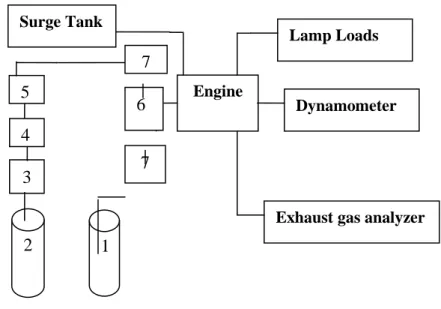
The mode of the fuel induction also plays the vital part in the performance of the engine. A simple Solenoid vacuum system is developed for fuel induction at appropriate time. Both switches are connected to mixing chamber and it connected to engine manifold system. The switch are connected to a battery and operates as on/off valve due to vacuum and system found to be a simple, effective and much more experimental data can be generated. The schematic diagram of the experimental set-up shown in fig.1and the different instruments mount on the test bed for measuring the parameters like power, temperatures, pressures on the test Fig.
Fig .1: Experimental set-up
1.CNG Cylinder, 2.LPG Cylinder, 3.Pressure Regulator, 4.Flow Meter, 5.Flame trap,6. Gaseous Mixture 7.Solenoid valve
Experimental Procedure
Experiments were conducted with gasoline to generate the base line data for comprehensive assessment. All experiments were conducted at constant speeds namely 2000, 2500 and 3000 rpm at full load conditions at constant compression ratio. Initially engine was made to run with 100% of CNG fuel with a single vacuum valve switch. Then, respectively 5% and 10% of secondary fuels namely LPG gas was supplied thorough flow meter to another vacuum valve switch by reduced 5% and 10% of CNG fuel. Finally, both fuels were mixed approximately in the mixing chamber and injected into the manifold system of the spark ignition engine. CNG enriched with 5% and 10% of LPG gas composition increased the combustion rate of CNG and significantly influenced in improving performance characteristics of CNG operated engine. The various chemical properties of CNG, LPG and Gasoline fuel shown in the table.1. In due course of experiments, it was observed that CNG enriched with LPG operated engine runs smoothly without any abnormal behavior at various conditions.
Table.1 Properties of CNG, LPG and gasoline fuels
S.No Properties CNG LPG Gasoline
1 Main compositions CH
4 C2H6 C8 H18
2 Lower calorific value (MJ/kg) 50 46 45 3 Stoichiometric air–fuel ratio
17.4 15.5 14.5 4 Auto ignition temperature 0C
542 428 256
5 Flame speed, m/sec. 0.34 0.38 0.35
2
1
6
Engine
Surge Tank
Exhaust gas analyzer Dynamometer Lamp Loads
3
4
5
7
7
Results and Discussions
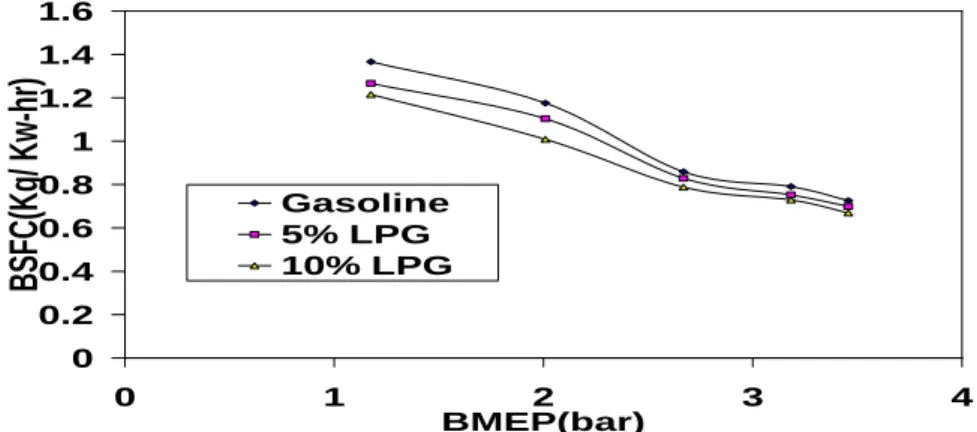
Fig. 2-7 shows some of the test results on the performance characteristics of the test rig. Fig.2-4 shows the break specific fuel consumption (BSFC) and Fig.5-7 shows the brake thermal efficiency (BTE) respectively. Since, emphasis was made on performance characteristics by using these fuels. Therefore, the detailed emissions characteristics of their blends have not been reported here.
Fig 2-4 shows that Fuel consumption as function of brake mean effective pressure with addition of 5% and 10% of LPG at different speeds namely 2000 rpm, 2500 rpm and 3000 rpm respectively. Fuel consumption is most important economical factor. From the graphs, it is observed that fuel consumption is decreasing with addition of LPG when compared to gasoline-operated engine. The better blend observed with addition of 10% of LPG at 3000-rpm shows the lower fuel consumption at full load condition compared to 5% LPG blend and gasoline due to higher flame speed of LPG blend which enhanced the combustion process when compared to gasoline and other blends operated engine.
Fig.5-7 shows that brake thermal efficiency as function of brake mean effective pressure with addition of 5% and 10% of LPG at constant respective speeds namely 2000 rpm, 2500 rpm and 3000 rpm respectively. Addition of LPG influences the thermal efficiency and brake mean effective pressure also, because it all depends on the combustion process. It is observed that thermal efficiency increasing with addition of 5% and 10% of LPG compared to gasoline operated engine at full load condition compared to 5% LPG blend and gasoline also due to higher flame speed of LPG blend which enhanced the combustion process when compared to gasoline and other blends operated engine.
0 0.2 0.4 0.6 0.8 1 1.2 1.4 1.6
0 1 2 3 4
BMEP(bar)
BS
FC(Kg
/ Kw-hr)
Gasoline 5% LPG 10% LPG
Fig.2: Variation of brake specific fuel-consumption of CNG-LPG blends at 2000 rpm.
0 0.2 0.4 0.6 0.8 1 1.2 1.4
0 1 2 3 4
BMEP(bar)
BS
FC
(kg/kw-hr)
Gasoline 5% LPG 10% LPG
0 0.2 0.4 0.6 0.8 1 1.2
0 1 2 3 4
BMEP(bar)
BS
FC(Kg
/Kw-hr)
gasoline 5% LPG 10% LPGFig.4 Variation of brake specific fuel-consumption of CNG-LPG blends at 3000 rpm.
0 2 4 6 8 10 12 14
0 1 2 3 4
BMEP(bar)
BTE
(%
)
Gasoline 5% LPG 10% LPGFig.5 Variation of brake thermal efficiency of CNG- LPG blends at 2000 rpm.
0 2 4 6 8 10 12 14 16 18
0 1 2 3 4
BMEP(bar)
BTE
(%
)
Gasoline 5% LPG 10% LPGFig.6 Variation of brake thermal efficiency of CNG-LPG blends at 2500 rpm.
0 5 10 15 20 25 30
0 1 2 3 4
BMEP(bar)
BTE
(%
)
Gasoline 5% LPG 10% LPGConclusions
Brake specific fuel consumption decreased with increase of LPG percentage compared to
gasoline operated engine at higher speed.
Brake thermal efficiency is also increased with the addition of LPG percentage to compared
to conventional gasoline fuelled engine at higher speed.
It is observed that appropriately designed simple solenoid valves mixing system can be
adopted for these fuels without going for much hardware system and engine design modifications.
This system can promise for safely and efficiently handling the fuel blending also.
Acknowledgements
One of the author1 express his heartfelt gratitude to his beloved teacher Prof. P.V.Krishnan for
his constant right guidance and shown the real path and also many thanks to Mr. Attar Singh for assisting while conducting the experiments.
References
1 Demirbas A (2002) Fuel properties of hydrogen, LPG, and compressed natural gas for transportation, Energy Sources, 24:601-610.
2 Choi GH, Chung YJ, Han SB (2005) Performance and emissions characteristics of a hydrogen enriched LPG IC engine at 1400 rpm, International Journal of hydrogen energy, 30:77-82.
3 Lufts S (2001) The Influence of Regulating Parameters of Dual Fuel Compression Ignition Engine Fuelled with LPG on its Maximum Torque, Overall Efficiency and Emission,” SAE Paper No. 2001-01-3264.
4 Naik RT, Babu MKG, Das LM (2006) Performance Characteristics of CNG-Hydrogen Operated Spark Ignition Engine, National Conference (NCME), Paper No: TH. 210, Delhi, India.
5 Biederman RJ, Blazek CF (1990) Economic Analysis of Low-pressure Natural Gas Vehicle Storage Technology, GRI-90/0139.
6 Hoekstra RL, Collier K, Mulligan N, Chew L (1995) Experimental study of a clean burning vehicle fuel, International Journal of Hydrogen Energy, 20:737-745.
7 Dinh and Han T (1994) Operating, Performance and Emission Characteristics of Compressed Natural Gas (CNG) Vehicles, Natural Gas and Alternative Fuels for Engines, ASME, IC Engines Division Publication, IUCE V 21.
8 Eldar Stephen T, Jones Keith and Robert RR (1985) Effects of varying fuel composition on the performance of CNG and LPG fuelled vehicles, Trans:Institute of Professional engineers, New Zealand, Electrical/Mechanical/Chemical Engineering section, Vol.12, Nov, New Zealand.
9 Latusek JP, Burraham and Robert W (1993) Conversion of Two Small Utility Engines to Liquid Petroleum Gas fuel (LPG), SAE paper No. 932447.
10 Choongsik Bae (2001) Spray Characteristics of Liquid Phase LPG Injection for Port Fuel Injection System in S.I Engine, 6th Liquid Atomization & Spray Systems, pp. 161-166.
AUTHORS BIOGRAPHY
Dr. R.T.Naik, holds a PhD in Mechanical Engineering from Indian Institute of Technology, Delhi, India. Currently working as Faculty (so) in the Department of Mechanical Engineering, Indian Institute of Science, Bangalore, India. His research interests are Internal Combustion Engines, Alternate fuels, Combustion, Computational Fluid Dynamics, Transportation Engineering, Emissions control and Automobile Engineering.
Dr M.K.G.Babu has a PhD in Mechanical Engineering and currently an Emeritus Professor at Indian Institute of Technology, Delhi. His research area includes IC Engines.
Dr.L.M.Das has a PhD in Mechanical Engineering and currently an Emeritus Professor at Indian Institute ofTechnology, Delhi. His research area includes IC Engines.