REPLICATION-BASED COST SCHEDULING STRATEGY
FOR FAULT TOLERANCE IN DISTRIBUTED
KNOWLEDGE MANAGEMENT SYSTEMS
O. O. BAMGBOYE1* , O. FOLORUNSO2, A.T. AKINWALE2 AND
G.A. ADEBAYO2
1 Computer Science Department, Moshood Abiola Polytechnic, Ojere, Abeokuta,
Ogun State
2 Department of Computer Science, Federal University of Agriculture, Abeokuta
Ogun State.
*Corresponding author: [email protected] Tel: +234(0)8037284536
and access to data and knowledge are be-coming an integral part of our daily life (Zhe et al., 2012). As a result of increased
com-ABSTRACT
Distributed Knowledge Management Systems (DKMS) often depends on the Semantic Web Peer-to-Peer (SW-P2P) model. The reason for this is based on its support for autonomy of knowledge node, ease of accessibility and scalability. The susceptibility to failure experienced during knowledge re-trieval has been a concern for the SW-P2P. This paper presents a fault tolerance system in order to resolve the problem of the DKM. The architecture of this design consists of five components namely; Replication Manager (RM), Fault Detector (FD), Fault Notifier (FN), Recovery Mechanism (RMe) and Global Control Monitor (GCM). This design adopted dynamic replication strategy and group constitu-tion procedure to guarantee knowledge availability on knowledge nodes. The dynamic replicaconstitu-tion strat-egy was used to create and delete replicas based on the changes in the DKMS environment. The group constitution procedure suggested the efficiency of fault recovery process in terms of the best available replica among knowledge service group. The fault tolerance system execution cycle was performed on a set of Virtual Machines (VM) using the VMware Workstation version 7.0.1, while Java programming language was used to implement the group and ungroup replicas. Sample data of vary-ing magnitude in ranges of 225Kilobytes to 512Kilobytes and 450Kilobytes to 512Megabytes were tested at different time intervals on both the grouped and ungrouped replicas at a threshold between 0.85 and 0.9 of knowledge retrieval. The results showed a reduction in the average response time of the grouped replicas which was measured to be 34 milliseconds and 68.2 milliseconds against un-grouped replica that was estimated as 53 milliseconds and 107.2 milliseconds respectively. The effect of this reduction in response time was that the grouped replica was faster than the approach of un-group replica. In addition, the un-group replica occupied less memory space because it does not need to store replicas on the active knowledge peer when recovering from failure. This result showed that the system guarantees the fault tolerance of each knowledge node in a DKMS.
Key words: Computer Network, Fault Tolerance, Knowledge Management, Recovery Systems,
Replication Algorithm, Peer-to-Peer
INTRODUCTION
With the growth of the computer networks, especially the internet, fast dissemination
Journal of Natural Science, Engineering
and Technology
ISSN:
Print - 2277 - 0593 Online - 2315 - 7461 © FUNAAB 2015
plexities and globalization, companies have quickly transformed its hierarchical struc-ture to flexible business networks, heavily depending on inter-organization and intra-organizational communication (Cuel et al., 2005). Knowledge Management (KM) is increasingly viewed as a core requirement in order to compete in the modern so-cial and economic environment (Senge 1990; Nonaka and Takeuchi 1995; Deven-port and prusak, 1998). Researchers and practitioners agree that those intellectual assets that are embedded in working practices, social relationships, and techno-logical artifacts constitute the only source of value that can sustain long term differentiation, quality of services, innovation, and adaptability (Stewart, 2002). Nonetheless, due to a debatable success of current KM implementations, it is still unclear how such matter should be managed in highly complex, distributed and heterogeneous settings. The general knowledge management types are the cen-tralized and distributed knowledge manage-ment systems (Schmidt et al., 2009).
Centralized KMS is aimed at creating large, homogeneous knowledge reposito-ries, in which corporate knowledge is made explicit, unified, represented and organized according to a unique conceptual schema.
Distributed Knowledge Management (DKM) is defined as management of autonomous groups that create local knowl-edge and exchange it across groups (Bonifacio et al., 2002). Distributed KMS are commonly described as socio- technical KMS aiming to actively engage users in knowledge acquisition and dissemination processes (push and pull approach). DKMS responds to two basic principles – autonomy and coordination (Cuel, 2003).
Autonomy designate the possibility each organizational unit to have the opportu-nity to conceptualize its local knowledge through maps, ontologies, contexts, etc. This could also be achieved with tags and folksonomies. The second principle – co-ordination, reflects the mechanism of projecting what other units know into its own interpretation schema. Thus, DKM suggests autonomous management of locally produced knowledge and coordination among different units without centrally de-fined view.
DKMS are often based on Peer-to-Peer (P2P) collaboration and rely on bottom-up knowledge management. P2P systems are distributed systems composed of inde-pendent nodes that run software with equivalent functionality without centralized control or hierarchical organization (Ehrig et al., 2003). The general interest to P2P architectures is due to their ability to func-tion, scale and self-organize, in the presence of a highly transient population of nodes, networks, and computer failures and with-out the need of central server (Androutsellis and Spinellis, 2004). Accord-ing to the literature (Ehrig et al., 2003; An-droutsellis and Spinellis, 2004; Bonifacio et al., 2004; Buchegger and Datta, 2009), the P2P is well suited for DKMS because of their scalability, acceleration of communica-tion processes and reduced collaboracommunica-tion costs, lack of centralized control, privacy of the user data, increased access to resources, opportunity to maintain own knowledge structure and conservation of original knowl-edge context.
The P2P approach helps to resolve a number of limitations such as; costs of design, implementation and maintenance of centralized server; simplifying system
complexity, reducing the barriers for par-ticipation, integrating the shared knowl-edge work space with personal knowlknowl-edge work spaces (Maier, 2007). The most com-mon applications of P2P remain the file-sharing and communication which are the main issues in DKMS.
Managing knowledge in a distributed envi-ronment is crucial and the main idea is to allow Community-of –Practice (CoP) mem-bers to continuously engage in knowledge exchange activities even in the presence of fault. This can be achieved by estimating the cost of generating knowledge replicas that can enhance knowledge availability. The rest of the paper is organised as fol-lows: section 2 presents related works on fault tolerance using replication techniques.
Section 3 contains the overall architecture and design details of FTA-DKM. The imple-mentation of the system is discussed in sec-tion 4 and the conclusion and future works are presented in section 5.
RELATED WORKS
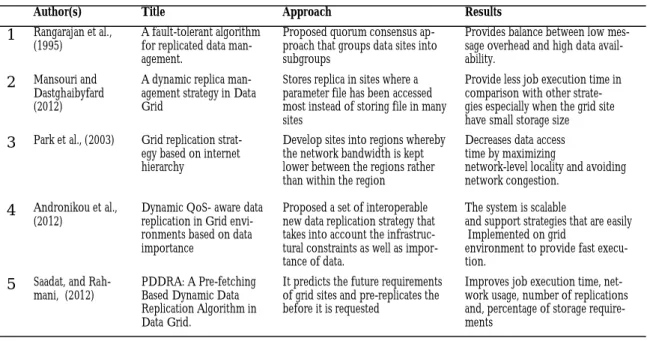
Much work has been done on fault tolerance using replication in distributed systems and several algorithms have been developed (Abbadi et al., 1985; Agrawal and Abbadi., 1990; Davidson et al., 1997). Fault tolerance in distributed systems is based on two funda-mental classes of replication techniques: pri-mary-backup replication (Guerrouri and Shiper, 1997) and active replication (state machine approach) (Schneider, 1990). Table 1 presents a summary of related works on fault tolerance in distributed systems.
Table 1: Summary of Related Works.
Author(s) Title Approach Results
1 Rangarajan et al., (1995)
A fault-tolerant algorithm for replicated data man-agement.
Proposed quorum consensus ap-proach that groups data sites into subgroups
Provides balance between low mes-sage overhead and high data avail-ability.
2 Mansouri and Dastghaibyfard (2012)
A dynamic replica man-agement strategy in Data Grid
Stores replica in sites where a parameter file has been accessed most instead of storing file in many sites
Provide less job execution time in comparison with other strate-gies especially when the grid site have small storage size 3 Park et al., (2003) Grid replication
strat-egy based on internet hierarchy
Develop sites into regions whereby the network bandwidth is kept lower between the regions rather than within the region
Decreases data access time by maximizing
network-level locality and avoiding network congestion.
4 Andronikou et al., (2012)
Dynamic QoS- aware data replication in Grid envi-ronments based on data importance
Proposed a set of interoperable new data replication strategy that takes into account the infrastruc-tural constraints as well as impor-tance of data.
The system is scalable
and support strategies that are easily Implemented on grid
environment to provide fast execu-tion.
5 Saadat, and Rah-mani, (2012)
PDDRA: A Pre-fetching Based Dynamic Data Replication Algorithm in Data Grid.
It predicts the future requirements of grid sites and pre-replicates the before it is requested
Improves job execution time, net-work usage, number of replications and, percentage of storage require-ments
REPLICATION STRAEGY FOR
FAULT TOLERANCE SYSTEM
IN DKMS
The proposed fault tolerance system is based on the Combined Cost Scheduling Strategy and Replication technique for fault tolerance. Data replication is becoming a popular strategy in many fields such as cloud storage, data grid, and P2P systems. By replicating files to other servers/nodes, network traffic and file access time can be reduced, and increase data availability to react to natural and man-made disasters (Zhe et al., 2012). In this paper, the fault tolerance technique adopts dynamic replica-tion strategy for the knowledge services across multiple nodes on the distributed knowledge management environment. The dynamic replication strategy creates and de-letes replicas based on the changes on the distributed knowledge management system. The cost of creating a replica is based on the node that is frequently accessed by failed node during fault recovery. The
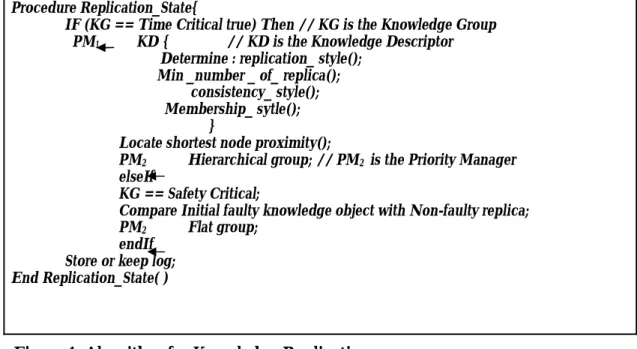
repli-cas that are not frequently used are deleted over a period of time. Dynamic replication strategy may be implemented either in a cen-tralized or in a distributed approach (Najme et al., 2013). It implements a replication algo-rithm as indicated in figure 1. The algoalgo-rithm is based on principle of group structure (Andrew et al., 2007) that suggests that two or more replicated knowledge services can be formed into either of the flat or hierarchi-cal group structure depending on some indi-cators that is being specified in a knowledge exchange activity. In case of failure of any k-peer, it is expected that any of the active rep-licated knowledge services will resolve the failure without seriously disturbing the rest of the system. This new approach of group structure will build a reliable fault tolerance system. Some of the previous research works on fault tolerance (Liang, 1999; fang et al., 2007) pointed out that a fault tolerance sys-tem should contain four fundamental func-tionalities that includes; replication manage-ment, fault managemanage-ment, logging and recov-ery mechanism and client fault transparency). Procedure Replication_State{
IF (KG == Time Critical true) Then // KG is the Knowledge Group PM1 KD { // KD is the Knowledge Descriptor
Determine : replication_ style();
Min _number _ of_ replica(); consistency_ style();
Membership_ sytle(); }
Locate shortest node proximity();
PM2 Hierarchical group; // PM2 is the Priority Manager
elseIf
KG == Safety Critical;
Compare Initial faulty knowledge object with Non-faulty replica; PM2 Flat group;
endIf Store or keep log;
End Replication_State( )
THE FAULT TOLERANCE
AR-CHITECTURE FOR DKMS
Fault tolerance structure is often imple-mented through replication of process or objects in a real time distributed system (Arvind et al., 2011). The specification for this structure is the determination of repli-cation style and the number of replica of knowledge objects on a distributed knowl-edge management system which is a neces-sary condition for the design of fault toler-ance structure. In other to support the fun-damental fault tolerance functionalities, the Fault Tolerant System for Distributed Knowledge Management (FTA-DKM) in-troduced four components:1. Replication Manager (RM) 2. Fault Detector (FD) 3. Fault Notifier (FN)
4. Logging/Recovery mechanism A new component called the Global Con-trol Monitor (GCM) was also introduced in other to build an efficient fault tolerance system.
The Replication Manager performs the rep-lication of knowledge services using certain set of desired properties such as replication style, minimal replication degree, number of replica, etc. It also performs the group con-stitution which is initiated through the Global Control Monitor interface. The specification for a particular group structure is achieved based on the priority levels (which can be the time specificity of trans-action, safety of knowledge property or a combination of both) as being clearly speci-fied by a knowledge seeker (a device capa-ble of initiating a knowledge request per time) in a knowledge transfer operation. The Fault Detector performs monitoring operation on each of the knowledge node in
other to detect the occurrence of failure and the fault notifier is responsible for the fault notification.
The logging mechanism captures and logs request for the recovery mechanism. The group constitution feature of the proposed fault tolerance architecture identifies two types of groups; these are the hierarchical and flat group structures respectively. The hierarchical group structure implement the principle of the best available replica (Nnebe et al., 2012) while the flat group structure im-plement the principle of the most available replica among replicated knowledge services. The flat group structure estimates the prop-erty of the replica that is involved during fault recovery by confirming the size and context of the requested knowledge on the knowledge provider device before the trans-fer is done. These properties are later com-pared with all available replicas to determine the best fit replica for recovery in a safety level priority specification. The Hierarchical group structure on the other hand measures the signal strength of the devices in a wire-less network that holds each replica. It uses the proximities of replicas to determine the most suitable replica in a time critical knowl-edge exchange process.
The fault tolerance life cycle for the DKMS is divided into three phases namely: initializa-tion, run-time/recovery and client fault transparency phase.
Initialization Phase
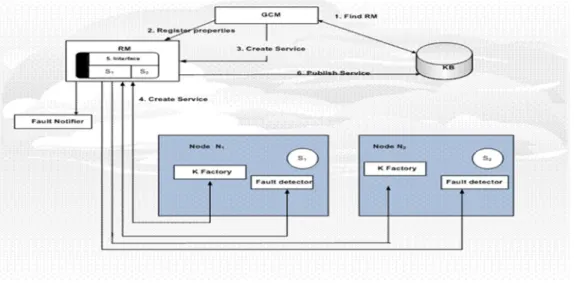
The Knowledge Seeker (K-Seeker) uses the group constitution function of the GCM ser-vice to constitute the serser-vice group of replica as shown in figure 2. The GCM registers the group replica (as either flat or hierarchical group structures) to be formed to the repli-cation manager. It then requests the RM tocreate the service group using the active replica. The RM automatically performs the complete group constitution procedure: re-quest that knowledge factory (a component that specifies knowledge representation for-mat) on N1 and N2 deploy their members
based on the fault tolerance properties; acti-vates fault detectors to monitor the knowl-edge services; subscribes fault notification
from fault notifier for the service group; chooses the active and primary replica based on group level priority specification and backup other members. Finally, RM pub-lishes the address of the knowledge replica to the centralized user’s Knowledge Base (KB) for K-seeker that intends to
access the service.
Figure 2: Showing the Initialization of Fault Tolerance System and Group Replica Constitution
Runtime Phase/Recovery Phase
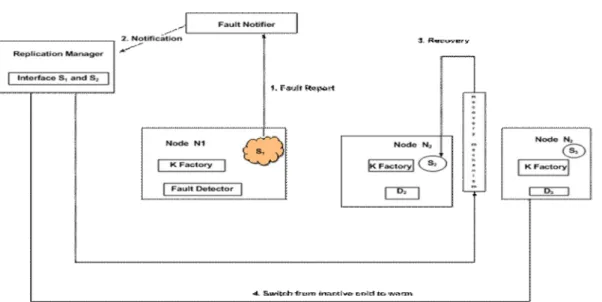
The Replication Manager requests fault detectors D1 and D2 monitor the replicas
S1 and S2 respectively. The fault detector
D1 sends fault report to the fault notifier
whenever it detects a service failure on the active member S1 as shown in figure 3
be-low. The fault notifier therefore, notifies the RM to start the recovering process that includes the following steps:
i. RM promotes S2 as the new active
rep-lica based on the group constitution policy that is being initiated (that is ei-ther as hierarchical or flat group struc-ture) through the GCM for fault
recti-fication.
ii. It instantiates S3 on N3 for the case of
hierarchical (in time critical transaction), otherwise it picks on the best available replica (in transaction where the safety of the knowledge property must be guarantee using the flat group structure) as warm backup.
iii. The RM informs the recovery mecha-nism to recover the state of S2 and;
iv. Finally, RM updates the GCM of the service to reflect the new active replica S2 and the new secondary replica
factory on the K-seeker sends a request to the primary K-peer service S1. The K-factory
receives a service fault exception if the pri-mary member S1 is down. The K-factory
then searches for the next available replica using the specified priority level (that is con-siders either the best or most available rep-lica). The new peer on node N3 returns result
if S2 is able to serve this request. Thus, the K
-seeker is unaware of the primary failure
Figure 3: Fault Recovery Process
Fault Transparency Phase
The fault recovery process is achieved anytime the k-seeker device is capable of redirecting request to another replica in case the primary k-provider failed. This is often achieved when the k-seeker create acquaintance with another service device or knowledge node that owns a replica of the previously failed service to form a new k-peer. As shown in figure 4, theCOST SCHEDULING
STRAT-EGY FOR FAULT TOLERANCE
It is often expected that there can exist a queue of knowledge request during the process of redirecting the request to other replica in a failed transaction, this queue of request are managed by the Cost scheduling Strategy. The main rationale behind the combined cost scheduling strategy is to maintain the cost and consistency in manag-ing the queue of knowledge requests in the fault tolerance domain of the distributed knowledge management environment. This will also maintain the knowledge availability present at each node or host.The proposed Combined cost Scheduling Strategy (CSS) at first determines the Best Node (BN). The Best Node is defined as a region that has most of the requested Knowledge (from size point of view). In other words, let KZ be the total size of re-quested knowledge available in node n, therefore the Relative Cost Rn;
Rn = γ × Ʃ |KZ| (1)
where γ is the constant reflecting the degree of parallelism. CSS computes Rn for each
node and selects the best node i.e. node with largest Rn value. Then the combined
cost for each host within the BN is com-puted and the request assigned to the host with minimum combined cost (MCC). Therefore, CSS does not search all re-sources to find the best one that has the lowest cost i.e.
MCC = Min CCi,j (2)
where n is the number of host within BN Let Ji = {F1, F2, ….. Fm} be the m required
knowledge for knowledge transaction i Let UKFi,j = Ʃ size of unavailable
knowl-edge request for transaction i in node j
Let Load j =
where Qj and sj are the number of
transac-tions waiting in queue and computing capac-ity of node j respectively. Therefore, the sum of these along with the actual weight (w1, w2)
for each factor yields the combined cost of executing knowledge transaction i in node j as follows:
CCi,j = (w1 × UKFi,j ) + (w2 × Load j) (3)
SYSTEM IMPLEMENTATION
This section describes a series of experi-ments conducted based on the architecture and algorithm that were described in section three. The various parameters that serve as input to the system include the datasets and the induced fault that was generated during the experiment. A faulty knowledge peer is the one that has been disconnected from the node or peer during knowledge ex-change. The variation in data size is rela-tively uniform throughout the experiment. Each of the knowledge peer also have the ability to transit into a faulty state at any given time. The fault tolerance property is estimated at a well defined threshold during the experiment.IMPLEMENTATION
ENVI-RONMENT AND TOOLS
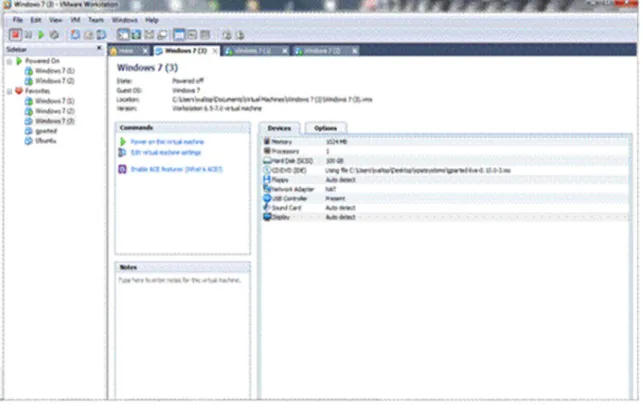
The design is implemented on a VMware environment. The VMware provides high availability and well secured framework that can allow different operating systems to interface with each other. Each VMware was configured on operating systems which were hosted by a node. A node consists of six individual operating systems that is run-ning on different virtual machines. A node is configured on a range of hardware speci-fications such as 100GB-700GB of Hard disk space, 1GB-6GB of RAM and various capacities ofintel processor. A node is connected to another node through a high speed router. A total of three nodes were considered for the purpose of fault injection during the experiment and each of the VMware can create acquaintance with other VMware on the network to form a peer. Each peer is being coordinated and managed through the Global Control Monitor. The Global Control Monitor was designed using java programming language on a Java Netbean development environment. Methods were also developed in java for capturing, repli-cating and grouping knowledge services.
DESCRIPTION OF THE
KNOWLEDGE SITES
The knowledge sites are implemented onthe VMware workstation, with each work-station being part of a node in other to form a DKMS. The node is configured on a com-puter system with large amount of memory and high disk space. Each workstation is in-stalled with different versions of windows operating system in other to verify the inter-operability of the various platforms. Two nodes were configured for the experimenta-tion with each node containing three virtual machines. A total of eight knowledge sites were created for the purpose of this experi-ment.
The use of synthetic data was also consid-ered for the experimentation of this work. The hardware configuration for these knowl-edge sites is indicated in table 2
DISCUSSION OF RESULTS
In other to properly analyze the strength of the fault tolerance system, a series of ex-periment were conducted in a distributed environment by directly injecting fault into the system. The experiment was conducted in other to be able to measure the effi-ciency of group replica of knowledge ser-vices based on the proximity of the knowl-edge site to an active node or knowlknowl-edge seeker when initiating a knowledge transac-tion. It also attempts to verify the property of each of the active knowledge service replica in a fault tolerance system.The experiments consist of two nodes N1
and N2 with each node accommodating
three virtual machines respectively. Each node is connected over a high speed router. Each virtual machine is capable of initiating an acquaintance with other ma-chine to form a knowledge peer (K-peer) and it can choose to dissociate and form a peer with another anytime. Each K-peer is made to engage in autonomous manage-ment of knowledge services which may be
later required by another peer or node.
The data source for the experimentation and performance analysis is from http://
www.dmoz.org.The website is a collection of internet links organized in a hierarchy (Marc et al, 2003). It contains 190,000,000 docu-ments of text characters. The contents of documents were distributed randomly among the k-peers. The distribution of documents within the peer-to-peer network is varied at regular interval in other to influ-ence the size of knowledge (data) that is ex-changed or shared by a peer. The experi-ments are conducted on two rounds of vary-ing data sizes. The range of data size in the first experiment is between 225 Kilobytes to 512Kilobytes. The second round of the ex-periment was conducted on data size that ranges from 450Kilobytes to 512 Megabytes. A set of k-peers are selected at random, and knowledge exchange activities are discon-nected at interval of 20minutes and 50min-utes respectively in other to measure the re-sponse times of the system.
A series of experiments were performed to
Table 2: Hardware Specification for site 1(Node 1)
Knowledge site Components Size/Type
Node 1 Hard Disk 700 GB
Memory 6GB
Processors quad Core(s) Operating System Windows 8
Node 2 Hard Disk 500 GB
Memory 4GB
Processors 2 Core(s)
Operating System Windows 7 Home Premium
Node 3 Hard Disk 100 GB
Memory 1 GB
Processors 1
measure the average response time of each of the group replica as defined by this work. The sizes of data were varied in dif-ferent times of experiment and the fault detection as performed by the fault detec-tor was conducted between 0.85 to 0.9 thresholds during knowledge retrieval. Each experiment was performed at numer-ous times on each of the group replica in other to collect a reasonable set of experi-mental results.
The response time for knowledge service failure is defined as the time span from when a primary or active knowledge service crashes to when a warm replica of knowl-edge service resumes the primary responsi-bility.. The response time of each of the group replica is considered to be the
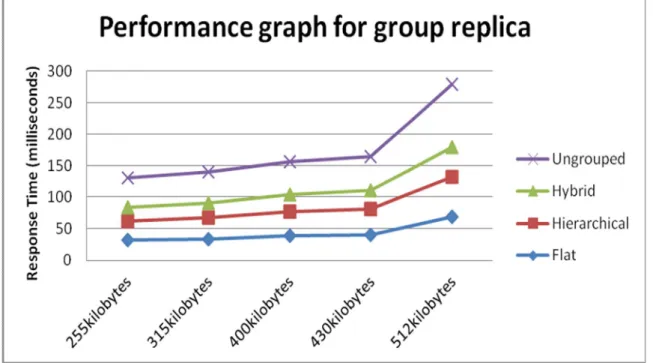
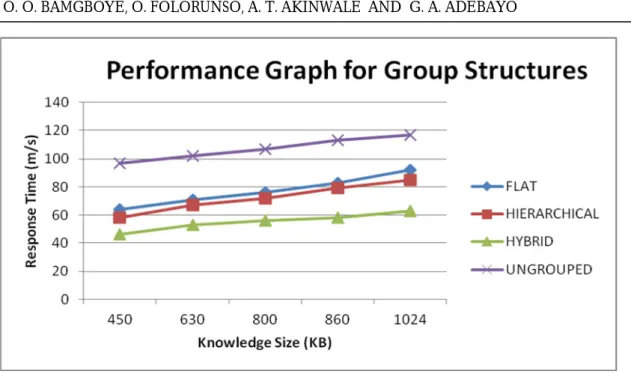
elapsed time between the faults is detected and when recovery is completed. It was measured in milliseconds (ms). The figures 6 and 7 shows that the combination of the group structures (hybrid) is more efficient in terms of response time compared to the other two types of group replicas (that is flat and hierarchical). The response time in fault recovery is also shown to be directly propor-tional to the knowledge size in a knowledge transaction. The ungroup structure requires high response time in fault recovery com-pared to the other group structures as identi-fied by this work. In general, the average re-sponse time of the grouped replicas was measured to be 34 milliseconds and 68.2 milliseconds against ungrouped replica that was estimated at 53 milliseconds and 107.2 milliseconds respectively.
Figure 6: Fault-tolerance performance for group structure on first round of experiment
CONCLUSION AND
FUTURE WORKS
In this paper, we developed a novel ap-proach of fault tolerance that adopts knowl-edge service replication technique in a Dis-tributed Knowledge Management System to enhance knowledge availability and fault tolerance. The fault tolerance architecture adopts 3-phase architecture and the knowl-edge replication algorithm to resolve the connectivity problem that can be associated with knowledge transfer operation in a knowledge transaction. It also implements a group constitution procedure in other to improve the performance and effectiveness of the system. This approach to fault toler-ance is efficient in terms of low response time in failure recovery and maintains the availability of knowledge. With the replica-tion scheme, it is clear that the system can equally guarantee a reliable and highly scal-able knowledge exchange environment.
In the future, the approach can be extended by introducing the principle of the agent-based technology the architecture in other to improve the efficiency of the system. Fur-thermore, this paper provides a theoretical background for researchers to explore the potentials of Distributed Knowledge Man-agement System particularly on the aspect of maintaining knowledge availability and rep-lica consistency.
REFERENCES
Abbadi, A.E., Skeen, D., Gristian, F. 1985. An Efficient Fault Tolerant
Proto-col for Replicated Data Management. Proc. Symp. Principles Database Syst. 215–228.
Accorsi, F. L. & Costa, J. P. 2008. Peer-to-Peer Systems Consubstantiating the
Ba-sic Concept. The Electronic Journal of Knowledge Management Vol. 6, Issue 1, pp 1 – 12.
Figure 7: Fault-tolerance performance for group structure on second round of experiment
Agrawal, D., Abbadi, A.E. 1990.
Exploit-ing logical structures in repli-cated databases. Inform. Process. Lett. 33 (5) 250–260.
Akoumianakis, D. 2008. Distributed
Knowledge Management in Virtual Organi-zations: the ‘Social’ Experience Factory. The Electronic Journal of Knowledge Management Vol. 6 Issue 1 pp. 13 – 32.
Andronikou, V., Mamouras, K., Tser-pes, K., Kyriazis, D., Varvarigou, T. 2012. Dynamic QoS- aware data replication
in Grid environments based on data impor-tance. Future Generation Computer Systems 28 (3):544–53.
Andrew, T., Maarten, S. 2007. Distrib-uted Systems-Principles and paradigm. Pearson Prentice Hall, Upper saddle River, New York.
Androutsellis, S., Spinellis D. 2004.
Sur-vey of P2P Content distribution technolo-gies. ACM Computing Surveys, Vol. 36 Issue 4, pp 335-357.
Arvind, K., Rama S., Yadav, R, Anjali J. 2011. Fault Tolerance in Real Time
Distrib-uted System. International Journal on Computer Science and Engineering. Vol.3 No.2, pp 933-939.
Bonifacio, M., Bouque, P., Busetta P., Danieli, A., Don, A., Mameli, G. & Nori, M. 2004. KEEx: A Peer-to-Peer
Tool for Distributed Knowledge Manage-ment. Proceedings I-KNOW ’04. http//:www.bg-openaire.eu (Accessed May 16, 2012)
Bonifacio, M., Giunchiglia, F., Zai-hrayeu, I. 2005. Peer-to-Peer Knowledge
Management. Proceedings I-KNOW ’05. http://
www.eprints.biblio.unitn.it/771/1/042.pdf (Accessed Oct.13, 2012)
Buchegger, S., Datta, A., 2009. A Case
for P2P Infrastructure for Social Net-works Opportunities and Challenges. In Proceedings of WONS 2009, Utah, USA, February 2-4.
Cuel, R. 2003. A New Methodology for
Distributed Knowledge Management Analy-sis. Proceedings of I-KNOW ‘03 Industry meet Science, Graz - Austria.
Cuel, R., Bouquet, P., Boniface, M. A.
2005. Distributed Approach to edge Management, the Concept of Knowl-edge Nodes, and their Implications. in Schwartz D.G. Ed., Encyclopedia of Knowl-edge Management.
Davenport, T., Prusak, L. 1998. Working
Knowledge – How Organizations Manage What They Know. Harvard Business School Press, Boston, MA.
Davidson, S.B., Garcia-Molina H. & Skeen, D. 1997. Consistency in
parti-tioned networks, ACM Comput. Surveys 17 (3) 341–370.
DMOZ. Data source for DKMS < http:// www.dmoz.org> accessed on October 4, 2013.
Ehrig, M., Tempich, C., Staab, S., Har-melen, F., Siebes, R., Sabou, M., Broek-stra,J., Stucken S. H. 2003. SWAP:
On-tology-based Knowledge Management with Peerto- Peer. London.
Fang, C., Liang, D., Lin, F. 2007. Fault
tolerant Web Services.Journal of Sys-tems Architecture, Vol. 53, Issue 1, January 2007, Pages 21–38.
Guerraoui, R. & Schiper, A.(1997).
Soft-ware-Based Replication for Fault Toler-ance. IEEE Computer, (30)4:68-74, Cited on Pages 328,629.
Mansouri, N., Dastghaibyfard, G.H. 2012. A dynamic replica management
strat-egy in Data Grid. Journal of Network and Computer Applications 35(4):1297–303.
Maier, R., 2007. Knowledge management
systems. 3rd ed., XIV, 720 p. 125 illus.
Marc, E., Christoph, S., Steffen, S., Julien, T., Christoph, T. 2003. Towards
Evaluation of Peer-to-Peer-based Distrib-uted Information Management Systems. American Association for Artificial Intelligence
Najme, M., Gholam, H. D., Ehsan, M. 2013. Combination of data replication and
scheduling algorithm for improving data availability in Data Grids. Journal of Network and Computer Applications pp 711–722.
Nonaka, I., Takeuchi, H. 1995. The
Knowledge Creation Company. New York, OXFORD University Press.
Nnebe, S. U., Onoh, G.N., Ohaneme, C.O., Nwankwo V.I. 2012. Empirical
Analysis of Signal Strength-Distance Varia-tions in IEEE 802.11b in WLAN. Interna-tional Journal of Engineering and Innovative Tech-nology (IJEIT), Vol. 2, Issue 6, pp.470-472.
Park, S.M., Kim, J.H., Go, Y.B. & Yoon, W.S. 2003. Dynamic Grid replication
strat-egy based on internet hierarchy, in interna-tional workshop on grid and cooperative computing.
1001:1324–1331.
Rangarajan, S., Setia, S., Triapthi, S.K.
1995. A fault-tolerant algorithm
for replicated data management. IEEE Trans. Parallel Distrib. Syst. 6 (12) 1271–1282.
Saadat, N., Rahmani, A.M. 2012.
PDDRA: A Pre-fetching Based Dynamic Data Replication Algorithm in Data Grid. Future Generation Computer Systems (28) 666– 681.
Sashi, K., Thanamani, A.S. 2010. A new
dynamic replication algorithm for European data grid. in: Proceedings of the Third Annual ACM Bangalore Conference, p. 17.
Schneider, F.B. 1990. Implementing
fault-tolerant services using the state ma-chine approach. a tutorial, ACM Comput. Surveys 22 (4) 299–319.
Schmidt, A., Hinkelmann, K., Ley, T., Lindstaedt, S., Maier, R.. & Riss, U. 2009. Conceptual Foundations for a
Ser-vice-oriented Knowledge and Learning Architecture. in Schaffert et al, (eds) Net-worked Knowledge-NetNet-worked Media,
Senge, P. 1990. The fifth discipline: the art
and practice of the learning organization. New York, NY: Doubleday.
Wei, L., FuMin Y., Gang, T., LiPing P. and Xiao, Q. 2007. TERCOS: A
Novel Technique for Exploiting redundan-cies in Fault-Tolerant and Real-Time Distributed Systems. 13th IEEE
Inter-national Conference on Embedded and Real-Time Computing Systems and Applications (RTCSA).
Zhe, W., Tao, L., Naixue, X., Yi P. 2012. A novel dynamic network data
replica-tion scheme based on historical access re-cord and proactive deletion. Journal of
Super-computing, Vol. 62, Issue 1, pp. 227-250.